上传

RJXA's Christmas approaches, it's time to refresh your fashion collections! Explore our high-quality lace, perfect for festive attire. Inquire now to enjoy holiday specials!

Member Center
Exit
Data is empty
0
qr Code Url

Scan the QR code to visit the mobile website

  • Home
  • Industrial
  • Renewable
  • Building & Home
  • Water Treatment
  • Automation
  • Kitchen
Home -News -Industrial Components -
Seals & Bearings
-
Future of plain bearings infographic showing industrial shift toward cleaner equipment, lower maintenance, reduced downtime, sustainable mechanical design, and better customer experience
2026-05-07

The Future of Plain Bearings: Dry Running, Polymer Materials, and Lower-Maintenance Industrial Design

Plain bearings are no longer only simple bushings for low-speed machinery. As factories demand cleaner, quieter, more sustainable, and lower-maintenance equipment, dry running bearings, polymer plain bearings, and self-lubricating technologies are changing how engineers design motion systems.
Learn more
Oil-embedded bronze bearing cutaway showing porous bronze structure, internal oil reservoirs, lubricating oil, and shaft sliding interface
2026-05-07

Oil-Embedded Bronze Bearings Explained: How Sintered Bushings Store and Release Lubrication

Oil-embedded bronze bearings are widely used in low-maintenance motion systems, but their value comes from a specific material structure. This article explains how sintered bronze bushings store oil, release lubrication during operation, and where they work best.
Learn more
Plain bearings for dirty outdoor environments infographic comparing clean-lab bearing logic with real-world dust, mud, water, corrosion, and harsh machinery conditions
2026-05-07

Plain Bearings for Dirty, Dusty, and Outdoor Environments: Why Real-World Conditions Change Bearing Selection

Dirty, dusty, wet, and outdoor environments change the way bearings fail. This article explains why plain bearings and bushings are often used in agricultural machinery, construction equipment, outdoor mechanisms, and contaminated industrial applications where load, dirt, lubrication, and maintenance reality matter more than clean-lab friction values.

Learn more
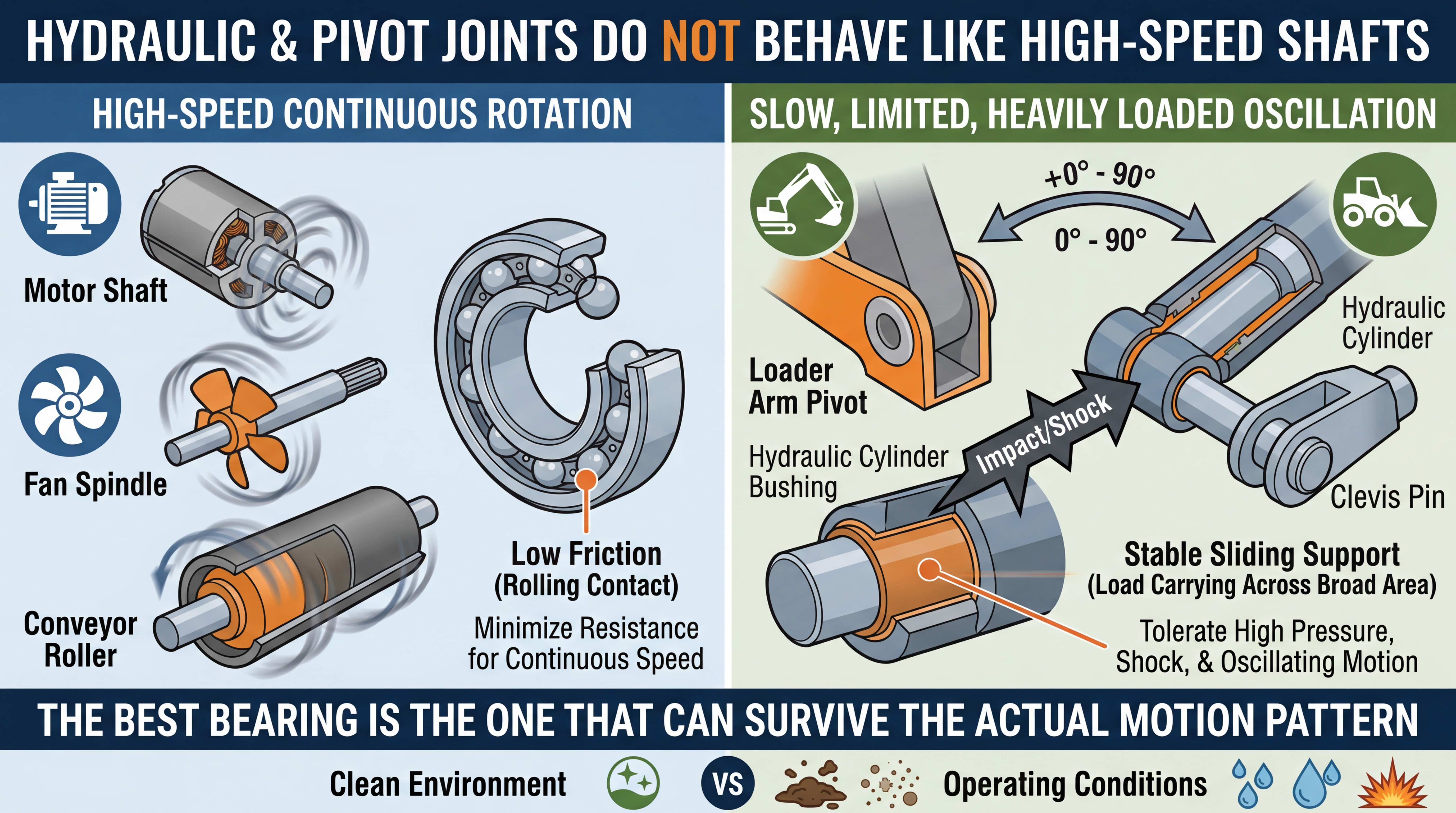
Hydraulic and pivot joints compared with high-speed shafts showing why oscillating motion, heavy load, shock, dirt, and operating conditions require different bearing selection
2026-05-07

Plain Bearings in Hydraulic Cylinders and Pivot Joints Why Oscillating Motion Needs a Different Bearing Logic

Hydraulic cylinders, clevis pins, loader arms, excavator linkages, and agricultural machinery pivots often rely on plain bearings instead of rolling bearings. This article explains why low-speed oscillating motion, high load, shock, dirt, and maintenance reality make bushings a practical engineering choice.
Learn more
Plain bearing clearance design infographic explaining free movement, lubrication film, thermal expansion, load distribution, seizure prevention, and wrong clearance risks
2026-05-07

Plain Bearing Clearance and Shaft Fit: The Details That Decide Service Life

Plain bearing service life is often decided by details that are easy to overlook: clearance, shaft fit, press-fit shrinkage, surface finish, thermal expansion, lubrication film, and installation accuracy. This article explains why these small dimensions can determine whether a bushing runs smoothly or fails early.
Learn more
Plain bearing failure diagnosis infographic showing worn bushing, shaft misalignment, lubrication problems, contamination, operating conditions, installation issues, and root cause analysis
2026-05-06

Why Plain Bearings Fail: Wear, Heat, Clearance, and Lubrication Problems Explained

Plain bearing failure is rarely caused by one single factor. This article explains how wear, heat, clearance, lubrication, shaft condition, misalignment, contamination, and maintenance habits work together to shorten bushing service life.
Learn more
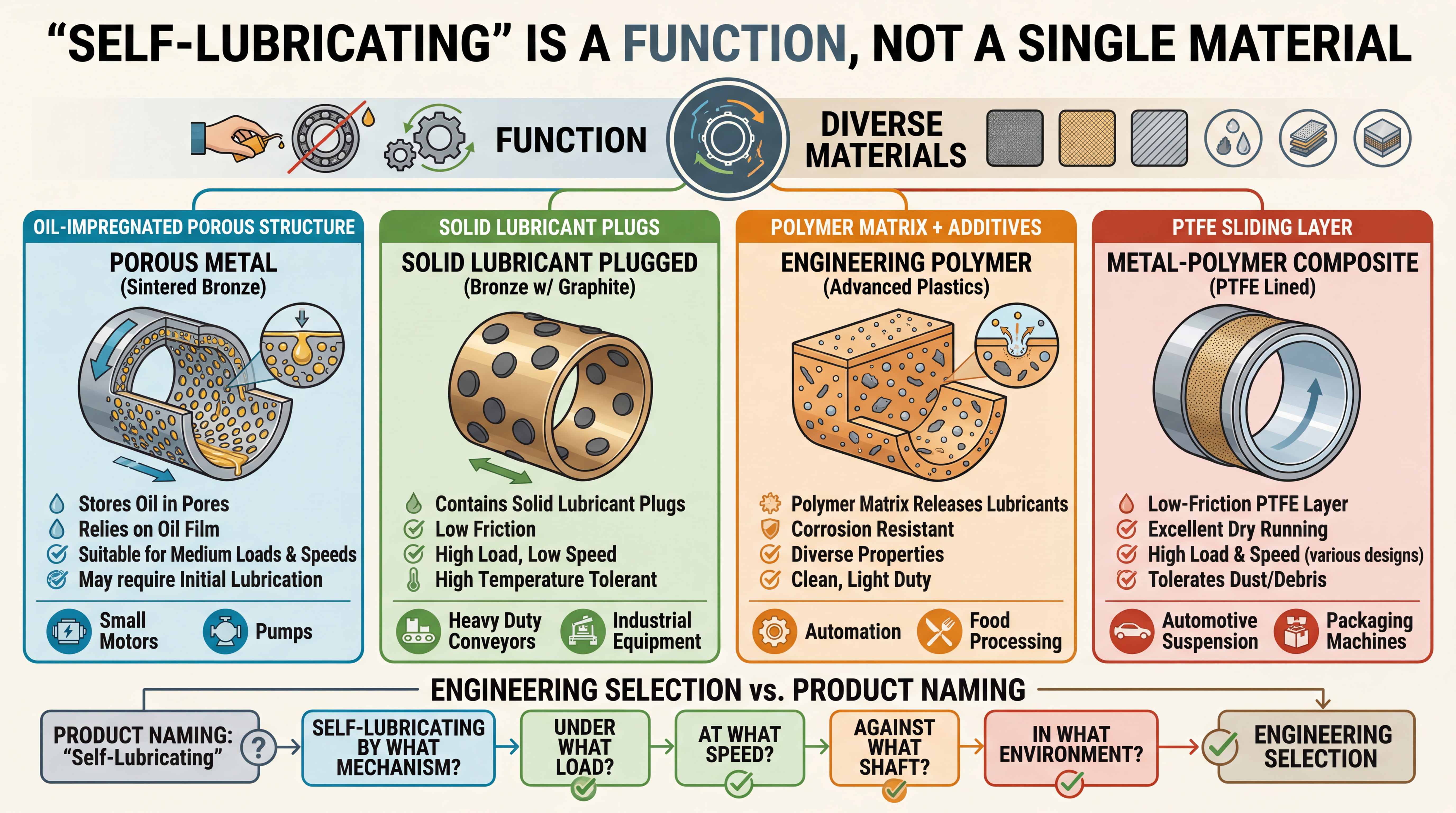
Self-lubricating bearing mechanisms comparison showing oil-impregnated bronze, graphite-plugged bronze, polymer, and PTFE-lined composite bearings
2026-05-06

Self-Lubricating Plain Bearings: What Maintenance-Free Really Means

Self-lubricating plain bearings can reduce grease points, downtime, and maintenance uncertainty, but they are not magic components. This article explains how different self-lubricating bearing materials work, where they add value, and how engineers should select them for real industrial conditions.
Learn more
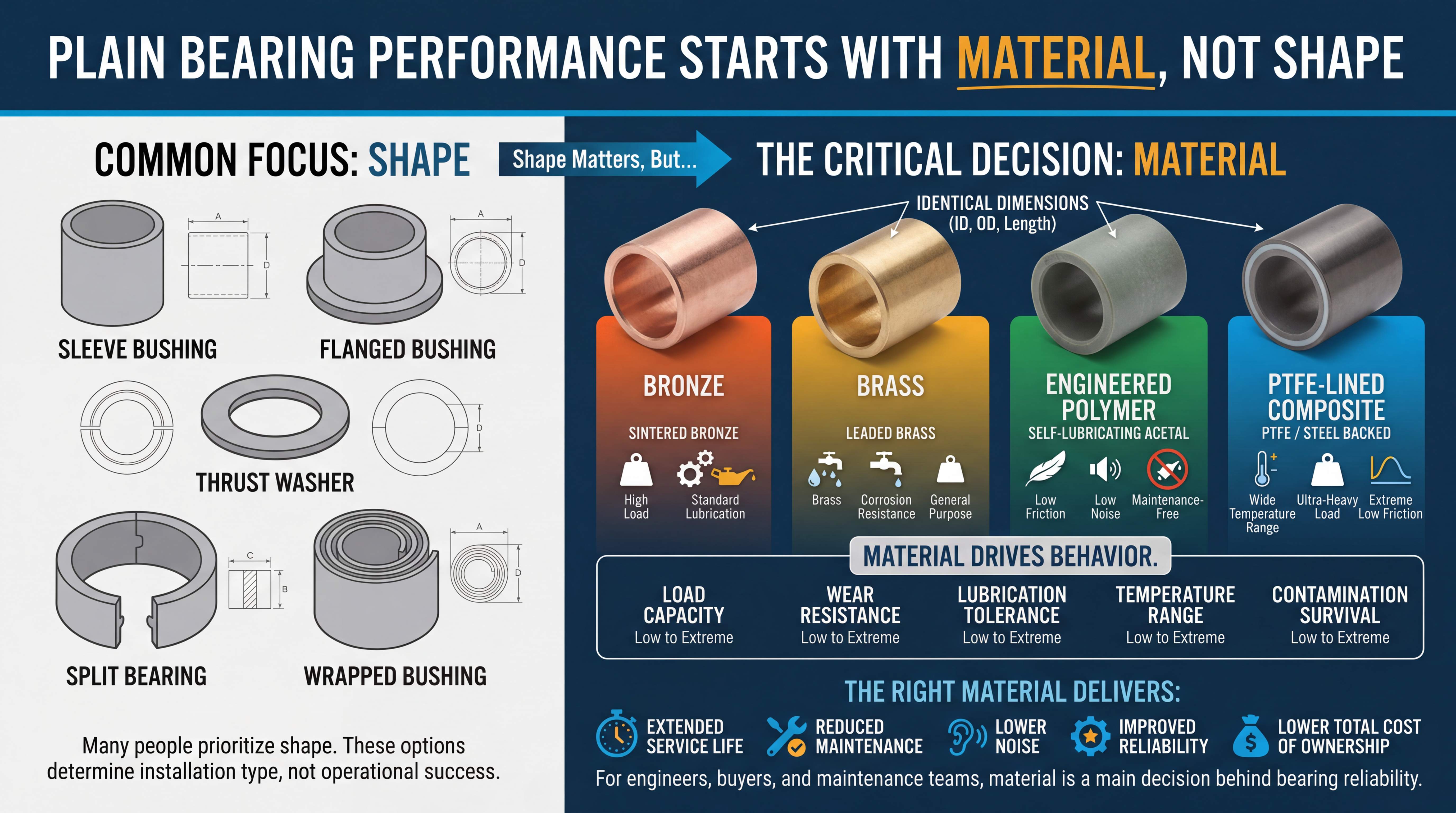
Plain bearing material selection infographic comparing bronze, brass, engineered polymer, and PTFE-lined composite bushings by load, wear, lubrication, temperature, and contamination performance
2026-05-06

Bronze, Brass, Polymer, or Composite How Engineers Actually Choose Plain Bearing Materials

Plain bearing performance is not decided by shape alone. This article explains how engineers compare bronze, brass, polymer, PTFE-lined, and composite bearing materials based on load, speed, lubrication, contamination, maintenance, and real working conditions.
Learn more
Bushings vs bearings infographic comparing industrial machine applications, motion reality, load, speed, maintenance, and rolling bearing selection
2026-05-06

Bushings vs Bearings: Why Many Machines Do Not Need a Rolling Bearing at All

Bushings are often treated as simple components, but in many machines they are the more practical choice. This article explains when a bushing is enough, when a rolling bearing is necessary, and how engineers should think about real working conditions.
Learn more
Plain bearing selection infographic explaining how working conditions such as load, speed, contamination, shock, and lubrication affect bearing choice
2026-05-06

Plain Bearings vs Rolling Bearings: When Sliding Contact Becomes the Smarter Engineering Choice

Not every machine needs a rolling bearing. This article explains when plain bearings become the better choice for low-speed, high-load, dirty, shock-prone, or maintenance-sensitive industrial applications.
Learn more
Mechanical seal replacement copy order risk showing failed seal evidence including scored carbon face swollen O-rings corroded springs and burned faces
2026-05-06

Mechanical Seal Selection Checklist: How Pump Buyers Can Avoid the Wrong Seal Decision

Mechanical seal selection is not just about shaft size or pump model. This guide helps pump users and B2B buyers define fluid data, operating conditions, materials, leakage risk, support systems and supplier communication before ordering a replacement seal.
Learn more
Chemical resistant mechanical seal compatibility challenge showing acid corrosive solvent volatile crystallizing alkali and oxidizing fluids attacking seal components
2026-05-06

Chemical-Resistant Mechanical Seals: How to Seal Corrosive, Crystallizing and Aggressive Fluids

Chemical pump sealing is not only about choosing a harder seal face. Corrosive fluids, solvents, acids, alkalis, crystallizing liquids and cleaning chemicals require a full compatibility strategy across seal faces, elastomers, metal parts and support systems.
Learn more
Dirty fluid mechanical seal selection comparison showing clean liquid support versus abrasive wastewater slurry causing seal wear and instability
2026-05-06

Mechanical Seals for Slurry and Wastewater Pumps: How to Handle Abrasive and Dirty Fluids

Slurry and wastewater pumps create difficult sealing conditions because particles, sludge, fibers, grit and abrasive solids can damage seal faces, clog springs and shorten seal life. This guide explains how to choose mechanical seals for dirty and abrasive pump applications.
Learn more
Mechanical seal support system functions showing flush cooling heat removal clean fluid supply barrier fluid buffer fluid and containment for pump reliability
2026-05-06

Mechanical Seal Support Systems: Why the Seal Needs More Than the Seal Itself

A mechanical seal does not work alone. This guide explains how flush plans, cooling systems, barrier fluid, buffer fluid and auxiliary piping protect seal faces and improve long-term pump reliability.
Learn more
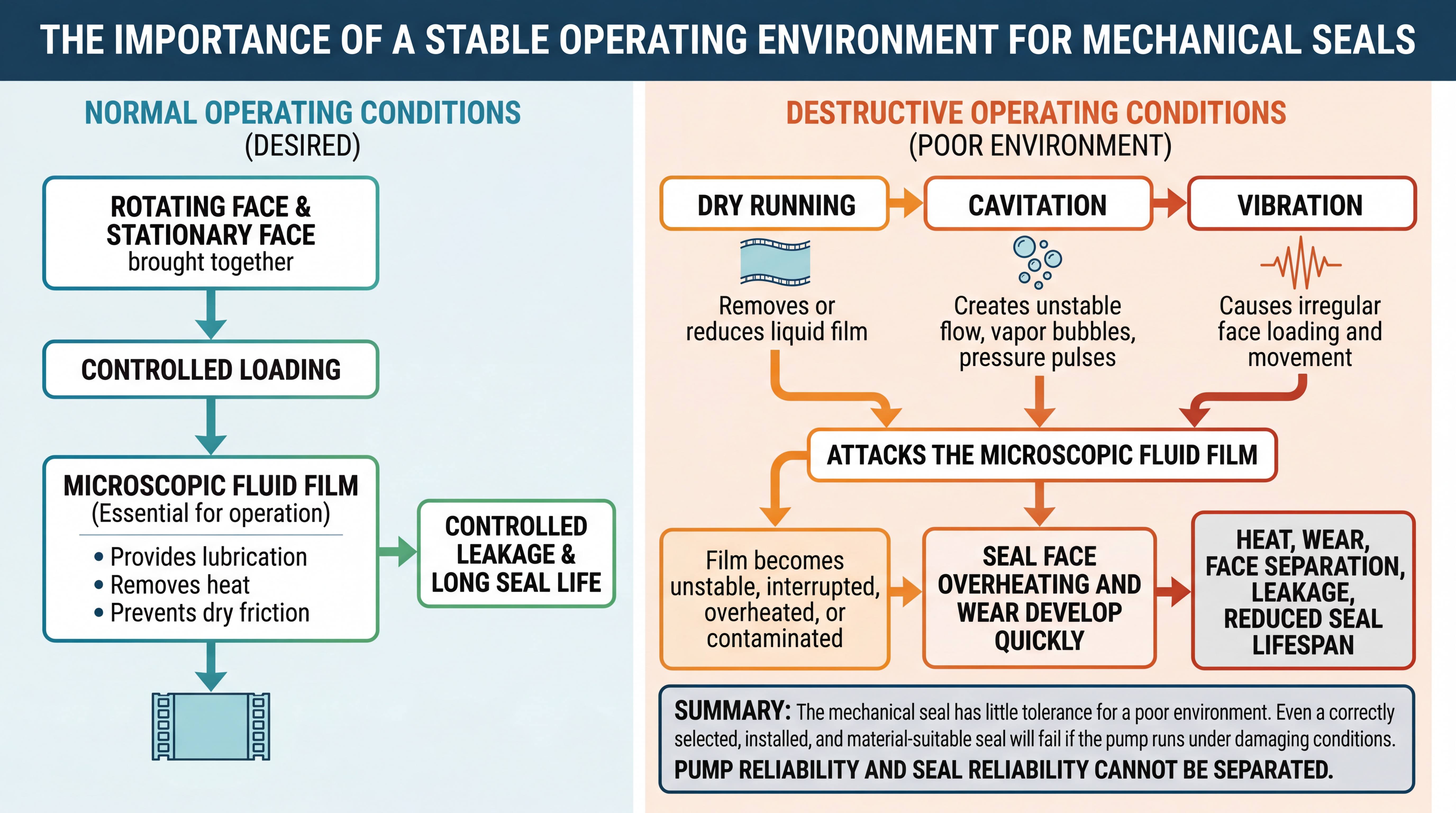
Mechanical seal operating environment diagram comparing normal lubrication conditions with destructive dry running cavitation and vibration effects
2026-04-30

Dry Running, Cavitation and Vibration: Three Hidden Killers of Mechanical Seals

Mechanical seals often fail because the pump system is unstable. This guide explains how dry running, cavitation and vibration damage seal faces, shorten seal life and create repeat leakage.
Learn more
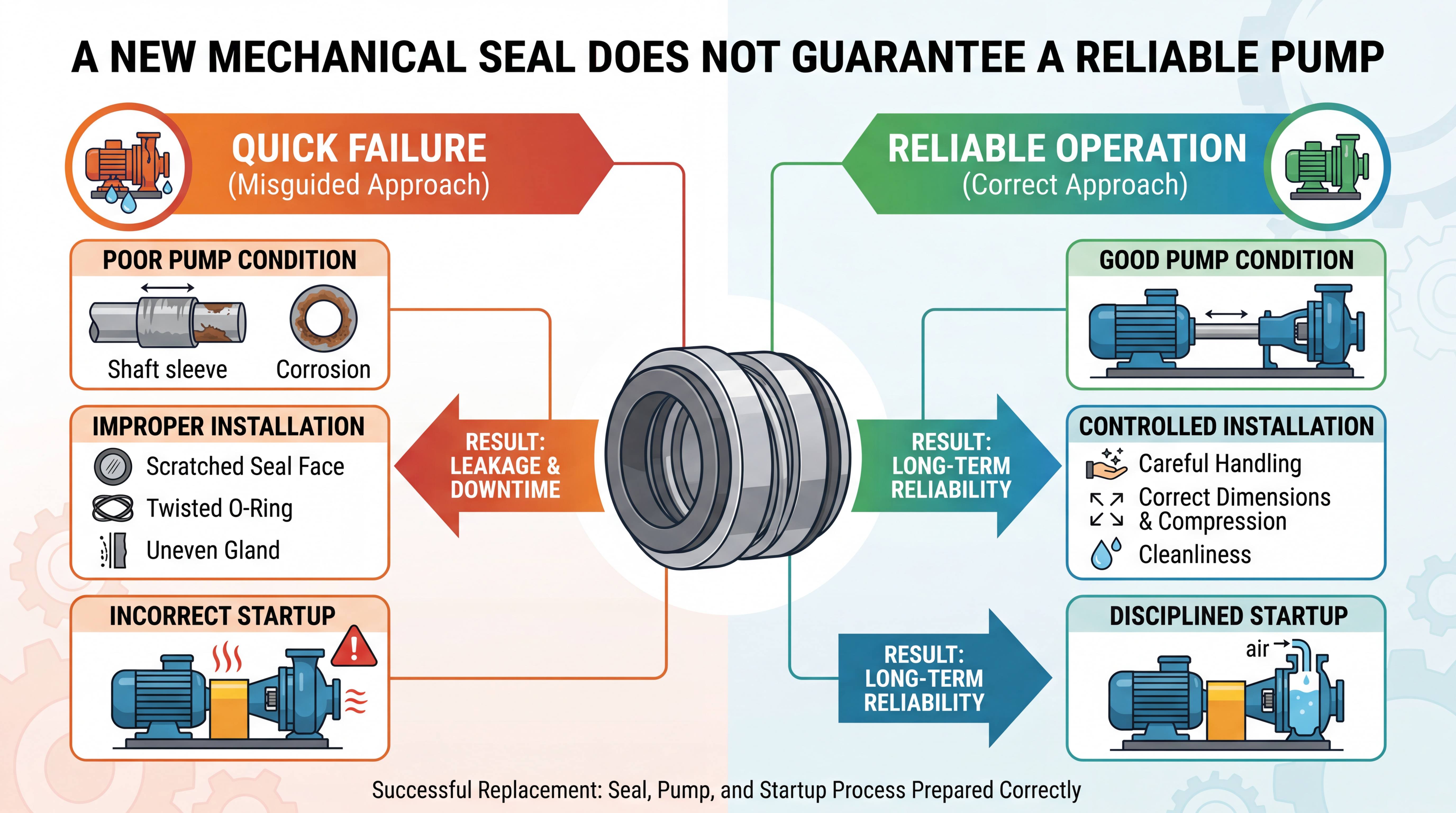
A new mechanical seal does not guarantee a reliable pump infographic comparing poor pump condition improper installation incorrect startup and the correct approach for long-term reliability
2026-04-30

Mechanical Seal Installation Mistakes Why New Seals Fail Too Soon

A new mechanical seal can fail quickly if the pump, shaft, seal chamber, elastomers, seal faces and startup process are not handled correctly. This guide explains the installation mistakes that cause early leakage.
Learn more
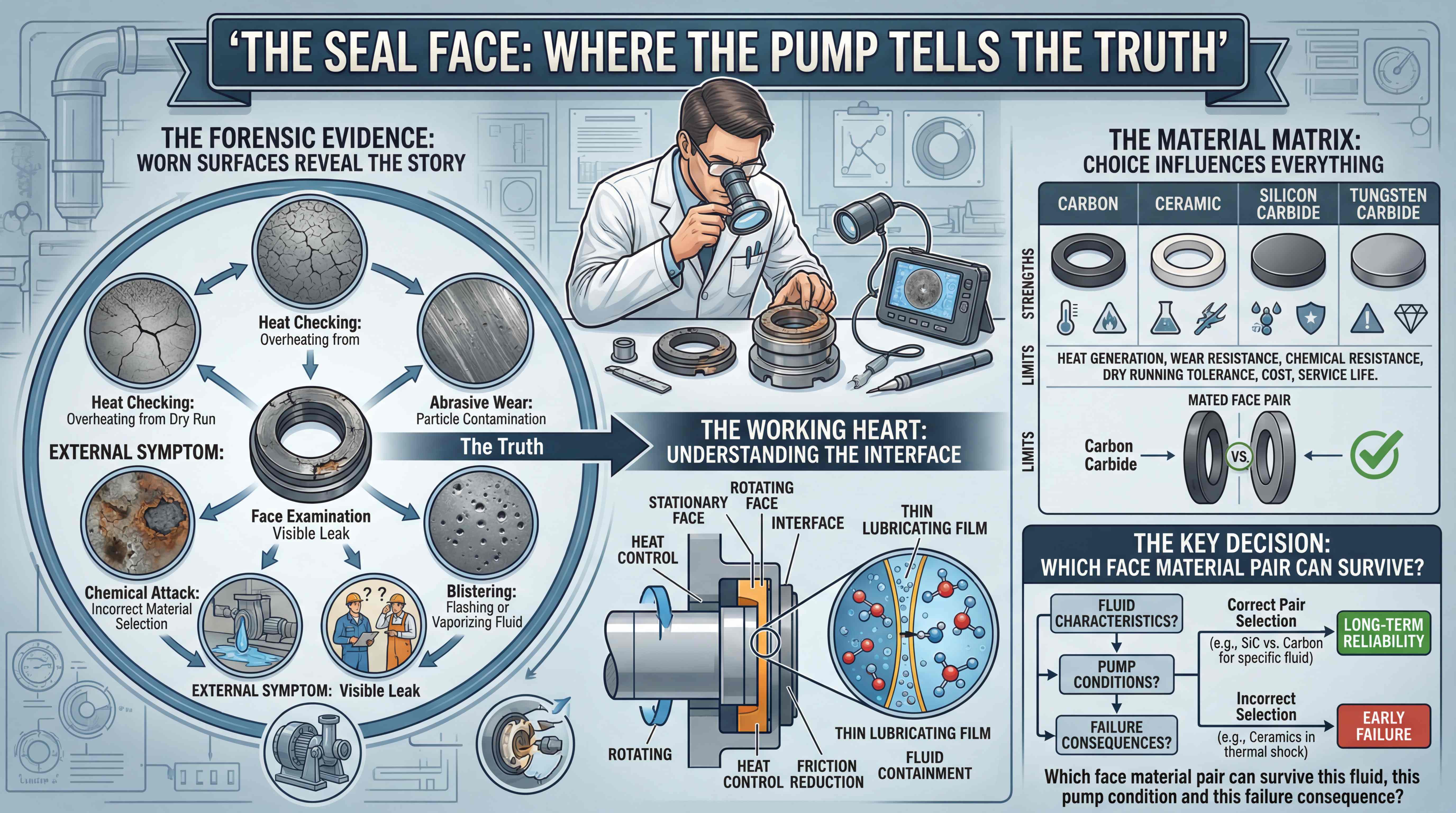
Mechanical seal face wear and material selection guide showing heat checking abrasive wear chemical attack blistering and face pair decision logic
2026-04-30

Mechanical Seal Face Materials Explained Carbon, Ceramic, Silicon Carbide or Tungsten Carbide

Mechanical seal face material selection is not just about hardness. This guide explains how fluid type, abrasion, corrosion, heat, lubrication and pump duty affect seal face reliability.
Learn more
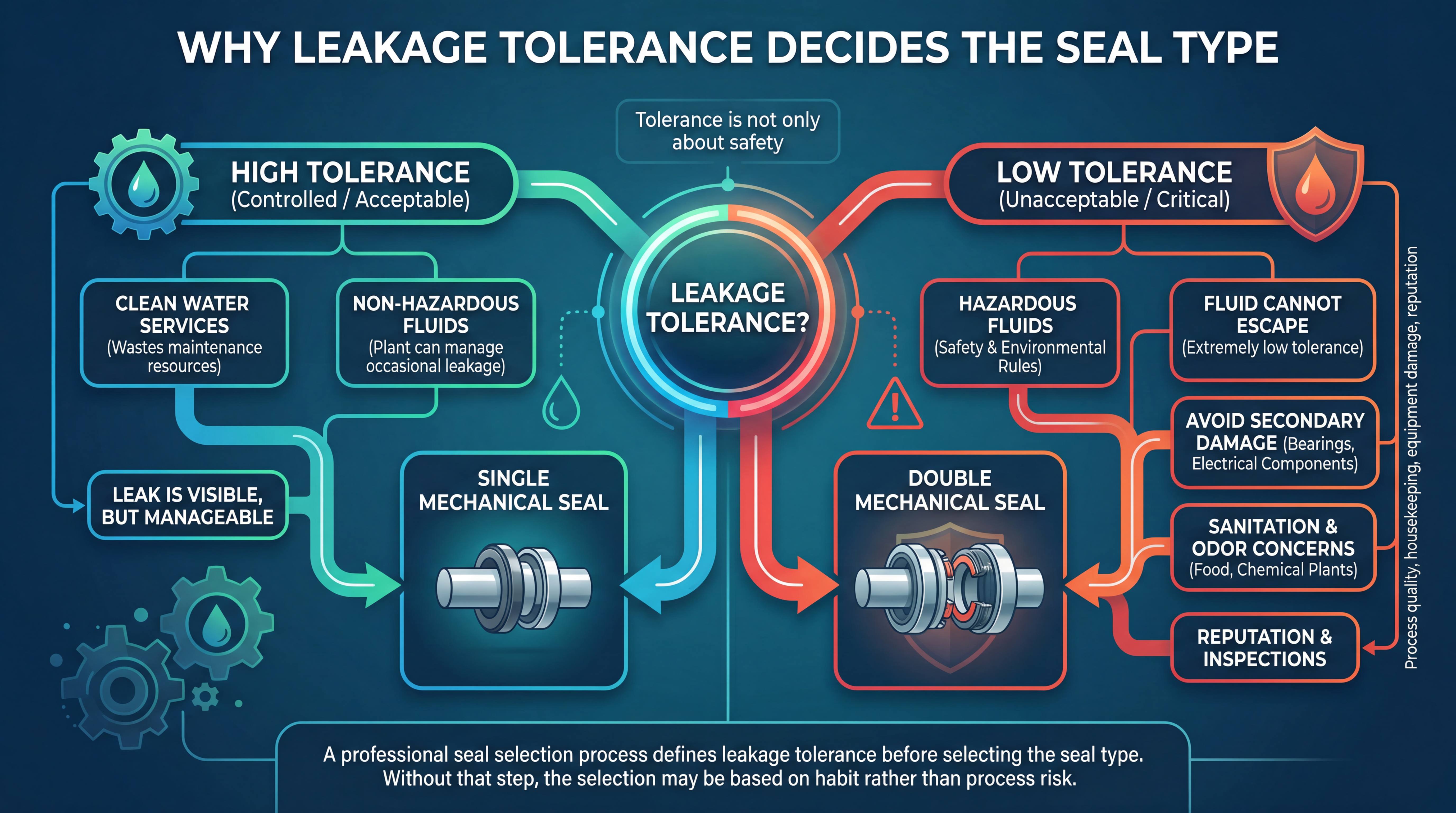
Leakage tolerance decision diagram comparing single mechanical seal for manageable leakage and double mechanical seal for hazardous or critical fluids
2026-04-30

Single vs Double Mechanical Seals: When Is One Seal Not Enough?

Choosing between a single and double mechanical seal is not only a product decision. It is a safety, leakage control, process reliability and maintenance risk decision.
Learn more
Mechanical seal selection comparison showing component seal installation risk and cartridge seal reliability advantages
2026-04-30

Cartridge Mechanical Seals vs Component Seals: How to Choose for Real Pump Applications

Cartridge and component mechanical seals are not simply “expensive” and “economical” options. This guide explains how installation skill, pump duty, downtime risk and maintenance strategy should influence seal selection.
Learn more
Centrifugal pump mechanical seal failure diagram showing seal assembly leakage points O-rings bearings and maintenance checklist
2026-04-30

Why Mechanical Seals Leak: A Practical Guide for Pump Maintenance Teams

Mechanical seal leakage is rarely caused by the seal alone. This guide explains how pump conditions, installation, materials, vibration, dry running and maintenance habits lead to repeated seal failure.
Learn more
  • 1
    Sitemap

    Industrial Components

    Kitchen Appliances

    Renewable Energy

    Building & Home Improvement

    Chemicals & Water Treatment

    Robotics & Automation

    Email:robertkileyman@gmail.com

    (508676)
    Email
    comment