上传

RJXA's Christmas approaches, it's time to refresh your fashion collections! Explore our high-quality lace, perfect for festive attire. Inquire now to enjoy holiday specials!

Member Center
Exit
Data is empty
0
qr Code Url

Scan the QR code to visit the mobile website

  • Home
  • Industrial
  • Renewable
  • Building & Home
  • Water Treatment
  • Automation
  • Kitchen
Home -
News
-
Comparison of normal refinery operation and startup transient conditions that threaten overhead corrosion and salt-control margin
2026-07-28

Refinery Neutralizer Control During Startup, Shutdown and Low-Rate Operation

A state-based guide to crude-unit overhead corrosion control during startup, low-rate operation, shutdown and restart. It aligns condensation, chemical delivery, water wash, monitoring, hold points and control authority so a normal neutralizer program does not fail during transient conditions.
Learn more
Refinery engineers reviewing neutralizer field trial data during an overhead system inspection
2026-07-28

How to Qualify a Refinery Neutralizer Program Before Full-Scale Changeover

A practical qualification framework for changing refinery neutralizers without turning the crude overhead into an uncontrolled experiment. It covers baseline creation, supplier evidence, laboratory screening, salt-risk modeling, injection-system compatibility, field-trial design, stop criteria, KPI normalization, commercial evaluation and management of change.
Learn more
Refinery tramp amine problem requiring coordination between crude procurement, laboratory testing, process engineering and corrosion control
2026-07-28

Tramp Amines in Crude: When H2S Scavengers Disrupt Refinery Neutralizer Control

Tramp amines can enter a refinery before the neutralizer program ever begins. This guide traces MEA and other amines from H2S scavenger-treated crude through desalting, furnace heating and the tower overhead, explaining how they distort pH, raise salt points, increase fouling risk and change crude purchasing, monitoring and mitigation decisions.
Learn more
Online refinery overhead monitoring and neutralizer control system with analyzer, dosing pump and field operator
2026-07-28

From Daily Samples to Closed-Loop Control: How Refiners Should Monitor Neutralizer Performance

A refinery monitoring guide for linking pH, chloride, iron, neutralizer rate, sample conditioning and process changes. It explains when continuous analyzers add value, why closed-loop dosing still needs operating boundaries, how to validate data, and how to turn high-frequency measurements into safer overhead decisions.
Learn more
Refinery overhead system showing desalter, caustic, water wash, neutralizing amine and filming inhibitor control layers
2026-07-28

Neutralizer vs Caustic vs Filming Amine vs Water Wash: What Each One Actually Does

A refinery decision guide explaining how caustic, neutralizing amines, filming inhibitors and water wash control different parts of crude overhead corrosion. It shows where each layer acts, what it cannot replace, how failures transfer risk downstream, and how refiners should build an integrated corrosion-control strategy.
Learn more
Refinery neutralizer injection system showing how chemical delivery and local mixing affect overhead pH control
2026-07-28

Neutralizer Injection Engineering: Where the Chemical Enters Can Decide Whether It Works

A refinery-focused engineering guide to neutralizer injection location, quills, steam atomization, droplet behavior, mixing, vaporization, materials, field validation and requalification. It explains why the same neutralizing amine can perform differently when the injection system changes.
Learn more
Neutralizing amine reducing acid corrosion while amine chloride salt deposits create localized corrosion risk
2026-07-28

When Neutralizers Create Salt: How Refinery Overheads Turn Protection into Corrosion

Neutralizing amines can suppress acidic corrosion yet create a second risk when their chloride salts form and deposit before bulk water appears. This technical guide follows the full failure chain from salt point and deposition to wet corrosive deposits, exchanger fouling, pitting, diagnosis and refinery-wide mitigation.
Learn more
Refinery engineers troubleshooting the complete process system before blaming neutralizer product performance
2026-07-28

Why Crude Overhead pH Suddenly Drops: A Root-Cause Guide for Refiners

A refinery troubleshooting guide for sudden crude overhead pH drops. It shows how to separate chloride surges, desalter disturbances, caustic interruptions, neutralizer delivery problems, crude changes, condensation effects and sampling errors by reading the event timeline instead of treating every low-pH alarm as a chemical-dose problem.
Learn more
Neutralizer risk envelope covering operating states, chloride load, temperature, condensation and chemical variability
2026-07-28

How to Select a Neutralizing Amine When Crude Slates Keep Changing

A refinery-focused selection guide for matching neutralizing amines to changing crude slates. It explains how chloride load, acid demand, vapor-liquid distribution, amine salt formation, desalter performance, injection design, monitoring and field validation should shape a defensible neutralizer program.
Learn more
Refinery overhead piping showing hidden corrosion risk despite an acceptable bulk water pH reading
2026-07-27

Neutralizing Amines in Crude Unit Overheads: Why pH Control Is Only Part of the Story

A technical refinery guide explaining why neutralizing amines cannot be judged by accumulator pH alone. It connects first-condensate acidity, chloride loading, amine salt formation, injection quality, water wash, monitoring and crude-slate variability to the real operating window for crude overhead corrosion control.
Learn more
Corroded cooling-water pipe during restart illustrating the risk of renewed corrosion and release of accumulated corrosion products
2026-07-27

Cooling Water Shutdown Corrosion: How Wet and Dry Layup Protect Idle Equipment

Cooling systems can corrode fastest when they are not operating. This engineering guide explains wet versus dry layup, stagnant-water and residual-moisture risks, shutdown preparation, restart verification, monitoring, metallurgy, supplier qualification and how to prevent an idle system from becoming a startup failure.
Learn more
Pinhole leak through a metal surface caused by deep localized pitting corrosion in a cooling-water system
2026-07-27

Pitting Corrosion in Cooling Water: Why Tiny Pits Can Cause Sudden Equipment Failure

Pitting can perforate equipment while average corrosion rates still look acceptable. This engineering guide explains how pits initiate, why chloride, temperature, oxidants, deposits and stagnant zones accelerate them, how carbon steel and stainless steel behave differently, and how plants should diagnose, monitor and control localized attack.
Learn more
Technician inspecting a corrosion coupon and cooling-water deposits in a phosphate-treated industrial system
2026-07-27

Phosphate-Free Corrosion Control: Why Cooling Water Treatment Is Moving Beyond Phosphorus

Phosphate-free cooling water treatment is not a simple one-for-one chemical replacement. This guide explains why plants are reducing phosphorus, how non-phosphorus programs protect steel, what changes in scale and deposition risk, and how engineers should qualify a transition without sacrificing corrosion performance.
Learn more
Three-layer corrosion monitoring architecture combining early warning, confirmation and asset integrity measurements
2026-07-27

Cooling Water Corrosion Monitoring: Why One Corrosion Rate Never Tells the Whole Story

Corrosion coupons, LPR probes, ER sensors and metal-ion trends do not measure the same thing. This guide explains what each monitoring method can and cannot prove, how location and heat transfer distort results, why averages can hide pitting, and how industrial teams should combine corrosion data into an evidence-based asset integrity program.
Learn more
Industrial copper-alloy heat exchangers and piping exposed to cooling water corrosion and treatment conditions
2026-07-27

When Biocide Control Raises Corrosion Risk: Protecting Copper Alloys in Cooling Water

Aggressive chlorination can improve microbial control while destabilizing copper-alloy protection. Learn how oxidizing biocides, azoles, copper release and monitoring interact in industrial cooling systems—and how operators can balance microbiological control with long-term asset integrity.
Learn more
Industrial cooling system using reclaimed water with online monitoring of conductivity, pH and water chemistry
2026-07-27

Recycled Water and Corrosion: The Hidden Chemistry Behind Industrial Water Reuse

Reusing treated wastewater can reduce freshwater demand, but it also changes the chemistry entering cooling systems. This guide explains how conductivity, chloride, sulfate, nutrients, biofilm, concentration cycles and treatment interactions reshape corrosion risk—and how plants can qualify reclaimed water without trading water savings for reliability.
Learn more
Industrial cooling water system using multiple metallic materials including steel and copper piping
2026-07-27

Mixed-Metallurgy Corrosion in Cooling Systems: When One Water Chemistry Meets Many Metals

A mixed-metal cooling system can fail even when bulk water chemistry looks acceptable. This guide explains galvanic coupling, area-ratio effects, copper deposition, aluminum and yellow-metal risks, material-specific treatment, startup passivation, monitoring, and procurement decisions for systems combining carbon steel, copper alloys, stainless steel and aluminum.

Learn more
Microbiologically influenced corrosion beneath biofilm causing localized pitting and degradation of industrial piping
2026-07-27

Microbiologically Influenced Corrosion: When Biofilm Becomes an Asset-Integrity Problem

Microbiologically influenced corrosion is not proven by finding bacteria alone. This guide explains how biofilms alter local electrochemistry, why planktonic counts can miss surface risk, how SRB and other microbial communities contribute to damage, and how plants should combine microbiology, metallurgy, chemistry and operating evidence to diagnose and control MIC.
Learn more
Engineer inspecting a large industrial heat exchanger for corrosion, fouling and deposit-related equipment damage
2026-07-27

Under-Deposit Corrosion in Industrial Water Systems: Why Clean-Looking Equipment Can Fail from Beneath

Under-deposit corrosion is one of the most easily misdiagnosed failure mechanisms in industrial water systems because the bulk water may remain within specification while aggressive chemistry develops beneath scale, corrosion products, suspended solids or biofilm.
Learn more
Closed-loop cooling system with internal corrosion developing despite apparently clean circulating water
2026-07-27

Why Closed-Loop Cooling Systems Still Corrode: The Hidden Risks Behind “Clean” Water

Closed-loop cooling systems are often assumed to be naturally protected from corrosion because they use relatively clean water and have limited exposure to the atmosphere. In reality, oxygen ingress, makeup water, mixed metallurgy, deposits, microbiological activity, poor commissioning and weak monitoring can gradually turn a stable loop into a hidden reliability risk.
Learn more
Industrial inhibitor supplier qualification process from vendor claims and laboratory testing to delivery and asset protection verification
2026-07-24

How to Qualify an Industrial Inhibitor Supplier: Performance Testing, Chemical Compatibility and Field Validation

A procurement-grade framework for qualifying industrial inhibitor suppliers through traceable product identity, comparable performance testing, formulation and materials compatibility, batch control, delivery-system readiness, controlled field trials, change management and outcome-based commercial evaluation.
Learn more
Radical-control system linking monomer identity, oxygen, temperature and inhibitor selection to storage protection
2026-07-24

TBC, MEHQ and PTZ in Monomer Storage: How Oxygen, Temperature and Inhibitor Depletion Change Risk

This industry guide compares TBC, MEHQ and PTZ as different monomer-protection tools rather than interchangeable additives. It maps styrene, acrylic and methacrylic storage risks across oxygen availability, temperature history, residence time, active-inhibitor measurement, phase segregation and emergency restabilization.
Learn more
Laboratory comparison of normal inhibitor protection, polymerization retardation and emergency shortstopping
2026-07-24

Polymerization Inhibitor, Retarder or Shortstop? Three Different Roles in Monomer Safety

A functional guide to separating routine inhibition, process retardation and emergency shortstopping in reactive monomer systems. It explains induction time, oxygen dependence, inhibitor depletion, rate control, emergency delivery, testing and procurement boundaries across storage, transport and processing.
Learn more
Field pipeline deposition compared with laboratory wax and asphaltene inhibitor failure analysis
2026-07-24

Why Wax and Asphaltene Inhibitor Programs Fail: Crude Compatibility, Thermal History and Injection Timing

A forensic guide to diagnosing wax and asphaltene treatment failures, from deposit identification and representative crude sampling to thermal-history reconstruction, chemical placement, compatibility testing and field-trial evidence.
Learn more
Subsea pipeline during a cold restart with hydrate risk monitoring and pressure-temperature data.
2026-07-24

MEG, Methanol, KHI or Anti-Agglomerant? Choosing a Hydrate Strategy for Subsea Production

A field-oriented guide to selecting MEG, methanol, kinetic hydrate inhibitors or anti-agglomerants for subsea production. It connects hydrate thermodynamics, shutdown and restart exposure, water cut, chemical recovery, environmental approval and qualification evidence to the strategy that best protects production availability.
Learn more
Diagram showing the placement, retention and production clocks in an oilfield scale inhibitor squeeze treatment
2026-07-24

Scale Inhibitor Squeeze Treatments: Designing for Retention, Return Profiles and Longer Treatment Life

A production-chemistry guide to designing oilfield scale inhibitor squeeze treatments as controlled underground chemical depots. It explains placement, adsorption versus precipitation, laboratory qualification, return-curve interpretation, MIC-based resqueeze criteria, formation-damage control and treatment-life optimization.
Learn more
Industrial reverse osmosis water treatment plant with membrane vessels, process piping and digital controls
2026-07-24

RO Antiscalant Dosing: How to Convert a ppm Target into Verified Chemical Delivery

A field-engineering guide to converting a water-specific RO antiscalant setpoint into verified chemical delivery. It covers dose basis, unit conversions, dilution, metering-pump calibration, injection-point design, interlocks, commissioning, daily reconciliation and failure diagnosis.
Learn more
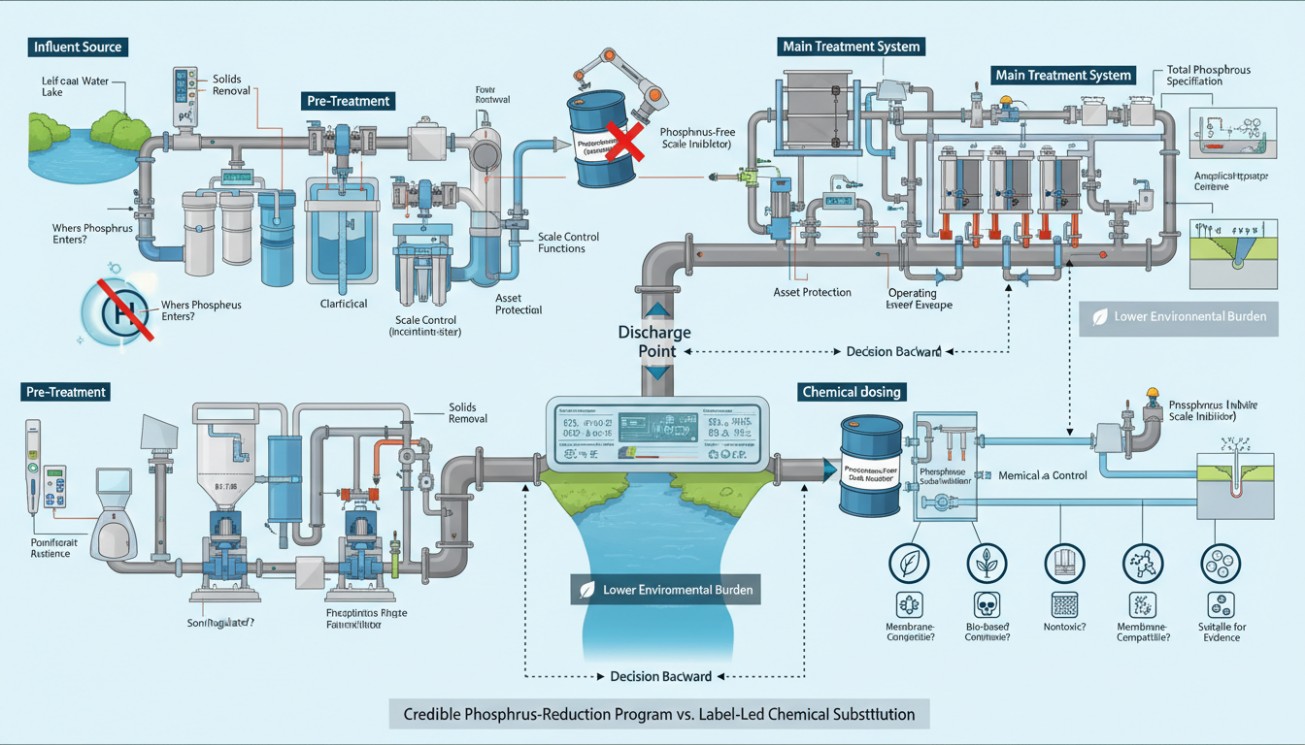
Industrial water treatment system tracing phosphorus-free scale control from discharge back to chemical dosing
2026-07-24

Phosphorus-Free Scale Inhibitors: How to Verify Performance, Biodegradability and Effluent Claims

Phosphorus-free scale inhibitors can reduce nutrient loading, but only when the claim, chemistry and outfall result are verified independently. This guide explains how to build a phosphorus mass balance, distinguish environmental claims, qualify replacement chemistry, run a controlled trial and measure both asset and effluent performance.
Learn more
Reverse osmosis membrane system showing antiscalant injection and mineral scale prevention
2026-07-24

How to Select an RO Antiscalant for Carbonate, Sulfate, Silica and Metal Fouling

Selecting an RO antiscalant is a concentrate-chemistry decision, not a product-label exercise. This guide explains how to distinguish carbonate, sulfate, silica and metal-associated risks, model mixed-water interactions, validate dosage and compatibility, and convert supplier recommendations into measurable operating controls for reliable membrane performance.
Learn more
Industrial inhibitor selection map comparing scale, polymerization, hydrate, wax and asphaltene risks
2026-07-24

Industrial Inhibitors Explained: A Decision Framework for Scale, Polymerization, Hydrate, Wax and Asphaltene Control

Industrial inhibitor selection fails when teams choose chemistry before defining the unwanted event. This guide builds a cross-industry decision framework for scale, unintended polymerization, hydrates, wax and asphaltenes, showing how mechanisms, operating envelopes, delivery systems, compatibility testing and field evidence determine whether an inhibitor program will succeed beyond the laboratory.
Learn more
  • 1
  • 2
  • 3
  • 17
    Sitemap

    Industrial Components

    Kitchen Appliances

    Renewable Energy

    Building & Home Improvement

    Chemicals & Water Treatment

    Robotics & Automation

    Email:robertkileyman@gmail.com

    (508676)
    Email
    comment