The Future of Plain Bearings: Dry Running, Polymer Materials, and Lower-Maintenance Industrial Design
Plain Bearings Are Becoming Part of a Bigger Industrial Shift
For many years, plain bearings were often described in simple terms: low-cost bushings, sliding bearings, bronze sleeves, or basic support components for low-speed motion. That description is not wrong, but it is no longer enough. The future of plain bearings is being shaped by a larger industrial shift toward cleaner equipment, lower maintenance, reduced downtime, simpler machine ownership, and more sustainable mechanical design.
Modern machinery is changing. Factories want fewer lubrication points. Equipment manufacturers want longer service intervals. Food and packaging companies want cleaner motion systems. Automation lines need quiet components that can run continuously with less operator attention. Outdoor equipment users want bearings that survive irregular maintenance. Global buyers want machines that are easier to operate in different markets, not machines that depend on perfect service behavior.
This shift does not eliminate rolling bearings, bronze bushings, or traditional lubricated designs. It simply changes how engineers think about motion support. The question is no longer only whether a bearing can carry load. The question is whether the bearing can support the machine’s long-term operating strategy.
A bearing is no longer just a part inside a housing. It is part of the machine’s maintenance model, environmental profile, noise behavior, cleanliness standard, energy use, and customer experience.
That is why industrial plain bearings are gaining new attention. Their future is not based on being the cheapest alternative to rolling bearings. Their future is based on helping machines become simpler to maintain, cleaner to operate, and more realistic for modern industrial users.
From Component Selection to Lifecycle Design

Traditional bearing selection often starts with dimensions, load, speed, and price. Those factors are still important, but future-oriented machine design goes further. It asks how the bearing affects the full lifecycle of the machine.
How often does the machine need lubrication?
How much downtime is required for maintenance?
Can the user easily access the bearing point?
Does grease attract dust or contaminate products?
Does the bearing create noise?
Can the material resist corrosion?
Can the machine run reliably even when maintenance is imperfect?
Does the bearing reduce total ownership cost?
These questions are increasingly important because many industrial users are no longer satisfied with components that only perform well on paper. They want systems that perform reliably in real production, with real operators, real maintenance schedules, and real environmental limits.
This is where maintenance-free bearings and self-lubricating bushings become more than product categories. They become design tools. By reducing dependence on external lubrication, they can simplify service routines, improve uptime, reduce contamination risk, and make machines easier to own.
Lifecycle design also changes how buyers compare costs. A more expensive bushing may be the better choice if it reduces downtime, avoids grease contamination, extends service intervals, or prevents shaft damage. A cheaper bearing may become costly if it requires frequent service or fails in a hard-to-access location.
The future of plain bearings will be driven less by unit price and more by system value.
Why Dry Running Bearings Are Gaining Attention
Dry running bearings are one of the strongest trends in plain bearing development. A dry running bearing is designed to operate without continuous external oil or grease under defined conditions. It may use engineered polymer materials, solid lubricants, PTFE-based layers, composite structures, or other low-friction systems.
The appeal is clear. If a bearing can operate without regular grease, the machine becomes easier to maintain. There are fewer service points. There is less risk of missed lubrication. There is less grease leakage. There is less dirt sticking to lubricated surfaces. In clean production environments, there is also less risk of lubricant contaminating products or packaging.
Dry running is especially valuable in equipment where lubrication is inconvenient, messy, or unreliable. Packaging lines, food equipment, textile machinery, medical devices, laboratory systems, conveyor mechanisms, small automation units, agricultural linkages, and outdoor mechanisms can all benefit in the right conditions.
However, dry running should not be misunderstood. A dry running bearing is not a bearing that ignores friction. It is a bearing that manages friction through its own material system rather than continuous external lubrication. Load, speed, temperature, shaft finish, clearance, and contamination still matter.
In the future, successful dry running bearing design will depend on application knowledge. Engineers will not simply ask whether a bearing can run dry. They will ask under what pressure, at what speed, against what shaft, at what temperature, and in what environment it can run dry.
The value of dry running bearings lies in reducing maintenance burden without pretending that physics has disappeared.
Polymer Plain Bearings Are Moving Beyond “Plastic Bushings”
Polymer plain bearings are often misunderstood as simple plastic substitutes for metal bushings. That view is outdated. Modern polymer bearing materials can include reinforcing fibers, solid lubricants, wear-resistant fillers, temperature-stable compounds, and carefully engineered surface behavior.
The future of polymer plain bearings is not about replacing all bronze bushings. It is about solving problems that traditional metal bushings cannot always solve easily.
Polymer bearings can reduce weight. They can resist corrosion. They can operate without grease in suitable conditions. They can reduce noise. They can avoid metal-to-metal contact. They can perform in wet or washdown environments. They can be useful in equipment where clean operation matters more than maximum heavy-load capacity.
This makes them highly relevant in automation, packaging, food processing, electronics assembly, light machinery, medical equipment, furniture mechanisms, access systems, and certain outdoor applications.
Noise reduction is one of their most practical advantages. As factories become more automated and equipment operates closer to workers, acoustic comfort matters. A quiet machine feels more refined, safer, and more modern. Polymer plain bearings can help reduce squeaking, vibration, and harsh contact noise in suitable applications.
Corrosion resistance is another major advantage. In humid, wet, or chemically exposed environments, polymer bearings may avoid the rust problems associated with some metal components. This can be valuable in washdown lines, outdoor equipment, marine-adjacent mechanisms, and agricultural applications.
But polymer bearings are not universal. They must be selected with attention to load, creep, temperature, moisture absorption, shaft finish, and thermal expansion. Their future depends not on marketing them as “better than metal,” but on using them where their material advantages match the application.
Lubrication-Free Bearings and Cleaner Machine Design

The phrase lubrication-free bearings is increasingly attractive because machine cleanliness has become a serious design issue. In many industries, lubrication is not just a maintenance topic. It is a contamination topic.
Grease can leak. Oil can drip. Dust can stick to lubricated surfaces. Product residue can mix with lubricant. In food, packaging, pharmaceutical, textile, and clean manufacturing environments, these problems matter. A bearing that requires frequent external lubrication may create hygiene, cleaning, or quality-control concerns.
Lubrication-free bearing design helps reduce those risks. In suitable applications, it can support cleaner machine frames, simpler washdown routines, reduced residue buildup, and fewer maintenance-related contamination points.
This trend is not limited to food and medical industries. Even in general automation, customers increasingly prefer machines that look clean and stay clean. A machine covered with grease around every pivot point may appear outdated, even if it functions. A cleaner design communicates better engineering, lower maintenance, and higher quality.
However, lubrication-free does not mean maintenance-free in every sense. The bearing still wears. The shaft still matters. The environment still matters. The bearing must still be inspected. The difference is that routine lubrication is reduced or eliminated under defined operating conditions.
In the future, lubrication-free bearings will be chosen not only for performance, but also for how they improve the appearance, cleanliness, and perceived quality of machinery.
Self-Lubricating Bushings as a Reliability Strategy
Self-lubricating bushings are often promoted as convenient components, but their deeper value is reliability strategy. They reduce the number of things that must go right for the machine to keep working.
In a traditional greased bearing system, reliability depends on correct lubricant, correct amount, correct interval, clean application, accessible grease points, trained maintenance staff, and consistent service discipline. If any of those factors fail, bearing life can fall.
A self-lubricating bushing reduces dependence on some of those external actions. It may contain oil, solid lubricants, PTFE-based sliding layers, polymer additives, or graphite plugs. The mechanism varies, but the purpose is similar: provide friction control from within the bearing system.
This is particularly valuable in distributed machinery. A machine may have dozens or hundreds of bearing points. Even if each point is simple, the combined maintenance burden becomes large. Reducing lubrication points can make the entire machine more reliable.
Self-lubricating bushings are also useful in global equipment sales. A machine may be sold into markets where maintenance habits, lubricant availability, technician training, and operating conditions vary widely. A design that depends on perfect greasing may perform inconsistently across customers. A lower-maintenance design can improve real-world reliability.
The future of self-lubricating bushings is not only technical. It is commercial. They help equipment manufacturers deliver machines that customers can maintain more easily.
Low Maintenance Machinery Is Becoming a Competitive Advantage
Low maintenance machinery is no longer just a convenience. It is becoming a competitive advantage.
For equipment buyers, maintenance is a cost. Every service interval requires time, labor, planning, and sometimes production stoppage. Every lubrication point is a possible failure point. Every difficult-to-access joint creates a risk that maintenance will be skipped. Every unexpected bearing failure can lead to downtime, emergency repair, spare parts delays, and customer frustration.
Machine builders understand this. They increasingly design equipment not only to perform well when new, but also to remain easy to own over years of operation. Bearings play a major role in that ownership experience.
A machine with fewer grease points is easier to maintain. A machine with predictable wear parts is easier to service. A machine with dry running or self-lubricating bearings can reduce operator dependence. A machine with quieter, cleaner motion feels more advanced.
This is why the future of plain bearings connects directly to equipment marketing. When manufacturers can claim reduced lubrication points, longer service intervals, cleaner operation, or simplified maintenance, those claims matter to buyers.
Plain bearings are small parts, but they can support big value messages: less downtime, less grease, less mess, less labor, and more predictable operation.
Sustainable Bearing Design Is More Than Material Recycling
Sustainable bearing design is often discussed in terms of materials, but the topic is broader than recycling. A bearing can support sustainability in several ways.
First, it can reduce lubricant consumption. Machines that require less grease or oil generate less lubricant waste and reduce the risk of leakage or contamination.
Second, it can extend service life. A bearing that lasts longer reduces replacement frequency, spare parts consumption, shipping, and maintenance labor.
Third, it can protect shafts and housings. If a bushing is designed as a replaceable wear component, it may prevent damage to more expensive machine structures. This reduces repair waste and extends equipment life.
Fourth, it can reduce cleaning burden. Lubrication-free or dry running designs may reduce oily residue and cleaning chemicals in some applications.
Fifth, it can support lighter machine design. Polymer and composite plain bearings may reduce weight compared with some metal solutions, depending on the application.
Sixth, it can improve energy efficiency in certain motion points by reducing friction and preventing poorly lubricated operation.
Sustainability is therefore not only about whether a bearing material is recyclable. It is about whether the bearing helps the machine use fewer resources over its full life.
The future of plain bearings will increasingly connect tribology with environmental responsibility. Engineers will ask not only whether a bearing works, but whether it helps the machine become cleaner, longer-lasting, and less resource-intensive.
Smart Manufacturing Components Need Predictable Behavior
As factories move toward automation, digital monitoring, and smart manufacturing, components are expected to behave more predictably. Smart manufacturing components do not always need to be electronic. A mechanical component can be “smart” in a practical sense if it reduces uncertainty, simplifies maintenance, and supports stable machine performance.
Plain bearings can contribute to this shift by offering predictable wear behavior, low-maintenance operation, and material systems matched to application conditions. In automated equipment, unpredictable lubrication failure is a problem. If a bearing point depends on manual service and that service is missed, the entire automation line can stop.
A self-lubricating or dry running plain bearing can reduce one source of uncertainty. A polymer bearing can reduce noise and corrosion. A composite bushing can provide compact low-friction movement. A replaceable plain bearing can protect more expensive structures.
In the future, plain bearings may also be integrated with condition monitoring strategies. While the bearing itself may remain simple, machine systems can monitor temperature, vibration, motion resistance, or clearance growth. This allows maintenance teams to replace bushings based on condition rather than fixed schedules.
This is important because plain bearing wear is often gradual. Gradual wear can be an advantage if it is monitored. Instead of sudden catastrophic failure, the machine can provide early warning signs: increased play, higher temperature, abnormal noise, or rising drive load.
Smart manufacturing does not always require complex bearings. Sometimes it requires simple bearings with predictable behavior inside a smarter machine system.
The Future Is Not Metal vs Polymer
A common mistake in future-oriented bearing discussions is to frame the topic as metal versus polymer. That is too simple.
Bronze, steel-backed composites, PTFE-lined bearings, engineered polymers, sintered bronze, graphite-plugged bronze, and fiber-reinforced materials all have roles. The future will not belong to one material. It will belong to better matching between material and application.
Metal plain bearings will remain important in heavy loads, shock applications, high-temperature systems, and rugged equipment. Bronze bushings will continue to serve hydraulic pivots, heavy machinery, and demanding industrial joints. Sintered bronze will remain useful where internal oil storage supports moderate-duty motion. Graphite bronze will remain useful in certain high-load, low-speed, hard-to-lubricate conditions.
Polymer and composite bearings will grow in applications where cleanliness, corrosion resistance, low noise, dry running, and weight reduction matter. PTFE-lined and metal-polymer bearings will remain important where compact low-friction sliding is needed.
The more advanced future is not choosing one material family and rejecting the others. It is selecting the right friction system for each bearing point.
A single machine may use multiple bearing technologies. Heavy pivots may use bronze. Clean sliding guides may use polymer. Compact oscillating joints may use PTFE-lined composite bearings. Light outdoor mechanisms may use self-lubricating bushings. This mixed approach is more realistic than trying to force one solution everywhere.
Application Areas That Will Drive Plain Bearing Innovation

Several industries are likely to drive future plain bearing development.
Automation and packaging equipment will continue to demand low noise, clean operation, compact design, and reduced maintenance. Polymer plain bearings, dry running bearings, and lubrication-free bearings are highly relevant here.
Food processing and beverage equipment will emphasize hygiene, washdown resistance, and grease reduction. Bearings that support cleaner design will gain attention.
Agricultural machinery will continue to need durable bushings for dirt, mud, seasonal use, and inconsistent maintenance. Self-lubricating and contamination-tolerant designs may grow.
Construction equipment will still require rugged heavy-duty plain bearings for shock, dirt, and high load. Innovation may focus on better materials, longer wear life, easier replacement, and improved sealing.
Renewable energy equipment, including solar tracking systems and wind-related mechanisms, may require long-life outdoor bearing solutions with low maintenance.
Robotics and logistics systems may use compact, quiet, and low-friction plain bearings in auxiliary motion points, even when precision rolling bearings remain necessary elsewhere.
Medical, laboratory, and electronics equipment may use dry running polymer bearings where cleanliness and quiet motion are critical.
These application areas show why the future of plain bearings is broad. Plain bearings are not limited to old machinery. They are part of modern industrial motion design.
Design Engineers Will Need Better Application Thinking
As bearing material options increase, engineers will need better application thinking. More choices can create better solutions, but only if the selection process is disciplined.
Future plain bearing selection should begin with the real machine condition: load, speed, motion type, temperature, shaft finish, environment, maintenance access, cleanliness requirement, and expected service life.
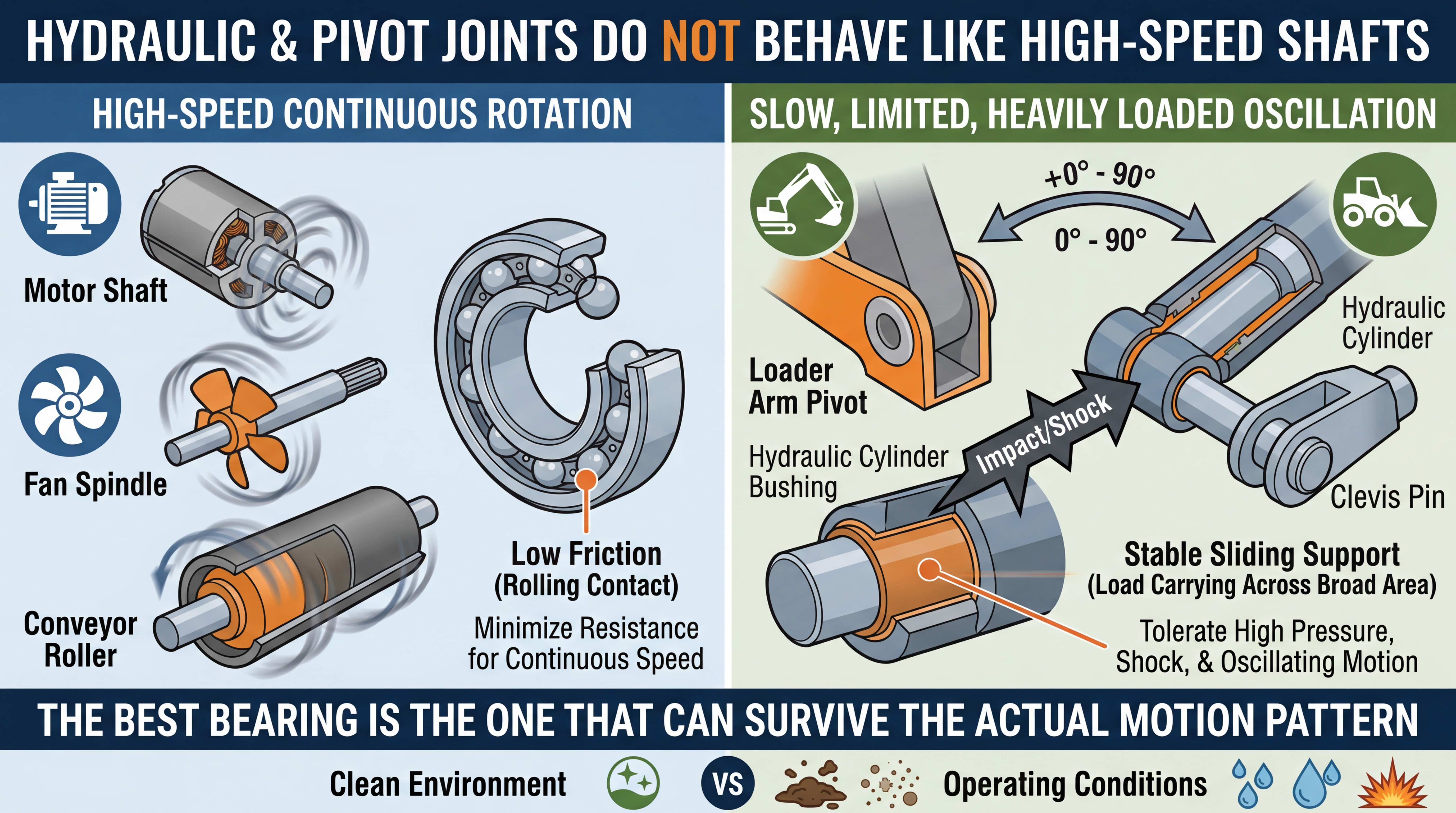
The engineer should ask whether the bearing point needs high-speed rotation, slow oscillation, dry running, corrosion resistance, dirt tolerance, low noise, or heavy shock capacity. The answer will guide the material.
The engineer should also consider the user. Will the user grease the machine regularly? Can the bearing be inspected easily? Is downtime expensive? Is the machine sold into markets with different maintenance habits? Is cleanliness part of the customer’s buying decision?
This user-centered engineering approach will become more important. A technically correct design that depends on unrealistic maintenance behavior may fail in the field. A slightly more expensive self-lubricating or dry-running bearing may create better real-world reliability.
The future of plain bearings is not only about better materials. It is about better assumptions.
Buyers Will Compare More Than Dimensions
Industrial buyers also need to change how they evaluate plain bearings. Dimensions will always matter, but they are not enough.
A buyer should not only ask for ID, OD, length, and material name. They should ask about lubrication requirements, shaft compatibility, load-speed limits, temperature range, contamination tolerance, installation method, and expected service conditions.
For example, two polymer plain bearings with the same dimensions may have very different load capacity and wear behavior. Two self-lubricating bushings may use completely different lubrication mechanisms. Two maintenance-free bearings may have different shaft finish requirements. Two industrial plain bearings may both fit the housing, but only one may match the real duty cycle.
As more products are marketed with terms like dry running, lubrication-free, self-lubricating, and maintenance-free, buyers need to understand what those terms mean in engineering practice.
Future purchasing decisions will be more application-driven. The best buyer will not simply choose the lowest price. The best buyer will choose the bearing that reduces failure risk and supports machine value.
The Limits of Future Plain Bearing Technology
A future-focused article should also be realistic. Plain bearings will not solve every motion problem.
High-speed precision shafts will still often require rolling bearings. Extremely high loads may still require heavy metal bushings, special lubrication, or custom bearing systems. Severe abrasive contamination can still destroy dry-running surfaces. High temperatures can still limit polymer materials. Poor shaft finish can still ruin a bearing. Misalignment can still create edge loading. Incorrect clearance can still cause heat, wear, or seizure.
No material can ignore physics. No maintenance-free bearing is truly condition-free. No lubrication-free design works in every environment.
The future of plain bearings will not be built on exaggerated claims. It will be built on clearer understanding of limits. The most successful suppliers, engineers, and content platforms will explain where each bearing type works and where it does not.
This honesty creates trust. It also helps users make better decisions.
A plain bearing becomes advanced not when it promises everything, but when it is selected correctly for the application.
Final Thoughts: The Future of Plain Bearings Is Practical, Not Theoretical
The future of plain bearings is not about making every bearing more complicated. It is about making machines easier to maintain, cleaner to operate, quieter to use, and more reliable in real working conditions.
Dry running bearings will grow because they reduce grease dependence. Polymer plain bearings will grow because they support clean, quiet, corrosion-resistant, and lightweight designs. Maintenance-free bearings will become more important because customers want simpler machine ownership. Self-lubricating bushings will help reduce service uncertainty. Lubrication-free bearings will support cleaner equipment design. Sustainable bearing design will connect component choices with resource efficiency and longer service life.
But the core principle remains the same: the bearing must match the motion, load, shaft, environment, temperature, maintenance reality, and expected lifecycle of the machine.
Plain bearings should not be viewed as simple old components. They are becoming part of a modern industrial design strategy. In some applications, their greatest value is not that they are inexpensive. Their value is that they reduce complexity where complexity does not help.
The best future machines will not use the most advanced component in every position. They will use the most appropriate component in every position.
That is where plain bearings will continue to matter. They support the quiet, hidden, practical side of industrial innovation: fewer grease points, fewer failures, cleaner systems, lower maintenance, and machines that keep working in the real world.
#FutureOfPlainBearings
#DryRunningBearings
#PolymerPlainBearings
#MaintenanceFreeBearings
#LowMaintenanceMachinery
#SelfLubricatingBushings
#LubricationFreeBearings
#SustainableBearingDesign
#SmartManufacturingComponents
#IndustrialPlainBearings