Plain Bearings for Dirty, Dusty, and Outdoor Environments: Why Real-World Conditions Change Bearing Selection
Dirty Environments Change the Bearing Question
In a clean test room, bearing selection may look straightforward. Engineers compare friction, speed, load rating, service life, and catalog data. A bearing that runs smoothly under controlled conditions may appear to be the best option. But many machines do not work in controlled conditions. They work in dust, mud, rain, soil, sand, fertilizer, gravel, cement powder, metal particles, wood fibers, crop residue, washdown water, salt spray, and outdoor temperature changes.
In these environments, the bearing question changes.
The question is no longer only: which bearing has the lowest friction?
The better question is: which bearing can keep working when the environment is not clean?
This is where plain bearings for dirty environments become important. A plain bearing or bushing may not always offer the lowest friction in ideal laboratory conditions, but it can be highly practical in machines that face contamination, impact, slow movement, inconsistent maintenance, and exposure to weather. In many outdoor applications, the most reliable bearing is not the most delicate or precise component. It is the component that can tolerate real working conditions.
Dirty environments affect every part of the bearing system. They damage lubrication, wear surfaces, seals, shafts, housings, and maintenance habits. They also change the value of design simplicity. A simple bushing may be easier to protect, inspect, clean, and replace than a more complex rolling bearing assembly. In some cases, a self-lubricating or dry-running bushing can reduce the amount of grease that attracts dirt. In other cases, a heavy-duty bronze bushing with proper grooves, seals, and maintenance access may be the better choice.
The correct answer depends on the machine. But one principle is clear: outdoor and contaminated environments require application-based bearing selection, not clean-room assumptions.
Why Clean-Lab Bearing Logic Often Fails Outdoors
Many bearing comparisons are made under ideal conditions. The bearing is clean. The lubricant is fresh. The shaft is smooth. The load is controlled. The temperature is stable. No abrasive particles enter the contact surface. Under those conditions, low friction and high rotational efficiency are easy to measure.
Outdoor machinery does not work that way.
A farm implement may operate in dry dust one day and wet soil the next. A construction loader may work in mud, sand, and gravel. A trailer jack may sit outdoors for months before being used. A conveyor in a quarry may face abrasive dust continuously. A gate hinge may experience rain, corrosion, and irregular lubrication. A hydraulic pivot may be greased, but the grease may soon mix with dirt.
When contamination enters a bearing position, performance changes quickly. Abrasive particles can scratch the shaft and bearing surface. Water can dilute or wash away lubricant. Mud can block lubrication paths. Dust can mix with grease and create abrasive paste. Corrosion can roughen the shaft. Temperature changes can alter clearance. Maintenance intervals may become unpredictable.
A rolling bearing can perform very well when it is sealed and protected. But if dirt enters the rolling elements or raceways, damage may accelerate. A plain bearing can also fail in dirt if the material and design are wrong. The key is not to claim that one bearing type always wins. The key is to understand how contamination changes the failure mode.
In harsh environments, the best design is often the one that is most tolerant of imperfect conditions.
How Dust and Dirt Attack Bearing Surfaces

Dust looks harmless until it becomes part of a sliding or rolling contact. In a bearing, dust can behave like abrasive powder. The harder the particles are, the more serious the wear becomes. Sand, soil minerals, cement dust, metal particles, and stone dust can be particularly damaging.
In a plain bearing, abrasive particles may enter the space between the shaft and bushing. During movement, the particles are dragged across the sliding surface. This can create scratches, grooves, and accelerated wear. If the bearing material is soft enough, some particles may become embedded. This may protect the shaft in some cases, but it may also turn the bearing surface into a cutting surface if particles remain active.
In greased joints, dust can become even more dangerous. Grease is sticky. It can attract particles and hold them around the joint. When the shaft moves, the grease-particle mixture can act like grinding compound. This is one reason why some dust resistant bushings are designed to reduce dependence on external grease in certain applications.
Rolling bearings face a different problem. Dust entering through a damaged seal can contaminate the grease inside the bearing. Abrasive particles can damage raceways and rolling elements. Once raceways are scored or pitted, noise, vibration, and heat can increase. The bearing may deteriorate quickly.
For this reason, dirt resistance is not only a material property. It is a system property. It depends on sealing, lubrication strategy, shaft condition, housing design, movement pattern, maintenance access, and whether the bearing can tolerate contamination without catastrophic damage.
Mud and Water Create a Different Kind of Risk
Mud is not just wet dirt. It combines water, fine particles, and sometimes chemicals or organic material. When mud enters a bearing location, it can create several problems at once.
First, mud can carry abrasive particles into the contact zone. Second, water can reduce lubricant effectiveness. Third, wet contamination can promote corrosion on steel shafts and housings. Fourth, mud can dry and harden around a joint, increasing movement resistance. Fifth, repeated washing can remove protective grease or expose surfaces to corrosion.
This is why mud resistant bearings are important in agricultural, construction, mining, forestry, and outdoor equipment. These machines may not only face dry dust. They may operate in wet soil, slurry, standing water, or repeated washdown.
Plain bearings can be practical in muddy environments when the design is right. A bushing may offer a large contact surface, simple geometry, and serviceable wear behavior. Some polymer or composite materials can resist corrosion and reduce grease requirements. Some bronze bushings can handle heavy load if lubrication is maintained and contamination is controlled. Some self-lubricating bushings may reduce routine greasing in positions that are difficult to access.
However, no bearing should be described as universally mud-proof. Mud is severe. If the shaft is rough, if clearance is wrong, if seals are absent, if material is unsuitable, or if contamination cannot escape, wear may still happen quickly.
The goal is not to pretend the bearing can ignore mud. The goal is to design a bearing system that can survive mud better.
Outdoor Machinery Bushings Must Handle Time, Not Just Motion
Outdoor equipment often spends more time waiting than moving. This creates a different challenge. A machine may sit in rain, sunlight, humidity, salt air, freezing temperatures, or dust before it operates again. When it finally moves, the bearing may already be affected by corrosion, dried lubricant, debris, or surface oxidation.
This is why outdoor machinery bushings must be evaluated differently from indoor factory bushings. Outdoor service life depends not only on operating hours, but also on exposure time.
A trailer support mechanism may move only occasionally, but it may sit outside all year. A gate hinge may move a few times per day but face constant weather. Agricultural equipment may work intensely during a season, then sit in storage for months. Construction attachments may be left outdoors between jobs. Marine or coastal equipment may face salt exposure even when idle.
In these cases, corrosion resistance and lubricant stability matter. A bushing material that works well in dry indoor conditions may not survive outdoor exposure. A steel pin with poor corrosion protection may damage the bushing even if the bushing itself is suitable. Grease may dry, wash out, or collect contaminants. Water trapped in the joint may accelerate rust.
A good outdoor bushing strategy should consider storage, weather, cleaning, corrosion, and re-start conditions. The bearing must survive both working motion and non-working exposure.
Agricultural Machinery Bushings Face Soil, Crop Residue, and Seasonal Pressure
Agricultural machinery bushings work in one of the most demanding contamination environments. Farm equipment faces soil, dust, crop residue, fertilizer, water, mud, and uneven ground. It also faces strong seasonal pressure. During planting or harvest, machines may run long hours, and downtime can be extremely costly. Maintenance may be done quickly in the field rather than carefully in a workshop.
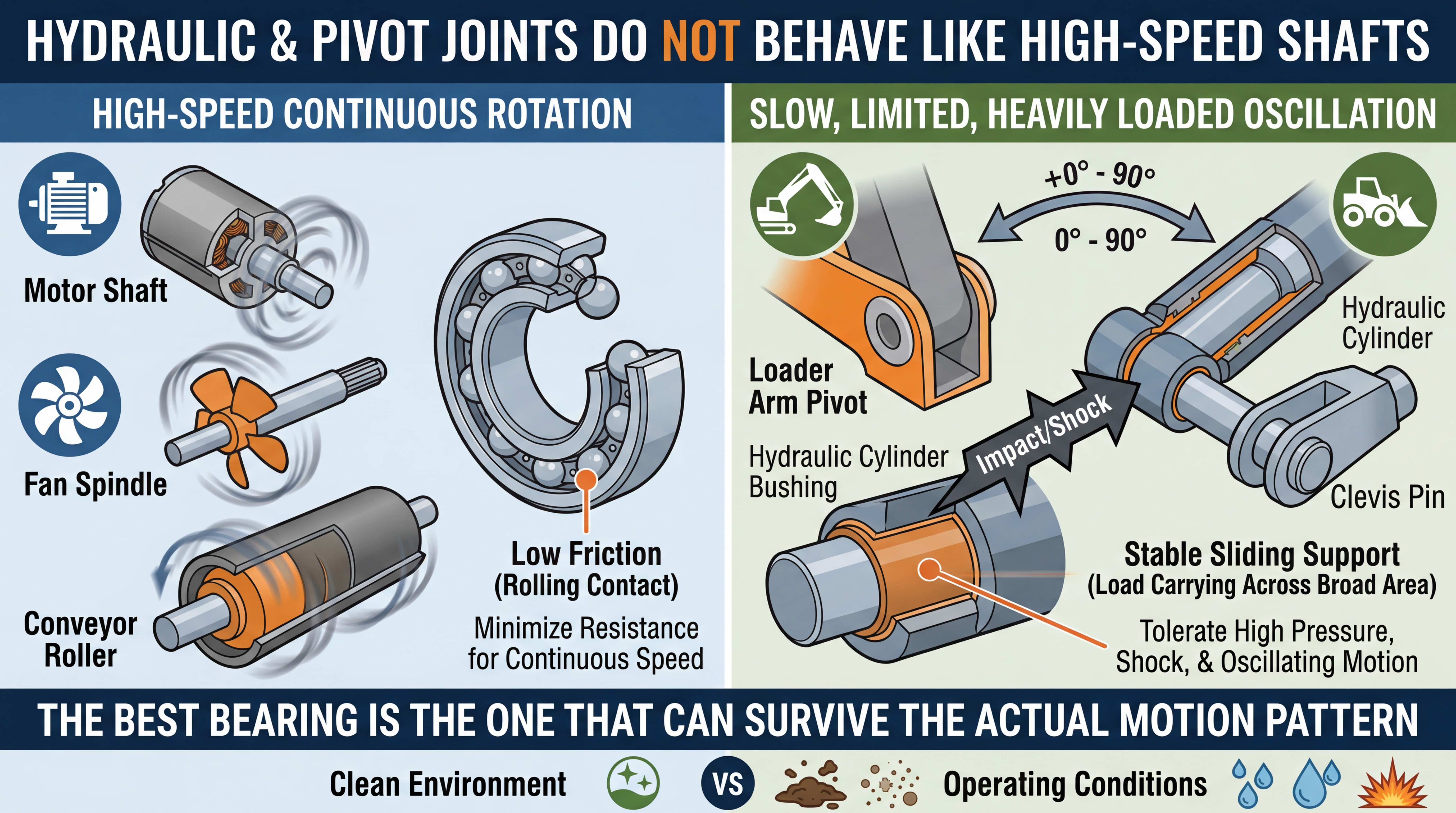
Bushings are used in seeders, planters, tillage equipment, harvesters, loaders, sprayers, balers, folding frames, hitch points, steering linkages, and many pivoting structures. These positions often involve slow, intermittent, or oscillating movement under load. A high-speed bearing solution is usually not the main requirement. The requirement is durable movement in dirt.
In farm machinery, grease can be both helpful and problematic. Grease protects and lubricates, but it can also attract soil and crop fibers. If dirty grease remains in the joint, abrasive wear increases. If operators do not grease often enough, bronze bushings may run dry. If too much grease is applied, contamination may build around the joint.
This is why some agricultural applications consider self-lubricating bushings, polymer bushings, or sealed bushing systems. The purpose is not simply to remove maintenance. The purpose is to reduce the risk that maintenance will be inconsistent or contaminated.
For agricultural equipment, the best bushing is often the one that balances load capacity, dirt tolerance, ease of replacement, and realistic field maintenance.
Construction Equipment Bushings Work Under Abrasion and Shock

Construction equipment bushings face a combination of load, shock, dirt, and operator-driven impact. Excavators, loaders, bulldozers, skid steers, cranes, compactors, and attachments all use pivot joints that operate in abrasive environments. These joints may experience mud, crushed stone, concrete dust, sand, and repeated impact.
The motion is often slow and oscillating, but the loads are high. A bucket linkage may dig into rocky soil. A loader arm may reverse direction under load. A hydraulic cylinder eye may receive shock when the attachment hits resistance. In these conditions, the bearing must survive not only contamination but also high mechanical stress.
Heavy duty plain bearings are commonly used because they can provide broad surface support and gradual wear behavior. Bronze bushings, hardened pins, greased joints, and replaceable wear parts are common in heavy equipment. In some positions, solid-lubricant bronze or composite bushings may be used to reduce maintenance or improve performance.
But dirt changes everything. If abrasive material enters the joint, the bushing and pin may wear together. If clearance grows, impact increases. If impact increases, the housing or bracket may become damaged. A small bushing problem can become a structural repair problem.
This is why construction equipment bushing design must include the full joint system: pin hardness, bushing material, grease path, seals, clearance, load direction, replacement access, and inspection intervals.
Why Grease Can Become Both Protection and Problem

Lubrication is essential for many plain bearings, especially bronze bushings under heavy load. But in dirty environments, grease has a complicated role.
Clean grease can reduce friction, protect against corrosion, and help flush contaminants from the joint if applied correctly. Grease grooves and fittings can help distribute lubricant across the bearing surface. Regular greasing can extend service life in heavy-duty pivots.
However, grease can also attract dust, sand, and fibers. If grease remains exposed around a joint, it may collect abrasive particles. If fresh grease does not purge old contaminated grease, the joint may continue to grind itself with dirty lubricant. If the grease path is blocked, the operator may believe the joint is lubricated while the actual contact surface remains dry.
This is one reason dry running bearings and self-lubricating bushings are attractive in certain contaminated environments. If the bearing can operate without sticky external grease, it may reduce particle buildup. This can be useful in dusty factory equipment, packaging systems, textile machinery, agricultural mechanisms, and outdoor linkages with moderate load.
But dry running is not always better. Heavy shock loads, very high pressure, extreme abrasion, or poor shaft surfaces may still require a different solution. The correct lubrication strategy depends on the application.
The professional question is not “grease or no grease?” The question is: which friction control method is most reliable in this environment?
Self-Lubricating Bushings in Contaminated Environments
Self-lubricating bushings can be valuable in dirty environments because they reduce dependence on frequent manual lubrication. They may use solid lubricants, polymer matrices, PTFE-based layers, oil-impregnated materials, or graphite plugs. Each system works differently, and each has limits.
In a dusty environment, a self-lubricating polymer bushing may reduce grease contamination. In a hard-to-reach outdoor joint, a graphite-plugged bronze bushing may reduce maintenance burden. In a compact mechanism, a PTFE-lined composite bushing may provide low friction with limited lubrication. In a light-duty rotating part, an oil-impregnated bushing may provide simple internal lubrication.
The important point is that self-lubricating does not mean contamination-proof. Abrasive particles can still damage sliding surfaces. A thin PTFE layer may wear if dirt is severe. A polymer bushing may perform poorly if the shaft is rough or the load is too high. Oil-impregnated pores may be affected by contamination. Graphite-plugged bronze requires correct load, motion, and surface conditions.
Self-lubricating bushings should therefore be selected by mechanism, not by label. The engineer should ask: how does the bearing provide lubrication? What happens if dust enters? What shaft finish is required? What is the load and speed? Can particles escape or will they remain trapped? Is the environment wet, dry, abrasive, or corrosive?
A self-lubricating bearing is not a shortcut around engineering. It is one possible engineering answer.
Contamination Resistant Bearings Are Designed as Systems
The phrase contamination resistant bearings should not be interpreted as a single product type. Contamination resistance is created by a system of choices.
The first choice is material. Some materials tolerate embedded particles better. Some resist corrosion better. Some operate without grease. Some handle heavy load. Some are more sensitive to abrasive dirt.
The second choice is shaft or pin surface. A hardened, corrosion-resistant, smooth shaft can extend bushing life. A rusty or scratched shaft can destroy the bearing quickly.
The third choice is clearance. Too little clearance can trap particles and increase friction. Too much clearance can allow impact and particle movement. The correct clearance depends on material, load, temperature, and contamination level.
The fourth choice is sealing or shielding. Seals can reduce contamination entry, but they must survive the environment. In some dirty applications, a simple shield, scraper, or protective geometry may help.
The fifth choice is lubrication strategy. Grease may be protective if regularly purged. Dry running may reduce dirt attraction. Solid lubrication may help where grease is difficult. Oil may work in controlled systems but may be less practical outdoors.
The sixth choice is maintenance access. A bearing in a dirty environment should be easy to inspect and replace. If replacement requires major disassembly, the failure cost increases.
Contamination resistance is not one feature. It is the result of designing the entire joint for reality.
Heavy Duty Plain Bearings Need Strong Mating Components
A bushing cannot protect a weak or damaged shaft forever. In dirty environments, the shaft or pin is often the component that decides whether the bearing lasts.
A hardened pin may resist abrasion better than a soft shaft. A plated or coated shaft may resist corrosion better than untreated steel. A polished surface may reduce wear against PTFE or polymer layers. A correctly machined grease groove may improve lubricant distribution. A damaged or pitted shaft may destroy a new bushing even if the bushing material is excellent.
This is especially important for heavy duty plain bearings in construction and agricultural machinery. The bushing may be designed as a replaceable wear part, but the pin and housing must also remain within acceptable condition. If the pin wears into an oval shape, clearance increases. If the housing becomes enlarged, the bushing may move. If the shaft corrodes during storage, the bearing surface may be damaged at startup.
Maintenance teams sometimes replace only the bushing because it is the visible worn part. But if the shaft is already scored, the new bushing will fail quickly. In dirty environments, the full contact pair must be inspected: bushing, shaft, housing, lubricant, seals, and contamination path.
The best bearing material cannot compensate for a poor mating surface indefinitely.
The Role of Clearance in Dirt and Outdoor Conditions
Clearance matters in every plain bearing application, but it becomes especially important in contaminated environments.
If clearance is too tight, dirt particles may create immediate friction and scoring. Lubricant may not reach the contact surface. Thermal expansion may reduce the clearance further. The bearing may overheat or seize.
If clearance is too loose, particles can move more freely through the joint, and the shaft may impact the bushing surface. This can create knocking, vibration, and accelerated wear. Once the joint becomes loose, contamination may enter more easily. The problem becomes self-reinforcing: more clearance allows more movement, more movement creates more wear, more wear increases clearance.
In outdoor machinery, clearance may also change with temperature and moisture. Polymer bushings may expand with heat or absorb moisture depending on material. Metal housings may expand differently from shafts. Corrosion products may occupy space in the joint. Dried mud may restrict movement.
This is why bushing clearance should be selected for the actual environment, not only for clean indoor operation. The designer must consider dirt, water, temperature, material expansion, lubrication, and wear allowance.
A bearing in the dirt needs enough clearance to survive, but not so much that it becomes unstable.
Designing for Gradual Wear Instead of Sudden Failure
In harsh environments, it may be unrealistic to expect zero wear. A more practical design goal is controlled and gradual wear. This is one reason plain bearings are often useful in dirty equipment.
A bushing can be designed as a serviceable wear component. It may wear slowly while protecting more expensive structures. When clearance reaches a certain limit, the bushing can be replaced. This is often preferable to sudden failure of a more complex bearing or damage to the housing.
Gradual wear is valuable because it gives warning. The joint may develop measurable play. Noise may increase. Movement may become less precise. Maintenance teams can inspect and replace the bushing before damage spreads.
However, gradual wear only works when the system is designed for it. The bushing must be accessible. Replacement parts must be available. The pin must be inspectable. The housing must be protected from wear. The maintenance team must know acceptable clearance limits.
In dirty environments, the goal is not always to eliminate wear. The goal is to make wear predictable, manageable, and cheaper than structural failure.
Application Examples Where Plain Bearings Often Make Sense
Plain bearings are common in outdoor and contaminated applications because many of these locations involve low-speed, high-load, oscillating, or intermittent movement.
In agricultural equipment, bushings are used in folding arms, seed meters, steering linkages, tillage frames, lift points, and hitch mechanisms. Dirt and crop residue are constant challenges.
In construction equipment, bushings are used in bucket linkages, boom pivots, hydraulic cylinder eyes, stabilizer legs, and attachment couplers. Shock and abrasion are severe.
In outdoor gates and access systems, bushings may support slow pivoting motion under weather exposure. Corrosion and irregular maintenance matter more than high-speed performance.
In trailers and towing equipment, bushings may support jacks, hinges, suspension points, and moving brackets. These components may sit outdoors and operate intermittently.
In mining and quarry equipment, abrasive dust is a major issue. Bearing systems must handle particles, vibration, and heavy loads.
In forestry equipment, mud, wood fibers, moisture, and impact all affect bearing selection.
In material handling yards, outdoor conveyors, loading arms, and lifting devices may face dust, rain, and inconsistent lubrication.
These examples show that dirty-environment bearing selection is not a niche topic. It is central to real industrial equipment.
How to Choose Plain Bearings for Dirty Environments
A practical selection process should begin with the type of contamination. Is it dry dust, wet mud, abrasive sand, water, chemical washdown, salt spray, crop residue, metal particles, or cement powder? Different contaminants create different failure risks.
Next, identify the movement. Is the bearing rotating continuously, oscillating, pivoting, sliding, or moving only occasionally? Plain bearings are often strong candidates for slow, oscillating, and intermittent motion.
Then evaluate load and shock. Outdoor machinery often experiences uneven loads, side forces, and impact. The bearing material must handle these realities.
Next, consider lubrication. Will the user grease the joint regularly? Can dirty grease be purged? Is dry running possible? Would grease attract too much dirt? Is a self-lubricating bushing suitable?
Then inspect the shaft and housing. Are they corrosion-resistant? Are they hard enough? Can they be protected from abrasion? Is replacement practical?
Then choose material. Bronze may suit high-load greased joints. Polymer may help in corrosion-resistant dry-running applications. Composite or PTFE-lined bushings may suit compact low-friction designs. Graphite-plugged bronze may help in high-load, low-speed, hard-to-grease positions.
Finally, design for maintenance. Even the best dirty-environment bearing should be inspectable. If the joint is impossible to service, small wear can become expensive damage.
Common Mistakes in Dirty-Environment Bearing Selection
One common mistake is choosing based only on clean-condition friction. Low friction in a clean catalog test does not guarantee durability in mud or dust.
Another mistake is assuming grease always solves the problem. Grease can help, but dirty grease can become abrasive.
A third mistake is selecting self-lubricating bushings without checking load, speed, shaft finish, and contamination type. Self-lubricating does not mean dirt-proof.
A fourth mistake is ignoring the shaft. A corroded or scratched shaft can destroy a new bushing quickly.
A fifth mistake is using the same bushing material for every location on a machine. A lightly loaded linkage, a heavy pivot, and a wet outdoor hinge may need different materials.
A sixth mistake is designing a bearing that is difficult to inspect or replace. In harsh environments, replacement access is part of reliability.
A seventh mistake is ignoring storage conditions. Outdoor equipment may degrade even when it is not operating.
Avoiding these mistakes can improve service life more than simply choosing a more expensive bearing.
Final Thoughts: The Best Bearing Is the One That Survives Reality
Dirty, dusty, muddy, wet, and outdoor environments change the rules of bearing selection. They make clean-lab friction values less important and make contamination tolerance, lubrication reality, material compatibility, shaft condition, and maintenance access more important.
Plain bearings are often a practical choice in these conditions because they can be simple, robust, compact, serviceable, and adaptable. They can be made from bronze, polymer, composite, PTFE-lined, or self-lubricating materials. They can support slow oscillating movement, high load, and gradual wear. They can be designed to reduce grease dependence or to work with realistic maintenance.
But plain bearings are not automatically better in every dirty environment. They must be selected correctly. Dirt, mud, water, corrosion, shaft damage, and poor lubrication can still cause early failure. The right solution depends on the full system: bearing material, shaft, housing, clearance, seals, lubrication, load, motion, and user behavior.
The most important lesson is simple: outdoor machinery does not care about ideal conditions. It only cares about what survives the field, the jobsite, the yard, the farm, the quarry, the washdown area, or the weather.
That is why plain bearings for dirty environments, outdoor machinery bushings, dust resistant bushings, mud resistant bearings, and contamination resistant bearings should be selected based on real operating conditions, not assumptions.
In harsh environments, the best bearing is not always the one that looks best on paper. It is the one that keeps working when the machine is dirty, wet, loaded, shocked, and maintained by real people in the real world.
#PlainBearings
#DirtyEnvironmentBearings
#OutdoorMachineryBushings
#DustResistantBushings
#MudResistantBearings
#AgriculturalMachineryBushings
#ConstructionEquipmentBushings
#SelfLubricatingBushings
#DryRunningBearings
#HeavyDutyPlainBearings