Oil-Embedded Bronze Bearings Explained: How Sintered Bushings Store and Release Lubrication
Oil-Embedded Bronze Bearings Are Not Just Bronze Parts with Oil Added
An oil embedded bronze bearing is often described in a very simple way: a bronze bushing that already contains oil. That description is easy to understand, but it does not fully explain why this bearing type matters in machine design.
The real value of an oil-embedded bearing comes from the structure of the material. A normal solid bronze bushing can be lubricated from the outside with grease or oil. An oil-embedded bushing is different because its body contains a network of microscopic pores. These pores can store lubricant inside the bearing material itself. During operation, oil can move toward the sliding surface and support the formation of a lubricating film between the shaft and the bushing.
This is why an oil impregnated bushing should not be understood as a bronze sleeve that has been dipped in oil. It is an engineered porous bearing material. Its performance depends on powder metallurgy, pore structure, oil content, shaft condition, load, speed, temperature, and movement pattern.
For industrial equipment designers, buyers, and maintenance teams, this distinction is important. Oil-embedded bronze bearings can reduce routine lubrication requirements in suitable applications. They can simplify machine design, reduce grease points, and support reliable movement in small motors, appliances, light machinery, office equipment, pumps, fans, linkages, and moderate-duty industrial systems.
But they are not magic components. They do not work in every condition. They still depend on correct application boundaries. If the load is too high, if the speed is too fast, if the temperature is too extreme, if the shaft is rough, or if contamination blocks the pores, the bearing may fail earlier than expected.
Understanding how these bearings work is the first step toward using them correctly.
Why Sintered Bronze Is Different from Solid Bronze

A sintered bronze bushing is made differently from a machined solid bronze bushing. A solid bronze bushing begins with a cast or wrought bronze material. It is then machined into shape. The final component is dense, strong, and suitable for many heavy-duty lubricated applications.
Sintered bronze starts with bronze powder. The powder is pressed into the desired shape and then heated below its melting point. During this process, the metal particles bond together while leaving controlled pores throughout the structure. This is the key difference.
A solid bronze bushing is dense. A sintered bronze bushing is porous.
That porosity is what allows oil impregnation. The open pore network can hold lubricant inside the bearing. After sintering, the part is often vacuum-impregnated with oil so the pores are filled deeply rather than only coated on the surface.
This gives the bearing a built-in lubrication reserve. During operation, heat and shaft movement can encourage oil to migrate toward the sliding interface. When the bearing cools or stops, some oil may be drawn back into the porous structure.
This does not mean sintered bronze is always better than solid bronze. It means it solves a different problem. Solid bronze is often preferred for heavier loads, shock conditions, high structural strength, or applications with external lubrication. Sintered bronze is often preferred where moderate load, controlled movement, compact design, and reduced maintenance are more important.
A bronze sleeve bearing may look similar from the outside, but the manufacturing route changes its behavior. Material structure is not a small technical detail. It is the reason the bearing works.
Powder Metallurgy Creates the Internal Oil Network
The phrase powder metallurgy bearing may sound like a manufacturing term, but it directly affects performance. Powder metallurgy allows the bearing manufacturer to control density, porosity, shape, and lubricant storage capacity.
In the production process, bronze powder is compacted under pressure into a bushing shape. The compacted part is then sintered at high temperature. The metal particles bond at their contact points, but the spaces between particles remain as pores. These interconnected pores create the internal reservoir that makes oil impregnation possible.
The porosity must be controlled carefully. If the material is too dense, it cannot hold enough oil. If it is too porous, mechanical strength may suffer. If pores are not properly connected, oil movement may be limited. If the surface is damaged or clogged, the oil release behavior may become unstable.
This is why the quality of a porous bronze bearing depends on more than its dimensions. Inner diameter, outer diameter, and length are important, but they do not describe the pore structure. Two bushings with the same dimensions can behave differently if their density, pore volume, oil content, and material consistency are different.
Powder metallurgy also allows efficient production of standard bushing shapes. This makes sintered bronze bushings common in many mass-produced systems where consistent performance, compact size, and economical manufacturing are important.
The key insight is simple: oil-embedded bronze bearings are not only mechanical parts. They are material systems designed to store and deliver lubrication.
How Oil Is Stored Inside a Porous Bronze Bearing
The oil inside an oil-embedded bearing is stored in the microscopic pores of the bronze structure. These pores act like tiny reservoirs. Because the pores are distributed throughout the bearing wall, the lubricant is not limited to the outer surface. It is held inside the material.
Oil impregnation is typically performed under vacuum or pressure-assisted conditions. The goal is to remove air from the pores and replace it with oil. This allows lubricant to penetrate deeper into the bushing body. A surface-oiled bearing would lose oil quickly. A properly impregnated bearing contains oil throughout its porous network.
This internal oil storage is the foundation of the self lubricating bronze bushing concept. The bearing can provide lubrication support during operation without requiring frequent external oiling or greasing, provided the application stays within its limits.
However, the oil is not unlimited. The bearing has a finite oil capacity. Operating temperature, duty cycle, load, shaft condition, and environment affect how quickly oil is consumed, redistributed, or lost. If the bearing runs too hot, oil may thin, oxidize, or leave the structure more rapidly. If the bearing is exposed to solvents or aggressive cleaning, lubricant may be removed. If dust enters the pores, oil movement may be affected.
The internal oil reserve is useful, but it must be protected. A self-lubricating mechanism does not remove the need for correct design.
How Oil Is Released During Operation

When the shaft begins to move inside the bushing, friction and temperature rise slightly at the sliding interface. This heat can reduce oil viscosity and encourage oil to move from the pores toward the bearing surface. Motion also helps distribute the lubricant across the contact area.
As oil reaches the sliding interface, it supports a thin bearing oil film. This film helps reduce direct contact between the shaft and bronze surface. In ideal conditions, the oil film lowers friction, reduces wear, and helps carry heat away from the contact zone.
When the machine stops and the bearing cools, some oil may return into the porous structure through capillary action. This release-and-return behavior is one of the reasons oil-embedded bronze bearings are useful in intermittent motion applications.
But the process is not the same as full hydrodynamic lubrication in a high-speed journal bearing. Many sintered bronze bushings work in mixed or boundary lubrication conditions, especially at startup, low speed, or intermittent movement. The bearing may not always have a fully separated oil film. Instead, the oil helps reduce friction and wear while the material and shaft still interact under load.
This is why the term “self-lubricating” must be used carefully. The bearing can supply oil, but it still operates according to load, speed, temperature, and surface condition. Oil release is a physical process, not a guarantee of infinite life.
The Bearing Oil Film Is the Real Working Layer

The most important part of an oil-embedded bearing is not visible. It is the lubrication film created between the shaft and the bushing. This bearing oil film is the working layer that reduces friction.
Without the oil film, the shaft and bronze surface experience more direct contact. Friction rises. Heat increases. Wear accelerates. Scoring may appear on the shaft or bushing. In severe cases, the bearing can seize.
With a suitable oil film, the shaft moves more smoothly. Wear is reduced. The bushing can run for a longer service interval with less external maintenance.
The quality of the oil film depends on several factors.
The first is sliding speed. If speed is too low, a stable hydrodynamic film may not fully develop. If speed is too high, heat may rise and oil may be lost quickly.
The second is load. High load squeezes the oil film and increases contact pressure. Oil-embedded bronze bushings are often better for moderate loads than severe heavy-duty shock applications.
The third is clearance. Too little clearance restricts oil movement and increases friction. Too much clearance can create unstable motion and impact.
The fourth is shaft surface finish. A rough shaft can scrape away the oil film and damage the bearing. A properly finished shaft supports smoother motion.
The fifth is temperature. Oil viscosity changes with heat. If the bearing becomes too hot, the lubricant may no longer protect the surface effectively.
This is why plain bearing lubrication is a system issue. The oil inside the bushing is only one part of the system. The shaft, clearance, load, speed, and temperature decide whether the oil can actually do its job.
Why Startup Conditions Matter
Startup is one of the most important moments for an oil-embedded bronze bearing. When the machine is not moving, the shaft and bushing may not have a fully developed oil film. At the beginning of movement, the bearing may operate under boundary lubrication conditions. This means the surfaces are not completely separated by oil.
As motion begins, oil is drawn to the surface and distributed through the sliding interface. If the load is moderate, the shaft is smooth, and the bearing has enough oil, the system can transition into a more stable lubricated condition.
But if startup load is too high, if the shaft is rough, if the bearing is dry from excessive heat or long storage, or if clearance is too tight, wear can occur quickly. Repeated dry starts can shorten service life.
This is especially important for intermittent equipment. Some machines may start and stop many times per day. Others may sit idle for long periods and then operate briefly. Oil-embedded bearings often handle intermittent use well, but only when the application is matched correctly.
For buyers and engineers, this means duty cycle matters. A bearing that works in continuous light motion may behave differently in frequent high-load start-stop movement. The number of starts, the load at startup, and the rest period between cycles can all affect performance.
An oil-embedded bronze bearing is not only selected by speed and load. It is selected by how the machine actually moves.
Where Oil-Embedded Bronze Bearings Work Well
Oil-embedded bronze bearings work well in many applications where the load is moderate, the movement is controlled, lubrication access is limited, and compact design is needed. They are widely used because they offer a practical balance between simplicity and lubrication support.
Common applications include small electric motors, fans, appliances, office equipment, pumps, light-duty gear mechanisms, instruments, hinges, linkages, packaging equipment, and various industrial mechanisms. They are also used in some automotive, agricultural, and general machinery applications where conditions match their limits.
A sintered bronze bushing can be a good choice when regular greasing is inconvenient but the application does not justify a more complex bearing system. It can also be useful where a simple sleeve bearing is needed and the machine benefits from internal oil storage.
These bearings are often attractive in high-volume production because they are compact, economical, and relatively easy to install. A properly designed oil-impregnated bushing can reduce maintenance steps and simplify assembly.
However, the best use cases share several characteristics: moderate load, manageable temperature, suitable shaft finish, controlled contamination, and movement that allows oil distribution. When these conditions are present, oil-embedded bronze bearings can provide reliable service with low maintenance.
They are especially useful when the application needs lubrication support but cannot depend on frequent manual lubrication.
Where Oil-Embedded Bronze Bearings Are Not the Best Choice
Oil-embedded bronze bearings have limits. Understanding those limits is just as important as understanding their benefits.
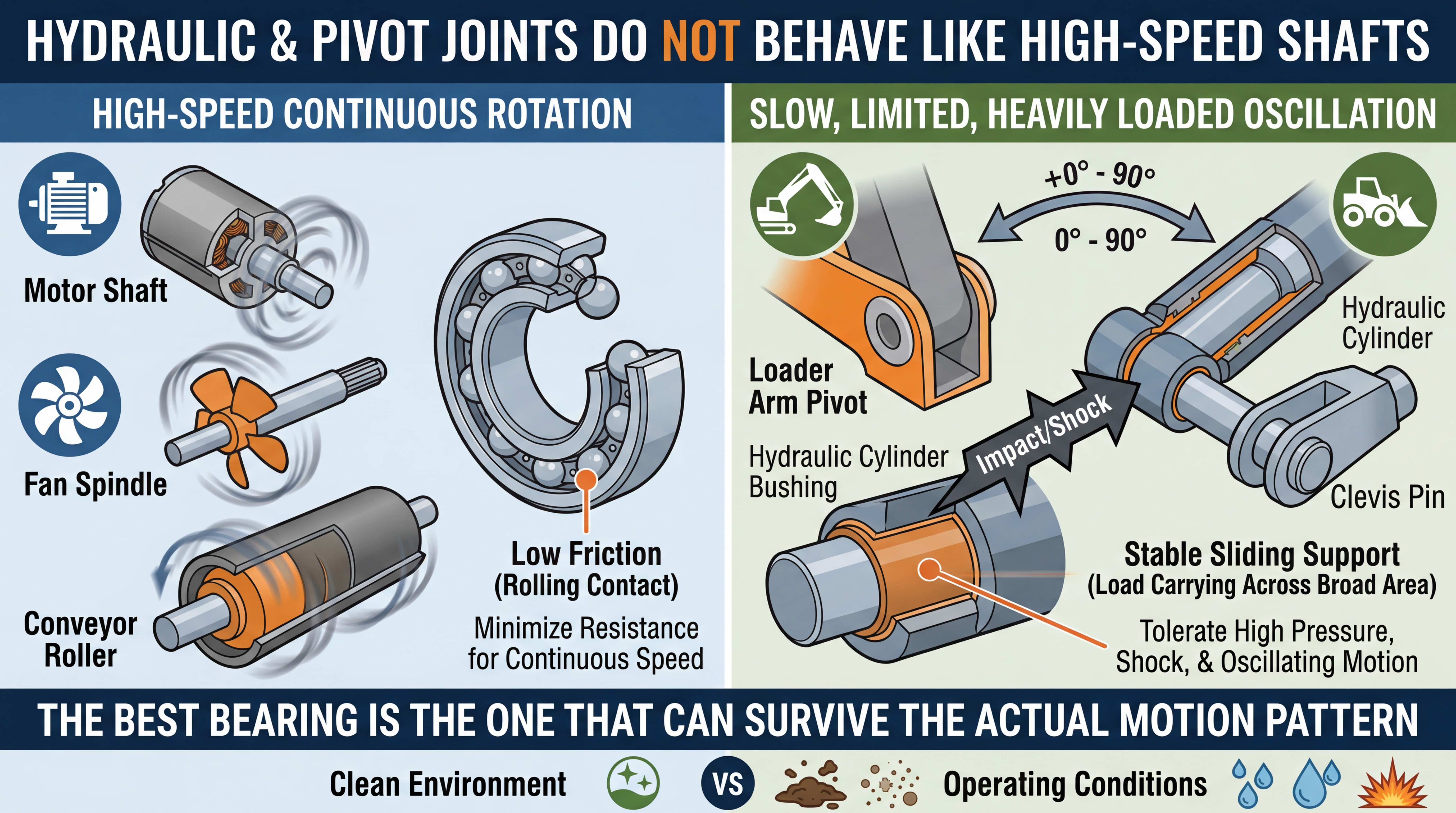
They are not always suitable for severe shock load. Heavy construction equipment pivots, excavator bucket linkages, and high-impact joints may need solid bronze bushings, hardened pins, grease systems, or other heavy-duty plain bearing solutions.
They may not be ideal in very dirty environments. Dust, mud, fibers, or abrasive particles can enter the contact area and damage the shaft and bushing. Contaminants may also clog pores or interfere with oil release. In dirty outdoor machinery, a different industrial bronze bushings solution may be better.
They may not perform well at excessive temperatures. Heat can reduce oil viscosity, accelerate lubricant loss, and affect material behavior. If the bearing runs too hot, the internal oil reserve may be depleted faster.
They may not be suitable for very high speeds unless the design is specifically validated. High sliding speed can generate heat and consume oil quickly.
They also require a suitable shaft surface. A rough, rusty, soft, or damaged shaft can destroy the bearing. Installing a new oil-impregnated bushing on a poor shaft is a common cause of early failure.
In short, oil-embedded bronze bearings are excellent in the right conditions, but they should not be treated as universal maintenance-free bushings.
Oil-Embedded Bronze vs Solid Bronze Bushings
The comparison between oil-embedded bronze and solid bronze is not about which material is better in general. It is about which one fits the application.
A solid bronze bushing is often stronger and more suitable for heavy-duty lubricated applications. It can be machined with grease grooves, oil holes, and custom dimensions. It may handle higher loads and shock conditions when properly lubricated. It is common in construction equipment, hydraulic joints, heavy machinery, and demanding industrial pivots.
An oil-embedded bronze bushing is designed for internal oil storage. It is often more suitable for moderate load, compact design, and low-maintenance applications. It can reduce the need for frequent external lubrication, but it may not match solid bronze in severe heavy-load or shock conditions.
A solid bronze sleeve bearing relies more heavily on external lubrication. An oil-embedded bushing relies on its porous structure and internal oil reserve. One is not automatically superior. They solve different engineering problems.
The wrong comparison is: “Which bronze bearing is better?”
The right comparison is: “Does this application need maximum heavy-duty strength or built-in lubrication support?”
That question leads to better selection.
Oil-Embedded Bronze vs Polymer Self-Lubricating Bushings
Oil-embedded bronze bearings and polymer self-lubricating bushings are both used to reduce maintenance, but they work in different ways.
Oil-embedded bronze uses a porous metal structure filled with oil. Its lubrication mechanism depends on stored oil moving to the sliding surface. It provides the strength and thermal conductivity of bronze, but it still depends on oil behavior.
Polymer self-lubricating bushings use engineered plastic materials with solid lubricants distributed through the material. They may run dry without oil or grease in suitable applications. They can offer corrosion resistance, low noise, and reduced weight. However, they may have different limits for load, temperature, creep, moisture absorption, and shaft requirements.
In a moderate-load application where a metal bearing is preferred and oil lubrication is useful, oil-embedded bronze may be appropriate. In a clean, corrosion-sensitive, grease-free, lower-load system, polymer may be better. In a dusty environment where grease attracts dirt, a dry-running polymer might reduce contamination buildup. In a hotter or more dimensionally demanding system, bronze may be safer.
Again, the selection is not about naming one winner. It is about matching mechanism to working condition.
Shaft Finish Is Critical for Sintered Bronze Bushings
A sintered bronze bushing depends heavily on the mating shaft. The shaft must be smooth enough to avoid abrasive wear but compatible with oil film formation. If the shaft is rough, it can scrape the bushing surface, disturb the oil film, and create wear particles. If it is corroded or pitted, it may quickly damage the bearing.
Shaft hardness also matters. A soft shaft may wear together with the bushing. This changes clearance and can create additional debris. A properly hardened and finished shaft helps the bushing work predictably.
Alignment is also important. If the shaft is misaligned, load may concentrate at one edge of the bushing. This edge loading can squeeze out oil locally and create uneven wear. A bushing with enough oil can still fail if the load is concentrated in the wrong area.
For replacement projects, the shaft should always be inspected. Many oil-impregnated bushings fail early because they are installed on damaged shafts. The bearing is blamed, but the real problem is the contact surface.
A good oil-embedded bearing system begins with a good shaft.
Clearance Controls Oil Movement and Heat
Clearance is another critical factor. The space between shaft and bushing must be correct for movement, oil distribution, thermal expansion, and load support.
If clearance is too tight, oil may not reach the sliding surface properly. Friction increases, heat rises, and the bearing may seize. This is especially dangerous because heat can reduce clearance further through thermal expansion and oil breakdown.
If clearance is too loose, the shaft may not be properly supported. It may vibrate, knock, or impact the bushing. This can cause noise, uneven wear, and accelerated clearance growth.
For an oil impregnated bushing, clearance also affects oil film behavior. The bearing must have enough space for oil to function but not so much that motion becomes unstable. Correct clearance depends on size, load, speed, oil type, shaft finish, and operating temperature.
This is why catalog dimensions alone are not enough. The installed running clearance matters. Press fit can reduce the bushing inner diameter. Housing tolerance can change the final shape. Temperature can change operating clearance.
A porous bronze bearing needs the right working geometry, not just the right nominal size.
Contamination Can Block the Lubrication Mechanism
Contamination is a serious risk for oil-embedded bronze bearings. Dust, abrasive particles, fibers, metal debris, and dried grease can affect both the sliding surface and the pore network.
If particles enter the contact zone, they can scratch the shaft and bushing. If particles become embedded in the bearing surface, they may continue cutting the shaft. If dirt clogs pores, oil release may be reduced. If the lubricant becomes contaminated, friction and wear can increase.
This is why oil-embedded bronze bushings are often better for relatively clean or controlled environments than for severe mud, sand, or outdoor abrasion. They can work in industrial settings, but the level and type of contamination must be considered.
In dirty environments, seals, shields, protective placement, or alternative bearing materials may be needed. For heavy outdoor machinery, a greased solid bronze bushing, graphite-plugged bronze bushing, or other heavy-duty plain bearing may be more appropriate.
A self-lubricating mechanism does not protect the bearing from all contaminants. The internal oil system works best when the bearing is not constantly attacked by abrasive particles.
Storage and Handling Matter More Than Many Buyers Realize
Oil-embedded bronze bearings contain oil before they are installed. That means storage and handling can affect performance.
If the bearings are stored in high heat, oil may migrate or evaporate over time. If they are stored in dusty environments, particles may contaminate the surface. If they are cleaned with the wrong solvent, oil may be removed from the pores. If they are handled roughly, the porous structure or bore surface may be damaged.
Some users make the mistake of washing sintered bronze bushings aggressively before installation. This may remove the very oil that the bearing needs. Others store them in open bins where dust and chips can enter the pores.
A properly supplied powder metallurgy bearing should be protected from contamination and excessive drying before use. The packaging and storage conditions should preserve the oil content and surface cleanliness.
In maintenance environments, old stock should be checked carefully. If bearings have been stored for years in poor conditions, lubrication quality may be uncertain. Depending on the application, re-impregnation or replacement may be required.
Low-maintenance bearings still need proper handling before they enter the machine.
Common Mistakes in Using Oil-Embedded Bronze Bearings
One common mistake is assuming oil-embedded means no lubrication concern at all. The bearing contains oil, but it still needs suitable operating conditions.
Another mistake is using sintered bronze in heavy shock applications where a stronger solid bronze or other heavy-duty plain bearing is more appropriate.
A third mistake is installing the bushing on a damaged shaft. Rough or corroded shafts can destroy the bearing quickly.
A fourth mistake is ignoring temperature. If the bearing runs too hot, oil loss and wear can accelerate.
A fifth mistake is exposing the bearing to severe contamination without protection. Abrasive particles can damage the surface and interfere with oil release.
A sixth mistake is machining the bushing incorrectly after oil impregnation. Aggressive machining can smear pores or alter the surface condition. If sizing is needed, it must be done in a way that respects the material.
A seventh mistake is comparing only price and size. Oil content, porosity, density, material consistency, and application fit matter.
Avoiding these mistakes can greatly improve service life.
How Engineers Should Select Oil-Embedded Bronze Bearings
A practical selection process should start with the application.
First, define the motion. Is the bearing rotating continuously, moving intermittently, or oscillating? Oil-embedded bronze often works well in moderate-duty rotating or intermittent motion, but the duty cycle must be realistic.
Second, define the load. Is it light, moderate, heavy, or shock-loaded? Severe shock may require another bearing type.
Third, define speed. Sliding speed affects heat and oil film behavior.
Fourth, define temperature. Both ambient temperature and friction-generated heat matter.
Fifth, check cleanliness. Is the environment relatively clean, dusty, wet, or abrasive?
Sixth, inspect the shaft. The shaft must have suitable hardness, finish, alignment, and corrosion resistance.
Seventh, check clearance and housing fit. Press fit and installation conditions can change the final bore size.
Eighth, consider maintenance goals. Is the purpose to reduce grease points, simplify assembly, extend service interval, or replace external lubrication entirely?
Only after these questions are answered should the bearing be selected by size.
This approach turns oil-embedded bronze from a generic bushing into a properly engineered component.
Why Oil-Embedded Bronze Bearings Still Matter
In modern machine design, many new materials compete for attention: engineered polymers, PTFE-lined composites, graphite bronze, coated bearings, and advanced metal-polymer systems. Even so, oil-embedded bronze bearings remain important because they solve a practical and common problem.
Many machines need a compact, economical, low-maintenance bearing for moderate-duty movement. They do not need a complex rolling bearing. They do not need a large greasing system. They do not need an expensive high-performance composite. They need a simple bearing that can support motion reliably with internal lubrication.
That is where oil-embedded bronze remains valuable.
It combines metal strength, compact geometry, internal oil storage, and practical manufacturing efficiency. It is familiar, widely available, and suitable for many applications when used correctly.
The future of bearing selection is not about replacing every traditional material. It is about using each material where its mechanism makes sense. Oil-embedded bronze has a clear mechanism: porous metal structure plus internal oil supply. When that mechanism matches the application, the bearing can be highly effective.
Final Thoughts: The Value Is in the Pores
Oil-embedded bronze bearings may look simple, but their performance comes from a hidden structure. The pores inside the sintered bronze body store lubricant, release oil during motion, and help create a bearing oil film at the sliding surface.
This makes the sintered bronze bushing a practical solution for many low-maintenance machines. It can reduce external lubrication needs, simplify assembly, and provide reliable motion in suitable applications.
But the same structure also has limits. The bearing must be used within proper load, speed, temperature, contamination, clearance, and shaft conditions. It is not the best choice for every heavy-duty pivot, dirty outdoor joint, or high-shock application. It is not simply a maintenance-free answer for all plain bearing problems.
The best way to understand an oil embedded bronze bearing is to see it as a lubrication system built into a bronze sleeve. The bronze provides the structure. The pores provide the oil reservoir. The shaft and clearance help form the oil film. The working condition decides whether the system succeeds.
That is the real engineering value of oil-embedded bronze bearings: not just bronze, not just oil, but a controlled porous material designed to support motion with less maintenance.
#OilEmbeddedBronzeBearing
#SinteredBronzeBushing
#OilImpregnatedBushing
#BronzeSleeveBearing
#PowderMetallurgyBearing
#PorousBronzeBearing
#SelfLubricatingBushing
#PlainBearingLubrication
#IndustrialBronzeBushings
#MechanicalComponents