上传

RJXA's Christmas approaches, it's time to refresh your fashion collections! Explore our high-quality lace, perfect for festive attire. Inquire now to enjoy holiday specials!

Member Center
Exit
Data is empty
0
qr Code Url

Scan the QR code to visit the mobile website

  • Home
  • Industrial
  • Renewable
  • Building & Home
  • Water Treatment
  • Automation
  • Kitchen
Home -News -
Robotics & Automation
-
Overhead factory view showing AMR traffic resource requests, granted routes and a recovery zone.
2026-09-11

Why AMR Fleets Become Slower as More Robots Are Added and How to Prevent It

An engineering guide to controlling intersections, narrow corridors, shared stations and queues in multi-robot fleets. It explains resource reservations, deadlock and livelock, failure recovery, traffic KPIs and the peak-condition tests buyers should require before accepting fleet performance.
Learn more
Technician records an AMR route segment, floor grade and red finding during a factory site survey
2026-09-10

What Should an AMR Site Survey Measure Before a Robot Is Selected

A field-ready guide to measuring the floors, aisle geometry, station interfaces, charging access, wireless conditions and mixed traffic that determine whether an AMR deployment is physically and digitally ready—and what must be corrected before robot selection.
Learn more
AMR fleet sizing comparison between an overcrowded factory fleet and an optimized robot count
2026-09-09

How Many AMRs Does a Factory Really Need A Practical Fleet Capacity Model

A practical engineering guide to calculating AMR fleet size from peak mission demand, complete cycle time, charging losses, downtime, target utilization and reserve capacity—then validating the estimate against stations, routes and failure scenarios.
Learn more
AMR sensor chain diagram showing connected, internally healthy, calibrated and application-verified states
2026-09-03

When Sensors Drift A Field Guide to AMR Diagnostics, Calibration and Maintenance

A field-level engineering guide for maintaining the sensor chain of an autonomous mobile robot. It explains how to separate contamination, misalignment, calibration drift, timing faults and environmental effects; build health baselines; select cleaning, calibration or replacement actions; and verify the robot before returning it to service.
Learn more
AMR reports successful conveyor docking despite a 5 mm roller height offset at the station interface.
2026-09-03

AMR Docking Tolerance Stack: How to Prove Station Alignment Before Production

A quantitative engineering guide to docking accuracy, repeatability and robot-to-station tolerance. It shows how to define coordinate frames, calculate worst-case and RSS budgets, transform yaw into interface error, design a multi-factor cycle test, interpret raw data, write acceptance criteria and monitor margin after go-live.
Learn more
AMR LiDAR and camera sensors operating through mist during an indoor condensation performance test
2026-09-03

AMR Sensor Edge-Case Testing Dust, Glare, Glass, Fog and Contamination

A field-validation guide for proving how AMR LiDAR, cameras, depth sensors and safety scanners behave under dust, fog, glare, glass, dark materials, contamination and environmental transitions. It introduces a repeatable challenge matrix, evidence metrics, cleaning triggers and release rules without confusing navigation performance with functional-safety integrity.

Learn more
Autonomous mobile robot undergoing software-patch change control in a factory speed zone.
2026-09-03

AMR Change Control After Go-Live How to Define the Right Revalidation Scope

A lifecycle engineering guide for controlling AMR software, firmware, map, payload, infrastructure and operating changes after acceptance. It introduces the Change Passport, Impact Cone and Revalidation Depth model to preserve safety claims, select regression tests, manage rollback and authorize production release.
Learn more
Engineers review an AMR site acceptance test matrix beside mobile robots in a warehouse before production release.
2026-08-31

AMR Site Acceptance Testing From Safety Claims to a Release-Ready Evidence Matrix

A practical engineering guide for converting AMR safety requirements into a site acceptance matrix. It defines the frozen test baseline, scenario coverage, instrumentation, stopping and protective-field tests, fleet and recovery challenges, evidence ownership, deviation control and the final release decision.
Learn more
Operator inspects a stopped pallet-carrying AMR in diagnostic hold while the factory map displays a fault.
2026-08-31

After the Stop How to Authorize Safe AMR Recovery and Return to Automatic Operation

This engineering guide separates fault reset from motion restart and defines the evidence required before an AMR can leave a safe hold. It covers authorization gates, manual recovery, degraded operation, remote commands, stored-energy boundaries and scenario-based validation.
Learn more
AMR in a repetitive warehouse aisle where similar rack geometry creates localization ambiguity
2026-08-28

When an AMR Stops Knowing Where It Is: Engineering Localization Confidence

This engineering guide turns localization confidence from a vendor score into a measurable operating envelope. It connects covariance, residuals, sensor agreement and data age to task-specific thresholds, constrained motion, safe stopping and boundary-scenario validation for industrial AMRs.
Learn more
Autonomous mobile robot navigating a warehouse while workers operate near shelving and a restricted work area
2026-08-28

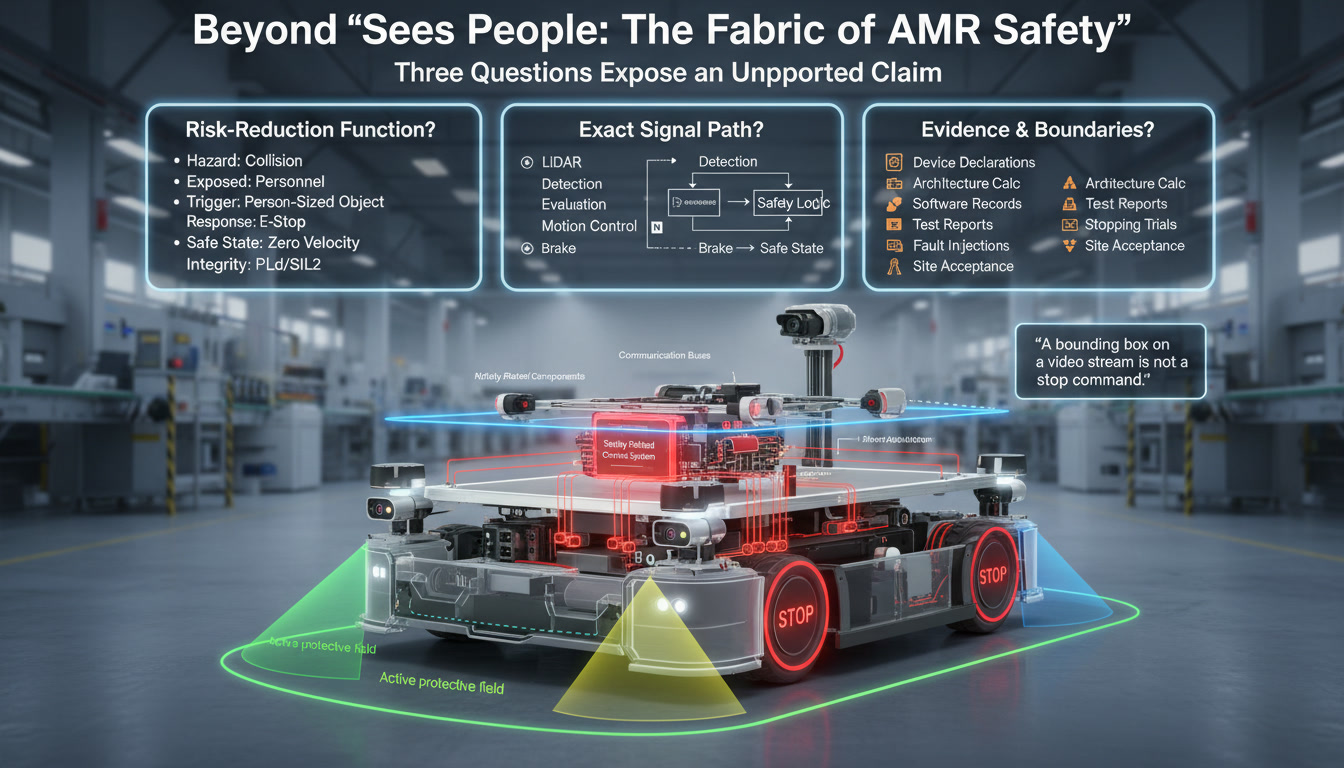
Safety-Rated Sensing vs Navigation Perception in AMRs An Evidence Audit

This engineering guide shows how to decide whether an AMR perception claim can be credited for risk reduction. It separates navigation data from safety outputs, audits AI and sensor-fusion evidence, traces the complete control path, and defines validation and lifecycle release gates for industrial deployments.
Learn more
AMR protective field shown as a motion budget based on speed, response delay, braking and human approach
2026-08-28

AMR Protective-Field Engineering From Measured Stops to Safe Field Sets

This engineering guide shows how to convert response-time ledgers, measured braking data, load contours and motion states into testable AMR protective fields. It includes an illustrative calculation, field-switching logic, FAT/SAT evidence and change-control triggers without inventing universal safety values.
Learn more
Industrial AMRs operating in a warehouse with mapped travel, recovery routes and monitored safety zones
2026-08-28

AMR Safety Requirements Specification From Hazards to Testable Evidence

This engineering guide explains how manufacturers, integrators and end users can translate AMR hazards and operating modes into testable safety requirements, trace them to controls and validation evidence, and keep the specification valid through commissioning and change.
Learn more
Heavy-payload AMR with rocker and spring suspension maintaining wheel contact across an uneven factory floor.
2026-08-27

Heavy-Payload AMR Suspension: Keep Every Wheel Loaded, Grounded and Useful

A heavy AMR can lose traction, overload a caster or twist its frame even when total payload is within rating. This guide explains how rocker, bogie, spring and equalizing suspensions manage wheel reactions across floor unevenness, braking, turning and payload changes—and how to validate contact continuity before production release.
Learn more
Heavy pallet on an AMR frame showing localized structural response at the load-support interfaces.
2026-08-27

Heavy-Payload AMR Chassis Fatigue: Deflection, Welds and Production Life

A frame that survives one proof load can still lose docking accuracy, crack at a weld or loosen an interface after repeated production cycles. This engineering guide converts route events into a structural duty spectrum, links stiffness and fatigue evidence, and shows how to validate chassis life with FEA, strain measurement, inspection and endurance testing.
Learn more
Heavy-payload AMR showing how wheel load, traction, rolling loss, heat and floor impacts define the duty envelope.
2026-08-27

Heavy-Payload AMR Wheel Selection: Material, Geometry, Heat, Wear and Service Life

Wheel capacity is not a complete selection rule. This engineering guide shows how wheel role, dynamic wheel load, polyurethane hardness, diameter, tread geometry, floor condition, heat and duty cycle define traction, energy use, docking accuracy, wear and replacement decisions for heavy-payload AMRs.
Learn more
Instrumented heavy-payload AGV traction test on dry and wet surfaces with load, force and motion data recorded.
2026-08-25

Heavy-Payload AMR Traction: Turning Motor Torque into Usable Floor Force

A motor can produce torque while a loaded AMR still fails to launch, climb, turn or hold its path. This engineering guide builds a traction budget from wheel load, floor friction, rolling resistance, grade, power and thermal limits, then shows how to validate the usable operating envelope for differential, steered and omnidirectional platforms.
Learn more
Heavy-payload AMR with conveyor top module showing gravity, traction, transfer and floor-impact force paths through the chassis
2026-08-25

Heavy-Payload AMR Load Path: How Forces Reach the Frame, Wheels and Floor

A payload reaches the floor through a chain of interfaces. This engineering guide shows how gravity, CG offset, acceleration, braking, turning, floor unevenness and transfer shocks redistribute forces through the top module, chassis frame, wheel mounts and tires—and how to validate the chain before production.
Learn more
Engineers documenting payload, wheel, software and restraint configuration before a heavy-payload AMR stopping test.
2026-08-25

Heavy-Payload AMR Stopping Distance How Load, Speed, Floor and Control Define the Stop

Stopping distance is not a catalog constant. This engineering guide separates response delay, braking travel, load settling and safety margin, then shows how payload, center of gravity, speed, floor friction, slope, turns, brake temperature and wear shape a heavy-payload AMR stop envelope.
Learn more
Heavy-payload AMR carrying a wooden crate across cracked and uneven factory flooring near a ramp and drainage channel
2026-08-25

Heavy-Payload AMR Floor Requirements Engineering Flatness, Friction, Joints and Ramps

The factory floor is a functional part of a heavy-payload AMR. This guide shows how local flatness, cross-slope, friction, joints, ramps, point loads and docking-zone geometry affect traction, stability, stopping, localization, wheel life and production release—and how to turn them into a measurable Floor Interface Envelope.
Learn more
Heavy-payload AMR carrying an engine assembly during a factory production-validation test
2026-08-24

How to Validate a Heavy-Payload AMR Before Production: Test Matrix to Release Evidence

A successful demo does not prove production readiness. This engineering guide shows how industrial teams validate a configured heavy-payload AMR through a traceable test matrix covering real loads, routes, stations, safety responses, software handshakes, fault recovery, endurance and controlled production release.
Learn more
Heavy-payload AMR losing wheel contact while turning with a tall industrial load
2026-08-24

Heavy-Payload AMR Dynamic Stability: CG, Turning, Braking and Load Shift

A heavy-payload AMR can support its rated load while stationary and still become unstable during braking, turning, cross-slope travel or load shift. This engineering guide turns dynamic stability into a measurable operating envelope built from moment balance, wheel-load transfer, route conditions, motion limits and worst-case validation.
Learn more
Heavy-payload AMR comparing a low, centered 1,000 kg load with a tall, high-CG load in a factory
2026-08-19

Payload Rating vs Usable Payload Why Center of Gravity Changes Everything

A heavy-payload AMR does not have one universally usable load limit. This guide explains how payload mass, combined center of gravity, offset, overhang, speed, route and validation define the real operating envelope—and how buyers can convert a catalog rating into a testable production specification.
Learn more
AMR docking sequence showing station approach, terminal alignment and mechanical engagement at a charging station
2026-08-18

AMR Docking Reliability Engineering How to Prove Autonomous Charging Works in Production

A production-grade AMR must do more than reach a charger. This engineering guide explains how to validate docking repeatability, alignment tolerance, electrical charging confirmation, retry behavior, station reliability, fleet-level charging impact and lifecycle drift using measurable evidence rather than demonstration success.
Learn more
AMR fleet in an industrial production area with go-live readiness and production reliability verified dashboard
2026-08-18

AMR Go-Live Readiness How to Prove a Mobile Robot System Is Ready for Production

A practical engineering framework for deciding whether an AMR or AGV system is truly ready for production. It converts site, safety, network, integration, capacity, operations and recovery dependencies into measurable readiness gates, challenge tests and buyer-verifiable evidence.
Learn more
Split factory scene comparing an AMR asset failure with a service failure that stops production
2026-08-18

AMR Failure Recovery: How to Preserve Material State and Restore Production

A deep engineering guide to AMR failure recovery: how to preserve mission and load state, separate asset repair from service restoration, design degraded modes, calculate recovery KPIs, and audit vendors using standards-based recovery evidence.
Learn more
Comparison of stable AMR operation and degraded fleet performance caused by operational drift after go-live
2026-08-17

Why AMR Systems Drift After Go-Live Control Every Change Before It Changes Production

An accepted AMR system can become unreliable after normal factory changes. This guide shows how to control map edits, software updates, traffic rules, payload changes, Wi-Fi changes, fleet expansion and station modifications through baselines, impact review, revalidation, rollback and lifecycle governance.
Learn more
AMR fleet analytics converting complex robot operating data into mission delay capacity loss throughput and root cause insights
2026-08-17

Why High AMR Utilization Can Be Bad Build KPIs Around Material Flow, Not Robot Motion

Robot utilization alone can make an AMR fleet look efficient while production still waits for material. This guide explains how to structure AMR operational data, distinguish productive time from hidden losses, build a KPI tree, analyze mission cycle time, interventions, congestion, downtime and throughput, and connect fleet analytics to material-flow value.
Learn more
AMR completing a production mission while engineers review system readiness during acceptance testing
2026-08-14

A Successful AMR Demo Is Not Acceptance How to Prove the System Is Ready for Production

An AMR can complete a demo and still fail under real production conditions. This guide shows how buyers and integrators can define FAT, SAT, operational acceptance, measurable KPIs, docking tests, degraded-mode scenarios, evidence requirements, and handover criteria before signing off a mobile robot system.
Learn more
AMR fleet charging system coordinating autonomous charging and operational availability in a smart factory
2026-08-13

Why AMR Battery Runtime Is the Wrong Metric Design for Fleet Availability Instead

Battery runtime alone cannot predict whether an AMR or AGV fleet will support production. This guide explains mission energy demand, charging windows, charger congestion, battery health, fleet reserves, scheduling logic, and the KPIs needed to design energy availability instead of simply buying more battery capacity.
Learn more
  • 1
  • 2
  • 3
    Sitemap

    Industrial Components

    Kitchen Appliances

    Renewable Energy

    Building & Home Improvement

    Chemicals & Water Treatment

    Robotics & Automation

    Email:robertkileyman@gmail.com

    (508676)
    0
    Service

    Email
    comment