Battery Box, Pump Box, or General Toolbox Understanding Functional Storage on Working Trailers
A lot of trailer owners use the word “toolbox” too broadly.
If a metal box sits on a trailer, many people assume it serves the same purpose as every other box on the market. In real working-trailer use, that assumption creates poor layouts, messy storage habits, harder maintenance, and in some cases unnecessary operational risk. A general trailer toolbox is not the same thing as a trailer battery box. A dump trailer pump box is not just a toolbox with a different label. These boxes may look similar from a distance, but they exist for very different jobs.
That distinction matters because working trailers do not operate like casual storage platforms. They carry systems, not just gear. Some boxes are designed to protect power. Some are designed to shelter hydraulic components. Some are designed to organize tools and securement hardware. Once a trailer is used daily for hauling, dumping, loading, contracting, landscaping, or equipment transport, storage stops being a convenience feature and becomes part of the trailer’s operating infrastructure.
That is why smarter buyers look beyond box size and start with function. The right question is not “Which box fits on the trailer?” The right question is “What role does this box need to perform inside the trailer’s operating system?”
Functional storage is different from general storage

A simple storage box solves one basic problem: where to put things.
A functional storage box solves a more specific problem: how to protect, separate, support, and access a particular category of equipment in the conditions where that equipment actually works. This is the core idea behind functional trailer storage.
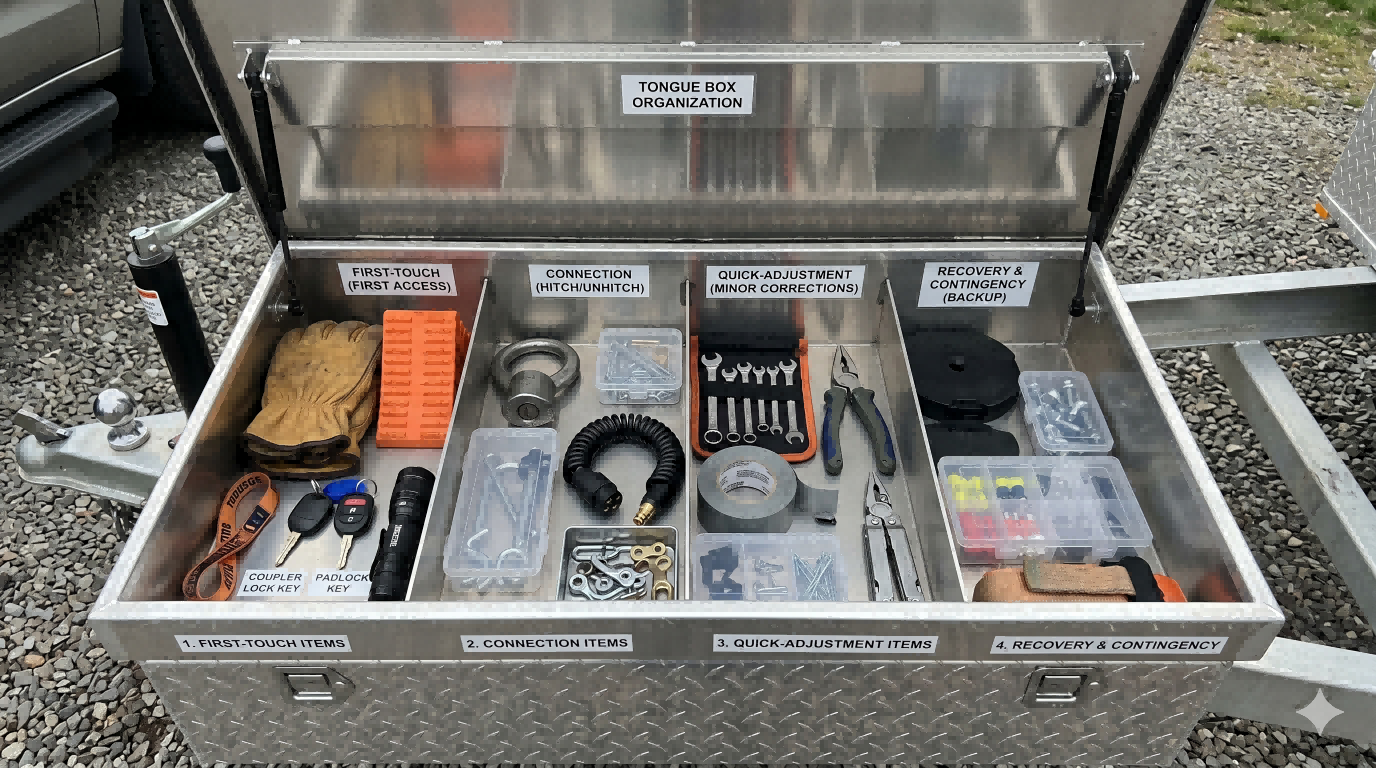
A general trailer toolbox is built to hold mixed-use items such as straps, chains, binders, hand tools, gloves, locks, adapters, repair hardware, and towing accessories. It is usually optimized for access, organization, and basic protection.
A trailer battery box is different. Its job is not simply to contain an item. Its job is to protect a power source, help maintain an orderly electrical area, and keep the battery from competing with unrelated gear for space.
A hydraulic pump box or dump trailer pump box is different again. It exists because hydraulic system components need a more disciplined environment than general towing gear. Pump-related storage is tied to power, system protection, service access, and working-trailer uptime.
This is where trailer storage becomes more mature. Instead of asking what fits inside a box, the buyer asks what function that box protects.
Why a trailer battery box exists in the first place
A battery is not just another heavy object that happens to live on a trailer.
It is a power source that supports a working system. On many trailers, especially dump trailers and equipment-oriented builds, the battery is part of the trailer’s operational core. That means it should not be treated like a loose item sharing space with chains, shackles, dirty gloves, or sharp hardware.
A proper trailer battery box helps create order around that power source. It defines where the battery belongs, reduces clutter around electrical components, and helps separate battery-related space from tool-related space. That separation matters for both service clarity and long-term trailer management.
A working trailer that uses battery-powered functions benefits when the electrical zone is visually obvious and physically distinct. When the battery lives in the same environment as random loose gear, two things usually happen: the storage area gets harder to maintain, and the trailer gets harder to troubleshoot.
That is why a dump trailer battery box is not simply a convenience add-on. It is often part of maintaining operational discipline.
Why a dump trailer pump box is not a normal toolbox
A dump trailer pump box exists because hydraulic systems are not general cargo.
A pump assembly, related controls, wiring, and supporting hardware may need protection from loose debris, unnecessary contact, and the kind of chaotic storage that is common in general-purpose boxes. In real working trailer storage design, a pump box is less about generic storage capacity and more about controlled enclosure.
This matters most on dump trailers, where the hydraulic system is directly tied to the trailer’s primary job. If the trailer cannot dump reliably, the trailer’s core value collapses. That is why a hydraulic pump box should be viewed as a system-protection box, not simply a place to hide components.
A general toolbox is designed around frequent human access to multiple item types. A pump box is designed around system protection, controlled access, and maintenance practicality. Those are not the same priorities.
A buyer who understands that difference makes better layout decisions from the beginning.
A general trailer toolbox still matters, but for a different reason
None of this means the general trailer toolbox becomes less important. It simply means it should stop being asked to do every job.
A trailer toolbox for work trailer applications remains essential because crews still need fast access to the items that support towing, loading, securement, and routine field adjustments. Chains, binders, gloves, connectors, small hand tools, pins, straps, flashlights, and basic repair gear all need organized storage somewhere. That somewhere is often a general toolbox.
The mistake happens when the general toolbox is expected to be the battery enclosure, the hydraulic equipment enclosure, the dirty chain bin, the emergency parts box, and the daily access station all at once. Once one box is forced to hold too many functions, it usually performs each of them poorly.
A mature trailer storage system gives the general toolbox a clear role: support the operator, not replace every other functional enclosure on the trailer.
Three different storage roles exist on many working trailers
Once buyers understand function, trailer storage becomes much easier to plan.
Power-storage role
This is the role handled by a trailer battery box. The purpose is to create a defined battery zone that supports cleaner wiring organization, clearer inspection, and better physical separation from unrelated gear.
Hydraulic-system role
This is the role handled by a hydraulic pump box or dump trailer pump box. The purpose is to protect core hydraulic components and keep them from being crowded by loose tools, chains, and field gear.
General-access role
This is the role handled by a general trailer toolbox. The purpose is to store the gear that operators need to reach quickly during routine trailer use, towing, loading, and on-site work.
When these three roles are confused, the storage layout becomes messy. When they are separated, the trailer becomes easier to operate and easier to maintain.
Dump trailers change the storage conversation completely
A dump trailer is one of the clearest examples of why functional trailer storage matters.
On a dump trailer, the trailer is not just carrying cargo. It is carrying a working hydraulic system, a power source, and often a set of tools and securement gear that support loading and unloading. That means the trailer may need more than one box, not because the owner likes extra storage, but because the trailer has more than one operating function.
This is where many buyers make a strategic error. They see one large box as a cleaner solution than several smaller purpose-driven boxes. In reality, a dump trailer often works better when the battery area, pump area, and general tool area are separated. That layout improves service access, reduces clutter, and helps crews understand where critical equipment belongs.
A dump trailer pump box should support system reliability. A dump trailer battery box should support clean electrical management. A general trailer toolbox should support the operator’s daily tasks. Once those roles are separated, the trailer works more like a professional piece of equipment and less like a storage compromise.
Mixing power, hydraulics, and loose tools usually creates problems
When buyers try to simplify too aggressively, they often create the exact problems they were trying to avoid.
Service access becomes slower
If general tools, chains, spare hardware, hydraulic components, and battery-related items all live together, the result is not convenience. The result is search time, crowded access, and slower maintenance.
Storage contamination increases
General field gear is often dirty, abrasive, oily, or wet. That kind of mixed environment is not ideal for every component. A battery box vs toolbox decision matters partly because not every item should share the same physical conditions.
System clarity disappears
When the battery area is visually mixed with tools and loose cargo, it becomes harder to inspect, harder to service, and harder to understand quickly. The same is true for hydraulic system areas.
Overuse of one box creates layout inefficiency
A single box asked to serve every purpose usually becomes overpacked, poorly organized, and badly prioritized. The trailer may technically have storage, but the storage no longer supports real work flow.
This is one of the most important reasons to think in terms of functional trailer storage instead of raw volume.
Working trailers should be designed around access logic
The best working trailer storage layouts follow access logic, not storage habit.
Power-related items should live where they can be inspected and serviced clearly. Hydraulic components should live where they are protected and logically grouped. Frequently used field gear should live where operators can reach it without digging through system-related components.
That sounds obvious, but many trailer layouts still ignore it. Instead of separating zones by role, they separate them by whatever empty space was available at the time of installation. That may work in the short term, but it rarely produces an efficient long-term trailer.
A better approach is to ask three questions:
What needs routine operator access?
This belongs in a general trailer toolbox or another quick-access zone.
What supports system operation?
This belongs in a trailer battery box, hydraulic pump box, or equivalent functional enclosure.
What should not compete for the same space?
Anything that creates clutter, slows inspection, or makes maintenance harder should be separated by design.
This kind of thinking produces cleaner and more durable layouts.
Multi-box trailer layouts are often a sign of better design, not excess
Some buyers assume that needing more than one box means the trailer design is inefficient. On a real work trailer, the opposite is often true.
A multi-box layout can be a sign that the trailer is being managed according to function instead of convenience. A trailer storage system that uses separate enclosures for battery, hydraulic, and general-access items is often easier to inspect, easier to service, and easier to keep organized.
That does not mean every trailer needs multiple boxes. A simple utility trailer may function perfectly with one well-planned general toolbox. But once the trailer includes operational systems such as hydraulic dumping or dedicated power support, separate storage roles start making more sense.
This is one of the clearest signs of professional trailer planning: the layout reflects the systems the trailer depends on.
How to choose between a battery box, pump box, or general trailer toolbox
The best decision comes from understanding what kind of trailer you are building or buying.
For dump trailers
A dump trailer pump box is usually the most function-specific enclosure on the trailer. It should be treated as part of the hydraulic operating system. A dump trailer battery box may also be justified if the trailer relies on battery-supported controls or functions. A general toolbox still matters, but it should not replace those system-specific roles.
For equipment trailers
Many equipment trailers do not require a hydraulic pump box, but they may still benefit from clear separation between power-related items and general-use tools. In these cases, a general trailer toolbox often remains the primary storage solution, with battery-related storage added only when the trailer’s functions justify it.
For contractor and service trailers
These trailers often carry a wider variety of field gear, which makes the trailer toolbox for work trailer role especially important. But if the trailer also supports system-critical components, those should still be separated from everyday tools and securement gear.
For mixed-use utility trailers
A mixed-use trailer may not need the full complexity of a multi-box system. But even here, the logic still applies: system items should not be forced to share a chaotic space with everything else just because one box is available.
The goal is not to add boxes for appearance. The goal is to assign the right storage role to the right trailer function.
What buyers should ask before choosing a box type
Buyers make better decisions when they ask functional questions instead of cosmetic ones.
What does this box need to protect?
If the answer is “general gear,” a general trailer toolbox may be enough. If the answer is “battery” or “hydraulic system,” a dedicated enclosure may be the better path.
How often does this area need service access?
If frequent inspection or maintenance matters, the enclosure should support clarity and separation, not mixed storage.
What happens if this storage area becomes cluttered?
If clutter would slow troubleshooting, interfere with system operation, or make maintenance less predictable, it should not be a general storage zone.
Is this trailer carrying systems, gear, or both?
This is one of the most important questions in working trailer storage planning. A trailer carrying systems usually needs more disciplined storage design than a trailer carrying gear alone.
These questions move the buying process from “Which box looks right?” to “Which box supports the trailer’s real job?”
Better trailer storage is really about role separation
At a higher level, this entire discussion is about role separation.
A trailer works better when electrical components, hydraulic components, and operator gear are not competing for the same enclosure. That is the real logic behind the distinction between battery box vs toolbox decisions and between hydraulic pump box layouts and general storage layouts.
Buyers who understand this usually make better long-term decisions. Their trailers stay cleaner. Their operators find tools faster. Their system areas remain more serviceable. Their layouts make more sense after months of real use, not just on delivery day.
That is the difference between adding storage and designing a trailer.
Final thoughts
A trailer battery box, a dump trailer pump box, and a general trailer toolbox may all look like simple storage enclosures, but in real working-trailer use they serve very different purposes.
A battery box helps define and protect the trailer’s power zone. A pump box helps protect hydraulic-system components and support service clarity. A general toolbox helps operators access the tools, securement gear, and towing equipment they need every day. When those roles are separated, the trailer becomes easier to run, easier to maintain, and more professional in its layout.
That is why smarter functional trailer storage starts with role, not box shape. The right storage decision is not the one that hides the most equipment in the fewest enclosures. It is the one that gives each system and each category of gear the kind of space it actually needs to perform well.
That is how a trailer stops being a collection of boxes and starts becoming a well-planned working platform.
#TrailerBatteryBox #DumpTrailerPumpBox #GeneralTrailerToolbox #WorkingTrailerStorage #HydraulicPumpBox #FunctionalTrailerStorage #TrailerToolbox #DumpTrailerAccessories #EquipmentTrailerStorage #WorkTrailerSetup #TrailerStorageSystem #TrailerPartsGuide