How to Power an Electric Trailer Winch: Battery, Cable Size, Circuit Protection, and Remote Setup
An electric trailer winch is often sold as a product, but in real operation it behaves like a system. Buyers frequently compare line pull ratings, motor size, or remote control features, yet many winch performance problems do not begin at the motor. They begin in the trailer winch electrical system.
When operators complain that a winch feels weak, slows down under load, overheats too quickly, or behaves inconsistently from one job to the next, the root cause is often not the winch itself. It is the trailer winch power supply, the battery location, the cable path, the circuit protection strategy, or the grounding quality.
That is why a professional electric trailer winch wiring discussion should not begin with “where do the red and black wires go?” It should begin with a more useful question: how should the entire power system be designed so the winch performs safely, consistently, and predictably in the real environment where the trailer is used?
For boat trailers, car haulers, and utility trailers, the answer is rarely identical. The correct winch battery setup depends on operating frequency, load profile, charging access, environmental exposure, and whether the trailer is used for occasional personal loading or repeated commercial work.

The Real Performance of an Electric Winch Is Decided Upstream
Many buyers assume that if they purchase a strong enough electric trailer winch, performance will take care of itself. In practice, electrical design determines whether the winch can actually deliver what the catalog promises.
A winch motor depends on stable current delivery. If the battery is undersized, the cable run is too long, the conductor is too small, the ground path is weak, or the connector quality is poor, real pulling performance drops. The operator may interpret that as an underpowered winch, when the real problem is a poorly designed trailer winch power supply.
This is especially important because trailer applications are rarely ideal. Marine ramps are wet. Recovery pulls are irregular. Utility trailer loads can be unpredictable. Voltage stability becomes even more important when the environment is already working against the operator.
That is why experienced buyers do not only ask how much line pull the winch has. They ask how the winch is powered, how the system is protected, and how consistent the electrical delivery will remain under actual working conditions.
A Good Winch Installation Starts with Application Logic
A reliable electric trailer winch installation should always be designed around use case rather than around convenience alone.
A light-duty boat trailer used a few times each season may not need the same architecture as a commercial trailer that operates every week. A car hauler winch for loading non-running vehicles requires a different power strategy from a small utility trailer used for occasional cargo movement. Even two similar-looking trailers may need different wiring solutions because of cable length, duty cycle, and charging access.
The First Questions to Ask
Before deciding how to wire a trailer winch, a buyer should answer these questions:
- How often will the winch be used?
- Will the trailer rely on tow-vehicle power, onboard battery power, or both?
- How long is the cable run from the power source to the winch?
- Is the trailer used in marine, muddy, or corrosive conditions?
- Does the operator need handheld control, wireless control, or fixed-position operation?
- Is the trailer used by one person or by multiple operators?
These questions matter because an electric winch is not just a powered pulling device. It is part of the trailer’s working infrastructure.
Battery Strategy Is the Foundation of the System
The first major decision in a winch battery setup is not battery brand. It is battery strategy.
A buyer generally has three broad options:
use the tow vehicle battery, install a trailer-mounted battery, or create a hybrid arrangement where the trailer has its own battery but can also be charged through the vehicle.
Each choice has advantages and trade-offs.
Using the tow vehicle battery simplifies equipment count, but long cable runs can increase voltage drop and make electric trailer winch wiring more sensitive to conductor size and connection quality. It also means the trailer winch shares power with the vehicle system, which may be acceptable in light-duty use but less ideal when the winch is heavily loaded or repeatedly used.
A trailer-mounted battery shortens the high-current path to the winch and often improves real pulling consistency. It also allows the trailer to remain more self-contained. This is a strong option for many boat trailer winch and car hauler winch applications. However, it requires a reliable charging plan, battery box protection, and secure mounting.
A hybrid system can offer flexibility, especially for trailers that move between different tow vehicles or operate in mixed-use environments. But it also adds complexity and must be designed cleanly to avoid confusing field maintenance.
Why Battery Placement Matters
In real use, battery placement affects:
- cable length
- voltage drop
- service access
- weather exposure
- weight distribution
- charging convenience
- connector wear
That is why a smart trailer winch battery box location is not just about where space is available. It is about where performance and maintenance make sense together.
Cable Size Is Not a Minor Detail
One of the most common mistakes in how to wire a trailer winch projects is underestimating cable size.
The motor may be rated correctly, the battery may be acceptable, and the winch may be mechanically sound, yet the system still performs poorly because the conductor cannot support the real current demand across the full cable run. In that situation, voltage drop turns into lost performance.
A winch does not need theoretical power. It needs delivered power. That is why winch cable size is one of the most load-bearing decisions in the entire installation.
What Smaller Cable Really Costs
When cable is undersized, the system may show:
- slower pulling speed
- weaker pull under load
- more heat in the wiring
- increased strain on connectors
- inconsistent performance between short and long pulls
- poor operator confidence in the system
This is particularly damaging in trailer applications because users often assume the motor is too small and replace the winch, when the actual problem is that the electrical pathway is restricting performance.
Cable Length and Layout Matter Too
The correct winch cable size is affected not only by current draw, but also by total circuit length and routing path. A clean, short route with good protection is usually better than a longer, more convenient path with more exposure and more voltage loss.
This is why professional electric trailer winch installation decisions always evaluate cable gauge together with distance, not in isolation.
Grounding Is Just as Important as Positive Power Delivery
In many trailer installations, buyers focus on the positive cable and treat the return path as an afterthought. That is a mistake.
A weak, corroded, or poorly secured ground can reduce performance just as effectively as an undersized positive conductor. In marine environments, grounding quality becomes even more important because moisture, corrosion, and vibration can gradually degrade the return path.
A reliable trailer winch electrical system should treat grounding as a full-performance requirement, not as a minimal compliance detail.
What Good Grounding Supports
Proper grounding improves:
- current stability under load
- motor consistency
- connector life
- remote control response
- reduced troubleshooting time
- long-term reliability in wet or dirty environments
For many field complaints, grounding quality is the hidden difference between a trailer winch that feels dependable and one that feels unpredictable.
Circuit Protection Should Protect the System, Not Merely Satisfy a Checklist
A powered winch requires controlled electrical protection. This is not just about preventing catastrophic failure. It is about protecting the wiring, the battery, the operator, and the trailer as a working platform.
A serious approach to circuit protection for winch systems considers where protection is installed, how it is rated, how it is serviced, and how it behaves in real trailer conditions.
If protection is oversized, it may fail to safeguard the system properly. If it is undersized, nuisance interruption can reduce usability. If it is mounted in a hard-to-access location, serviceability becomes poor. If it is exposed to water and corrosion, long-term reliability suffers.
What Protection Strategy Should Consider
A professional trailer winch power supply design should account for:
- short-circuit risk
- overload exposure
- service accessibility
- weather protection
- battery proximity
- trailer vibration
- operator troubleshooting needs
This is especially important for boat trailers and commercial-use trailers, where field reliability matters more than theoretical neatness.
Connectors and Quick-Disconnects Shape Real Usability
In many electric trailer winch wiring layouts, connector decisions determine whether the system feels professional or improvised.
A trailer that is disconnected frequently, shared between tow vehicles, or stored separately from the towing unit benefits from a clean quick-connect strategy. A fixed direct-wired system may work in some situations, but it is not always the best choice for service access or flexibility.
Where Connector Quality Matters Most
Connector quality becomes especially important when:
- the trailer is regularly detached
- the battery is mounted remotely
- the system operates in wet environments
- charging and winching share connection points
- multiple operators use the equipment
A weak connection point can introduce heat, resistance, and intermittent behavior. In a trailer system, this is more than an annoyance. It directly affects pulling confidence.
That is why buyers choosing how to wire a trailer winch should think of connectors as performance components, not just convenience hardware.
Charging Strategy Separates Occasional Systems from Dependable Systems
A winch battery setup is incomplete if it does not include a clear charging plan.
For occasional personal use, some operators are comfortable charging the battery manually between uses. For regular marine loading, repeated recovery work, or commercial trailer operation, a passive or irregular charging habit often creates reliability problems. The trailer may appear ready, but the battery may not be fully prepared for actual load.
A dependable system should answer three questions:
how is the battery charged, how often is it charged, and how does the operator know the power source is ready for work?
Why Charging Discipline Matters
Battery neglect creates problems that are often misdiagnosed as:
- weak winch motors
- inconsistent pulling speed
- remote control issues
- sudden voltage sag
- shortened equipment life
In reality, many of these complaints begin with an incomplete trailer winch battery box and charging strategy rather than a poor winch product.
For buyers who want a trailer to perform as a reliable work tool, charging should be treated as part of the installation, not as an afterthought.
Remote Control Layout Is a Safety and Workflow Decision
A remote control trailer winch is often marketed as a convenience feature. In real trailer use, it is more than that. Control layout directly affects visibility, positioning, operator safety, and loading precision.
For a boat trailer winch, remote control can improve alignment control near the bow stop and reduce unnecessary repositioning. For a car hauler winch, it can help the operator manage awkward vehicle entry angles and keep a safer view of the pull path. For utility trailers, it supports better positioning when loads are irregular or obstructed.
Good Remote Setup Supports Better Operation
A well-planned remote arrangement should consider:
- where the operator needs to stand
- whether the full pull path is visible
- how much cable or wireless range is needed
- how exposed the control is to weather
- whether the trailer is used by trained or mixed-skill operators
The wrong remote layout can force the user into poor standing positions, partial blind spots, or rushed operation. That is why a remote control trailer winch should be planned as part of the work process, not added only for convenience.
Boat Trailers, Car Haulers, and Utility Trailers Need Different Power Priorities

A good trailer winch electrical system is never completely generic.
Boat Trailer Applications
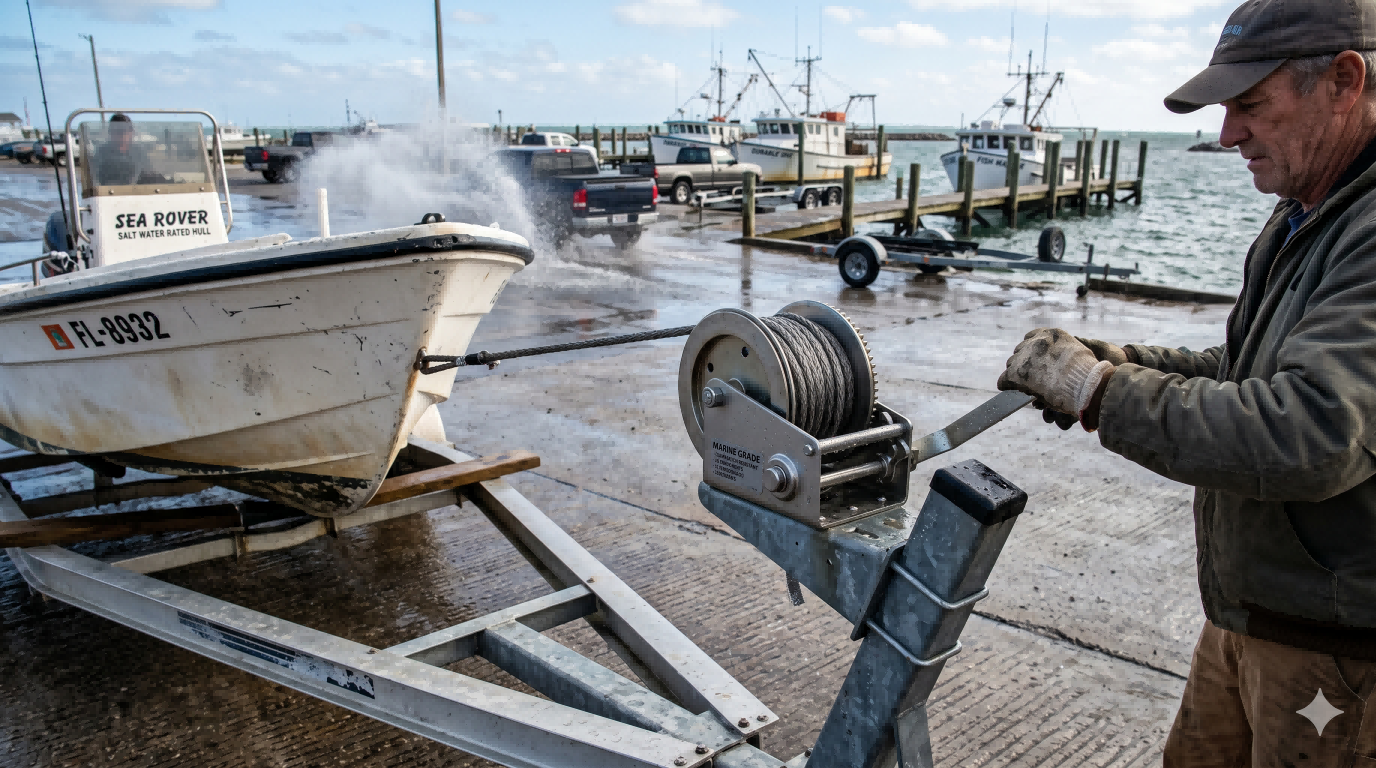
For boat trailers, the power system must prioritize corrosion resistance, sealed connections, battery protection, and reliable performance in wet launch conditions. Operators often need smooth control, dependable remote operation, and strong current delivery at the ramp where environmental exposure is highest.
Car Hauler Applications
For a car hauler winch, priority often shifts toward high-current stability, repeated pull consistency, and strong connector durability. Loading non-running vehicles creates more uncertainty, and that uncertainty demands a more confidence-inspiring electrical system.
Utility Trailer Applications
For utility trailers, flexibility is often the dominant requirement. The trailer may be used less predictably, by different operators, and across changing tasks. In these cases, the best trailer winch power supply may not be the most complex one, but the one that balances practical installation, easy inspection, and dependable readiness.
Most Electric Winch Problems Are System Problems in Disguise
One of the most useful industry truths for buyers is this: many electric winch complaints are actually electrical architecture problems.
When a winch pulls slowly, stalls early, behaves differently from one day to the next, or gives operators low confidence, the real issue is often found in one of these areas:
- battery readiness
- cable sizing
- voltage drop
- grounding quality
- connector condition
- poor circuit protection planning
- incomplete charging strategy
- control layout that creates bad workflow
This is why replacing the winch without correcting the system often fails to solve the real problem.
A good installation is not only about making the winch run. It is about making the winch perform the same way each time the trailer is asked to work.
How Professional Buyers Should Approach Electric Winch Power Design
Serious buyers do not evaluate electric trailer winch wiring as a side task after the product is chosen. They treat power design as part of winch specification from the start.
A professional process usually looks like this:
Define the Application First
Identify whether the trailer serves marine loading, vehicle recovery, mixed utility hauling, or repeated commercial work.
Choose the Power Strategy
Decide whether the system should rely on tow-vehicle power, a trailer-mounted battery, or a hybrid layout.
Design the Current Path
Evaluate cable distance, winch cable size, grounding, connectors, and exposure points.
Protect the System Properly
Build in practical circuit protection for winch systems with attention to safety and service access.
Plan the Operator Workflow
Set up remote location, connector access, battery serviceability, and charging routine so the system works in the field, not only in the workshop.
This is the difference between installing a product and engineering a useful trailer subsystem.
Final Thoughts
A strong electric trailer winch does not guarantee strong real-world performance. The winch can only perform as well as the system that powers it.
That is why the right approach to how to wire a trailer winch is not to ask only where to connect power. The better question is how to build a complete trailer winch electrical system that supports stable current delivery, safe protection, easy service, and repeatable pulling performance.
For a boat trailer winch, that means managing wet environments and corrosion exposure. For a car hauler winch, it means supporting unpredictable recovery loads. For utility trailers, it means balancing readiness, simplicity, and flexibility. Across all of them, the core principle is the same: electrical architecture determines operational confidence.
When buyers understand that, they stop treating the winch as a standalone motor and start building a real trailer winch power supply system. That is where dependable performance begins.
#Electric Trailer Winch #Trailer Winch Wiring #Winch Battery Setup #Trailer Winch Power Supply #Boat Trailer Winch #Car Hauler Winch #Utility Trailer Winch #Trailer Electrical System #Towing Safety #Trailer Winch Installation