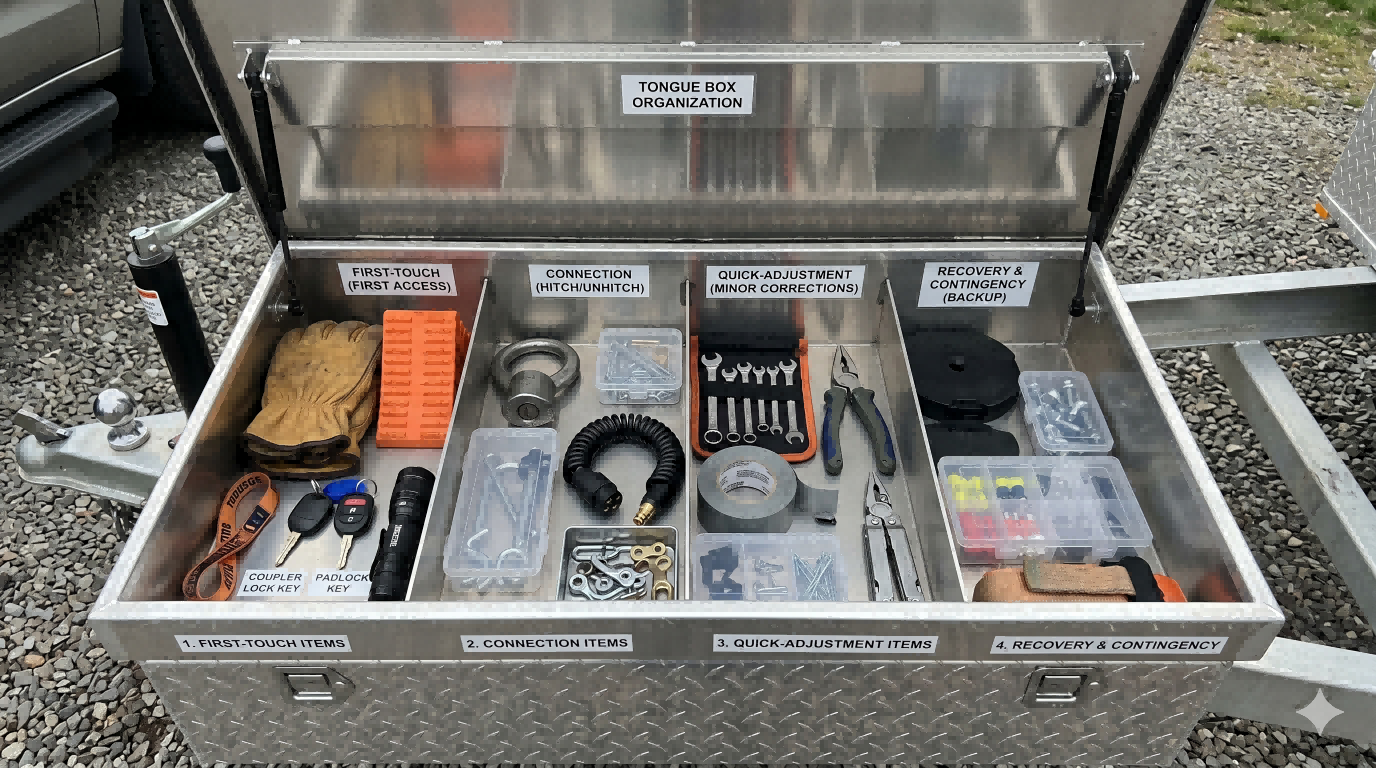
Weatherproof Is Not Enough: How to Evaluate Water Resistance, Dust Control, and Theft Protection in Trailer Toolboxes
Many trailer toolbox buyers focus on size, material, and mounting position first. Those things matter. But once a toolbox enters real service, another question becomes more important: How well does it protect what is inside?
That is where many purchasing decisions fall short.
A toolbox may look rugged, mount cleanly, and offer enough capacity, yet still perform poorly in real outdoor use if water enters around the lid, road dust works its way into the corners, or the locking system creates only the appearance of security. That is why evaluating a weather resistant trailer toolbox requires more than reading a product title or trusting a generic marketing phrase.
In real-world towing, a toolbox is exposed to more than rain. It faces road spray, standing moisture, mud, dust, vibration, UV exposure, repeated opening and closing, parking-lot exposure, roadside stops, and long hours of unattended storage. If the box is mounted at the tongue or underbody, these stresses become even more concentrated. That is why a serious buyer should evaluate water resistance, dust control, and theft protection as one integrated protection system rather than three separate features.
Weatherproof is a marketing word, not a technical conclusion
One of the biggest mistakes buyers make is treating the word “weatherproof” as if it proves performance.
In practice, weather resistant trailer toolbox performance depends on design details, not label language. A box is not protective simply because it is made from aluminum, steel, or poly. It becomes protective only when the lid closes correctly, the seal compresses evenly, the corners are well built, the latching system holds pressure consistently, and the mounting position does not create an avoidable exposure problem.
This matters because a waterproof trailer toolbox is rarely defined by a single feature. Water enters through weak points. Dust enters through weak points. Theft begins at weak points. The real evaluation question is always the same: where are the weak points, and how likely are they to fail in normal use?
A more professional buying mindset does not ask, “Does this box claim to be weatherproof?” It asks, “What does the design do to resist water, control dust, and discourage forced access over time?”
Water resistance starts with lid design, not with material alone
When people think about weather resistance, they often start with the box material. That is understandable, but incomplete.
The primary path for water intrusion is usually not the side wall. It is the lid opening system. A trailer tongue box weather resistance evaluation should begin with the lid shape, lid overlap, seal line, corner treatment, and closing pressure.
A well-designed lid does three jobs at once. It sheds water away from the opening edge, compresses the seal evenly, and resists distortion during vibration and repeated use. If the lid flexes too much, closes unevenly, or depends on weak latch pressure, the seal cannot do its job consistently.
This is why the best outdoor trailer toolbox designs are usually the ones where the lid, frame, and latch system were clearly developed as a complete closure structure rather than as isolated parts.
A seal is only as good as the pressure behind it
Many buyers see a rubber seal and assume the toolbox is protected. That assumption causes problems.
A seal does not work by existing. It works by being compressed correctly and consistently. If the lid closes unevenly, the latch pulls harder on one side than the other, or the body flexes under load, the seal may leave tiny pathways for water and dust to enter.
That is why evaluating a waterproof trailer toolbox means looking beyond the gasket itself. Ask these practical questions:
- Does the lid close evenly on all sides?
- Is latch pressure strong enough to create uniform compression?
- Do the corners look like likely leak points?
- Will the closure system still seat well after months of vibration and repeated opening?
A seal without structural support is only a visual comfort. A seal backed by proper lid geometry and consistent pressure becomes real protection.
Dust control is harder than many buyers expect
Rain exposure is easy to imagine, but dust is often the more persistent problem.
A trailer traveling on gravel roads, jobsite surfaces, farm lanes, or dry construction areas is exposed to fine airborne particles that behave differently from water. Dust does not need a large gap. It only needs repeated airflow, vibration, and small entry paths. That is why trailer toolbox dust control deserves more attention than it usually gets.
Dust is especially destructive because it does not only make gear dirty. It contaminates lock cylinders, coats lubricated parts, settles into electrical components, and shortens the life of tools and small hardware. A toolbox that controls water reasonably well may still do a poor job at controlling dust if its closure tolerances are loose or if the mounting position puts it directly in an airflow path that drives particles into the gaps.
For trailers used in construction, agriculture, road maintenance, or dry regional climates, dust control should be treated as a first-level performance criterion, not an optional bonus.
Mounting location changes the exposure pattern

A toolbox does not face the same environment everywhere on the trailer.
A front-mounted tongue box sees direct spray, open-air exposure, and frequent contact during hookup and towing. An underbody toolbox may see more road debris, more grime, and more aggressive moisture contact from below. A side-mount box may avoid some lower-road exposure but face different access and security issues depending on where the trailer is parked and how visible the box is.
This is why a secure trailer storage box should always be evaluated in relation to its mounting location. The same box may perform acceptably on one trailer and poorly on another because the exposure pattern has changed.
Front-mounted toolbox exposure
A tongue-mounted box often faces:
- direct rain exposure
- wind-driven spray
- frequent opening during travel stops
- easy visual access when parked
- higher risk of casual tampering in public settings
Underbody toolbox exposure
An underbody box often faces:
- heavier road spray
- dust and mud impact
- standing grime on seams and hardware
- lower visibility during inspection
- harsher long-term exposure around hinges and latches
Side-mount toolbox exposure
A side-mounted box often faces:
- repeated side access on jobsites
- easier visibility for theft attempts
- varying splash exposure depending on trailer layout
- more direct interaction with operators, tools, and cargo edges
The smartest buyers do not ask whether a toolbox is protective in general. They ask whether it is protective in the position where they plan to use it.
Theft protection is not just about having a lock
One of the most misleading assumptions in trailer storage is that a toolbox becomes secure the moment it can be locked.
A lockable trailer toolbox is not automatically a secure one. Security depends on the entire forced-entry path. A thief does not care whether the latch has a key if the lid can be pried, the body can be flexed, the mounting bolts are exposed, or the lock hardware is weak enough to fail under simple leverage.
This is why real trailer toolbox theft protection should be evaluated at three levels:
- lock quality
- body and lid resistance
- mounting security
If any one of those levels is weak, the overall protection system becomes easier to defeat.
A toolbox with a decent lock but poor lid rigidity may still be a poor choice. A box with thick material but exposed mounting hardware may still invite theft. A box with a recessed handle may look secure but offer weak latch engagement. Real protection is always structural, not cosmetic.
Lid rigidity matters for both weather and security
There is an important connection between weather resistance and security: both depend heavily on how stable the lid remains under force.
A lid that flexes too easily is more likely to lose even seal compression over time, which hurts water and dust control. The same lid is also easier to pry, distort, or exploit at the edge, which hurts security. That is why lid rigidity is one of the most overlooked indicators in evaluating an anti theft trailer toolbox.
A rigid lid does not have to mean unnecessary weight. It means the closure stays stable under real conditions. That includes road vibration, repeated opening, accidental contact, rough handling, temperature change, and possible tampering.
For many buyers, this is the point where the conversation matures. Instead of comparing box thickness in isolation, they begin comparing structural confidence in the whole lid-and-frame system.
Locks should protect access, not just provide appearance
Lock hardware deserves more serious evaluation than it usually receives.
A key cylinder or locking paddle handle may look professional, but what matters is how the lock transfers force. Does it engage securely into reinforced structure? Does the latch keep the lid tight under vibration? Is the locking point protected from easy attack? Does the system still operate reliably after dust, moisture, and repeated use?
These questions matter because the best heavy duty trailer toolbox security systems are usually simple, protected, and structurally integrated. The worst are often the ones that look secure from a distance but rely on shallow engagement or exposed weakness.
A buyer choosing a lockable trailer toolbox should also remember that security is never absolute. The goal is not to make theft impossible. The goal is to increase effort, reduce speed, and make the box a less attractive target than easier alternatives nearby.
Mounting security is part of theft protection
Even a strong box can be vulnerable if the installation is weak.
A box mounted with exposed, easy-to-access fasteners may be easier to remove than to open. In real theft scenarios, some storage systems fail not because the lid was defeated, but because the whole box was taken. That is why trailer toolbox theft protection should always include how the box is attached to the trailer.
A properly mounted secure trailer storage box should make removal difficult, slow, and conspicuous. The best setup depends on trailer design, but the evaluation mindset should always include these questions:
- Are mounting bolts exposed in an easy attack path?
- Does the mounting method resist vibration and loosening?
- Can the box be removed quickly with ordinary hand tools?
- Is the mounting zone visible enough to discourage tampering?
A protective toolbox is not just a product. It is a product plus an installation strategy.
Drainage, cleanliness, and maintenance still matter
No toolbox stays protective on design alone.
Even a strong weather resistant trailer toolbox can lose performance if seals are dirty, drainage paths are blocked, hinges collect debris, or latch areas go uninspected for months. Protection is partly designed into the box, but it is also preserved through basic upkeep.
This does not mean buyers should accept poor design and compensate with maintenance. It means the smarter box is the one that holds up well with realistic maintenance habits. If a toolbox requires perfect cleaning discipline to stay functional, that is not a strength. It is a warning sign for real-world use.
This is especially important for outdoor and commercial applications, where the box may be opened with dirty gloves, exposed to rain repeatedly, and left unattended for long stretches. A good outdoor trailer toolbox should tolerate normal use without becoming fragile or maintenance-sensitive.
What real buyers should inspect before choosing a toolbox

The best way to evaluate a toolbox is to stop thinking in terms of claims and start thinking in terms of inspection points.
Closure and seal inspection
Look at:
- lid overlap
- seal continuity
- corner sealing
- latch compression
- even closure from side to side
Dust-control inspection
Look at:
- tightness around lid edges
- likely air and dust entry paths
- fit consistency at corners
- hinge and latch exposure to debris
Security inspection
Look at:
- latch protection
- lock placement
- lid rigidity
- pry resistance
- mounting fastener exposure
Real-use inspection
Look at:
- how the box will be mounted
- how often it will be opened outdoors
- whether the storage contents are weather-sensitive
- whether the trailer will sit unattended in exposed places
This kind of evaluation produces far better decisions than comparing product photos alone.
Protection level should match what is stored inside
Not every trailer toolbox needs the same protection level.
If the box mainly carries low-value straps, gloves, and replaceable accessories, the buyer may prioritize practical weather control over advanced theft resistance. If the box carries expensive tools, electrical equipment, lock kits, testing gear, or fleet-sensitive items, the balance changes. In those cases, a stronger lockable trailer toolbox with better structural integrity becomes more important.
This is where many buyers improve their thinking. Instead of asking whether a box is “secure enough” in the abstract, they ask whether its protection level matches the value, sensitivity, and replacement cost of what will live inside.
A toolbox should be judged by the risk profile of its contents, not just by its appearance.
The smartest buyers think in systems, not features
A professional trailer storage decision is rarely based on one feature.
The best weather resistant trailer toolbox is not necessarily the one with the thickest gasket. The best anti theft trailer toolbox is not necessarily the one with the most aggressive marketing language. The best secure trailer storage box is the one where lid design, seal performance, mounting security, access control, and real-use environment all work together.
That systems view matters because real service conditions are cumulative. Water resistance, dust control, and theft protection do not fail independently. They often fail in combination. A distorted lid weakens sealing and security. A dusty lock becomes less reliable. A poor mounting location increases exposure and makes tampering easier. A weak latch compromises both closure and protection.
The best buying decisions come from recognizing that toolbox protection is a complete operating system.
Final thoughts
A trailer toolbox should not be judged by storage capacity alone. In real outdoor use, protection quality is just as important as volume.
A true weather resistant trailer toolbox must manage more than rain. It must resist repeated moisture, control dust intrusion, hold up under vibration, and protect stored gear from casual or opportunistic theft. A dependable lockable trailer toolbox must do more than accept a key. It must combine structural rigidity, reliable closure, and sound mounting logic. A practical secure trailer storage box must match the risks created by its mounting position, its operating environment, and the value of what it carries.
That is why weatherproof is not enough. The smarter question is whether the toolbox protects tools, hardware, and accessories in the real conditions your trailer actually faces.
When you evaluate that way, you stop buying by label and start choosing by performance.
#TrailerToolbox #WeatherResistantTrailerToolbox #LockableTrailerToolbox #TrailerToolboxSecurity #TrailerTongueBox #TrailerStorage #TrailerToolboxDustControl #TrailerToolboxWaterResistance #AntiTheftTrailerToolbox #OutdoorTrailerStorage #UtilityTrailerAccessories #TrailerPartsGuide