Aluminum, Steel, or Poly? Choosing the Best Trailer Toolbox Material for Real-World Use
Choosing a trailer toolbox material sounds simple until the trailer enters real work.
On paper, every material has a selling point. Aluminum is lightweight. Steel is strong. Poly does not rust. But trailers do not operate on paper. They operate in rain, dust, mud, jobsite traffic, parking lots, gravel roads, coastal air, and repeated cycles of loading, towing, opening, closing, and neglect. That is why the best material decision is never just about specs. It is about whether the box keeps doing its job after months and years of actual use.
For many buyers, the wrong decision starts with a narrow question: Which material is best? The better question is: Which material is best for the way this trailer works?
A trailer tongue box material does not face exactly the same conditions as an underbody toolbox material. A contractor trailer does not place the same demands on a box as a weekend utility trailer. A fleet buyer does not evaluate value the same way as an owner-operator. Once those differences are clear, the material choice becomes far more practical.
Choosing material is really about choosing risk

Most buyers think they are choosing a box. In reality, they are choosing a maintenance profile, a durability pattern, and a failure risk.
Every trailer toolbox material performs well under the right conditions and poorly under the wrong ones. A box that looks premium in a catalog may become a frustrating liability if it is too heavy for the mounting location, too vulnerable to corrosion for the climate, or too flexible for the equipment stored inside. The material determines far more than appearance. It affects tongue weight, structural stability, surface wear, latch behavior, long-term maintenance, and how well the box protects tools from real-world abuse.
That is why a smart material comparison should focus on five questions:
- How much structural strength is actually needed?
- How much weight can the trailer layout reasonably carry at that location?
- How aggressive is the working environment?
- How often will the box be opened, loaded, and exposed?
- What type of maintenance is the owner realistically willing to do?
Once those questions are answered, the choice between an aluminum trailer toolbox, a steel trailer toolbox, and a poly trailer toolbox becomes much clearer.
Aluminum: the balanced choice for many towing and utility applications

An aluminum trailer toolbox is often the most broadly practical choice because it solves several problems at once. It offers good structural performance, relatively low weight, and strong resistance to corrosion compared with untreated steel. That balance makes it popular for tongue boxes, utility trailer storage, work trailers, cargo trailers, and towing setups where front-end weight matters.
One of aluminum’s greatest advantages is efficiency. It provides useful durability without adding as much load to the trailer as steel. On front-mounted storage, that matters. A box placed near the coupler can influence tongue weight quickly, especially when filled with chains, hitch hardware, locks, tools, and other dense items. In these cases, a lighter material helps the storage system stay useful without turning the front of the trailer into an overloaded zone.
Aluminum is also a strong candidate when weather exposure is a concern. Buyers looking for a corrosion resistant toolbox often move toward aluminum because it handles outdoor use better than conventional steel in many environments. For owners who park outside, tow in wet conditions, or operate in regions with frequent humidity, rain, or seasonal road exposure, that matters over the long term.
That said, aluminum is not automatically the answer for every job. The right way to view aluminum is not “light but weaker.” That is too simplistic. The real question is whether the specific box design has enough rigidity, reinforcement, hinge strength, and lid structure for the intended use. A well-built aluminum box can be an excellent real-world performer, but a thin and lightly built one may disappoint buyers who confuse material type with build quality.
Steel: the material for load confidence and impact tolerance

A steel trailer toolbox is usually chosen when the buyer values rigidity, impact resistance, and a more solid-feeling storage structure. In demanding commercial or heavy-duty applications, steel remains a serious option because it gives users confidence when the box will carry dense equipment, live around rough handling, or operate in environments where dents, contact, and abuse are part of daily work.
For trailers that support demanding work routines, steel often feels more reassuring than lighter materials. This is especially true when buyers want a heavy duty trailer storage box for tools, binders, chains, hardware, repair gear, or jobsite equipment that gets moved aggressively and does not live a careful life.
Steel also works well when the mounting position is less sensitive to weight than the tongue area. In some side-mounted or chassis-supported applications, the extra mass may be acceptable if the operational value comes from the box’s sturdiness. That makes steel worth considering in certain service trailers, industrial setups, or rugged daily-use environments.
But the advantage of steel always comes with responsibility. Weight is not just a spec sheet number. It affects installation difficulty, trailer balance, and the total load carried after the box is filled. A steel box on the tongue may become a poor decision if it encourages the operator to store too much heavy equipment in a front-end zone that should stay efficient and controlled.
Corrosion is the other major issue. Steel can be durable, but it is not naturally forgiving in harsh exposure. A weather resistant trailer toolbox made from steel depends heavily on coating quality, finish integrity, maintenance discipline, and how often chips, scratches, or worn areas are addressed. In clean fleet conditions, that may be manageable. In neglected outdoor storage, it often becomes the difference between long service life and early deterioration.
Poly: the low-corrosion, low-maintenance option with different strengths

A poly trailer toolbox is often underestimated because buyers tend to judge it by the visual expectations set by metal boxes. But poly should not be treated as a cheap imitation of aluminum or steel. It is a different storage strategy.
The real strengths of poly are corrosion immunity, lower maintenance needs, and tolerance for wet or dirty operating environments where surface rust would be a constant concern with steel and cosmetic oxidation or finish wear would still matter to metal-box owners. For trailers used in wet climates, chemical exposure zones, or casual outdoor service, poly can be a very practical choice.
A poly trailer toolbox also makes sense when the owner values utility more than industrial appearance. If the goal is to keep straps, gloves, connectors, small tools, and towing accessories protected without taking on a maintenance burden, poly can do that well. It is particularly attractive for users who know they will not consistently clean, repaint, polish, or monitor the box.
However, poly demands realistic expectations. Buyers should not ask whether poly “looks as tough” as steel. They should ask whether poly is right for the kind of stress the box will actually face. If the storage needs involve sharp, heavy, abrasive, or high-density items being dropped in constantly, the evaluation standard changes. Poly can be very useful, but it should be matched to a storage role that aligns with its real-world strengths rather than forcing it into jobs better suited to metal.
Trailer tongue box material: why weight matters more at the front

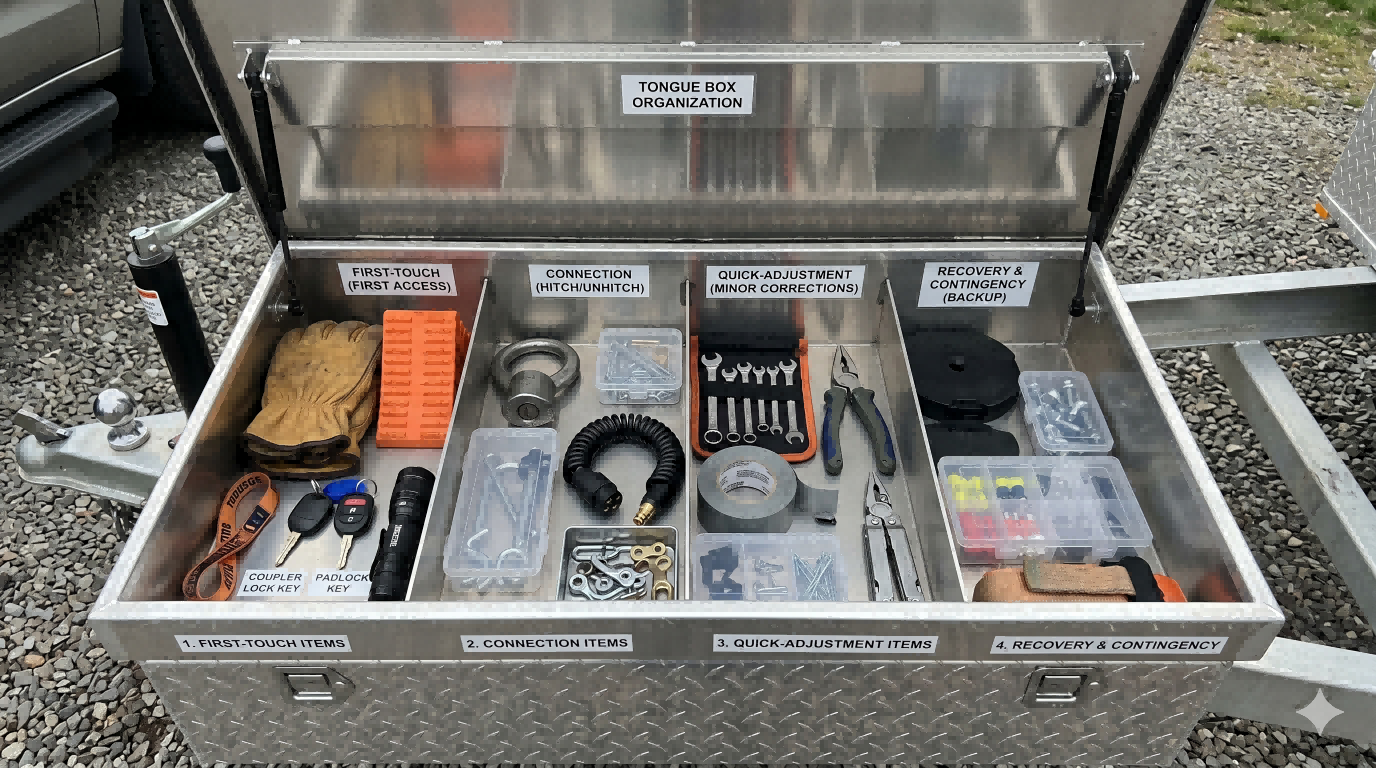
The choice of trailer tongue box material should be made more carefully than many buyers realize because the tongue is not just another mounting location. It is a critical functional zone. It affects hitch access, jack operation, coupler visibility, and the way weight is carried at the front of the trailer.
For that reason, front-mounted storage should usually prioritize balance over brute capacity. This is where an aluminum trailer toolbox often becomes the preferred option. It gives users a strong compromise between weight control, corrosion resistance, and daily practicality. Poly can also be a sensible solution when the storage load is moderate and maintenance reduction matters. Steel can still work, but it requires more discipline in both sizing and loading logic.
The mistake many owners make is not buying the wrong material in theory. It is buying the wrong material for the wrong loading behavior. A steel tongue box filled with chains, hitch heads, and heavy hardware may create a front-end storage system that is technically strong but operationally inefficient. A lighter material, properly matched to high-frequency towing essentials, often produces the better overall result.
Underbody toolbox material: durability depends on exposure pattern
The right underbody toolbox material is shaped by a different set of priorities. Underbody positions are usually more exposed to road spray, dirt, gravel impact, standing moisture, and debris thrown from tires. That means environmental exposure becomes more important, and access speed becomes less important than protected storage durability.
For underbody use, steel may appeal to buyers who want a rugged structure and high confidence under demanding work conditions. Aluminum remains attractive because it resists corrosion better and reduces weight on the trailer. Poly becomes more application-specific, depending on mounting method, box design, and the type of work environment.
What matters here is that buyers stop assuming one material rule fits every mounting position. The best underbody toolbox material is not necessarily the same as the best trailer tongue box material because the box is living in a different hazard profile. A smart buyer compares materials by exposure, not by habit.
Strength is not just about material type
One of the most common buying mistakes is using material as a shortcut for overall quality.
A buyer sees steel and assumes maximum durability. Another sees aluminum and assumes easy compromise. Another sees poly and assumes light-duty use only. Real product performance is more complicated than that. Thickness, reinforcement, hinge design, latch quality, lid support, mounting structure, and manufacturing consistency all influence whether a box performs well in service.
This is important because a poorly built steel box may still disappoint, while a well-designed aluminum box may outperform expectations in daily use. The material gives a starting point, but the box design determines how that material is translated into real function.
For buyers trying to choose the best trailer toolbox material, this is the point where procurement becomes more mature. Do not compare material names alone. Compare the whole storage system.
Weather exposure changes the ranking quickly
Material choice becomes much easier when the operating environment is defined honestly.
If the trailer lives outdoors year-round, corrosion resistance and maintenance tolerance should move up the priority list. If it travels through wet, muddy, or coastal conditions, a weather resistant trailer toolbox becomes more than a convenience feature. It becomes part of cost control and service life. If the trailer works in dry but physically harsh conditions, impact tolerance and structural confidence may become more valuable than finish perfection.
This is why material debates often go nowhere in the abstract. Aluminum, steel, and poly each make sense under different environmental realities. The trailer owner who faces constant rain will not value the same things as the contractor who values rugged load security above all else. Material should follow exposure, not preference.
Maintenance is part of material cost
Many buyers compare material by purchase price and miss the larger financial picture.
The real cost of a trailer toolbox material includes surface care, coating repair, cleaning effort, potential corrosion management, installation demands, and the consequences of early deterioration. A material that costs less at the start may cost more in time and upkeep. A material that costs more initially may reduce maintenance and stay presentable longer.
This does not mean one material is always cheaper in the long run. It means ownership style matters. If the owner is disciplined and maintains the box regularly, steel may remain a very strong value. If the owner wants lower upkeep and more weather forgiveness, aluminum or poly may create a better long-term experience. The most practical material choice is the one the owner can realistically support.
Matching material to the user, not just the trailer

The smartest material decision often comes from understanding the operator profile.
Fleet and commercial users
These buyers often value consistency, predictable replacement cycles, and operational toughness. They may accept higher weight or more structured maintenance if the storage system delivers confidence across daily service.
Owner-operators and contractors
These users often need a balance of durability, weather resistance, and manageable weight. For them, an aluminum trailer toolbox is frequently attractive because it performs well across multiple priorities without becoming extreme in any one category.
Casual trailer owners and mixed-use users
These buyers may prioritize simplicity, weather tolerance, and low upkeep over industrial appearance. In these cases, a poly trailer toolbox can become more appealing than many buyers expect.
The real decision point
The best material is the one that fits the trailer’s workload, the operating climate, and the owner’s maintenance behavior at the same time.
A simple real-world framework for choosing material
If the trailer needs balanced daily performance, lighter weight, and better corrosion resistance, aluminum is often the strongest all-around choice.
If the trailer needs a more rigid and impact-tolerant storage solution for rugged commercial work, steel deserves serious consideration.
If the trailer needs practical storage with lower corrosion concern and lower maintenance expectations, poly may be the smartest solution.
The goal is not to choose the material with the strongest marketing language. The goal is to choose the material whose weaknesses will matter least in your real operating conditions.
Final thoughts
There is no universal winner in the aluminum vs steel trailer toolbox debate, and poly should never be dismissed without context. The right answer depends on how the box will be mounted, what it will carry, where the trailer will live, and how the owner will maintain it.
An aluminum trailer toolbox often offers the best balance for broad real-world use. A steel trailer toolbox remains valuable where rigidity and hard-use confidence matter most. A poly trailer toolbox becomes a smart option when corrosion resistance and lower maintenance matter more than a traditional metal-box feel.
The most professional way to choose the best trailer toolbox material is to stop asking which material sounds strongest and start asking which one performs best in the specific life your trailer actually leads.
That is the difference between buying a box for the catalog and choosing a box for the field.
#TrailerToolbox #TrailerToolboxMaterial #AluminumTrailerToolbox #SteelTrailerToolbox #PolyTrailerToolbox #TrailerTongueBox #UnderbodyToolbox #WeatherResistantToolbox #TrailerStorage #UtilityTrailerAccessories #TowingEquipment #TrailerPartsGuide