Avoiding Front-End Clutter: How to Add a Toolbox Without Compromising Jack Operation
A trailer toolbox is supposed to solve front-end problems. In many real-world setups, it creates new ones.
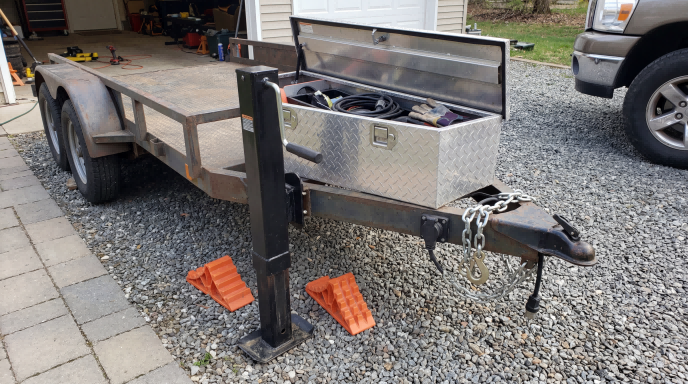
That usually happens when buyers treat the tongue area as empty space instead of working space. A box is added because the dimensions look close enough, because the trailer has room at the front, or because front storage seems convenient. Then the daily problems begin. The jack handle becomes awkward to turn. The power jack housing feels crowded. The coupler latch is harder to reach. Safety chains drag across the box edge. The lid opens into the wrong zone. What looked like an upgrade on paper becomes friction in practice.
That is why adding a box is not just a product decision. It is a layout decision. The goal is not simply trailer tongue box installation. The goal is to create a front-end system that preserves movement, access, and safety while improving storage.
A smarter front-end design starts with one principle: storage should support operation, not compete with it. If a toolbox weakens trailer jack operation, then the layout is wrong even if the box technically fits.
The trailer tongue is an operating zone, not a storage shelf
One of the most common mistakes in trailer planning is assuming that the front tongue is simply a mounting platform.
It is not.
The tongue area is where hitching, unhitching, jack use, plug connection, coupler access, chain handling, and quick front-end checks all happen. This means the front of the trailer is an active working zone. Every inch added to it changes how the operator moves, where the hands go, and how easily important parts can be reached.
This is why front-end trailer layout matters so much. The front box is not being added to a neutral area. It is being added to a zone that already has a job. If the new storage does not respect that job, it creates trailer front-end clutter even when the installation looks clean from a distance.
A trailer owner should not ask, “Can a box fit here?” The better question is, “Can a box fit here without weakening the way the front of the trailer works?”
The biggest front-end mistake is optimizing for volume instead of access
A larger toolbox often looks like the better value. More volume seems like more utility. But on the tongue area, added capacity can easily reduce front-end function.
This is the point where many layout decisions fail. The box is chosen by dimensions and storage appeal rather than by access logic. In practice, the front zone does not need maximum volume. It needs usable clearance.
A well-designed front box should improve:
- access to frequent-use items
- organization of front-end essentials
- speed of hitching and unhitching
- front-zone cleanliness and predictability
It should not make any of these harder:
- turning the jack handle
- accessing a powered jack head
- reaching the coupler latch
- routing or lifting safety chains
- opening the lid fully
- working close to the tow vehicle during hookup
This is why toolbox without blocking trailer jack is not just a slogan. It is the real standard of front-end fitment quality.
Trailer jack operation requires more than static clearance

One of the most misleading fitment assumptions is this: if the box does not physically touch the jack, the layout is acceptable.
That is not enough.
Good trailer toolbox jack clearance means preserving the full working zone of the jack, not just leaving a gap next to it. A jack does not function as a static object. It functions through motion, reach, angle, and repeated hand contact.
A manual jack needs room for handle rotation and arm movement. A powered jack needs room for housing access, switch reach, and cable management. A drop-leg or side-wind system may need more usable operating space than a measurement sheet suggests.
That is why trailer jack operation should be evaluated through movement patterns:
- Can the handle rotate freely?
- Can the operator stand naturally while using it?
- Can the powered controls be reached without reaching around the box?
- Does the box crowd the user’s wrist, forearm, or working angle?
- Is the jack still easy to use when the trailer is already hitched to the tow vehicle?
A box that passes a tape-measure test but fails a motion test is still the wrong box.
Coupler access is just as important as jack clearance

A lot of front-end clutter problems are blamed on the jack when the real issue is coupler access.
The coupler area is one of the most sensitive operating points on the trailer. It must stay visible, reachable, and easy to work around. The operator may need to lower the coupler, latch it, inspect it, lock it, unlock it, or make a small adjustment while also managing chains and the plug connection.
A poorly placed box can create a bottleneck in this area even if trailer tongue box clearance seems acceptable from the side. That is why a smarter trailer hitch area storage plan always asks how the box changes coupler access, not just jack access.
Common warning signs include:
- the box extends too far forward
- the box forces hand access from one awkward side only
- the lid blocks working posture when open
- chains rub or bunch against the box
- the plug cable is rerouted unnaturally because of the box position
A front box should organize the hitch zone, not narrow it.
Front-end clutter usually comes from mixed roles
Clutter is not just about having too many objects in one place. It is about assigning too many jobs to one zone.
A trailer tongue already contains several roles:
- lifting and support
- connection and disconnection
- security and locking
- front-end storage
- quick inspection
- stabilization support
When the front box is expected to store everything from daily-use hitch gear to heavy backup tools and unrelated field equipment, the front zone loses clarity. That is where trailer tongue storage design becomes important. A well-planned front box should support front-end tasks, not absorb every loose item that did not fit somewhere else.
The more disciplined the role of the box, the less likely the front zone is to become crowded.
A good toolbox layout begins with front-zone priorities
The simplest way to avoid clutter is to decide what belongs in the front zone before choosing the box.
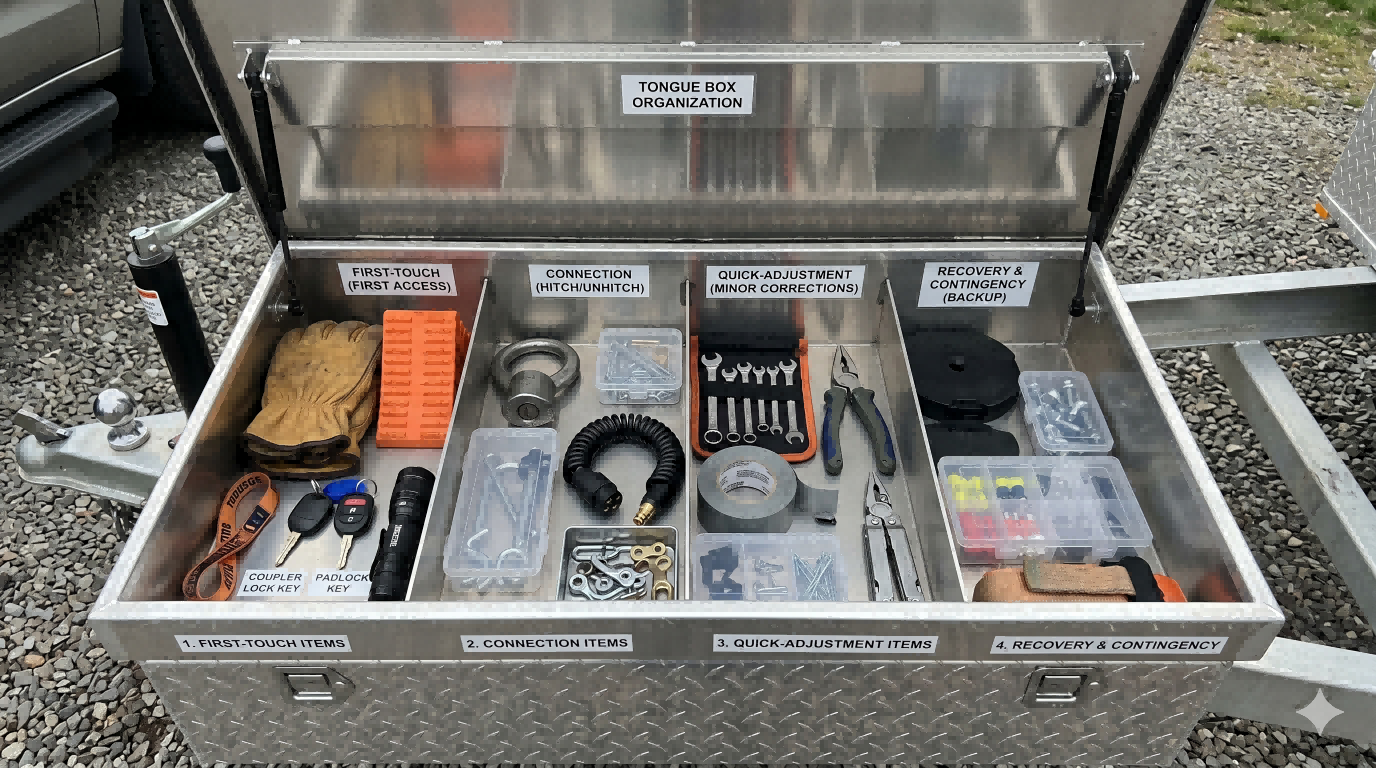
That means identifying the items that are actually tied to front-end use. These often include:
- gloves
- wheel chocks
- coupler lock
- hitch pin or related hardware
- plug adapter
- small inspection light
- a few quick-adjustment tools
- small contingency items tied to hitching or jack use
These are different from general trailer cargo tools, long-term spares, or heavy recovery gear. When the front box is reserved for true front-end items, utility trailer toolbox layout becomes much easier to manage.
The box does not need to hold everything. It needs to hold the right things in the right place.
The lid path matters as much as the box footprint

Buyers often focus on where the bottom of the box sits and ignore what happens when the lid opens.
That is a mistake.
A box may fit perfectly when closed and still create front-end clutter when open. If the lid arc pushes into the operator’s working position, interferes with the trailer body, crowds a power jack head, or feels awkward next to the tow vehicle, the layout loses usability fast.
This is why trailer tongue box installation should always consider two separate envelopes:
- the footprint of the box when closed
- the operating space of the box when open
The front zone must work in both states. A box that is easy to live with closed but frustrating to use open still weakens the trailer.
Different jack types create different toolbox constraints

Not every trailer jack creates the same layout rules.
Top-wind jacks
These often need vertical hand space and clear upper motion. A nearby box may interfere less with lateral movement, but lid height and top access still matter.
Side-wind jacks
These are more sensitive to handle sweep and side working room. A box placed too close can make the handle usable in theory but awkward in practice.
Powered jacks
These need space for housing access, switch use, wiring, and sometimes cover clearance. Their physical bulk can also reduce the usable storage area around them.
Drop-leg and heavy-duty jacks
These often operate in more demanding trailer environments and deserve more generous clearance planning, especially if the trailer is used on gravel, jobsites, or uneven terrain.
This is why how to add a toolbox without blocking trailer jack never has one universal answer. The right layout depends on the jack design as much as the box shape.
Trailer type changes the layout pressure

The same box position can feel excellent on one trailer and cramped on another.
Utility trailers
These often benefit from a straightforward front box because the front end is relatively open. But they can still become cluttered if the box is oversized or loaded with unrelated gear.
Equipment trailers
These often involve heavier front-end gear, stronger securement needs, and more frequent jack use on uneven sites. That makes trailer toolbox jack clearance even more important.
RV and recreational trailers
These trailers may already have tanks, batteries, covers, or curved-front structures competing for tongue space. A smaller and more disciplined box often works better than a larger one.
Contractor and work trailers
These may visit jobsites often, which increases the importance of quick access and repeatable layout. A clean front zone reduces wasted movement and setup friction.
Trailer type changes the stress on the front zone, but the same principle remains: the front box should support the trailer’s use pattern, not just occupy space.
There are four questions every buyer should ask before installing a tongue box
A better front-end layout usually comes from asking better questions.
Does the box preserve natural jack motion?
Not just “Can the jack still move?” but “Can the operator still use it comfortably and repeatedly?”
Does the box preserve coupler access?
Not just visual access, but real hand access during hitching and unhitching.
Does the box improve front-end workflow?
Not just add storage, but make the front of the trailer faster and cleaner to use.
Does the box reduce clutter or simply relocate it?
A box that becomes a catch-all container may hide clutter without actually solving it.
These questions are more useful than product dimensions alone because they evaluate the real front-end system.
Better front-end layouts usually rely on restraint

Many strong trailer layouts are not built by maximizing what can be installed. They are built by limiting what the front zone is asked to do.
This means:
- choosing a box size that leaves real working room
- storing only front-end essentials in the front box
- keeping heavy, low-frequency gear elsewhere
- respecting the jack’s full operating space
- treating the coupler zone as protected working space
This is one of the clearest signs of mature front-end trailer layout thinking. The goal is not visual fullness. The goal is practical usability.
A less crowded tongue area often performs better than a more impressive one.
The cleanest layouts are the easiest to repeat

A good front-end layout is not judged only by first installation. It is judged by repeat use.
If the operator can hitch, unhitch, raise, lower, secure, and inspect the trailer with consistent motion and minimal searching, the system is working. If the jack handle clears easily every time, the system is working. If the toolbox supports the process without forcing awkward movement, the system is working.
That is why the cleanest trailer hitch area storage systems are usually the most repeatable ones. They are not overbuilt. They are not overfilled. They are simply organized around how the front of the trailer actually works.
Final thoughts
Adding a front box should make the tongue area cleaner, safer, and easier to use. If it creates crowding, awkward jack motion, or harder coupler access, it is not an upgrade. It is a compromise.
That is why trailer toolbox jack clearance should be treated as a design priority, not a last-minute check. A successful trailer tongue box installation preserves trailer jack operation, protects the hitch area, and improves front-end workflow without turning the tongue into a cluttered storage shelf. The smartest trailer tongue storage design starts with movement, access, and task sequence. Storage comes after that.
When buyers think this way, they stop asking whether a box can fit and start asking whether the front of the trailer will work better once it does.
#TrailerToolboxJackClearance #TrailerTongueBoxInstallation #FrontEndTrailerLayout #TrailerJackOperation #TrailerTongueBoxClearance #TrailerHitchAreaStorage #TrailerFrontEndClutter #TrailerTongueStorage #UtilityTrailerAccessories #TrailerSetupSystem #TrailerPartsGuide #TrailerOrganization