From Campsite to Jobsite: How Toolboxes Improve Trailer Setup Speed, Safety, and Daily Workflow
A trailer toolbox is often described as a storage accessory. That description is technically correct, but operationally too small.
In real-world use, a toolbox affects much more than where gear is stored. It influences how quickly a trailer can be set up, how consistently key items can be found, how safely the front-end zone is managed, and how smoothly the operator moves from one task to the next. That is why a good toolbox does not just create capacity. It improves trailer setup speed, supports trailer toolbox safety, and strengthens the trailer’s overall working rhythm.
This is true in more than one environment. A campsite and a jobsite look very different, but they share one operational truth: both punish disorganization. At a campsite, poor storage slows leveling, stabilizing, and hookup routines. On a jobsite, poor storage wastes time, delays loading, increases small mistakes, and turns repeat tasks into repeated friction. In both cases, a smarter trailer toolbox workflow makes the trailer easier to use.

That is why the most valuable toolbox is not always the biggest. It is the one that improves movement, access, and predictability across the trailer’s daily operating sequence.
A trailer works through sequences, not isolated accessories

One reason storage is underestimated is that many buyers still evaluate trailer parts individually.
The jack is judged by lift. The coupler is judged by connection. Chains are judged by rating. The toolbox is judged by volume. But actual trailer use does not happen in isolated parts. It happens in sequences. The trailer is approached, checked, stabilized, hitched, loaded, adjusted, locked, unhitched, and resecured through a connected series of actions.
This is where a strong trailer setup system becomes important. A toolbox changes the sequence because it changes where the operator reaches, how often gear is searched for, and how quickly tasks can be completed without interruption.
When the right items are stored in the right place, the trailer becomes smoother to operate. When they are not, setup time stretches, repeated walking increases, and small frustrations multiply. That is why trailer daily workflow is a better lens for evaluating a toolbox than storage capacity alone.
Setup speed is really a storage problem in disguise

Many trailer owners think slow setup is caused by the complexity of the task. In reality, it is often caused by disorganized access.
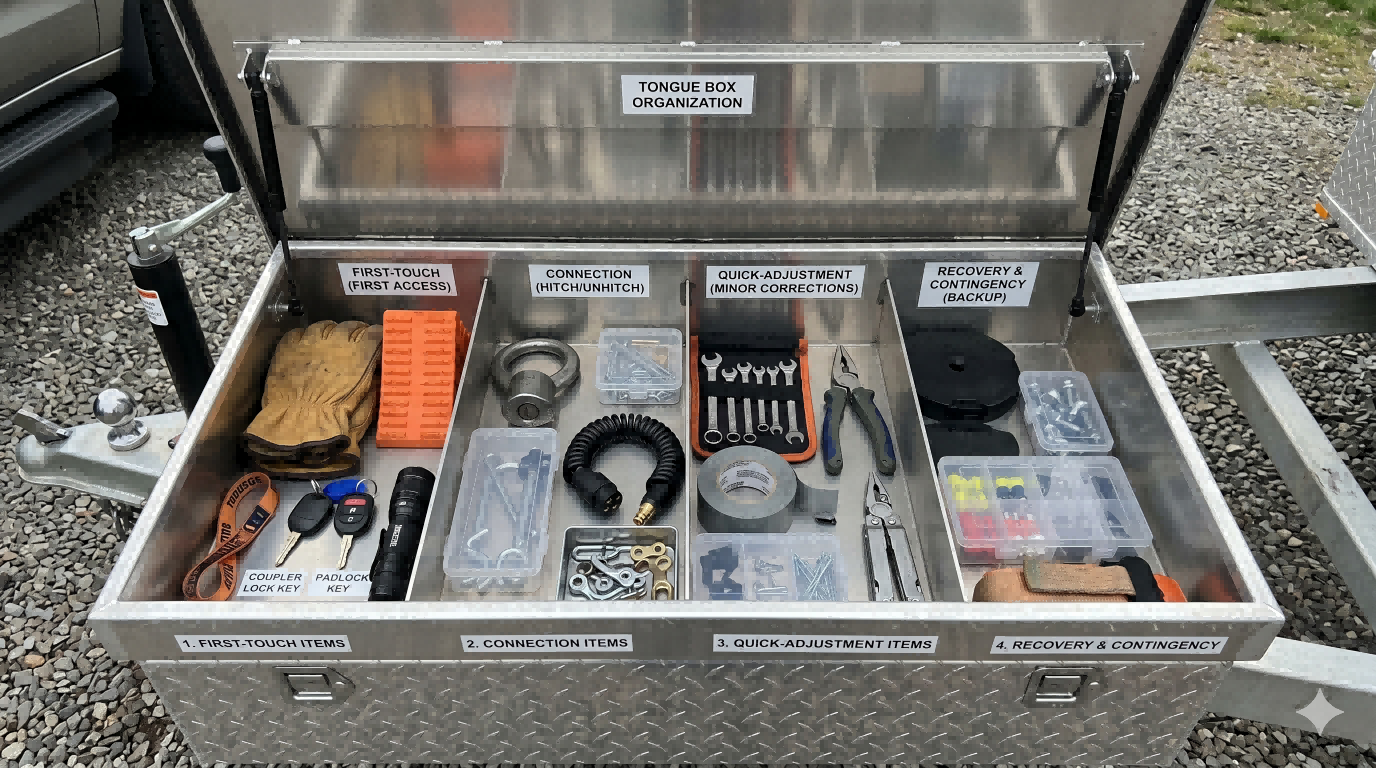
If gloves are in the truck bed, the wheel chocks are under loose gear, the plug adapter is somewhere in a side compartment, and the coupler lock key is mixed into a larger tool pile, setup becomes slower before the hard work even begins. Nothing is technically broken. The process is just inefficient.
A properly planned toolbox improves trailer setup speed by reducing the time between intention and action. The operator does not need to search for essentials because those essentials live where the process needs them.
This is why towing gear organization should be treated as part of trailer efficiency, not as an afterthought. A five-minute task often becomes a two-minute task not because the operator became more skilled, but because the trailer became easier to operate.
Campsite efficiency and jobsite efficiency are more similar than they look

At first glance, a campsite trailer and a work trailer seem to require different storage logic. One supports recreation. The other supports labor. But both environments reward the same design principles.
At a campsite, the operator needs predictable access to setup gear, leveling items, chocks, adapters, locks, and front-end accessories. Delays are annoying, but more importantly, disorder can make the setup feel stressful and unstructured.
On a jobsite, the trailer may need repeated stops, multiple securement checks, adjustments, and fast access to frequently used equipment. Here, delays cost time and concentration.
The real common ground is not the load. It is the workflow. Both environments benefit when a trailer toolbox workflow reduces searching, separates high-frequency gear from low-frequency gear, and supports the front-end and side-access tasks that happen most often.
That is why campsite trailer storage and jobsite trailer toolbox planning should both begin with the same question: what items are needed first, most often, and under the least ideal conditions?
A good toolbox improves safety by improving order

Safety is often discussed in terms of ratings, materials, and hardware strength. Those things matter. But daily trailer safety is also influenced by how well the operating area is organized.
A disorganized front zone creates small but meaningful risks:
- wheel chocks are not reached quickly
- lock components are misplaced
- chains and plug cables are handled awkwardly
- tools are set down in the wrong place
- the operator rushes because the workflow feels cluttered
This is where trailer toolbox safety becomes practical rather than abstract. A good box does not make the trailer safe by itself. It helps the operator behave more safely because the right items are easier to access, easier to return, and easier to verify.
In that sense, order is a safety tool. The more predictable the storage, the more predictable the process.
Daily workflow depends on where the box is placed

Not every toolbox improves the trailer in the same way. Its effect depends on placement.
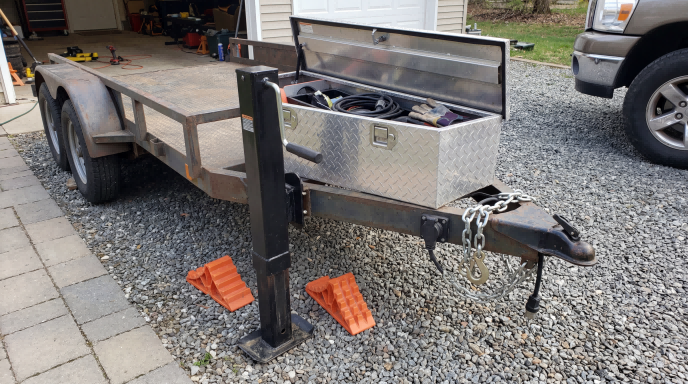
A front-mounted tongue box usually has the greatest influence on hitching, unhitching, quick checks, and access to front-end essentials. An underbody box often supports capacity and keeps heavy or lower-frequency tools out of the working surface. A side-mount box can improve access for service tasks, cargo adjustments, and lateral work zones.
This is why a real work trailer storage solution should not begin with the question “Which box looks best?” It should begin with “Which operating zone needs more support?”
Front-mounted boxes
Best for:
- chocks
- lock items
- gloves
- plug adapters
- hitch-related accessories
- quick front-end tools
Underbody boxes
Best for:
- heavier tools
- chains
- backup gear
- low-frequency work items
- dirty or rugged-use equipment
Side-mount boxes
Best for:
- side-access tools
- service items
- measuring tools
- cargo-adjustment gear
- worksite-use accessories
The more closely the box location matches the operator’s real movement pattern, the better the trailer storage efficiency.
The most productive trailers separate fast-access gear from bulk storage
One reason toolboxes fail to improve workflow is that they are treated as general catch-all storage. Once that happens, the items needed most often disappear under the items needed least often.
A better approach is to separate storage into two functional layers.
Fast-access layer
This layer supports the first several minutes of trailer use:
- gloves
- wheel chocks
- lock and key items
- plug adapters
- small inspection lights
- frequently used clips and pins
Bulk-support layer
This layer supports the larger job, but not necessarily the first touch:
- extra chains
- spare binders
- larger repair tools
- backup straps
- lower-priority hardware
- contingency gear
This is one of the clearest differences between casual storage and professional storage. Casual storage tries to keep everything in one place. Professional storage supports the order in which work happens.
Repeat tasks are where a good toolbox creates the most value
A toolbox is most valuable where the trailer is used repeatedly.
That is why contractors, landscapers, equipment haulers, service crews, and frequent recreational trailer users all benefit from better storage logic. The more often the trailer is approached, opened, checked, adjusted, or resecured, the more valuable a predictable storage system becomes.
This is where trailer daily workflow becomes the real metric of quality. A box that saves a minute or two in a single use may not seem significant. A box that saves that time every day, while also reducing search errors and improving consistency, becomes a serious operational upgrade.
The same principle applies to jobsite trailer toolbox use. On busy days, the cost of disorganization compounds fast. The box that supports speed, consistency, and repeat access is doing more than storing tools. It is supporting labor efficiency.
Better workflow usually means fewer unnecessary steps
A smart trailer layout reduces unnecessary movement.
That may mean:
- fewer trips back to the tow vehicle
- fewer repeated searches for the same items
- fewer interruptions during hookup
- fewer delays during leveling or stabilization
- fewer moments where gear must be moved to access other gear
This is where trailer setup speed and trailer storage efficiency overlap. The box is not valuable just because it protects items. It is valuable because it removes extra steps from the operating sequence.
That kind of efficiency matters in every environment. At a campsite, it reduces setup frustration. On a jobsite, it reduces wasted motion and mental clutter. During mixed-use hauling, it makes the trailer feel more controlled and ready.
Professional-looking trailers are usually better organized trailers
There is a visual side to workflow, but it comes from function, not decoration.
A trailer that looks professional usually looks that way because the storage system has logic. Items are grouped, zones are respected, and the front-end and side-access areas are not overloaded with random gear. The trailer appears cleaner because it is easier to keep clean.
This matters because professional appearance is not only cosmetic. It usually reflects a more reliable operating pattern. A trailer that is easier to inspect, easier to reset, and easier to load consistently will almost always look more disciplined than a trailer where everything is stored wherever it happens to fit.
That is another reason the best work trailer storage solution is often modest in size but strong in logic. Good organization usually looks better because it works better.
Different users still benefit from the same storage principle

The exact contents of a trailer toolbox will change, but the operating principle stays consistent.
Campsite and RV users
They benefit from quick-access gear for leveling, locking, adapters, lights, gloves, and stabilization. For them, campsite trailer storage should reduce setup stress and make arrival routines more predictable.
Utility trailer users
They benefit from flexible storage for basic towing items, light-duty tools, and repeat-use accessories. For them, the priority is often convenience and repeatable front-end access.
Equipment trailer users
They benefit from stronger separation between fast-access items and heavy-duty securement gear. Here, the wrong storage mix can slow work and overload the front-end zone.
Contractor and service users
They benefit from storage that supports repetition, speed, and predictable access across a busy workday. For them, a strong jobsite trailer toolbox layout can improve not just order, but pace.
The user changes the kit. The principle does not change: storage should support the work sequence.
What a smarter toolbox strategy looks like in practice
A smarter toolbox strategy usually has four characteristics.
It prioritizes first-use items
The most important items are not the biggest or most expensive. They are the ones that interrupt workflow if missing.
It respects operating zones
The front of the trailer, the side-access zone, and the main cargo area should not all be asked to do the same job.
It separates frequent-use gear from backup gear
Fast access matters more than total capacity in the areas touched most often.
It makes reset easier
A good system helps the operator put items back where they belong, which protects tomorrow’s workflow as much as today’s.
This is the practical form of trailer toolbox workflow. It turns a box from passive storage into an active operating aid.
The best toolbox upgrade is often invisible after a few days
One of the strongest signs that a toolbox is truly improving the trailer is that the user stops noticing it.
That may sound counterintuitive, but it is true. Once the layout is right, the trailer begins to feel smoother. Setup feels shorter. The right gear appears where it is needed. Fewer things are forgotten. Fewer steps are repeated. The workflow becomes quieter.
That is what real trailer storage efficiency looks like. It does not usually feel dramatic. It feels normal in the best possible way.
The trailer becomes easier to trust because it becomes easier to repeat.
Final thoughts
A trailer toolbox should not be judged only by how much it holds. It should be judged by how much it improves the trailer’s real operating life.
From campsite arrival to jobsite setup, a well-planned box can improve trailer setup speed, strengthen trailer toolbox safety, reduce unnecessary movement, and support a cleaner trailer daily workflow. The best storage systems do not simply add capacity. They organize action. They place the right gear in the right zone, support repeatable routines, and help the trailer function more like a system and less like a collection of loose parts.
That is why the smartest trailer toolbox workflow is not built around storage volume. It is built around access, predictability, and the way real trailers are actually used.
#TrailerToolbox #TrailerToolboxWorkflow #TrailerSetupSpeed #TrailerToolboxSafety #TrailerStorageEfficiency #TowingGearOrganization #TrailerSetupSystem #WorkTrailerStorage #CampsiteTrailerStorage #JobsiteTrailerToolbox #TrailerDailyWorkflow #TrailerPartsGuide