Marble Look SPC Wall Panels: A Modern Alternative to Natural Stone Slabs
Marble-look walls are popular because buyers want stone atmosphere without stone complexity
Marble has always carried a strong design signal. It suggests luxury, permanence, cleanliness and architectural value. In bathrooms, hotel suites, spa areas, reception walls and apartment interiors, marble-look surfaces can immediately change how a space feels. But real marble is not a simple material to specify. It is heavy, expensive, variable in pattern, difficult to transport, demanding to cut, sensitive to installation skill and not always practical for fast renovation. This is why marble look SPC wall panels are becoming more relevant in the modern wall panel market.
The rise of SPC marble wall panels should not be understood as a cheap imitation trend only. It reflects a larger change in building and renovation logic. Many projects now need stone-effect walls that are lighter, easier to handle, faster to install, more predictable in pattern, easier to clean and more suitable for repeated commercial use. A hotel may want the visual language of marble across many bathrooms. A landlord may want a high-end rental bathroom without natural stone installation cost. A homeowner may want a cleaner shower wall with fewer grout lines. A distributor may want a product line that can be sampled, stocked and explained more easily than stone slabs.
This is where stone effect wall panels become important. They do not replace natural stone in every project. Real stone still has its place in premium architecture, high-end custom interiors and projects where material authenticity is the main value. But for many bathrooms, apartments, hotels and commercial interiors, the buyer is not asking for geological uniqueness. The buyer is asking for a practical wall system that creates a marble or stone atmosphere with less construction risk.
Earlier SPC articles on this site introduced SPC wall panels as rigid waterproof wall systems, compared SPC wall panels vs tiles, and explained SPC shower wall panels for wet rooms and bathrooms. This article focuses on the design-driven side of SPC: how marble-look, stone-effect and large-format panels are changing the way buyers think about premium wall surfaces.
Why marble-look SPC is different from ordinary printed wall boards
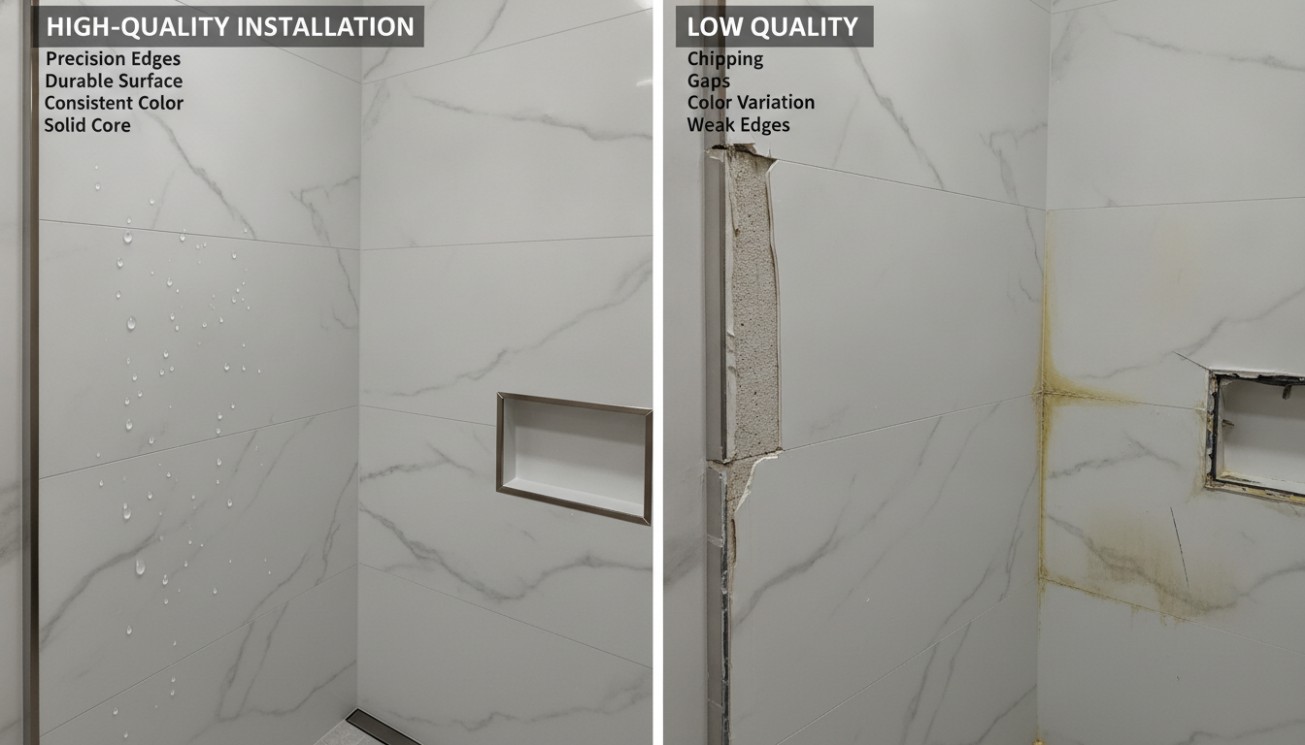
Not every marble-look panel belongs to the same quality level. Some products are thin printed sheets with limited durability and obvious pattern repetition. Others are more complete wall systems with a rigid core, controlled surface finish, matching trims, edge details, wet-area suitability and better pattern planning. When buyers compare decorative SPC panels, they should look beyond the first catalog image.
A good marble-look SPC panel is not only a surface picture. It is a combination of core structure, decorative film, surface coating, panel size, edge precision, installation system and pattern design. The panel must look convincing on a full wall, not only on a small sample. It must work under bathroom lighting, hotel lighting, daylight and mirror reflections. It must handle cleaning, surface contact, moisture exposure and edge finishing. It must also be supported by supplier documentation and accessory systems.
The core gives the panel its practical wall behavior
SPC is often used because it provides a more rigid wall panel structure than many lightweight decorative sheets. That rigidity can help create a flatter and more stable wall appearance, especially in bathrooms and large wall areas. It also gives the product a more solid feel, which matters when the buyer wants a premium marble-look surface rather than a thin plastic impression.
However, rigidity also increases the importance of wall preparation. Large format wall panels need a reasonably flat and stable substrate. If the wall behind the panel is uneven, damp or weak, the finished surface may not sit correctly. The guide on SPC wall panel installation explains why tools, trims, adhesive and sealing details are essential for a successful finished wall.
The surface decides whether the panel looks premium or flat
The most common weakness of low-grade marble-look panels is surface flatness in the visual sense. The panel may be physically flat, but the printed pattern looks shallow, repetitive or artificial. A high-quality marble-look SPC surface should have better pattern depth, controlled color, suitable gloss and a finish that matches the intended space.
Glossy surfaces can create a polished luxury effect in bathrooms and hotel interiors, but they can also show fingerprints, water marks or glare under strong lighting. Matte surfaces may look more natural and calmer, but they need enough surface quality to avoid appearing dull. Lightly textured finishes can improve realism, but deep texture may collect dirt if used in wet areas. Buyers should choose finish type by application, not only by showroom appearance.
Pattern scale matters more than many buyers expect
A marble pattern that looks attractive on a 200 mm sample can look repetitive on a full bathroom wall. This is one of the most important issues when sourcing SPC marble wall panels. Buyers should examine full-size panels or installed displays whenever possible. They should check whether veins repeat too often, whether adjacent panels can be arranged naturally, and whether the pattern looks balanced across a large wall.
In high-end visual projects, the problem is rarely whether the panel is white, grey or beige. The problem is whether the vein scale fits the room. A small bathroom may need a softer pattern. A hotel lobby may need bolder movement. A shower wall behind glass may need a pattern that does not become visually broken by fittings and reflections.
SPC marble panels vs natural stone slabs

The comparison between natural stone alternative panels and real marble should be handled honestly. SPC does not become natural marble just because it uses a marble pattern. Real stone has depth, mineral variation, cold touch, natural veining and a material authenticity that printed products cannot fully duplicate. But natural stone also brings cost, weight, installation and maintenance challenges that many projects do not want.
Natural marble offers authenticity, but also complexity
Natural marble is valued because every slab is unique. Designers can select slabs, bookmatch veins, polish edges and create truly premium stone surfaces. In luxury residences, flagship hospitality spaces and architectural projects, that authenticity can be worth the cost.
But natural marble is heavy. It requires careful shipping, handling, cutting and installation. It can crack during fabrication or transport. It may need sealing depending on the stone and application. It may stain or etch if exposed to certain chemicals. It also requires skilled labor and more project planning. In smaller renovations or repeatable commercial bathrooms, this level of complexity may not be practical.
SPC offers a controlled stone-look system
Marble look SPC wall panels offer a different value. They provide a controlled decorative surface that can be produced in repeatable patterns, easier-to-handle panel formats and more predictable wall systems. A hotel buyer can approve a series and use it across many rooms. A distributor can keep samples and trims in stock. A contractor can install panels faster than natural stone in many renovation contexts.
The main benefit is not that SPC is more luxurious than marble. It is that SPC makes a stone-look wall more accessible and easier to repeat. For many bathrooms, rental properties and commercial interiors, this is the practical advantage.
Stone replacement should be based on project purpose
If the project is a luxury villa where the owner wants real stone authenticity, natural marble may still be the right choice. If the project is a hotel bathroom renovation where downtime, cleaning, repeatability and cost control matter, SPC may be more practical. If the project is a retail or apartment feature wall where visual effect matters more than stone authenticity, stone effect wall panels can be a logical solution.
A similar sourcing logic appears in the article on PU stone panels vs real stone veneer. Buyers often compare stone-look materials not only by appearance, but by weight, labor, installation risk, shipping and application boundaries. SPC follows the same broader market logic, but with a flatter, bathroom-friendly and marble-look wall position.
SPC marble panels vs ceramic tiles
Many bathroom buyers compare SPC marble panels with ceramic or porcelain tiles. Tiles remain a strong and familiar wall material. They can be durable, beautiful and accepted by contractors and homeowners. However, tiles also create grout lines, require skilled installation and take more time in many renovation projects.
Luxury bathroom wall panels made from SPC often appeal to buyers who want a large marble-look surface without many grout lines. In a shower area, fewer joints can create a cleaner visual result and reduce some grout maintenance. In small bathrooms, large panels can make the room feel calmer and less visually fragmented.
Tiles create modular design
Tile walls are built from many individual units. This modularity can be part of the design. Subway tiles, mosaic tiles, handmade ceramic tiles and textured porcelain tiles all use repetition and grout lines to create character. In traditional or craft-oriented bathrooms, this can be valuable.
SPC creates larger visual continuity
SPC panels create a different effect. Seamless wall panels or low-joint panel systems can make the wall feel more continuous. The design language is closer to a slab surface than a tiled field. This is why marble-look SPC is often used in modern bathrooms, hotel bathrooms, spa interiors and minimalist wet rooms.
Tiles may still win in some applications
SPC should not be described as better than tile in every situation. Tiles may be better for high-heat zones, complex mosaic work, traditional bathrooms, premium ceramic authenticity or areas where local market expectation strongly favors tile. The article on SPC wall panels vs tiles explains this trade-off in detail. The key point is that SPC is a different wall logic, not a universal replacement.
Large-format SPC panels change how bathrooms are designed

The strongest visual advantage of marble-look SPC is often size. Large format wall panels can reduce the number of visible joints and make a bathroom feel more architectural. This matters because bathroom walls are usually interrupted by mirrors, basins, shower glass, niches, pipes and lighting. Too many joints can make the room look busy.
Large panels can make small bathrooms feel calmer
Small bathrooms often suffer from visual fragmentation. Floor joints, wall tile joints, shower glass frames, vanity cabinets and fixtures all create lines. A large marble-look SPC panel can reduce wall lines and create a cleaner background. This can make the room feel larger, brighter and more modern.
Light marble patterns are especially useful in smaller spaces. They reflect light, coordinate with white sanitaryware and create a sense of cleanliness. Soft grey veining can add interest without making the wall too busy. Strong dark veining should be used carefully in small rooms because it can dominate the space.
Large panels support hotel-style bathrooms
Hotels often use larger wall surfaces to create a premium impression quickly. Hotel wall panels need more than beauty. They need repeatability, cleaning logic, replacement planning and supplier consistency. Marble-look SPC can help hotels create a controlled design standard across many rooms without custom stone fabrication for each bathroom.
For hotel buyers, pattern approval should happen before bulk purchasing. A sample board is not enough. They should review full panel mockups, corner trims, shower details and lighting conditions. They should also ask whether future batches can match the approved color and pattern closely enough for maintenance replacement.
Large panels reduce joints but do not eliminate detailing
The phrase seamless wall panels is often used in marketing, but buyers should understand what it really means. Most panel walls still have some joints, edges, corners and transitions. The goal is not to pretend the wall has no technical details. The goal is to reduce visual interruption and control joints in places where they look intentional and can be sealed properly.
Bookmatch and pattern continuity can make or break the premium effect

Bookmatch wall panels are designed or arranged so patterns mirror or continue across adjacent panels. In marble-look interiors, this can create a dramatic luxury effect. A well-planned bookmatch wall can become the focal point of a bathroom, reception wall or hotel suite. But poor bookmatching can make the wall look forced or artificial.
Bookmatch is not only a printing issue
Some buyers assume bookmatch quality depends only on the printed image. In reality, it also depends on panel size, cutting accuracy, sequence marking, packaging order, installer planning and wall layout. If panels are shipped or installed out of sequence, the visual continuity can be lost. If trims interrupt the pattern in the wrong place, the bookmatch effect may weaken.
Bookmatch works best on feature walls
Bookmatched marble-look SPC is often most effective on a main shower wall, vanity wall, hotel bathroom backdrop, spa treatment room or reception feature wall. It may be less necessary on side walls, service areas or walls with many interruptions. Buyers should use bookmatch where the visual value is visible enough to justify the planning.
Pattern direction should be planned before cutting
Installers should not cut bookmatch wall panels casually. Panel direction, vein alignment, fixture positions and joint locations should be planned before adhesive is applied. A shower valve placed directly through a critical vein may damage the visual balance. A niche cut through a strong vein may look awkward unless planned carefully.
Where marble-look SPC wall panels work best

Decorative SPC panels with marble or stone effects are useful in several interior applications. Their strongest value appears when design, moisture resistance, installation speed and repeatability matter together.
Modern bathrooms and shower walls
Bathrooms are the most natural application for SPC marble wall panels. The surface can create a clean, premium, stone-like effect while reducing grout-line maintenance compared with traditional tile. In showers and wet rooms, the product must still be installed as a proper wall system with trims, sealant and substrate control.
The guide on SPC shower wall panels explains why waterproof performance depends on the whole wall, not only the panel surface. This is especially important for marble-look bathrooms because visual quality can distract buyers from technical details.
Hotel bathrooms and hospitality interiors
Hotel wall panels need repeatability. A hotel may want the same marble-look bathroom across dozens or hundreds of rooms. Natural stone makes each room unique, but uniqueness can become a challenge when replacement and consistency matter. SPC offers a more controlled approach, as long as the supplier can maintain batch consistency and provide matching accessories.
For hospitality projects, buyers should check cleaning resistance, spare panel strategy, trim availability, fire documentation where required, and whether the product can handle commercial maintenance routines. A beautiful wall that cannot be cleaned safely by housekeeping teams may create long-term problems.
Apartment and rental property upgrades
Rental bathrooms need to look modern but remain practical. Natural stone alternative panels can help landlords create a better visual impression without the cost and complexity of stone. In some projects, SPC can be installed over prepared existing tile, which may reduce renovation time. The article on installing SPC wall panels over tiles explains when that shortcut is safe and when old tiles must be removed first.
Commercial feature walls
Marble-look SPC is not limited to bathrooms. It can be used for reception walls, clinic interiors, beauty salons, retail displays, showroom backgrounds and restaurant feature walls. In these spaces, the buyer usually wants a polished or stone-like atmosphere without heavy slab installation.
For dry commercial feature walls, wet-area sealing may not be the main concern, but surface durability, lighting reflection, edge finish and fire requirements may matter more. This is why application context should guide material selection.
Where buyers should be cautious with marble-look SPC
SPC can be useful, but it should not be oversold. A credible material guide should explain where caution is needed.
High-heat or fire-sensitive areas
Marble-look SPC should not be assumed suitable near open flame, high heat appliances or fireplace interiors. A stone-look surface can create a false safety impression. If a wall is near heat, buyers should request product-specific fire and heat documentation. A real stone slab and a stone-look composite panel are not the same material.
Luxury projects where natural material authenticity is essential
Some projects require real marble because authenticity is part of the design value. In a high-end residence, flagship hotel lobby or luxury retail environment, the client may want natural variation, stone texture and material prestige. SPC may be a practical alternative, but it should not be presented as equal to real marble in every luxury context.
Walls with poor substrate conditions
Large format wall panels need stable backing. If the wall is damp, loose, cracked, severely uneven or contaminated, the panel may not perform well. A marble-look surface can hide a poor wall temporarily, but hidden substrate problems can still cause failure.
Projects with heavy fixture loads
Floating cabinets, grab bars, shelves, shower seats and heavy mirrors require proper structural support behind the panel. The SPC panel is a finish layer, not a structural backing. Buyers and installers should plan fixings before installation.
How to judge the quality of marble-look SPC panels
Because many marble look SPC wall panels appear similar online, buyers need a practical quality checklist. A good product should be judged by both visual quality and wall-system quality.
Check full-panel pattern realism
Do not rely only on small samples. Review full panels or installed displays. Check whether the marble veins look natural, whether the pattern repeats too obviously, whether colors match the target market, and whether the design remains attractive under real lighting.
Check surface finish
Surface finish affects both appearance and maintenance. Glossy panels may look premium but show water spots or glare. Matte panels may look calmer but require enough surface depth to avoid looking flat. Textured panels may feel more realistic but must remain cleanable in bathrooms.
Check edge precision
Edges affect joints, trims and installation quality. Poor edges can make a premium panel look cheap. For seamless wall panels or low-joint wall systems, edge accuracy is especially important because any misalignment becomes visible across a large surface.
Check core stability
The core should be stable enough for the intended wall size and installation method. Panels should not warp easily, chip excessively or feel brittle during cutting. A rigid core is valuable only if it remains stable through shipping, cutting and installation.
Check accessory support
High-quality decorative SPC panels should be supported by trims, corners, end caps, joining profiles, adhesive guidance and installation documents. Without accessories, even a good surface can become difficult to install professionally.
Check batch consistency
For hotels, apartments and wholesale distribution, batch consistency is critical. Buyers should ask how color and pattern are controlled between production runs. They should also consider keeping spare panels for future repair.
How distributors should position marble-look SPC product lines
For distributors, marble-look SPC should not be sold as one random decorative board among many. It should be positioned as a specific product family with clear applications and quality levels.
Create separate series by design intention
A strong product line may include soft marble, bold marble, grey stone, warm beige stone, concrete stone and bookmatch feature-wall series. This helps buyers choose by project style instead of scrolling through random patterns.
Build bathroom and hotel displays
Because luxury bathroom wall panels depend heavily on visual effect, distributors should create installed displays. A full-size shower wall mockup is more persuasive than a small sample book. Displays should show trims, corners, joints, shower fittings and lighting effects.
Provide technical sheets with design sheets
Design buyers want images, but contractors need data. A complete product package should include panel size, thickness, weight, finish, suitable zones, installation method, trims, cleaning guidance, packing details and certificate information where available.
Separate premium SPC from low-cost decorative sheets
If a distributor sells premium marble-look SPC and low-cost decorative sheets together without explanation, customers may compare only price. Clear positioning helps explain why one panel has better surface realism, core structure, edge quality, accessory system and project suitability.
Design guidance for better marble-look SPC walls
Good design can make SPC marble wall panels look much more convincing. Poor design can make even a good panel look artificial.
Use bold patterns selectively
Strong veining works best on feature walls. If every wall has bold marble veins, the bathroom may feel too busy. A balanced design may use one bold shower wall with calmer side walls. In commercial interiors, bold marble-look panels can work behind reception counters or display walls, while surrounding walls remain simpler.
Coordinate with lighting
Lighting changes how marble-look panels appear. Warm lighting can soften beige and gold tones. Cool lighting can emphasize grey and white marble. Mirror lighting can reflect glossy panels and create glare. Buyers should review samples under project lighting, not only under showroom lights.
Match trims to the intended style
Black trims can create a modern shower enclosure look. Brushed metal trims can feel softer and more premium. White or color-matched trims can reduce contrast. The trim choice should match fixtures, mirrors, glass frames and vanity hardware.
Think about floors and vanity materials
A marble-look wall should coordinate with floor tile, vanity color, basin style and countertop material. Too many competing stone patterns can make the room look chaotic. If the wall has strong veining, the floor may need to be calmer. If the wall is soft and light, the vanity can introduce warmth through wood-look finishes.
Final perspective: marble-look SPC is strongest when design and system logic work together
Marble look SPC wall panels are becoming important because they solve a modern wall design problem. Buyers want the atmosphere of marble and stone, but many projects cannot accept the weight, cost, installation complexity and maintenance behavior of natural slabs. SPC provides a practical alternative when the goal is a large, clean, stone-effect surface with easier handling and better repeatability.
But the best use of stone effect wall panels requires honesty. SPC is not natural marble. It should not be sold as a perfect replacement for stone in every luxury project. Its strength is different. It brings marble-look design into bathrooms, hotels, apartments and commercial interiors where speed, consistency, maintenance and system support matter.
For bathrooms, SPC can create luxury bathroom wall panels with fewer grout lines and a more continuous surface. For hotels, it can support repeatable hotel wall panels across many rooms. For distributors, it can become a clear product category when organized by pattern series, panel size, trims and installation support. For contractors, it can reduce some installation complexity when the wall is prepared correctly. For designers, it opens a middle ground between ordinary tile and heavy stone slab.
The strongest projects treat SPC marble wall panels as both design material and wall system. They check full-panel pattern realism, surface finish, edge precision, substrate condition, trims, sealing, lighting and maintenance. They use large format wall panels where visual continuity matters. They use bookmatch wall panels where a feature wall deserves stronger drama. They use natural stone alternative panels where the project needs stone atmosphere without stone complexity.
In short, marble-look SPC is not only a decorative trend. It is part of a broader movement toward panelized, repeatable and design-driven wall systems. When chosen carefully and installed correctly, it can help modern interiors achieve a stone-inspired look with a more practical construction and sourcing logic.
Focused FAQ
What are marble look SPC wall panels?
Marble look SPC wall panels are decorative stone plastic composite panels designed to create a marble or stone-like wall surface. They are commonly used in bathrooms, shower walls, hotels, apartments and commercial interiors where a large-format stone effect is desired.
Are SPC marble wall panels the same as natural marble?
No. SPC marble wall panels imitate the appearance of marble but are not natural stone. They offer easier handling, repeatable design and panelized installation, while natural marble provides real stone authenticity, mineral variation and premium material value.
Where are stone effect wall panels commonly used?
Stone effect wall panels are commonly used in bathrooms, shower walls, wet rooms, hotel bathrooms, apartment upgrades, spa interiors, reception walls, retail backgrounds and other interior feature walls.
Are large format wall panels better for bathrooms?
Large format wall panels can be better when the project wants fewer visible joints, a calmer wall appearance and a more slab-like design. They still require proper substrate preparation, cutting, trims and sealing.
What are bookmatch wall panels?
Bookmatch wall panels are panels arranged so the pattern mirrors or continues across adjacent pieces. They are often used for marble-look feature walls, shower back walls, hotel bathrooms and reception areas where a stronger luxury effect is desired.
Are SPC panels a good natural stone alternative?
Natural stone alternative panels such as SPC can be a good choice when the project needs a marble-look wall with easier handling, lighter weight, faster installation and repeatable design. Natural stone may still be better when material authenticity is the main priority.
Can decorative SPC panels be used in showers?
Decorative SPC panels can be used in shower areas when the product is designed for wet-zone use and installed with proper trims, sealant, pipe penetration details and substrate preparation.
Do luxury bathroom wall panels need grout?
Many luxury bathroom wall panels made from SPC are installed as large panels with fewer joints than traditional tile, so they do not require traditional tile grout. However, they still need correct sealing at corners, edges and penetrations.
Are marble-look SPC panels suitable for hotel wall panels?
Yes. Hotel wall panels made from marble-look SPC can support repeatable bathroom and interior design when the supplier provides stable patterns, matching trims, cleaning guidance, spare panel planning and project documentation.
Are seamless wall panels truly seamless?
Seamless wall panels usually mean low-joint or visually continuous wall systems rather than walls with no technical joints at all. Panels still require planned joints, corners, trims, edges and installation details.
#MarbleLookSPCWallPanels #SPCMarbleWallPanels #StoneEffectWallPanels #LargeFormatWallPanels #BookmatchWallPanels #NaturalStoneAlternative #DecorativeSPCPanels #LuxuryBathroomWallPanels #HotelWallPanels #SeamlessWallPanels #BathroomRenovation #InteriorWallPanels #FocusedFAQ