What Are SPC Wall Panels A Practical Guide to Waterproof Rigid Wall Systems for Modern Interiors
SPC wall panels are becoming important because walls are expected to do more than look finished
SPC wall panels are often introduced as decorative sheets for bathrooms, kitchens, commercial walls and modern interior renovation. That description is correct, but it is not complete enough. In today’s wall panel market, buyers are no longer choosing a product only because it covers a wall. They are choosing a material that can reduce installation time, control moisture risk, create a cleaner surface, support repeated project delivery, and help distributors build a more explainable product line.
This is why stone plastic composite wall panels deserve a more serious explanation. They are not the same as ordinary plastic wall boards, and they should not be treated as a simple visual alternative to ceramic tiles. A good SPC wall panel belongs to a wider category of waterproof wall panels and rigid wall panels, but its real value depends on how the panel core, surface layer, edge design, adhesive, trims, substrate and installation details work together.
Many buyers first meet SPC through flooring. Because SPC flooring is already familiar in many markets, some people assume that SPC wall panels are just flooring boards moved onto a vertical surface. That is a narrow way to understand the category. Wall panels face different requirements. They must handle vertical alignment, visible joints, large decorative surfaces, corners, wet-area sealing, wall flatness, impact zones, cleaning expectations and design continuity. A floor needs to be walked on. A wall needs to be seen, touched, cleaned, sealed, coordinated with fixtures and sometimes installed over an old surface.
For this reason, SPC wall cladding should be explained as a wall system rather than a single sheet. The panel itself matters, but so do the accessories and the installation method. A board may be waterproof in the core, but a finished bathroom wall will only perform well when joints, edges, corners, penetrations and the wall behind it are handled correctly. This distinction is one of the most important ideas in the SPC category.
The broader wall panel market already includes PU, WPC, PVC, SPC and UV board products. Each material has a different logic. The article on PU stone wall panels explains how lightweight cladding helps create stone-look walls without heavy masonry. The article on WPC, PVC, SPC and wood wall panel comparison discusses why buyers should choose wall materials by environment rather than by trend. This article begins the SPC category by focusing on what makes SPC different: rigidity, waterproof structure, decorative surface options and practical wall-system thinking.
What are SPC wall panels?

SPC wall panels are wall covering products made from a stone plastic composite structure. In most market language, SPC means stone plastic composite or stone polymer composite. The core is usually based on mineral powder and polymer material, which gives the panel a harder, denser and more rigid character than many lightweight plastic boards. Depending on the manufacturer, the surface may use decorative film, printed texture, UV coating, wear-resistant treatment, embossed finish, matte finish, glossy finish or stone-look design.
The most common buyer-facing description is simple: SPC panels are rigid, waterproof decorative wall boards. However, a professional buyer should look beyond that sentence. A finished SPC product normally includes several performance layers. The core gives structure and dimensional stability. The surface layer provides color, pattern, texture and cleaning performance. The edge design affects joint quality. The back surface affects bonding or installation method. The trim system affects corners and exposed edges. The packaging affects transport damage. The supplier’s documentation affects installation success.
This is why stone plastic composite wall panels should not be compared only by thickness or pattern. Two panels may both be called SPC, but they may behave differently during cutting, adhesive bonding, installation over old tile, shower wall sealing, batch reordering, freight handling and long-term cleaning. A buyer who only compares photos may miss the real difference between a decorative board and a project-ready wall material.
SPC describes the material, but the wall decides the performance
A wall panel is never used in a perfect laboratory. It is installed on a real wall that may be painted, tiled, uneven, dusty, damp, repaired, newly plastered or old and cracked. The room may be a dry bedroom, a hotel bathroom, a kitchen splash zone, a wet room, a retail display wall, a clinic reception area or an apartment renovation. Each wall creates different demands.
For example, bathroom wall panels must handle water exposure, humidity, cleaning chemicals, soap residue, edge sealing and fixture penetrations. A retail feature wall must handle lighting, signage, display fixtures and customer contact. A hotel bathroom wall must support fast installation, repeated room design, easy cleaning and future maintenance. An apartment renovation may require a product that can cover an old tile wall without demolition, but only when the existing wall is stable enough.
This is why SPC should be understood as a material family with application boundaries. It can solve many wall problems, but it does not remove the need for wall inspection, correct installation and realistic use-zone planning.
Why SPC is different from ordinary decorative wall boards
The wall panel market has many products that look similar in online photos. A marble-look sheet may be PVC, SPC, UV board, laminate, aluminum composite panel, sintered stone, ceramic slab or another decorative material. A wood-look panel may be WPC, PVC, MDF, veneer, laminate or SPC. This creates confusion for buyers because the surface image does not explain the core structure.
SPC wall panels stand out because they combine a rigid mineral-polymer core with decorative surface technology. Compared with many lightweight plastic sheets, SPC usually feels denser and more stable. Compared with MDF or untreated wood-based boards, SPC has a much stronger moisture-resistance advantage. Compared with ceramic tile, SPC can create larger continuous surfaces with fewer grout lines and faster installation in many renovation contexts. Compared with natural stone slabs, SPC is lighter, easier to handle and more practical for many decorative wall projects.
However, this does not mean SPC is automatically better than every material. It means SPC solves a specific group of problems. The strongest use cases are walls that need a clean decorative finish, moisture resistance, panelized installation, lower maintenance and a more solid feel than very light plastic panels. The weakest use cases are situations where the wall requires true structural material, heavy load support, direct high heat resistance, outdoor exposure without approval, or repair of hidden water damage behind the wall.
SPC is not just about being waterproof
Many sellers promote waterproof wall panels as if waterproofing is one simple property. In reality, waterproof performance has layers. A panel core may resist water, but the installed wall still includes cut edges, vertical joints, horizontal transitions, internal corners, external corners, bottom edges, shower fittings, niches, shelves, pipes and adhesive lines. Water does not only attack the front surface. It finds openings.
This is why professional SPC content should avoid overpromising. A strong SPC wall panel can be a very practical bathroom and wet-area material, but the completed wall must be detailed correctly. The installer should use compatible trims, sealants, adhesives and joint methods. The wall behind the panel should be sound and dry. The bottom edge should not trap water. Shower corners should not be left unfinished. Pipe penetrations should be sealed. If the existing wall has active leakage or mold, SPC panels should not be used as a cosmetic cover to hide the problem.
The same logic applies to WPC. The existing guide on WPC wall panels waterproof claims explains why moisture resistance, edges, joints and wall conditions decide final performance. SPC has a stronger waterproof positioning than many WPC interior panels, but the principle remains the same: a panel is not the same as a finished waterproof wall system.
Where SPC wall panels are commonly used

SPC wall cladding is strongest when the project needs a balance between decorative appearance and practical wall performance. It can be used in residential, commercial and light project environments, but each application should be judged by water exposure, traffic level, cleaning method, wall condition and design expectation.
Bathrooms and shower walls
The most important market for SPC wall panels is the bathroom. Bathrooms create many of the problems that ordinary wall finishes struggle with: humidity, splashes, soap, cleaning, grout staining, mold risk and renovation downtime. Traditional tiles remain a strong and durable choice, but they require skilled installation, grout, longer labor time and more dust when old surfaces are removed.
SPC panels offer another route. They can create a larger, cleaner surface with fewer joints. They can imitate marble, stone, concrete, tile or modern decorative finishes. They can reduce grout-line maintenance. They can often be installed faster than tile, especially in renovation projects where the wall is suitable for direct panel installation. For homeowners, landlords, hotel operators and renovation contractors, this can be a practical advantage.
However, bathroom use requires discipline. Bathroom wall panels should not be selected only by pattern. Buyers should check whether the panel system is recommended for wet areas, whether there are matching trims, whether the edges can be sealed properly, whether the surface is easy to clean, and whether the adhesive or fixing method is suitable for the substrate. A beautiful marble-look SPC panel can fail visually or functionally if the shower corner is poorly sealed.
Kitchens and splashback zones
SPC can also be used in kitchen splashback areas, pantry walls, breakfast bars and decorative surfaces near sinks. In these locations, the buyer usually wants easy cleaning, water resistance and a design effect that looks more finished than paint. Decorative wall boards with stone or marble patterns are especially attractive because they can create a high-end visual impression without using heavy stone slabs.
Kitchen use still requires caution around heat. SPC wall panels should not be assumed suitable behind high-temperature cooking equipment unless the supplier confirms the application and local requirements are respected. Around sinks, counters and splash zones, edge sealing and cleaning resistance are important. In many projects, SPC works better as a splash-resistant decorative wall surface than as a material for direct high-heat or heavy grease exposure.
Hotels, apartments and rental renovation
Hotels, serviced apartments and rental properties are strong applications for low maintenance wall panels. These spaces need walls that can be cleaned repeatedly, installed efficiently and replaced with predictable results. A hotel may need the same bathroom wall design across many rooms. A rental apartment operator may need a fast renovation material that reduces downtime. A developer may want a wall material that looks modern but can be purchased in repeatable batches.
SPC becomes valuable here because it can support a more standardized wall finish. The article on WPC wall panels for commercial spaces explains why commercial interiors need repeatability, maintenance logic and supplier support. SPC follows a similar commercial logic, especially in bathrooms, kitchens, wet service zones and stone-look feature walls where moisture resistance and easy cleaning are important.
Retail, office and feature walls
SPC is not limited to wet rooms. It can also be used as interior wall panels for retail stores, office reception areas, clinics, showrooms, beauty spaces and display backgrounds. In these spaces, the motivation is often visual: marble-look panels, stone-effect surfaces, concrete-style walls or clean modern finishes. Compared with real stone or ceramic slab, SPC may reduce weight, installation difficulty and handling risk.
For feature walls, design quality matters. A low-quality printed pattern can make a wall look cheap. A better SPC panel should have controlled color, realistic surface depth, suitable gloss level, clean edges and a repeat pattern that does not look obviously artificial on a large wall. Lighting should also be tested. Glossy surfaces can look premium in the right space, but they may create glare under strong lights. Matte and lightly textured surfaces may look more natural in offices, clinics and hospitality interiors.
How SPC compares with PVC, WPC, tiles and stone

Buyers often ask whether SPC wall panels are better than PVC, WPC, tiles or stone. The better question is: better for which wall, which room, which budget, which installer and which long-term maintenance plan?
SPC vs PVC wall panels
PVC panels are usually lighter and often more flexible. They can be attractive for budget-sensitive projects, quick DIY installation, ceilings, light walls and decorative areas where a very rigid panel is not required. PVC can work well in many bathroom panel systems when the product is designed for that application.
SPC usually has a denser and more rigid feel. It can be more convincing when buyers want a stone-like or tile-like wall finish with a stronger board structure. This makes SPC attractive for projects that want a more solid impression than lightweight plastic sheets. However, that rigidity can also make cutting, handling and installation more demanding than very light PVC products. Installers must use suitable tools and plan the layout carefully.
SPC vs WPC wall panels
WPC is often associated with wood-look profiles, fluted walls, slat panels and warm interior decoration. It is strong in dry or selected semi-dry interior design contexts where the project needs rhythm, texture and wood-like atmosphere. WPC can also be used in some exterior cladding systems when the product is specifically designed for outdoor use.
SPC is usually stronger in bathroom, shower, kitchen and stone-look wall applications. If the buyer wants a fluted wood-look wall behind a hotel bed, WPC may be the better category. If the buyer wants a marble-look shower wall with fewer grout lines, SPC may be the more relevant category. The two materials should not be forced into the same role. The existing WPC vs PVC vs SPC wall panel guide is useful for this broader comparison.
SPC vs ceramic tiles
Ceramic and porcelain tiles remain powerful wall materials. They are durable, familiar, widely accepted and suitable for many wet areas when installed correctly. Their biggest disadvantages are not always material performance, but installation time, grout maintenance, demolition dust and labor requirements.
Waterproof wall panels such as SPC appeal to buyers who want a faster and cleaner renovation route. They can reduce grout lines and create large-format visual continuity. For bathrooms, rental units, hospitality renovation and light commercial projects, that can be meaningful. But tiles may still be better for certain high-abuse, high-heat, exterior or design-critical applications where ceramic performance, fire resistance or long-term traditional acceptance is required.
SPC vs natural stone slabs
Natural stone has a visual depth that printed decorative panels cannot fully replace. Marble, travertine, slate and granite can create premium walls with unique variation. But natural stone is heavy, expensive, difficult to cut, difficult to transport and more demanding to install. It may also require sealing and careful maintenance depending on the stone type.
SPC wall cladding provides a more practical alternative when the project wants a stone-like or marble-like appearance without stone weight, stone fabrication and stone installation complexity. This is similar to the logic behind PU stone panels vs real stone veneer, where the market compares not only appearance but also weight, labor, transport and installation risk. SPC does not replace premium natural stone in every project, but it can make stone-look walls more accessible and repeatable.
What buyers should check before choosing SPC wall panels

A serious buyer should not approve SPC wall panels based only on a catalog image. The product may look beautiful online but behave differently in cutting, handling, installation and long-term use. Importers, distributors, contractors and project buyers should evaluate SPC as a product system.
Core rigidity and density
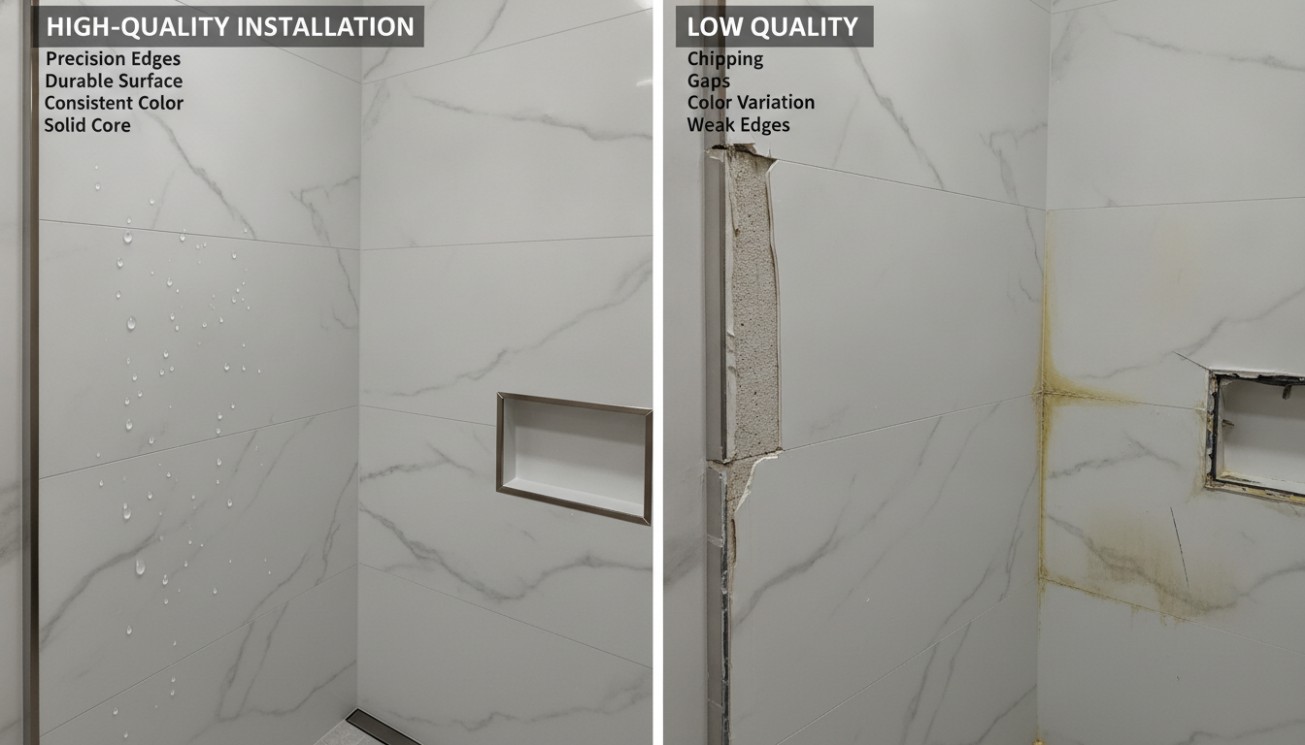
The core affects how the panel feels, cuts and stays flat. A stable core helps reduce warping, weak edges and poor joint alignment. Buyers should ask for sample boards and test cutting behavior. A panel that chips badly or bends too easily may create installation problems. A panel that is too brittle may also cause damage during transport or site handling.
Surface quality and decorative realism
Surface quality is one of the biggest differences between basic and premium decorative wall boards. For marble-look or stone-effect SPC panels, the pattern should not look flat or overly repeated. The gloss level should fit the project. The surface should resist normal cleaning and contact. Buyers should check whether the finish is matte, glossy, embossed, textured or UV-coated, and whether the supplier can keep color consistent across batches.
Thickness and panel size
Thickness is important, but it is not the only quality indicator. A thicker panel with a weak core may not outperform a thinner panel with better structure and surface. Large-format panels can create a more seamless wall, but they also require better packaging, handling and installation planning. Smaller panels may be easier for DIY users or small renovation teams, but they may create more joints.
Edge design and joint control
Edges are critical because they decide how the wall looks after installation. If edges are rough, uneven or poorly protected, the finished wall may look cheap. For wet areas, edge sealing is also part of moisture control. Buyers should check whether the product uses straight edges, tongue-and-groove joints, click systems, H-joints, trims or other connection methods.
Accessory system
A professional SPC product line should include more than panels. It should offer trims, internal corners, external corners, end caps, joining profiles, sealant recommendations, adhesive guidance and installation documents. Without accessories, even a strong panel can become difficult to install cleanly. The existing WPC wall panel installation guide shows how much the final wall depends on fixing methods, trims and wall preparation. SPC requires the same kind of system thinking.
Packaging and transport protection
SPC panels can be damaged if packaging is weak. Corners, edges and glossy surfaces need protection. For export, the buyer should check carton strength, pallet method, corner guards, surface film, labeling and loading plan. A low unit price can become expensive if panels arrive scratched, broken or bent.
Why SPC should be positioned as a wall system, not only a product

The strongest way to understand SPC wall panels is to see them as part of a complete wall system. The panel is only the visible part. The hidden part includes the substrate, adhesive, mechanical support, trims, sealant, joint design, installer skill, storage condition and maintenance plan.
This system view is especially important for distributors and building material wholesalers. If they sell SPC only as a sheet, customers may ask the same questions repeatedly: Can it be used in a shower? Can it cover old tiles? Which adhesive should be used? How are corners finished? Can shelves be fixed on it? How is it cleaned? Is it fire-rated? Will the color match next year? Can broken panels be replaced?
A supplier who can answer these questions clearly has a stronger product line. The buyer can create sample boards, installation displays, bathroom mockups, trim kits, technical sheets, packing standards and training content. That is how modern wall panel materials become easier to sell and easier to use.
For homeowners, the system reduces uncertainty
A homeowner may only want a cleaner bathroom wall or a modern marble-look feature wall. They do not want to become a material expert. A clear SPC system helps them understand what they are buying, how it will be installed, how it should be cleaned and where it should not be used.
For contractors, the system reduces installation risk
Contractors care about wall flatness, cutting, adhesive, corners, joints, fixture openings and callbacks. If the supplier provides clear installation guidance, the contractor can work faster and with fewer mistakes. If the supplier only provides panels, every installer must invent the details on site, which increases risk.
For distributors, the system creates a stronger product line
Distributors need products that can be displayed, explained, stocked, shipped and reordered. A complete SPC line can include several patterns, controlled sizes, matching accessories, installation kits, sample folders and project documentation. This makes SPC wall cladding more than a one-time decorative product. It becomes a category that can be developed over time.
Common mistakes in the SPC wall panel market
As SPC becomes more visible, several mistakes appear repeatedly. These mistakes do not mean the material is weak. They mean the category needs better explanation.
Mistake one: selling every SPC panel as suitable for every wall
No wall panel material fits every application. SPC may work well in bathrooms, kitchens, commercial interiors and renovation walls, but buyers still need to check heat exposure, outdoor conditions, fire requirements, substrate quality and local building rules. A product that performs well in a shower wall may not be suitable behind a stove or on an exposed exterior facade unless specifically approved.
Mistake two: confusing waterproof panels with waterproof construction
This is the most serious misunderstanding. A waterproof panel does not automatically create a waterproof wall. The finished system must include proper sealing, edge protection, corner treatment and wall preparation. If water enters behind the panel, the problem may not be the SPC core. It may be the installation detail.
Mistake three: judging quality by thickness alone
Thickness matters, but quality also includes density, surface treatment, dimensional stability, edge precision, pattern quality, packaging and supplier control. Buyers should test samples instead of accepting a simple thickness comparison.
Mistake four: ignoring the wall behind the panel
A damaged, damp or unstable wall should not be covered quickly just because the panel looks waterproof. If the wall has active leakage, loose tiles, mold, weak plaster or structural movement, the problem should be corrected before installation. SPC is a finishing material, not a cure for a failing substrate.
Mistake five: choosing a pattern without thinking about scale
A marble pattern may look good on a small sample but become repetitive on a full wall. A glossy panel may look premium in a showroom but create glare in a bathroom. A dark stone pattern may feel luxurious in a hotel lobby but make a small bathroom feel heavy. Pattern scale, lighting and room size should be considered together.
How SPC wall panels fit into the future of wall materials
The growth of SPC wall panels reflects a wider shift in building and renovation materials. Many projects need faster installation, cleaner renovation, lighter logistics, easier maintenance and more predictable visual results. Traditional materials such as tile, stone, wood and plaster are not disappearing. They still have strong roles. But panelized materials are becoming more important because they answer a different market need.
In residential renovation, people want less demolition and faster transformation. In hospitality, operators want repeatable room upgrades. In rental housing, landlords want walls that look clean and are easier to maintain. In retail and offices, designers want surfaces that create identity without custom construction. In distribution, wholesalers want product lines that can be explained through samples, specifications and installation kits.
Stone plastic composite wall panels fit this shift because they combine design flexibility with practical wall performance. They can create marble-look bathrooms, stone-effect commercial walls, clean kitchen backsplashes and modern feature surfaces. They can reduce grout-line maintenance and support faster installation when the wall condition is suitable. They can help suppliers build a more systematic wall panel category.
The future of SPC will not be decided only by who offers the cheapest panel. It will be shaped by who can provide better surface realism, stronger quality control, clearer installation systems, safer documentation, better packaging, more reliable accessories and more honest application guidance. Buyers will become more educated. They will ask not only what the panel looks like, but where it should be used, how it should be installed, how it should be maintained and what risks should be avoided.
Final perspective: SPC wall panels are valuable when they are selected with system logic
SPC wall panels are not just another decorative board in the wall covering market. Their real value comes from the way they combine a rigid composite core, waterproof positioning, decorative surface options and practical installation possibilities. They are especially relevant for bathrooms, shower walls, kitchens, hotels, apartments, commercial interiors and renovation projects that need a cleaner, faster and more maintainable wall finish.
But SPC should not be oversold. It is not magic. It does not repair bad walls, replace structural waterproofing, eliminate the need for sealing, or fit every high-heat, outdoor or high-abuse application. The best results come when buyers treat SPC as a wall system. That means checking the wall environment, choosing the correct panel grade, planning trims and edges, controlling installation details, testing samples, and asking suppliers for realistic technical support.
For homeowners, SPC can make bathroom and interior renovation easier. For contractors, it can reduce labor complexity when properly installed. For hotels and apartments, it can support repeatable wall upgrades. For distributors and importers, it can become a strong product line if the supplier provides stable quality, accessories, packaging and documentation. For the wall panel industry, SPC represents a practical movement toward waterproof wall panels that are not only decorative, but also easier to specify, install, clean and repeat.
The most professional way to position SPC is therefore simple: it is not a universal replacement for tile, stone, PVC, WPC or natural wood. It is a modern rigid wall panel system for projects where waterproof structure, decorative surface, installation speed and long-term maintenance all matter at the same time.
Focused FAQ
What are SPC wall panels?
SPC wall panels are decorative wall covering panels made with a stone plastic composite structure. They are commonly used for bathrooms, kitchens, shower walls, commercial interiors and renovation projects that need a rigid, moisture-resistant and low-maintenance wall surface.
What does SPC mean in wall panels?
SPC usually means stone plastic composite or stone polymer composite. In wall panels, it refers to a rigid composite core that combines mineral material and polymer material to create a stable decorative wall board.
Are SPC wall panels waterproof?
Many SPC wall panels are designed as waterproof wall panels, but the finished wall depends on proper installation. Edges, joints, corners, trims, sealant, adhesive and the wall substrate all affect final waterproof performance.
Can SPC wall panels be used in bathrooms?
Yes. Bathroom wall panels are one of the strongest applications for SPC. They can be used in shower walls, wet rooms, vanity areas and bathroom renovations when the product is suitable for wet areas and the installation is sealed correctly.
Are SPC wall panels better than tiles?
SPC panels are not automatically better than tiles. They are better when the project needs faster installation, fewer grout lines, easier cleaning and large decorative surfaces. Tiles may still be better for some high-abuse, high-heat or traditional applications.
What is the difference between SPC and PVC wall panels?
SPC panels usually have a denser and more rigid core, while PVC panels are often lighter and more flexible. SPC may feel more solid and stone-like, while PVC may be easier to handle in budget or lightweight applications.
What is the difference between SPC and WPC wall panels?
SPC is usually stronger for waterproof, bathroom and stone-look wall applications. WPC is often stronger for wood-look fluted walls, slat panels and warm decorative interiors. The right choice depends on wall environment and design purpose.
Can SPC wall panels be installed over old tiles?
SPC panels can often be installed over old tiles if the tile surface is clean, flat, dry and firmly bonded. Loose tiles, mold, active leakage or unstable walls should be repaired before installation.
Where should SPC wall panels not be used?
SPC wall panels should be used carefully near high heat, open flame, unstable substrates, active water leakage, exterior exposure without approval, or walls that must support heavy fixtures without proper backing.
How should buyers choose high-quality SPC wall panels?
Buyers should check core density, surface finish, thickness, edge precision, joint system, trim availability, waterproof installation guidance, color consistency, packaging quality and supplier documentation before sourcing stone plastic composite wall panels.
#SPCWallPanels #StonePlasticComposite #WaterproofWallPanels #BathroomWallPanels #SPCWallCladding #InteriorWallPanels #DecorativeWallBoards #WallPanelMaterials #BathroomRenovation #CommercialInteriors #BuildingMaterials #WallPanels #GlobalSupplyChain #FocusedFAQ