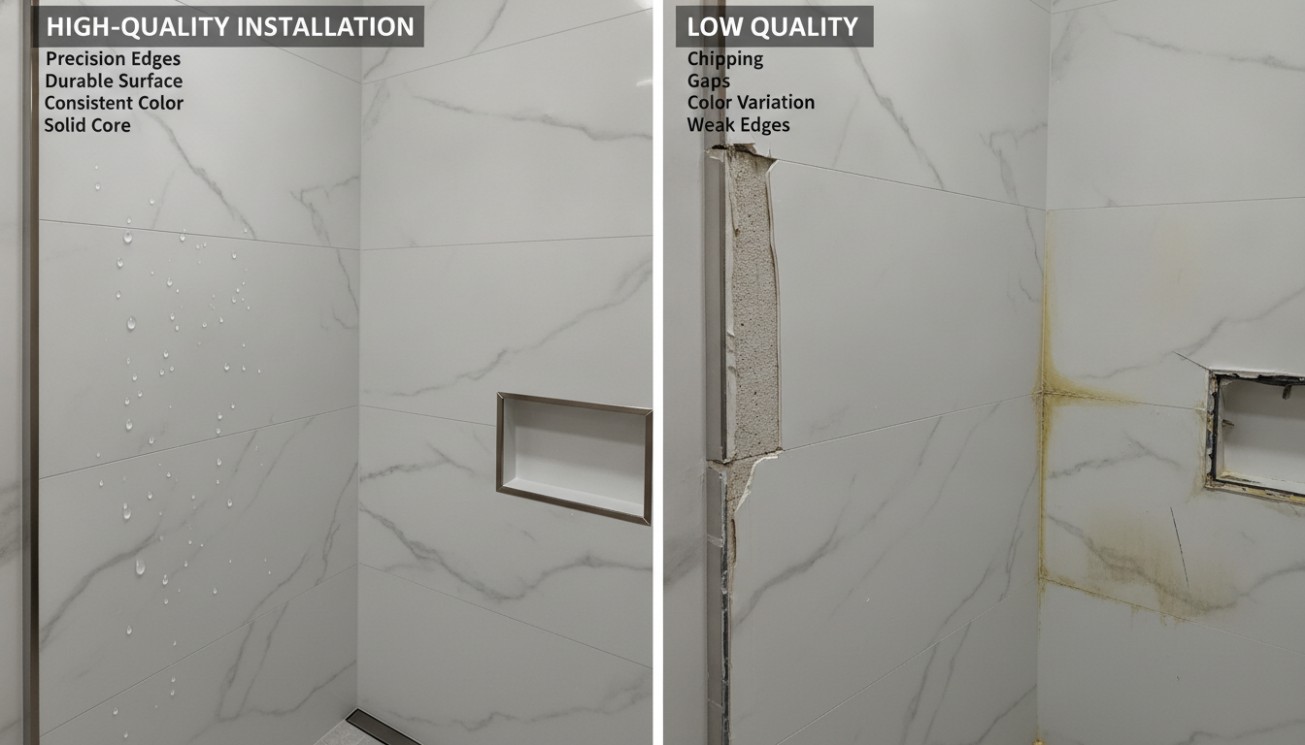
Why SPC Shower Wall Panels Are Becoming Popular in Wet Rooms and Bathrooms
Bathroom walls are a different category of interior wall
Most interior wall materials are judged by appearance first. A living room feature wall may need texture, warmth, rhythm, color or brand atmosphere. A hotel lobby wall may need visual identity and repeatable design. An office reception wall may need a clean background for lighting and signage. Bathroom walls are different. They are exposed to water, vapor, soap, cleaning chemicals, temperature changes, ventilation problems, pipe penetrations, corner joints and daily use in a smaller space. This is why SPC shower wall panels should not be understood as ordinary decorative panels moved into a bathroom.
A bathroom wall is closer to a working surface than a simple decorative surface. It must resist moisture, remain clean, support fixtures, coordinate with shower glass, handle edges around basins and floors, and still look acceptable after years of cleaning. In wet rooms and shower areas, the wall is part of the moisture-control system. This is the reason bathroom SPC wall panels are becoming more visible in renovation, hospitality, apartment, rental housing and modern residential bathroom projects.
The rise of wet room wall panels is not only about fashion. It is a response to real construction and maintenance problems. Tile walls remain common and valuable, but many buyers want fewer grout lines, faster installation, easier cleaning and a more continuous stone-look or marble-look wall surface. Contractors want systems that can be repeated. Importers want products that can be sampled, explained and sold with accessories. Hotel and apartment operators want bathrooms that can be renovated faster with lower maintenance pressure. These needs create the space where waterproof shower panels and SPC systems become relevant.
Earlier SPC content on this site introduced SPC wall panels as waterproof rigid wall systems and compared SPC wall panels vs tiles for bathroom renovation. This article goes deeper into one specific application: shower walls, wet rooms and high-moisture bathroom environments. The focus is not whether SPC can look attractive. The focus is how it works as a wall system in a room where water will test every weak point.
Why shower walls create a higher risk than normal walls

A standard interior wall usually faces dust, light contact and occasional cleaning. A shower wall faces repeated wetting, direct water flow, soap residue, shampoo, body oils, hot vapor, cleaning sprays and drying cycles. In a small bathroom with weak ventilation, moisture may remain on surfaces for a long time. This creates a very different performance requirement for bathroom wall cladding.
The center of a panel may perform well, but bathrooms usually fail at transitions. Corners, joints, pipe holes, tray edges, wall-to-floor connections, niches, shelves and exposed edges are more vulnerable than the middle of the panel. This is why a buyer should not ask only whether the panel material is waterproof. The better question is whether the complete shower wall panel system can control water at every transition.
The wall surface is only the visible layer
When people see a clean shower wall, they usually notice the surface first. They see marble patterns, stone effects, concrete looks, tile effects or modern plain colors. But the hidden system is more important. Behind the visible surface, the project may include plasterboard, cement board, old tiles, waterproof membrane, adhesive, mechanical fixing, trims, sealant and hidden pipe penetrations. If any of these parts are weak, the finished wall may fail even when the panel itself is water-resistant.
This is why SPC shower wall panels should be evaluated through the entire wall build-up. A rigid SPC panel may reduce visible grout lines and provide a clean surface, but it still needs a stable wall behind it. If the old wall has active leakage, mold, loose tiles or unstable plaster, installing a new panel over the problem will only hide the risk temporarily. A professional bathroom renovation begins with wall diagnosis, not product decoration.
Water does not need a large opening to create damage
In bathrooms, water often enters through small weaknesses. A tiny gap around a pipe, an unfinished internal corner, a poorly sealed bottom edge or a cracked bead of sealant can allow moisture to travel behind the visible wall. Once water reaches an enclosed space, it may dry slowly. This can lead to hidden mold, odor, staining, adhesive failure or substrate damage.
For this reason, waterproof wall panels for bathrooms must be installed with careful detailing. The panel may be waterproof, but water management depends on edge treatment. Buyers should pay attention to matching trims, corner profiles, sealant compatibility, recommended adhesive, wall flatness and whether the supplier provides installation guidance for wet areas.
What makes SPC useful in bathrooms and wet rooms
SPC is not the only wall panel material used in bathrooms. PVC, acrylic, laminate, compact boards, ceramic panels and tile systems all exist in the market. SPC becomes attractive because it combines a rigid composite core, decorative surface options and moisture-resistant positioning in a panel format that can create a modern bathroom wall.
SPC bathroom panels are especially relevant when the project needs a wall that looks more solid than lightweight plastic panels, installs faster than traditional tile in many renovation cases, and creates fewer joints than small-format wall finishes. They are also useful when the design requires stone-look, marble-look or large-format wall surfaces without using heavy natural stone slabs.
Rigid core behavior
The rigid core is one reason SPC feels different from many flexible plastic wall panels. A denser, more stable board can create a flatter visual surface and a stronger impression when used on large bathroom walls. This is important in modern bathrooms where the wall is highly visible under mirror lights, ceiling lights and natural window light.
However, rigidity has two sides. A rigid panel can look more solid, but it also demands better wall preparation. If the wall behind it is uneven, a large rigid panel may not sit properly. Installers need to check flatness before bonding. This is especially important for wet room wall panels, where the finished surface is often large and uninterrupted.
Large-format visual continuity
Bathrooms are often small rooms, but the walls are visually important. Grout lines, small tiles and busy patterns can make a small space feel more fragmented. Large SPC panels can create a calmer and more continuous surface. Marble-look and stone-look panels are especially popular because they can give a bathroom a hotel-style appearance without the cost and weight of real stone slabs.
This visual continuity is one reason grout free bathroom walls are attractive. The value is not only reduced cleaning. It is also design clarity. A wall with fewer visual interruptions can make a shower area feel larger, cleaner and more modern.
Lower daily cleaning pressure
Every bathroom surface needs cleaning. SPC does not remove maintenance, but it can reduce some of the cleaning problems associated with grout-heavy walls. With fewer joints, there are fewer places where soap residue and discoloration can collect. This is useful in family bathrooms, hotel bathrooms, rental apartments and shared housing where the user may not clean carefully after every shower.
For this reason, many buyers describe SPC as part of a low-maintenance bathroom strategy. A better phrase may be “easier maintenance” rather than “no maintenance.” Mold resistant wall panels still need ventilation, cleaning and correct installation. No wall panel can compensate for a bathroom with constant condensation, poor airflow and hidden water leakage.
Wet room design changes the role of wall panels
A wet room is not just a bathroom with a shower. It is usually a more open water environment where the shower area may not be fully enclosed by a traditional tray or curtain. Water can spread across floor and wall zones more freely. This makes wall detailing more demanding.
In this context, wet room wall panels must do more than decorate. They need to coordinate with floor falls, drains, glass partitions, waterproof membranes, wall-to-floor transitions and the general moisture plan of the room. A panel used in a dry bathroom vanity area faces a different level of risk than a panel used inside an open wet room shower zone.
Wet rooms need zone-based material planning
Professional bathroom design should divide the room into zones. The direct shower zone has the highest water exposure. The area near the basin has splash exposure. The wall behind a toilet may face humidity but less direct water. A ceiling or upper wall may face vapor more than liquid water. The same material may be acceptable in several zones, but the installation details may change.
For SPC shower wall panels, the most demanding zone is the shower wall itself. Here, the installer must pay special attention to vertical joints, internal corners, bottom edges and fixture penetrations. In lower-risk zones, the same product may be easier to install, but edge finishing and cleaning behavior still matter.
Open showers increase the value of fewer joints
Open showers expose more wall area to water and vapor. A wall system with many small joints creates more potential cleaning points. Large-format waterproof shower panels can reduce the number of visible joints and make the wet area easier to wipe down. This is one reason SPC is increasingly discussed for modern wet room bathrooms.
However, fewer visible joints do not mean no technical joints. The panel system still needs planned connections. Long walls may require joining profiles. Corners need finishing. Shower valve openings need sealing. The correct design is not to pretend the wall has no joints, but to move and control the joints intelligently.
The biggest advantage is not only waterproofing, but grout reduction

Many product descriptions focus on waterproof performance, but for end users, the more visible advantage is often grout reduction. Traditional tile walls use grout lines as part of the system and design. Grout can be attractive, but it can also become a maintenance burden. It may discolor, crack, absorb residue or require scrubbing.
Grout free bathroom walls appeal to people who want the bathroom to stay cleaner with less effort. They also appeal to commercial operators who do not want housekeeping teams spending extra time on grout-heavy walls. In hotels, student housing, rental apartments and senior living facilities, cleaning time is not only a user preference. It is an operating cost.
Grout lines are maintenance points
A tiled shower wall may include hundreds of grout lines. Each line is a potential visual and cleaning issue. In a well-built bathroom with good ventilation, high-quality grout and regular cleaning, the wall may perform very well. But many real bathrooms are not ideal. Ventilation may be weak. Users may not dry the walls. Cleaning may be irregular. Hard water may leave mineral marks.
Large-format SPC bathroom panels reduce the number of joints. This does not make them maintenance-free, but it simplifies the wall surface. For many buyers, this is the practical reason to consider SPC in a shower area.
Cleaning expectations should still be realistic
It would be misleading to describe SPC as a wall that never needs care. Soap, minerals and cleaning residue can still build up on any surface. Glossy surfaces may show water spots. Textured surfaces may need more careful wiping. Sealant lines still need inspection. The correct promise is not zero maintenance. The correct promise is fewer grout-related cleaning problems when the product is installed and maintained properly.
SPC shower panels should be sold as a system, not as loose boards

The difference between a low-risk SPC bathroom project and a problem project often comes down to system completeness. A panel without the right accessories leaves too many decisions to the installer. A strong shower wall panel system should include panels, trims, joining profiles, internal corners, external corners, end caps, adhesive guidance, sealant guidance, cutting guidance, substrate requirements and cleaning instructions.
This is especially important for B2B buyers. Importers, distributors and wholesalers do not only need attractive product photos. They need a product line that can be explained to contractors, retailers, showrooms and end users. If a customer asks how to finish an inside corner, the distributor needs a clear answer. If a contractor asks which adhesive to use over old tile, the supplier needs documented guidance. If a hotel buyer asks how to handle future replacement, the product line should support repeat supply.
Trims decide how professional the wall looks
Trims are often treated as small accessories, but they strongly influence the finished bathroom. Internal corners, external corners, end caps and joining profiles can make the wall look intentional rather than improvised. Poor trim selection can make a good panel look cheap. In shower areas, trims also help protect edges and control water exposure.
For this reason, bathroom wall cladding should be purchased with matching accessories whenever possible. A buyer who sources panels from one supplier and random trims from another supplier may face color mismatch, fit problems or installation uncertainty.
Sealant compatibility matters
Sealant is one of the smallest but most important parts of a wet wall system. The wrong sealant can fail, discolor, lose adhesion or react poorly with the panel surface. Suppliers should provide recommendations for compatible sealants and wet-area use. Contractors should follow the guidance rather than using whatever material is already on site.
In a shower wall, the sealant line may be the final defense at corners, tray edges and pipe penetrations. If that line fails, water can reach the wall behind the panel. This is why the system view is essential.
Where SPC bathroom panels work best

SPC bathroom panels are not automatically the best option for every bathroom, but they are very suitable for certain project conditions. Understanding these conditions helps buyers avoid both underusing and overpromising the material.
Residential bathroom renovation
In residential renovation, the homeowner often wants a cleaner bathroom without a long construction period. SPC panels can be attractive when the existing wall is suitable, the design goal is modern, and the homeowner wants fewer grout lines. Marble-look and stone-look panels are common choices because they create a strong visual upgrade quickly.
The key is wall inspection. If old tiles are firmly bonded and flat, some systems may allow installation over existing tile after proper preparation. If the wall is damaged, loose or damp, the old problem must be repaired first. Waterproof wall panels for bathrooms should not be used as a cover for hidden failure.
Hotel bathrooms
Hotels need bathrooms that can be cleaned efficiently and renovated with limited downtime. A guest may not notice the technical difference between tile and SPC, but hotel operators care about maintenance time, room closure, cleaning complaints and repeatable replacement. SPC shower wall panels can be useful when the hotel wants a consistent stone-look bathroom wall across many rooms.
For hotel use, the buyer should check batch consistency, surface durability, cleaning chemical resistance, fire documentation where required, spare panel availability and installation training. A hotel project is not a single bathroom. It is a repeatable system.
Rental apartments and student housing
Rental properties face frequent user turnover and uneven cleaning behavior. Walls must be practical, not only attractive. Mold resistant wall panels can help reduce some surface maintenance problems when used with proper ventilation and sealing. Fewer grout lines can make cleaning easier between tenants.
However, rental projects also need repair planning. If a panel is damaged, can the same pattern be replaced later? Can the distributor keep stock? Are trims available? Are installers trained? These questions matter because rental bathrooms may require future repairs more often than owner-occupied homes.
Senior living and accessible bathrooms
Accessible bathrooms often use open showers, grab bars, seats and wider wet zones. These spaces need careful wall planning. SPC panels may provide a cleaner surface, but fixture support is critical. Grab bars and seats should not rely only on the panel. They need proper backing and structural fixing behind the wall.
For this reason, wet room wall panels in accessible bathrooms should be planned with the whole wall assembly. The decorative panel is only one layer. Safety fixtures must be fixed into suitable structural support.
Where SPC shower wall panels should be used with caution
A strong material category becomes more credible when its limits are explained honestly. SPC shower wall panels have real advantages, but they should not be used carelessly in every bathroom condition.
Walls with active leakage or mold
If the existing wall has active leakage, mold, damp patches or rotten substrate, panel installation should be delayed until the problem is repaired. Covering damage with a decorative panel may make the bathroom look clean for a short time, but hidden moisture can continue to spread behind the wall.
Very uneven walls
Large rigid panels need a reasonably flat surface. If the wall is uneven, bowed or patched poorly, the finished panel may not bond correctly or may show gaps. Wall preparation is especially important for large-format waterproof shower panels. The larger the panel, the more visible alignment problems can become.
High heat or open flame areas
Bathrooms usually do not have open flame exposure, but some mixed-use spaces may place panels near heaters, saunas, steam equipment or high-temperature fixtures. SPC suitability should be confirmed for those conditions. The product should not be assumed suitable for high heat simply because it is used in wet areas.
Walls requiring heavy fixtures without backing
Shower seats, grab bars, floating shelves, heavy mirrors and cabinets require proper support. The panel itself is not a structural wall. Heavy fixtures should be anchored into appropriate backing or substrate according to the installation requirements. This is especially important in commercial and accessible bathroom projects.
How buyers should evaluate SPC shower wall products
For importers, distributors and contractors, selecting bathroom SPC wall panels is not only a design choice. It is a sourcing decision. A good product line should reduce installation questions, reduce damage risk, support repeat orders and create confidence in the wet-area application.
Check wet-area suitability first
Buyers should confirm whether the product is recommended for shower walls and wet rooms. Some decorative panels may be suitable only for dry interior walls. If the supplier cannot clearly explain wet-area use, sealing details and substrate requirements, the buyer should be cautious.
Review the accessory range
Panels without accessories are harder to sell and harder to install. A complete shower wall panel system should include profiles for corners, edges and joints. The accessory finish should match the panel style. The system should allow installers to create a clean wall without improvising at every transition.
Inspect surface behavior
Bathroom surfaces are touched, cleaned and exposed to water marks. Buyers should test the surface with normal cleaning methods. They should check whether the finish scratches easily, whether glossy panels show marks too strongly, whether textured panels trap dirt, and whether the pattern looks realistic at full wall scale.
Test cutting and edge quality
Cut edges are common in bathrooms because panels must fit around corners, ceilings, floors, shower controls and pipe openings. Buyers should test cutting behavior before placing large orders. Chipping, cracking or rough edges can increase installer complaints.
Ask for installation documentation
A supplier should provide clear installation instructions. These should include wall preparation, adhesive guidance, trim placement, joint spacing, cutting tools, sealing method, storage and cleaning. Without documentation, every contractor may install the product differently, which increases failure risk.
The same sourcing discipline appears in other wall panel categories. The guide on wall panel installation with adhesives, clips, battens and trims shows why installation method and substrate preparation can decide final performance. SPC bathroom panels need the same level of installation discipline, especially in wet zones.
Why commercial buyers care about repeatability
For a homeowner, one successful bathroom is enough. For a hotel group, apartment operator, builder or distributor, one bathroom is only the beginning. Commercial buyers care about repeatable results. They need the same color, the same trims, the same installation method and the same maintenance logic across many rooms.
This is where SPC bathroom panels can become a business category rather than a single renovation product. A distributor can build a showroom display with several patterns, matching trims and bathroom installation samples. A contractor can standardize cutting and sealing steps. A hotel buyer can approve a wall system for multiple rooms. A property operator can keep spare panels for future repair.
Repeatable bathrooms reduce project uncertainty
In commercial renovation, uncertainty is expensive. If every bathroom requires different tile cutting, grout color matching and installer decisions, project control becomes harder. A panelized system can reduce some of this uncertainty when it is designed and supplied properly.
This does not mean panel systems remove all skill. Installers still need training. But a well-documented shower wall panel system can make the process easier to repeat than a custom tile design in every room.
Maintenance teams need simple surfaces
Hotel and apartment maintenance teams prefer surfaces that are easy to understand and clean. Grout free bathroom walls can reduce some cleaning complexity because there are fewer grout lines to monitor. If a wall surface can be cleaned quickly without special procedures, it becomes more attractive in commercial use.
However, maintenance teams still need instructions. They should know what cleaning chemicals are acceptable, how to inspect sealant lines, how to report edge damage and how to avoid abrasive tools that may damage the surface.
SPC shower wall panels and design expectations
Performance matters, but bathrooms are also emotional spaces. Users judge bathrooms quickly. A clean, modern bathroom can improve the perception of a home, hotel room, apartment or commercial property. This is why design is central to the growth of SPC shower wall panels.
Marble-look panels create a hotel-style bathroom
One of the most popular SPC bathroom looks is marble. Marble-look panels create a premium impression without using heavy natural stone slabs. In small bathrooms, a light marble pattern can make the room feel brighter and larger. In hotels, it can create a consistent luxury signal across many rooms.
The risk is pattern quality. A cheap printed marble can look artificial on a large wall. Buyers should review full-size samples, not only small swatches. They should also check whether pattern repeats are too obvious and whether panels can be arranged in a visually balanced way.
Stone-look panels support calmer wet rooms
Grey stone, limestone, concrete and soft mineral patterns are common in wet rooms because they create a calm background. These finishes can coordinate well with black shower frames, brushed metal fixtures, wood-look vanity units and simple lighting. Matte or low-gloss surfaces may look more natural in these settings.
Tile-look SPC can reduce maintenance while keeping a familiar style
Some users still like the look of tiles but dislike grout maintenance. Tile-look SPC panels can serve this middle ground. They give the visual reference of tile but reduce the number of actual grout lines. This is useful in markets where customers still expect a bathroom to look tiled, but project owners want easier maintenance.
Practical installation principles for wet areas
Installation details vary by product, but several principles apply to most waterproof wall panels for bathrooms. These principles help buyers understand why supplier guidance matters.
Start with a dry and stable wall
The substrate should be dry, stable, clean and suitable for bonding or fixing. Dust, oil, loose paint, weak plaster and dampness can reduce adhesion. Old tiles must be firmly bonded if the system allows installation over tiles. Any loose or hollow tile should be removed and repaired.
Plan panel layout before cutting
Panel layout affects the final appearance. Installers should avoid awkward narrow strips where possible. Pattern direction should be considered. Joints should be placed logically. In marble-look panels, vein direction and visual balance should be planned before adhesive is applied.
Seal penetrations carefully
Shower valves, pipes, outlets, brackets and shelves create openings in the panel. These openings must be sealed according to the system instructions. A clean front surface means little if water can enter around a pipe.
Protect bottom edges and corners
Bottom edges and internal corners are high-risk areas. Water can sit or collect there. Trims, sealants and correct transitions to trays, floors or adjoining walls are essential. The installer should not leave raw edges exposed in wet zones.
Final perspective: SPC is popular because it solves bathroom operating problems, not only design problems
The popularity of SPC shower wall panels in bathrooms and wet rooms comes from a combination of design, construction and maintenance logic. They offer a modern surface, fewer grout lines, large-format visual continuity and practical moisture-resistant positioning. They can help homeowners renovate faster, help hotels standardize bathrooms, help landlords reduce cleaning pressure and help distributors build a more explainable bathroom wall category.
But SPC succeeds only when it is treated as a system. A panel alone is not enough. The finished wall depends on substrate condition, layout planning, adhesive, trims, sealant, edges, pipe holes, corners, cleaning guidance and realistic application limits. The product should not be sold as a magic waterproof sheet. It should be sold as a complete bathroom wall solution with clear boundaries.
This is the difference between basic product marketing and real industry understanding. Waterproof shower panels matter because bathrooms expose every weak detail. Mold resistant wall panels matter only when ventilation, cleaning and installation are also controlled. Grout free bathroom walls are valuable because they reduce daily maintenance, but they still require edge inspection and proper care. Bathroom SPC wall panels are not replacing every tile wall. They are becoming important in the spaces where speed, clean design, easier maintenance and repeatable wet-area installation matter more than traditional construction habits.
For buyers, the best question is not simply whether SPC is suitable for bathrooms. The better question is whether the specific SPC system is suitable for the specific bathroom wall. If the wall is stable, the product is designed for wet areas, the accessories are complete and the installation is disciplined, SPC can be a strong modern solution for showers and wet rooms. If those conditions are missing, even a good-looking panel can become a weak bathroom wall.
Focused FAQ
Are SPC shower wall panels suitable for wet rooms?
SPC shower wall panels can be suitable for wet rooms when the product is designed for wet-area use and the installation includes proper sealing, trims, substrate preparation and moisture-control details. The panel should be treated as part of a complete wall system.
Are SPC bathroom panels waterproof?
SPC bathroom panels are often designed as water-resistant or waterproof panels, but finished wall performance depends on joints, corners, edges, pipe penetrations, adhesive, sealant and the wall behind the panel.
Can SPC panels be used inside a shower?
Yes, many SPC shower wall panels are used inside shower areas. Buyers should confirm that the specific product is recommended for shower use and that the supplier provides wet-area installation guidance.
Do SPC wall panels prevent mold?
Mold resistant wall panels can reduce surface maintenance problems when they are installed and cleaned correctly, but they cannot solve hidden leakage, poor ventilation or existing mold behind the wall. Moisture control is still necessary.
Are grout free bathroom walls easier to clean?
Grout free bathroom walls are usually easier to wipe and maintain because they have fewer grout lines where soap residue, discoloration and mold can collect. They still require regular cleaning and sealant inspection.
Can SPC wall panels be installed over old bathroom tiles?
Some SPC systems can be installed over old tiles if the surface is clean, flat, dry and firmly bonded. Loose tiles, active leakage, mold or unstable walls should be repaired before installing waterproof wall panels for bathrooms.
What accessories are needed for an SPC shower wall system?
A professional shower wall panel system should include panels, internal corner profiles, external corner profiles, joining trims, end caps, compatible adhesive, sealant guidance and installation instructions.
Are SPC panels better than tiles for shower walls?
SPC panels may be better when the project needs faster renovation, fewer grout lines and easier cleaning. Tiles may still be better for traditional premium bathrooms, complex designs or projects requiring ceramic material authenticity.
What should buyers check before sourcing bathroom SPC panels?
Buyers should check wet-area suitability, panel rigidity, surface durability, edge quality, trim availability, sealant compatibility, installation documents, packaging protection and supplier support before sourcing bathroom SPC wall panels.
Where should SPC shower panels be used with caution?
SPC shower panels should be used carefully on uneven walls, damaged substrates, areas with active leakage, walls requiring heavy fixtures without backing, and any high-heat environment unless the supplier confirms suitability.
#SPCShowerWallPanels #BathroomSPCWallPanels #WetRoomWallPanels #WaterproofShowerPanels #BathroomWallCladding #GroutFreeBathroomWalls #SPCBathroomPanels #ShowerWallSystem #BathroomRenovation #WaterproofWallPanels #MoldResistantWallPanels #BuildingMaterials #FocusedFAQ