SPC Wall Panels vs Tiles: Are They a Better Choice for Bathroom Renovation?
Bathroom wall decisions are no longer only about choosing tiles

For decades, ceramic and porcelain tiles have been the default answer for bathroom walls. They are familiar, durable, widely available and accepted by homeowners, contractors, designers and building material distributors. In many projects, tile is still the right answer. But the bathroom renovation market has changed. Buyers now care about installation speed, demolition dust, grout maintenance, labor shortage, apartment turnover, hotel room downtime, rental property maintenance and whether a wall can be upgraded without rebuilding the entire wet area.
This is why the comparison between SPC wall panels vs tiles has become more important. The question is not simply whether one material is better than the other. The real question is: which wall system solves the actual renovation problem more efficiently?
SPC wall panels are often promoted as waterproof, rigid and easy to clean. Tiles are promoted as traditional, durable and premium. Both descriptions can be true, but they are incomplete. A bathroom wall is not judged only by the front surface. It is judged by substrate condition, installation method, waterproof detailing, joint control, cleaning behavior, repair options, fixture integration, cost structure and the skill level required on site.
When buyers search for tile alternative wall panels, they are usually not rejecting tiles completely. They are trying to solve specific tile-related problems: slow installation, grout discoloration, mold in joints, expensive labor, demolition mess, difficult maintenance or the desire for a larger, more seamless wall appearance. This article explains where bathroom wall panels instead of tiles make sense, where tiles still win, and how contractors, importers, distributors and homeowners should compare both materials with realistic project logic.
If you need a broader material comparison beyond SPC and tiles, the existing guide on WPC, PVC, SPC and wood wall panels explains why wall material selection should begin with environment and application rather than trend. This article narrows the focus to bathroom renovation, where the decision between tiles and SPC becomes most visible.
Why tiles became the bathroom standard in the first place

Before comparing SPC wall panels vs tiles, it is important to understand why tiles have dominated bathroom walls for so long. Tiles became standard because they solve real problems. They handle water exposure well when installed correctly. They resist cleaning chemicals. They are available in countless sizes, colors, textures and price levels. They are accepted by contractors and homeowners. They also carry a strong perception of permanence.
A well-installed porcelain tile wall can last many years. It can feel solid, traditional and high-value. In premium bathrooms, tiles can still deliver a level of material authenticity that many panel systems cannot fully replace. Large porcelain slabs, handmade ceramic tiles, textured feature tiles and natural stone tiles all have design value that goes beyond simple wall coverage.
However, tile is not only a material. It is also an installation process. That process usually includes substrate preparation, waterproofing membrane where required, tile layout, adhesive or mortar, cutting, leveling, spacers, grout, curing, cleaning and sometimes sealing. In new construction, this may be acceptable. In fast renovation, it can become a problem.
The strength of tiles is also their limitation
Tiles are strong because they are mineral, hard and long-lasting. But the same qualities also make them slower to install, heavier to handle and more difficult to remove. Cutting tile creates dust and noise. Old tile demolition can damage the wall behind it. Grout lines create maintenance points. Small format tiles require many joints. Complex layouts require skilled labor. Repairing a cracked tile or failed grout line may not be as simple as replacing a panel.
This does not make tiles outdated. It simply means tile is not the only logical answer for every bathroom. In rental housing, hotels, budget renovations, senior living units, prefabricated bathroom upgrades, fast apartment turnover and wet wall retrofits, speed and maintainability may matter as much as tradition.
What SPC wall panels bring to bathroom renovation
SPC wall panels are stone plastic composite wall panels designed to provide a rigid, decorative and moisture-resistant wall surface. In bathroom applications, they are usually discussed as waterproof bathroom panels, SPC shower panels, wet wall panels or tile replacement panels. These terms do not always mean exactly the same thing, but they point to the same buyer demand: a cleaner and faster wall finish for wet or humid interior spaces.
The main value of SPC is not that it imitates tile perfectly. Its value is that it changes the renovation workflow. Instead of setting many individual tiles, the installer works with larger panels. Instead of creating many grout joints, the wall can have fewer visible joints. Instead of relying on grout as part of the finished appearance, the system uses panel edges, trims, sealants and connection details. Instead of treating the wall as a field of small units, SPC treats it as a panelized surface.
This is why grout free shower panels are attractive to many homeowners and project buyers. Grout is not automatically bad, but it is one of the most common maintenance concerns in bathrooms. Grout can discolor, crack, collect soap residue or require periodic cleaning. A wall system with fewer grout lines can reduce this daily maintenance burden, especially in shower areas, rental bathrooms and hotel rooms.
The first SPC category article, SPC wall panels waterproof rigid wall systems, explains why SPC should be understood as a complete wall system rather than only a decorative sheet. This point is essential in a bathroom comparison. A waterproof panel alone does not create a successful bathroom wall. The wall system must include correct installation, sealed edges, stable substrate and suitable accessories.
SPC wall panels vs tiles: the real comparison points
The most useful way to compare SPC wall panels vs tiles is not to ask which one is “better.” That question is too broad. A more professional comparison asks how each option performs in the areas that decide bathroom renovation success.
Installation speed
Installation speed is one of the strongest arguments for bathroom renovation panels. SPC panels usually cover a larger wall area with fewer pieces. This can reduce layout time, joint work and finishing time. In renovation projects where the existing wall is stable and suitable, some panel systems may be installed over old tile or other prepared surfaces, reducing demolition work.
Tiles usually require more steps. Even when tile installation is done by an experienced professional, it involves setting individual pieces, controlling alignment, cutting edges, spacing, grouting and curing. In a small bathroom, this may not seem like a major issue. In a hotel, apartment block or multi-room renovation, it can become a significant labor and scheduling factor.
For contractors, faster installation does not only mean fewer hours. It also means less disruption, fewer site visits, less drying time and potentially faster project handover. For commercial operators, it may mean less downtime. For landlords, it may mean a rental unit returns to the market sooner.
Grout maintenance
Grout is one of the key reasons buyers consider tile alternative wall panels. A tile wall has many joints. Those joints can be beautiful when new, but they are also places where cleaning becomes more complicated. In showers, grout lines can collect soap, mineral deposits and discoloration. If ventilation is poor, mold risk increases.
Low maintenance bathroom walls are not about avoiding cleaning altogether. Every bathroom wall needs cleaning. The difference is the number of points where dirt and moisture can collect. SPC panels can create a smoother wall with fewer visible joints. This makes routine cleaning easier, especially in shower enclosures, wet rooms, hotel bathrooms and rental properties where users may not maintain the space carefully.
Tiles still have an advantage in long-term mineral durability, but grout maintenance remains a real issue. High-quality grout, correct installation and good ventilation can reduce problems, but they do not remove grout from the maintenance equation.
Waterproof performance
Waterproofing is often misunderstood in both tile and panel markets. Tiles are water-resistant, but a tiled wall is not automatically waterproof unless the substrate, membrane, grout, corners and penetrations are handled correctly. SPC panels may be waterproof in the core, but a finished SPC wall is not automatically waterproof unless edges, joints, trims and sealants are handled correctly.
This is why professional buyers should compare systems, not slogans. A tiled shower with poor waterproofing can fail. A panel shower with poor sealing can also fail. The difference is not only material; it is detail discipline.
When evaluating waterproof bathroom panels, buyers should ask several questions. Is the panel approved or recommended for shower areas? What sealant should be used? How are internal corners treated? How are pipe penetrations sealed? How is the bottom edge finished? Can the panel be installed over old tiles? What substrate is required? How are vertical joints handled? How are external corners finished?
The guide on wall panel waterproof claims and moisture limits makes a useful point for all panel categories: water resistance must be judged through edges, joints, substrate and installation conditions. SPC has a strong bathroom position, but it still follows the same rule.
Surface appearance
Tiles offer huge design flexibility. They can be small, large, textured, handmade, glossy, matte, patterned or stone-look. They can create a traditional, modern, rustic, minimalist or luxury bathroom. In design freedom, tile remains very strong.
SPC panels offer a different kind of appearance. They are often designed as marble-look, stone-look, concrete-look, tile-look or plain modern surfaces. Their advantage is visual continuity. A large SPC panel can create a broad surface with fewer interruptions. This is why SPC is attractive for modern bathrooms that want a clean hotel-style wall.
However, surface quality matters greatly. Low-quality SPC can look printed, flat or repetitive. A poor marble pattern may look acceptable on a sample but cheap on a full wall. A high-gloss panel can look luxurious in a showroom but too reflective under bathroom lighting. A matte stone-effect panel may look more natural but may need texture control for easy cleaning.
Tiles are usually more accepted in high-end traditional bathrooms. SPC is often stronger when the project wants a modern, clean, fast and panelized surface. The right choice depends on the design goal.
Cost structure
Many buyers ask whether bathroom wall panels instead of tiles are cheaper. The answer depends on what is included in the cost comparison. If only material price per square meter is compared, tiles may appear cheaper in some markets. But material price is not the full bathroom cost.
A realistic cost comparison should include demolition, wall preparation, waterproofing, adhesive, grout, trims, labor, waste, tool cost, site time, cleaning, repair risk and downtime. SPC may reduce some labor and time costs, especially in renovation. Tiles may be cost-effective when installers are available, the substrate is ready and the design uses standard sizes.
For B2B buyers, the cost question is even broader. Importers and distributors should consider packaging, breakage, storage, accessories, sample display, installer training, complaint handling and repeat orders. A cheap panel that creates installation problems may cost more than a slightly more expensive system with better documentation and trims.
When SPC wall panels can be the better choice

SPC wall panels vs tiles is not a universal competition. SPC becomes the stronger choice when the project has specific conditions that match its advantages.
Fast bathroom renovation
SPC is especially useful when speed matters. A bathroom renovation in a rental unit, hotel room, student housing apartment, senior living facility or serviced apartment may have a short work window. The operator wants a clean, presentable and durable wall with less downtime.
In these cases, bathroom renovation panels can reduce installation complexity. If the wall is suitable, the project may avoid full tile demolition. Larger panels can cover more area quickly. Fewer grout lines reduce finishing work. The result is not always cheaper in material price, but it may be more efficient in total project time.
Grout-free shower walls
For many users, the strongest emotional reason to choose SPC is grout. They do not want to scrub grout lines. They do not want discoloration. They do not want moldy joints. They want a cleaner shower wall surface.
Grout free shower panels answer this need directly. They create a larger surface with fewer joints and less daily cleaning stress. This is particularly useful in bathrooms used by multiple people, rental bathrooms, hospitality bathrooms and wet rooms where maintenance must be simple.
Modern stone-look walls without stone weight
SPC panels can provide marble-look or stone-effect surfaces without the weight and installation complexity of natural stone. This is useful in bathrooms where the designer wants a premium visual effect but the project cannot support the cost, fabrication or handling requirements of real stone slabs.
This logic is similar to the broader stone-look wall market. The guide on PU stone panels vs real stone veneer explains how buyers often compare stone-look products through weight, labor, shipping and installation risk, not just appearance. SPC follows a similar practical logic in bathroom walls.
Multi-room and repeatable projects
Hotels, apartment operators and developers often need repeatability. A single luxury bathroom can justify custom tile work. A 100-room renovation may require a more controlled wall system. SPC can be attractive because panels, trims, patterns and installation methods can be standardized.
Repeatability is not only a design issue. It affects purchasing, inventory, installer training, repair parts and future renovation. If a distributor can supply consistent SPC colors, matching trims and clear installation guidance, the system becomes easier to specify across multiple rooms or projects.
When tiles are still the better choice
A professional article should not claim that tile replacement panels should replace tile everywhere. Tiles remain better in many situations.
High-end traditional bathrooms
In premium residential projects, especially where the buyer wants natural ceramic texture, handmade tile variation, mosaic details or traditional craftsmanship, tiles may provide a stronger design result. SPC can imitate stone or tile looks, but it cannot fully replace the material authenticity of high-quality ceramic, porcelain or natural stone tile.
Complex layouts and custom details
Bathrooms with many niches, curves, benches, built-in shelves, decorative borders or complex tile patterns may still be better served by tile. Panel systems work best when large, relatively flat wall areas can be planned cleanly. They can handle corners and cutouts, but too many interruptions may reduce their advantage.
Very high heat or special code requirements
Tiles are mineral materials and may be more suitable in areas with high heat exposure or strict fire-performance expectations. SPC should not be assumed suitable for every heat-adjacent or code-sensitive area unless the supplier provides clear documentation. Bathrooms usually do not have high heat wall demands, but some mixed-use areas, spa facilities or commercial environments may require extra verification.
Projects where long-term resale expectations favor tile
In some markets, homeowners and real estate buyers still associate tile with long-term value. Even if SPC performs well, buyers may perceive tile as more permanent. For high-value residential properties, local market expectation should be considered. A material can be practical and still face perception barriers.
Important risks when using SPC panels in bathrooms

SPC shower panels can be practical, but only when risks are controlled. Most failures do not come from the idea of SPC itself. They come from poor substrate assessment, weak sealing, wrong adhesive, unfinished edges or unrealistic application claims.
Risk one: hiding wall problems behind panels
SPC should not be used to hide active leakage, mold, rotten substrate, loose plaster or unstable tile. If the wall behind the panel is failing, the finished surface may look good for a short time but problems can continue behind it. A waterproof-looking surface can create false confidence if the underlying wall is not corrected.
Risk two: poor edge and corner sealing
Bathrooms fail at edges, not only in the middle of panels. Internal corners, external corners, bottom edges, pipe penetrations and shower tray transitions must be sealed correctly. A panel core may resist water, but water can still enter through open joints.
Risk three: using the wrong adhesive
Adhesive must match the panel backing, wall substrate and wet-area requirements. A general-purpose adhesive may not be suitable. Some systems may require specific bonding methods, mechanical support, double-sided tape during curing or specialist sealants. Installation documents should not be ignored.
Risk four: treating large panels like small tiles
Large panels behave differently from tiles. They need flat walls, careful measurement, controlled cutting and proper handling. A wall that can be adjusted tile by tile may not be suitable for a large panel without preparation. Installers must check wall flatness before installation.
Risk five: choosing appearance without checking quality
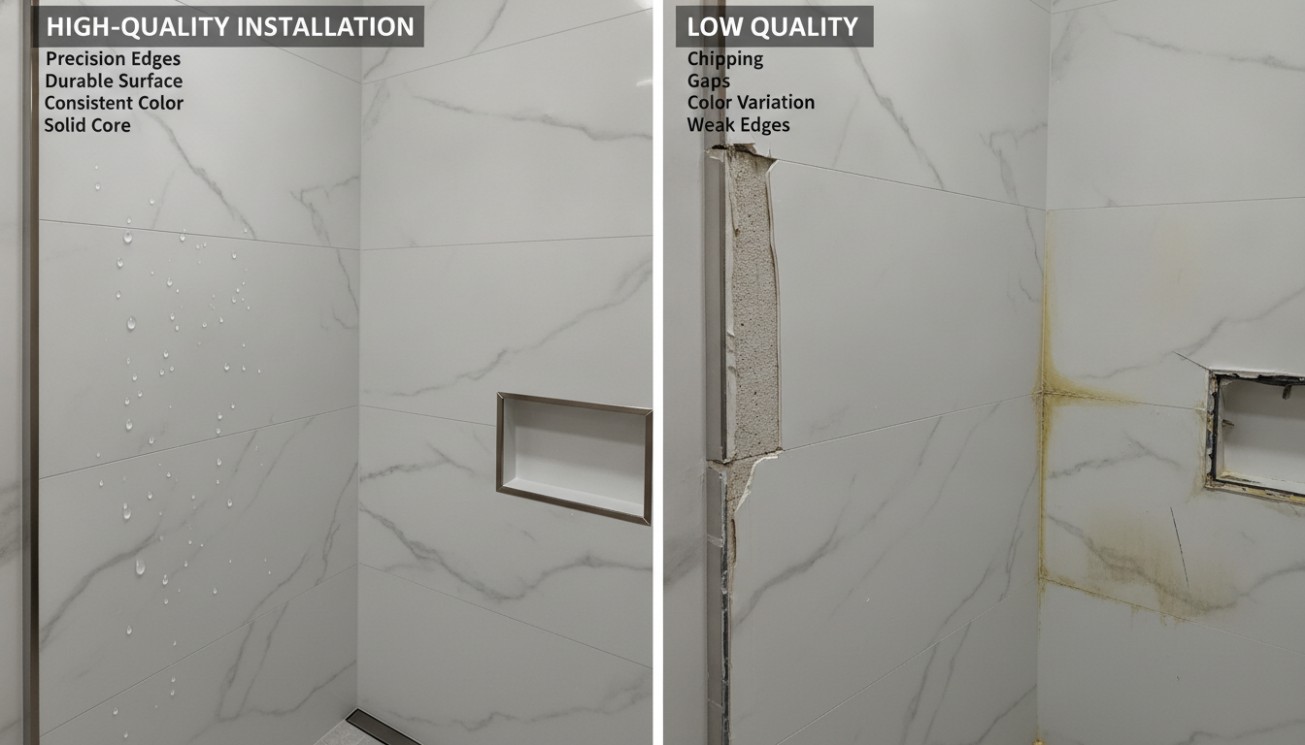
A bathroom wall is exposed to moisture, cleaning and daily use. A nice pattern is not enough. Buyers should check surface durability, color consistency, scratch resistance, cleaning behavior, edge quality, panel flatness and packaging protection.
The related wall panel installation guide for WPC shows how installation details, trims and substrate preparation can decide final wall quality. Although SPC installation is different, the same principle applies: a panel material succeeds only when the installation system is respected.
How contractors should explain SPC vs tiles to customers
Contractors should avoid presenting the decision as a simple upgrade or downgrade. Instead, they should explain the trade-offs clearly. A customer who wants a traditional, long-lasting, ceramic bathroom may still prefer tile. A customer who wants a faster, cleaner, grout-reduced renovation may prefer SPC.
Explain the difference between material and system
Customers often ask, “Is it waterproof?” The contractor should explain that both tile and SPC need correct installation. Tiles need waterproofing and grout discipline. SPC needs sealed joints, trims and suitable substrate. This builds trust because it avoids unrealistic promises.
Show full-size samples, not only small swatches
SPC patterns can look different on a large wall than on a small sample. Contractors and distributors should show larger boards or installed displays whenever possible. This is especially important for marble-look and stone-effect panels. Customers need to see pattern scale, gloss and joint appearance.
Compare maintenance honestly
The maintenance difference is one of the most persuasive points for low maintenance bathroom walls. Contractors can explain that SPC reduces grout-line cleaning, but the wall still needs regular cleaning and seal inspection. This is more credible than promising a maintenance-free bathroom.
Discuss repair and future replacement
Tiles and SPC repair differently. A cracked tile may be replaced individually if matching tile is available. A damaged panel may require replacing a larger section. The customer should understand the repair logic before choosing. For hotels or apartments, stocking spare panels can be part of the project plan.
How importers and distributors should position SPC bathroom panels
For importers and building material distributors, waterproof bathroom panels are not only a product. They are a category that must be packaged, displayed, explained and supported. A distributor who sells SPC only by pattern and price will struggle when customers ask installation questions.
Create a bathroom system offer
A strong SPC bathroom program should include panels, trims, corners, adhesives, sealant guidance, sample books, installation instructions, maintenance guidance and display walls. The product line should make the buyer feel that the supplier understands the entire bathroom wall, not just the surface sheet.
Separate tile-look, marble-look and stone-look series
Not every buyer wants the same visual result. Some want a tile-look wall with fewer joints. Some want a marble-look hotel bathroom. Some want a matte stone-effect wet room. Clear series positioning helps distributors avoid confusing customers with too many random patterns.
Provide realistic technical documents
Technical sheets should include panel size, thickness, weight, surface finish, installation method, suitable substrates, wet-area notes, cleaning guidance, packaging, storage and accessory compatibility. If fire rating, VOC data or other certificates are available, they should be documented clearly.
Train installers before scaling sales
SPC bathroom panels can create complaints if installers are not trained. A distributor should not wait for problems before creating guidance. Training should cover wall inspection, layout, cutting, adhesive, edge sealing, corners, pipe holes and final cleaning. Installation confidence supports repeat sales.
Cost comparison: why the cheapest material is not always the lowest-cost wall
One of the most common mistakes in SPC wall panels vs tiles discussions is comparing only the purchase price of panels and tiles. A bathroom wall is a delivered system, not a material receipt.
Tile cost includes more than tile
Tile projects may include demolition, disposal, substrate repair, waterproofing membrane, tile adhesive, spacers, grout, sealant, cutting tools, labor, curing time and cleaning. If the bathroom is in use or part of a commercial property, downtime also has a cost.
SPC cost includes more than panels
SPC projects may include panels, trims, internal corners, external corners, end caps, adhesive, sealant, wall preparation, cutting tools, delivery protection and sometimes installer training. If the wall is uneven or damaged, preparation may reduce the speed advantage.
The right comparison is project cost
For a simple new bathroom with skilled tile labor available, tiles may be cost-effective. For a fast renovation over a stable existing surface, SPC may reduce time and disruption. For a hotel or apartment operator, faster room turnover may matter more than material price per square meter. For a distributor, fewer claims and clearer installation systems may matter more than a low buying price.
Design comparison: tile character vs SPC continuity
Design is not only a question of beauty. It is a question of what kind of wall the project wants to create.
Tiles create modular texture
Tiles create rhythm through repeated units. Grout lines can be part of the design. Subway tile, mosaic tile, terrazzo-look tile, textured tile and handmade ceramic tile all use modularity as a visual language. If the bathroom wants craft, detail and surface variation, tile may be the stronger design choice.
SPC creates panelized continuity
SPC panels create larger surfaces with fewer breaks. This suits modern bathrooms, hotel bathrooms, minimalist wet rooms and marble-look shower walls. The design language is cleaner and more continuous. It can make small bathrooms feel less visually busy because the wall has fewer grout lines.
Pattern quality decides whether SPC looks premium
SPC should not be judged only by whether it looks like marble in a catalog. Buyers should check pattern repeat, color depth, surface gloss, texture, edge finish and how panels align across a larger wall. Poor pattern control can make SPC look cheap. Good surface design can create a convincing and practical wall finish.
Decision guide: when to choose SPC and when to choose tiles
The most practical way to decide between SPC wall panels vs tiles is to match the material to the project condition.
Choose SPC wall panels when:
- The project needs faster bathroom renovation with less downtime.
- The buyer wants bathroom wall panels instead of tiles to reduce grout maintenance.
- The space needs a modern marble-look, stone-look or clean panelized wall.
- The wall condition is stable, flat and suitable for panel installation.
- The project involves rental units, hotels, apartments or repeatable bathroom upgrades.
- The supplier can provide trims, sealants, installation documents and technical support.
- The user prefers grout free shower panels and easier cleaning.
Choose tiles when:
- The project requires traditional ceramic or porcelain authenticity.
- The bathroom has complex custom details that suit tile layout better.
- The local resale market strongly expects tiled bathrooms.
- The wall requires high heat or stricter mineral-material performance.
- Skilled tile labor is available and project time is not the main constraint.
- The design depends on mosaic, handmade tile, textured ceramic or premium porcelain.
Final perspective: SPC is not a shortcut; it is a different bathroom wall logic
SPC wall panels vs tiles should not be treated as a simple battle between old and new materials. Tiles are not obsolete. SPC is not automatically superior. They represent two different bathroom wall logics.
Tile is a modular mineral finish with strong tradition, design flexibility and long-term acceptance. It works well when installed by skilled professionals with correct waterproofing and grout details. It remains a strong choice for premium bathrooms, complex designs and projects where tradition matters.
SPC is a panelized waterproof wall approach designed for speed, fewer joints, easier cleaning and modern surface continuity. It works best when the project values fast renovation, reduced grout maintenance, repeatable installation and practical wall-system thinking. It is especially relevant for bathrooms, shower walls, wet rooms, hotels, apartments and rental renovations.
The best buyers do not ask whether tile replacement panels are always better than tile. They ask what problem the wall needs to solve. If the problem is a high-end ceramic design, tile may win. If the problem is fast renovation with a clean, grout-reduced surface, SPC may be the more practical choice. If the problem is maintenance across many rooms, SPC deserves serious attention. If the substrate is damaged or the waterproofing is uncertain, neither material should be installed carelessly.
In the future, bathroom walls will not be defined by one material. Tiles, SPC, PVC, WPC, stone-look panels, UV boards and other systems will all serve different project needs. The professional advantage belongs to buyers, contractors and distributors who understand the wall as a complete system rather than a surface choice. In that system, SPC shower panels are not merely a cheaper tile substitute. They are a practical response to modern bathroom renovation demands: speed, cleanliness, moisture control, simplified maintenance and repeatable project delivery.
Focused FAQ
Are SPC wall panels better than tiles for bathrooms?
SPC wall panels can be better than tiles when the project needs faster installation, fewer grout lines, easier cleaning and lower renovation disruption. Tiles may still be better for premium traditional bathrooms, complex layouts and projects requiring ceramic or porcelain authenticity.
Can SPC wall panels replace bathroom tiles?
Yes, bathroom wall panels instead of tiles can work in many renovation projects if the wall is stable, the panel system is suitable for wet areas and the joints, corners and edges are sealed correctly. SPC should not be used to hide active leakage or damaged substrates.
Are SPC shower panels waterproof?
SPC shower panels are often designed as waterproof panels, but a waterproof panel does not automatically create a waterproof shower wall. Final performance depends on trims, sealants, substrate condition, pipe penetrations, corners and installation quality.
Do SPC wall panels need grout?
No. One major advantage of grout free shower panels is that they avoid traditional tile grout lines. However, SPC panels still require proper joint treatment, edge sealing and accessory installation in wet areas.
Are SPC panels cheaper than tiles?
SPC panels are not always cheaper by material price. The real comparison should include labor, demolition, wall preparation, grout, adhesive, trims, downtime and maintenance. In fast renovation projects, SPC may reduce total project time and disruption.
Can SPC panels be installed over existing tiles?
SPC panels can sometimes be installed over existing tiles if the tile surface is flat, clean, dry and firmly bonded. Loose tiles, mold, active leakage or unstable walls should be repaired before installation.
What is the biggest advantage of SPC wall panels over tiles?
The biggest advantage is usually the combination of faster installation, fewer joints and easier cleaning. This makes waterproof bathroom panels attractive for shower walls, rental bathrooms, hotel rooms and fast renovation projects.
What is the biggest advantage of tiles over SPC panels?
Tiles offer strong material authenticity, long market acceptance, high design flexibility and excellent mineral durability when installed correctly. They remain a strong choice for premium bathrooms and complex custom designs.
Do SPC panels look cheaper than tiles?
Low-quality SPC panels can look cheap, especially if the pattern is flat, repetitive or poorly finished. High-quality SPC panels with realistic stone-look surfaces, good edge control and suitable gloss can create a clean modern bathroom appearance.
Who should consider SPC wall panels instead of tiles?
Homeowners, landlords, hotel operators, contractors, importers and distributors should consider tile alternative wall panels when they need faster renovation, lower grout maintenance, repeatable bathroom upgrades and practical wet wall solutions.
#SPCWallPanels #SPCWallPanelsVsTiles #BathroomWallPanels #TileAlternative #GroutFreeShowerPanels #SPCShowerPanels #BathroomRenovation #WaterproofWallPanels #WetWallPanels #TileReplacementPanels #InteriorWallPanels #BuildingMaterials #FocusedFAQ