Why a Trailer Jack and Toolbox Work Better as a System, Not as Separate Accessories
A trailer jack and a trailer toolbox are often bought as separate accessories. One is treated as a lifting and support component. The other is treated as a storage add-on. On paper, that seems reasonable. In real trailer use, it is incomplete.
The front of a trailer is not just where two products happen to sit near each other. It is the trailer’s first operating zone. It is where hitching begins, where unhitching happens, where pre-trip checks are made, where wheel chocks are often reached, where safety chains are handled, where plugs are connected, and where small but essential tools are needed at exactly the wrong moment if they are not easy to find. That is why a trailer jack and toolbox should not be planned as separate accessories. They should be planned as one functional system.
Once the trailer is viewed this way, a lot of design decisions become clearer. The purpose of the jack is not simply lifting. The purpose of the toolbox is not simply storage. Together, they shape how efficiently the operator can manage the trailer’s front-end workflow. When the layout is right, setup is cleaner, safer, faster, and less frustrating. When the layout is wrong, even quality components can create a slow and cluttered operating experience.
The front of a trailer is a working zone, not a leftover space
Many trailer owners still think of the tongue area as empty space that should be filled with whatever fits. That mindset causes problems.
The front of the trailer is one of the most active zones in the entire trailer system. It handles connection, disconnection, stabilization, quick inspection, and access to the gear most likely to be needed at the beginning and end of trailer movement. That is why trailer front-end storage should never be treated as random convenience storage.
The operator typically interacts with the jack, coupler, chains, wiring, breakaway cable, lock, and small towing accessories within the same physical zone. This means the front of the trailer is not just a hardware cluster. It is an operating sequence. If the jack is easy to reach but the gloves, coupler lock, or wheel chock are buried somewhere else, the process breaks down. If the toolbox is large but blocks the jack handle or crowds hand access around the coupler, the system breaks down in a different way.
The real goal is not to install a jack and then add storage later. The real goal is to design a trailer setup system that supports the order in which the trailer is actually used.
A trailer jack solves motion, but the toolbox supports the task around that motion
A jack lifts, lowers, stabilizes, and supports. But in real use, that movement is only one part of a larger task.
Whenever a trailer is hitched or unhitched, the operator rarely uses the jack in isolation. They may also need a coupler lock, receiver pin, gloves, flashlight, plug adapter, wheel chock, small level, pin clip, or hitch accessory. That is why the jack is only one piece of a broader operating sequence.
This is where the trailer tongue box becomes more important than many buyers realize. A properly positioned toolbox supports the task ecosystem around the jack. It keeps the items needed before, during, and immediately after jack operation close to the place where they are used.
That is the real logic behind integrating a trailer jack and toolbox. The toolbox does not just store gear. It reduces motion, reduces search time, and reduces interruptions in the trailer setup sequence.
The best toolbox location is the one that respects jack access

One of the most common mistakes in trailer front-end storage planning is optimizing for box size instead of working clearance.
A large tongue box may look efficient because it creates more storage volume, but if it interferes with jack handle travel, reduces hand access, crowds the coupler zone, or makes the operator work from an awkward angle, it weakens the very system it was supposed to improve.
A good front-end layout must preserve three things at the same time:
- clear jack operation
- clean access to the hitch area
- easy reach to high-frequency towing gear
This is why trailer jack and toolbox clearance planning matters. The box should support the jack, not compete with it. Storage that harms movement is not efficient storage.
In mature trailer design, the front box is not judged by how much it can hold. It is judged by how well it supports the operator while the jack, coupler, and connection hardware are being used.
Access frequency matters more than category labels

Many owners organize their toolbox by item type. That is only partly useful.
The front box should first be organized by access frequency. The reason is simple: the hitch area runs on timing. Some items are needed almost every time the trailer is touched. Others are needed occasionally. Others are only backups.
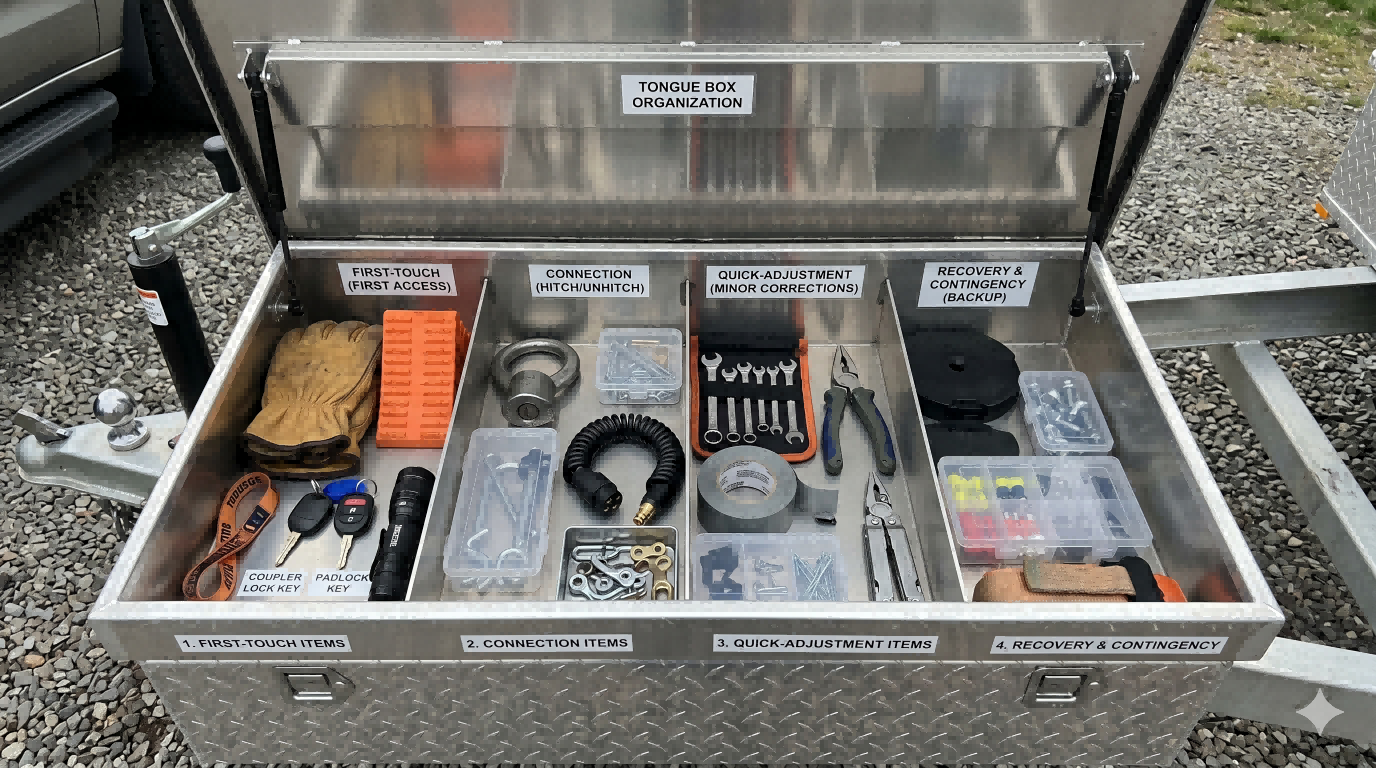
A practical trailer toolbox organization system near the jack should give priority to the items most tied to front-end workflow.
High-frequency front-end items
These are the items that should sit in the fastest-access area of the box:
- gloves
- coupler lock
- hitch pin or clip
- wheel chock
- plug adapter
- flashlight
- small inspection tool
Medium-frequency towing support items
These can sit slightly deeper in the box:
- short ratchet straps
- spare clips
- shackles
- small hand tools
- spare hardware
- repair tape
Low-frequency backup items
These should not dominate prime front storage:
- rarely used specialty tools
- large repair items
- spare mounting hardware
- seasonal accessories
- heavy items that are not needed during routine hitching
This is where trailer tongue storage becomes more effective. The box is no longer just holding things. It is staging the right items in the right sequence.
A good front-end system reduces unnecessary movement
A poorly organized trailer makes operators move more than they should.
They walk back to the truck bed for gloves. They search for a coupler pin in a side box. They realize the wheel chock is under other gear. They return to the trailer because the adapter was stored somewhere else. None of these moments seem large by themselves, but together they slow trailer use and increase friction.
A strong towing workflow is built around reducing unnecessary movement. That means the tools and accessories most closely associated with jack and hitch activity should live near the jack and hitch area.
This is especially important for work trailers, equipment trailers, and utility trailers where repeated stops, repeated checks, or repeated adjustments are part of daily use. In these situations, a well-planned trailer hitch area storage strategy does more than improve convenience. It improves operator rhythm.
The best front-end layout often feels small and obvious in use, which is exactly why it works. It removes small inefficiencies before they become routine frustration.
The trailer jack and toolbox should be planned around the same risk points

A front-end system is not only about speed. It is also about control.
The front of the trailer contains several natural risk points: incomplete hitching, forgotten pins, missing locks, poor wheel stabilization, misplaced electrical adapters, and clutter around moving hardware. A good trailer jack and toolbox layout helps control these risks by keeping the right accessories nearby and making them easier to inspect.
This is where trailer jack accessories deserve more attention. Items such as stabilizing pads, retaining pins, maintenance tools, or small support parts may not look important in the catalog, but they matter at the exact moment when the trailer needs to be raised, supported, or adjusted safely.
A front-mounted toolbox helps by giving those items a predictable home. Predictability matters more than people expect. The safer system is often the one where the operator always knows where the essentials are.
System thinking is what separates professional trailer layouts from casual ones
The difference between a professional trailer layout and a casual one is rarely one expensive component. It is the logic that connects components.
A casual layout installs a jack, then later adds a box if there is space. A more professional layout starts with the operating sequence and asks what the front of the trailer needs in order to work smoothly. That mindset leads to better spacing, better item placement, and better decisions about box size and storage role.
This is why utility trailer front storage deserves more strategic thinking than it usually gets. On many trailers, the front box becomes the most frequently visited storage position on the entire trailer. That alone makes it more important than a generic “extra box.”
When the layout is designed as a system, the jack, toolbox, coupler, chains, and connection accessories stop competing for space and begin supporting one another.
Different trailer types still follow the same logic

The exact layout will vary, but the system principle remains consistent.
Utility trailers
These often benefit the most from a simple, highly accessible front box because towing essentials and quick-use accessories are a major part of daily use. A well-planned trailer tongue box near the jack can dramatically improve routine setup.
Equipment trailers
These may need more robust front-end gear such as chains, binders, wheel chocks, and securement accessories. Here, the system logic is even more important because front-end items are heavier and the temptation to overload the tongue box is greater.
RV and recreational trailers
These often need a cleaner approach to front-zone planning because the jack area may already compete with tanks, battery trays, or other front-mounted hardware. In these cases, a smaller and more disciplined storage strategy may perform better than a larger box.
Contractor and work trailers
These benefit from front-end organization because repeated loading, unloading, and repositioning create more frequent trailer interaction. For these users, the front-end storage zone should support repeated field efficiency, not just occasional travel convenience.
The trailer type changes the exact contents. It does not change the need for a coherent trailer setup system.
The wrong layout usually creates the same predictable problems
A front-end layout fails in familiar ways.
The box blocks the jack
This is the most obvious failure. The toolbox fits physically but weakens jack operation or forces awkward hand placement.
The jack works, but the system does not
This happens when the jack remains usable, but the items connected to jack activity are stored too far away or too randomly.
The tongue box becomes a clutter trap
Once the box turns into a catch-all container, the items tied to front-end workflow become harder to find at the exact moment they are needed.
The front zone carries too much weight
This happens when the box is treated as the default storage location for heavy gear that does not truly belong in the front-end operating zone.
Each of these problems comes from the same root cause: the jack and toolbox were treated as separate accessories rather than one integrated system.
A better front-end storage strategy starts with workflow, not hardware
The smartest buyers do not begin by asking which box looks best. They begin by asking how the front of the trailer is used.
What must be reached during hitching or unhitching?
These items belong nearest the front operating zone.
What is used with the jack most often?
These items should live in the quickest-access section of the box.
What can be stored elsewhere without slowing the operator down?
These items do not need to take up prime front-end space.
What would make the front zone cleaner, not busier?
This question matters because efficient storage is not about filling every inch. It is about preserving a working environment.
This kind of thinking produces a stronger trailer toolbox organization strategy and a better overall towing workflow.
The best front-end systems are easy to repeat
Repeatability is one of the clearest signs of good trailer design.
If different people can approach the trailer and still find the essentials quickly, the system is working. If the operator can hitch, unhook, stabilize, and re-secure the trailer without guesswork, the system is working. If the jack can be used naturally and the box supports that sequence without interference, the system is working.
That is why the best trailer jack and toolbox layouts are rarely the most crowded or the most visually aggressive. They are the ones that are easiest to repeat under real conditions: early morning, bad weather, roadside stops, muddy jobsites, and routine daily use.
A repeatable front-end system is not just more efficient. It is more professional.
Final thoughts
A trailer jack and toolbox should never be treated as unrelated accessories that happen to share the same section of the trailer.
The jack controls movement and support. The toolbox supports the tools, accessories, and quick-access items that make that movement practical, safe, and efficient. When they are planned together, the trailer’s front zone becomes easier to use, easier to organize, and easier to trust. When they are planned separately, the operator usually pays for it in clutter, delay, awkward access, and weaker workflow.
That is why a smarter trailer front-end storage strategy begins with the operating sequence, not with the product list. A good trailer tongue box does more than add storage. It helps complete the front-end system around the jack, the coupler, and the daily realities of towing. The result is not just a cleaner trailer. It is a better working trailer.
#TrailerJackAndToolbox #TrailerTongueBox #TrailerFrontEndStorage #TrailerSetupSystem #TowingWorkflow #TrailerJackAccessories #TrailerToolboxOrganization #TrailerTongueStorage #UtilityTrailerAccessories #TrailerHitchArea #TrailerPartsGuide #TrailerOrganization