Automated Ball Valve RFQ Checklist How to Make Supplier Quotes Comparable
A Comparable Quote Starts with a Comparable Obligation
An automated ball valve RFQ should define the required operating duty, the complete supply boundary, the evidence needed to demonstrate suitability, and the conditions for accepting the finished assembly. Ask every bidder to respond to the same numbered requirements with an offered value, a document reference, and an explicit exception where necessary. Only compare prices after identifying which offers meet the same technical and delivery obligations.
Consider an equipment builder buying valves for a water treatment skid. Three suppliers offer a stainless steel ball valve with an actuator at the requested nominal size. One price includes position feedback, another assumes the customer will add it, and the third includes a feedback device whose output does not match the control panel. All three quotations can look reasonable on the first page. They do not represent the same installed function.

The purchasing problem is therefore not simply collecting more specifications. It is preventing incomplete assumptions from becoming contractual commitments. A useful ball valve RFQ checklist connects each requirement to an owner, a supplier response, an acceptance basis, and an identifiable delivered configuration. That connection matters to procurement, process engineering, controls, quality, and maintenance for different reasons.
This guide follows the procurement decision from enquiry to purchase-order release. It focuses on comparable offers and documented decisions. The technical background for choosing a complete valve automation package is covered separately; here, the objective is to turn those requirements into a bid that a buyer can evaluate and award.
Freeze the Buying Basis Before Asking for Prices
A quotation should identify a specific project duty, not an imagined average application. Start with equipment or valve tags, quantities, service descriptions, and the revisions of the documents that define them. Where several tags share the same design, create a configuration group while retaining the individual tag list. Similar nominal sizes do not justify grouping valves that have different media, shutdown behavior, or installation conditions.
Classify every requirement as mandatory, preferred, or supplier-proposed. Mandatory requirements determine technical eligibility. Preferred requirements can influence selection after eligibility is established. Supplier-proposed items invite an engineered recommendation and require an explanation of its basis. This distinction prevents a bidder from interpreting a genuine requirement as an optional upgrade, and prevents buyers from rejecting a useful alternative merely because its catalog description differs.
For example, a project may mandate a particular end connection and defined loss-of-energy behavior while allowing alternative actuator brands. In that case, the RFQ should protect the required interfaces and behavior without unnecessarily locking the order to one manufacturer's naming system. Conversely, an existing plant may need a specific replacement interface to avoid modifying its control cabinet. That restriction should be identified as an installed-base constraint rather than hidden in an informal email.
Record open inputs honestly. If the minimum available air pressure has not been measured or established by the responsible designer, mark it as an unresolved buyer input. Request a conditional proposal with clearly stated assumptions, and prohibit final technical approval until the input is resolved. A blank field must not silently become permission to use a convenient catalog condition.
Issue a single revision index with the enquiry. List the datasheet, piping reference, control narrative, inspection requirements, and commercial schedule included in that issue. When a requirement changes, send the same revision to all affected bidders and ask them to identify its price and schedule effects. Otherwise, a later comparison may reward the supplier who happened to price an older, easier requirement.
Use a Response Sheet That Makes Assumptions Visible
An actuated ball valve specification sheet works best when the supplier completes it rather than merely attaching a brochure. Use separate columns for the buyer's requirement, offered configuration, evidence reference, compliance status, and exception number. Responses such as “standard,” “suitable,” or “as requested” should lead to clarification when they conceal an essential value, model, or test condition.
The matrix below is an original procurement framework. It is not a universal valve design standard. Add project-specific fields and have the responsible engineers establish the values. Its purpose is to show which information must be explicit before two offers can be treated as equivalent.
Manufacturer enquiry forms illustrate why the fields need to extend beyond size and material. Spears' ball-valve actuation questionnaire includes process, connection, actuation, control, and accessory questions. Its 2010 form is a useful historical example of enquiry structure, not a current specification for every valve or a source of universal product limits. [4]
| Requirement group | Buyer input | Required supplier response | Comparison question |
|---|---|---|---|
| Identity and duty | Tags, quantity, service, operating modes, document revisions | Offered configuration code and applicable tags | Are all bidders pricing the same duties? |
| Process conditions | Fluid composition, concentration, solids, normal and limiting conditions, cleaning exposure | Suitability statement with assumptions and supporting product data | Has any bidder excluded an actual operating condition? |
| Pressure and temperature | Operating and design basis, differential pressure during movement and shutoff, temperature range | Applicable pressure-temperature limits and operating basis | Does the offered assembly cover the specified conditions together? |
| Flow function | Isolation, diversion, or modulation; flow states and relevant flow requirements | Port configuration, flow data where required, travel and orientation | Will the same command create the same process result? |
| Mechanical interfaces | Size, connection standard, envelope, supports, access restrictions | Assembly drawing, dimensions, mounting and coupling details | Can the complete assembly be installed and serviced? |
| Actuation and utilities | Available power or air, duty pattern, required behavior during failures | Exact actuator model, sizing basis, utility demand, operating limitations | Is performance based on the actual available utilities? |
| Controls and feedback | Command, feedback, local operation, interlocks, reset requirements | Terminal or connection schedule and functional description | Does the offered interface match the receiving system? |
| Environment and evidence | Location, ambient exposure, project approvals, inspection requirements | Configuration-specific evidence, proposed tests, exclusions | Does the documentation apply to the equipment being offered? |
Separate Line Pressure from the Pressure Across the Valve
One pressure entry can conceal several different engineering questions. The pressure-containing parts need an appropriate pressure-temperature basis. Actuator selection also needs the differential pressure that the valve must overcome during relevant operating movements. The shutoff requirement may have its own defined pressure direction and test basis. A headline pressure rating does not answer all three questions.
Require the process engineer to identify credible operating states, including startup, shutdown, blocked downstream conditions where applicable, and cleaning. Do not automatically assume every maximum occurs simultaneously; state the combinations that the design must address. The supplier should identify which combination governs its selection. This makes an unusually small actuator or low-cost material choice easier to investigate without assuming that either is inherently wrong.
Describe the Actual Fluid and Every Relevant Exposure
“Water” may omit treatment chemicals, cleaning solutions, suspended particles, or intermittent hot flushing. “Chemical service” is even less useful without composition and concentration. Provide the information available and identify uncertainty that needs resolution. Ask for the complete wetted-material configuration, including seats, seals, packing, and any relevant coatings or liners, rather than accepting a body-material description as the entire answer.
Use the existing ball valve material selection guide to frame the discussion, then obtain product-specific confirmation for the actual duty. Where the supplier relies on a compatibility chart, record its identity and stated conditions. A general material recommendation should not override the offered valve manufacturer's pressure, temperature, or service limitations.
Require a Defensible Actuator Selection, Not Just a Torque Number
In a valve technical bid evaluation, actuator torque should be a traceable selection result. Ask for the valve torque basis, the service assumptions, any adjustment or margin applied, and the actuator output information used. The reviewer should be able to see why the offered actuator can operate the valve throughout the required movement without exposing the valve, coupling, or mounting arrangement to unacceptable loading.
A supplier's single “maximum torque” number may not describe the available output at every relevant travel position or utility condition. For pneumatic equipment, specify the minimum pressure guaranteed at the actuator connection during the required movement, and ask how the spring-driven movement was checked when spring return is required. Also provide the maximum supply pressure for review against actuator limits and possible output loading. For electric equipment, ask for the specified duty capability, supply conditions, torque protection, and operating limitations. The RFQ should request the evidence; it should not substitute an arbitrary universal safety factor for an engineering selection.
Bettis' published selection procedure supports this evidence-led approach: it requests valve torque information with operating adjustments, relevant travel positions and directions, and minimum and maximum supply pressure at the actuator. Use that published method as supporting context, while obtaining current data for the particular actuator offered. [5]
Maximum allowable stem torque, often abbreviated MAST, also deserves a distinct entry where applicable. It is an upper mechanical limit to verify with the valve manufacturer, not a target operating torque and not a substitute for the torque needed to move the valve. Bray's Series 98H hydraulic-actuator manual treats MAST separately from operating torque in its sizing discussion; its hydraulic product values should not be transferred to a pneumatic selection. [6] The supplier should identify how the offered drive and protective settings respect the applicable mechanical limits. The existing ball valve actuator sizing guide provides the background for reviewing this evidence.
Keep mechanical attachment evidence separate from operating suitability. ISO 5211:2026 addresses specified actuator attachment dimensions and reference torque values; its published scope also identifies limits, including the intermediate-support-to-valve connection. Ask the supplier to identify the actual interface, coupling, support arrangement, and drawing revision. A statement of ISO 5211 compatibility does not by itself complete the assembly review. [1]
Draw the Supply Boundary Around a Working Assembly
A valve automation package can be supplied as a factory-built assembly, as separately delivered components, or through a split between the valve vendor and the control-panel builder. Each arrangement can be legitimate. The problem arises when the quotation leaves assembly, configuration, verification, and warranty responsibility between organizations without an explicit owner.
Ask every supplier to classify each required item as included and assembled, included loose, excluded, or optional. Identify the entity that will install and verify anything supplied loose. A component present in the shipping carton is not automatically a commissioned function. Similarly, an optional item should not be counted as included simply because its data sheet appears in the quotation package.

| Boundary item | Question that must be answered | Evidence at handover |
|---|---|---|
| Valve, actuator, coupling, and bracket | Who selects, assembles, aligns, and accepts the combination? | Identified assembly drawing and configured bill of materials |
| Feedback equipment | Who supplies the correct output type, sets the indication, and verifies it? | Terminal schedule and recorded functional checks |
| Air accessories | Which regulator, solenoid, fittings, tubing, and exhaust components are included? | Pneumatic diagram and accessory model list |
| Electrical connection | Where does vendor wiring end and site wiring begin? | Connection drawing, entry details, and defined terminal boundary |
| Configuration and testing | Who sets travel, verifies failure behavior, and closes test exceptions? | Approved procedure and configuration-linked results |
| After-sales responsibility | Who investigates an assembly fault and coordinates component suppliers? | Named support route and written warranty scope |
Electric and Pneumatic Offers Need Different Supporting Fields
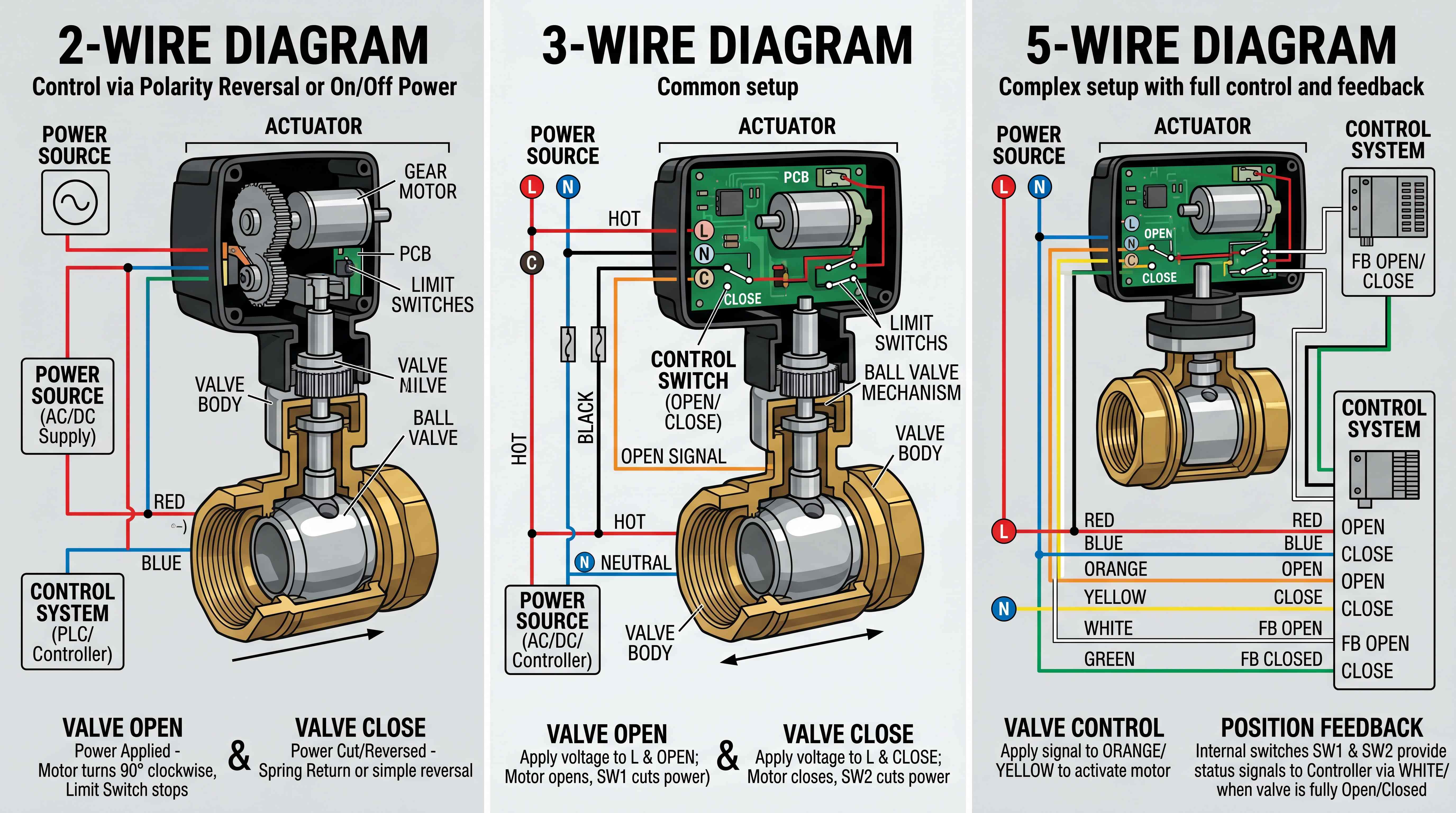
For electric actuated ball valve specifications, identify the supply type and voltage, command method, feedback type, duty pattern, operating time requirements, local controls, and required loss-of-power behavior. Request the actual wiring diagram and electrical demand information needed by the panel designer. Wire count alone is not a reliable interface definition, and a supplier's standard cable color should not become a project-wide wiring convention. Review the motorized ball valve wiring and feedback requirements when preparing the interface questions.
For pneumatic actuated ball valve specifications, define the available air conditions, actuator action, solenoid function, electrical coil interface, required feedback, and the accessories within the supply boundary. List loss of air, loss of electrical power, and loss of control signal separately, together with relevant combinations. For each event, specify the required final state, permitted operating time, and behavior after recovery. “Fail close” should be supported by an assembly description, not left as a label attached to an actuator catalog number.
If the procurement allows either actuation method, invite clearly separated alternatives. Each alternative must meet the same process requirements and disclose its different site infrastructure needs. Use the existing electric versus pneumatic ball valve comparison for technology selection. The quotation exercise should then compare the actual supplied and installed obligations of the alternatives.
Turn Document Requests into Evidence Requirements
A long documentation list can look rigorous while still producing an unusable handover. The useful question is what each document proves about the offered and delivered configuration. A catalog establishes available product features. An approved drawing identifies the proposed assembly. A test record reports what was checked under stated conditions. A certificate has its own scope. These documents serve different purposes and should not be treated as interchangeable.

Separate bid-stage evidence from documents needed after award. The bid should contain enough information to establish suitability and identify exclusions. Detailed production drawings may follow a controlled approval milestone. Final records should identify the actual delivered items and incorporate approved changes. Requiring every final record before an order exists is unrealistic; accepting every critical selection question as “to be confirmed after order” creates a different risk.
Make the Test Basis Specific Without Inventing Universal Limits
State the applicable project test requirements and ask the supplier to identify its proposed procedure, inspection points, acceptance criteria, and records. Distinguish pressure-boundary and closure testing from assembly movement, feedback, and failure-response checks. ISO 5208:2015 concerns pressure testing of metallic industrial valves; its public scope is not a complete functional acceptance procedure for an automated package, and it should not be applied indiscriminately to every valve material. [2]
Do not insert generic pressure multipliers, test durations, or leakage limits simply to make the enquiry look detailed. The responsible reviewer should establish the applicable standard edition, product requirements, and contractual acceptance basis. A workshop movement test at an unspecified condition does not demonstrate all required operating duties. Ask which requirements are verified at the factory, which need design evidence, and which require site confirmation.
Match Special Approvals to the Actual Configuration
Where a project requires a specific approval, identify the relevant equipment and application boundary. Request the model identification and supporting evidence for the configuration offered, including accessories when relevant. Avoid accepting a company's general claim as proof for every item in its range. For IECEx equipment, the scheme's official guidance makes the online certificate record and its current status important to verification. [3]
This RFQ is also the place to define traceability depth. Decide which material records, serial or batch identifiers, inspection records, and document revisions must be linked to the delivery. More paperwork is not automatically better. The required records should let the buyer verify the agreed claims and later identify the equipment without rebuilding the procurement history from scattered emails.
Resolve Exceptions in a Shared Register
A valve supplier deviation list should be a controlled part of the bid, not a collection of footnotes. Give each exception an identifier and record the affected requirement, offered alternative, reason, technical consequence, price effect, schedule effect, decision owner, and closure evidence. Require a positive declaration when the supplier claims there are no exceptions. Silence should not be interpreted as acceptance where a response is missing.
Use a small set of statuses consistently: compliant with evidence, clarification open, deviation awaiting decision, accepted deviation, and rejected deviation. “Equivalent” is a supplier assertion that needs a defined comparison. For example, a different feedback sensor may be acceptable if its interface and environmental suitability meet the project requirements. A different failure position is not made acceptable by a lower price or faster delivery.
| Register field | Illustrative entry |
|---|---|
| Reference | DEV-03; RFQ requirement CTRL-07; affected valve tags listed in attachment |
| Supplier proposal | Replace the specified feedback device with an alternative model; attach its datasheet and terminal drawing |
| Open question | Confirm compatibility with the receiving input, required indication, and installation environment |
| Decision ownership | Controls reviewer assesses technical suitability; procurement confirms revised price and delivery effects |
| Release condition | Written acceptance, updated bill of materials and drawings, and agreed verification requirements |
| Current status | Deviation awaiting decision; no substitution authorized by this example |
Close technical questions with the person authorized to make that decision. Procurement can coordinate the register, but it should not independently approve material compatibility, process failure behavior, or control-system changes. Likewise, a technical reviewer should identify a necessary change without silently accepting its commercial consequences. Record both decisions so that an approved engineering alternative does not reappear later as an unexpected variation.
Keep clarified bids comparable. If the buyer relaxes a requirement for one bidder because it was unnecessarily restrictive, determine whether the same revised basis should be offered to the other bidders. If an exception is unique to one configuration, document why it is acceptable and include its consequences in that offer's evaluation. Equal treatment depends on a consistent decision basis, not on pretending all proposed designs are identical.
A Worked Comparison: When the Lowest Unit Price Stops Being the Lowest Offer
The following valve quotation comparison is a hypothetical purchasing example for 24 identical pneumatic on-off ball valve assemblies. Every price is an invented USD figure for illustrating the method. The numbers are not current market prices, supplier quotations, or industry cost benchmarks. The base requirement includes compatible position feedback, a local filter-regulator, and agreed factory functional testing.
Assume Suppliers A and B have already demonstrated compliance with the technical requirements. Supplier C has an unresolved failure-response question. All offers use the same currency and commercial delivery basis. Freight, taxes, installation, and shared site costs are excluded consistently from this limited illustration. A real comparison must reconcile those items where they differ.
| Cost or status | Supplier A | Supplier B | Supplier C |
|---|---|---|---|
| Quoted base price | 420 | 485 | 455 |
| Required feedback omitted from base | 58 | Included | 25 |
| Required filter-regulator omitted from base | 22 | Included | Included |
| Required functional testing omitted from base | 18 | Included | 15 |
| Known comparable-scope subtotal per unit | 518 | 485 | 495, provisional |
| Known subtotal for 24 assemblies | 12,432 | 11,640 | 11,880, provisional |
| Technical status | Qualified | Qualified | Failure-response evidence unresolved |
| Eligible for final price ranking? | Yes | Yes | No, pending technical closure |
Supplier A initially appears USD 65 cheaper per assembly than Supplier B. Across 24 units, that headline difference is USD 1,560. Once the required omitted scope is added using the assumed firm add-on prices, A becomes USD 33 more expensive per assembly, or USD 792 more expensive for the order. The reversal comes from scope, not from a prediction about which supplier has better quality.
Supplier C is different. Its USD 495 subtotal is not an approved evaluated price because a mandatory functional question remains open. Do not invent a small contingency to make an unqualified offer look comparable. If the supplier later confirms a compliant configuration with an agreed revised price, update the comparison and obtain the required technical release. Until then, retain the uncertainty as a visible unresolved item.
Use Firm Adjustments and Keep Unknowns Visible
Only add an omitted item at a firm price when its scope, compatibility, and responsible supplier are established. A buyer's rough allowance may help budget planning, but it is not equivalent to a binding price for an integrated, warranted solution. Distinguish confirmed add-ons from estimates and unresolved costs in the evaluation sheet.
A complete valve technical bid evaluation should also check quantities, discounts, minimum-order rules, quotation validity, payment milestones, packing, inspection attendance, and delivery assumptions. Keep recurring unit costs separate from one-time engineering or tooling charges. State whether spare parts are included in the comparison or priced as options. Otherwise, the arithmetic can be accurate while the comparison remains misleading.
Do Not Monetize a Mandatory Failure
An offer that cannot meet a mandatory process function should fail the technical gate unless the authorized project team changes that requirement. A weighted score should not allow a very low price to compensate for an unacceptable failure state, incompatible interface, or unverified material selection. Scoring is useful for qualified alternatives; it is a poor substitute for eligibility decisions.
Assign Decisions to the People Who Will Live with Them
A valve procurement checklist should reflect the buying organization, not only the component specification. Process engineering owns the duty and acceptable operating states. Mechanical or valve engineering reviews the valve and mounting selection. Controls engineering checks commands, feedback, and integration. Quality defines the evidence and acceptance route. Procurement reconciles scope, price, schedule, and contractual commitments. Maintenance contributes access, replacement, and spares requirements.

In a small OEM, one person may perform several of these roles. The decisions still need to be identifiable. A short approval record is more useful than assuming that everyone copied on an email has reviewed every issue. Require the responsible reviewer to identify remaining conditions instead of using an unqualified approval when essential data is outstanding.
EPC buyers should connect the valve tag list to the project document schedule and inspection responsibilities. An approved vendor name does not eliminate the need to review the actual offered configuration. OEMs should connect the approved assembly to their machine revision and service parts list. Distributors should preserve enough configuration detail to reorder a genuinely compatible assembly rather than relying on a broad product family description.
Maintenance requirements also deserve early commercial attention. Ask for replaceable part identification, recommended spares, access requirements, and the route for obtaining a replacement actuator or accessory. Keep these requests proportionate to the service. The goal is to avoid discovering after installation that a supposedly interchangeable replacement changes the wiring, mounting, or functional behavior.
Make the Approved Offer the Purchase-Order Baseline
Once the preferred supplier is selected, consolidate the approved configuration, drawings, clarified scope, accepted deviations, agreed prices, delivery milestones, and required records into the purchase-order baseline. List document numbers and revisions. A quotation number alone may refer to attachments that have changed during negotiation or leave conflicting statements unresolved.

Agree a document precedence rule for conflicts. Identify which approved specification, datasheet, clarification record, drawing, and commercial schedule governs each issue. This is especially useful when a standard supplier quotation includes exclusions that contradict a later technical clarification. Resolve the conflict before release rather than relying on an informal understanding that one sentence will be ignored.
Define the event that starts lead time. A supplier may count from order receipt, deposit, drawing approval, or final technical clarification. Those are different commitments. If the project needs equipment on site by a particular date, map the intervening approvals, manufacturing, inspection, document release, packing, and transport responsibilities. A short manufacturing lead time can still produce a late project delivery if the approval assumptions are unrealistic.
Require review of proposed substitutions that affect the approved configuration. The supplier should identify the changed part, reason, interface effects, supporting evidence, and any retesting needed before shipment. “Same specification” is insufficient when a new accessory changes electrical behavior or a replacement seat changes the selection basis. Keep the approved change linked to the final bill of materials and handover records.
Close the enquiry with a release check: mandatory requirements resolved, remaining conditions assigned, comparable price established, scope boundary accepted, document schedule agreed, and delivered configuration identifiable. This is the practical output of an automated ball valve RFQ. The buyer should be able to explain what was purchased, why the offer was selected, what remains to be verified, and who is responsible at each handover.
Focused FAQ
What should an automated ball valve RFQ include?
Include identifiable duties and quantities, process conditions, valve and connection requirements, actuator selection inputs, controls and feedback, failure behavior, environment, supply boundary, evidence requirements, and commercial milestones. Ask the supplier to respond to numbered requirements and identify exceptions. A completed response sheet is more useful for comparison than a general product brochure.
Is an actuated ball valve specification sheet enough to compare suppliers?
It is the technical starting point, but it does not necessarily define assembly work, testing, documents, accessories, delivery conditions, or warranty responsibility. Pair the datasheet with a supply-boundary schedule and deviation register. Require offered values and evidence references so that an unchecked field or unexplained assumption does not appear as confirmed compliance.
How should buyers compare electric and pneumatic alternatives?
First establish the same required process function and acceptable failure behavior. Then compare each alternative's complete assembly, utility needs, control integration, operating limitations, and installation obligations. Keep alternative configurations separate in the bid. Comparing the actuator purchase prices alone will miss work that may move to the panel builder or site contractor.
Should an RFQ prescribe one actuator safety factor?
Only where the responsible engineering basis establishes that requirement. Otherwise, ask the supplier to disclose its valve torque data, service assumptions, applied margin, available actuator output, and mechanical limit checks. An unexplained common factor does not make different torque data or operating assumptions equivalent. Obtain technical review of the resulting selection.
What belongs in a valve supplier deviation list?
Record the affected requirement, offered alternative, reason for the exception, technical impact, price and schedule effects, decision owner, and closure evidence. Distinguish an unanswered question from an explicitly accepted deviation. Approved exceptions should be carried into the purchase-order baseline so that manufacturing and inspection use the same agreed configuration.
Can missing accessories simply be added to the lowest quote?
They can be added when their configuration, integration, price, and responsibility are confirmed. A loosely estimated accessory allowance does not establish a working assembly or preserve the original warranty boundary. Ask who selects, fits, configures, and tests the additional equipment, and incorporate those commitments into the revised offer before ranking it.
Does a factory movement test establish complete acceptance?
No. Movement is one part of acceptance. The project may also require pressure or closure testing, feedback verification, defined failure-response checks, configuration review, and supporting records. Establish the applicable tests and limits for the actual product and duty. Identify which requirements can be demonstrated at the factory and which require separate engineering evidence or site verification.
How can procurement avoid delaying an order with excessive documentation?
Separate information needed for selection from documents needed for manufacture and final handover. Request the critical suitability evidence with the bid, then agree controlled milestones for detailed approvals and final records. Assign reviewers and response times. The objective is timely decisions supported by appropriate evidence, rather than demanding every possible document at the earliest stage.
Professional Sources and Editorial Method
The response matrices, comparison workflow, and commercial example are original editorial tools. The price example is hypothetical; no supplier was audited, no product was tested, and no market-price dataset was used. Linked internal articles provide background. The primary references below support the identified engineering, standards, and certification statements; they do not certify the proposed procurement framework or any product.
- ISO 5211:2026 — Industrial valves: Part-turn actuator attachments. Official scope used to distinguish attachment requirements from complete assembly suitability.
- ISO 5208:2015 — Industrial valves: Pressure testing of metallic valves. Official scope used to distinguish metallic-valve pressure testing from complete automated-package functional acceptance.
- IECEx — Certified Equipment Scheme FAQs. Official guidance used for checking certificate records and status.
- Spears Manufacturing — Appendix C: Valve Actuation Questionnaire Checklist. Thermoplastic ball-valve questionnaire, PDF page 2, Rev. A 2010; used only as an example of manufacturer enquiry fields.
- Emerson/Bettis — Actuators Selection Procedures. September 2010, sections 2–4; used for the disclosed torque and supply-pressure selection basis, not current model availability.
- Bray — Series 98H Hydraulic Scotch Yoke Actuator Technical Sales Manual. Sizing discussion, PDF pages 20–21; used for the distinction between operating torque and MAST, not pneumatic product ratings.