What Is an Actuated Ball Valve? From Manual Shut-Off to Automated Flow Control
What Is an Actuated Ball Valve?
An actuated ball valve is a ball valve equipped with a valve actuator that opens, closes, or positions the valve without manual hand operation. Instead of relying on an operator to turn a lever, an actuated ball valve uses electric power, compressed air, hydraulic force, or another actuation method to rotate the valve stem. In most industrial systems, the actuator turns the ball 90 degrees, which is why a ball valve is also known as a quarter turn valve.
At first glance, an automated ball valve may look like a simple combination of two components: a valve body and an actuator. In real applications, however, it is much more than a mechanical add-on. It becomes part of a larger control system. A motorized ball valve may receive a signal from a PLC, a control panel, a sensor, a timer, a building automation system, or a remote monitoring platform. A pneumatic ball valve may be connected to solenoid valves, air preparation units, position feedback devices, and safety interlocks.
This is why ball valve automation is important in modern fluid handling. A manual ball valve is useful when people can safely and conveniently reach the valve. But when the valve is installed in a hazardous area, a high-temperature pipeline, a remote pumping station, an automated machine, or a process line that must respond quickly, manual operation becomes a limitation. An actuated ball valve allows the system to control liquid, gas, steam, chemical, slurry, or utility flow with higher consistency and less dependence on human intervention.
The core purpose of an actuated ball valve is simple: to transform a manual shut-off component into an automated flow control device. But the actual value depends on how well the valve, actuator, control signal, material, torque, sealing structure, and working environment are matched.
Why Ball Valves Are So Common in Automation
Ball valves are widely used in automation because their working principle is simple and reliable. Inside the valve body, there is a ball with a hole through the center. When the hole is aligned with the pipeline, fluid can pass through. When the ball rotates 90 degrees, the solid side of the ball blocks the flow. This structure makes the ball valve especially suitable for fast on-off service.
Compared with some linear-motion valves, a quarter turn valve requires only a short rotational movement to change from fully open to fully closed. This makes it easier to automate with compact electric actuators or pneumatic actuators. A valve actuator does not need to push a stem up and down over a long travel distance. It only needs to deliver enough torque to rotate the ball and overcome friction, pressure, seat resistance, and media-related load.
Another reason ball valves are popular is their sealing performance. In many shut-off applications, a properly selected industrial ball valve can provide tight closure and low leakage. For water, compressed air, natural gas, chemical dosing, filtration systems, industrial skids, OEM equipment, HVAC systems, and process pipelines, this makes the ball valve a practical choice.
Ball valves are also available in many body materials, connection types, port designs, seat materials, and pressure ratings. This makes them flexible for automation. A small brass motorized ball valve may be used in a water system. A stainless steel pneumatic ball valve may be used in a chemical line. A PVC automated ball valve may be used in water treatment. A V-port ball valve may be used for more controlled flow regulation.
The basic mechanical action is simple, but the application possibilities are broad. That is why the actuated ball valve has become one of the most recognizable products in the valve automation market.
Manual Ball Valve vs Actuated Ball Valve

A manual ball valve is operated by a handle. The user turns the handle by hand, usually 90 degrees, to open or close the valve. It is simple, low-cost, and easy to understand. For many low-frequency systems, a manual valve is still the most economical solution.
An actuated ball valve replaces the manual handle with a valve actuator. The actuator may be powered by electricity or compressed air. Instead of a person physically turning the valve, the control system sends a signal, and the actuator rotates the valve stem.
The difference is not only about convenience. It changes how the entire system can be managed.
A manual ball valve depends on human availability. Someone must be near the valve, know when to operate it, turn it correctly, and confirm whether it is fully open or fully closed. In a small workshop or simple plumbing line, this may be acceptable. In a process plant, water treatment facility, chemical dosing system, automated production line, or remote pumping station, it may not be reliable enough.
An automated ball valve allows scheduled operation, sensor-based operation, emergency shutdown, remote control, and system-level coordination. For example, a remote control valve can open when a tank reaches a certain level, close when pressure exceeds a limit, or work together with pumps, flow meters, alarms, and safety logic.
Manual valves are still useful, but they do not provide automatic response. Actuated valves are more suitable when the process needs repeatability, safety, remote operation, or integration with industrial control.
Main Components of an Actuated Ball Valve Assembly
An actuated ball valve assembly normally includes the valve body, the ball, the stem, the seats, the seals, the actuator, the mounting interface, and sometimes accessories such as limit switches, solenoid valves, position indicators, manual overrides, or control modules.
The valve body is the pressure-containing part. It may be made of brass, stainless steel, carbon steel, PVC, CPVC, PP, PVDF, or other materials depending on the media and working conditions. The body design may be one-piece, two-piece, three-piece, wafer-style, or flanged.
The ball is the rotating closure element. In a standard on-off ball valve, the ball has a straight bore. In a three-way ball valve, the ball may have an L-port or T-port flow pattern. In a V-port ball valve, the ball has a shaped opening designed for better flow modulation.
The valve seats provide sealing between the ball and the valve body. Common seat materials include PTFE and reinforced PTFE, but many other materials may be used depending on pressure, temperature, chemical compatibility, and wear resistance.
The stem transfers torque from the actuator to the ball. In valve automation, the stem design and connection are very important because the actuator must rotate the valve smoothly and repeatedly.
The actuator is the power unit. An electric ball valve uses an electric actuator. A pneumatic ball valve uses a pneumatic actuator. The actuator must be sized correctly so that it can overcome the required operating torque of the valve.
The mounting interface connects the actuator to the valve. Many automated valve assemblies use ISO 5211 mounting patterns, which help standardize the connection between quarter-turn valves and actuators. However, matching the mounting pad alone is not enough. The stem size, coupling, bracket, rotation direction, and torque requirement must also be considered.
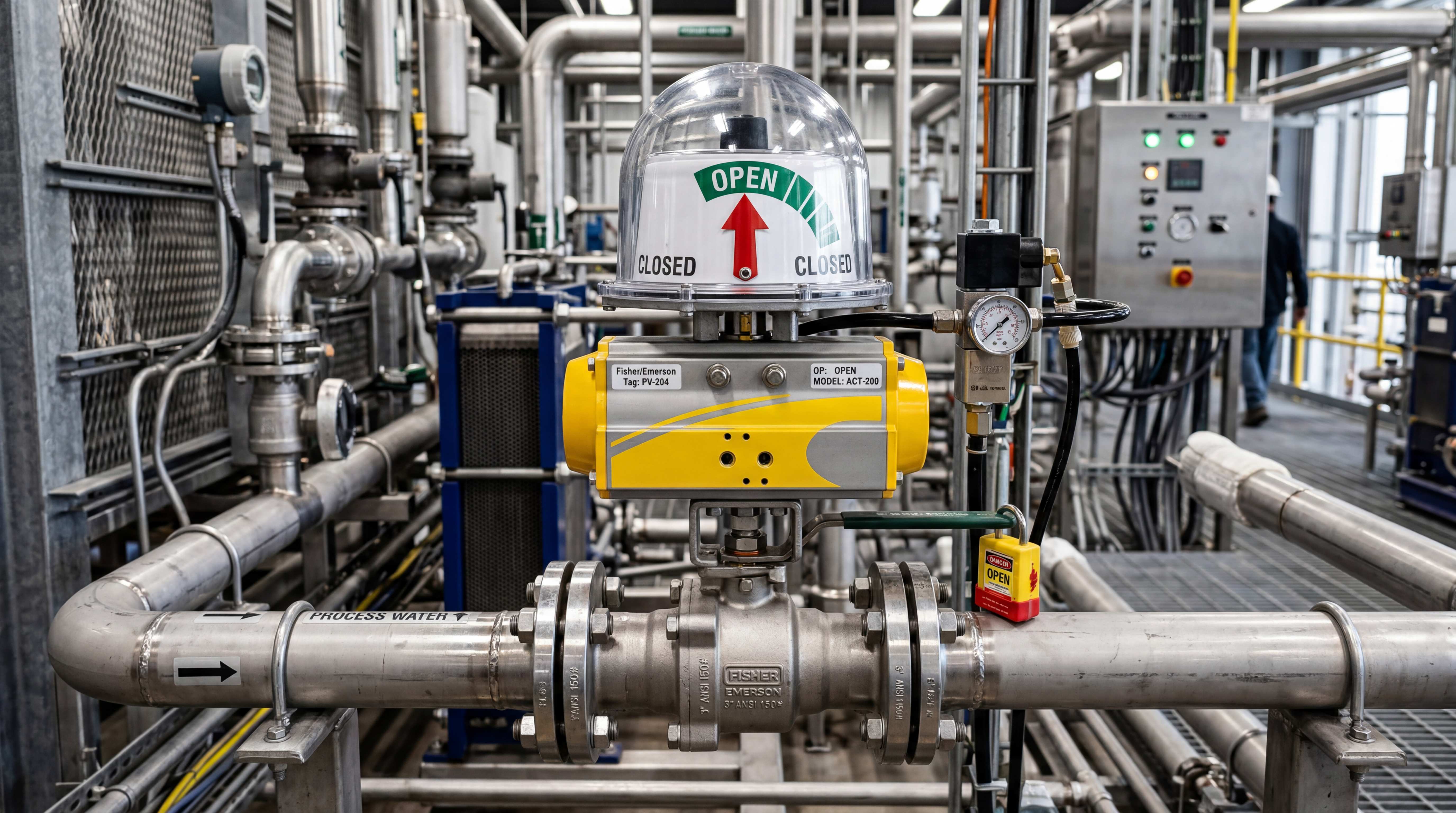
Accessories make the assembly more intelligent or easier to integrate. Limit switches can show whether the valve is open or closed. Position feedback can send a signal to a control system. A solenoid valve can control air supply to a pneumatic actuator. A manual override allows emergency operation if power or air is lost.
A good actuated ball valve is not just a valve with a motor mounted on top. It is a complete mechanical and control package.
Electric Ball Valve: When Electrical Automation Makes Sense

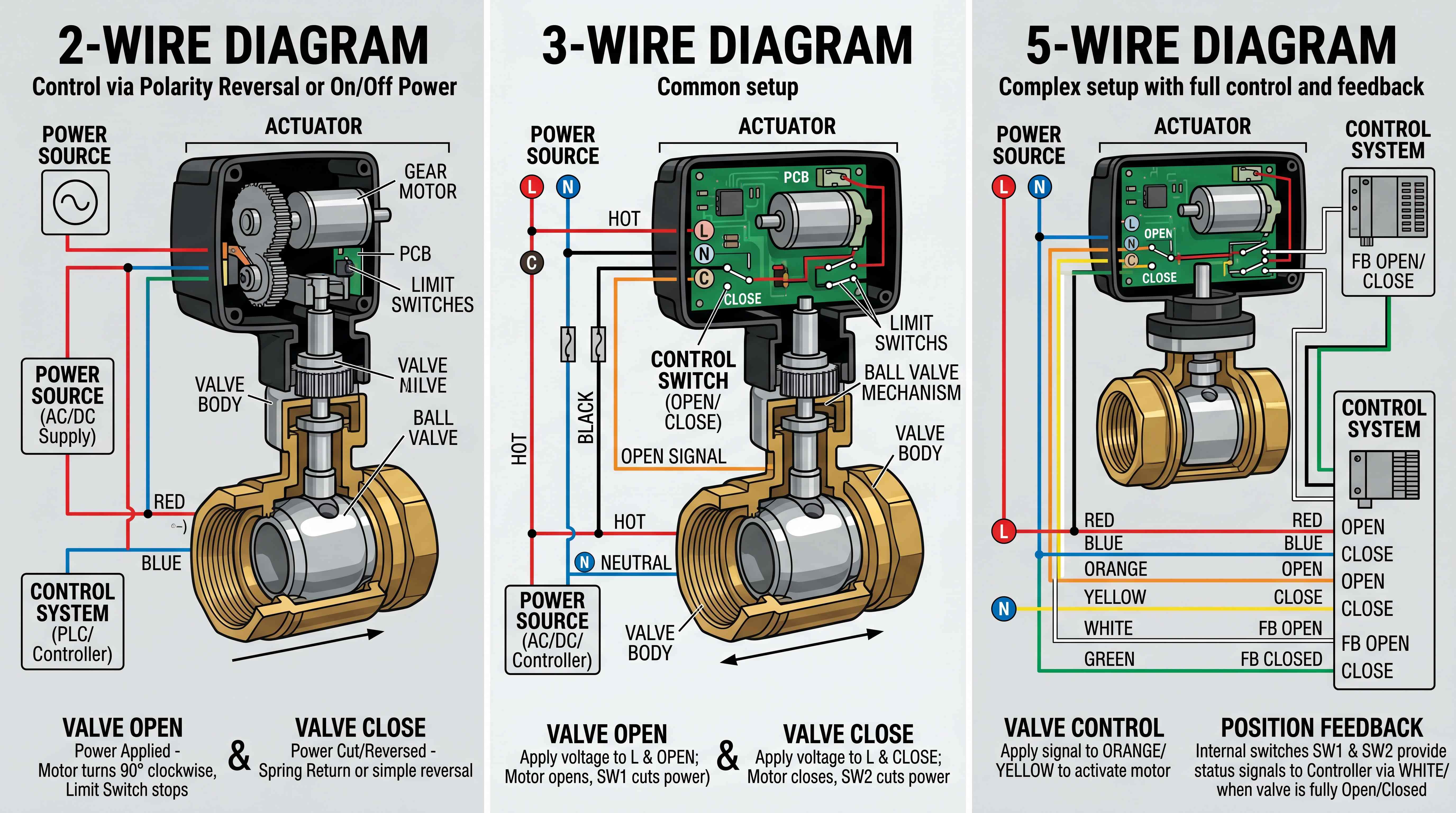
An electric ball valve uses an electric actuator to rotate the ball. It is often called a motorized ball valve. Depending on the actuator design, it may work with AC or DC power, such as 12VDC, 24VDC, 110VAC, or 220VAC. It may use simple on-off wiring, three-wire control, five-wire feedback wiring, or more advanced control signals.
Electric ball valves are common when compressed air is not available. They are also useful in remote or distributed systems where electrical wiring is easier than installing pneumatic tubing. Water treatment systems, irrigation equipment, HVAC systems, dosing skids, laboratory equipment, and OEM machines often use electric ball valves because they are relatively easy to integrate.
One advantage of an electric ball valve is control simplicity. For low-frequency operation, the actuator can open or close the valve when a signal is received. Some motorized ball valve designs include limit switches, which stop the motor when the valve reaches the open or closed position. Some include position feedback so that the control system can confirm valve status.
Electric actuators can also support different functions. Some are simple on-off actuators. Some provide modulating control, allowing the valve to move to intermediate positions. Some include manual override. Some include fail-safe functions such as capacitor return or battery return.
However, electric ball valves are not always the best choice. Opening and closing speed may be slower than pneumatic actuation. High-cycle applications may require careful actuator selection. Hazardous environments may require explosion-proof or special electrical protection. Outdoor applications require attention to enclosure rating, moisture protection, condensation, and wiring reliability.
In short, electric ball valves are strong choices for systems that need remote control, low to moderate cycling, simple installation, and electrical integration without compressed air infrastructure.
Pneumatic Ball Valve: Why Air Actuation Remains Popular
A pneumatic ball valve uses compressed air to drive a pneumatic actuator. The actuator converts air pressure into rotational torque, usually through a rack-and-pinion or scotch-yoke mechanism. Pneumatic actuated ball valves are common in factories, process plants, chemical systems, packaging lines, water treatment facilities, and other industrial environments where compressed air is already available.
The main advantage of a pneumatic ball valve is speed and durability. Pneumatic actuators can often open and close valves quickly. They are well suited for high-cycle operation. They can also deliver strong torque in a compact size, especially when properly matched with available air pressure.
Pneumatic actuators are commonly available in double acting and spring return designs. A double acting actuator uses air pressure to move in both directions: air opens the valve, and air closes the valve. A spring return actuator uses air pressure in one direction and springs in the other direction. This is important for fail-safe applications. For example, a system may require the valve to fail closed if air pressure is lost, or fail open if that is safer for the process.
A pneumatic ball valve usually needs additional components. A solenoid valve controls the air supply. Air filters, regulators, and lubricators may be used to prepare the air. Limit switches or position indicators may be added for feedback. Tubing and fittings are needed to connect the air system.
The strength of pneumatic automation is not only the actuator itself. It is the ability to build a reliable industrial control loop with fast response, clear fail-safe behavior, and rugged operation. In systems where compressed air is standard, pneumatic ball valves often remain the preferred solution.
The limitation is that pneumatic systems need clean, dry, stable air. If air pressure is unstable, if moisture enters the actuator, or if the solenoid valve fails, the valve may not operate correctly. Therefore, pneumatic valve automation requires attention to air quality, sizing, installation, and maintenance.
Automated Ball Valve vs Solenoid Valve
Many buyers compare an automated ball valve with a solenoid valve. Both can control flow automatically, but they are not the same type of product.
A solenoid valve uses an electromagnetic coil to move a plunger or internal mechanism. It is usually compact, fast, and suitable for many small-flow applications. Solenoid valves are widely used for water, air, steam, and other media in control systems.
An actuated ball valve uses a rotating ball and a separate actuator. It may be larger, slower, and more mechanically robust. It often provides a full-bore or near-full-bore flow path, which can reduce pressure drop compared with some solenoid valve designs. It may also be more suitable for certain fluids with particles, higher flow requirements, or applications where a simple quarter-turn shut-off design is preferred.
A motorized ball valve is often chosen when the system needs a valve that stays in position without continuously energizing a coil. Many electric ball valves only consume power while moving. This can be useful in battery-powered systems, remote installations, or applications where heat from continuous coil energization is undesirable.
A pneumatic ball valve may be chosen when larger sizes, higher torque, or fail-safe spring return action are required. It can also be better suited to high-cycle industrial environments when compressed air is already available.
The choice between solenoid valve and automated ball valve depends on media, flow rate, pipe size, pressure drop, duty cycle, power consumption, response speed, contamination tolerance, and maintenance expectations.
A good engineering decision does not ask, “Which valve is better?” It asks, “Which valve matches this system’s control purpose and operating conditions?”
Where Actuated Ball Valves Are Used
Actuated ball valves are used wherever flow must be controlled automatically, remotely, or repeatedly.
In water treatment, automated ball valves are used for filtration, backwash, chemical dosing, bypass lines, tank filling, and drain control. PVC, CPVC, stainless steel, or brass valves may be selected depending on the water quality and chemicals involved.
In chemical processing, pneumatic ball valves and stainless steel ball valves are common because they can handle aggressive media when the correct body, seat, and seal materials are chosen. Chemical systems often require careful attention to corrosion resistance, leakage prevention, actuator enclosure, and safety shutdown logic.
In HVAC systems, motorized ball valves are used to control hot water, chilled water, and zone flow. Electric actuators are common in building automation because they can connect to controllers and support remote operation.
In food and beverage systems, sanitary design and material compatibility become important. Stainless steel ball valves may be used where cleaning, hygiene, and corrosion resistance matter.
In OEM equipment, actuated ball valves are often built into machines, skids, test benches, fluid dispensing systems, and mobile equipment. The OEM does not only need a valve; it needs a repeatable component that fits the machine design, electrical architecture, control logic, and service strategy.
In oil and gas, power generation, mining, marine, and industrial utilities, automated ball valves may be used for isolation, safety, draining, venting, or process routing. These applications often require higher pressure ratings, special certifications, hazardous-area protection, and rugged actuator designs.
The same basic product category can serve very different industries. That is why ball valve automation should always be discussed in terms of application context.
The Importance of Valve Actuator Sizing
One of the most common mistakes in ball valve automation is assuming that actuator selection is based only on valve size. In reality, a valve actuator must be selected according to torque demand, media, pressure, temperature, seat material, valve condition, operating frequency, and safety factor.
A 2-inch ball valve in clean water at moderate pressure may require a very different actuator from a 2-inch ball valve handling viscous or contaminated media. A valve that operates once per day may behave differently from a valve that remains closed for months and then must open under pressure. A valve exposed to high temperature, corrosion, or solids may develop higher operating resistance over time.
Breakaway torque is especially important. This is the torque required to start moving the ball from its seated position. In many ball valves, breakaway torque is higher than running torque. If the actuator cannot overcome this first movement, the valve may remain stuck, partially open, or fail to respond.
Oversizing and undersizing both create problems. An undersized actuator may stall, overheat, fail to fully close, or damage internal components. An oversized actuator may increase cost and may apply excessive force if not properly controlled. In some cases, excessive torque can damage the valve stem, seats, or mechanical connection.
Good actuator sizing considers both present operating conditions and realistic future conditions. Engineers should not size only for a clean new valve on a test bench. They should consider pressure fluctuation, media buildup, seal aging, temperature changes, and emergency operation requirements.
This is where industry experience matters. A properly automated ball valve is not simply assembled; it is engineered.
Open-Close Control vs Modulating Control

Most ball valves are used for on-off control. They are either fully open or fully closed. This is the simplest and most common use of an actuated ball valve. In this role, the ball valve acts as an automated shut-off device.
However, some applications require intermediate positioning. This is called modulating control. A modulating actuator can move the valve to different positions, such as 25%, 50%, or 75% open, based on a control signal.
Not every ball valve is suitable for precise modulating control. A standard full-port ball valve does not always provide a linear relationship between opening angle and flow rate. Small changes in position may produce large changes in flow, especially near certain opening ranges. This can make fine control difficult.
For better flow control, a V-port ball valve may be selected. The V-shaped opening provides a more controlled flow characteristic than a standard round port. This makes V-port ball valves useful in certain process control applications where a globe valve might otherwise be considered.
The key point is that “automated” does not always mean “modulating.” Many automated ball valves are simple on-off valves. If the system requires accurate flow regulation, the valve type, actuator type, control signal, and flow characteristic must be evaluated carefully.
A ball valve is excellent for isolation and shut-off. It can also be used for control in the right design. But using a standard on-off ball valve as a precision control valve without analysis can create unstable flow, poor control accuracy, and premature wear.
Remote Control and Feedback Signals

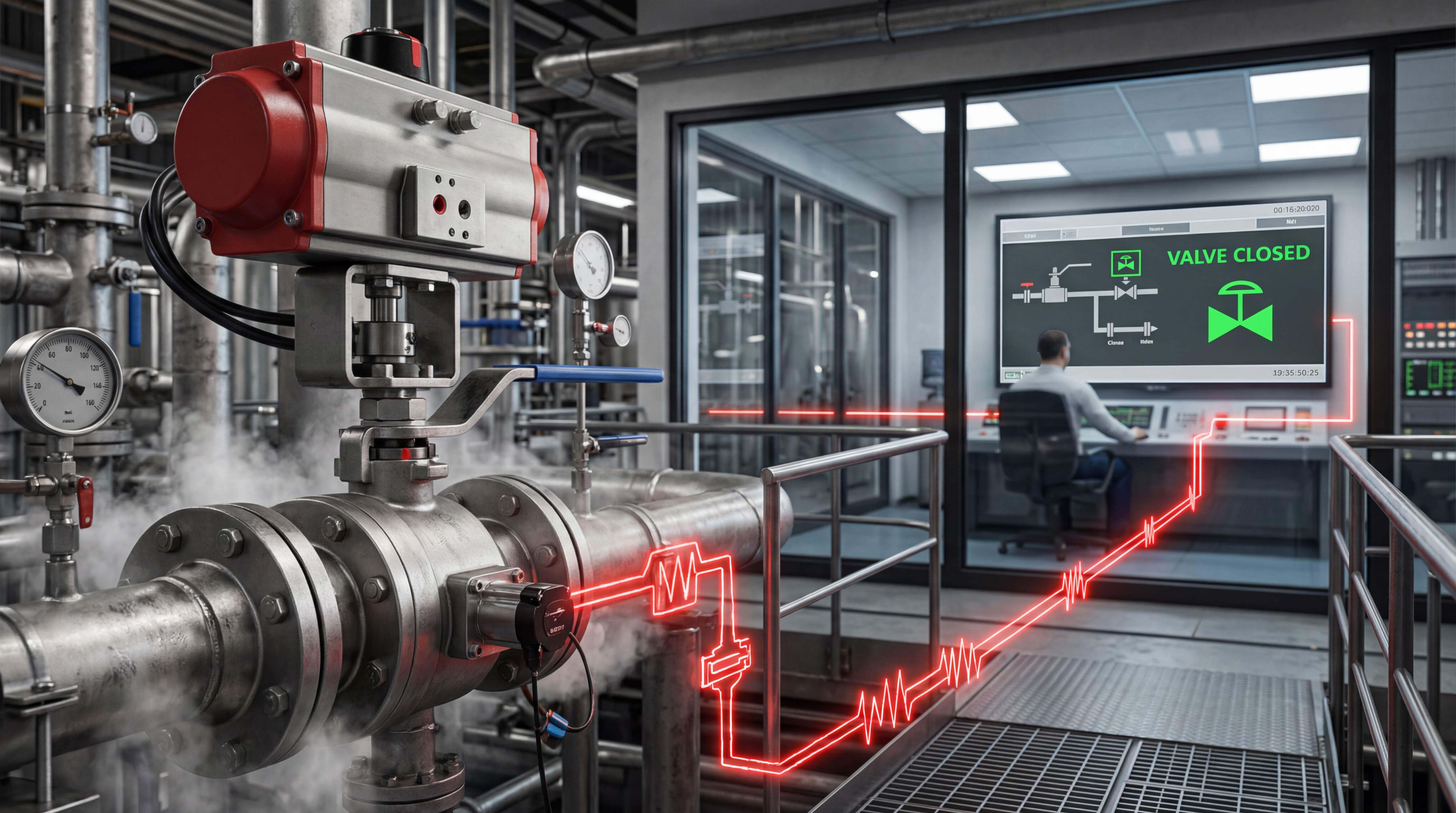
One of the strongest reasons to use an automated ball valve is remote control. A remote control valve allows operators or control systems to open and close flow paths without physically accessing the valve.
Remote control becomes especially valuable when valves are installed in hard-to-reach locations, hazardous areas, elevated pipe racks, underground chambers, unmanned stations, or enclosed equipment. It also reduces the need for manual operation in repetitive processes.
However, remote control without feedback can create uncertainty. The control system may send a signal to open the valve, but how does it know the valve actually opened? This is where feedback devices become important.
Limit switches can indicate open and closed positions. Position transmitters can provide continuous feedback. Visual indicators can help local maintenance personnel. Some smart actuators can provide diagnostic information, alarms, travel time, torque trends, or communication status.
For simple systems, open/close confirmation may be enough. For more complex process automation, feedback signals improve safety, troubleshooting, and process reliability.
For example, if a pump starts before a valve opens, pressure may rise unexpectedly. If a chemical dosing valve fails to close, overfeeding may occur. If a drain valve remains open, product loss or contamination may happen. Position feedback helps the system confirm that commands have been executed.
In modern valve automation, the value of an actuated ball valve is not only movement. It is movement plus confirmation.
Safety and Fail-Safe Considerations
Safety is one of the main reasons to automate a ball valve, but automation also introduces new safety questions.
What should happen if electrical power is lost? What should happen if compressed air pressure drops? Should the valve fail open, fail closed, or stay in its last position? Is manual override required? Does the actuator need explosion-proof protection? Does the system need emergency shutdown integration?
A spring return pneumatic ball valve is often used when a defined fail position is required. If air pressure is lost, the spring drives the valve to its safe position. This can be fail closed or fail open depending on the process.
An electric ball valve may use a capacitor return, battery backup, or mechanical spring return depending on the actuator design. Some electric actuators stay in their last position when power is lost. That may be acceptable in some systems but dangerous in others.
Fail-safe design should be based on process risk, not convenience. In a fuel line, chemical feed line, steam system, cooling system, or drain system, the safe valve position must be considered carefully.
Safety also includes maintenance. An automated valve may move unexpectedly if the control system sends a signal. Lockout procedures, local disconnects, manual override rules, and clear position indication are important in industrial environments.
A well-designed actuated ball valve system should answer three questions clearly: how the valve moves, how the system confirms its position, and what the valve does during failure.
How to Choose the Right Actuated Ball Valve

Choosing an actuated ball valve should begin with the application, not the product catalog.
First, define the media. Is it water, air, oil, gas, steam, chemical, slurry, wastewater, or food-grade liquid? Media determines body material, seat material, seal material, and cleaning requirements.
Second, define pressure and temperature. The valve must be rated for normal conditions and possible peaks. Temperature affects seat materials, seals, actuator enclosure, and long-term reliability.
Third, define the function. Is the valve only for on-off shut-off, or does it need modulating control? Is it a two-way valve, a three-way diverting valve, or a mixing valve? Does it need full-port flow or controlled flow?
Fourth, define the actuation method. Use an electric ball valve when electrical control is preferred and compressed air is unavailable or unnecessary. Use a pneumatic ball valve when fast operation, high cycling, or fail-safe spring return is required and compressed air is available.
第五, define the control interface. Does the actuator need simple open-close wiring, PLC control, 4-20 mA modulation, position feedback, limit switches, fieldbus communication, or manual override?
Sixth, define the installation environment. Indoor, outdoor, washdown, corrosive area, hazardous area, high humidity, vibration, and temperature swings all affect actuator and valve selection.
Seventh, define maintenance expectations. A three-piece ball valve may be easier to service in some pipelines. A direct-mount ISO 5211 design may simplify actuator replacement. A standardized automated ball valve assembly may reduce spare part complexity.
The correct valve is not always the most expensive one. It is the one that matches the system with the least operational risk.
Common Mistakes in Ball Valve Automation
A common mistake is choosing the actuator after the valve has already been purchased, without checking torque, mounting pattern, stem connection, or control requirements. This can lead to poor mechanical fit or unreliable operation.
Another mistake is focusing only on pipe size. Pipe size matters, but torque, pressure, media, seat material, and valve design matter just as much. Two ball valves of the same size can require different actuator torque.
Some users choose an electric ball valve because it looks easier, even when the application needs fast cycling or a defined fail-safe action. Others choose a pneumatic ball valve because the plant has air supply, but they do not check air quality or available pressure at the valve location.
Wiring mistakes are also common. A motorized ball valve may be damaged if the wrong voltage is applied or if the control logic does not match the actuator type. A 2-wire, 3-wire, and 5-wire actuator may look similar from outside but behave very differently.
Another issue is ignoring feedback. A system may send an open command but never confirm whether the valve moved. In critical applications, this can create process uncertainty.
Finally, some installations ignore environmental protection. Outdoor actuators need proper enclosure ratings and cable sealing. Chemical areas may require corrosion-resistant housings. Hazardous areas may require certified actuator designs.
Ball valve automation fails most often when the valve is treated as a simple commodity instead of a functional part of the control system.
Why Actuated Ball Valves Matter in Industrial Automation
Industrial automation is not only about robots, sensors, software, or control panels. It also depends on physical components that execute commands in the real world. Valves are among the most important of these components because they control the movement of fluids.
An actuated ball valve connects digital or pneumatic control logic with physical flow. When a sensor detects a tank level, the valve opens. When a PLC starts a cleaning cycle, the valve changes flow path. When an emergency signal is triggered, the valve closes. When a remote operator checks system status, the valve feedback confirms the process condition.
This connection between control decision and mechanical action is why valve automation has strategic value. It reduces manual labor, improves response speed, supports remote operation, improves repeatability, and makes systems easier to monitor.
For OEM equipment builders, automated ball valves can make machines more integrated and easier to operate. For plant operators, they can reduce manual intervention and improve process consistency. For maintenance teams, feedback signals and standardized assemblies can simplify troubleshooting. For system integrators, well-selected valves reduce commissioning problems.
The ball valve may be a familiar component, but once automated, it becomes part of a larger control architecture.
The Future of Actuated Ball Valves
The future of the actuated ball valve is moving beyond simple open-close automation. More systems are asking for position feedback, smart diagnostics, remote monitoring, predictive maintenance, and digital integration.
In the past, many automated valves only needed to open or close. Today, operators increasingly want to know whether the valve reached position, how long the movement took, whether torque is increasing, whether the actuator is overheating, and whether maintenance may be needed soon.
Smart valve actuators can help industrial systems reduce uncertainty. If an actuator starts taking longer to close, it may suggest valve friction, media buildup, seal wear, air pressure problems, or mechanical misalignment. If this data is available before failure, maintenance can be planned instead of reactive.
Digital communication also matters. As industrial sites adopt connected control systems, automated ball valves may become more visible in the automation network. Instead of being hidden mechanical devices, they can become monitored assets.
However, the foundation remains the same. A smart actuator cannot compensate for a poorly selected valve. A digital system cannot fix incorrect torque sizing. Remote monitoring cannot solve material incompatibility. The future of ball valve automation still depends on correct engineering at the beginning.
The best automated ball valve systems will combine strong mechanical selection with intelligent control.
Final Thoughts
An actuated ball valve is one of the most practical and widely used components in valve automation. It starts with a simple quarter-turn valve, but when combined with the right valve actuator, it becomes a powerful tool for automated flow control.
The value of an automated ball valve is not limited to opening and closing a pipe. It can improve safety, reduce manual work, support remote operation, enable process sequencing, and provide feedback to control systems. Whether the system uses an electric ball valve, a pneumatic ball valve, or a more advanced smart actuator, the key is matching the valve assembly to the actual application.
A manual ball valve is a component. An actuated ball valve is a controlled device. An intelligently selected actuated ball valve is part of a reliable industrial automation system.
For engineers, buyers, OEM equipment builders, and plant operators, the most important lesson is this: ball valve automation should never be treated as an afterthought. The valve, actuator, torque, material, signal, environment, and fail-safe behavior must be considered together.
When those elements are properly matched, the actuated ball valve becomes more than a shut-off device. It becomes a dependable link between industrial control and real-world fluid movement.
Focused FAQ
What is an actuated ball valve?
An actuated ball valve is a ball valve operated by an actuator instead of a manual handle. The actuator rotates the ball inside the valve to open, close, or position the flow path. It is commonly used in industrial automation, water treatment, HVAC, chemical processing, and OEM equipment.
What is the difference between a motorized ball valve and a pneumatic ball valve?
A motorized ball valve uses an electric actuator, while a pneumatic ball valve uses compressed air. Motorized ball valves are often used where electrical control is convenient. Pneumatic ball valves are often preferred for fast operation, high-cycle applications, and fail-safe spring return control.
Is an actuated ball valve the same as an automated ball valve?
In most practical contexts, yes. An automated ball valve usually refers to a ball valve with an actuator that allows automatic or remote operation. The terms actuated ball valve, automated ball valve, electric ball valve, motorized ball valve, and pneumatic ball valve may overlap depending on the specific actuation method.
Can a ball valve be used for flow control?
A standard ball valve is mainly used for on-off shut-off control. It can be used for basic throttling in some cases, but it is not always ideal for precise flow control. For better modulation, a V-port ball valve or another control valve design may be more suitable.
How do I choose the right valve actuator for a ball valve?
The actuator should be selected based on valve torque, media, pressure, temperature, cycle frequency, control signal, fail-safe requirement, mounting interface, and environment. Pipe size alone is not enough to choose the correct actuator.
Why is ISO 5211 important for actuated ball valves?
ISO 5211 helps standardize the mounting interface between quarter-turn valves and actuators. It can make actuator mounting easier, but engineers still need to check stem size, coupling, bracket design, rotation angle, and torque requirements.
When should I use an electric ball valve?
Use an electric ball valve when the system needs remote electrical control, low to moderate cycling, no compressed air infrastructure, or easy integration with control panels, timers, sensors, or building automation systems.
When should I use a pneumatic ball valve?
Use a pneumatic ball valve when compressed air is available and the application needs fast response, high-cycle operation, strong torque, or a clear fail-safe position using a spring return actuator.
What causes an actuated ball valve to fail?
Common causes include undersized actuator torque, incorrect wiring, poor air supply, wrong voltage, valve seat wear, corrosion, media buildup, misaligned mounting, damaged stem coupling, or lack of position feedback.
Why are actuated ball valves important in industrial automation?
Actuated ball valves allow systems to control fluid flow automatically, remotely, and repeatedly. They help connect control logic with real pipeline operation, making industrial systems safer, more consistent, and easier to monitor.
#ActuatedBallValve #AutomatedBallValve #MotorizedBallValve #PneumaticBallValve #ElectricBallValve #BallValveAutomation #QuarterTurnValve #IndustrialBallValve #RemoteControlValve #ValveActuator #IndustrialComponents #ValveAutomation #FlowControl #ProcessAutomation #FluidHandling