
Choosing a Pallet Shuttle System That Works With Your AMR Fleet
A pallet stored is not yet a pallet delivered
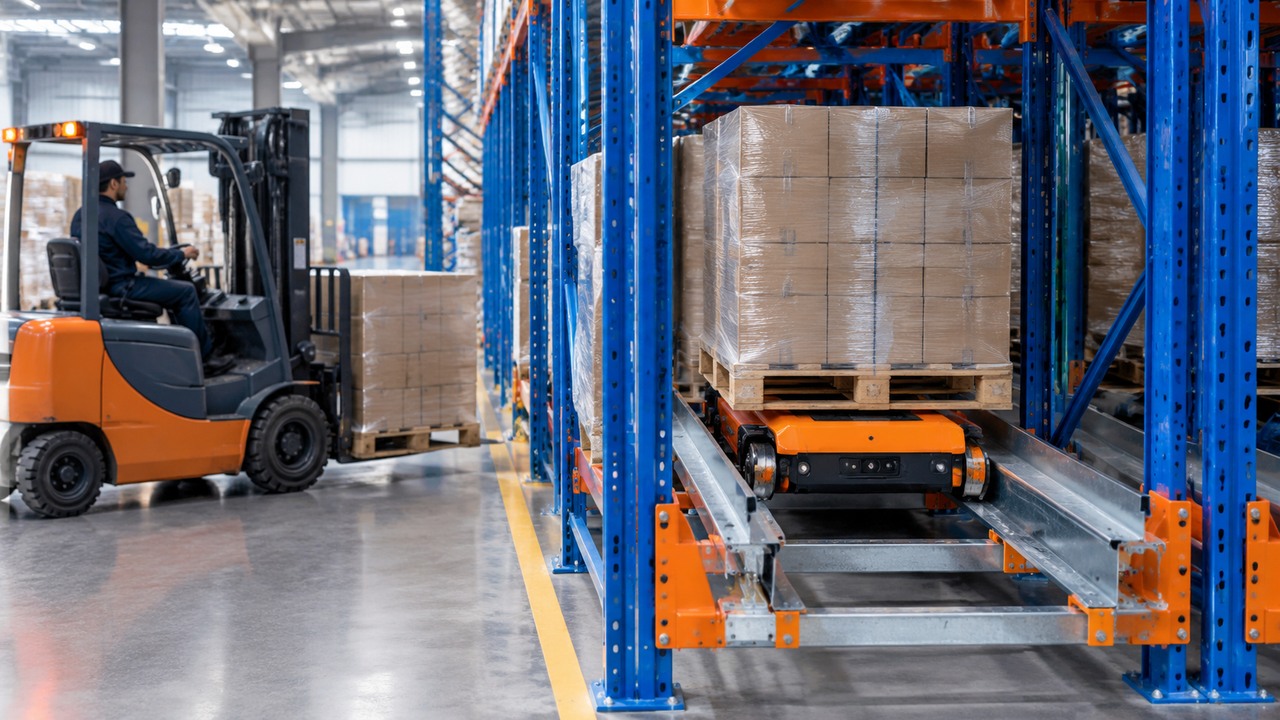
A pallet shuttle system moves pallets within purpose-designed storage channels. Depending on its architecture, forklifts, transfer cars, lifts or other equipment connect those channels to the rest of the warehouse. An autonomous mobile robot usually performs a different job: moving a pallet between accessible floor-level pickup and delivery points. The purchasing question is therefore not simply which machine is better. It is which combination completes the required storage and transport work.
This distinction matters when a project begins with an attractive density calculation. A warehouse can gain storage positions while leaving its production line waiting for material. Equally, a capable AMR fleet can move pallets promptly between stations without creating any additional rack capacity. Storage, retrieval and floor transport need a common operating brief, but they do not have to use the same technology.
A new announcement makes this boundary particularly relevant. On October 22, 2026, Jungheinrich announced a partnership with Automha involving the two-way UP-Carrier GTJ pallet shuttle. The stated approach allows an initial arrangement served by industrial trucks, with potential expansion using Jungheinrich mobile robots. That is a current supplier proposition for gradual automation, not proof that every existing warehouse can follow the same conversion path economically. [1]
The announcement follows Jungheinrich's August 13, 2026 partnership with Movu Robotics. That earlier release describes the coordination of shuttle systems, conveyors and mobile robots through an integrated software stack. Together, these announcements put both phased investment and integrated material flow on the purchasing agenda. They describe commercial offerings rather than independently measured throughput results. [2]
For a buyer, the practical response is to describe the journey before selecting the machines. Start with a received or produced pallet, follow it into storage, identify what makes it eligible for release, and finish when the correct downstream location accepts it. Then identify every point where it can wait. Those waiting points often determine the operating result more strongly than the advertised speed of any individual vehicle.
Three warehouse briefs that should produce different quotations
The following briefs are hypothetical purchasing situations. They are intended to expose differences in scope, not to represent customer installations or measured performance. Each involves heavy pallets, but the operational problem is different.
Brief A: A manufacturer needs more room for repeat products
A manufacturer stores substantial quantities of a limited product range. Forklift operators already handle receiving and dispatch, and the immediate constraint is storage space. Orders usually remove several pallets from the same product family. The plant is not seeking an unattended warehouse; it wants operators to spend less time entering deep storage locations.
Here, semi-automated shuttle pallet racking deserves evaluation. The buyer can compare its usable capacity, channel assignment and handling work with the existing arrangement without assuming that every forklift must disappear. The quotation should identify the work retained by operators, including moving the shuttle between channels where required. Automation within a lane does not automatically automate the journey to that lane.
The decisive demonstration is a representative receiving and dispatch sequence. A fast shuttle movement in an otherwise empty channel will not reveal how often the operator changes channels, waits for an available vehicle, or handles an unsuitable pallet. The test should include the actual number of active products and the expected daily changes in stock.
Brief B: A distribution operation needs predictable release by deadline
A distributor has sufficient total stock but struggles to release the right pallets in the right sequence before dispatch cutoffs. Several orders compete for the same storage resources, and late changes occur while outbound staging is already busy. Its purchasing objective is reliable completion of order groups, not simply a larger count of storage positions.
For this site, automated pallet storage must be assessed together with retrieval scheduling and the outbound interface. A supplier should explain how the system deals with an urgent pallet, a blocked destination and a group of orders concentrated in one part of the rack. A high average retrieval rate can coexist with poor performance on the specific order that has the earliest deadline.
AMRs may be valuable between storage exits and multiple dispatch or production points. However, adding mobile transport does not remove a rack retrieval bottleneck. The demonstration must preserve the order mix and destination availability that create the real operating difficulty.
Brief C: A factory has changing destinations outside a stable store
A factory keeps its central storage area in one location, but production cells and material delivery points change over time. Some destinations need only occasional pallet deliveries. Long fixed conveyor routes would commit floor space to a layout that is expected to evolve.
This brief makes the division of labor clearer. A warehouse shuttle system can serve the storage function, while an AMR fleet provides the connecting floor movements. The important buying decision is where to place the exchange points and how much temporary holding space each needs. A single convenient exit may minimize equipment but concentrate traffic and create a common failure point.
These three briefs should not receive the same standard proposal with a different number of vehicles. The scope should change because the business constraint changes: space in the first case, deadline performance in the second, and adaptable transport in the third.
Separate the storage architecture from the floor transport choice

Product names can make different arrangements sound interchangeable. Before comparing prices, ask each supplier to draw the boundaries of its proposed system and identify the equipment responsible for each movement. In particular, establish who moves a pallet into the channel, who moves it between levels, and who takes it from storage to its final destination.
Mecalux describes its semi-automated arrangement as a rail-guided shuttle operating inside storage channels, with a forklift placing the shuttle and feeding or retrieving pallets. Its documented configuration supports LIFO operation from one working aisle or FIFO operation using two working aisles. Those descriptions establish the division of work for that product; they should not be generalized into a claim that every shuttle installation has the same geometry. [3]
The same supplier's automated system replaces forklift servicing of the channels with arrangements using stacker cranes or transfer cars, alongside rack storage and infeed/outfeed equipment. Its transfer-car architecture uses elevators and accumulation conveyors. That illustrates why the word “automated” changes the system scope substantially: the buyer is purchasing coordinated handling equipment around the shuttle, not merely a different control setting. [4]
| Architecture under review | Primary work it addresses | Question the quotation must answer |
|---|---|---|
| Semi-automated channel shuttle with forklift service | Movement within deep storage channels | How much operator and forklift work remains for the proposed inventory mix? |
| Fully automated rack storage with connected handling equipment | Coordinated storage and retrieval through defined entry and exit points | Can the complete system release the required order mix within the available time? |
| Floor transport by AMRs | Movement between accessible stations outside the storage rack | Can the fleet deliver to the required destinations without creating queues at shared interfaces? |
| Combined rack automation and AMR transport | The connected storage-to-destination journey | Who guarantees the completed pallet flow across both equipment packages? |
Within that comparison, radio shuttle racking should not be assumed to provide unattended end-to-end operation. Conversely, a four way pallet shuttle should not be evaluated solely by its ability to change direction. The relevant proposal includes the rack layout, access to levels, traffic rules, interfaces, maintenance access and operating software. Directional capability is one feature within that design.
Also avoid a false choice between a shuttle and AS/RS. A shuttle can be part of an automated storage and retrieval system. The useful comparison is between defined architectures, including their equipment and operating responsibilities, rather than between overlapping labels.
For the floor connection, there is direct product evidence of complementary roles. Mecalux describes a pallet-conveyor AMR that can supply an AS/RS or shipping area, transferring loads through its upper conveyor. This demonstrates one possible interface concept; it does not establish compatibility with an arbitrary rack exit, pallet or third-party vehicle. [5]
Test usable storage against the inventory you actually hold

The attraction of high density pallet storage is easy to understand: more pallets can occupy a defined building footprint. The purchasing mistake is to treat every physical position as equally usable for every inventory pattern. Channel assignment, product segregation and access requirements can create empty positions that cannot be filled conveniently by the stock currently available.
Consider a simplified planning example with twenty storage channels, each ten pallets deep. The nominal capacity is 200 pallets. Assume, for this example only, that the operating policy dedicates each channel to one product and lot combination and does not mix other stock into its remaining positions.
If twenty combinations each require six pallets of stock, the warehouse holds 120 pallets. All twenty channels are assigned, yet eighty positions remain empty. Physical occupancy is 60%, and a new combination cannot be introduced without changing the allocation or moving existing stock. The example is not a prediction of a particular supplier's utilization. It shows why channel depth and inventory distribution must be evaluated together.
Now consider ten combinations, each holding eighteen pallets. Two channels per combination accommodate 180 pallets, leaving twenty empty positions. The same nominal 200-position layout reaches 90% occupancy under this different inventory pattern. Neither percentage is an inherent property of the shuttle; both result from the stated stock and allocation assumptions.
A useful dataset therefore contains more than average pallet count. Include product and lot identifiers, stock on hand over time, arrivals, release dates, hold status and the rules governing which pallets may share storage. If expiration priority matters, identify the information required to apply it. A FIFO physical layout is not, by itself, a complete inventory policy.
Ask the supplier to replay several representative periods, including a promotional peak or production campaign if applicable. The output should show assigned channels, occupied positions, inaccessible stock under the modeled rules, and any relocation movements. Inspect the difficult periods rather than accepting one favorable average week.
For a pallet shuttle racking system, this exercise can change the commercial comparison. A deeper lane may increase nominal density while reducing the practical fit for a broad mix of small stock quantities. A shallower arrangement may sacrifice positions but improve allocation flexibility. The buyer needs the cost per usable operating position and the required service level, not only the cost per position shown on the drawing.
The same discipline applies when reserve storage feeds a separate picking or production process. Reserve inventory may fit the rack well even though the downstream operation needs a more selective buffer. Trying to make one storage design solve both requirements can obscure a simpler arrangement with clear responsibilities.
Choose how pallets travel after they leave the rack
The outside-rack route deserves its own comparison. A fixed conveyor can be a candidate when the connection is stable, the transfer points are well defined and the layout can accommodate the permanent equipment. An AMR connection deserves evaluation when several destinations share transport resources or the site expects route changes. Neither description establishes a universal cost or speed winner.
Ask the project team to draw the same pallet journeys for both alternatives. Include crossing points, temporary holding areas, access for maintenance and the distance between the storage exit and the final acceptance point. A short conveyor segment may be a strong interface even in a predominantly mobile transport design. The choice need not be an all-conveyor or all-AMR warehouse.
For an AMR proposal, distinguish an available route from an available destination. A robot may reach the production area and still be unable to unload because the previous pallet remains in place. If the vehicle waits while carrying the next load, it is no longer available for another mission. The destination's operating behavior therefore belongs in the fleet model.
For a fixed route, examine what happens when one destination or section is unavailable. Determine which pallet flows can continue, where arriving loads wait, and how access is restored. A proposal should describe these operating states before the buyer assigns a value to continuous movement.
There is also a legitimate alternative to buying dense storage immediately: retain the existing storage arrangement and automate selected connecting journeys first. This can suit a site whose dominant problem is repetitive transport rather than space. It should remain in the comparison when the inventory analysis does not support deep-lane storage, even if the original request began with shuttle technology.
The commercial comparison then becomes more useful. Evaluate the service achieved by each complete arrangement, its residual work and its ability to accommodate the next known change. Use the site's AMR cost and ROI analysis for the broader investment model, keeping the assumptions for storage and floor transport visible as separate lines.
Calculate the complete release path before adding more robots

An automated pallet shuttle can be part of a fast storage installation while the overall pallet journey remains slow. The limiting resource may be a shared exit, a lift, a transport vehicle or an unavailable destination. Buyers should ask for capacity calculations at the interfaces where independent equipment packages meet.
The following calculation is an original illustrative scenario, not supplier performance data. Assume a production area requires 24 pallets per hour during a steady operating window. A proposed rack arrangement is modeled to release 36 pallets per hour for the specified order mix. One exchange position requires two minutes for each complete transfer transaction, including the station occupancy assumed in this example. A dedicated AMR needs a six-minute round trip, including loading, travel, unloading and return.
| Resource | Illustrative calculation | Nominal capacity |
|---|---|---|
| Rack release | Supplier model input for the stated mix | 36 pallets/hour |
| One exchange position | 60 minutes ÷ 2 minutes per transaction | 30 pallets/hour |
| One dedicated AMR | 60 minutes ÷ 6 minutes per round trip | 10 pallets/hour |
| Three dedicated AMRs | 3 × 10, assuming no interference | 30 pallets/hour |
Under these simplified assumptions, the connected path cannot exceed 30 pallets per hour, even though the rack is modeled at 36. Three AMRs would operate at 80% of their combined nominal capacity to serve demand of 24 pallets per hour. That arithmetic does not prove the fleet is sufficient. It excludes variability, charging constraints, congestion, faults and uneven dispatch timing.
A fourth AMR would increase nominal transport capacity to forty pallets per hour, but the single exchange position would still limit the path to thirty. The extra vehicle might improve recovery or scheduling resilience, yet it cannot remove the stationary transfer constraint. The business case should identify which of those benefits is actually being purchased.
Now change the demand profile. Suppose the same 24 pallets per hour average includes a fifteen-minute burst at forty pallets per hour. Ten pallets are required during that quarter hour. A path operating at thirty pallets per hour can provide an average of 7.5 pallets in the same interval under the simplified continuous-flow model. The shortfall is 2.5 pallets, so at least three ready pallets would be required before the burst to cover that arithmetic difference.
Three is only a lower-bound planning result for the stated idealized conditions. Pallets are discrete, transfer timing matters, and the correct products must be in the buffer. Three pallets of the wrong material provide no protection. A detailed model must examine the event sequence and any additional margin required by the site's service target.
Recovery deserves a separate calculation. If the transport path is unavailable for ten minutes while demand continues at 24 pallets per hour, four pallets of demand accumulate. After service resumes at thirty pallets per hour, the surplus over ongoing demand is only six pallets per hour. Clearing that four-pallet backlog takes forty minutes in this simplified model, provided the downstream process can accept the recovery deliveries and no further interruption occurs.
This explains why a brief interruption can create a long operating tail. The important margin is the capacity available above continuing demand, not the headline capacity alone. A plant that needs faster recovery may require more buffer, more effective path capacity, different dispatch priorities or a defined manual contingency.
Before using the model commercially, replace every assumption with measured or supplier-supported inputs. Record what the cycle includes, whether resources overlap, and which steps must occur sequentially. Then simulate or test the proposed sequence with the real destination mix. Do not add independent equipment capacities together as if their work occurred on parallel alternatives when the pallet must pass through each in series.
Make the pallet itself part of the interface specification

The transport object connects every machine in the proposal. A pallet that can be carried by a forklift is not automatically suitable for every shuttle, conveyor, lifting platform or automated inspection point. Compatibility must cover the pallet construction, the loaded unit and the way each piece of equipment supports it.
Begin with a controlled pallet family list. Include dimensions, permitted orientation, support surfaces, entry geometry and the variations actually accepted at receiving. Add load height, overhang, wrapping, straps, protrusions and the position of labels. Record the loaded mass and the permitted distribution of that mass. A nominal maximum load does not describe every possible load condition.
Mecalux's automated shuttle description includes an entry checkpoint that examines pallet deckboards and dimensions. The procurement implication is broader than that particular product feature: rejection should happen at an agreed, recoverable location before an unsuitable unit enters a more difficult part of the system. The supplier must define what is inspected, what passes, and what happens when a pallet fails. [4]
Use physical samples during the design review. Include the normal pallet and credible variations from the accepted population. If a carrier must be repaired, replaced or placed on a slave pallet before entry, include that work and equipment in the proposed operating scope. Otherwise, the project can appear fully automated only because a preparation task has disappeared from the quotation.
For the AMR connection, verify the support and transfer geometry at the actual exchange point. A conveyor-equipped vehicle, an under-pallet lifter and an autonomous forklift do not necessarily approach or transfer a unit in the same way. The receiving station must suit the chosen mechanism and leave room for the required approach, departure and recovery movements.
Keep detailed control validation in the interface work package. The existing guide to AMR and PLC transfer validation provides a related discussion. For the architecture decision, the immediate question is simpler: can every pallet type complete the proposed physical journey, and can a rejected pallet be removed without stopping unrelated work?
Floor conditions belong in that same physical review because the AMR must connect the fixed stations repeatedly under the specified load. Use the site's heavy-payload AMR floor requirements as a separate engineering check. A successful rack design does not establish that the external transport route is ready.
Buy the next operating stage without making the following stage harder
Phased investment can be sensible when a site needs storage capacity now but cannot justify complete transport automation immediately. The challenge is to distinguish an intentional first stage from a layout that will require expensive reconstruction when the next stage begins.
For buyers comparing pallet shuttle systems that reduce forklift traffic, specify where the reduction should occur. Removing forklift travel inside storage channels is different from removing forklift service at the rack face, and both differ from automating transport to production. The business case should identify the actual movements changed at each stage.
A first stage might retain forklift service while improving channel handling. A later stage might introduce automated storage interfaces or AMR transport. That sequence is an option to evaluate, not a promise that a particular semi-automated installation can be converted economically. Ask the supplier to identify retained equipment, replaced equipment, software changes, construction work and the downtime required for the proposed transition.
Reserve physical space with a defined purpose. Future exchange stations need approach paths, maintenance access and temporary pallet positions. An empty rectangle on a drawing is not sufficient if it later becomes the only pedestrian crossing or emergency access route. The site team should reconcile these needs before approving the layout.
Commercial boundaries need equal attention. When separate suppliers provide the rack automation and mobile fleet, name the party responsible for the complete throughput and recovery demonstration. An interface drawing can establish a connection while leaving both suppliers free to guarantee only their own equipment. The buyer needs a clear acceptance owner for the whole operating result.
Run acceptance in layers. First establish that representative pallets complete the normal route. Then test the required order mix and demand peaks. Finally, introduce agreed recoverable interruptions, such as an unavailable destination or an isolated vehicle, under a controlled test plan. Record the backlog, the recovery time and the work required from operators.
The site's AMR and AGV failure recovery guide can support the last layer. The acceptance criterion should concern restored material flow, not merely a machine returning to a ready status. A recovered robot can still leave the production area waiting for the pallet that missed its delivery window.
Request the information needed to operate after handover: accepted pallet definitions, rejection handling, channel allocation rules, dispatch priorities, interface ownership and escalation contacts. These records should match the installed configuration. They are part of the purchased capability because the warehouse must continue working when the original project team is no longer present.
Focused FAQ
Does a shuttle installation replace forklifts?
Not necessarily. A semi-automated configuration can retain forklifts for servicing storage channels and other warehouse movements. A more automated design can change those responsibilities, but the complete receiving, storage and dispatch scope must be specified. Ask which forklift tasks disappear, which remain, and which are replaced by other operator work.
Can an AMR replace the shuttle inside the rack?
Do not assume that a floor AMR can operate inside purpose-designed shuttle channels. Rack equipment and floor transport usually address different parts of the flow. Evaluate any proposed exception as a specific engineered system, including its structure, access, load support and recovery arrangements. For many projects, the useful relationship is complementary rather than substitutive.
Is a four-direction vehicle automatically the best storage choice?
No single movement capability determines the best architecture. Compare the complete layout against inventory distribution, retrieval demand, level access, maintenance needs and expansion plans. More flexible vehicle movement can be useful, but its value depends on how the rest of the system uses that capability.
What should buyers request before accepting a throughput claim?
Request the demand profile, product mix, pallet assumptions and exact start and finish points of the measurement. Establish whether the result includes transfers, queues and destination waiting. Then examine peak demand and recovery separately from the average. A rack-only result should not be presented as completed deliveries to production.
How should a combined storage and AMR project be compared commercially?
Compare the cost of the complete operating scope at the required service level. Include preparation, interfaces, buffers, integration, retained labor and recovery arrangements. Identify who owns acceptance across suppliers. The strongest proposal is the one that demonstrates the required pallet journey with clear operating responsibilities, rather than the one that combines the largest capacity figures.
Sources and evidence boundaries
- Jungheinrich and Automha enter strategic partnership, October 22, 2026. Primary source for the new shuttle offering and its stated gradual automation approach.
- Jungheinrich: Shuttle technology and integration expertise, August 13, 2026. Primary source for the announced Movu partnership and its integration scope; not an independent performance study.
- Mecalux: Pallet Shuttle. Product documentation for the described semi-automated arrangement and its FIFO/LIFO configurations.
- Mecalux: Automated Pallet Shuttle. Product documentation for the described automated handling architecture and pallet entry checks.
- Mecalux: Autonomous mobile robots. Product documentation illustrating floor transport and conveyor transfer connections to storage or shipping.
The purchasing briefs, inventory examples and capacity calculations in this article are original illustrative analyses. They are not measured customer results, supplier guarantees or site-specific engineering approvals. Actual selection requires a model and acceptance tests built around the proposed equipment, pallets, layout and operating demand.


