
Can AMRs Handle Paper Rolls Without Damaging Them or Delaying the Press
The delivery is complete. Is the roll ready to run?
AMRs can transport paper rolls without damaging them when the vehicle, handling attachment, roll condition and receiving equipment have been validated together. A payload rating alone does not establish that capability. For a printer or converter, successful paper roll handling automation means that the correct material reaches an approved support in the required condition and orientation, with a workable route for whatever remains after production.
That last requirement changes the purchase. A new roll can fit a transporter's published diameter range, while the partly consumed roll no longer does. A machine can deliver beside a press without loading its unwind. An undamaged reel can still be unusable for the assigned job because its width, winding direction, quality status or remaining length is wrong. These are different failures, and they require different remedies.
The practical question for the next investment is therefore precise: which material states and production handovers will the supplier automate? This article follows a roll from its selection in storage through physical handling, press acceptance and return. The aim is to help production managers, packaging converters, material-quality teams and automation buyers define a transport system that supports usable output.
Recent announcements are expanding the options, not making them interchangeable
On September 30, 2026, MoviĜo Robotics announced its Ŝharko5 technology platform, identifying a dedicated RT variant for paper reels alongside pallet-handling models. Its LOUPE Americas event page also promoted reel transport for the September 15–17 exhibition. These announcements put a compact paper roll transport AMR into a current purchasing discussion; they do not establish that every roll type or press interface is supported.
The manufacturer's published RT specifications, checked on October 22, list an 850 kg maximum payload, a roll-diameter range of 750–1,270 mm and availability at the end of 2026. The number in the product family name is not a five-tonne capacity. Buyers should also distinguish a product announcement from a delivered installation and obtain the actual commercial schedule for their region.
There is activity beyond that robot platform. In a September 2026 announcement, Bolzoni described AGV attachments for vertical and horizontal paper-roll handling, with application-dependent capacities, opening ranges, rotation and control functions. Its MIAC 2026 preview, for October 7–9, separately highlighted a clamp intended for large-diameter, low-density tissue rolls. The distinction matters: apparently similar cylinders can need very different contact arrangements.
HP's June 23 announcement had already identified the Sharko 5 RT within its expanding print-focused AMR offering. More recently, MoviĜo's PACK EXPO page described the broader platform's feeder, stacker and buffer-area applications for October 18–21. Those platform applications should not be read as proof that the RT automatically mounts every roll onto every press.
The evidence supports renewed supplier attention to automated material movement in printing and packaging. It does not provide a measured global search trend, an industry-wide adoption rate or independently verified performance for a proposed installation. The purchasing opportunity is to ask more specific questions while these product options are developing.
Choose the roll family before choosing the vehicle
A useful equipment shortlist begins with several real rolls, including returns, rather than a single maximum weight. Record the roll's material grade, width, outside diameter, core dimensions, mass, storage orientation and protection. Then add its current state: wrapped or exposed, quality-released or held, full or partial, and assigned or unassigned. The physical and administrative descriptions need to refer to the same individual item.
For a paper roll handling AGV, minimum dimensions can be as consequential as maximum dimensions. A support that captures a large roll securely may not engage a smaller remainder. A clamp opening that accommodates the largest diameter tells the buyer little about contact geometry at the other end of the range. A narrow roll can create another problem even when both its mass and diameter are acceptable.
Orientation needs an explicit drawing. An upright roll has its core axis vertical; a horizontal roll has its core axis horizontal. Turning a mobile base in the aisle does not convert one condition into the other. If storage and the unwind use different orientations, identify the machine that performs the conversion, its approved roll range and the space it occupies while doing so.
Winding direction is a separate attribute. The correct side of coated, printed or otherwise directional material must meet the process in the required way. A roll can be positioned at the correct coordinates and still require reorientation before threading. Production should define the reference view used to describe winding direction so that warehouse labels, software and the receiving operator mean the same thing.
| Roll information | What the buyer needs to establish | What can otherwise go wrong |
|---|---|---|
| Mass and outside diameter | Approved combinations throughout the consumption range | A lighter returned roll is outside the pickup geometry |
| Width and core condition | Support, engagement and receiving compatibility | Nominally suitable material cannot be accepted at the unwind |
| Material and surface protection | Permitted contact areas and protection state | Handling leaves marks on usable material |
| Orientation and winding direction | A shared physical reference and conversion responsibility | The roll arrives correctly identified but wrongly presented |
| Remaining quantity and quality status | Current evidence that the roll can serve the intended job | Automation delivers stock that production cannot use |
Keep materially different families separate during evaluation. A compact reel for digital label production, a large corrugating roll and a soft tissue parent roll should not inherit one another's handling recipe. An automation supplier may cover several families, but that should appear as documented configurations and operating conditions, not as an unrestricted claim that the machine handles paper.
Follow the contact surfaces from storage to the unwind
The choice of paper roll handling equipment is largely a choice about where forces enter the material. The chassis carries the system, but the attachment determines whether support passes through a carrier, the roll circumference, an approved core interface or another designed contact. Compare complete arrangements, including the station that accepts the roll, rather than comparing bare vehicle prices.
A carrier can simplify transport while adding another material flow

An under-riding AMR may move a purpose-built cradle or trolley. This can give the robot a consistent pickup interface while allowing the cradle to support and restrain the roll. It does not eliminate the need to get the roll onto that carrier or off it at the destination. Include those operations, the empty-carrier return and any cleaning or inspection work in the proposal.
Carrier geometry must be suitable for the actual roll family. A restraint that works for one diameter is not automatically effective for a smaller remainder. Ask how the fixture prevents unwanted rolling, how it accommodates permitted width variation and how the load remains stable during the approved travel and stopping conditions. A carrier also becomes an inventory item: if all suitable cradles are occupied, an available robot cannot create another one.
Direct pickup removes a carrier only when both endpoints support it
A vehicle designed to pick a roll directly from an approved floor position can reduce carrier movements. The source condition still matters: clearance, placement, surface condition and identification must allow the mechanism to engage as designed. The destination must then accept the roll in a controlled condition. A nearby empty patch of floor is not automatically an approved receiving position.
Ask the supplier to show the roll's contact surfaces during approach, engagement, lift, travel and release. Consider the possibility of trapped packaging, protruding labels or loose material. The purpose is not to create a universal rejection rule; it is to establish which conditions the machine detects, which it tolerates and which require a defined exception path.
Clamping adds a material-quality decision
A clamp-based roll handling robot can provide functions that a simple carrier transporter does not, including certain orientation or stacking tasks. However, successful gripping requires compatibility among the attachment, roll construction and operating motion. The equipment maker should define the approved contact and force-control method for the materials in scope. Increasing grip simply because a roll slipped is not an adequate engineering response.
The supplier should explain how the operating recipe is selected and verified. Is it linked to material identity, measured geometry or an operator's selection? What happens when those inputs disagree? An attractive automatic adjustment feature has little value if the system applies the wrong material recipe. Request evidence of the actual configured attachment rather than assuming that a standard truck attachment behaves identically after automation.
For a concrete example of configuration-dependent control, Bolzoni's HTX technical sheet describes adjusting clamp pressure from lift-mast pressure through a preset response curve. That document concerns a specified lift-truck clamp system, not a universal AMR feature. It illustrates why buyers should request the selected control method and its commissioning settings instead of asking for one supposedly correct clamping pressure for every paper roll.

Quality inspection should include the regions that the handling mechanism touches. The acceptance discussion might cover visible edge disturbance, surface marks, core condition and any defect that the plant has already linked to downstream waste. Quality personnel should set the criteria for each material family. A camera image or a machine's successful grip indication does not by itself certify the whole roll's condition.
Keep material damage separate from vehicle stability
The robot can remain upright while the roll moves relative to its support. It can also hold the roll securely while leaving an unacceptable contact mark. These are separate outcomes, so demonstrate both load retention and material condition. Our heavy-payload AMR dynamic stability guide explains the vehicle-level relationships among load position, turning, braking and shifting payloads.
For this application, review those relationships with the actual roll and attachment installed. Include the loaded footprint, not only the empty chassis envelope. A wide roll may project into a crossing while the base remains inside its marked route. Trials involving abnormal conditions or stops must follow the approved commissioning and risk-assessment process; production staff should not improvise a roll-release test.
Write down what happens after the robot arrives
Suppliers use the phrase automated reel handling for different scopes. One system delivers to a staging position. Another transfers to a preparation machine. A third forms part of an integrated roll-stand supply process. Each can be useful, but comparing them as equivalent transport quotations conceals work that the factory will still have to perform.
Draw a boundary around the receiving operation. It may include wrapper removal, preparation of the roll surface, presentation of the core, shaft or chuck engagement, positioning at the unwind and preparation for threading or splicing. Which steps apply depends on the press and substrate. Assign each applicable step to specific equipment or personnel and state what evidence marks its completion.
Material readiness can also depend on conditioning. Holmen's technical guidance for its specified paperboard families advises retaining moisture-proof wrapping until the board reaches the environment's temperature, explaining the condensation risk when cold board meets warmer air. Use the applicable material supplier's requirements; do not turn one producer's guidance into a universal waiting time. A fast delivery cannot cancel a required conditioning step.
A 2026 JAPAN TAPPI Journal abstract on BHS iMotion illustrates why this scope distinction matters. It describes an integrated corrugator supply system combining a transport vehicle, handover equipment, surface-preparation technology and production-data connections. Its cited 4.4-tonne transport capacity belongs to that system description. It is not a capacity extension for the compact RT model discussed earlier.
BHS separately describes iPrep's camera-based surface-damage detection and removal of affected layers. That is a preparation function with its own equipment and operating scope. If a transport quotation excludes preparation, its completion time should not be presented as the time at which production can necessarily start.
At each proposed receiving point, identify the physical support before release. If the press or preparation machine has not accepted the roll, the transport system must not treat arrival as completed transfer. The plant also needs an agreed response when the machine changes job, becomes unavailable or reports contradictory status after the roll has already been reserved.
The existing AMR PLC handshake validation guide covers the detailed distinction between transfer evidence and departure permission. For rolls, add the material identity and required presentation to that physical sequence. A correct handshake for the wrong roll still produces the wrong production result.

Finally, identify whether the robot leaves after depositing the roll or remains committed during receiving and preparation. Both arrangements may be appropriate, but they consume fleet time differently. Any capacity comparison should include the occupied period, empty travel and return work. The site's AMR fleet sizing for peak demand analysis provides the broader workload method without assuming that all waiting can be eliminated by adding vehicles.
The return roll may be lighter and harder to automate
A new roll and the remainder returned after a short production run are different transport objects. The remainder weighs less, but its diameter, exposed surface, label position and support conditions may have changed. The outward journey can therefore work while the return journey falls outside the equipment's approved operating range. A purchasing specification that lists only the largest roll misses this boundary.
Consider a separate hypothetical return roll measured at 680 mm in diameter. A transporter with a published minimum roll diameter of 750 mm does not become suitable merely because this remainder is lighter than its maximum payload. The supplier must propose and validate another arrangement, such as a suitable carrier or a different handling resource. Software should not send the original pickup instruction and hope that reduced weight compensates for the geometry.
This creates two independent questions for partial roll inventory: can the material satisfy a production order, and can the approved logistics process deliver it? A roll may pass either question and fail the other. Keeping both results visible prevents an inventory planner from reserving material that production cannot actually obtain.
Convert remaining material into the job's unit of demand
For a hypothetical single-layer paper roll K, assume a verified net paper mass of 240 kg, a web width of 1.00 m and a basis weight of 80 g/m². These are illustrative inputs, not measurements from a named customer installation. Core, packaging and handling-fixture mass have already been excluded.
| Calculation | Illustrative result |
|---|---|
| Paper mass per running metre: 1.00 m × 0.080 kg/m² | 0.080 kg/m |
| Estimated material length: 240 kg ÷ 0.080 kg/m | 3,000 m |
| Less an agreed allowance for startup and unusable tail | 100 m |
| Estimated usable length | 2,900 m |
| Next job's required usable length | 3,200 m |
| Shortfall if roll K is assigned alone | 300 m |
Roll K is insufficient for that job on these assumptions. It is not necessarily scrap. It may fit a shorter order or an approved production plan involving another roll and a permitted splice. The planning decision should preserve that distinction rather than converting every short roll into either unrestricted stock or waste.
The estimate also needs an uncertainty policy. Nominal basis weight, weighing error, damaged outer layers and the actual startup allowance can change usable length. Use verified production information where available, and identify whether each inventory figure is measured, calculated or inherited from an earlier record. A composite substrate requires a basis weight representing the complete material being weighed; the simple paper example should not be applied indiscriminately to film or multilayer stock.
Give returned material a disposition, not just a location
Putting a remainder back in storage completes a transport task. Making it available for another order completes a materials task. The second task requires a durable roll identity, an updated quantity, a quality decision and a usable handling route. Without those elements, automated returns can create a tidy warehouse containing stock that planners cannot confidently consume.
At unloading, preserve the relationship between the physical roll and its production history. Record what ran, what remains, whether the web end is secured and whether the roll needs inspection or preparation. If a label must be replaced, connect the replacement to the existing identity rather than silently creating another roll record. A new barcode should not create new material.
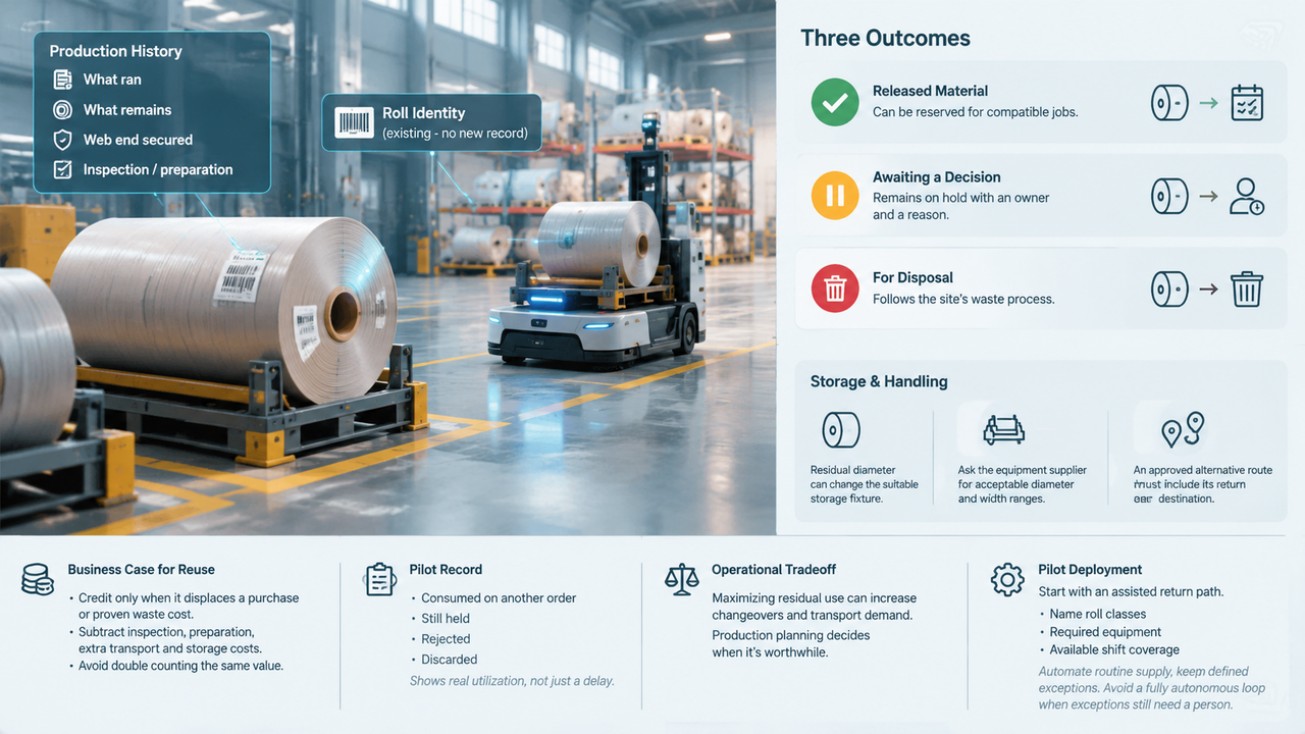
Separate three outcomes. Released material can be reserved for compatible jobs. Material awaiting a decision remains on hold with an owner and a reason. Material approved for disposal follows the site's waste process. These states should remain distinct even when the rolls share one physical buffer. Location alone cannot tell an AMR dispatcher whether moving a roll will help production.
Residual diameter can also change the suitable storage fixture. The position that supported the incoming roll may not support the remainder in the same way. Ask the equipment supplier to define acceptable diameter and width ranges for each relevant carrier and receiving position. An approved alternative route should include its return destination, not stop at the instruction to obtain manual assistance.
The business case for reuse starts with actual consumption. Credit recovered material when it displaces another purchase or a demonstrated waste cost, not when it is merely returned to a shelf. Subtract inspection, preparation, extra transport and storage costs where they arise. Do not count the same material value once as avoided scrap and again as avoided purchasing unless the accounting basis clearly separates those benefits.
A useful pilot record follows each returned roll until its next disposition: consumed on another order, still held, rejected or discarded. This reveals whether the project improves material utilization or simply postpones the decision. It also exposes a common operational tradeoff: maximizing residual use can increase changeovers and transport demand. Production planning should decide when that trade is worthwhile.
Keeping an assisted return path can be a reasonable first deployment boundary. The quotation should then name the affected roll classes, required equipment and available shift coverage. A project can automate most routine supply while retaining defined exceptions; the error is pricing a fully autonomous loop when those exceptions still depend on an unplanned person.
Bring four rolls to the supplier demonstration
A useful answer to how to automate paper roll handling should survive more than a demonstration with one perfect new roll. Select four representative material conditions with production, quality and the supplier. Define the expected decision for each before the trial. Use approved procedures and suitable test material; an excluded or suspect load should test rejection and routing, not an unsafe lifting attempt.
| Demonstration item | Question to answer | Evidence to retain |
|---|---|---|
| Approved full roll | Can the complete routine job finish without extra repositioning? | Identification, pickup, transport, handoff and release records |
| Usable partial roll inside the handling range | Can the system reserve the remainder for a compatible order and deliver it? | Updated quantity, job match, destination acceptance and returned-stock history |
| Partial roll outside the handling range | Does the system refuse the unsuitable mission and activate the defined alternative? | Rejection reason, assigned owner and an executable alternative route |
| Roll with a controlled identity or quality exception | Does the process preserve the hold instead of completing a convenient but incorrect delivery? | Hold status, exception notification and authorized resolution |
For paper roll damage prevention, agree on inspection points before the first movement. Document existing marks, then inspect relevant contact areas after transport and after the receiving operation. The same agreed criteria should distinguish pre-existing damage, handling damage and material removed during normal preparation. Photographs help trace events, but they do not replace material-specific quality requirements.
Observe the handoff with the people who operate the press. Note whether someone must rotate the roll, move a cradle, recover a label or repeat a positioning action. These interventions are part of printing press roll handling even when the robot's mission dashboard reports success. Time them and assign them to the correct scope rather than deleting them from the demonstration result.
Repeat meaningful conditions across the permitted range, including a normal queue at the destination and a planned change in the next production order. Confirm that reservations are updated and that a roll already collected is not abandoned without an agreed destination. The purpose is to verify decisions and recovery behavior under realistic variation, not to produce a large number of identical successful trips.
The final record should make rejected missions visible alongside completed ones. A correct refusal protects people, equipment and material, but it still consumes operational attention. Procurement needs to know which refusals represent planned scope boundaries, which reveal poor incoming material control and which indicate an integration defect. Those distinctions turn a demonstration into a credible production decision.
Give the purchase a boundary that production can recognize
A useful first project may automate only the transfer of approved, wrapped rolls between two prepared locations. Another plant may need a connection all the way to the roll stand, including identification, preparation and return handling. The more ambitious scope is not automatically the better investment. Choose the boundary that removes a verified constraint while leaving a manageable and explicit amount of human work.
Ask operations to describe the retained tasks as actual shift assignments. Someone may still inspect a damaged edge, remove protective material, load a shaft or authorize a substitute grade. If those duties remain, identify when they occur and how the operator is notified. A proposal does not become unattended simply because its transport segment requires no driver.

Keep the commercial evidence tied to the same scope. Supplier demonstrations, quotations and acceptance records should name the roll families, attachments, stations, software versions and exceptions they cover. A successful trial with one material is evidence for that tested condition. Expanding into a new diameter range, a different surface or another press requires a review of what has changed.
For printing and converting businesses, the strongest purchasing question is straightforward: can the system keep usable material moving through the agreed process, including the return? That question gives logistics, production and quality a shared basis for approval. It also makes hidden handling work visible before the fleet is purchased.
Focused FAQ
How to automate paper roll handling in an existing print shop?
Start by defining the material families and the exact transfer boundary. Record full and partial-roll dimensions, permitted contacts, protection, orientation and receiving conditions. Then compare carrier-based transport, direct pickup and clamp-based arrangements against the same tasks. Validate the complete route and return process with representative production material before extending the scope.
Can a standard pallet AMR move paper rolls?
It may move an approved carrier holding a secured roll if the complete configuration is within its validated limits. That does not mean it can directly pick an unsupported roll or mount one onto an unwind. The fixture, load restraint, combined mass, geometry and receiving interface all require application-specific confirmation.
Can the same robot handle a full roll and its remainder?
Only if both states are supported. A partially consumed roll can be well below the weight limit but outside the attachment's minimum diameter, width or engagement requirements. Check the smallest remainder that production intends to recover. If it needs another carrier or another handling route, include that arrangement in the purchased process.
Does a reel-transport AMR automatically load a printing press?
Not necessarily. Transport to a floor position, transfer to a preparation station and loading an unwind are different scopes. Confirm responsibility for any protection removal, orientation change, core engagement and machine acceptance. A platform's general press-integration claims should not be treated as proof of every function on every robot variant.
How should buyers evaluate roll damage?
Use material-specific criteria agreed with quality and production personnel. Compare condition before and after the defined handling route, identify which surfaces were contacted and inspect downstream behavior where appropriate. Record safe refusals separately from damage caused during transport. A small successful demonstration supports a pilot decision, not a guaranteed lifetime damage rate.
Is an AMR better than an AGV for paper rolls?
The label alone does not decide the result. Compare navigation behavior, approved operating environment, attachment capabilities, load limits, interface functions and service support. A suitable established AGV can be more appropriate for one process than a newer AMR; another application may benefit from a different route strategy. Evaluate the configured system against the actual production duty.
Which metric best captures a successful roll delivery?
Track whether the correct, usable roll was accepted at the agreed production boundary by its required time. Report transport completion, quality exceptions, preparation delays and manual interventions separately. Include return eligibility and reconciliation for partial rolls so that a successful outbound move does not conceal a failed recovery process.
Source notes and scope
This article is original editorial analysis prepared on October 22, 2026. Product facts are attributed to the sources below; supplier descriptions are not independent performance verification. The worked material example and demonstration design are illustrative, not results from an installed system. Publication announcements, planned availability and operational deployment are treated as different stages.
- MoviĜo Robotics, technology-platform announcement, September 30, 2026: recent product-development context.
- MoviĜo Robotics, product specifications: RT payload, diameter limits and stated end-2026 availability, checked October 22, 2026.
- MoviĜo Robotics, LOUPE Americas 2026 and PACK EXPO 2026: announced exhibition scope, not a firsthand show report.
- HP Japan, June 23, 2026 announcement: print-focused AMR portfolio context.
- Bolzoni, September 2026 AGV attachments announcement and MIAC 2026 preview: specialized attachments and material-family distinctions.
- Ishida and Moriyama, iMotion by BHS, JAPAN TAPPI Journal, volume 80, issue 4, pages 334–337: public abstract, released May 1, 2026, used to distinguish integrated roll preparation and supply from transport alone.
- Bolzoni HTX technical sheet, February 2025: an example of attachment-specific clamping-pressure control.
- Holmen General Technical Information, December 10, 2025: material-conditioning guidance for its named paperboard families.
- BHS iPrep product documentation: the scope of a separate roll-preparation operation.


