PU Wall Panel VOC Emissions What Indoor Projects Should Verify
Material Identity Is Not Indoor-Air Evidence
Short answer: A PU wall panel cannot be described as low-emitting, non-toxic, or suitable for every indoor project from its material name alone. Indoor-air evidence should identify the finished product configuration, test method, chamber conditions, loading factor, air exchange, conditioning period, sampling times, and measured compounds. Adhesives, sealants, coatings, and cleaners used during installation may contribute separate emissions, while odor is not a substitute for analytical data. Buyers should review the complete report or a verifiable certification listing, confirm that the tested SKU and finish match the supplied product, and check project-specific requirements before approval.
The useful procurement question is not, “Is polyurethane safe?” It is, “What does the evidence show for this finished panel, in this configuration, under this method, for this intended project?” That change in wording matters. Polyurethane is a broad material family, while a commercial wall panel is a manufactured system that may include a foam core, molded skin, backing treatment, pigments, primers, paints, clear coats, inks, release-agent residues, repair coatings, packaging contact, and installation products. Two panels sold under the same material label can therefore have different emission profiles.
Current search results also reveal a difficult market reality. Buyers looking for are PU wall panels toxic often encounter categorical supplier claims before they encounter a test method, product code, or report. A technically responsible answer cannot be reduced to yes or no. “Toxic” is not a product specification, and health significance depends on the compounds present, concentration, exposure scenario, duration, occupant susceptibility, and applicable evaluation criteria. A procurement team should avoid converting an incomplete marketing statement into a universal health conclusion.
This guide establishes an evidence chain for PU wall panel VOC emissions. It does not give medical advice, set a universal exposure limit, or declare a product acceptable in every jurisdiction. Its purpose is to help architects, importers, distributors, contractors, and compliance teams ask for the right records, detect scope gaps, and make a traceable approval decision.
Four Different Questions That Marketing Often Blends Together
The word “VOC” is used in several technical and commercial contexts. Confusion begins when content, emissions, odor, and health are treated as interchangeable. The U.S. Environmental Protection Agency notes that VOC definitions and measurement approaches differ by context, and that analytical methods vary in what they can detect and quantify. A claim without a method has limited decision value.
| Question | What it actually asks | Useful evidence | What it cannot prove alone |
|---|---|---|---|
| VOC content | How much regulated volatile material is formulated into a liquid product, often reported by mass or volume under a specified rule. | Current technical data, formulation-specific declaration, and the cited content test or calculation method. | What a cured panel or installed assembly emits into indoor air over time. |
| VOC emissions | Which chemicals leave a finished product under defined chamber conditions and at what measured or modeled concentration. | A product-specific VOC chamber test report or a current third-party certification listing with clear scope. | Universal safety in every room, climate, loading rate, or occupancy. |
| Odor | Whether people perceive a smell and how they describe its intensity or acceptability. | A defined sensory protocol, alongside—not instead of—chemical analysis. | The absence, identity, or health significance of VOCs. Some compounds have little detectable odor; some odors occur at low concentrations. |
| Health claim | Whether exposure under a defined scenario is associated with an evaluated health endpoint. | Compound-specific data, exposure assumptions, recognized criteria, and qualified professional review where needed. | A blanket “safe,” “non-toxic,” or “healthy” conclusion from material name, smell, SDS, or TVOC alone. |
This distinction is especially important for wet-applied products. A low-VOC content statement for an adhesive may be relevant to a rule or specification, but it is not automatically an emissions result for the cured installation. Conversely, a finished panel chamber result does not describe the emissions from an adhesive that was not included in the specimen. A good submittal keeps both types of evidence in their proper lanes.
Formaldehyde requires similar precision. A request for PU wall panel formaldehyde emissions should lead to a method, measured result, reporting limit, sample identity, and date—not merely a statement that polyurethane is not a wood composite. Formaldehyde can be evaluated separately from VOCs analyzed by other techniques, and a report must show whether it was within the analytical scope. “Not listed” is not the same as “tested and not detected,” while “not detected” means below the method’s stated reporting threshold, not absolute zero.
Build an Emissions Inventory for the Installed System
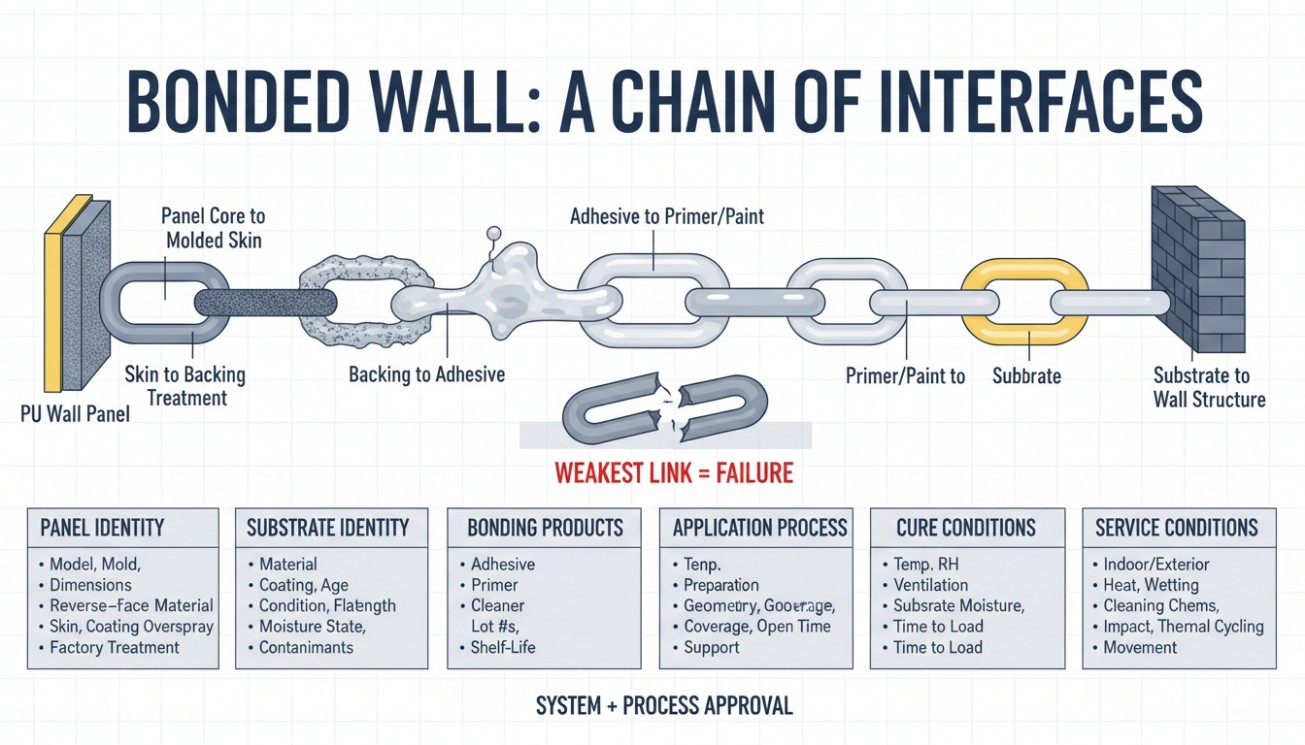
Product approval frequently stops at the visible panel. The occupied room, however, receives an installed system. That system can contain factory-applied and field-applied components that were never placed in the same test chamber. Before evaluating any result, create a bill of materials for every product that can contribute emissions during installation, curing, cleaning, or normal use.
| System element | Identity to record | Evidence to request | Common scope failure |
|---|---|---|---|
| PU panel | Product family, SKU, dimensions, thickness, density range, molded skin, backing, factory, and intended use. | Finished-product emissions report or exact certification listing; technical data; sample-to-production declaration. | A core-only specimen is presented as evidence for a coated, molded, printed, or backed finished panel. |
| Factory coating and ink | Primer, color layers, clear coat, ink system, supplier, formula revision, and cure process. | Evidence that the tested specimen used the same coating stack and representative application weight. | One neutral finish is used to support every color, special effect, touch-up paint, or coating revision. |
| Adhesive or tape | Manufacturer, exact product code, lot, application rate, bead geometry, open time, and cure conditions. | Applicable content declaration, emissions evidence, SDS, technical data, and compatibility approval. | The panel certificate is assumed to cover a separately purchased adhesive. |
| Primer and sealant | Exact primer, joint sealant, perimeter sealant, quantity, and exposed geometry. | Product-specific documentation and project acceptance criteria. | Small volume is treated as zero contribution, even when many joints or edges are installed. |
| Cleaner and repair material | Surface cleaner, solvent, touch-up coating, filler, and cleaning schedule. | Use instructions, SDS where applicable, ventilation guidance, and substitution controls. | An installer uses an unapproved solvent or repair coating that was absent from the submittal. |
| Substrate and existing finish | Drywall, masonry, wood-based board, paint, primer, contamination, age, and moisture condition. | Compatibility records and project-specific review. | The new panel is blamed for an odor or emission source originating behind it. |
The resulting document is an emissions inventory, not merely a shopping list. It shows which elements have independent evidence, which were included in a tested assembly, and which remain unassessed. This is the right place to investigate wall panel adhesive VOC emissions, because the installed quantity, cure chemistry, exposed edges, ventilation, temperature, and relative humidity can all differ from the factory-cured panel condition.
For installation compatibility and field-validation logic, connect this inventory to the project’s adhesive-selection process rather than choosing a product on “low odor” alone. The site’s PU wall panel sourcing guide for distributors is also useful at this stage because model control, sample control, and document control should begin before the purchase order.
Follow the Specimen Through the Chamber, Not Just the Result

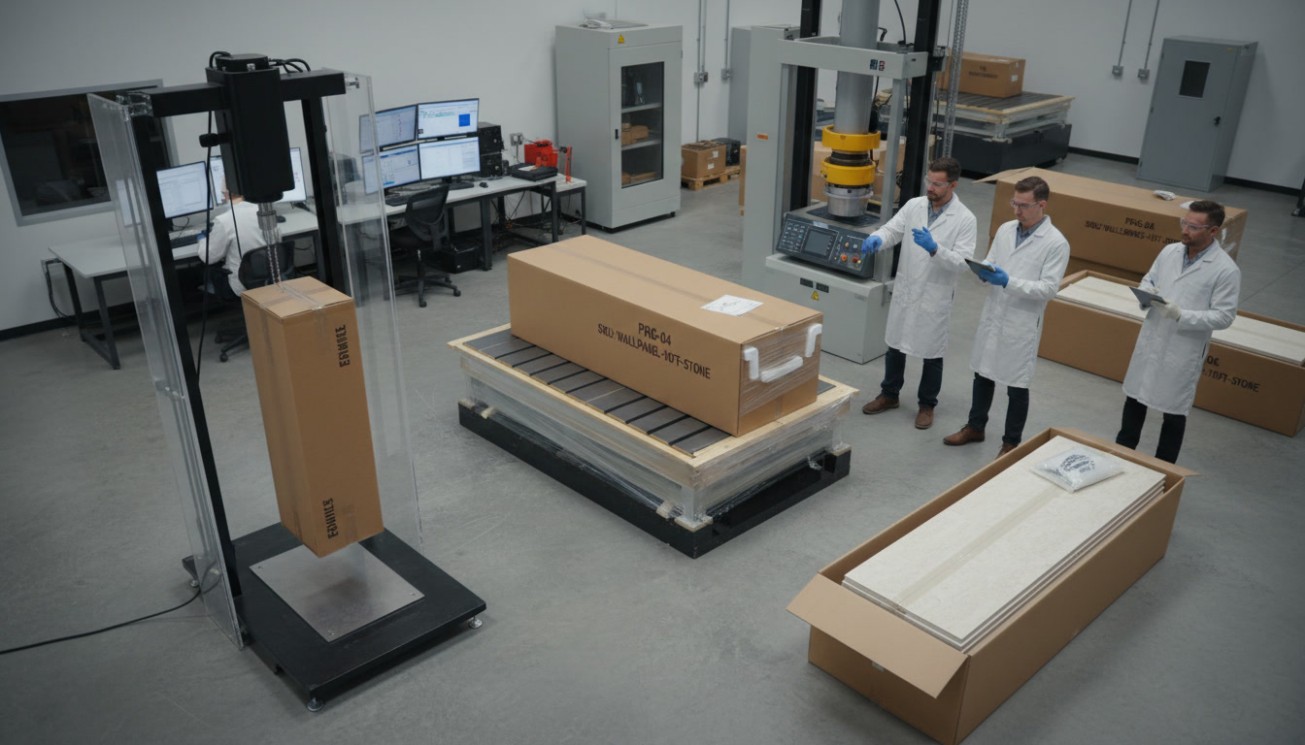
ISO 16000-9:2024 describes a general chamber method for determining area-specific emission rates from samples of building products and furnishings under defined climatic conditions. The California Department of Public Health Standard Method v1.2 is a widely referenced evaluation framework for emissions from indoor sources using environmental chambers. A report may use one of these frameworks directly, combine referenced methods, or operate under a certification program with its own requirements. The buyer’s job is to identify the exact method and version, not infer one from a laboratory logo.
Evidence flow: supplied SKU and finish → representative specimen selection → documented packaging and transport → conditioning or preparation → controlled chamber exposure → scheduled air sampling → chemical analysis → model-room calculation or program evaluation → product-specific decision.
Each arrow can change the meaning of the result. If a specimen was left unpacked for an undocumented period before testing, early emissions may have declined. If only the decorative face was exposed in the chamber but field-cut edges remain open in the real installation, the tested geometry may underrepresent the installed condition. If the chamber loading factor differs from the modeled use, the result cannot be transferred without understanding the program’s calculation.
Chamber conditions are part of the result
A defensible PU wall panel emissions test identifies chamber volume, temperature, relative humidity, air exchange rate, product loading factor, exposed surface area, and sampling times. It should also explain how edges and backs were sealed or exposed, how the specimen was mounted, and whether the product was tested as received, cut, assembled, or cured. These are not administrative details. They define the environment in which the emission rate was generated.
The loading factor connects product area to chamber volume and then to a model room or use scenario. A small decorative accent area, full-height wall covering, ceiling application, and compact test cell do not represent the same material loading. Air exchange affects dilution. Temperature and humidity can affect emission behavior. Sampling time matters because many products show a changing profile rather than one permanent value.
Sample preparation can create hidden bias
Ask who selected the specimen and from what production event. A factory-prepared laboratory sample can be technically valid yet commercially unrepresentative if its formulation, coating weight, age, or cure differs from supplied production. The report should state the date received, package condition, date opened, storage conditions, specimen preparation, test start, and test end. These timestamps allow the reviewer to reconstruct elapsed time.
Dimensions and exposed faces also deserve attention. A core-only cube does not represent an intact coated panel. An intact face may not represent a field-cut panel. A sealed rear face may be appropriate for one installation and inappropriate for another. The buyer should not demand one universal configuration; the buyer should demand a configuration that matches the claim being made.
Audit the report line by line

| Report field | Why it matters | Risk when missing | Buyer action |
|---|---|---|---|
| Laboratory and accreditation scope | Shows who performed the work and whether relevant methods are within the accredited scope. | A certificate logo is mistaken for competence for this specific test. | Request the current scope and verify the test discipline, location, and report issuer. |
| Method and version | Defines preparation, chamber operation, analysis, modeling, and criteria. | Results from unlike methods are compared as if they were equivalent. | Record the complete citation, edition, program, and any deviations. |
| Sample identity | Links the result to product name, SKU, finish, coating, thickness, factory, and lot. | A generic “PU panel” description supports unrelated products. | Reconcile the report description with drawings, purchase documents, labels, and retained samples. |
| Timeline and handling | Reveals aging, storage, packaging, opening, conditioning, and test timing. | Undocumented pre-airing or storage changes the emission profile. | Build a date sequence and query unexplained gaps. |
| Specimen geometry | Shows total area, exposed faces, edge sealing, installation simulation, and loading factor. | The chamber specimen does not represent the claimed application. | Compare laboratory geometry with the project’s actual coverage and cut-edge condition. |
| Chamber conditions | Temperature, humidity, ventilation, and air mixing influence the test environment. | A number is detached from the conditions that produced it. | Check method tolerances, recorded values, and deviations. |
| Analytes and analytical methods | Identifies which VOCs and aldehydes were targeted and how they were quantified. | “Passed VOC” is assumed to mean every possible airborne chemical was evaluated. | Review compound lists, unidentified peaks where reported, calibration approach, and separate formaldehyde analysis. |
| Limits, units, and uncertainty | Detection or reporting limits, units, and measurement uncertainty affect interpretation near a criterion. | ND is read as zero, or unlike units are compared directly. | Normalize units only with a valid conversion and ask how conformity was decided near a boundary. |
| Decision rule and authorization | Shows how a pass/fail statement was reached and who approved the report. | A raw value or draft is represented as a final compliance decision. | Obtain the signed final report and the applicable criterion or program rule. |
Interpret TVOC, Individual VOCs, and Formaldehyde Without Shortcuts
A single total can be attractive because it appears easy to compare. TVOC, however, is a method-dependent aggregate. Its value can change with the defined analytical window, collection method, instrument response, calibration convention, and treatment of identified and unidentified compounds. It should be interpreted within the named method, not as a universal toxicity score.
Individual compounds matter because equal totals can contain different chemical profiles. Formaldehyde and other aldehydes may require a different sampling and analytical method from VOCs commonly collected on sorbent tubes. The EPA’s technical overview explicitly warns that no single measurement method captures every VOC accurately and that statements need the measurement approach for meaningful interpretation. A responsible report therefore identifies the analytical methods and reports compound-specific data required by the governing program.
Use the following reading discipline:
- Confirm whether the value is an emission rate, chamber concentration, modeled concentration, content value, or certification criterion.
- Confirm the units and time point. Do not compare micrograms per cubic meter with milligrams per square meter per hour without the model inputs required for conversion.
- Check whether formaldehyde is reported separately and whether the stated result is quantified, below a reporting limit, or outside scope.
- Review individual compounds and any program-specific chronic reference exposure levels or allowable concentration criteria used by the evaluator.
- Read qualifications, deviations, uncertainty, and specimen notes before accepting the headline conclusion.
A request for low VOC PU wall panels should therefore become a request for a defined low-emitting criterion and matching evidence. “Low” only has commercial meaning when the buyer knows low relative to which program, method, time point, product loading, and product configuration. Likewise, “zero emissions” should not be inferred from a non-detect or from zero-VOC content language.
Verify Certification Scope in the Issuer’s Current Database

Third-party certification can reduce review burden, but only when the listed product and supplied product are the same within the certification scope. UL Solutions states that GREENGUARD certification addresses chemical emissions for product groups including building materials, while GREENGUARD Gold uses lower emission limits and incorporates the CDPH Standard Method requirements. It also states that certified products are subject to manufacturing-process review and routine testing. Those program features are valuable, but a logo copied onto a catalog page is not the listing.
If a specifier requests GREENGUARD certified wall panels, search the issuer’s current database rather than relying on a screenshot or undated certificate. UL’s SPOT database allows users to search by manufacturer, product, standard, and other attributes and to retrieve current listings or certificates. Record the search date because certification status and scope can change.
Verification flow: certification claim → issuer database → listed company → listed product family → model or series → included finishes and options → certification level and standard → current status → supplied SKU and label → purchase-order record.
Five scope checks before approval
- Certificate owner: Is the listed company the actual manufacturer, a brand owner, or another entity? Does that relationship match the supply chain?
- Product identity: Does the listing name the same series, model, construction, thickness, and use? A family name that sounds similar is not enough.
- Finish coverage: Are all proposed colors, coatings, print systems, and backing options included? Request written confirmation when the public listing is not sufficiently granular.
- Certification level and status: Is the claim GREENGUARD or GREENGUARD Gold, and is the listing active on the verification date?
- Installation scope: Does the listing cover only the factory-finished panel, or an assembly including a named adhesive? Do not extend scope by assumption.
This is why a search for GREENGUARD PU wall panels should end in a traceable listing-to-SKU record rather than a generic “green” statement. Certification is a controlled claim. It should not be stretched to unlisted factories, private-label equivalents, new coatings, touch-up paints, sealants, or installation adhesives.
Reconnect the Laboratory Sample to Production Supply

Even a well-executed test becomes weak procurement evidence when it cannot be mapped to the shipped product. The test report is a snapshot; commercial supply is a process. Buyers need a bridge between the two.
Start with a product identity sheet that records the marketed name, internal model, mold number, dimensions, nominal thickness, density specification, resin or formulation revision, pigments, coating stack, backing treatment, factory, production line, and label format. Then place the laboratory specimen into that identity system. The factory should be able to state which production lot supplied the specimen, when it was made, and whether it was standard saleable production.
A retained reference sample is valuable when it remains sealed, labeled, photographed, and governed by a retention period. It gives the buyer and supplier a physical comparison point for later lots. Retention does not prove continuing conformity, but it makes investigations more disciplined.
Changes that should trigger documented review
- Resin, catalyst, blowing agent, pigment, flame-retardant package, or additive supplier changes.
- New primer, coating, ink, clear coat, release agent, backing, repair material, or cure schedule.
- Transfer to another factory, production line, mold process, or subcontracted coating operation.
- New thickness, density band, exposed geometry, surface area, or backing option outside the evaluated family.
- Persistent odor complaints, unusual analytical findings, nonconforming raw materials, or major process excursions.
- Certification renewal, method revision, project-specification change, or a request to extend a claim to a new market.
Not every change automatically requires a full chamber retest. It does require documented technical review by the responsible organization or certification body. The decision may be no action, supplier evidence review, focused analytical work, comparative screening, or full re-evaluation. The essential point is that the change and the decision are visible.
This production link complements the site’s discussion of PU wall panels as documented lightweight wall systems. The category becomes project-ready when suppliers manage identity, accessories, data, and changes together—not when they simply add a new surface pattern.
Fit the Evidence to the Project and the Installation Period
An emissions result does not select a project by itself. An office reception wall, apartment bedroom, school classroom, healthcare waiting area, retail rollout, and short-term exhibition may use different specifications, rating systems, procurement rules, occupant assumptions, material loading, and ventilation plans. The governing requirements can also vary by jurisdiction and client.
For indoor air quality wall panels, begin with the project specification and room schedule. Identify the occupied area, panel coverage, ceiling height, ventilation design, installation sequence, handover date, and whether the project applies a recognized low-emitting-material program. Determine whether the program evaluates individual products, categories, assemblies, or a calculated percentage of compliant materials. Do not claim a universal approval when the result supports only one program or use case.
Commercial projects create an additional coordination burden. A brand may repeat the same finish across hotels, stores, or offices, but local adhesive availability, substrate conditions, installer practice, and ventilation can vary by location. The site’s guide to commercial PU stone panel project controls provides useful context for repeatable submittals, maintenance, and rollout consistency. Visual application decisions belong in the separate PU wall panel interior design guide; the present decision remains focused on emissions evidence.
Curing and ventilation are controls, not substitutes for evidence

Follow the manufacturers’ instructions for storage, substrate preparation, temperature, humidity, open time, cure time, and ventilation. Where the project requires flush-out, air testing, or an occupancy delay, coordinate those requirements with the construction schedule and the relevant professional. Do not invent a generic “air out for 24 hours” rule: products and project protocols differ.
Ventilation can reduce indoor concentrations by dilution and removal, but it does not convert an unverified product into a verified low-emitting product. Likewise, a certified panel does not neutralize an unreviewed adhesive or solvent cleaner. Source selection, correct installation, and ventilation are complementary layers.
Odor complaints need a structured response. Record the location, time, temperature, ventilation state, products recently used, installation date, lot numbers, and complaint pattern. Inspect packaging, substrate, moisture, cleaners, adjacent work, and HVAC operation. An odor may justify investigation, but smell alone cannot identify the source or quantify exposure. Do not ask untrained occupants to make a safety determination by sniffing.
Use Claim Language That the Evidence Can Carry
The strongest technical marketing is precise enough to survive a buyer’s document audit. Claims should name the product, method or certification, scope, date or current status, and relevant limitation. If that makes the sentence longer, the added length is doing useful work.
| Risky wording | Why it fails | More defensible wording pattern |
|---|---|---|
| “Non-toxic PU panels” | Unqualified, universal, and detached from exposure conditions and evidence. | “Model [X], finish [Y], was evaluated for chemical emissions under [method/program]; review the current report/listing and project requirements.” |
| “Zero VOC” | May confuse content with emissions or turn a reporting threshold into absolute absence. | “The stated VOC content is [value] under [rule/method],” or “the finished product met [named emissions criterion] at [time point].” |
| “No formaldehyde” | Does not state whether this means no intentionally added ingredient, a non-detect, or a certification claim. | Use the exact verified claim, such as “formaldehyde was below the report’s stated limit at [time point] under [method],” when supported. |
| “Odor-free, therefore safe” | Odor perception is not a comprehensive chemical analysis or health assessment. | Report odor observations separately and cite analytical emissions evidence for the tested product. |
| “The whole system is certified” | May improperly extend a panel listing to adhesives, sealants, primers, cleaners, or substrates. | List each certified component and each separately reviewed installation material by exact product code. |
| “Meets all global standards” | No single report creates universal market or project acceptance. | Identify the specific standard, edition, result, product scope, and target project or market. |
A strong PU wall panel certification statement should therefore be narrower than the sales team may initially prefer. Narrow claims are easier to verify, update, and defend. They also reduce the risk that distributors repeat a statement beyond the manufacturer’s evidence.
Keep fire performance separate from chemical-emissions certification. A surface-burning classification does not establish low emissions, and an emissions certification does not establish fire performance. Readers evaluating fire documentation can use the site’s PU stone panel fire-rating guide without blending the two approval tracks.
Buyer Submittal Checklist: Make the Approval Reproducible

A useful submittal lets a second reviewer reach the same decision without relying on the first reviewer’s memory. Organize the file by evidence chain rather than by whichever documents the supplier happened to send first.
1. Product identity
- Legal manufacturer, brand owner, manufacturing site, product family, model, SKU, finish, color, thickness, density specification, and intended interior use.
- Current technical data sheet, dated product drawing, label photograph, packaging label, and approved physical sample.
- Factory coating, backing, touch-up material, and any option that changes the supplied construction.
2. Emissions evidence
- Complete signed report—not a cropped pass page—with laboratory, method, edition, program, report number, issue date, and authorization.
- Receipt, opening, conditioning, and test dates; package condition; specimen dimensions; exposed faces; chamber settings; loading factor; and sampling schedule.
- Analyte list, analytical methods, results, units, detection or reporting limits, uncertainty where applicable, model assumptions, criteria, deviations, and decision rule.
- Separate identification of TVOC, individual VOCs, formaldehyde or aldehydes, and any substances outside the analytical scope.
3. Certification verification
- Issuer, certification level, standard, listing number, certificate owner, product family, covered models and finishes, expiration or status information, and verification date.
- Saved link or exported record from the issuer’s database and a written mapping to the offered SKU.
- Explicit statement of whether the listing excludes adhesives, sealants, primers, coatings, or field-applied products.
4. Installation-material register
- Exact adhesive, primer, sealant, cleaner, filler, touch-up coating, tape, application rate, and substitution policy.
- Technical data and SDS for handling and hazard communication, plus emissions or content documentation required by the project.
- Surface compatibility, cure conditions, ventilation instructions, approved substrate, and installer record.
5. Production and change control
- Tested-lot identity, current production formula or revision mapping, factory and line, retained reference sample, and release authorization.
- Change-notification agreement covering raw materials, coating, backing, factory, process, dimensions, and new finishes.
- Defined triggers and responsible parties for document review, focused testing, certification-body consultation, or retesting.
6. Project decision record
- Applicable specification section, room or occupancy, installed area, program or jurisdictional requirement, reviewer, decision date, conditions, and unresolved exceptions.
- Approval language limited to the reviewed SKU, finish, installation materials, and project—not a general endorsement of all PU panels.
- Records retained with procurement, receiving inspection, lot traceability, substitutions, and final installed-product documentation.
The checklist can be converted into a one-page “Indoor Air Quality Product Submittal” form with columns for required, received, verified, exception, owner, and due date. That format exposes missing evidence before shipment or installation, when corrective action is still practical.
Focused FAQ
Are PU wall panels non-toxic?
Material identity alone cannot support that broad claim. Review evidence for the exact finished panel, including coatings and backing, under a named emissions method or current certification program. Then compare the scope and results with the project requirements. Installation adhesives, sealants, primers, and cleaners need separate review unless a documented assembly evaluation explicitly includes them. Avoid turning a limited test result into a universal health statement.
Does strong smell mean high VOC emissions?
Not necessarily. Odor threshold, analytical concentration, and health significance are different concepts. Some chemicals can be smelled at low concentrations, while others may have little perceptible odor. Record an odor complaint and investigate the source, timing, ventilation, installation materials, substrate, and nearby work, but use appropriate analytical evidence and qualified review rather than smell as a pass/fail test.
Is an SDS enough to verify indoor air quality?
No. An SDS is a hazard-communication document that provides information such as chemical properties, hazards, protective measures, handling, and storage. It remains important for workplace and installation controls, but it is not a finished-product chamber emissions report. An SDS may not disclose every constituent, quantify emissions over time, reproduce a room-use scenario, or establish compliance with a low-emitting-material program.
Does GREENGUARD certification for a panel cover the installation adhesive?
Do not assume it does. Verify the public listing or certificate scope. If the listing identifies only the panel, the adhesive remains a separate product requiring the documentation specified by the project. Even when both products are individually certified, confirm that each exact manufacturer, model, and current status matches the materials delivered to site.
When should a VOC emissions test be repeated?
There is no single interval for every product and program. Follow the certification scheme, project specification, laboratory or qualified reviewer, and applicable jurisdiction. Reassessment should be considered when formulation, coating, backing, factory, process, thickness, exposed geometry, or installation system changes; when a claim is extended to a new product; when significant complaints or process deviations occur; or when a governing method or criterion changes.
Can a core-only test support every finished PU panel?
No. A core-only result describes the tested core specimen under the stated conditions. A finished panel may add a molded skin, backing treatment, pigments, coatings, inks, and other components. If the commercial claim concerns the finished panel, the evidence should represent that finished configuration or provide a technically justified, documented product-family rationale accepted by the relevant program or reviewer.
What should a buyer do when a report shows “ND”?
Read the report’s definition, analytical method, reporting limit, units, and sampling time. ND normally means the compound was not detected or not quantified above a stated method threshold; it does not mean absolute zero. Also confirm that the compound was actually within the method’s target list and that the reporting limit is suitable for the applicable evaluation criterion.
Evidence Notes, Claim Limits, and Editorial Review
Evidence date: 9 September 2026. Article scope: procurement and project-document review for finished PU decorative wall panels used indoors. Claim limit: This article explains how to evaluate evidence; it does not certify a product, replace the governing project specification, provide occupational or medical advice, or establish legal compliance in a particular jurisdiction.
Author: Global Supply Chain Briefing Editorial Team. Technical review recommended: indoor-air-quality or materials-compliance professional familiar with the target project, test program, and jurisdiction. Buyers should use the current editions and current public listings available at the time of approval.
Primary references
- ISO 16000-9:2024 — Emission test chamber method for VOCs from building products and furnishings
- California Department of Public Health Standard Method v1.2 (2017)
- U.S. EPA — Technical Overview of Volatile Organic Compounds
- U.S. EPA — VOCs’ Impact on Indoor Air Quality
- UL Solutions — GREENGUARD Certification
- UL Solutions SPOT — current certification listings
- U.S. OSHA — Hazard Communication Standard: Safety Data Sheets