Inside a PU Wall Panel: How Density, Cell Structure and Surface Skin Affect Performance
A lightweight decorative panel can feel convincing in a showroom and still fail during cutting, fastening, shipping, or repeat production. That is why a buyer should not reduce PU stone panel quality to one number on a quotation sheet. Density matters, but its meaning depends on what was measured, where the specimen came from, whether the molded skin was included, how uniform the cells are, and what the panel must do after it reaches the jobsite.
This guide focuses on molded polyurethane decorative wall panels, especially stone-look and rock-effect products used as non-structural finishes. It does not treat polyurethane insulation boards, metal-faced sandwich panels, spray foam, and finished wall assemblies as interchangeable products. The purpose is to help importers, distributors, specifiers, contractors, and quality teams turn PU wall panel density from a marketing claim into a controlled purchasing parameter.
The practical answer is simple: use density as the beginning of an investigation, not the end of one. A defensible decision connects mass and volume data to cell morphology, skin condition, edge behavior, dimensional consistency, fastening method, coating condition, and batch variation. Buyers who want a broader visual and sourcing checklist can first review the guide to choosing high-quality PU stone panels; this article goes deeper into the internal structure and evidence behind that inspection.
Why PU wall panel density is not a product grade
Density is mass divided by volume. The formula is straightforward, but a molded decorative panel is not always a straightforward test piece. Its face may contain deep stone relief, its back may include ribs or recesses, its edges may interlock, and its surface may carry paint or another protective finish. Two suppliers can quote the same nominal density while measuring different parts of the product or using different specimen preparation rules.
A buyer should therefore ask four questions whenever a density value appears:
- Is the value for the complete molded panel, including its skin and coating, or only for a cut section of the cellular core?
- Was density calculated from the actual irregular panel volume, from a simple rectangular coupon, or from a nominal drawing?
- How many specimens were measured, and were they taken from different locations and production lots?
- Is the result a target, a typical average, a minimum, or an allowed range with a defined tolerance?
Without these details, a figure for rigid polyurethane foam density cannot be compared confidently across factories. Even within one factory, a single average can hide weak zones, abnormal voids, a thick surface region, or lot-to-lot drift. A specification that says only “density: high” or “density: 200 kg/m³,” without a method and sampling rule, is not yet an auditable requirement.
Separate the core, molded skin, coating, and installed wall
The first technical task is to define the object being evaluated. A useful polyurethane wall panel structure model has at least four layers of responsibility, even when the product is manufactured as one molded piece.
The cellular body

The cellular body gives the panel much of its volume at relatively low mass. Its cells may differ in size, shape, orientation, and uniformity. Local voids, collapsed regions, unusually coarse cells, or density gradients can affect how the panel behaves when it is held from one corner, cut around an outlet, pressed against an uneven wall, or fixed near an edge.
The molded surface skin
A denser region may form near a mold surface. For a decorative product, the face geometry and molded surface can contribute to perceived hardness, detail retention, resistance to minor knocks, and the way a cut edge behaves. The back and perimeter may not have the same skin condition as the decorative face. This is why PU panel skin thickness should never be inferred from total panel weight alone.
The decorative coating system
Color layers, protective coatings, primers, and touch-up materials affect appearance and serviceability, but they are not the same as the polyurethane body. A panel with acceptable density can still have weak coating adhesion, poor cleaning resistance, or unstable color. Conversely, an attractive coating can temporarily conceal inconsistent molding beneath it. Coating evidence belongs in a separate validation plan.
The installed wall assembly
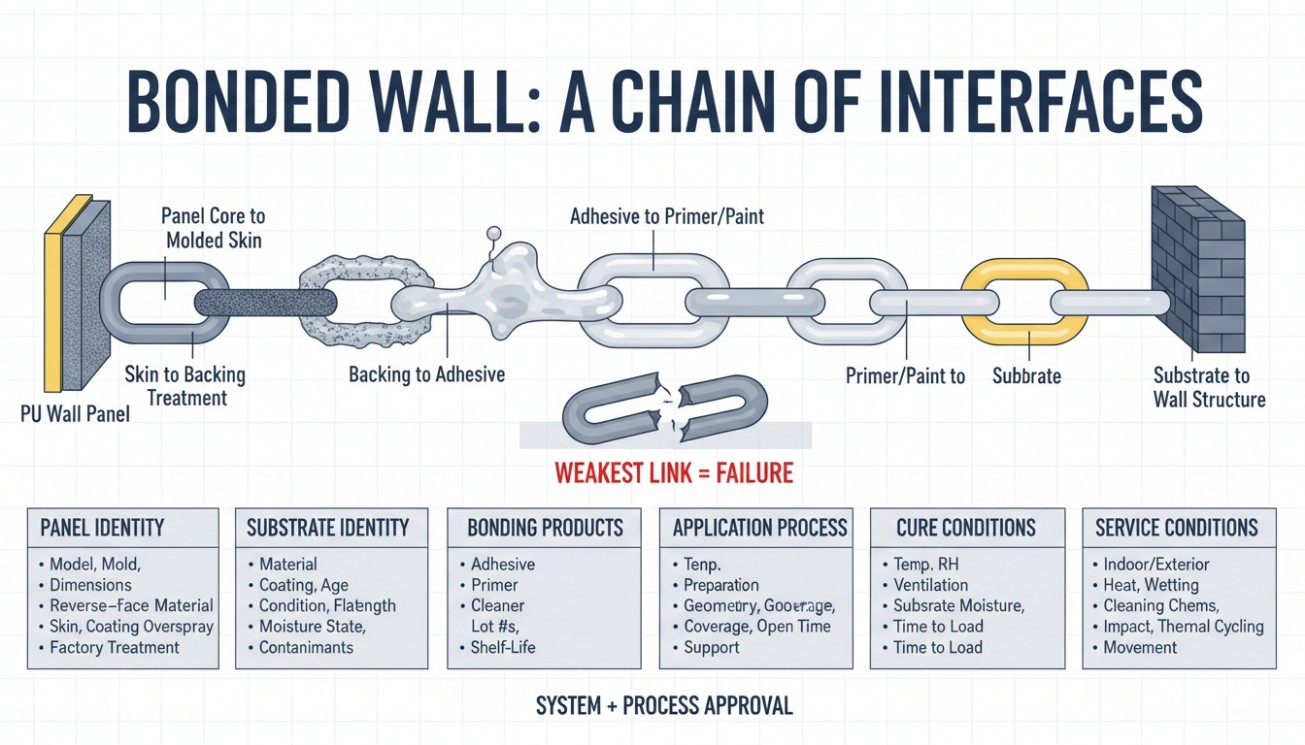
The finished wall includes the substrate, primer, adhesive, mechanical fasteners, joints, trims, penetrations, and environmental conditions. Panel data cannot by itself prove the strength, fire performance, moisture resistance, or durability of that assembly. This boundary is central to responsible specification: material evidence supports a material claim, while system evidence is required for a system claim.
Overall density and core density answer different questions

ISO 845:2006, confirmed by ISO in 2024 as the current edition, addresses apparent overall density and apparent core density for cellular plastics and rubbers. The distinction matters when skins are formed during molding or extrusion. The current ASTM D1622-26 similarly distinguishes an overall result that includes forming skins from a core result obtained without those skins.
For a decorative wall panel intended to remain intact, apparent overall density can help describe the supplied molded product. Core density may help investigate the cellular material beneath the surface. Neither number automatically replaces the other. If a supplier reports only core density but the buyer receives a deep-relief finished panel, the reported value does not fully describe the shipped article. If a supplier reports only an overall value, the result may not reveal internal variability.
What a useful density report should state
- Product code, color, mold or pattern, nominal dimensions, and production lot.
- Whether the specimen represents the complete product, a cut molded section, or core with the forming skin removed.
- Conditioning environment and time before mass and dimensions were measured.
- Specimen location, preparation method, dimensions, calculated volume, and mass.
- Individual results, mean, range, and an appropriate measure of variation rather than only one rounded average.
- Test method and edition, including any justified departure required by irregular geometry.
A laboratory method should be followed by qualified personnel using the full standard. A buyer’s receiving check can use the same measurement logic for screening, but it should not be presented as an accredited test unless it was performed within the required scope and controls.
Why location within a molded panel matters
Foam does not necessarily develop identically at every point in a mold. Flow path, mold temperature, local thickness, venting, reaction conditions, and distance from the injection area can create gradients. Research on molded rigid polyurethane foam has shown that density, cell morphology, and mechanical response can vary with position and mold geometry; importantly, morphology and mechanical properties may change even when density changes are small. The underlying study is available through the University of Nevada, Las Vegas research repository.
This does not provide a universal prediction for decorative stone panels. It provides a strong reason not to cut one convenient center coupon and call it representative. A deep-relief panel may contain thick peaks, thin valleys, narrow edges, interlocking areas, and large flat back sections. The sampling map should reflect the actual geometry and likely failure locations.
A practical sampling map
For development or supplier qualification, divide the panel into labeled zones rather than taking anonymous pieces. Include the four corners, four edge midpoints, the center, at least one deep relief area, one thin transition, and any designed fixing or overlap region. Photograph the intact panel and mark every specimen location before cutting. When production uses more than one mold cavity, tool, line, or shift, record that information too.
For routine receiving inspection, the number of panels and cut locations should be based on lot size, process capability, risk, and the cost of a failure. The article should not invent a universal sample count. A new supplier, new mold, changed formulation, or exterior-grade claim justifies a more intensive plan than a stable repeat order with verified history.
| Zone | Why inspect it | Suggested observations |
|---|---|---|
| Center body | Provides a baseline for the main molded area | Mass/volume result, cell uniformity, voids, cut quality |
| Perimeter edge | Frequently exposed to handling, cutting, and joint stress | Skin continuity, crumbling, chipping, dimensional accuracy |
| Corner | Common transport and installation damage location | Local weakness, missing material, impact damage, geometry |
| Deep relief | Geometry may alter local molding and volume calculation | Cell shape, skin condition, thin sections, coating coverage |
| Fixing or overlap area | Transfers installation forces and controls joint fit | Fastener behavior, splitting, fit, repeatability |
Cell morphology explains what an average can hide

PU foam cell structure includes more than a simple open-cell or closed-cell label. A useful examination considers cell size, size distribution, shape, orientation, wall integrity, local collapse, large voids, and variation between panel zones. These features can reflect formulation and process conditions, but buyers should avoid diagnosing chemistry from a photograph alone.
A coarse, irregular region beside a fine, uniform region may signal uneven processing or local geometry effects. Elongated cells may also produce direction-dependent behavior. A clean cross-section can therefore add information that total weight cannot provide. For supplier approval, macro photographs with scale references may be sufficient to identify obvious inconsistency. For root-cause analysis or product development, microscopy and a documented image-analysis method provide stronger evidence. This is why PU foam cell structure should be mapped, not represented by one convenient photograph.
Cell images should always be connected to a performance question. Counting cells for its own sake does not approve a wall panel. The buyer should ask whether observed variation corresponds with edge breakage, local indentation, cutting dust, fastener damage, warping, or another relevant failure. The most valuable evidence is a chain: specimen location, measured structure, test condition, observed result, and acceptance decision.
Do not confuse closed cells with a waterproof wall
A supplier may use a closed-cell statement to imply that the finished wall is waterproof. That conclusion skips the joints, screw points, cut edges, penetrations, adhesive, substrate, and drainage path. A cell-structure result can describe a specimen; it cannot certify a complete wall against water entry. Exterior or wet-area claims require system-specific evidence and clearly defined exposure conditions.
The molded skin is functional, but it is not the coating
The surface of a molded panel may contain a locally denser skin, and the finished face may also carry one or more applied color or protective layers. These must be recorded separately. A cross-section can show where the cellular core transitions toward the molded face. A coating adhesion test, by contrast, evaluates an applied layer and its interface. Calling both features “the surface” creates confusion during failure analysis.
When PU panel skin thickness is relevant, the method should define where measurements are taken and how an irregular transition is treated. A single value from one peak is unlikely to represent valleys, edges, or the back. The buyer may instead use a mapped set of observations, supported by scaled cross-section images, and relate those observations to specified handling or finish requirements.
Possible skin-related symptoms include a face that dents differently across the same panel, edges that powder after trimming, a relief peak that breaks under moderate handling, or a back that tears around a fixing point. These observations do not prove the root cause by themselves. They tell the quality team where to compare structure, processing records, and mechanical results.
Translate structure into jobsite performance
Density and morphology become valuable when they help predict or control a real task. The performance plan for lightweight faux stone panels should reflect how the product is packed, lifted, cut, attached, joined, cleaned, and replaced. It should not copy an insulation-foam test list without checking whether those outputs matter to a decorative finish.
Edge integrity and cutting behavior

PU panel edge strength is important because edges are exposed during transport, dry layout, trimming, and joint formation. A repeatable workshop check can record tool type, blade, feed method, cut orientation, breakout length, crumbling, tearing, and coating damage. The procedure should use the same panel orientation and tool setup across compared lots.
A panel that cuts cleanly in the center may still chip at an interlocking edge. Evaluate representative geometry. Do not turn a casual hand cut into a scientific-sounding value; either define the method sufficiently for repeat use or describe the result as an observational screening check.
Fastener-zone behavior
If mechanical fasteners are part of the approved installation, the relevant question is not whether the foam has a high density in general. It is whether the designated fixing region tolerates the specified fastener, edge distance, installation torque, substrate, and service condition. Test the intended system. Record head pull-through, local crushing, splitting, and permanent indentation. Fastener capacity should never be inferred from density alone.
Local indentation and handling
Hand pressing is useful for finding obvious soft spots, but it is subjective. Supplier qualification can use a controlled indenter, defined contact area, loading rate, maximum load or displacement, dwell time, and recovery time. The goal is not to claim structural capacity. It is to compare production consistently and identify whether visible or tactile variation has become unacceptable.
Panel flex and dimensional consistency
Flexibility may help a panel follow limited substrate variation, yet excessive flexibility can complicate alignment and seam control. Measure overall dimensions, critical joint geometry, thickness at defined points, and flatness under stated support conditions. Relate the observations to the approved PU stone panel installation process, because an adhesive-only interior application and a mechanically secured exterior accent do not impose identical demands.
Build a test matrix instead of searching for one magic threshold
There is no responsible universal density threshold that makes every decorative PU panel “high quality.” Different relief depths, sizes, formulations, skins, coatings, fixing details, and intended environments require different balances. An overly narrow target copied from an unrelated product may increase weight and cost without controlling the buyer’s actual failure modes.
A better approach is to define a reference product that has passed the intended application, document its measurable characteristics, and establish controlled limits supported by test and production data. Measured PU wall panel density then becomes one input in a multi-variable acceptance model.
| Decision variable | Evidence to collect | What it can support | What it cannot prove alone |
|---|---|---|---|
| Overall apparent density | Method, specimen geometry, locations, individual results | Controlled comparison of intact molded product | Impact, fastening, fire, UV, or wall-system performance |
| Core apparent density | Skin-removal rule, specimen map, conditioning | Comparison of the cellular core | Finished surface or full-panel behavior |
| Cell morphology | Scaled images, locations, image method, defect limits | Uniformity and process investigation | Automatic acceptance without linked performance tests |
| Molded skin | Cross-sections, location map, local response | Surface and edge consistency investigation | Coating adhesion or outdoor durability |
| Finished panel tests | Cut, indentation, fastening, dimensions, handling records | Performance under defined purchase and installation tasks | Different products, assemblies, or environments not tested |
A repeatable buyer protocol for sample and batch approval
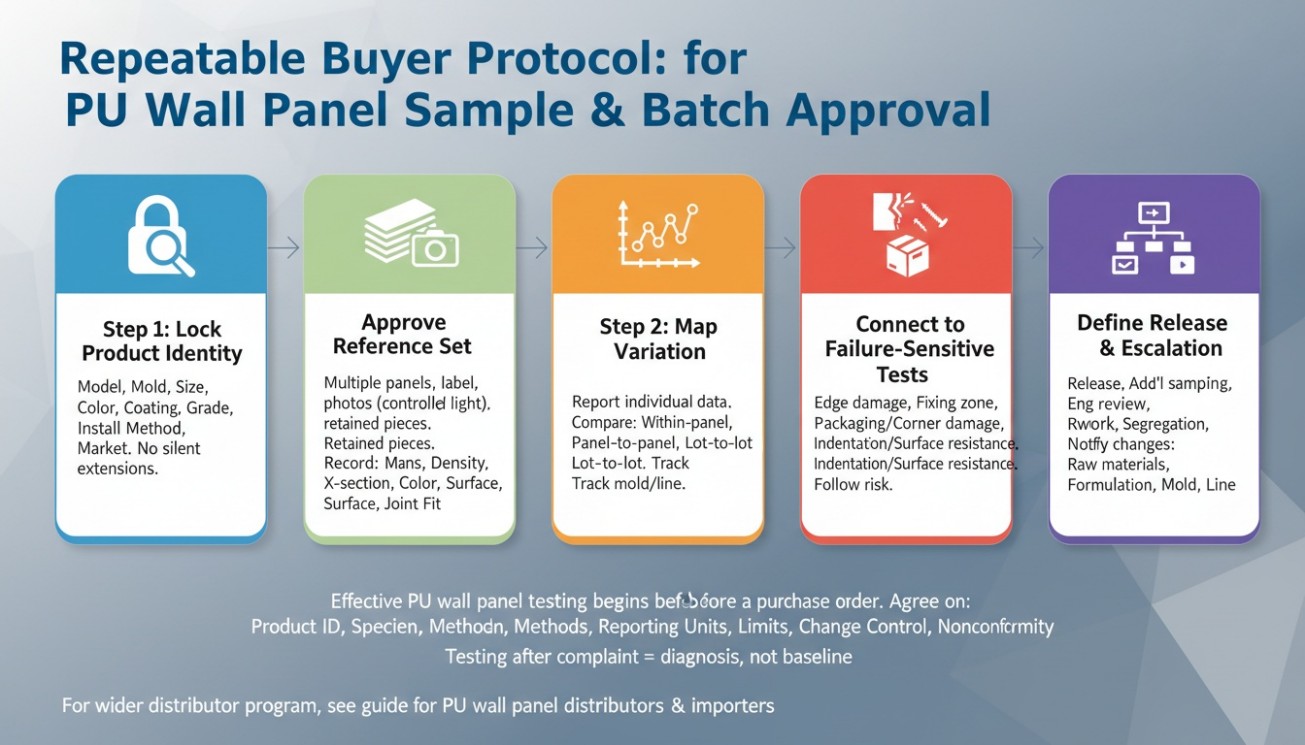
Effective PU wall panel testing begins before a purchase order. The buyer and supplier should agree on product identity, specimen selection, methods, reporting units, acceptance limits, change control, and what happens after a nonconforming result. Testing after a complaint is useful for diagnosis, but it is a poor substitute for an approved baseline.
Step 1: lock the product identity
Record the model, mold or pattern, nominal size, color, coating system, intended grade, installation method, and target market. If the supplier offers indoor, commercial, or exterior versions, each grade requires its own evidence. A report for one formulation, thickness, coating, or mold should not be silently extended to another.
Step 2: approve a representative reference set
Do not approve only the most attractive sample. Select multiple panels that represent normal production, label them, photograph them under controlled lighting, and retain protected reference pieces. Record mass, dimensions, density method, cross-section appearance, color reference, surface condition, joint fit, and agreed practical checks.
Step 3: map variation within and between panels
Keep the raw values visible
Measure more than one location and more than one panel. Report individual data instead of hiding all variation behind an average. Compare within-panel variation, panel-to-panel variation, and lot-to-lot variation. If a mold has multiple cavities or the factory operates several lines, preserve that traceability.
Step 4: connect the result to failure-sensitive tests
If the main risk is edge damage, add a controlled edge or cut evaluation. If fasteners are used, test the fixing zone with the specified detail. If the product is handled through parcel distribution, include packaging and corner-damage evidence. If the wall will be frequently touched, add an indentation or surface-resistance check. The test plan must follow risk, not habit.
Step 5: define release and escalation rules
State which results trigger release, additional sampling, engineering review, rework, segregation, or rejection. A borderline result should not be negotiated differently for every shipment. The supplier should also notify the buyer before changing raw-material sources, formulation, blowing system, coating, mold, production line, or another controlled factor that may affect the approved baseline.
For a wider distributor program—including SKU selection, packaging, sample systems, and after-sales planning—see the guide for PU wall panel distributors and importers. The density protocol here should become one controlled part of that larger sourcing system.
Failure patterns and what to investigate first
| Observed symptom | Possible contributors | Confirmation work | Procurement response |
|---|---|---|---|
| Corner breaks during unpacking | Local weak zone, skin discontinuity, impact, poor corner protection | Compare cross-sections, density map, drop location, carton damage | Hold affected lot; separate product and packaging causes |
| Edge crumbles during cutting | Coarse cells, voids, weak edge geometry, unsuitable tool or technique | Repeat controlled cuts across zones and reference panels | Revise limits, process, tool guidance, or panel design |
| Fastener head sinks into panel | Local crushing, wrong fixing zone, excessive torque, missing washer | Recreate the specified assembly and record failure mode | Do not approve a different fastener detail without testing |
| Panels from one carton feel different | Within-lot process variation, mixed lots, geometry or skin differences | Check labels, mass distribution, mapped density, cross-sections | Strengthen traceability and lot segregation |
| Panel looks good but seams will not align | Dimensional drift, warped panels, mold wear, joint damage | Measure joint geometry and dry-fit a multi-panel mock-up | Control fit separately from density |
A failure table prevents a common mistake: treating every symptom as a density problem. Packaging, tool choice, mold geometry, installation torque, dimensional tolerance, coating, and storage can create similar complaints. Density data should narrow the investigation, not prematurely end it.
What belongs in a purchase specification
A useful PU decorative panel specification does not need to publish confidential chemistry. It does need enough controlled information to make repeat orders verifiable. The following fields create a stronger starting point:
- Exact product, mold, color, coating, nominal size, intended grade, and approved installation route.
- Applicable density definition: overall, core, or both; method and current edition; specimen preparation and conditioning.
- Target and permitted variation supported by qualification data, not an unexplained market benchmark.
- Sampling locations, number of specimens, reporting units, individual results, mean, and variation.
- Visual limits for large voids, collapsed cells, missing material, damaged skin, edge defects, and exposed core.
- Dimensional and joint-fit requirements for the delivered panel.
- Defined cut, edge, indentation, or fixing-zone checks where relevant to the intended installation.
- Approved reference samples, lot identification, certificate or inspection record, retention period, and change-notification requirements.
- Rules for additional sampling, quarantine, concession, rework, replacement, or rejection.
Acceptance limits must come from qualified products, project requirements, repeatable manufacturing capability, and relevant tests. They should not be copied from an unrelated insulation board or sandwich panel. If evidence is incomplete, describe the information gap and require qualification rather than presenting a guess as an industry limit.
What density and cell structure cannot prove
Strong technical content is defined partly by what it refuses to overstate. Density and cell images cannot independently establish the following:
Fire behavior
Density does not make a decorative PU panel fireproof or establish a wall fire-resistance period. Reaction-to-fire results depend on the tested product and conditions, and assembly performance involves additional components. Buyers should review matching reports and the limitations explained in the PU stone panel fire-rating guide.
Exterior durability

A denser panel is not automatically UV-stable, weather-resistant, or suitable for every climate. Coating, color system, wet-dry exposure, thermal movement, fasteners, joints, drainage, and substrate remain important. Use the separate guide to evaluate exterior PU stone panel applications.
Waterproofing
Low water uptake by a specimen or a closed-cell description does not prove a watertight installed wall. Joints, penetrations, raw cut edges, fixings, sealants, substrate, and drainage require system-level evaluation.
Indoor-air or health claims
Mass and cell morphology do not establish VOC emissions, odor acceptability, or a broad “non-toxic” claim. The polyurethane body, coating, adhesive, production age, packaging time, test chamber conditions, and evaluation criteria must be addressed separately.
Structural capacity
Most faux-stone decorative panels are specified as finishes, not load-bearing structural elements. Apparent density cannot be converted directly into permitted loads, pull-out capacity, impact classification, or support spacing. Those decisions require tests on the relevant product or assembly.
A better purchasing decision
The best density is not the highest number or the lowest shipping weight. It is a controlled range within a product whose cell morphology, surface skin, geometry, coating, and installation behavior have been verified for a defined application. This keeps the lightweight advantage described in the guide to lightweight PU stone panels without allowing weight reduction to hide weak or inconsistent production.
For first-time supplier qualification, request both the density definition and the raw specimen results. Inspect multiple locations. Connect the numbers to cutting, edges, fixing zones, dimensions, and actual handling. Keep approved reference samples and require traceable lot data. For repeat orders, monitor trends rather than waiting for a shipment to cross one final pass/fail line.
This approach turns PU wall panel testing and a vague “high-density panel” claim into a reviewable evidence chain: identified product, defined specimen, current method, recorded condition, individual data, observed performance, accepted boundary, and purchasing action. That is the level of information serious wall-panel sourcing now requires.
Focused FAQ
Does higher density always mean a better PU wall panel?
No. Higher density may change stiffness, hardness, weight, and local mechanical response, but it does not guarantee better cell uniformity, clean edges, coating adhesion, dimensional accuracy, UV stability, fire performance, or installation success. The appropriate range must be connected to a defined product design and application.
What is the difference between overall density and core density?
Overall apparent density includes the forming skin when the product is used with that skin intact. Core apparent density evaluates the cellular material after the forming skin is removed. The report should state which value is provided, how specimens were prepared, and whether the specimen represents the delivered decorative panel.
How should an importer compare density data from two suppliers?
Confirm that both suppliers use the same density definition, method edition, specimen geometry, conditioning, sampling locations, and reporting units. Request individual results and variation, not only an average. Then compare relevant finished-panel behavior, including cutting, edges, dimensions, joint fit, and the approved fixing method.
Can a buyer calculate density by weighing one complete panel?
Panel weight can support a consistency check, but deep relief, ribs, recesses, interlocks, skins, and coatings make accurate volume determination difficult. Whole-panel weight per unit of nominal coverage can be a useful receiving metric if geometry is stable, but it should not be mislabeled as a standardized density result.
What should a cross-section of a PU panel show?
A documented cross-section can show cell size and distribution, large voids, collapsed regions, differences between the surface and core, edge condition, and local inconsistency. Include a scale and specimen location. A photograph is evidence of morphology, but it should be linked to performance tests before it drives acceptance.
Can density prove that screws will hold?
No. Screw or fastener behavior depends on local panel geometry, skin and core condition, fastener type, washer or head, edge distance, installation torque, substrate, and load direction. Test the approved fixing detail on the intended product and record the actual failure mode.
Can closed-cell PU panels be called waterproof?
Not on cell structure alone. The completed wall contains joints, penetrations, fixings, cut edges, sealants, adhesive, and a substrate. Water resistance of a panel specimen and water management of an installed wall are different claims requiring different evidence.
How can buyers control batch consistency?
Use approved reference panels, traceable lot codes, defined sampling locations, recorded mass and dimensions, density results, cross-section images, joint-fit checks, surface inspection, and agreed practical tests. Require supplier notification before controlled materials, formulation, mold, coating, or process conditions are changed.
Which standards can be used to evaluate apparent density?
ISO 845:2006 and ASTM D1622-26 are current reference methods for apparent density of cellular materials within their stated scopes. The complete standard, relevant product specification, specimen preparation, conditioning, geometry, and laboratory competence must be reviewed before claiming conformity.
Should density be placed on every purchase order?
Include it when qualification data show that it helps control meaningful product variation. State the definition, method, product identity, target or range, sampling, and reporting requirements. Do not use density as a decorative number if edge behavior, dimensions, coating, joint fit, or another variable controls the actual risk.
Sources and scope
- ISO 845:2006 — Cellular plastics and rubbers — Determination of apparent density.
- ASTM D1622-26 — Standard Test Method for Apparent Density of Rigid Cellular Plastics.
- Hawkins, O'Toole and Jackovich — Cell Morphology and Mechanical Properties of Rigid Polyurethane Foam.
This article is a purchasing and technical-evaluation guide, not a product certification, laboratory report, installation approval, or code opinion. Standards, product identity, test conditions, and target-market requirements should be checked in their current form before publication or project use.