Can PU Stone Panels Be Used Outside? A Practical Guide to Exterior Wall Applications
Outdoor use is not a yes-or-no question
Many buyers ask a simple question: can exterior PU stone panels be used outside?
The honest answer is not a simple yes or no. Some PU stone-look panels can be used for selected outdoor applications. Some should only be used indoors. Some are suitable for sheltered exterior areas but not harsh façade exposure. Some may perform well on a porch, patio wall, balcony background, garden feature, or storefront accent, but may not be suitable for a large open façade exposed to intense sun, rain, wind, freeze-thaw cycles, and public impact.
This is why outdoor use must be discussed as a project condition, not a marketing slogan. A supplier should not simply write “indoor and outdoor use” and stop there. A buyer should not assume that all outdoor PU wall panels have the same durability. A contractor should not install every panel the same way. An importer should not buy exterior products only by surface photo and FOB price.
Outdoor wall materials face a harder environment than interior feature walls. Sunlight can fade color. Rain can enter joints. Wind can stress fasteners. Temperature movement can affect panel stability. Dust and pollution can change the surface. Moisture can expose weak substrates. Impact can damage low-density material. Poor installation can create problems even when the panel itself is acceptable.
For this reason, exterior faux stone panels should be evaluated through a full exterior-use framework: material grade, surface coating, UV resistance, water behavior, fastening method, wall preparation, expansion control, joint sealing, accessory system, maintenance expectation, and application boundary.
The real question is not “can PU be outside?” The better question is “which PU panel, on which wall, in which climate, with which installation method, and under which performance expectation?”
Why buyers want PU panels for exterior walls
The demand for PU stone cladding in outdoor spaces comes from several practical needs.
First, many buildings need stone-look decoration without the weight of natural stone or cement-based veneer. Exterior accents around entrances, porches, garden walls, columns, façades, commercial storefronts, and foundation areas can look stronger with a stone texture. But traditional stone systems can be heavy, slow, costly, and labor-intensive.
Second, renovation projects often cannot support full masonry work. A homeowner may want to refresh a porch wall. A small shop may want a more attractive entrance. A café may want a photo-friendly exterior seating area. A hotel may want to upgrade a courtyard wall without a long construction cycle. In these cases, lightweight outdoor wall cladding can be attractive.
Third, distributors and e-commerce channels like products that are easier to ship and display. Compared with heavy stone veneer, PU panels can reduce handling difficulty and make small project packages easier to sell. For building material sourcing, this is important because exterior decorative materials are not only judged on wall performance; they are also judged on logistics and channel practicality.
Fourth, some buyers want a dry installation path. Mortar-based systems require more preparation, labor skill, curing time, and site cleanup. PU-based facade wall panels can sometimes reduce installation complexity when the wall condition and product design are suitable.
But these advantages only matter if the product is honestly matched to the environment. Lightweight is valuable. Fast installation is valuable. But neither can compensate for poor UV resistance, weak coating, poor fastening, or unclear exterior instructions.
The difference between indoor-grade and exterior-grade PU panels

One of the biggest mistakes in the market is treating all PU panels as the same.
Indoor-grade PU panels may be designed mainly for living rooms, TV walls, bedrooms, restaurants, hotels, offices, and retail interiors. Their coating, density, color stability, and installation method may be suitable for controlled indoor environments. These panels may look excellent in catalog photos, but that does not automatically mean they can survive long-term outdoor exposure.
Exterior-grade exterior PU stone panels should be designed with outdoor conditions in mind. They need better surface protection, stronger color stability, suitable density, more reliable fastening options, and clearer installation instructions. If a supplier claims outdoor use, buyers should ask what makes the product outdoor-grade.
What should define an exterior-grade product?
An exterior-grade product should have a coating system that resists sunlight and weather. It should have a surface that does not fade too quickly under UV exposure. It should handle rain and humidity without swelling, peeling, or surface breakdown. It should have enough panel strength to resist normal handling and moderate impact. It should include guidance for fasteners, joints, edges, trims, and substrate requirements.
The key point is that exterior-grade is not a decorative claim. It is a performance category.
Why “waterproof” alone is not enough
Some suppliers describe weather resistant wall panels as waterproof. That word can be misleading. Outdoor wall performance is not only about whether the panel absorbs water. It is also about what happens at joints, edges, screw points, wall penetrations, substrate contact, backside ventilation, drainage, and repeated wet-dry cycles.
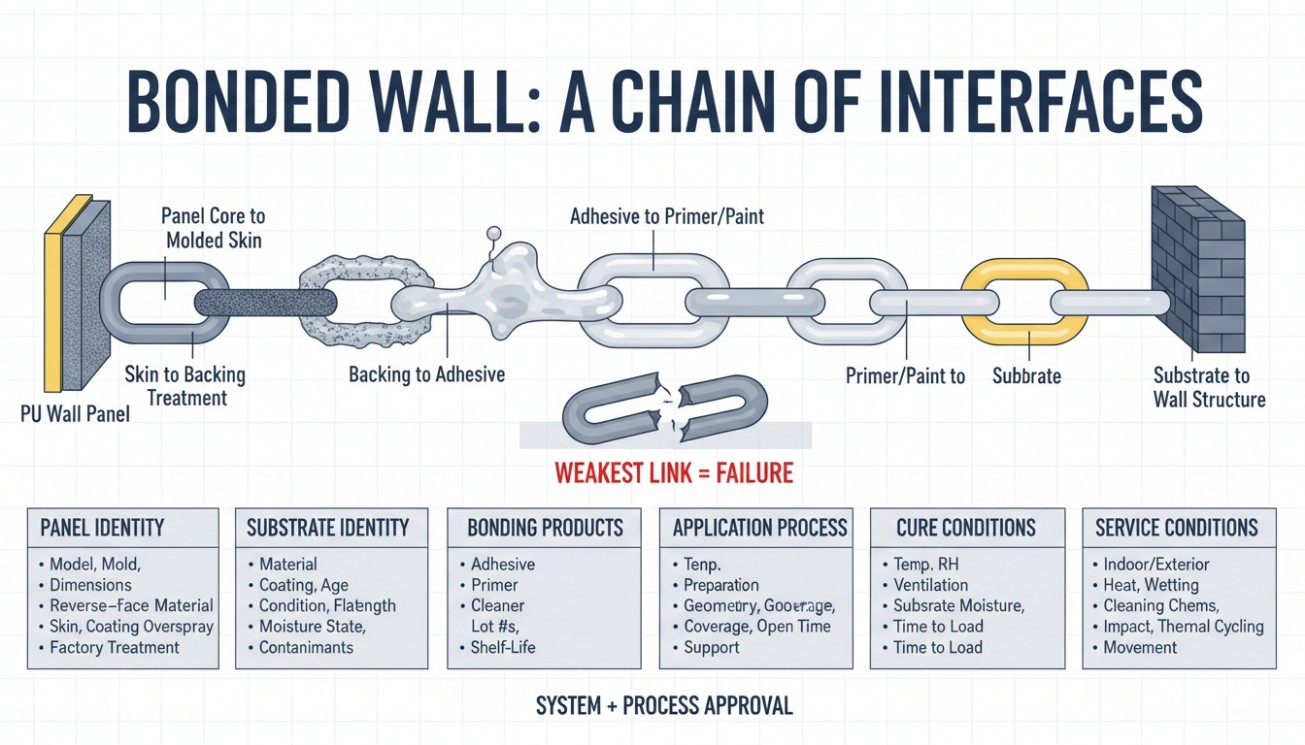
A panel surface may resist water, but the wall system may still fail if water enters behind it and cannot escape. Outdoor cladding must be considered as a system, not only as a sheet.
UV resistance is one of the first questions buyers should ask
Sunlight is one of the most damaging outdoor factors. For UV resistant wall panels, the main concern is not only whether the product survives one summer. The concern is how the surface color, coating, and texture age after long exposure.
Dark colors can absorb more heat. Strong sunlight can accelerate fading. Low-quality surface paint may chalk, discolor, or lose depth. If the panel relies on shallow surface coloring, fading can make the wall look artificial or worn. If the coating is weak, the stone effect can become flat and tired.
For buyers, UV resistance should be treated as a sourcing checkpoint. Ask whether the product is designed for exterior exposure. Ask whether the coating includes UV-resistant additives. Ask whether the supplier has aging test information. Ask whether darker colors behave differently from lighter colors. Ask whether color variation after exposure is covered by warranty.
For distributors, this issue becomes more serious. A single homeowner complaint may be manageable. But if a distributor imports a container of exterior faux stone panels that fade quickly in a sunny market, the after-sales risk can damage the entire product line.
UV performance also affects market selection. A panel that works well in a mild, shaded climate may not perform the same in desert heat, coastal sun, or high-altitude UV exposure. Buyers should think about geography, not only product description.
Rain, humidity, and drainage decide long-term wall behavior

Rain exposure is another major factor for outdoor PU wall panels. The issue is not only direct water contact. It is also water movement.
Outdoor walls are rarely perfectly dry. Wind-driven rain can hit the surface from angles. Water can run down vertical joints. Moisture can collect at bottom edges. Small gaps around windows, corners, outlets, signage, or fasteners can create entry points. If panels are installed over a poor substrate or without drainage logic, problems may appear later.
PU stone cladding should be installed with attention to water shedding. Joints should not create water traps. Bottom edges should avoid holding standing water. Exterior corners should be properly finished. Seams should be sealed or overlapped according to product design. The wall behind the panel should be suitable for exterior use.
Backside moisture is often ignored
Many buyers focus on the front surface, but backside moisture can be equally important. If moisture enters behind facade wall panels, it may affect adhesive, fasteners, substrate, or the wall assembly. In some climates, trapped moisture can lead to mold, staining, swelling of backing materials, or freeze-thaw damage.
This is why exterior wall design often needs drainage or ventilation thinking. Even lightweight decorative panels should not be treated as simple wallpaper when used outside.
Sheltered exterior spaces are different from full exposure
A covered porch wall is not the same as an open west-facing façade. A balcony background under a roof is not the same as a coastal exterior wall hit by wind-driven rain. A garden feature wall may have different demands from a commercial storefront.
When evaluating exterior PU stone panels, buyers should classify the exposure level. Sheltered, partially exposed, and fully exposed applications should not be treated equally.
Temperature movement and freeze-thaw conditions need attention
Outdoor materials expand and contract as temperature changes. This is true for many cladding materials, including polymers, composites, metal, and even masonry systems. For outdoor wall cladding, movement must be allowed for in installation design.
If panels are installed too tightly, movement can create stress. If fasteners are placed incorrectly, panels may warp or crack. If joints are sealed without considering movement, sealant may fail. If adhesive is used alone where mechanical fixing is required, the bond may weaken over time.
Freeze-thaw climates add another layer of risk. When water enters cracks, joints, or backing areas and then freezes, expansion can damage the wall system. Even if the PU panel itself resists water, the assembly may fail if water is trapped behind it.
For buyers in cold climates, exterior wall panel installation should be reviewed carefully. Ask whether the product has been used in freeze-thaw regions. Ask about fastener spacing, joint gaps, expansion allowances, and substrate requirements. Ask whether the supplier recommends adhesive, screws, clips, or combined fixing.
A panel that performs well in a warm sheltered patio may not be suitable for exposed cold façades without proper installation design.
Fastening method matters more outdoors than indoors
Indoor panels can often be installed with adhesive and light mechanical fastening depending on the substrate and product design. Outdoor use is less forgiving.
For exterior wall panel installation, fasteners must resist wind load, panel movement, vibration, substrate variation, and long-term weather exposure. Adhesive alone may not be reliable in many exterior conditions unless the product system specifically supports it. Screws, nails, clips, anchors, or combined methods may be required.
The correct fastening method depends on the wall type. Concrete, brick, cement board, wood framing, metal framing, existing siding, and masonry surfaces all require different installation logic. A supplier should provide guidance rather than one generic instruction.
Wind load should not be ignored
Even lightweight panels create surface area. Wind can pull, push, and vibrate cladding. On low walls or sheltered accents, this may be less serious. On higher façades, open corners, coastal areas, or commercial buildings, wind behavior matters.
If facade wall panels are not properly fastened, edge lifting, rattling, separation, or panel loss can occur. Buyers should avoid using interior installation methods for exterior façades.
Fastener visibility affects appearance
Outdoor cladding must be strong, but it should also look finished. Visible screws may be acceptable in some rustic or industrial designs, but not in every project. Some systems use hidden fastening, color-matched fasteners, overlapping edges, or touch-up methods. The supplier’s accessory system matters.
Joints, corners, and edges are the real test of exterior quality
Flat panel photos can look convincing, but exterior success is often decided by joints, corners, and edges.
A wall rarely consists of one perfect rectangular surface. It includes corners, window returns, door frames, bottom edges, top edges, columns, utility penetrations, signage, lighting fixtures, and transitions to other materials. These are the areas where poor exterior cladding reveals itself.
Exterior faux stone panels need proper corner pieces or clear corner treatment. Without them, the wall may look unfinished from the side. Edges should not expose weak backing or raw foam-like material. Bottom edges should be protected from water accumulation and impact. Transitions to glass, metal, stucco, brick, or wood should be clean.
Pattern continuity affects realism
Stone-look panels must also manage visual continuity. If joints repeat too clearly, the wall may look artificial. If corner pieces do not match flat panels, the cladding loses realism. If panels are installed in a grid pattern without staggering, the result can look like wallpaper instead of stone.
For PU stone cladding, realism is not only about texture. It is about how the system handles the entire wall.
Sealant selection affects performance
Outdoor joints often need sealants or compatible finishing materials. But not all sealants bond well to all surfaces. Some may discolor, crack, shrink, or fail under UV exposure. Suppliers should recommend compatible sealants and finishing methods. Installers should not choose random indoor caulk for outdoor applications.
Where exterior PU stone panels make the most sense

The best outdoor applications for exterior PU stone panels are those where the material’s lightweight and decorative advantages match the exposure level.
Porch walls are a strong application. They are visible, often partially sheltered, and benefit from warm stone texture. A porch feature wall can make a home entrance feel more premium without full masonry work.
Exterior columns and posts are another good use case. Stone-look column wraps can create a stronger entrance, patio, garden, or commercial storefront appearance. Here, accessory fit and corner treatment are critical.
Garden walls and patio backgrounds can also work well when exposure conditions are suitable. A stone texture can make outdoor seating areas feel more finished. For cafés and restaurants, it can support outdoor dining atmosphere.
Commercial storefront accents are another opportunity. A shop, salon, café, or small hotel entrance may use outdoor PU wall panels to create a more distinctive façade without a heavy construction process. The panel should be selected for weather exposure and public contact.
Foundation skirting and lower wall accents can be attractive, but they need special care because lower areas may face water splash, dirt, impact, snow, and landscaping contact. Not every PU panel is suitable near the ground.
Balcony and terrace walls are also possible in selected conditions. These spaces often need lightweight materials, but they may also face sun, rain, and wind. The exposure level should be reviewed carefully.
The common thread is clear: PU works best where the wall is decorative, non-structural, and matched with a suitable exterior-grade system.
Where PU panels should be used carefully or avoided
A professional guide must also identify risky applications.
Large high-rise façades require caution. Wind load, fire code, façade engineering, public safety, access for maintenance, and building regulations may exceed the intended use of many PU panel systems. In such cases, specialized façade materials may be more appropriate.
High-impact public areas are also risky. School corridors, transport stations, street-level walls in crowded areas, sports facilities, and public building entrances may expose panels to repeated impact, vandalism, or abrasion. Unless the product has sufficient impact resistance and protection design, another material may be safer.
Ground-contact zones are challenging. Water splash, soil moisture, insects, snow, landscaping tools, and cleaning chemicals can stress panels. If used near the ground, the installation should include correct clearance and protection.
High-heat areas require strict review. Outdoor fire pits, grills, fireplace surrounds, and heating equipment can expose panels to temperatures beyond normal exterior wall conditions. Weather resistant wall panels are not automatically heat-safe panels.
Harsh coastal environments also require caution. Salt air, humidity, wind, and intense sunlight can accelerate aging. If a supplier claims coastal suitability, buyers should ask for more evidence.
The point is not to reject exterior faux stone panels. The point is to define the application boundary so buyers do not misuse the material.
How exterior PU panels compare with natural stone and manufactured veneer outdoors
For outdoor walls, buyers often compare PU panels with natural stone veneer and manufactured stone veneer.
Natural stone has strong authenticity and mineral durability. It is often preferred in high-end exterior architecture where permanence matters. However, it is heavy, costly to install, and requires skilled labor.
Manufactured stone veneer can offer a masonry-like exterior appearance with more controlled production than natural stone. It is still heavier and usually requires wet installation or masonry-style methods.
Exterior PU stone panels compete differently. They do not win by being the most authentic mineral material. They win when the project needs lightweight handling, faster installation, easier cutting, and lower logistics pressure. They can be especially useful for decorative exterior accents, small commercial upgrades, porch renovations, garden spaces, and selected façade details.
This comparison should be honest. For demanding structural or premium exterior projects, natural or manufactured veneer may be better. For decorative renovation and lightweight exterior accents, PU stone cladding may be more practical.
In building material sourcing, this distinction helps avoid wrong positioning. PU should not be sold as universal stone replacement. It should be positioned as a lightweight decorative exterior cladding option for suitable applications.
What importers should ask suppliers before buying exterior PU panels

Importers and wholesalers should build a clear supplier checklist.
First, ask whether the product is indoor-grade, exterior-grade, or suitable only for sheltered exterior use. Do not accept vague answers.
Second, ask about UV resistance. What coating is used? Is there aging test information? Are dark colors recommended for hot climates? How much color change should be expected?
Third, ask about water behavior. Is the panel surface water resistant? What about edges, backside, joints, and fastener points? What installation method prevents water trapping?
Fourth, ask about temperature range. Can the panel handle hot and cold climates? Is there guidance for expansion gaps?
Fifth, ask about fire documentation. Outdoor use does not eliminate fire concerns, especially near grills, fireplaces, commercial buildings, or regulated façades.
Sixth, ask about fastening. Does the supplier recommend adhesive, screws, clips, or combined fixing? What spacing is required? What substrates are supported?
Seventh, ask about accessories. Are corner pieces, trims, edge caps, touch-up coatings, and installation materials available?
Eighth, ask about packaging. Outdoor panels may be shipped long distances and stored in warehouses before installation. Cartons should protect corners, surface coating, and panel shape.
Ninth, ask about warranty boundaries. What conditions are covered? What climates or applications are excluded? What installation mistakes void the warranty?
Tenth, ask for project references. Real exterior installations are more useful than studio photos.
This is how building material sourcing becomes professional rather than price-driven.
How contractors should approach exterior wall panel installation
Contractors should begin with site evaluation.
The wall surface must be stable, clean, dry, and suitable for exterior cladding. Any loose paint, damaged stucco, moisture problem, cracking, or weak substrate should be corrected before installation. A decorative panel cannot fix a failing wall.
Next, contractors should plan drainage and water movement. Where will rainwater go? Are there bottom edges that collect moisture? Are window and door transitions protected? Are horizontal ledges sloped or sealed? Does the system need flashing?
Then they should plan layout. Stone-look panels should be staggered to avoid obvious repetition. Corners should be solved before flat panels are completed. Panel cuts should be placed in less visible areas when possible.
Fastening should follow product guidance. Outdoor conditions may require mechanical fasteners even if indoor installation would use adhesive. Fasteners should be corrosion-resistant if exposed to moisture. Holes, seams, and edges should be finished properly.
Finally, contractors should inspect the wall after installation. Check loose edges, open joints, exposed backing, trapped water points, visible repeated patterns, and unfinished corners.
Exterior wall panel installation is not the same as installing a decorative interior wall. It requires exterior thinking.
Maintenance expectations should be realistic
Outdoor walls age. Even the best weather resistant wall panels require realistic maintenance expectations.
Buyers should understand how to clean the surface. Harsh chemicals, pressure washing, abrasive brushes, or solvents may damage coating. Gentle cleaning methods are usually safer, but the supplier should provide specific instructions.
Inspecting joints and edges is important. Outdoor sealants can age. Fasteners can loosen. Corners can be damaged. Plants, sprinklers, snow, and dirt can affect lower areas. Regular inspection helps prevent small issues from becoming larger failures.
Color change should also be discussed honestly. All exterior surfaces age differently depending on sunlight, pollution, climate, and orientation. South-facing or west-facing walls may age faster than shaded walls. Dark colors may behave differently from light colors.
For distributors, setting correct expectations reduces complaints. If customers expect UV resistant wall panels to look absolutely unchanged forever, disappointment is likely. The better message is that exterior-grade products are designed to resist outdoor exposure, but correct installation and maintenance still matter.
Exterior marketing should avoid overpromising
The PU wall panel category can grow in outdoor applications, but only if suppliers communicate responsibly.
Avoid saying “permanent replacement for natural stone” unless the product truly supports that claim. Avoid saying “fireproof” unless there is clear documentation and correct context. Avoid saying “waterproof façade system” if only the front surface resists water. Avoid saying “maintenance-free” because exterior walls always need some inspection.
Better marketing language is more specific: suitable for selected exterior accents, designed for outdoor decorative cladding, UV-resistant coating available, lightweight stone-look panels for porch and storefront upgrades, recommended for sheltered and semi-exposed exterior walls, installation guidance required for façade use.
This kind of language may sound less aggressive, but it builds long-term trust. Professional buyers prefer defined performance over exaggerated promises.
For exporters, this is especially important. Overseas distributors face local customers, local climates, and local complaints. If a supplier overpromises outdoor performance, the distributor carries the risk. Clear documentation protects both sides.
Future development: exterior PU panels need better systems, not just better patterns
The future of exterior PU stone panels will not be decided only by more colors or deeper textures. It will be decided by better systems.
Better systems include exterior-grade coatings, improved UV stability, stronger panel density, better hidden fastening, corner accessories, edge protection, flashing guidance, installation manuals, climate-specific recommendations, and testing documents.
A supplier that sells only flat panels will struggle in exterior markets. A supplier that sells a complete outdoor wall cladding system can build more trust with contractors, distributors, and project buyers.
The same trend applies to facade wall panels in general. Buyers increasingly want products that are easier to specify, easier to install, easier to maintain, and easier to explain. They do not want vague claims. They want product logic.
For PU manufacturers, exterior applications are an opportunity, but also a higher standard. Outdoor walls expose weaknesses quickly. If the product is weak, the market will notice. If the system is strong, PU can occupy a valuable space between heavy masonry and low-end decorative panels.
Final perspective: exterior PU panels are about correct boundaries

The outdoor market for PU stone-look panels has real potential, but it requires disciplined thinking.
Exterior PU stone panels can be useful for porch walls, patio backgrounds, garden features, exterior columns, storefront accents, balcony walls, and selected façade details. They can offer lightweight handling, faster installation, easier logistics, and attractive stone-like texture. For many renovation and commercial upgrade projects, those advantages matter.
But outdoor use is not automatic. Buyers must check UV resistance, water behavior, coating quality, density, fastening, joint design, substrate condition, exposure level, fire requirements, and maintenance expectations. Contractors must treat outdoor installation as a wall system, not a simple decorative attachment. Importers must evaluate documentation and warranty boundaries, not only product photos.
The strongest position for exterior faux stone panels is not “they replace all stone.” The stronger position is “they provide a lightweight decorative cladding option for the right outdoor applications.”
When the boundary is clear, PU stone cladding becomes more credible. When the product is exterior-grade, the installation is correct, and the application is realistic, PU can help buyers create stone-look outdoor walls with less weight, less disruption, and more flexible sourcing.
That is the real value of exterior PU wall panels.
Focused FAQ
Can exterior PU stone panels be used outside?
Yes, exterior PU stone panels can be used outside when the product is designed for exterior exposure and installed correctly. Buyers should confirm UV resistance, water behavior, coating quality, fastening method, joint treatment, and application limits before using PU panels outdoors.
Are outdoor PU wall panels suitable for all climates?
Not always. Outdoor PU wall panels may perform differently in hot, cold, humid, coastal, shaded, or high-UV climates. Buyers should ask suppliers about temperature range, UV stability, moisture behavior, freeze-thaw suitability, and warranty conditions.
What are exterior faux stone panels used for?
Exterior faux stone panels are commonly used for porch walls, garden features, patio backgrounds, storefront accents, exterior columns, foundation accents, balcony walls, and selected façade details. They are most suitable for decorative, non-structural outdoor applications.
Is PU stone cladding waterproof?
PU stone cladding may have water-resistant surfaces, but outdoor performance depends on the whole wall system. Joints, edges, fastener points, backside drainage, substrate condition, and installation method all affect whether the wall performs well in rain and humidity.
What makes weather resistant wall panels different from indoor panels?
Weather resistant wall panels should have stronger surface protection, better coating stability, outdoor-compatible installation guidance, and resistance to sunlight, rain, humidity, temperature movement, and normal exterior exposure. Indoor panels should not be assumed suitable for outdoor use.
Why are UV resistant wall panels important?
UV resistant wall panels help reduce color fading, surface aging, chalking, and coating breakdown caused by sunlight. UV resistance is especially important for exterior walls exposed to strong sun, hot climates, high altitude, or west-facing façades.
Where is outdoor wall cladding most useful?
Outdoor wall cladding is useful for improving exterior appearance, adding texture, protecting selected surfaces, and upgrading entrances, patios, porches, storefronts, garden walls, and façade accents. The material should be selected according to exposure level and installation conditions.
Can facade wall panels made from PU replace natural stone?
Facade wall panels made from PU can replace natural stone in selected decorative applications, but they should not be treated as universal replacements for all exterior masonry or architectural stone projects. Natural stone may still be better for premium, structural, or highly demanding exterior applications.
What should contractors know about exterior wall panel installation?
Exterior wall panel installation requires stable substrates, proper fastening, drainage planning, joint control, edge finishing, exterior-grade sealants, and attention to wind, water, sunlight, and temperature movement. Outdoor installation should not copy indoor methods blindly.
What should importers check in building material sourcing for exterior PU panels?
In building material sourcing, importers should check exterior-grade claims, UV resistance, coating system, water behavior, fire data, fastening guidance, accessory range, packaging strength, warranty boundaries, and real project references before buying exterior PU panels.
#ExteriorPUStonePanels #OutdoorPUWallPanels #ExteriorFauxStonePanels #PUStoneCladding #WeatherResistantWallPanels #UVResistantWallPanels #OutdoorWallCladding #FacadeWallPanels #ExteriorWallPanelInstallation #BuildingMaterialSourcing