上传

RJXA's Christmas approaches, it's time to refresh your fashion collections! Explore our high-quality lace, perfect for festive attire. Inquire now to enjoy holiday specials!

Member Center
Exit
Data is empty
0
qr Code Url

Scan the QR code to visit the mobile website

  • Home
  • Industrial
  • Renewable
  • Building & Home
  • Water Treatment
  • Automation
  • Kitchen
Home -News -Robotics & Automation -
Heavy-Payload Chassis
-
Heavy-payload AMR with rocker and spring suspension maintaining wheel contact across an uneven factory floor.
2026-08-27

Heavy-Payload AMR Suspension: Keep Every Wheel Loaded, Grounded and Useful

A heavy AMR can lose traction, overload a caster or twist its frame even when total payload is within rating. This guide explains how rocker, bogie, spring and equalizing suspensions manage wheel reactions across floor unevenness, braking, turning and payload changes—and how to validate contact continuity before production release.
Learn more
Heavy pallet on an AMR frame showing localized structural response at the load-support interfaces.
2026-08-27

Heavy-Payload AMR Chassis Fatigue: Deflection, Welds and Production Life

A frame that survives one proof load can still lose docking accuracy, crack at a weld or loosen an interface after repeated production cycles. This engineering guide converts route events into a structural duty spectrum, links stiffness and fatigue evidence, and shows how to validate chassis life with FEA, strain measurement, inspection and endurance testing.
Learn more
Heavy-payload AMR showing how wheel load, traction, rolling loss, heat and floor impacts define the duty envelope.
2026-08-27

Heavy-Payload AMR Wheel Selection: Material, Geometry, Heat, Wear and Service Life

Wheel capacity is not a complete selection rule. This engineering guide shows how wheel role, dynamic wheel load, polyurethane hardness, diameter, tread geometry, floor condition, heat and duty cycle define traction, energy use, docking accuracy, wear and replacement decisions for heavy-payload AMRs.

Learn more
Instrumented heavy-payload AGV traction test on dry and wet surfaces with load, force and motion data recorded.
2026-08-25

Heavy-Payload AMR Traction: Turning Motor Torque into Usable Floor Force

A motor can produce torque while a loaded AMR still fails to launch, climb, turn or hold its path. This engineering guide builds a traction budget from wheel load, floor friction, rolling resistance, grade, power and thermal limits, then shows how to validate the usable operating envelope for differential, steered and omnidirectional platforms.
Learn more
Heavy-payload AMR with conveyor top module showing gravity, traction, transfer and floor-impact force paths through the chassis
2026-08-25

Heavy-Payload AMR Load Path: How Forces Reach the Frame, Wheels and Floor

A payload reaches the floor through a chain of interfaces. This engineering guide shows how gravity, CG offset, acceleration, braking, turning, floor unevenness and transfer shocks redistribute forces through the top module, chassis frame, wheel mounts and tires—and how to validate the chain before production.
Learn more
Engineers documenting payload, wheel, software and restraint configuration before a heavy-payload AMR stopping test.
2026-08-25

Heavy-Payload AMR Stopping Distance How Load, Speed, Floor and Control Define the Stop

Stopping distance is not a catalog constant. This engineering guide separates response delay, braking travel, load settling and safety margin, then shows how payload, center of gravity, speed, floor friction, slope, turns, brake temperature and wear shape a heavy-payload AMR stop envelope.
Learn more
Heavy-payload AMR carrying a wooden crate across cracked and uneven factory flooring near a ramp and drainage channel
2026-08-25

Heavy-Payload AMR Floor Requirements Engineering Flatness, Friction, Joints and Ramps

The factory floor is a functional part of a heavy-payload AMR. This guide shows how local flatness, cross-slope, friction, joints, ramps, point loads and docking-zone geometry affect traction, stability, stopping, localization, wheel life and production release—and how to turn them into a measurable Floor Interface Envelope.
Learn more
Heavy-payload AMR carrying an engine assembly during a factory production-validation test
2026-08-24

How to Validate a Heavy-Payload AMR Before Production: Test Matrix to Release Evidence

A successful demo does not prove production readiness. This engineering guide shows how industrial teams validate a configured heavy-payload AMR through a traceable test matrix covering real loads, routes, stations, safety responses, software handshakes, fault recovery, endurance and controlled production release.
Learn more
Heavy-payload AMR losing wheel contact while turning with a tall industrial load
2026-08-24

Heavy-Payload AMR Dynamic Stability: CG, Turning, Braking and Load Shift

A heavy-payload AMR can support its rated load while stationary and still become unstable during braking, turning, cross-slope travel or load shift. This engineering guide turns dynamic stability into a measurable operating envelope built from moment balance, wheel-load transfer, route conditions, motion limits and worst-case validation.
Learn more
Heavy-payload AMR comparing a low, centered 1,000 kg load with a tall, high-CG load in a factory
2026-08-19

Payload Rating vs Usable Payload Why Center of Gravity Changes Everything

A heavy-payload AMR does not have one universally usable load limit. This guide explains how payload mass, combined center of gravity, offset, overhang, speed, route and validation define the real operating envelope—and how buyers can convert a catalog rating into a testable production specification.
Learn more
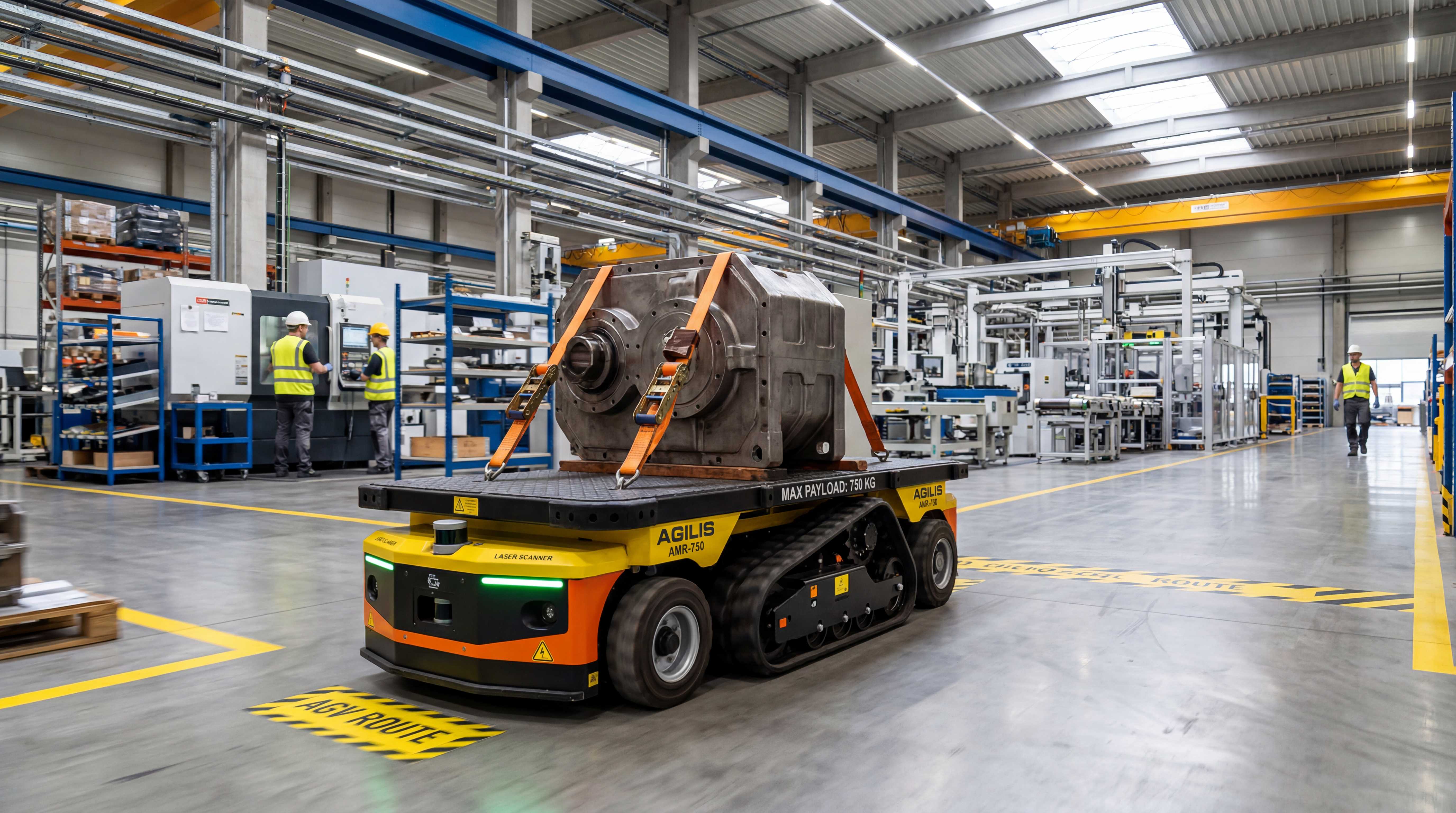
Heavy-payload AMR chassis transporting a large industrial mold on a factory route
2026-05-19

How to Buy a Heavy-Payload AMR Chassis: Specification, Acceptance Testing and Long-Term Value

Selecting a heavy-payload AMR chassis is not only a product comparison. Buyers need to define real load conditions, route requirements, docking accuracy, integration scope, safety validation, acceptance tests, ROI logic and long-term service capability before making a procurement decision.
Learn more
Heavy-payload AMR fleet integration with dashboard, charging station and conveyor system
2026-05-19

From One Robot to a Working Fleet: How to Integrate Heavy-Payload AMRs into Industrial Systems

A heavy-payload AMR project does not end when one robot completes one route. Long-term success depends on system integration, mission triggers, fleet management, traffic control, charging strategy, PLC communication, exception handling and measurable deployment performance.
Learn more
Heavy-payload AMR carrying an industrial load in a safe factory route
2026-05-19

Safety Is a System: How to Design Heavy-Payload AMR Operation Around People, Loads and Real Factory Traffic

Heavy-payload AMR safety is not only about sensors. It requires risk assessment, load stability control, safety field design, speed zones, emergency stop logic, worker training, traffic rules and continuous site management.
Learn more
Heavy-payload AMR navigating through a real factory with a large industrial load
2026-05-18

SLAM, QR Code or Hybrid Navigation How Heavy-Payload Chassis Should Navigate in Real Factories

Heavy-payload AMR navigation is not only about route finding. It must support stable movement under load, reliable localization, accurate docking, safe obstacle response and predictable operation in real factories and warehouses.
Learn more
Conveyor AMR with roller top module transferring goods in warehouse automation
2026-05-18

The Load Interface Problem Why Lifts, Rollers, Forks and Custom Fixtures Define Heavy-Payload AMR Success

A heavy-payload AMR becomes valuable only when the load interface fits the real material, station, pallet, rack, conveyor or fixture. This guide explains how lift modules, conveyor tops, fork modules, towing interfaces and custom AMR fixtures turn a mobile robot chassis into a working industrial application.
Learn more
Heavy-payload chassis drive type with omnidirectional AMR platform in a warehouse aisle
2026-05-18

Differential, Omnidirectional, Steering or Mecanum Which Drive Type Works Best for Heavy-Payload Chassis

The drive type of a heavy-payload chassis affects turning radius, aisle behavior, docking accuracy, load stability, floor wear, energy use and long-term maintenance. This guide explains how industrial buyers should compare differential drive AMR, steering wheel AGV, omnidirectional AGV and mecanum wheel AMR designs.
Learn more
Forklift alternative AMR supporting autonomous material flow in a smart factory
2026-05-15

From Forklift Traffic to Autonomous Material Flow: Where Heavy-Payload Chassis Creates Real Value

Heavy-payload chassis does more than replace forklifts. It helps factories and warehouses redesign heavy material flow with safer routes, predictable pallet movement, automated line-side delivery, work-in-process transport and scalable autonomous material handling.
Learn more
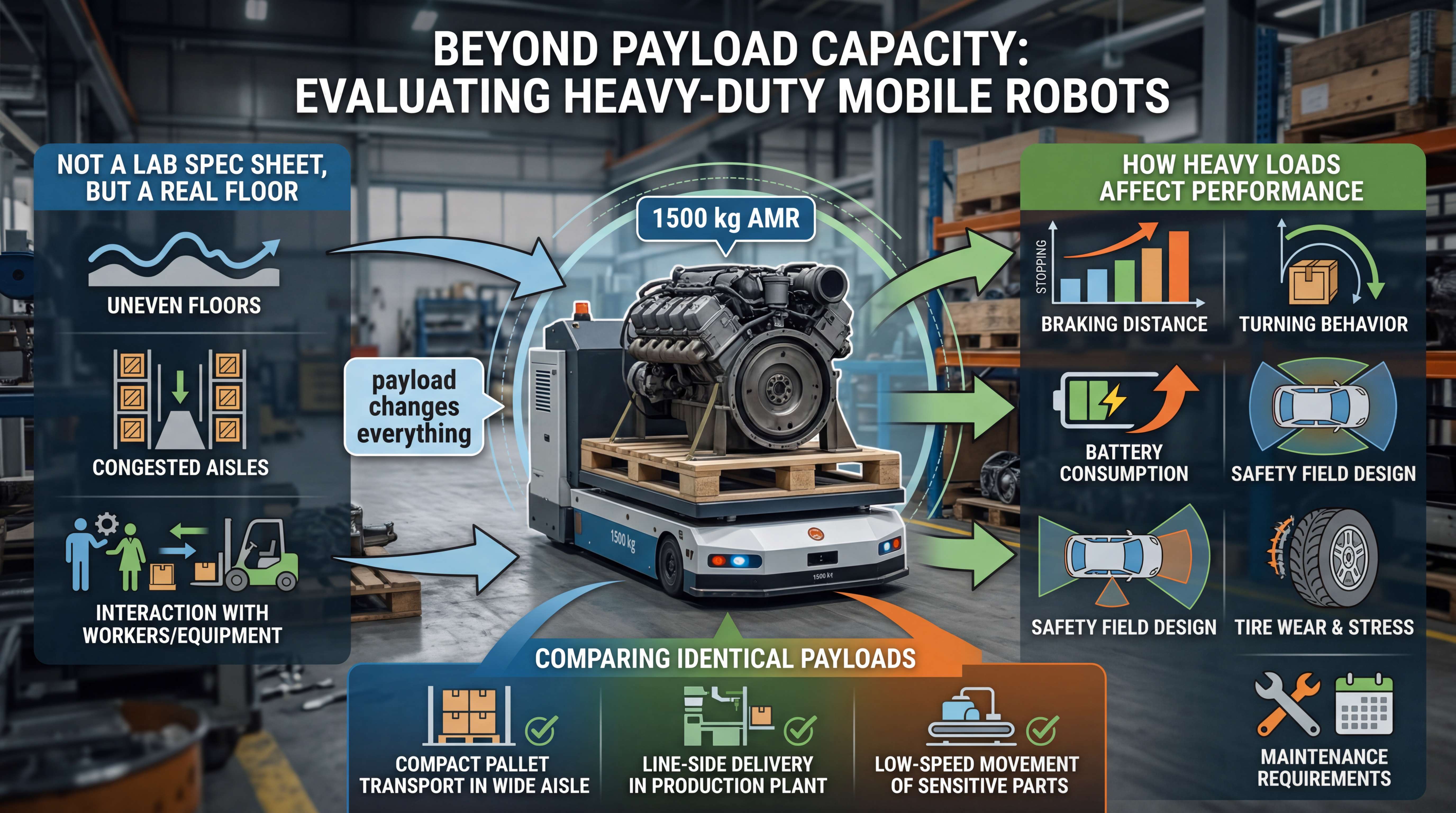
Heavy-payload AMR selection infographic showing factors beyond payload capacity
2026-05-15

Payload Capacity Is Only the Beginning How to Evaluate a Heavy-Payload Mobile Robot Chassis

A heavy-payload mobile robot should never be selected by payload rating alone. This guide explains how industrial buyers should evaluate load profile, stability, speed, braking distance, battery runtime, floor conditions, turning radius, safety margin and long-term operation before choosing a heavy-duty robot chassis.
Learn more
Heavy-duty AMR and autonomous forklift comparison for warehouse pallet transport
2026-05-15

Heavy-Duty AMR vs Heavy-Load AGV vs Autonomous Forklift: Which One Fits Your Material Flow?

Heavy-duty AMRs, heavy-load AGVs and autonomous forklifts can all move industrial materials, but they solve different problems. This guide explains how to choose the right automation platform based on routes, payloads, load interfaces, safety risks and system integration needs.
Learn more
Heavy-payload chassis carrying palletized industrial goods in a warehouse automation zone
2026-05-15

Heavy-Payload Chassis Is Not Just a Bigger AMR: What Industrial Buyers Should Know

A heavy-payload chassis is more than a stronger mobile robot base. It is an industrial motion platform designed for stable load handling, safer material flow, reliable navigation, system integration and long-term factory productivity.
Learn more
  • 1
    Sitemap

    Industrial Components

    Kitchen Appliances

    Renewable Energy

    Building & Home Improvement

    Chemicals & Water Treatment

    Robotics & Automation

    Email:robertkileyman@gmail.com

    (508676)
    0
    Service

    Email
    comment