
Why a Hydraulic Lift Table Needs More Than a Load Rating for AMR Integration
A lift that carries the pallet may still fail the transfer
A hydraulic lift table can have enough rated capacity for a pallet and still be the wrong purchase for an automated workstation. The missed requirement is often the transition: a pallet arriving partly supported, a roller deck settling under load, a robot waiting for a clear transfer signal, or an operator needing access after the machine stops. These conditions determine whether the installation works as a repeatable process.
For heavy-payload autonomous mobile robot projects, the buying question should therefore be specific: can this lift receive, position and release our actual load, through our actual transfer sequence, at the required production rate? Answering that question requires more than selecting a capacity and a platform size. It connects mechanical design, controls, human access and responsibility for recovery.
This guide follows four conflicts that regularly appear in equipment specifications: rated load versus moving load; convenient floor access versus controlled transfer geometry; comfortable working height versus a repeatable machine interface; and individual machine speed versus complete station output. It is intended for buyers, manufacturing engineers and integrators selecting material-positioning equipment, rather than personnel access platforms.
Why lift-table selection deserves attention in 2026
Current supplier developments show continued investment in how pallets enter, leave and interact with workstations. Blue Giant's Zero Ground Level Scissor Lift offering distinguishes standard floor-level loading from a drive-through arrangement that transfers material toward an elevated receiving surface. Its current product information also describes narrower side pods and conveyor options. These are application choices, not evidence that every low-entry lift is automatically compatible with an AMR. Blue Giant's product documentation provides the specific configurations.
Southworth is also promoting new pallet-handling equipment, including Mast Lift 26, alongside its established scissor and positioning products. The development matters because the useful purchasing comparison extends beyond one lifting mechanism. A mast-based arrangement, a scissor platform and a self-leveling workstation solve different access and positioning problems. The company's Mast Lift 26 product information confirms the active product development; buyers should obtain configuration-specific drawings before comparing suitability.
Earlier this year, Bolzoni included its 2E double-scissor and 1A single-scissor tables in the equipment presented for LogiMAT, March 24–26, 2026. On August 31, Autoquip published a technical discussion of integrating lifts with automated warehouse systems. These are distinct developments: an exhibition presentation and an integration article, not a claim that a single new universal AMR lift has launched.
In these applications, a lift should be evaluated as one element in a combined manual and automated material flow. Choosing it in isolation can move an unresolved problem downstream to the robot supplier or commissioning team. The following evaluation treats the whole handover as the unit being purchased.
Start with the station's job, then name the equipment
Write one sentence describing the required material movement before requesting quotations. For example: “Receive a loaded pallet from an AMR at a fixed transfer height, present cartons to an operator, then return the empty pallet through the same interface.” That sentence exposes at least three operating states. A catalog search for a pallet lift table does not establish whether a proposed model supports all three.
Distinguish the lifting mechanism from its power source. A scissor lift table describes an arrangement of supporting arms. Hydraulic actuation describes how force is produced. An electric lift table may use an electric motor to drive a hydraulic pump, so “electric” and “hydraulic” are not necessarily competing categories. Ask suppliers to identify the actual drive, position control, holding arrangement and power requirements.
Similarly, a pallet positioner may adjust height as layers are removed, rotate a load for easier access, or perform both functions. A spring-balanced model can be useful for manual handling, but its load-dependent height is not automatically the fixed receiving datum required by a conveyor or mobile robot. The specification needs to say which height is controlled, under what loading condition, and how the receiving device knows the station is ready.
For a fixed automated cell, an industrial lift table should be compared with other appropriate architectures only after the access routes are drawn. A low-entry platform, conventional scissor mechanism and mast-supported solution can offer different space and maintenance arrangements. There is no universal winner. The best architecture is the one that satisfies the complete sequence without relying on an undocumented exception.
Conflict one: the rated load is not the complete loading case
Describe what happens before the pallet is centered
A catalog capacity normally comes with assumptions. The buyer must obtain those assumptions rather than treating the number as permission for every loading condition. A pallet placed centrally on a platform presents a different problem from a pallet moving across its edge. During a transfer, support can be shared between the sending device and receiving deck, while the load is temporarily concentrated on a limited area.
The distinction is reflected in the MHI LIFT glossary, which treats lifting capacity and rollover capacity separately. The glossary defines rollover capacity for a single-axle load crossing the platform in its fully closed position. It is not an elevated edge-transfer rating for a pallet conveyor. Obtain the manufacturer's applicable rating for the actual transfer state rather than translating one rating into another.
Ask the supplier to review the complete sequence in a drawing: initial contact, intermediate support, full placement and departure. Identify pallet runners or feet, the direction of travel, any conveyor rollers or transfer plates, and the maximum offset allowed. A heavy duty lift table description is not a substitute for a documented rating for those conditions.
The declared moving load also needs a clear boundary. State the goods, pallet or carrier, fixtures and any equipment carried by the lifting structure. Ask the lift manufacturer how platform-mounted conveyor equipment, rotating attachments or customer fixtures affect the usable payload of its proposed configuration. Do not simply subtract an estimated attachment weight from a catalog rating and assume the remaining arrangement is approved.
Advance Lifts' application guide explicitly distinguishes removable loads from permanent items such as conveyors and fixtures. That manufacturer guidance supports asking for an assembled-equipment review. It does not justify applying one supplier's platform allowances or loading rules to a different machine.
Separate total weight from the way it reaches the deck
Two loads with identical total mass can demand different designs. One may distribute weight over a broad pallet base; another may stand on narrow feet. An off-center machine component can create a different loading case again. Purchasing should therefore collect a load family, not just a single maximum weight. Include the smallest supporting footprint, most uneven distribution and most difficult normal orientation.
For an AMR transfer, the responsibility cannot end at the lift's platform boundary. The receiving rollers, stops, guides and supporting frame must suit the same pallet and intermediate loading states. If a third party supplies the conveyor top, require the lift and conveyor vendors to review the assembled configuration. Otherwise, each supplier may approve its own component while nobody approves the combined handover.
This is also where procurement should separate an allowable working condition from a recovery condition. A pallet stopped halfway across an interface may need to remain supported while the fault is investigated. Determine who defines the permitted recovery method and how the load is prevented from moving unexpectedly. A successful normal cycle does not demonstrate that the interrupted condition is adequately addressed.
| Specification item | What the buyer should supply | What the supplier should confirm |
|---|---|---|
| Maximum load | Goods, carrier and relevant attached equipment | Configuration-specific usable capacity and assumptions |
| Load support | Runner, foot or wheel contact geometry | Permitted concentrated and distributed loading |
| Transfer state | Direction, offsets and intermediate pallet positions | Suitability throughout the approved sequence |
| Interrupted cycle | Credible stop points and access limitations | Supported state and documented recovery responsibility |
The buying decision should be based on the supplier's reviewed application drawing and written limits. This is more useful than asking for an arbitrary percentage of extra capacity, because additional nominal capacity alone may not resolve an unsuitable platform geometry or transfer condition.
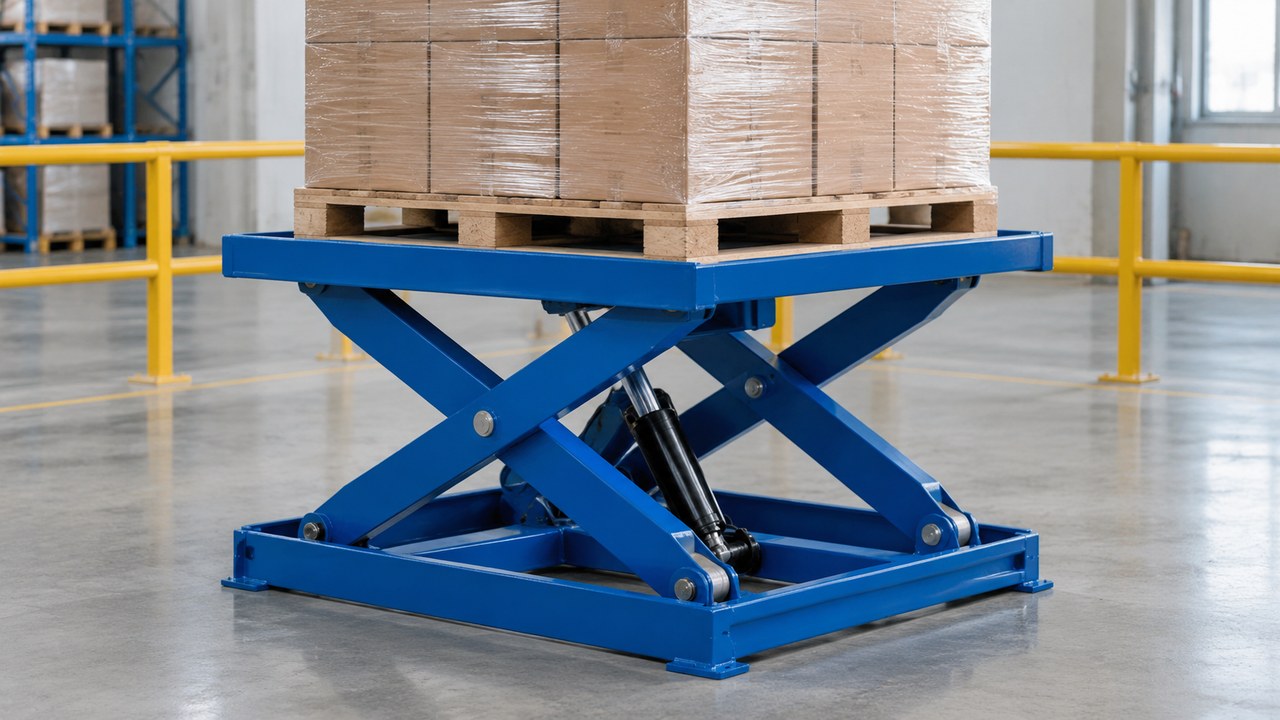
Conflict two: low entry height can make the interface harder to define
Floor access is a geometry problem
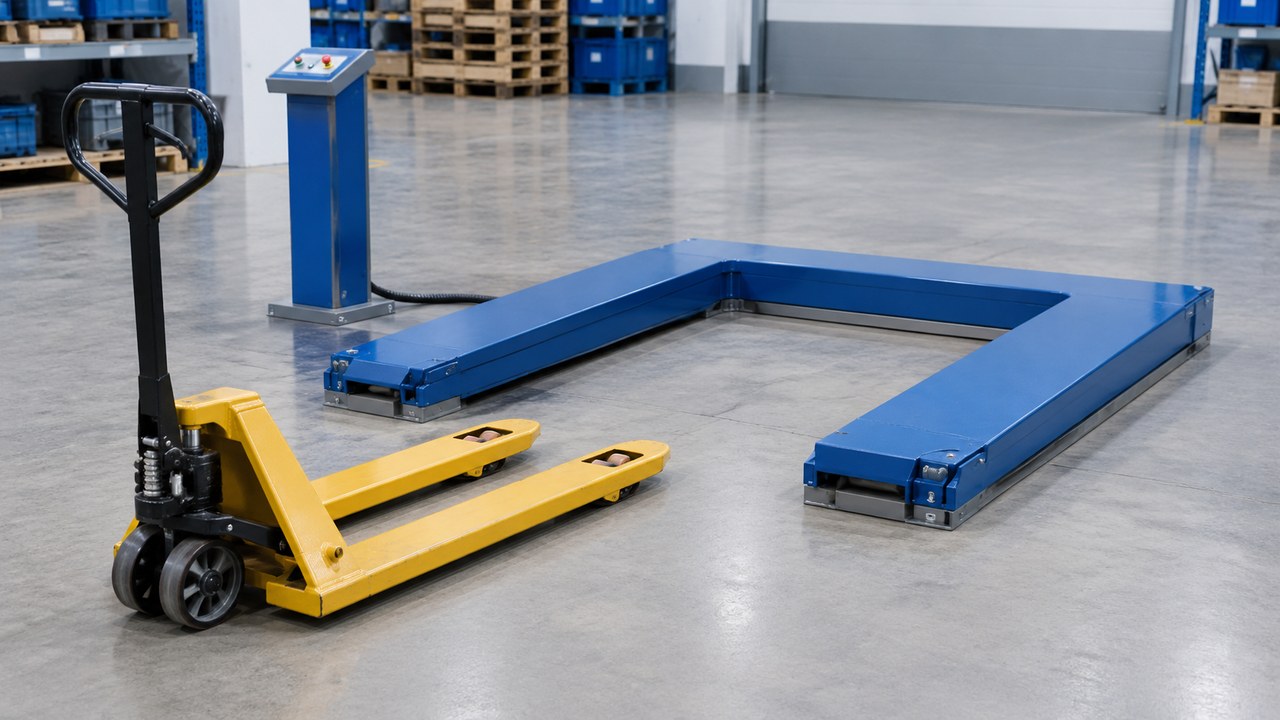
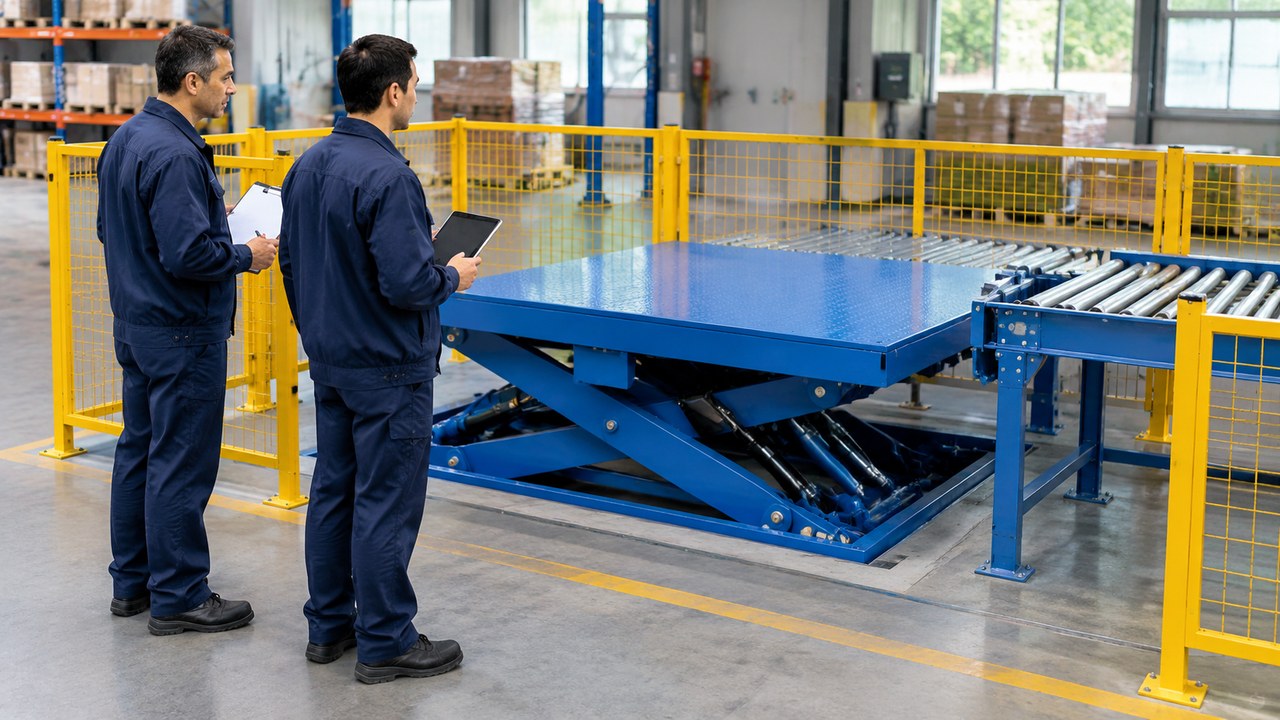
A low profile lift table can reduce the height a manual pallet truck must overcome, but the label does not describe every approach path. Check the entry opening, lip, ramp if present, side structures and wheel clearance. Then compare those features with the actual vehicle. A manual pallet truck, fork-equipped AMR and roller-top AMR may require very different receiving arrangements.
For a vehicle expected to enter or straddle the station, the equipment drawing must show the relevant envelope throughout the movement. For a roller transfer, the robot may remain outside the lift while the pallet crosses a gap. These are different designs. A photograph of an empty lowered platform cannot prove that either sequence will work with the proposed chassis and loaded pallet.
Blue Giant's distinction between standard ground-level access and drive-through transfer is useful here. It demonstrates why the direction and purpose of entry belong in the specification. It does not establish compatibility with a particular robot. Buyers still need the lift supplier and vehicle integrator to confirm clearances, support conditions and permitted operating modes for the actual installation.
Define the reference surface under working conditions
The transfer height should refer to a physical surface: for example, the top of the receiving rollers at the defined operating position. Record the condition under which it is measured. An unloaded nominal platform height is not the same statement as the position of the receiving surface with the approved load in place. Drawings should distinguish platform structure, attachments, rollers and any carrier interface.
Keep lowered height, raised height and vertical travel as separate fields in the request for quotation. Travel describes movement between positions; it does not, by itself, state the final elevation of the receiving surface. A conveyor top or fixture can change the interface elevation without changing the lift's stated travel. Record those dimensions in the assembled drawing so the robot supplier and workstation supplier are discussing the same datum.
List the contributors that can change the relationship between the two devices. These may include installation level, floor variation at the robot position, pallet condition, structural movement under load and the repeatability of each positioning system. The project needs a permitted combined interface condition, not separate tolerances that nobody has checked together.
There is no responsible universal gap or height allowance for every pallet transfer. The acceptable values depend on the pallet, roller arrangement, approach, load and equipment design. Use the approved interface drawing and supplier evaluation to establish them. Our guide to AMR docking tolerance verification explains how the surrounding installation can contribute to the final handover condition.
Count the space that disappears during maintenance
A compact stationary lift table can look attractive in a layout while leaving insufficient room to inspect or service it. Show access to the power unit, controls, lubrication points and parts that may need replacement. Include the route used to remove a failed component and the location of the approved mechanical support arrangement during maintenance.
Do not assume that the robot aisle can double as a permanent service area. If maintenance requires occupying that aisle, operations needs an agreed isolation and diversion plan. The resulting downtime and access requirements belong in the purchasing comparison, particularly when the station will feed a shared production line.
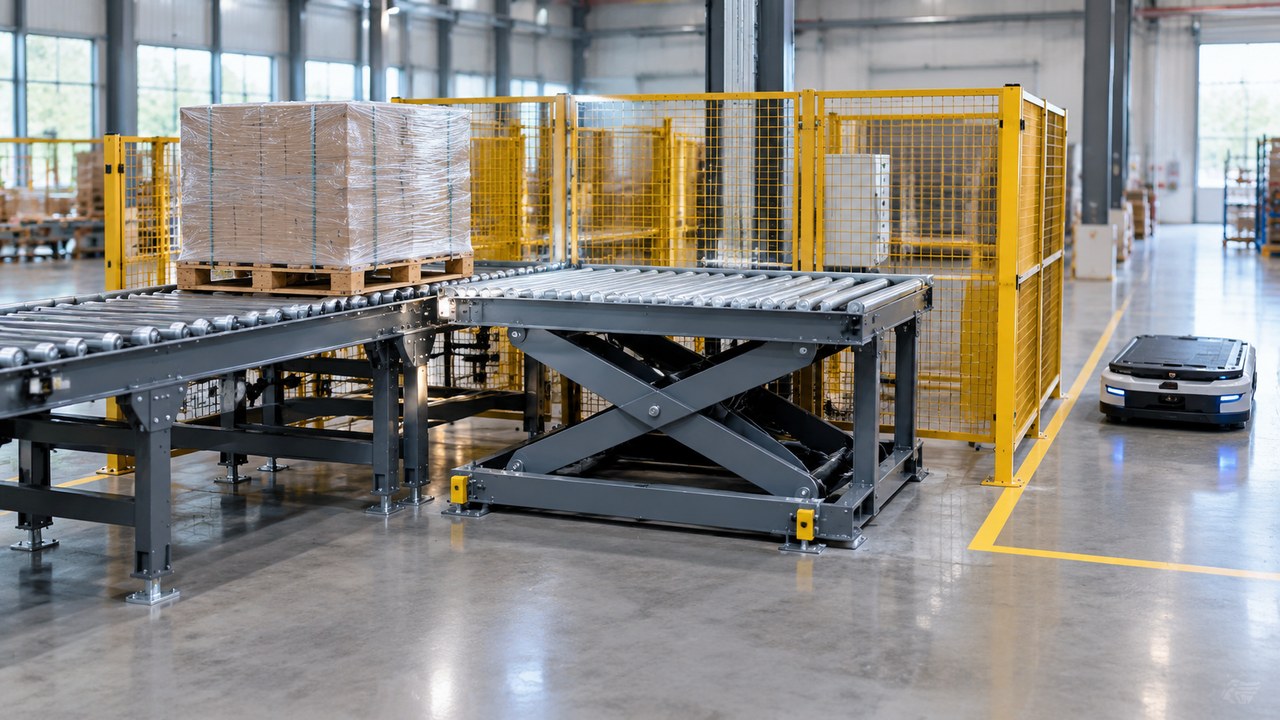
Conflict three: a good operator height is not always a good robot height
Give manual work and automatic transfer separate states
Human work often benefits from an adjustable presentation height. A machine interface usually benefits from a defined, repeatable receiving position. Combining them is possible, but the control sequence must distinguish them. A workstation should not be assumed ready for robot transfer simply because an operator has finished removing cartons.
Describe the sequence as operational states: receiving, positioned for work, ready to return, transferring and faulted. The actual control design belongs to the responsible engineers, but buyers should insist that each state has a clear owner and a clear transition. For instance, who commands the table back to the transfer position, and which device confirms that the required condition has been achieved?
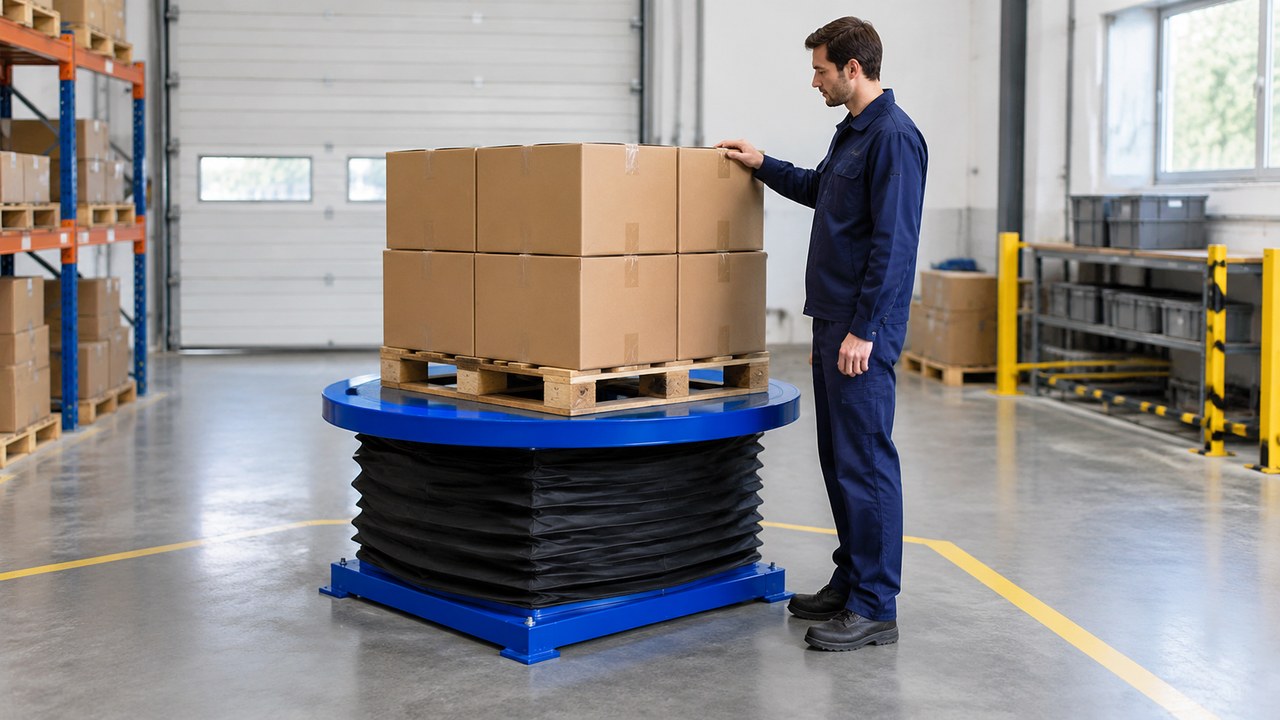
A self-adjusting pallet positioner deserves particular care in this comparison. Its purpose may be to keep the working layer accessible as weight changes. That benefit does not by itself make the platform a fixed docking destination. If automatic loading or unloading is required, ask for a specifically engineered transfer arrangement instead of assuming that an ergonomic accessory can accept a robot interface unchanged.
Specify readiness rather than a single “done” signal
The purchasing documents should define what transfer readiness means. Depending on the approved system design, relevant conditions may include the correct receiving position, a permitted operating mode, a clear receiving space and confirmation that the intended load can move. The controls team must decide how these conditions are detected and how their validity is maintained during the transfer.
Separate ordinary process messages from the safety functions required by the application. A standard data message saying “ready” is not automatically a safety-rated permission. The equipment suppliers and responsible integrator must determine the necessary protective measures through the application assessment. Buyers should request the resulting documented responsibilities and validation evidence rather than prescribing a network message as a complete safety solution.
Our discussion of AMR and PLC transfer handshakes provides a related view of the interface problem. For lift selection, the essential point is commercial as well as technical: the order needs to identify who delivers the complete working sequence, including what happens when one device changes state unexpectedly.
Protect recovery access without improvisation
Define how the station is placed into a condition where a trained person can investigate a fault. Access beneath a raised structure, entry into a transfer area and manual movement of a partly transferred pallet are not interchangeable recovery tasks. The supplier's instructions and site procedures need to address the actual intervention, including stored energy and mechanical support where applicable.
Equipment intended to position material should not be treated as a personnel lift. Procurement should also avoid vague promises that a maintenance technician can “just reach in” to clear a jam. If routine recovery depends on an awkward intervention, the station design or operating method needs attention before acceptance.
Conflict four: fast lifting does not guarantee a productive station
Measure the complete cycle
A quoted raising time is only one part of the station cycle. The process may also include waiting for a vehicle, positioning it, confirming readiness, transferring the pallet, completing the work, returning to the transfer position and releasing the station. Some activities overlap; others cannot. The production model should show those dependencies explicitly.
Consider an illustrative planning case, not a measured installation. A station needs 12 seconds to receive a pallet, 8 seconds to position it, 45 seconds for the work, 8 seconds to return and 12 seconds to release the pallet. If all five activities are sequential, the cycle totals 85 seconds. Dividing 3,600 by 85 gives a theoretical upper rate of about 42 cycles per hour before delays, stops or variability.
Reducing the upward movement from 8 seconds to 5 seconds would reduce that simplified cycle to 82 seconds, increasing its theoretical rate only to about 44 cycles per hour. The arithmetic does not predict a real site's output. It shows why paying for a faster lift may produce a small benefit when manual work or vehicle availability dominates the complete cycle.
State the working pattern, not only the hourly average
Give suppliers the expected cycles per shift, operating hours, load range and burst pattern. An average of a few transfers per hour can conceal a period when many pallets arrive together. Ask how the proposed drive and controls suit that duty, and request the maintenance schedule associated with the stated operating conditions.
An electric lift table quotation should identify the electrical supply and control arrangements for the actual configuration. For an electrohydraulic design, ask about the hydraulic system and intended operating pattern as part of the same package. For other electric drive architectures, request the corresponding operating and service requirements. Compare complete configurations rather than assuming one power-source label predicts all lifecycle characteristics.
The surrounding material flow matters too. A station may need a waiting position so that a delayed robot does not block a completed job. Alternatively, an upstream process may need permission to hold the next pallet. The right choice depends on the layout and production sequence; adding a faster lift does not create missing storage space.
For routes that combine fixed equipment and mobile transport, the pallet conveyor and AMR selection guide examines where buffering and fixed transfer points belong. The lift-table decision should use that same complete-route view.
Decide whether the lift should stay at the station or travel with the robot
A fixed lifting station can let a transport robot deliver a pallet and leave while work continues, provided the transfer and independent support arrangement have been designed for that sequence. It also concentrates the lifting equipment at the point where height adjustment is needed. This can be attractive when a small number of repeatable workstations receive loads from a larger shared fleet.
A robot with an integrated lifting module may serve several destinations without installing a separate powered platform at each one. That option needs a different comparison: the approved payload and center-of-gravity envelope of the complete vehicle, the module's useful travel, the supporting arrangement at each destination and the time the robot remains committed to the job. A mechanism intended to lift a carrier clear of its support is not automatically a workstation positioner with the required working-height range.
Count equipment and occupied resources separately. One mobile lifting device serving many locations may reduce fixed installations, but if it must stay under the load during a long assembly task, it cannot perform another transport job at that time. Conversely, installing a lift at every rarely used destination may add avoidable maintenance points. Compare the number of destinations, simultaneous jobs, handover durations and credible recovery routes using the same operating schedule. The purpose is to locate the lifting function where it supports the process, rather than selecting a mobile or fixed architecture from its purchase price alone.
Compare quotations through three real operating scenarios
A useful bid comparison asks each supplier to respond to the same scenarios. This makes differences visible without requiring the purchasing team to invent an engineering solution. The examples below describe evaluation questions, not approval criteria or validated machine designs.
| Scenario | Primary decision | Evidence needed before ordering |
|---|---|---|
| Manual pallet-truck loading followed by case handling | Entry access and suitable working-height range | Vehicle clearance, load support, operator access and approved loading method |
| AMR roller transfer to an adjustable workstation | Repeatable receiving position and complete transfer control | Interface drawing, loading states, control ownership and fault-recovery sequence |
| Heavy component presented to a production machine | Actual load distribution and process integration | Fixture details, concentrated loads, required positioning and maintenance access |
For the first scenario, a low profile lift table may address a genuine access constraint. For the second, a conventional hydraulic scissor lift table with an engineered conveyor top may be a candidate, but only after the combined assembly and interface have been reviewed. For the third, the geometry of a fixture or component can matter more than whether the product family is marketed for pallets.
Ask every bidder to identify exclusions in plain language. Examples include a conveyor top supplied by others, anchoring or foundation work outside the order, controls integration, commissioning support, and testing with customer pallets. An apparently inexpensive quotation may simply assign more unfinished work to the buyer.
Use a single responsibility matrix across the lift supplier, robot supplier, system integrator and site team. Assign ownership of the assembled transfer drawing, commissioning sequence, fault handling and final acceptance record. This prevents a common contractual gap: each component is delivered successfully, but nobody is accountable for making the station perform its intended job.
Also define what constitutes a future change. A new pallet size, heavier fixture, different robot top module or revised production sequence can invalidate an earlier assumption even when the station continues to move. Include a review route for those changes in the handover documentation. Operations should know when it can use an approved alternative and when it must ask the responsible supplier to reassess the application.
Buy an acceptance plan together with the equipment
Before the order is placed, agree which evidence will close each open requirement. Dimensions should be confirmed through approved drawings. Loading conditions require supplier review. Transfer performance should be demonstrated using representative carriers and loads. Recovery and maintenance need documented methods that fit the actual installation.
The test set should represent the agreed load family, including difficult normal conditions. Depending on the application, that may mean the smallest permitted pallet footprint, the heaviest load, an approved off-center distribution or the lowest and highest required working positions. The supplier and integrator should define which combinations are valid and how they will be tested.
Separate factory and site evidence. A factory demonstration can verify the supplied assembly and agreed control sequence under its test conditions. Site acceptance must also consider the installed floor, adjacent equipment, actual vehicle approach and production interfaces. Passing one stage does not automatically prove every condition at the other.
Record the outcome in a form future teams can use: final drawings, configured settings, permitted load definitions, operating instructions, spare-parts information, training records and unresolved exceptions. Avoid accepting a demonstration that depends on an undocumented adjustment only one technician knows how to reproduce.
Commercial comparison should include the consequences of a stopped station. A readily serviceable design, accessible replacement parts and a workable intervention route can be valuable even when the initial equipment price is higher. Ask for the proposed support arrangements and planned service requirements; do not replace those facts with a generic promise of low maintenance.
The strongest purchase order does not demand the largest capacity or fastest motion available. It defines a pallet lift table that handles the approved load family, connects correctly to the surrounding process and can be restored to service through an agreed method. That is the equipment specification most likely to remain useful after the commissioning team leaves.
Focused FAQ
How should buyers size a hydraulic lift table for pallets?
Provide the maximum goods and carrier weight, support footprint, load distribution, attachments and transfer sequence. Ask the supplier to confirm the usable capacity of the proposed assembly under those conditions. A nominal capacity alone does not establish suitability for an edge-loaded or partly transferred pallet.
Is an electric lift table different from a hydraulic model?
The terms can overlap. An electric motor can power the pump in an electrohydraulic design. Compare the actual lifting mechanism, drive, position control, holding arrangement and maintenance requirements. A product label should not replace a configuration-specific technical description.
Can a low profile lift table receive a load from any AMR?
No. Compatibility depends on the vehicle's transfer method, approach envelope, ground clearance, receiving height and load support. A platform accessible to a manual pallet truck may still require a different arrangement for a fork-equipped or roller-top robot.
Can a pallet positioner act as an automatic docking station?
Only if that use has been specifically engineered and approved. A self-leveling device may change height with the load, whereas a robot transfer can require a defined receiving position. Confirm the interface and operating sequence instead of assuming that ergonomic adjustment provides docking control.
What should a scissor lift table acceptance test include?
Use the agreed load family and operating sequence, verify the assembled interface, and evaluate specified interruptions and recovery methods under controlled conditions. Factory and site tests should have distinct scopes, recorded results and named responsibility for resolving exceptions.
Does choosing a heavy duty lift table remove integration risk?
No. Additional nominal capacity does not resolve an unsuitable transfer geometry, undefined controls, restricted maintenance access or missing system ownership. Ask for evidence against the complete application requirements, including the intermediate loading states.
Sources and technical context
- Blue Giant: Zero Ground Level Scissor Lift — current manufacturer descriptions of floor-level and drive-through arrangements.
- Southworth: Mast Lift 26 — current manufacturer product information.
- Bolzoni: LogiMAT 2026 — exhibition product presentation, March 24–26, 2026.
- Autoquip: Integrating Material Handling Lifts with Automated Warehouse Systems — technical article, August 31, 2026.
- MHI LIFT glossary — industry terminology for lift capacity and configuration.
- Advance Lifts: Production Scissors Lifts Application Guide — manufacturer guidance on application data and loading conditions.
Supplier information describes specific products. The procurement analysis and numerical planning example in this article are original editorial analysis, not a reported installation test or a substitute for application-specific engineering.


