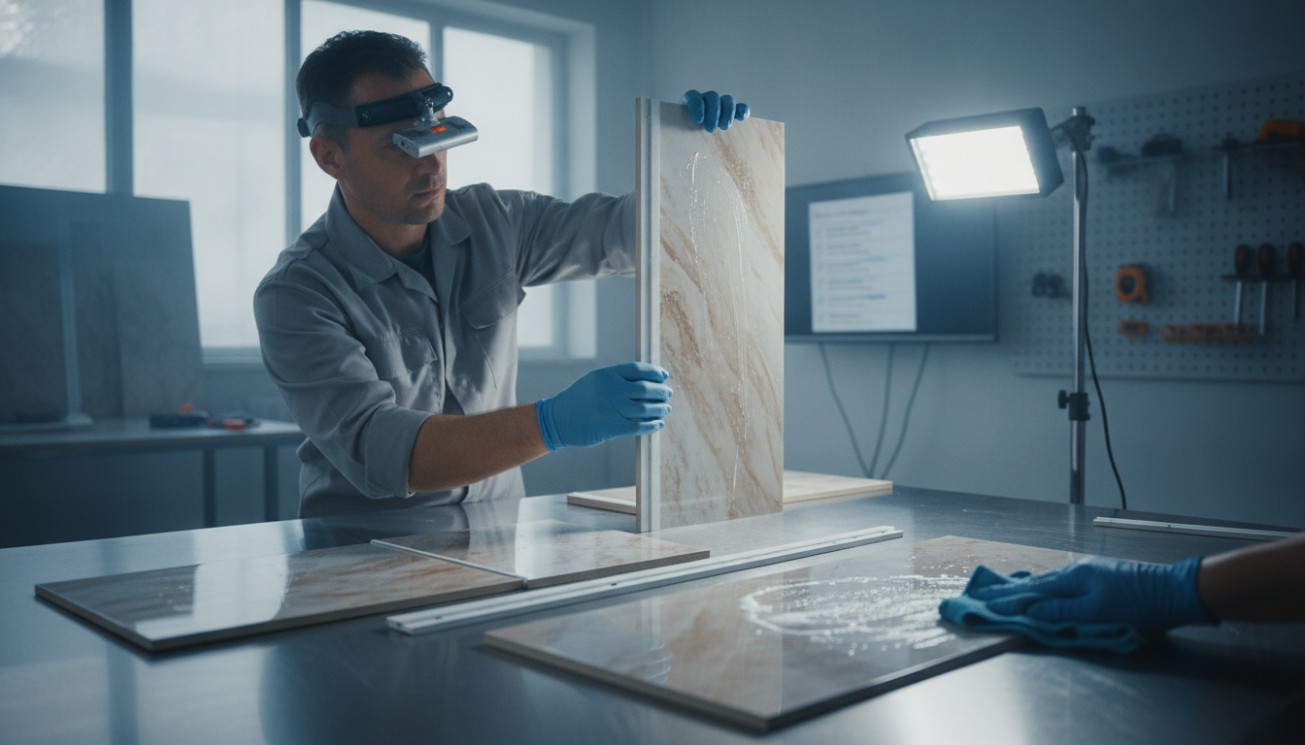
Waterproof PVC Shower Panels: What Buyers Should Check Before Choosing Wet Wall Cladding
Shower walls fail at the details, not only at the surface

When buyers search for waterproof PVC shower panels, they usually focus on the word waterproof. That is understandable. A shower wall is exposed to direct water, steam, soap residue, cleaning chemicals, temperature changes, and repeated daily use. If a wall covering cannot handle moisture, it does not belong in a shower area. But in real projects, the biggest risk is rarely the flat center of the panel. The risk usually appears at the joints, corners, pipe holes, tray connection, bathtub edge, substrate, adhesive layer, and finishing trims.
This is why PVC shower wall panels should not be treated as simple decorative sheets. A reliable shower wall is a system. The visible panel is only one layer. Behind and around it are many decisions that affect whether the wall stays clean, dry, stable, and maintainable after installation. A panel may have a water-resistant surface, but if the cut edge is exposed, if the corner trim is poorly sealed, if the wall behind it is damp, or if the shower tray connection is weak, the project can still fail.
For homeowners, this failure may mean hidden moisture, odor, stains, loose edges, or repeated sealant repair. For contractors, it may mean callbacks and reputation damage. For importers and distributors, it may mean product complaints even when the panel material itself was not the real problem. For project buyers, it may mean that a fast bathroom renovation turns into a costly repair cycle.
Earlier articles on Global Supply Chain Briefing explained why PVC bathroom wall panels are becoming a no-grout option for modern bathrooms and how buyers should compare PVC wall panels vs tiles in renovation decisions. This article goes deeper into the wettest and most demanding part of the bathroom: the shower zone. It explains what buyers should check before choosing wet wall cladding for shower enclosures, bathtub surrounds, wet rooms, rental bathrooms, hotels, and fast renovation projects.
The first buyer mistake is confusing waterproof material with waterproof installation

The word waterproof is often used too broadly in the wall panel market. A product photo may show water droplets on a glossy surface. A supplier may say the panel is waterproof because PVC itself does not absorb water like wood or gypsum. A retailer may describe the product as suitable for bathrooms. These statements can be true in a limited sense, but they do not prove that the completed shower wall will perform well.
A shower wall is exposed to water in three ways. First, water hits the visible surface. Second, water moves toward joints, corners, edges, and penetrations. Third, moisture can become trapped behind a wall if the substrate is already damp or poorly prepared. A good waterproof wall panels system must respond to all three conditions. Surface resistance alone is not enough.
Surface waterproofing is only the starting point
The front surface of PVC wet wall panels is usually the easiest part to understand. It should resist water, wipe clean, and maintain its appearance under normal bathroom use. If the surface is laminated, printed, coated, embossed, gloss, matte, marble-effect, tile-effect, or plain white, buyers should still ask the same question: how does this finish behave when exposed to soap, hard water, mild cleaners, and repeated wiping?
A bathroom panel that looks attractive in a dry showroom may behave differently in a shower enclosure. Glossy surfaces can show water marks. Dark panels can show mineral deposits. Very textured surfaces may hold residue. Low-quality printed layers may appear less convincing across a large wall. A buyer should not only touch the sample; they should imagine how it will look after daily use.
Joints and edges decide whether water stays on the front side
The second layer is more important. Water rarely enters through the middle of a sound panel. It looks for openings. Panel joints, vertical seams, internal corners, external corners, bottom edges, top edges, cut-outs, valve penetrations, and shower tray lines are the real inspection points.
This is where PVC panel trims become more than decorative accessories. Trims, joining profiles, internal corner pieces, end caps, sealant lines, and pipe collars decide whether the wall behaves like a planned shower system or like panels attached to a wet wall. A buyer who ignores trims during sourcing may save money at the quotation stage and lose it during installation or after-sales service.
The wall behind the panel can make or break the project
The third layer is the substrate. Many buyers like the idea of installing panels over old tiles or existing bathroom walls because it saves demolition time. That can work in some cases, but only when the wall is stable, dry, clean, flat enough, and suitable for bonding or fixing. If the old wall has loose tiles, hidden leaks, active mold, wet plaster, crumbling board, or uneven surfaces, covering it with panels may only hide a problem that continues to grow.
This principle also appears in other waterproof panel systems. The site’s guide on SPC shower wall panels explains that wet-room walls must be evaluated as complete systems, not only as rigid decorative boards. The same thinking applies to PVC. A buyer should ask not only “Is this panel waterproof?” but “Can this full installation control water at every vulnerable point?”
Map the water exposure before selecting the panel
Not every bathroom wall faces the same level of water exposure. A wall behind a vanity is different from a wall inside a shower enclosure. A guest toilet is different from a family wet room. A hotel bathroom with daily cleaning is different from a private bathroom used by one person. Before choosing shower wall cladding, buyers should map the water exposure level of the project.
Direct shower zones need the strictest system
The direct shower zone includes the walls that receive regular water spray. These areas require the most careful evaluation. The panel surface, joint design, corner detail, bottom connection, pipe penetration, adhesive compatibility, and substrate preparation all matter. If a product is only intended for decorative bathroom walls, it should not be automatically used in this zone.
For direct shower use, buyers should ask whether the supplier provides a wet-area installation guide. The guide should explain recommended adhesive, sealant type, trim system, panel edge treatment, minimum wall preparation, joint sealing method, and cleaning restrictions. If the supplier cannot explain these details, the product may not be ready for serious shower applications.
Bathtub surrounds need edge control
A bathtub surround is not the same as a shower enclosure, but it still receives water. The most important point is usually the connection between the wall and the bathtub edge. If water can sit at the bottom of the panel or move behind the wall at the tub line, the project becomes vulnerable.
For bathtub applications, buyers should ask how the bottom edge is finished. Is there a recommended trim? Is a flexible sealant used? How should the panel meet the tub lip? Can the system allow for small movement? How should corners be cleaned and inspected over time? These questions are practical, but they are often more important than the decorative pattern.
Bathroom splash zones can use a different grade
Walls near vanities, toilets, laundry sinks, and general bathroom areas face moisture and splashes, but not constant direct shower spray. Some bathroom wall panels may be suitable here even if they are not designed for direct shower exposure. This distinction helps buyers choose the right product grade instead of overpaying for every wall or under-specifying the wettest zone.
For importers and distributors, this creates a useful product strategy. A complete product line may include direct-shower panels, general bathroom panels, decorative wall panels, trims, adhesives, sealants, and installation accessories. Buyers should not mix these categories casually.
Panel structure matters more than product photos suggest
Many PVC shower wall panels look similar in online images. A marble-effect surface, a white gloss wall, or a tile-effect print can make different products appear equally suitable. But the product photo does not reveal thickness, core structure, edge strength, surface bonding, stiffness, weight, impact resistance, or cutting behavior. These hidden factors affect installation and long-term use.
Thickness should match the application, not just the price point
Panel thickness is one of the first details buyers ask about, but thickness should be understood carefully. A thicker panel may feel stronger, flatter, and more stable. It may hide minor wall imperfections better and feel more substantial during handling. However, thicker panels may require compatible trims, more precise cutting, and higher freight volume. A thinner panel may be easier to cut and ship, but it may feel less rigid or show wall irregularities if the substrate is not smooth.
The right question is not simply “Which panel is thickest?” The better question is “Does the panel thickness match the shower application, installation method, trim system, and expected customer segment?” A retail DIY product, a hotel project panel, and a budget rental renovation panel may not require the same structure.
Hollow, cellular, and solid structures behave differently
PVC panels can be made with different internal structures. Some are hollow-core boards, some are cellular or foamed, and some may be denser sheet-like panels. These structures affect weight, rigidity, cutting behavior, edge sealing, and perceived quality.
Hollow panels can be lightweight and cost-effective, but buyers should check rib strength, edge behavior, and trim compatibility. Cellular panels may offer a more solid feel, but consistency matters. Dense panels may feel premium, but they may increase handling and shipping costs. No structure is automatically best. The structure must fit the room, market, and installation method.
Cut edges reveal real quality
A sample should always be cut before approval. Cutting reveals whether the panel chips, cracks, releases excessive dust, leaves rough edges, exposes weak internal ribs, or causes the decorative surface to lift. In shower applications, cut edges are not only visual details. They often appear around valves, pipe penetrations, corners, niches, and end points.
A strong supplier should be able to explain how cut edges are protected. Are they hidden by trims? Are they sealed with silicone? Are pipe penetrations fitted with collars or sealant? Should installers avoid certain cutting tools? These practical answers matter more than a polished catalog image.
The trim system is the real test of wet wall professionalism
In many wall panel businesses, trims are treated as an accessory afterthought. That is a serious mistake. For wet wall cladding, trims are part of the waterproofing logic, installation logic, and finished appearance. A strong panel with weak trims can still create a poor wall.
Internal corners are high-risk zones
Internal shower corners receive frequent water flow and cleaning pressure. If the corner trim is loose, poorly sealed, mismatched, or difficult to clean, the wall becomes vulnerable. Buyers should inspect whether the internal corner profile allows neat panel insertion, whether sealant is required, whether the surface is easy to wipe, and whether the color matches the panel.
Some systems rely heavily on sealant at corners. Others use profiles to create a more controlled connection. Both methods can work if properly designed and installed. The key is that the supplier must provide a clear method instead of leaving installers to improvise.
Bottom edges and tray connections need special attention
The bottom of the shower wall is one of the most important details. Water runs downward. Soap residue collects near the base. Cleaning tools often touch this area. Movement between the tray and wall may occur. A weak bottom connection can allow water to move behind the panel.
For shower panel installation, buyers should ask how the panel meets a shower tray, bathtub, or wet-room floor. Is there a base trim? Should the panel stop above the tray and be sealed? Should it sit behind a lip? How is movement handled? How often should the sealant line be inspected? These questions should be answered before the product reaches the job site.
Pipe penetrations are small openings with large risk
Every shower valve, mixer, pipe, hose outlet, and fixture creates a penetration. These openings are often cut on site, which means installer skill matters. If the hole is too large, poorly sealed, or not covered properly, water can enter behind the wall.
Professional PVC panel trims and accessories should include guidance for penetrations. The supplier may recommend escutcheons, sealant, collars, or specific cutting methods. Buyers should not assume installers will automatically know the best approach for every panel structure.
Adhesive and fixing methods should be selected for wet conditions

Many PVC panel failures are linked to wrong adhesive, poor adhesive coverage, dusty walls, damp substrates, or incompatible surfaces. A wall panel may be waterproof, but if it loses bond behind the wall, the system can move, open joints, or create hollow spots.
Adhesive must match panel and substrate
Adhesive selection depends on panel type, wall material, room moisture, temperature, open time, curing behavior, and manufacturer guidance. A product suitable for dry decorative walls may not be suitable for shower applications. Some adhesives may react poorly with certain plastics or coatings. Some may fail if applied over dusty or glossy old tiles without proper preparation.
Buyers should ask suppliers for approved adhesive types, coverage patterns, curing conditions, and unsuitable substrates. If the supplier gives only a vague answer such as “use construction glue,” the buyer should request more detail before approving the product.
Mechanical fixing may be useful in selected projects
Some installations may use mechanical fixing, battens, or mixed methods depending on the panel system and wall condition. This can be useful where direct bonding is not ideal, where walls are uneven, or where access behind panels is planned. However, mechanical fixing in wet areas must be designed carefully because screws and penetrations can create water paths.
The decision should not be made casually. A bathroom panel system should explain whether adhesive-only, trim-supported, batten-mounted, or mechanically fixed installation is recommended for each application. A single product may have different installation methods for dry walls and wet zones.
Installer documentation reduces claims
For distributors, installation documentation is a commercial asset. It reduces guesswork, improves consistency, and protects the product from being blamed for poor workmanship. A complete guide should include tools, wall preparation, cutting, adhesive, trim sequence, joint sealing, corner treatment, pipe penetrations, tray connection, cleaning after installation, and maintenance advice.
This is also why material comparison content is valuable. Readers who are still comparing categories can review SPC vs PVC vs WPC wall panels to understand that each material has its own installation logic, not just a different name.
Cleaning performance should be tested like a real bathroom surface
Many product descriptions say easy to clean, but waterproof PVC shower panels should be tested against real bathroom conditions. The shower wall faces soap film, shampoo, conditioner, hard water marks, limescale, body oil, steam, cleaning sprays, cloth wiping, and sometimes abrasive cleaning habits. A beautiful panel that is difficult to clean will not satisfy long-term users.
Gloss level affects water mark visibility
Glossy panels can make a bathroom feel brighter and more modern. They also reflect light and can make small rooms appear larger. However, high-gloss surfaces may show water spots, fingerprints, cleaning smears, or scratches more easily depending on the finish. This does not make gloss bad, but it means buyers should test cleaning behavior.
Matte panels can look more premium and calmer, but some matte surfaces may hold marks or require more careful cleaning. Textured panels can hide minor imperfections but may collect residue if the texture is too deep. The best finish is not always the most beautiful sample. It is the finish that remains acceptable after repeated use.
Cleaning chemicals should be confirmed before selling
Suppliers should provide clear cleaning guidance. Can users clean the surface with mild soap? Are bleach-based cleaners allowed? Are acidic limescale removers allowed? Are abrasive pads prohibited? Can commercial cleaning teams use standard bathroom sprays? These details affect customer satisfaction and warranty control.
For hotels, student housing, rental apartments, and public facilities, cleaning behavior is especially important because the wall may be cleaned frequently by different people. A surface that requires delicate care may not be suitable for high-rotation bathrooms.
White panels and marble-effect panels age differently
Plain white panels can look clean and hygienic, but they may show scratches or discoloration if the surface quality is weak. Marble-effect panels can hide minor marks better, but low-quality printing may look repetitive across large surfaces. Dark stone-effect panels can look dramatic, but they may show hard water marks more clearly.
Buyers should view samples vertically, under bathroom-like lighting, and after wiping with water and mild cleaner. Sample testing should be simple but realistic.
Fire rating and application limits must be handled responsibly
PVC is a plastic-based material, so fire-related claims should be handled carefully. In bathrooms, direct high heat is usually less common than in kitchens or fireplace areas, but building codes, hotel requirements, multi-unit housing rules, and commercial specifications may still require documentation.
Do not confuse fire-resistant with fireproof
Some panels may have fire-retardant additives or test reports. Others may be decorative products with limited fire-performance documentation. Buyers should avoid vague claims such as fireproof unless supported by proper standards and context. Fire-resistant, fire-rated, flame-retardant, and self-extinguishing are not the same thing.
For project use, suppliers should provide test reports where required and explain the intended application. A product suitable for private residential bathrooms may not automatically be approved for hotels, hospitals, public buildings, or high-occupancy projects.
Heat sources should be separated from shower panel claims
A shower wall panel should not be promoted for high-heat walls unless the supplier supports that use. Even if a panel performs well in wet bathrooms, it may not be suitable behind stoves, near heaters, in saunas, or close to strong heat sources. This is why honest application guidance is important.
Commercial buyers need documentation, not only samples
Commercial buyers often need more than a good sample. They may require fire documents, cleaning guidance, VOC or indoor air considerations, installation instructions, maintenance recommendations, and warranty conditions. If a supplier cannot support documentation, the product may be limited to small retail or low-risk renovation applications.
Packaging and logistics affect delivered shower panel quality

A shower panel can be well made and still arrive damaged. Long panels are vulnerable to scratches, corner damage, bending, compression, surface film abrasion, and carton failure. For importers and distributors, packaging is not a small operational detail. It is part of product quality.
Long panels need edge and corner protection
Bathroom wall panels are often large enough to reduce joints, which is one of their advantages. But larger panels create shipping and handling challenges. Corners can crush. Edges can chip. Decorative film can scratch. Panels can bend if stacked or stored incorrectly.
Buyers should ask for carton specifications, corner protection, pallet method, loading photos, carton labeling, and storage guidance. Retailers selling through e-commerce may need stronger parcel packaging than wholesalers shipping by pallet.
Batch control matters for replacement
In a shower wall, color variation can be obvious because panels sit side by side under bright bathroom lighting. If replacement panels from a later batch do not match, repair becomes difficult. This is especially important for marble-effect, stone-effect, and tile-effect finishes.
For distributors, repeat-order stability is part of the product line. This principle is similar to the quality logic discussed in the guide on WPC wall panel quality, where surface consistency, batch control, packaging, and supplier reliability affect the business beyond the first sample.
Accessory packaging should not be ignored
Trims, corners, end caps, and profiles can arrive scratched or bent if poorly packed. If accessories are damaged, installation may stop even when panels are fine. A complete bathroom renovation panels package should protect both panels and accessories.
How buyers should inspect samples before ordering
A sample inspection should simulate real project questions. Looking at a small panel under showroom light is not enough. Buyers should cut, clean, connect, seal, and compare samples before approving bulk orders.
Cut the sample and inspect the cross-section
Cutting shows the core structure, edge strength, surface bonding, and tool behavior. Buyers should check whether the panel cuts cleanly, whether the surface layer lifts, whether the edge looks fragile, and whether the profile supports sealing and trimming. This is especially important for holes around shower valves and pipe exits.
Connect two or three panels together
A single panel does not show joint performance. Buyers should connect multiple pieces and check seam visibility, alignment, tightness, and trim fit. If the joint is difficult to close on a sample table, it may be harder on a real wall.
Test the trim system with the panel
Do not approve panels without trims. Place the panel into internal corner profiles, end caps, joining strips, and base trims. Check whether the color matches, whether the profile grips properly, whether the trim looks cheap, and whether the joint can be sealed cleanly.
Wipe the surface after water exposure
Spray water on the sample, allow it to dry, and wipe it with a mild cleaner. Check for marks, smears, scratches, gloss changes, and residue. A product that looks perfect before cleaning may reveal problems after simple use simulation.
Ask for installation and maintenance documents
A serious supplier should provide installation instructions and cleaning guidance. If the product is sold into wet areas, the documents should include shower-specific details. Without documentation, every installer must invent a method, which increases risk.
How suppliers should position PVC shower panels in the market
Suppliers should avoid presenting waterproof PVC shower panels as a universal replacement for every bathroom material. A stronger strategy is to define the product clearly: a fast-install, no-grout, easy-clean wall cladding solution for suitable wet areas when installed as a complete system.
Sell the system, not just the board
The most professional suppliers sell panels, trims, adhesive guidance, sealing instructions, cleaning advice, packaging support, and application limits together. This makes the product easier to specify and reduces after-sales confusion. A panel-only quotation may win on price, but a system-based quotation wins on project reliability.
Separate residential, rental, hotel, and commercial use
Different markets require different proof. A DIY bathroom buyer may care most about appearance and easy installation. A landlord may care about turnover speed and cleaning. A hotel buyer may care about repeatability and maintenance. A commercial buyer may ask about fire documents, cleaning chemicals, and impact resistance.
By segmenting the market, suppliers can avoid overpromising. They can recommend different thicknesses, finishes, accessories, and documents for different applications.
Use comparison content to educate buyers
Many buyers arrive at PVC after considering tiles, SPC, WPC, acrylic panels, FRP, paint, or drywall. Educational content helps them understand the role of each material. An article about PVC shower wall panels should link naturally to comparison guides, installation guides, and material selection articles. This creates a stronger content pathway and helps search engines understand the category relationship.
A practical buyer checklist for waterproof PVC shower panels
Before approving a product, buyers can use the following checklist to reduce risk.
Product identity checklist
Confirm whether the panel is designed for direct shower use, bathtub surrounds, general bathroom walls, or dry decorative interiors. Do not assume that all PVC panels are suitable for direct water exposure.
Structure checklist
Check thickness, core structure, weight, stiffness, cut edge quality, surface bonding, and impact behavior. Confirm whether the panel structure fits the intended customer segment and installation method.
Water control checklist
Review joint design, internal corners, external corners, bottom edge, shower tray connection, bathtub edge, pipe penetrations, sealant requirements, and trim compatibility.
Installation checklist
Confirm substrate requirements, approved adhesive, fixing method, wall preparation steps, cutting tools, trim sequence, curing time, and installer documentation. A product without installation guidance is risky in wet zones.
Maintenance checklist
Check cleaning method, chemical restrictions, scratch behavior, hard water visibility, sealant maintenance, replacement process, and spare panel availability.
Business checklist
For importers and distributors, check MOQ, packaging, carton strength, batch labeling, replacement support, accessory supply, documentation, lead time, and supplier communication. A good shower panel line must be sellable repeatedly, not only attractive in one sample set.
Focused FAQ
Are PVC shower panels fully waterproof?
PVC shower wall panels usually have a water-resistant or waterproof surface, but the finished shower wall depends on the complete system. Joints, trims, sealant, pipe penetrations, tray connections, substrate condition, and installation quality all decide whether the wall performs well in a wet area.
Can PVC panels be used inside a shower enclosure?
Some waterproof PVC shower panels are designed for direct shower use, but not every PVC panel is suitable. Buyers should confirm wet-area approval, joint design, trim system, adhesive guidance, and installation documentation before using panels inside a shower enclosure.
What is the most important detail in shower panel installation?
The most important details are usually joints, corners, bottom edge sealing, pipe penetrations, and substrate preparation. The center of the panel is rarely the first failure point. Good shower panel installation controls water where the wall changes direction or meets another surface.
Do PVC shower panels need trims?
In most professional installations, yes. PVC panel trims help finish edges, corners, joints, and transitions. They also improve appearance and can support water-control details when used correctly. Trims should be treated as part of the wall system, not optional decoration.
Can PVC shower panels be installed over old tiles?
They can sometimes be installed over old tiles if the tiles are stable, clean, dry, flat, and firmly bonded. Loose tiles, damp walls, mold, cracked substrates, and uneven surfaces should be repaired first. Covering a failing wall can create hidden problems.
Are thicker PVC shower panels always better?
Not always. Thickness should match the application, panel structure, trim system, installation method, and market positioning. A thicker panel may feel stronger, but it may also require different trims and increase logistics cost. The best panel is the one that fits the project requirement.
How should buyers test PVC shower panel samples?
Buyers should cut the sample, inspect the edge, connect multiple panels, test trims, wipe the surface after water exposure, check cleaning behavior, and request installation documents. Sample testing should simulate real bathroom use, not only showroom viewing.
Are PVC shower panels better than tiles?
They are better for some renovation projects, especially when fast installation, fewer grout lines, easier cleaning, and lower disruption are important. Tiles may still be better for premium craft, high-heat areas, or markets where traditional hard surfaces are preferred. The right choice depends on the project.
Conclusion: a waterproof shower wall is a system decision
Waterproof PVC shower panels are valuable because they can simplify bathroom renovation, reduce grout maintenance, create clean large surfaces, and support faster installation. But buyers should not treat waterproof as a single material label. In shower areas, reliability is decided by the whole system: panel structure, joints, trims, adhesive, substrate, sealant, cleaning behavior, documentation, and long-term replacement support.
For homeowners, this means choosing a product that fits the shower area rather than only choosing a surface pattern. For contractors, it means following a controlled installation method instead of improvising on site. For importers and distributors, it means building a product line with panels, trims, packaging, documents, and after-sales logic. For project buyers, it means verifying performance before large-scale use.
The strongest wet wall cladding products are not the ones with the loudest waterproof claim. They are the ones that make every vulnerable point understandable: corners, edges, joints, penetrations, tray connections, cleaning routines, and replacement planning. When those details are handled correctly, PVC wet wall panels can become a practical and commercially strong solution for modern shower walls and bathroom renovation projects.
#WaterproofPVCShowerPanels #PVCShowerWallPanels #WetWallCladding #BathroomWallPanels #ShowerWallCladding #PVCWetWallPanels #WaterproofWallPanels #PVCPanelTrims #ShowerPanelInstallation #BathroomRenovationPanels #WallCladding #BuildingMaterials #WetRoomDesign #GEOFocusedContent