
Replacing RV Scissor Jacks: Is a 24-Inch or 30-Inch Model the Right Fit?
Choose the replacement by its operating envelope, not the larger number
A 30-inch model is appropriate when the approved installation needs its additional reach and the complete assembly fits the mounting position, operating space and transport envelope. A 24-inch model can be the better replacement when it supplies the required working range and preserves the correct folded clearance. Neither nominal height proves compatibility, and a taller jack does not automatically have a higher capacity.
For buyers comparing RV scissor jacks, the useful starting point is a particular vehicle and support position. Record where the upper bracket attaches, where the foot will bear, how the mechanism folds, and what the equipment manufacturer permits that position to do. Then ask the supplier to match a defined assembly to those conditions. Buying an extra six inches of advertised extension cannot resolve an unidentified mounting interface or an unsuitable frame connection.
This guide addresses replacement selection for parked recreational vehicles. It is written for owners, dealer service desks, rental fleets and purchasing teams that need an order they can verify. It does not provide a universal installation procedure. The manufacturer’s instructions for the actual jack and vehicle govern the work, including any restrictions on adjustment, mounting and operation.
The existing tongue jack and stabilizer jack comparison explains the basic division of roles. Here the buying question is narrower: will the proposed replacement fit this installation through its complete permitted range, and what evidence supports that conclusion?
Build a fit record from the vehicle before comparing catalogues
Start with photographs of the current installation, identification markings and the surrounding structure. Record the vehicle identity separately from the jack identity. An RV model name is useful for locating factory information, but an earlier repair may have changed the fitted assembly. A general description such as “rear camper jack” leaves too much room for a supplier to infer the wrong product.
A replacement RV scissor jack also needs a position reference. Label the location in a way the service team can repeat, such as left rear viewed in the direction of travel. Keep the same reference on photographs, measurements and the purchase request. Two corners that appear similar may differ because of a drain line, spare-wheel carrier, step, enclosure or other fitted equipment.
Separate ground distance from catalogue extension
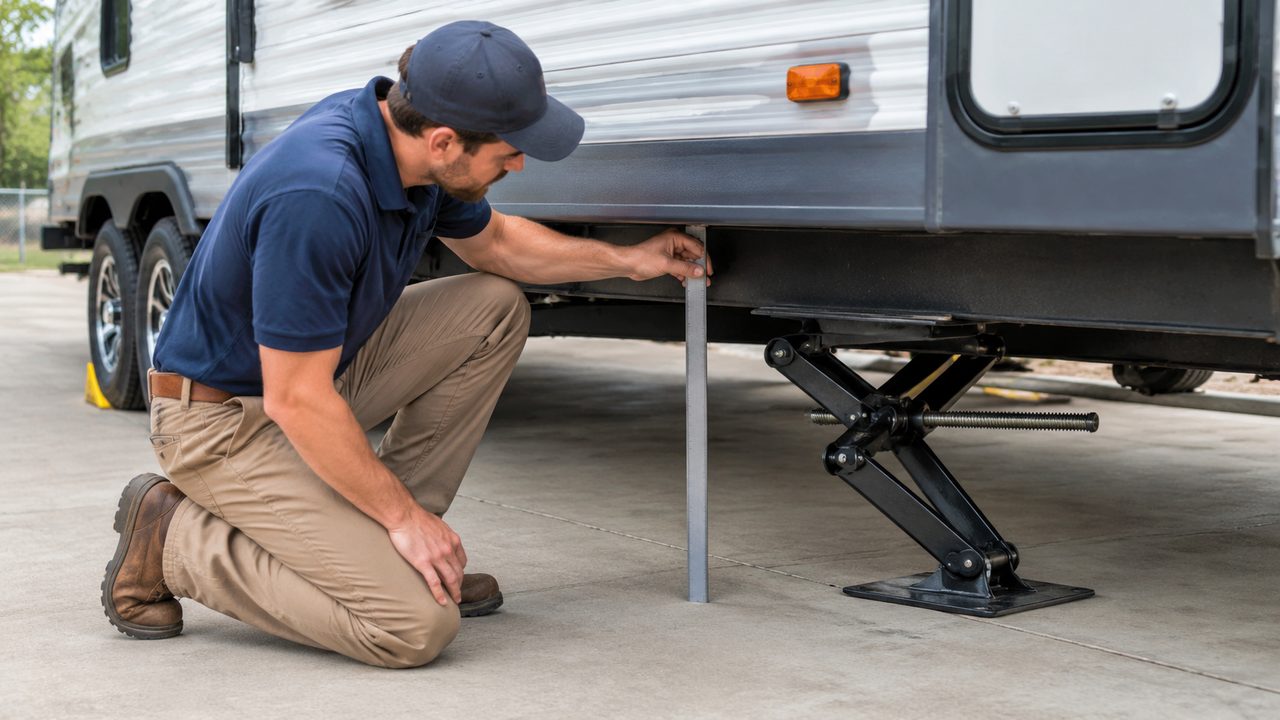
Measure the relevant mounting-plane-to-bearing-surface distance under the vehicle conditions specified for the assessment. State whether the measurement is to bare ground or to the top of an intended pad. Also record the vehicle setup and ground condition. A number taken on one driveway does not describe every campsite, and it should not silently become the maximum requirement for an entire fleet.
Nominal jack height, maximum extension and usable working range are different fields. Ask which dimension the advertised 24 or 30 inches represents, where its endpoints lie, and whether the manufacturer specifies operating restrictions within that range. Do not create a generic “safe percentage of extension” or reserve distance unless the applicable technical information supplies one.
| Fit-record field | What to record | What the supplier should confirm |
|---|---|---|
| Assembly identity | Brand, complete number, markings and photographs of the fitted unit. | The proposed replacement and any relevant version restriction. |
| Measurement endpoints | Named mounting plane and intended foot-bearing surface. | How those endpoints correspond to the product drawing. |
| Required operating range | Measured site cases and the vehicle setup for each observation. | Whether the proposed assembly meets those cases under its instructions. |
| Folded envelope | Available space around the retracted arms, foot and drive. | The complete retracted dimensions and any moving projection. |
| Interface and access | Mounting arrangement, nearby components and crank approach. | Compatible mounting details and a usable operating path. |
For a service desk, this record is more useful than asking the customer to choose a height immediately. It allows a missing dimension to remain an open item. If safe access or reliable identification is unavailable, arrange the appropriate inspection instead of turning an estimated photograph dimension into an approved specification.
A fleet can retain the record against the asset and installation position. Later orders then begin with a known configuration. The record should still be reviewed after changes to wheels, suspension, steps, plumbing or mounting brackets, because the original clearance observation may no longer represent the vehicle being serviced.
Read height and capacity as separate specifications
Current BAL product information provides a useful counterexample to the assumption that greater extension means greater capacity. Its Classic and Deluxe range lists a 24-inch standard assembly, a 24-inch Deluxe assembly and a 30-inch Deluxe assembly with different stated static capacities. The figures below belong to those identified products; they are not universal ratings for every jack sold at the same height. [1]
| BAL set / single-jack number | Listed type | Nominal extension | Listed static capacity per jack |
|---|---|---|---|
| 24002C / 24009 | Standard | 24 inches | 5,000 lb |
| 24002D / 24010 | Deluxe | 24 inches | 7,500 lb |
| 24003D / 24013 | Deluxe | 30 inches | 5,000 lb |
The procurement implication is straightforward: keep extension, capacity and intended use in separate columns. A 24 inch scissor jack is a size description, not a complete specification. The same applies to a 30 inch scissor jack. Neither phrase identifies the mounting pattern, folded dimensions, operating method or permission to apply a particular load to the vehicle.
Do not convert a component rating into a vehicle lifting claim
Ask what the published rating describes and how it applies to the quoted configuration. Multiplying a per-jack rating by four does not establish that the vehicle may be lifted on four corner supports. The vehicle structure, load distribution and permitted use remain separate questions. A static capacity field cannot supply missing information about those conditions.
Terminology also varies between manufacturers. Lippert’s scissor-jack support guidance states that its intended application is stabilization rather than leveling and that the assembly alone is not intended for tire service. BAL’s cited instructions describe their specified leveling and stabilization use while prohibiting lifting tires clear and tire-changing use. Carry the applicable instructions with the product instead of transferring one brand’s wording to another. [2] [3]
This distinction matters when a buyer searches for RV stabilizer jacks and receives quotations containing the word “leveling.” Require the supplier to identify the exact product and permitted function. A marketing category should not decide how a technician operates a support device or what the vehicle attachment can accept.
For OEM purchasing, include the intended task in the specification before comparing prices. A requirement for parked stabilization is different from a requirement for a vehicle leveling system. If the need is actually the latter, the selection should be reviewed at system level rather than solved by ordering a taller version of the existing corner component.
Keep each alternative on its own dimensional row
Lippert’s current 24-inch kit 285326 and 30-inch kit 285344 both list a 4-1/4-inch retracted height and a 5,000-pound rating per jack, while listing different maximum extensions. These examples show why each dimension needs its own field: two assemblies can share one folded dimension without every other dimension or application becoming identical. The listed shipping dimensions are not installation dimensions. [5] [6]
Keep a separate row for every quoted SKU, even when the supplier describes a product as belonging to the same series. Attach the relevant drawing or written confirmation to that row. If a catalogue mixes product dimensions, package dimensions and a general range description, identify which field is being used for the installation review. A value becomes useful when its meaning and application are clear.
For a deeper review of what a stated capacity actually demonstrates, consult the site’s trailer jack load-rating verification guide. That evidence review complements dimensional fit; passing one does not remove the need to complete the other.
Match the upper interface before deciding that a jack is interchangeable
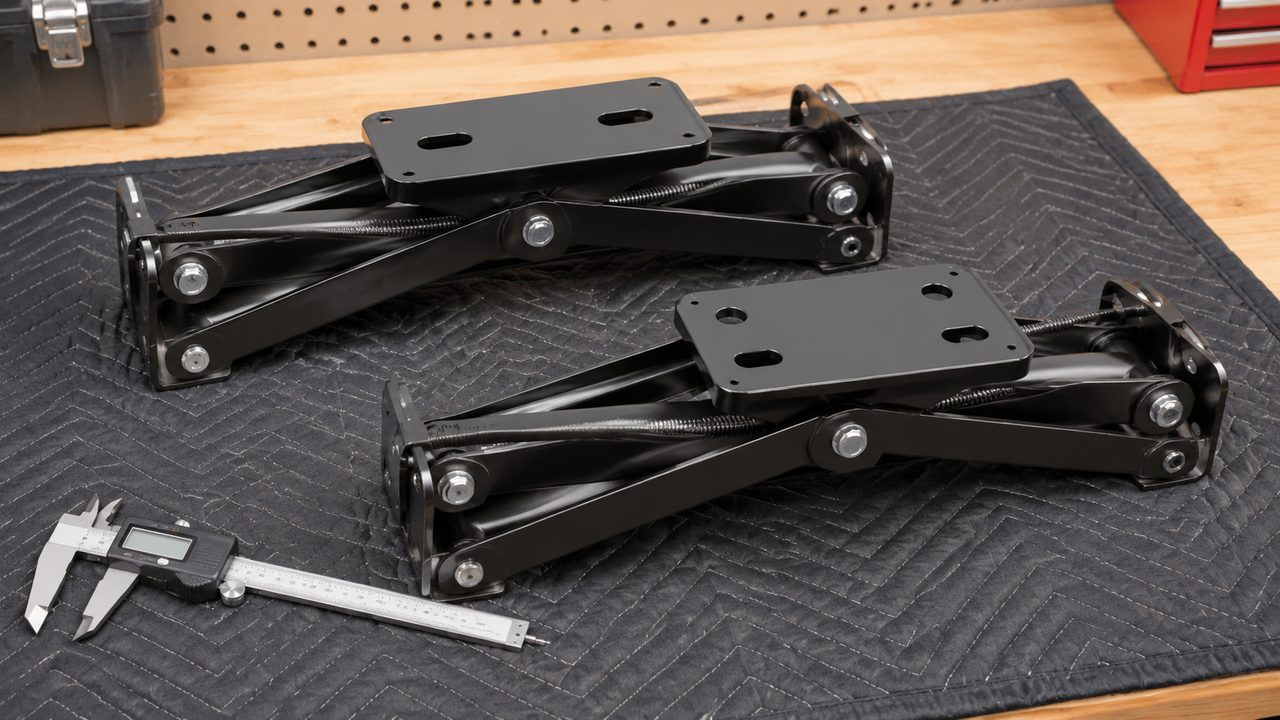
A compatible attachment requires more than a similar plate outline. Compare the correct product drawing with the actual mounting arrangement. Record hole locations from a defined reference, the available attachment surfaces and the surrounding structure. Confirm the supplied brackets and hardware instead of assuming that a single replacement jack includes everything supplied with a boxed pair.
BAL publishes a separate mounting-hole drawing for this product family. Its existence is a useful reminder that hole geometry belongs in the selection process. Use the drawing applicable to the quoted assembly and retain its identity in the order record; do not substitute an approximate grid reconstructed from a catalogue photograph. [4]
The published drawing distinguishes Classic and LoPro SJ24 arrangements. A shared hole-diameter label does not make their complete patterns interchangeable. Before using a drawing for a purchase decision, confirm its applicable model, units, revision and measurement references. Do not silently supply a missing unit or assume that two dimensions measured from different edges describe the same location. [4]
A matching hole is only one part of an acceptable connection
When comparing scissor jacks for RV applications, establish who is responsible for the vehicle interface. The jack supplier can identify its product dimensions and installation requirements. The RV manufacturer or authorized technical owner must address the relevant vehicle arrangement where that information is needed. Neither party’s silence should be recorded as approval by the other.
A plate that can be placed beneath a rail is not automatically a suitable mounting location. The purchasing record needs a supported connection, not simply a way to get fasteners through metal. This article deliberately gives no generic bolt grade, tightening torque, drilling pattern or weld detail. Those choices belong to the instructions and approved interface for the actual equipment.
For replacement work, distinguish an undisturbed original interface from a modified one. Earlier added spacers, elongated holes or an auxiliary bracket can change the meaning of “same as existing.” Photograph the complete connection and refer uncertainty to the appropriate technical owner. Ordering the same nominal height does not validate an earlier alteration.
Define what “replacement supplied” includes
Specify whether the quotation covers one jack, a pair, a crank handle, mounting hardware and any required brackets. Identify components that will be reused and the conditions for doing so. A lower unit price is difficult to compare if one offer contains a complete defined package and another relies on unlisted items from the removed assembly.
Dealers can make this clear with three order lines: purchased assembly, required companion items and retained items subject to acceptance. That structure exposes a missing bracket or handle before the vehicle reaches the service bay. It also prevents a purchasing assistant from treating two differently packaged offers as equivalent merely because both say “24 inch.”
If a supplier proposes an alternative to the original product, ask for the differences in the same record. A concise deviation list is easier to review than a general assurance of compatibility. Resolve changed dimensions, attachment details, operating methods and supplied scope before issuing the order, and preserve the accepted answer with the asset documentation.
Check the folded assembly through the transport space
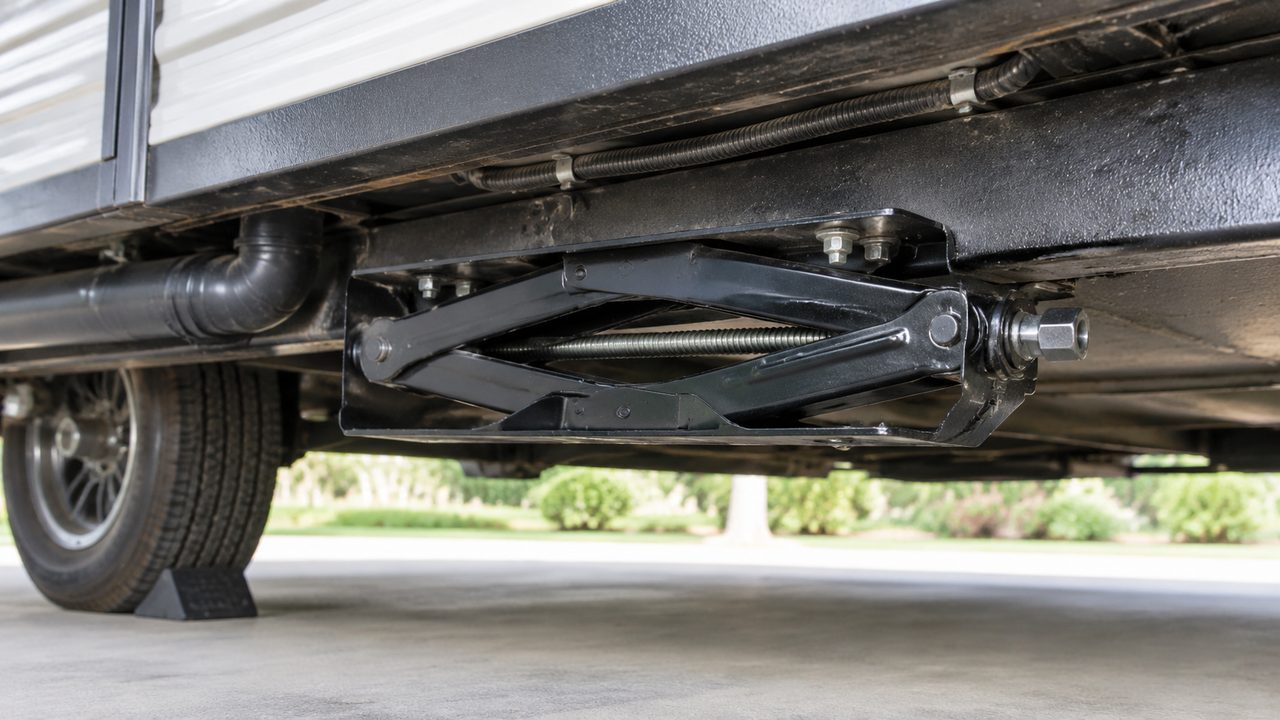
The tallest operating position often receives the most attention, but a replacement spends its road journey retracted. The full folded assembly therefore needs its own review. Consider the arms, lower plate, screw, drive end and mounting arrangement together. A single “closed height” value may leave a projection or change in horizontal length unexamined.
BAL’s installation instructions call for a closed-position trial and checks around under-chassis components, drive access and ground clearance. They also address projections relative to the vehicle’s approach and departure geometry. These are product-specific instructions, not a universal clearance dimension that can be applied to every RV. [3]
Review the movement, not just a still photograph
For a proposed RV scissor jack replacement, keep the retracted, moving and intended operating positions distinct. A component may clear a pipe when fully folded yet pass close to it during movement. Conversely, a jack that reaches its working position may not retract into the available space. The relevant review should follow the manufacturer’s prescribed process through the permitted range.
Record crank access from the user’s position. A drive end can remain visually exposed while a skirt, step or adjacent fitting prevents a practical handle approach. Include the handle and the operator’s hand in the access assessment. Do not assume a powered tool will solve a restricted approach; tool use and operating limits need separate product approval.
The transport check should also identify additions beneath the foot. An accessory that remains attached can become the lowest projection when the assembly is folded. A removable item needs a defined storage and pre-travel routine. Catalogue photographs showing a bare jack do not establish the transport envelope of the assembled package the customer will actually use.
For fleet records, mark the checked configuration explicitly. “Clears when retracted” is less useful than a note naming the jack, bracket and attached accessories that were present. If a later order changes one of those items, the team can see why the earlier observation may need review rather than assuming the approval follows the marketing name.
A supplier drawing can support this comparison, but it cannot describe every object already installed beneath the vehicle. Give the service team a place to record both catalogue dimensions and installation observations. The combination is what makes a replacement decision reviewable.
Keep the foot, pad and site condition in the same height calculation
The distance a jack must reach ends at its bearing surface. If a permitted pad sits beneath the foot, the pad top is the relevant surface for that setup. If the accessory changes, the geometry changes. Record the complete arrangement rather than treating the pad as an unrelated purchase made after jack selection.
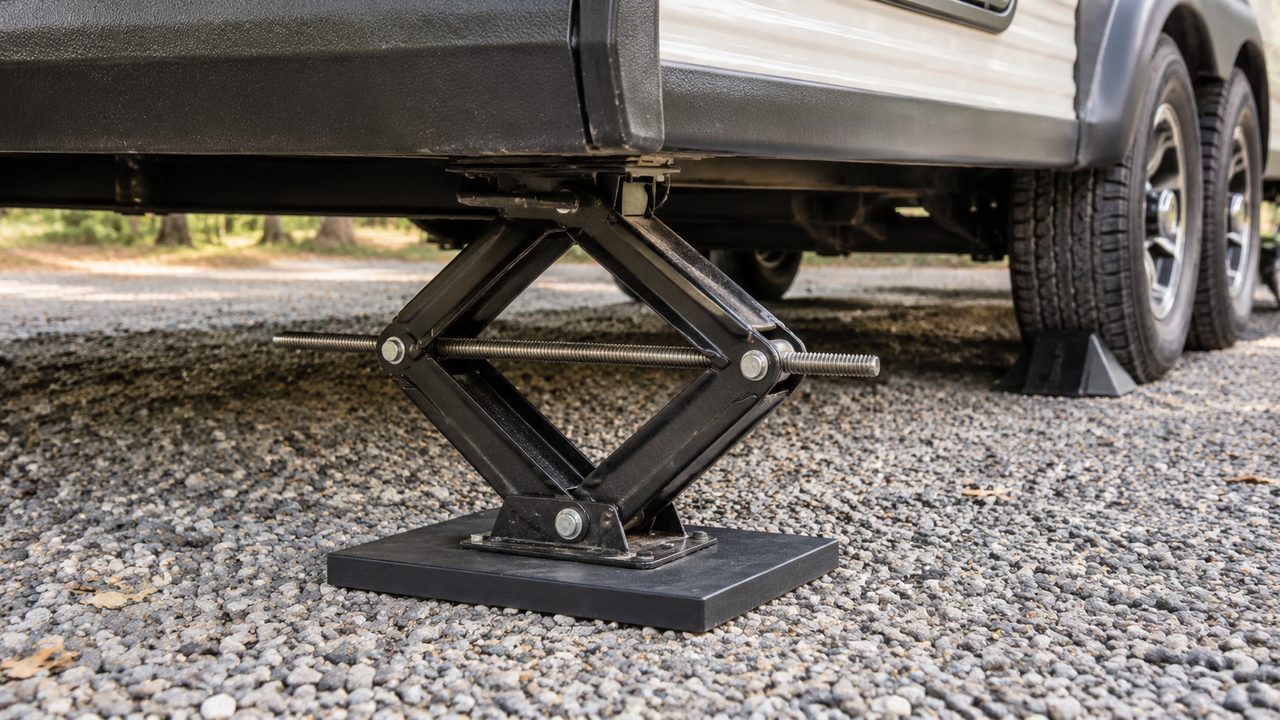
For camper stabilizer jacks, a ground-contact record can be simple: surface description, selected accessory, foot compatibility and the observed height requirement. It should also identify who confirms the accessory’s suitability. A large-looking pad does not establish its strength, and a hard-looking patch of ground does not prove that it will remain unchanged after rain or repeated use.
Additional reach does not correct an unresolved support surface
A longer assembly may reach a lower surface, but that fact does not resolve an unsuitable bearing area or an unapproved stack. Avoid purchasing extra extension as a substitute for understanding the setup. If a location cannot be accepted through the applicable instructions and site assessment, revise that setup through the responsible technical process.
Likewise, do not assume that a stack beneath the foot is interchangeable with a taller jack. The accessory arrangement introduces its own interfaces and conditions. Keep any restrictions on material, height, stacking and transport with the product information. If the proposed combination is not covered, obtain confirmation rather than inventing a general rule from another owner’s photograph.
For rental operations, define the supplied kit as the arrangement the customer receives. If customers are expected to provide their own ground accessories, that expectation affects the handover information. If the fleet supplies them, identify the correct items so that replacement stock preserves the checked configuration. A parts list is useful only when staff can tell which accessory belongs to which support arrangement.
Review site variation separately from product variation. One vehicle can encounter several ground clearances without changing its jack. A useful specification describes the cases the business actually needs to accommodate and records the limits of that decision. It should not imply that a single observation proves suitability for every future pitch.
Work a 24-versus-30-inch enquiry through a decision record
Consider the following original, hypothetical dealer enquiry. A customer requests a taller replacement after the existing support struggles to reach at one storage position. The dealer has not yet confirmed the current assembly or the proposed alternatives. The numbers illustrate how to organize the enquiry; they are not product specifications, installation allowances or recommended working limits.
| Illustrative observation | Recorded finding | Decision consequence |
|---|---|---|
| Usual parking arrangement | Mounting-plane-to-pad-top distance measured as 18 inches. | Compare this case with each candidate’s documented working range. |
| Second intended arrangement | The same defined endpoints measure 25 inches. | A candidate documented to extend only to 24 inches does not cover this stated case. |
| Potential taller assembly | The supplier offers a nominal 30-inch model, but its folded drawing is not yet supplied. | Additional advertised reach does not close the transport-fit question. |
| Existing attachment | The original bracket is identified; compatibility with the alternative remains unconfirmed. | Keep the interface open rather than authorizing installation. |
| Requested outcome | A supported replacement for both intended arrangements. | Release only after the application, geometry and supplied package are resolved. |
The first result is limited but useful. A documented maximum below a required distance excludes that candidate for the stated configuration. It does not prove that the taller alternative is suitable. The second result is an open technical enquiry about range, mounting, folded space and permitted operation.
The dealer can then compare legitimate options: a suitable taller assembly, a different approved support package or a revised parking arrangement. Those options need their own evidence. Raising the vehicle on an improvised stack or altering the attachment is not a justified shortcut merely because the original request mentioned more height.
Use three purchasing outcomes instead of a forced yes-or-no answer
Mark each candidate as acceptable for the defined configuration, excluded by a documented condition, or pending specific information. “Pending folded dimensions” is a useful result. It tells the buyer exactly what remains unresolved and prevents a quotation from being mistaken for an approved installation.
This approach also helps an importer compare trailer stabilizer jacks from multiple suppliers. A missing drawing is an information gap, while a known incompatible dimension is a technical difference. Keeping those outcomes separate allows the buyer to request evidence from one supplier without pretending that an unverified product has passed the same review as a documented candidate.
Do not turn the decision record into a scoring system that allows a critical mismatch to be averaged away. Attractive price, packaging or delivery time cannot compensate for an unsupported interface. Commercial comparison begins after the relevant technical conditions are met, using the actual quantities, accessory scope and availability for that order.
Order a configuration that service staff can recognize and release
For distributors, the long-term value of an accepted replacement lies in repeatable identification. Link the purchased item to its supported vehicle or assembly configuration, drawings and instructions. A stock label containing only height and capacity can be insufficient when several products share those numbers but differ in brackets, folded length or included hardware.
Separate the product, package and installation records
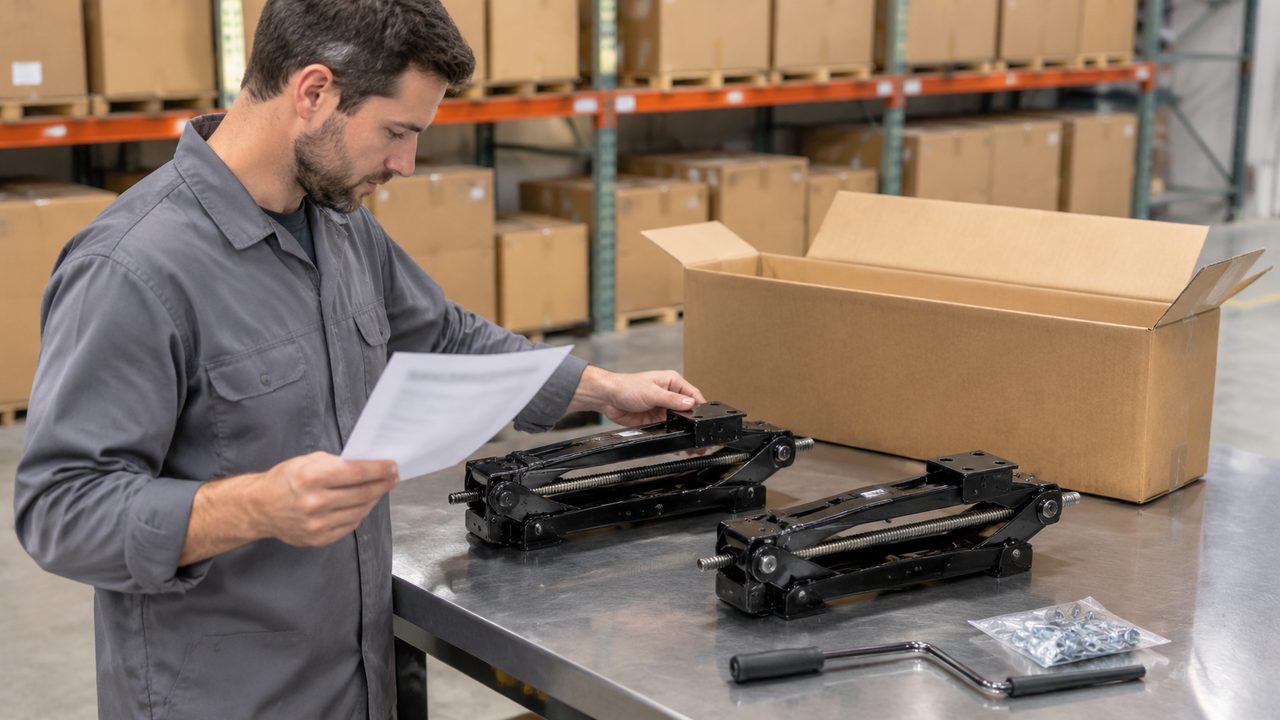
The product record identifies the jack and technical information. The package record identifies whether the sale contains a single unit, a pair, a handle and companion hardware. The installation record identifies the actual vehicle position and any approved configuration details. Keeping those records connected makes ordering easier without collapsing three different questions into one stock description.
When stocking scissor stabilizer jacks, preserve supplier part numbers and accepted alternatives. If a component is superseded, retain the former number and any conditions attached to the new one. Staff should be able to explain whether a substitute changes only packaging or requires another compatibility review.
A concise order request can state: “Please confirm the replacement for the identified assembly and vehicle position. Provide the current dimensional drawing, mounting details, permitted operating range, capacity description, matching instructions and complete supplied scope. Identify differences from the existing configuration and any items that must be purchased separately. Do not treat nominal height alone as confirmation of compatibility.”
The site’s broader trailer jack RFQ checklist can help purchasing teams carry that technical definition into quantity, delivery and supplier-response fields. Keep the accepted specification available to the person receiving the goods, so the warehouse can distinguish a correctly identified shipment from a carton carrying only a familiar size description.
Make the handover specific to the accepted assembly
After the prescribed work and verification, record what was installed and what was checked. Include identification, relevant accessories and the applicable procedure. A successful movement observed in one condition establishes only that recorded result; it should not be described as proof of every possible site, load or operating state.
Give the customer the appropriate instructions and explain how the supplied configuration is identified. A fleet handover should also show where removable accessories are stored and which pre-travel checks belong to the equipment. Keep these directions consistent with the actual product rather than copying instructions from a different jack merely because both use a scissor mechanism.
Commercially, this supports more useful feedback. A return described as “wrong height” could involve inadequate reach, a mismatched bracket, an unexpected folded projection or a misunderstanding of intended use. Recording the original configuration lets the business investigate the actual difference and improve future quotations instead of simply adding taller products to stock.
Focused FAQ
Is a 30-inch model always an upgrade over a 24-inch model?
No. More nominal extension can address a documented reach requirement, but compatibility also depends on the working range, attachment, folded envelope, access and permitted application. A taller product should be evaluated as a different assembly, not assumed to be a direct upgrade.
Does a higher extension number mean a higher capacity?
No. The BAL product examples in this guide show why the two fields must be read separately. Confirm the stated rating for the exact product and configuration, then keep that rating distinct from vehicle-interface approval and permission to lift or adjust the vehicle.
How should I measure the height I need?
Use the endpoints specified for the installation assessment and record the vehicle setup. Name the mounting plane and intended bearing surface, including the top of any permitted pad. Compare those measurements with the corresponding endpoints and operating information in the candidate’s current drawing.
Can I order by matching the existing mounting holes?
Hole correspondence is one check. The mounting arrangement, required hardware, supporting vehicle structure, folded space and operating access also need to match. Existing alterations should be identified rather than accepted automatically as part of the original approved installation.
Can the replacement be used to change a tire?
Do not infer a tire-service function from a component capacity label or its scissor shape. The cited BAL and Lippert information imposes specific limits. Use the vehicle’s applicable tire-service procedure and suitable equipment instead of transferring a parked-support rating into a lifting authorization.
Why does a jack that reaches the ground still fail the fit review?
Reach answers only one geometry question. The assembly may interfere while moving, project too far when retracted, lack usable crank access or require an unsupported attachment. The accepted configuration must satisfy all relevant conditions rather than passing on maximum extension alone.
Should all four corners use the same replacement?
Follow the requirements for the vehicle and support arrangement. Do not assume either that mixed assemblies are acceptable or that every corner is geometrically identical. Identify each position, preserve the intended system configuration and obtain the necessary confirmation for proposed differences.
What should a business retain after the order is complete?
Keep the purchased part and package identities, accepted drawings, instructions, compatibility response and installation record. Include any accessory conditions and supplier substitution restrictions. That creates a usable starting point for repeat orders, customer support and later configuration changes.
Sources and technical references
These first-party references support the identified manufacturer examples and application limits. The fit record, enquiry method and numerical selection exercise are original editorial analysis. The example measurements are hypothetical and do not establish a universal installation rule.
- BAL: Classic and Deluxe Scissors Jack, 24 or 30 inches. Current product identities, nominal sizes and listed static-capacity examples.
- Lippert: Scissor Jacks support resources. Manufacturer-specific stabilization and tire-service boundaries.
- BAL: Leveling Scissors Jack Installation and Operating Instructions. Identified product applications, vehicle-interface concerns and closed-position clearance checks.
- BAL: Mounting Hole Dimensions. Manufacturer drawing to consult for the matching assembly; no hole grid is inferred from a product photograph.
- Lippert: 24-inch Manual Scissor Jack Kit, 285326. Current product dimensions and rating for this identified kit.
- Lippert: 30-inch Manual Scissor Jack Kit, 285344. Current product dimensions and rating for this identified kit.


