
Trailer Jack Repair or Replacement: How to Match Handles, Gears and Rebuild Kits
Should you repair the trailer jack or replace the complete assembly?
Choose trailer jack repair when the fault has been identified, the manufacturer supports the proposed repair, the correct parts are available, and the remaining assembly is fit for service. Choose a compatible replacement when the structure or mounting cannot be accepted, the mechanism is not serviceable through an approved method, or repair no longer offers a practical route back to use. The price of a handle or gear kit cannot answer those questions by itself.
A useful decision has three gates: establish what failed, confirm what can be repaired, then compare the complete repair and replacement scopes. Passing the first gate does not guarantee the second. A damaged handle might be an isolated service item, or it might be evidence that somebody applied extra force to a binding mechanism.
For owners, this approach reduces wrong-part orders. For dealers and rental fleets, it separates a recoverable service issue from a unit that should remain out of operation. For OEM buyers, it makes spare-parts support part of the original equipment specification instead of a problem discovered after production has moved to another model.
Current manufacturer catalogues demonstrate that service parts exist for selected designs. Lippert lists handles, wheels, feet, internal gears and other identified parts. Fulton offers a specific F2 gear kit. Those examples support a model-by-model service strategy; they do not establish that all trailer jacks can be rebuilt or that a similar-looking component is interchangeable. [1] [2]
Start the parts search with the jack, not the trailer's description
A trailer's make, year and general category help a dealer locate records, but they may not identify the jack currently fitted. A previous owner could have installed another assembly, a manufacturer could have changed suppliers during production, or a fleet workshop could have replaced only part of a system. The actual component needs its own identity.
Before ordering trailer jack parts, collect the brand, complete model or part number, capacity marking, operating style and mounting arrangement. Photograph the identification marking and the complete installed unit from safe positions. Keep a separate close-up of the failed item. A close photograph of a broken handle without the surrounding jack can hide the feature that distinguishes one version from another.
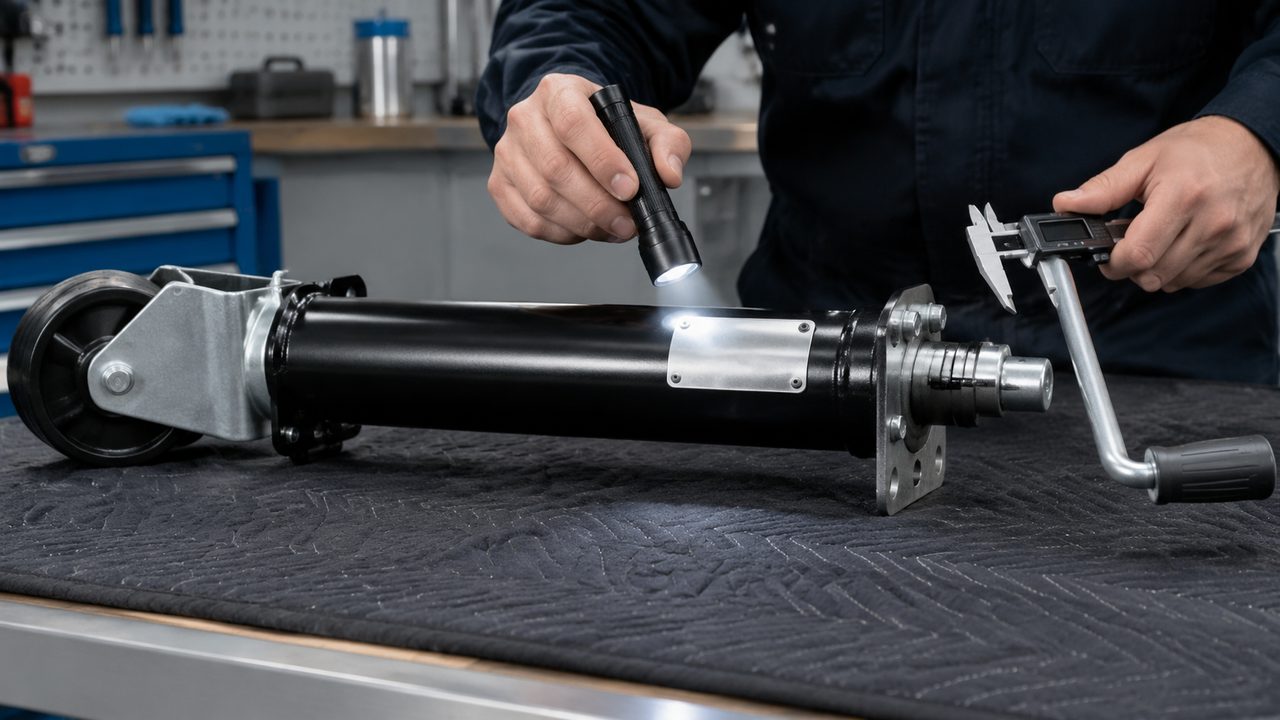
Use a short identity record that a supplier can act on
| Record item | What to provide | What it helps resolve |
|---|---|---|
| Jack identity | Manufacturer, full model or assembly number, markings and any revision information. | The correct parts diagram and service instructions. |
| Installed configuration | Top-wind or side-wind, electric or manual, mount type, foot or wheel. | Which variant is actually present. |
| Complaint | The first abnormal event and the conditions when it occurred. | Whether the requested part addresses the original fault. |
| Failed item | Photographs, diagram item number and retained sample where available. | Component identification without relying on a broad name. |
| Previous work | Earlier replacements, modifications, impacts and unusual operating force. | Whether the assembly still matches its original specification. |
| Requested confirmation | Part number, compatibility, required companion items and service method. | A reviewable supplier response. |
Do not treat a missing label as a reason to select the nearest catalogue photograph. Ask the supplier how the unit can be identified and what additional features or measurements are needed. If identification remains uncertain, the purchasing record should preserve that uncertainty rather than turn an estimated model into an established fact.
For a workshop managing several brands, attach the identity record to the trailer asset number. This avoids repeatedly describing the same jack during later calls. It also prevents an approved spare for one trailer being issued to another merely because both trailers have the same colour, body size or advertised tongue capacity.
The appropriate question is often more specific than “Will this fit my trailer?” Ask, “Is this the approved replacement for item X in assembly Y, including the version shown in these photographs?” A useful answer should identify the component and any conditions. A generic statement that a listing is not vehicle-specific does not establish compatibility with every jack.
A replacement handle must match the drive and clear the installation
The trailer jack handle is an accessible service item, so it is easy to underestimate its specification. The grip, crank arm, shaft connection and retention hardware perform different jobs. A replacement that appears to attach may still have the wrong offset, interfere with nearby equipment or omit a required retaining component.
First identify whether the complaint concerns a loose grip, a bent crank arm, a damaged shaft interface or resistance inside the jack. These observations lead to different parts requests. A handle that turns without producing movement is not automatically a handle failure; the drive connection and mechanism need to be assessed through the applicable service procedure.
Separate attachment fit from operating clearance
Attachment fit concerns the shaft interface, hole position, retained length, fastener or pin and the method specified for assembly. Operating clearance concerns the path swept by the handle and the user's hand. Both need to be checked. A crank that fits on the bench can strike a propane-cylinder cover, toolbox or trailer body once installed.
Record the required handle swing and the space available through a complete permitted operating cycle. Account for the grip, not only the metal arm. If the original installation already had interference, copying the original part may restore the previous problem. That situation calls for a review of the equipment arrangement rather than an improvised bend in the new handle.
Longer handles also change the force that can be applied to the mechanism. Do not select extra length as a remedy for unexplained resistance. Resolve why normal operation has become difficult, and use the handle configuration approved for the jack. Increasing available leverage can conceal an obstruction while transferring higher forces to another component.
For purchasing, specify the supplied scope. Does the order include the grip, crank arm, pin, fastener, bushing or other hardware required for that model? An attractive unit price becomes less useful if the repair cannot be completed because a small retained item was assumed to be reusable and turns out to be damaged.
A dealer can keep this exchange efficient with one marked photograph and a parts-diagram reference. The customer does not need an engineering drawing for every grip replacement. The supplier does need enough information to confirm that the requested item belongs to the actual assembly and can be fitted through the prescribed method.
Evaluate the gear kit as a complete service package
A trailer jack repair kit should be selected through the assembly identity and approved parts information. Its value comes from the components and instructions needed for a defined repair. The word “kit” does not guarantee that every worn item in the jack is included, and it does not establish that the remaining components are acceptable.
Fulton's F2 kit 500314 provides a useful example. The official listing identifies a shim washer, straight pin, groove pin and washer in its supplied description, alongside its F2 gear-kit identity. The page also explains that the listed components work together. Its published package dimensions are explicitly shipping dimensions; they should not be used as installation measurements. [2]
Ask what is included, what is reused and what must be inspected
A complete quotation should distinguish the new components from the items retained in service. If a kit renews a gear and its retaining parts but reuses a shaft, bearing or housing, the inspection of those reused items remains part of the repair decision. A new gear cannot establish the condition of the rest of the drive.
The useful inquiry about trailer jack gears therefore includes the matching shaft arrangement, retention, bearing support and lubrication requirements described for the assembly. Visual similarity or a matching outside diameter is inadequate evidence of interchangeability. Do not convert a catalogue search into an attempt to reproduce an unverified gear arrangement from approximate measurements.
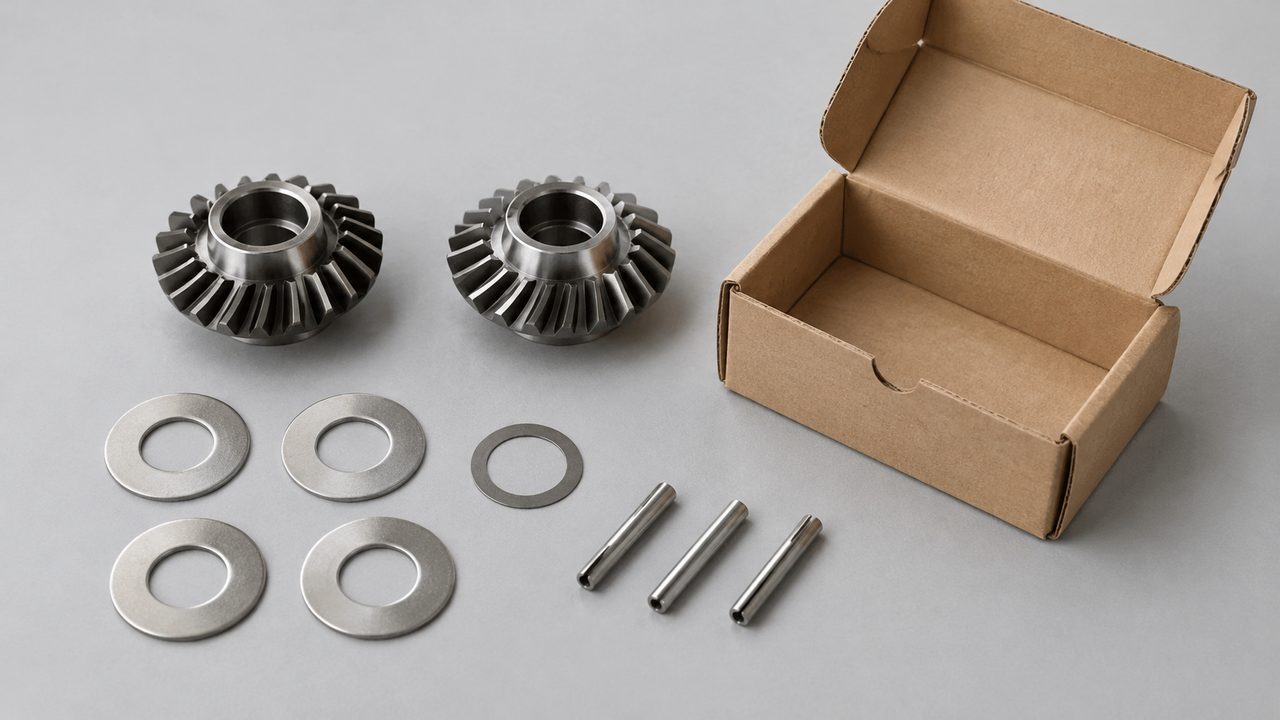
Use the manufacturer's parts diagram to identify component relationships. A small washer may control a position that is not obvious from an assembled photograph. A pin may be a specified retained item rather than a convenient piece of hardware. If the service instructions require a new component, confirm that it is supplied instead of substituting something that happens to pass through the hole.
Keep removed parts together with their work order until the service decision is complete. Mixing parts from several dismantled units can destroy the evidence of how each assembly was configured. A workshop tray labelled with the asset and assembly identity is a simple way to preserve that link without creating an elaborate record system.
Use catalogue language carefully
A customer searching for Fulton trailer jack parts may reach several products within the same brand. The brand narrows the search, but the actual jack model and service part remain necessary. An F2 kit name should not be extended to a different Fulton mechanism solely because both assemblies support a trailer tongue.
Likewise, “universal vehicle fit” and “not vehicle specific” usually answer a different catalogue question from “compatible with this jack assembly.” Read the detailed application statement, compare the part number and obtain confirmation where needed. The broad fitment label does not erase the specific product description beside it.
For importers and private-label buyers, request an equivalent level of definition from the original supplier. An internal factory part code can be usable if it is tied to the supplied assembly revision and maintained through changes. A description such as “standard gear set” without an application link leaves the distributor carrying the compatibility risk.
Pins, mounts and retaining rings are not one interchangeable category
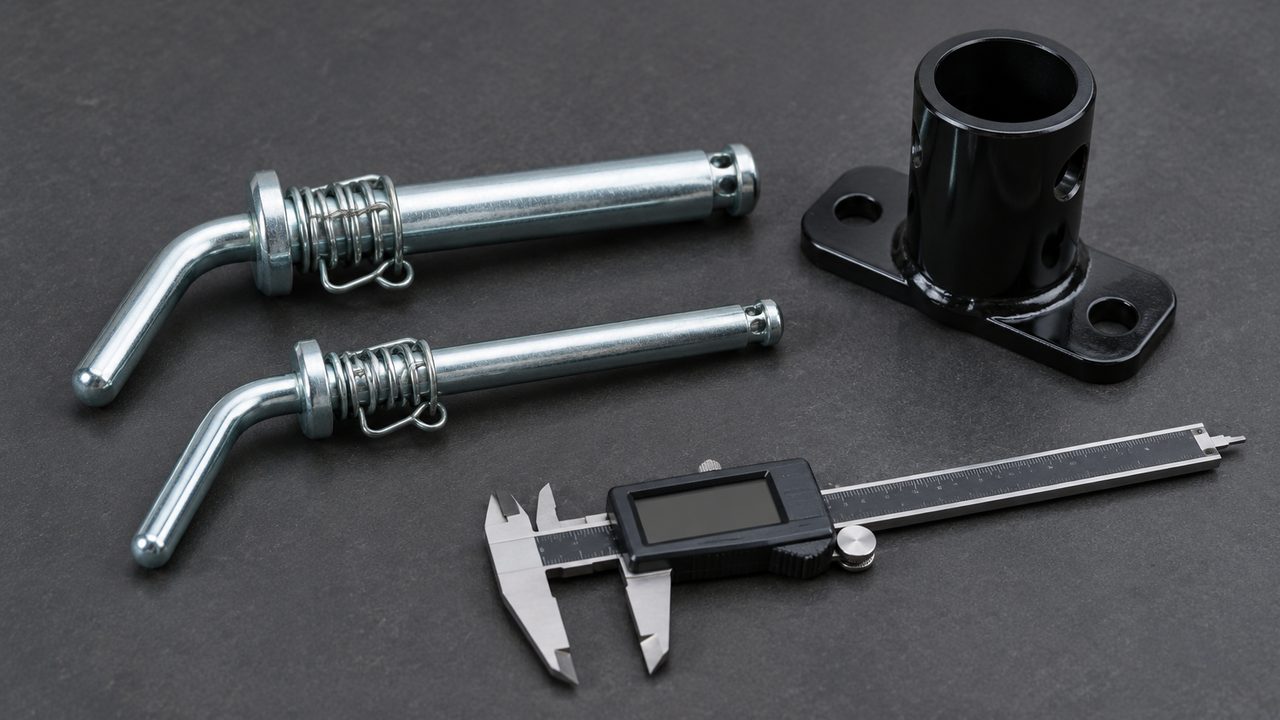
Small hardware can decide whether an otherwise functioning jack remains correctly attached and locked. A pivot pin, a swivel plunger, a drop-leg pin and a snap ring have different functions. A parts counter should identify which connection is involved before discussing diameter or price.
BULLDOG's tongue-jack instructions distinguish these retention arrangements and give different engagement requirements for them. This supports a practical rule for the intake record: name the function and exact assembly, not simply “the jack pin.” The instructions for the particular product still govern installation, engagement and replacement. [3]
A same-brand example shows why series names are not enough
Two current BULLDOG mount listings illustrate the problem. Part 0152730300 is described for a 9/16-inch pin and series 150 and 170 jacks. Part 500240 is described as a tubular male weld-on mount for a 5/8-inch pull pin and series 170 jacks. The series overlap does not make these two interfaces identical. [4] [5]
This is a parts-identification example, not permission to substitute one pin size for the other or alter a mount. When looking for BULLDOG trailer jack parts, ask for the assembly-to-mount compatibility and the complete supplied hardware. A general brand match is only the beginning of that check.
For retaining hardware, inspect the receiving feature as well as the removable item under the prescribed service method. A replacement ring does not establish that its groove is undamaged. A new locking pin does not establish that the holes and surrounding structure are acceptable. The component that is easy to order may not be the only component requiring attention.
Do not solve an unidentified mismatch by enlarging a hole, grinding a pin, welding an improvised stop or adding unapproved spacers. Such changes can alter the load path or retention arrangement. The technician and supplier need to establish whether the correct service part, a supported subassembly or a complete replacement is appropriate.
A useful stock label identifies function, part number and application. “Drop-leg pin for assembly Y” is more useful than “large trailer pin.” It also reduces the chance that hardware with a similar appearance is moved between a jack, coupler and vehicle receiver without understanding the different connection involved.
Confirm the fault before authorizing internal work
A request for trailer jack replacement parts sometimes arrives before anyone has established the failure. The customer hears a click, sees the light work, or notices the handle feels different and asks for a motor or gear. A professional service process should retain those observations while testing the proposed explanation.
For an electric unit, confirm the power source and circuit condition through the matching service procedure before condemning the internal mechanism. The existing electric trailer jack voltage drop testing guide explains the electrical comparison in detail. A parts order should follow the finding rather than substitute for it.
Make the service boundary visible
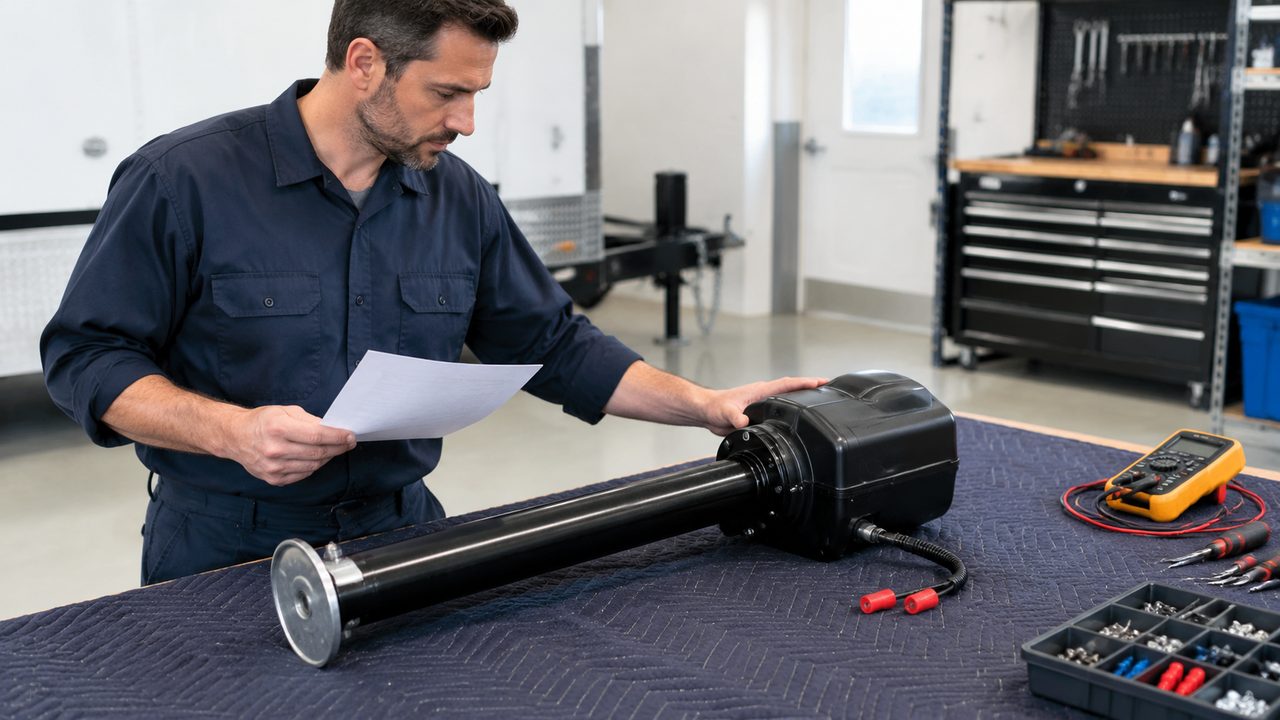
Before removing or dismantling a jack, establish the trailer's independent support and the required isolation procedure. The jack cannot be used as its own safe service fixture while its load-carrying components are being disturbed. This article does not supply a universal support layout; the correct arrangement depends on the trailer, work area and approved procedure.
On a suitably prepared bench, the technician can follow the model's inspection sequence and identify what must be replaced, retained or referred to the manufacturer. Preserve the difference between an observed damaged item and an assumed cause. A worn component may explain a symptom, while the reason it deteriorated could involve load, interference, maintenance or another condition still requiring correction.
Fulton's cited instructions require replacement of bent, broken or worn parts and prohibit modifications outside their stated instructions. These limits help define the decision boundary. They do not authorize straightening a damaged structural part or drilling a new attachment because a rebuild kit is available. Match the service scope to the actual product and current supplier guidance. [6]
Record what a successful check actually demonstrates
After repair, carry out the manufacturer's required assembly and functional checks. A brief unloaded movement can establish only what was observed under that condition. It does not by itself establish the assembly's suitability for every load, installation or operating state. The release record should identify the applicable procedure and the conditions of the check.
Include retention, operating clearance, supplied accessories and transport configuration where relevant. A mechanism that moves smoothly but lacks the correct retained hardware has not completed a meaningful return-to-service review. Equally, a repaired electrical control does not resolve a separate mounting defect discovered during the same work order.
For warranty analysis, state whether the cause was confirmed. “Drive pin damaged; associated shaft inspected under procedure X; specified parts renewed” is more informative than “rebuilt.” Where the original fault was not reproduced, preserve that result. A clear record supports further investigation if the complaint returns.
Compare the complete repair and replacement jobs
The choice of trailer jack replacement should account for the installed assembly, not only the price of a boxed jack. A replacement can require mounting hardware, a different foot, electrical work or a clearance review. A repair can require diagnostic time, companion components and a service check. Compare both options with the same boundary.
The following example is an original purchasing exercise. The prices and labour times are invented to show the method; they are not supplier quotations, market averages or guaranteed repair times. Both options assume that the proposed work is technically acceptable and can use the same workshop labour rate.
| Illustrative cost item | Approved repair | Compatible complete replacement |
|---|---|---|
| Main purchased item | $45 service kit | $150 complete jack |
| Required companion hardware | $12 | $12 |
| Work at an assumed $80 per hour | 1.4 hours: $112 | 0.7 hours: $56 |
| Verification at the same assumed rate | 0.3 hours: $24 | 0.3 hours: $24 |
| Freight allocated to this job | $14 | $14 |
| Illustrative total | $207 | $256 |
In this example, a $105 difference between the main purchased items becomes a $49 difference between the complete jobs. The calculation does not decide the repair. If inspection reveals an unacceptable housing or unsupported modification, the assumed repair scope no longer applies. The technical gate comes before the cost comparison.
Availability also matters. Record the earliest realistic return-to-service date for each option, including confirmation and delivery time. Avoid turning downtime into a speculative large number solely to justify the preferred purchase. If the fleet has a measured dispatch impact or an available spare trailer, use those actual conditions.
A workshop with a repeatable repair process may reach a different economic decision from an owner buying tools for one job. A welded installation may also change replacement scope. The useful result is a comparison tied to that installation and service capability, rather than a universal rule that repair is worthwhile below a fixed percentage of new price.
When complete replacement is selected, use the site's replacement trailer jack measurement guide for the dimensional review. Verify required duty and accessory limits separately through the trailer jack load-rating verification guide. A convenient fit does not establish the required capacity.
Build a spare-parts programme around supported configurations
For dealers and fleets, the largest improvement often comes from reducing uncertainty before a failure. Link each stocked service item to the assemblies it supports, retain the relevant parts information and define who approves a substitute. This makes a small inventory more useful than a large collection of unverified components.

Begin with the installed base. Count the jack models actually in service and distinguish revisions where the supplier identifies a difference. Then examine the service history: which parts have confirmed failures, which are lost during use, and which orders were wrong because identification was incomplete. Do not stock every catalogue item simply because it is inexpensive.
Separate consumable availability from repair capability
Having a handle, pin or gear kit on the shelf does not establish that every branch is equipped or authorized to fit it. Define which work can be performed locally, which needs the central workshop and which requires supplier involvement. Include the inspection and verification capability in that decision.
For an OEM supply agreement, ask how service information follows a production change. If a shaft or gear is revised, determine whether old and new parts remain interchangeable, whether a complete kit is required, and how the change is communicated. A purchase order using only the same marketing name can miss a meaningful configuration change.
Request identifiable spare packaging and a clear application reference. Where the supplier offers a superseding part, retain the relationship between the former and current numbers and any fitting conditions. Do not erase the old number from the record if it is still printed on equipment in the field.
Write a parts inquiry that exposes missing information
A concise request can say: “Please confirm the service part for the attached jack assembly and identification marking. The observed fault is described in the work-order notes. Identify the applicable part number, any revision restriction, the complete kit contents and items that must be ordered separately. Please also provide the matching service instructions, the inspection requirements for reused components and the verification required before release. If the original item has been superseded, state the replacement relationship and any installation conditions.”
This wording gives the supplier a defined question without pretending that the buyer has already diagnosed every internal component. It also creates a useful purchasing boundary: an alternative is acceptable for review when its application and conditions are stated. A statement that two parts look alike, share a capacity number or have been supplied to other customers should not close an unresolved compatibility question.
A practical minimum stock record contains the spare part number, supported assembly, required companion items, service-document revision and replenishment owner. For a kit, record whether issuing one unit supplies the whole job or whether another item must be issued separately. This prevents a technically correct main component arriving without the hardware needed to finish the repair.
Review the programme using confirmed outcomes. Useful internal measures include wrong-part returns, repeat complaints after repair and the time spent identifying the installed unit. These are proposed management measures, not published industry benchmarks. Their purpose is to show whether better identification and supplier support are making service work more reliable.
Focused FAQ
Can every trailer jack be rebuilt?
No. Serviceability depends on the design, manufacturer support, available components and condition of the remaining assembly. A catalogue containing a repair kit for one model does not establish that another jack can use it. Confirm the exact unit and proposed service scope before ordering or dismantling anything.
Can I buy a handle by matching its overall length?
Overall length is only one feature. The drive interface, retention, offset and installed swing clearance also matter. Identify the jack and the failed handle component, then confirm the appropriate replacement. Extra handle length should not be used to compensate for unexplained mechanical resistance.
Does a universal fit label mean a gear kit fits any brand?
No. A broad vehicle-fit label does not establish interchangeability between jack mechanisms. Use the detailed application, assembly number and supplier confirmation. A kit should be matched to the specified repair and include any required companion components.
Why should I order pins and washers when only the gear looks damaged?
The manufacturer's specified repair scope determines which components must be renewed or inspected. Small parts can control retention or component position. Confirm the kit contents and fitting instructions rather than assuming every removed item can be reused. Visible gear damage also does not establish that the surrounding mechanism is healthy.
Can a new locking pin correct a worn swivel mount?
A new pin cannot establish the condition of the mount and its receiving features. The complete interface needs assessment under the relevant instructions. Identify the pin's function, exact assembly and permitted service parts; do not enlarge holes or substitute a different diameter as an improvised repair.
Should a noisy electric jack receive a new gearbox immediately?
Start with the first abnormal response and follow the model's diagnostic procedure. Electrical supply, loading, travel position and mechanical condition can affect behaviour. A sound alone is not a complete parts diagnosis. Record the finding that supports the proposed replacement.
What if the original part number is no longer sold?
Ask the manufacturer or authorized supplier for a documented superseding part or assembly and any conditions attached to it. Preserve both identities in the service record. If no supported repair path exists, compare a suitable complete replacement after checking mounting, clearance, duty and accessories.
Is repair always cheaper than replacing the jack?
No. Compare parts, companion hardware, diagnosis, labour, verification, freight and actual availability for the complete job. Technical acceptability comes first. The cheapest kit is not an economical solution when the remaining assembly cannot be accepted or the required service cannot be performed properly.
What information should a B2B supplier provide before a spare-parts order?
Request an exact part number linked to the supported assembly, kit contents, required companion items, applicable instructions and any supersession conditions. Include availability and the technical contact for uncertainty. That gives the buyer a defined service package rather than a component selected mainly from its photograph.
Sources and technical references
Manufacturer references support the identified product examples. The identity record, purchasing calculation and spare-parts programme are original editorial analysis. The numerical cost example is illustrative. Match all service work to the actual equipment and applicable instructions.
- Lippert: Trailer Jack Replacement Parts. Current first-party catalogue showing different types of identified service components.
- Fulton: F2 Gear Kit, part 500314. Specific kit identity, listed companion items and shipping-dimension distinction.
- BULLDOG: Tongue Jack Installation Instructions. Distinct retention arrangements and model-dependent engagement requirements.
- BULLDOG: Weld-On Male Swivel Mount, part 0152730300. Listed 9/16-inch pin application for series 150 and 170.
- BULLDOG: Tubular Male Weld-On Mount, part 500240. Listed 5/8-inch pull-pin application for series 170.
- Fulton: F2 Trailer Jack Installation Instructions, F3576 Rev D, August 2012. Manufacturer-hosted instructions addressing damaged parts and limits on modifications; not a new 2026 standard.


