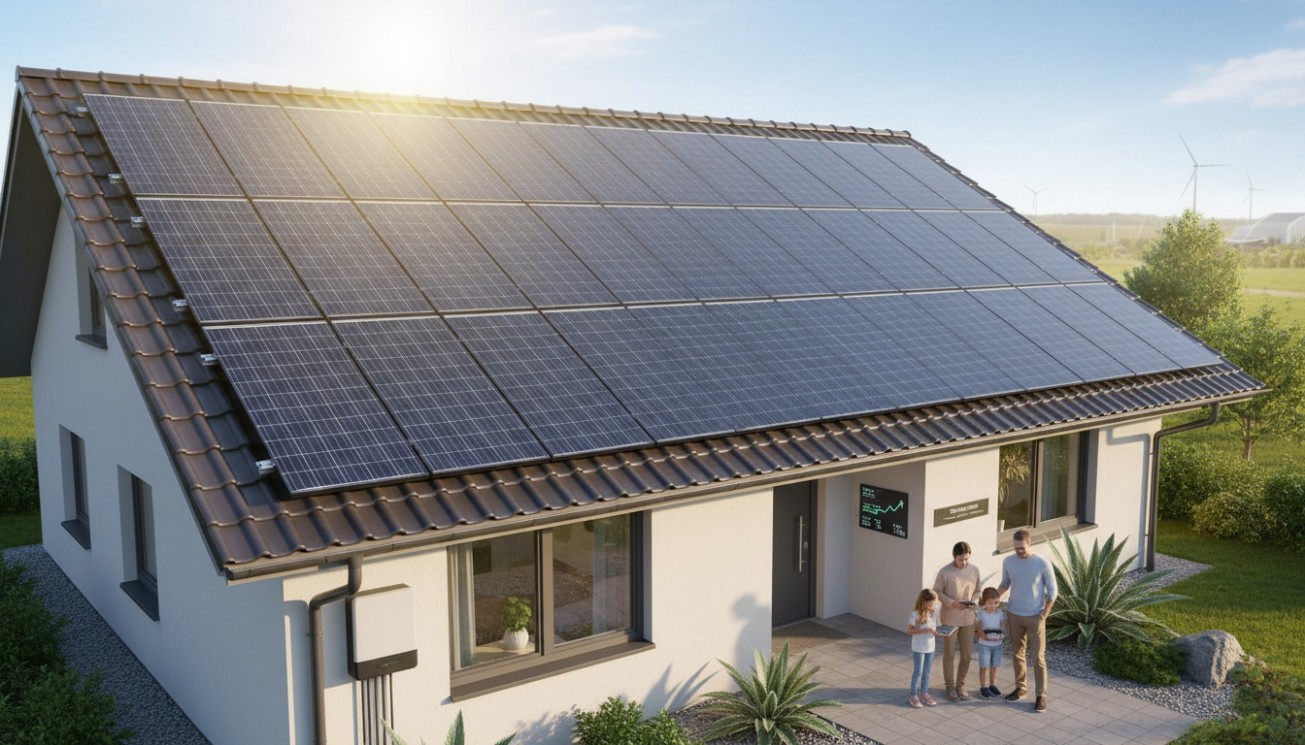
How to Choose PV Modules for a Residential Rooftop Solar Project
A Residential Rooftop Solar Project Starts with the Roof, Not the Module
Many homeowners begin a solar project by asking a simple question: which solar panel is the best? That question sounds logical, but it often starts the decision from the wrong place. For a residential rooftop project, the first question should not be about the brand, wattage, or cell technology of the panel. The first question should be about the roof.
A home roof is not a neutral platform. It has shape, age, direction, slope, structure, obstacles, shading, fire access needs, weather exposure, and visual importance. These factors decide what kind of residential rooftop solar system can actually be installed. A module that looks excellent on a datasheet may not be the best choice if it is too large for the roof planes, difficult to handle on a steep slope, visually disruptive, or poorly matched with the inverter architecture.
This is why roof solar panel selection must be treated as a project design decision rather than a product comparison exercise. The right module is not always the highest-wattage module. It is the module that can be arranged efficiently on the available roof area, maintain safe installation spacing, match the electrical design, meet local code expectations, satisfy the homeowner’s appearance requirements, and perform reliably over many years.
For installers, distributors, and B2B buyers, this distinction is very important. Residential solar projects are repeated in small roof-specific designs. Unlike utility-scale projects, where a large number of identical modules can be deployed across an open site, a residential installer may face different roof geometry every day. One home may have a simple south-facing roof. Another may have dormers, skylights, vent pipes, a chimney, tree shade, and multiple roof planes. If the module size and product package are not suitable for these variations, installation efficiency and customer satisfaction can quickly decline.
A professional residential PV module selection process should therefore begin with roof reality. The module should follow the project, not the other way around.
The First Layer: Understanding Usable Roof Area

The total roof area and the usable roof area are not the same thing. This is one of the most common misunderstandings in residential solar planning. A homeowner may look at a roof and think there is enough space for many panels, but the actual usable area may be reduced by roof edges, ridges, valleys, chimneys, vents, skylights, dormers, satellite equipment, shading zones, walkways, local fire access rules, and safe mounting margins.
For a rooftop solar project, usable area is the space where modules can be installed safely, legally, and productively. This area should be measured by roof plane, not only by total roof size. Each plane may have a different orientation, slope, shape, and shading condition. A large roof plane with poor sun exposure may be less valuable than a smaller roof plane with strong exposure. A narrow roof section may look available but may not fit the chosen module dimensions without waste.
This is where home solar panel layout becomes more important than theoretical system size. A homeowner may want a 10 kW system, but the roof may only support a clean 7 kW array. Another homeowner may have enough total roof area but only in fragmented sections. In that case, a module with suitable dimensions can make the difference between a practical layout and a compromised design.
The usable roof area should also be evaluated with installation access in mind. Installers need space to work, move equipment, attach mounting structures, route wiring, and service the system later. A layout that fills every possible roof gap may create maintenance difficulty or violate local safety expectations. A mature design does not maximize panel count blindly. It balances energy production with safe access and long-term serviceability.
Roof Planes Should Be Classified Before Choosing Modules
A practical approach is to classify the roof into different zones. The best zones are large, clear, structurally sound, and exposed to strong sunlight. Secondary zones may be usable but affected by partial shade, less ideal orientation, or irregular shape. Avoid zones include heavy shading areas, weak roof sections, access pathways, or places where installation could create leakage or service problems.
This zone-based thinking helps avoid a common mistake: choosing a module first and trying to force it onto every roof surface. Instead, the designer first understands the roof, then selects a module that supports the layout.
The Second Layer: Orientation, Tilt, and Energy Timing

Traditional solar advice often says that the best roof faces south in the northern hemisphere or north in the southern hemisphere. While this is broadly useful, residential design is more nuanced. A roof with slightly less ideal orientation may still deliver strong value if electricity prices are high, the household consumes power during the right hours, or the system is designed around self-consumption.
For home solar system design, orientation and tilt should be connected to the household’s electricity behavior. A south-facing array may produce strong midday energy. An east-facing array may support morning consumption. A west-facing array may be useful where afternoon or early evening electricity is expensive. An east-west combination may spread production across more hours of the day, which can be useful for homes with broader daytime loads.
Tilt also matters, but it should not be considered in isolation. A steep roof may receive favorable seasonal sunlight but increase installation complexity. A low-slope roof may be easier to work on but may need careful attention to drainage, wind uplift, and module cleaning. A flat roof may allow adjustable tilt, but the design must consider row spacing, ballast, wind exposure, and roof membrane protection.
A good residential rooftop solar design does not chase a theoretical perfect angle at the expense of practical installation. The right approach is to evaluate how much energy the system can generate across the year, how that energy aligns with household demand, and how much complexity the design introduces.
The Best Roof Direction Is the Direction That Fits the Energy Goal
A homeowner focused on maximum annual production may prefer the strongest solar exposure. A homeowner focused on reducing evening peak bills may value late-day production more. A homeowner with a home battery may be more flexible because excess daytime energy can be stored. A homeowner with limited net metering may prefer a design that improves direct self-consumption.
This is why orientation should be discussed as part of the energy strategy, not as a fixed rule.
The Third Layer: Shading Is a Design Problem, Not Only a Performance Problem

Shading is one of the most important issues in roof shading analysis. Even small shadows from chimneys, trees, poles, nearby buildings, roof vents, or dormers can reduce output if the system is not designed properly. The problem is not only how much shade exists. The problem is when the shade occurs, how it moves across the day, and how the electrical system responds to it.
A roof may appear clear at noon but receive heavy shade in the morning or late afternoon. A tree may not block sunlight in summer but may create seasonal shadows in winter. A chimney may shade only a small section of the roof, but if the module layout and string design are poor, the effect can be larger than expected. This is why a professional solar panel roof assessment should consider daily and seasonal shading, not just a quick visual inspection.
Shading also affects module selection. If the roof is simple and unshaded, standard module-level design may work well. If the roof has multiple orientations or partial shading, the system may need optimizers, microinverters, or a string design that limits mismatch loss. The module itself cannot solve every shading problem, but module dimensions, electrical characteristics, and compatibility with power electronics can support a better design.
For installers, explaining shading honestly is a trust-building opportunity. Some customers expect every roof area to be used. A professional installer should show why certain areas are not recommended and how a cleaner layout can produce more reliable long-term results. For suppliers, this means product information should help installers design around real roof conditions instead of only promoting maximum output.
Not Every Empty Roof Space Should Receive a Panel
A common residential design mistake is placing panels in marginal areas just to increase system size. If a panel is frequently shaded, difficult to service, or placed in a visually awkward position, it may reduce overall project quality. A smaller but better-positioned array can sometimes deliver stronger real value than a larger but poorly designed array.
The Fourth Layer: Module Size Can Decide the Layout

The solar industry often promotes higher power modules, but solar module size is just as important as wattage in residential projects. A larger module may reduce the number of panels needed, but it may also be harder to fit on smaller roof planes. A slightly smaller module may allow a cleaner layout with fewer gaps and better visual alignment. The best choice depends on the roof.
In utility-scale projects, large modules can reduce balance-of-system cost and improve installation efficiency across open land. On residential rooftops, the situation is different. Installers must lift modules onto roofs, work around obstacles, and place panels on irregular roof surfaces. A very large module may be heavy or inconvenient on steep roofs, narrow access paths, or complex roof geometry. It may also create layout waste if the roof plane cannot fit the module dimensions cleanly.
This is why residential PV module selection should compare module wattage together with length, width, weight, frame strength, mounting compatibility, and handling practicality. A 440 W module that fits the roof perfectly may be more valuable than a 500 W module that creates layout gaps or installation difficulty. In residential solar, the best wattage is the wattage that works on the actual roof.
Module weight also matters. Residential roofs have structural limits, and installation crews must handle panels safely. While most modern solar modules are designed for rooftop use, the combined load of modules, rails, mounting hardware, wind, and snow should be considered. A lightweight module is not automatically better, but weight should be part of the design conversation.
Module Dimensions Should Be Checked Against Common Roof Patterns
For distributors and installers, choosing a product line with residential-friendly dimensions can improve repeatability. If a module size fits many common roof types, crews can design faster, install more efficiently, and reduce layout compromises. This is especially useful for businesses handling many residential projects each month.
The Fifth Layer: Electrical Compatibility Must Be Planned Early

A residential solar project is both a construction project and an electrical project. Module selection must match the inverter architecture, string voltage limits, current limits, module-level electronics, battery plans, and local grid requirements.
The module’s electrical parameters affect system design. Open-circuit voltage, maximum power voltage, short-circuit current, operating current, temperature coefficient, and power tolerance all matter. These values help determine how many modules can be connected in a string, whether the inverter input range is suitable, and how the system behaves under hot or cold conditions.
For home solar system design, inverter selection is closely connected to roof complexity. A simple, single-orientation, low-shade roof may be suitable for a string inverter. A complex roof with multiple orientations or shading may benefit from optimizers or microinverters. A homeowner planning to add batteries may need an inverter ecosystem that supports storage integration. A homeowner who wants backup power must understand that the module alone does not provide backup during an outage.
This is where many residential buyers misunderstand solar. They may assume that if the roof has panels, the home will have power when the grid goes down. In many grid-tied systems, solar production stops during an outage for safety unless the system includes appropriate backup architecture. This is not a module failure. It is a system design issue.
A professional roof solar panel selection process should therefore include electrical design from the beginning. If module current is too high for certain inverter inputs, compatibility problems may occur. If the string design ignores temperature effects, performance or safety issues can appear. If future battery plans are ignored, the homeowner may face expensive upgrades later.
Battery Readiness Should Be Treated as a Design Option
Not every homeowner needs a battery immediately. However, many residential buyers want the system to be storage-ready. The module choice should support a system architecture that can reasonably expand in the future. This does not mean overselling batteries. It means avoiding design decisions that block future flexibility.
The Sixth Layer: Fire Access, Codes, and Service Pathways
Residential solar design must respect safety rules. Different markets have different codes, but many regions require attention to roof access, setbacks, emergency pathways, rapid shutdown, electrical labeling, grounding, and safe disconnection. Even when local rules vary, the principle is consistent: solar systems must be safe for homeowners, installers, service technicians, and emergency responders.
A strong residential solar installation plan should leave room for inspection, roof access, and maintenance. A design that covers too much of the roof may appear productive, but it can create safety or compliance problems. Firefighters may need access paths. Technicians may need to inspect or replace components. Roofers may need to service the roof later. These practical needs should be considered before final module count is finalized.
Module placement should also consider cable routing. Poor cable management can create long-term reliability risks. Wires should be protected from abrasion, heat, water accumulation, animals, and mechanical stress. Connectors should be compatible and properly installed. Junction boxes should be accessible enough for service. These details may not be visible in marketing photos, but they strongly affect system reliability.
For B2B buyers, this is a key supplier evaluation point. A residential module supplier should provide clear installation manuals, mechanical loading data, electrical limits, connector information, certification documents, and warranty instructions. When documentation is weak, installers face more risk in the field.
Safety Is Part of Product Value
A residential customer is placing an electrical power system on a private home. Trust is therefore part of the product value. Suppliers and installers should not treat safety documentation as a formality. It is part of the purchase decision.
The Seventh Layer: Roof Material and Mounting Compatibility

Different roofs require different installation methods. Asphalt shingles, clay tiles, concrete tiles, metal roofs, slate roofs, and flat membranes all create different mounting challenges. A module may be suitable for residential use in general, but the project still needs the right mounting system and installation method for the specific roof material.
On asphalt shingle roofs, flashing and waterproofing quality are critical. On tile roofs, installers must avoid breakage and use suitable mounting components. On metal roofs, clamps may reduce penetrations if the roof profile allows it. On flat roofs, ballast and wind design may become important. On older roofs, the first decision may be whether to replace or repair the roof before solar installation.
This is why solar panel roof assessment should include roof material and roof condition. A roof that is near the end of its life may not be a good candidate for immediate solar installation. Removing and reinstalling panels later can add cost and inconvenience. A professional installer should discuss roof age early, even if that conversation delays the project.
For home solar panel layout, roof material can also affect where panels are placed. Some roof sections may be easier to mount safely than others. Some areas may be avoided because of drainage, structural concerns, or access difficulty. The best layout is not only the one with the highest estimated production. It is the one that can be installed correctly and maintained over time.
The Eighth Layer: Appearance Can Decide Customer Acceptance

In residential solar, aesthetics are not decoration. They are part of the project decision. Homeowners may reject a technically strong system if it looks messy or conflicts with the appearance of the house. This is especially true in neighborhoods where roof visibility is high or property design is important.
All-black modules, black frames, neat array edges, symmetrical layouts, and hidden cable routing can improve customer acceptance. A visually clean residential rooftop solar system may also help installers build a stronger reputation through project photos and referrals. In contrast, a layout that uses every possible roof section may look fragmented and create customer dissatisfaction.
Aesthetic expectations vary by market. Some homeowners prioritize maximum energy production. Others prefer a balanced design that produces slightly less energy but looks better. Some communities may have homeowner association guidelines. Some premium housing markets may prefer integrated or low-profile appearances. These preferences should be discussed before final module selection.
For suppliers, aesthetic positioning can be important. A module designed for residential applications should not only show electrical performance. It should also provide product photos, roof application examples, frame color options, and clear visual presentation. In the residential market, the roof is part of the home’s identity.
A Clean Array Can Be More Valuable Than a Crowded Array
A professional installer should help the homeowner understand the trade-off between maximum panel count and visual quality. Sometimes a cleaner layout can improve acceptance, reduce installation complexity, and still meet the homeowner’s energy goals.
The Ninth Layer: Climate and Local Environment Affect Module Choice

A residential rooftop system must survive local weather for decades. Climate conditions should therefore influence residential PV module selection. Heat, humidity, snow, wind, hail, salt mist, dust, and pollution can all affect long-term performance and reliability.
In hot climates, module temperature behavior can influence real output. Panels installed close to the roof can become hot, so airflow and mounting design matter. In snowy regions, mechanical load ratings and roof snow behavior should be considered. In coastal areas, corrosion resistance and connector protection can become more important. In dusty or desert regions, soiling and cleaning access may affect long-term energy yield.
This does not mean every homeowner needs the most expensive module. It means the module should be suitable for the environment. A low-cost module that performs well in one climate may not be the best choice in another. A product with strong mechanical load rating may be valuable in snow-prone areas. A module with proven resistance to humidity or salt mist may be better for coastal markets.
For B2B distributors, climate-specific positioning can create a stronger product strategy. Instead of selling one generic residential panel everywhere, they can match product features to regional risks. This improves credibility with installers and end users.
The Tenth Layer: The Quote Should Reflect the Design Logic

Many residential solar quotes are difficult for homeowners to compare. One quote may use more panels, another may use higher-efficiency modules, another may include microinverters, and another may include battery readiness. If the homeowner only compares total price, the decision can become misleading.
A better quote should explain the design logic behind the system. It should show the selected module, number of modules, total system size, expected production, roof planes used, inverter design, monitoring, warranty, installation scope, and assumptions about shading or export rules. It should also make clear what is included and what is not included.
For a rooftop solar project, the quality of the design explanation is often as important as the equipment list. A lower price may hide weaker assumptions. A higher price may include better equipment, safer installation methods, stronger warranties, or more complete service. Homeowners should be able to understand why the proposed home solar panel layout makes sense.
Installers can use this as a competitive advantage. Instead of selling only a price-per-watt number, they can sell design confidence. Suppliers can support this by providing clear datasheets, installation guides, module drawings, warranty terms, packaging information, and application support.
A Good Residential Solar Proposal Should Answer These Questions
Why was this roof area selected?
Why were these modules chosen?
How does the layout handle shading and obstacles?
How does the inverter design match the roof?
What safety and access requirements are considered?
How will the system be monitored?
What warranty applies to the modules and installation?
Can the system support future batteries or EV loads?
What assumptions affect the savings estimate?
If a proposal cannot answer these questions, the homeowner is not comparing real value. They are only comparing incomplete numbers.
How Installers Should Build a Repeatable Selection Process

Residential projects are unique, but the selection process should be repeatable. A professional installer or distributor can create a structured method that reduces mistakes and improves customer communication.
The process can begin with roof qualification. This includes roof age, material, orientation, available area, shading, and structural concerns. The next step is energy qualification, including electricity usage, future loads, utility rules, and customer goals. Then comes module fit, including size, weight, efficiency, appearance, warranty, and handling. After that, the electrical design should connect modules with inverters, monitoring, safety devices, and battery options. Finally, the proposal should explain cost, expected performance, warranty, and installation schedule.
This repeatable process makes roof solar panel selection more professional. It also helps installers avoid overpromising. When customers understand why some roof areas are not used or why a certain module is recommended, they are more likely to trust the design.
For B2B buyers sourcing modules, this process also helps define product requirements. They can ask whether a supplier’s residential module line supports common roof layouts, whether packaging is suitable for local delivery, whether datasheets are easy for installers to use, and whether warranty support is practical in the target market.
Common Mistakes in Residential Rooftop Module Selection
One common mistake is choosing modules only by wattage. Higher wattage can be useful, but it must be balanced against module size, roof fit, handling, and inverter compatibility.
Another mistake is ignoring shading until after the sale. Shading should be assessed before the system is proposed. If shading is serious, the design should address it clearly instead of hiding it in optimistic production estimates.
A third mistake is filling every possible roof area. More panels do not always mean better value. Poorly placed panels may reduce appearance, complicate wiring, increase service difficulty, or produce less energy than expected.
A fourth mistake is treating all roofs the same. A tile roof, metal roof, shingle roof, and flat roof should not be approached with one generic installation mindset.
A fifth mistake is ignoring future loads. If the homeowner may add an EV charger, heat pump, battery, or electric water heater, the design should at least consider future expansion.
A sixth mistake is separating module selection from inverter design. The module and inverter must work together electrically and practically.
A seventh mistake is presenting payback without assumptions. Residential solar economics depend on local electricity prices, export rules, incentives, financing, roof conditions, and energy behavior. A responsible proposal should make these assumptions clear.
Focused FAQ
What is the first step in choosing PV modules for a residential rooftop solar project?
The first step is a roof assessment. Before choosing modules, the homeowner or installer should evaluate usable roof area, roof age, orientation, tilt, shading, obstacles, roof material, access needs, and local safety requirements.
Why is module size important for residential rooftop solar?
Solar module size affects how many panels can fit on each roof plane. A larger module may offer higher wattage but may not fit well on smaller or irregular residential roofs. A residential-friendly module should balance power, dimensions, weight, and handling.
Is the highest-wattage panel always the best choice for a home?
No. High wattage can be useful, but residential PV module selection should also consider roof fit, shading, inverter compatibility, appearance, installation safety, warranty, and long-term value.
How does shading affect home solar panel layout?
Shading can reduce output and influence electrical design. A proper roof shading analysis should check when shade occurs, how it moves through the day and year, and whether the system needs optimizers, microinverters, or a different layout.
Should homeowners use every available roof space for panels?
Not always. Some roof areas may be shaded, hard to access, visually awkward, or unsuitable for safe installation. A clean and productive home solar panel layout is often better than a crowded layout.
How do roof material and roof age affect solar module selection?
Roof material affects mounting method and installation complexity. Roof age affects whether solar should be installed immediately or after roof replacement. A strong solar panel roof assessment should review both before finalizing the project.
Do residential rooftop systems need batteries?
Not every system needs a battery. However, battery readiness may be useful if the homeowner wants backup power, higher self-consumption, or protection against changing utility export rules.
Why does inverter compatibility matter when choosing modules?
Modules must match inverter voltage and current limits. Inverter architecture also affects performance on shaded or multi-orientation roofs. Good home solar system design connects module selection with inverter selection from the beginning.
Are black solar panels better for residential rooftops?
Black panels are not automatically better electrically, but they can improve roof appearance. For many homeowners, aesthetics are an important part of residential rooftop solar acceptance.
What should installers look for in residential PV modules?
Installers should look for suitable size, manageable weight, reliable performance, clear documentation, strong packaging, inverter compatibility, good warranty terms, and products that support efficient residential solar installation.
Conclusion
Choosing PV modules for a residential rooftop solar project is not a simple product ranking exercise. It is a roof-first, system-level decision. The best module is the one that fits the actual roof, supports the right layout, works with the electrical design, satisfies safety and appearance expectations, and delivers reliable value over time.
A strong residential rooftop solar project begins with usable roof area, shading, roof condition, and household energy goals. Module wattage and efficiency matter, but they do not stand alone. The real value of a module appears only when it is installed in the right place, connected to the right inverter, supported by proper mounting, protected by safe wiring, and explained through a clear proposal.
For homeowners, this means asking better questions before signing a solar contract. For installers, it means designing around roof reality instead of selling only system size. For distributors and B2B buyers, it means selecting residential modules that are easy to install, easy to explain, and suitable for repeated rooftop projects.
Residential solar is moving toward more mature decision-making. The market is no longer only asking how many watts a panel can produce. It is asking whether the system fits the home, the roof, the family, the climate, the utility rules, and the future energy lifestyle. That is the real foundation of professional residential PV module selection.
#ResidentialRooftopSolar #HomeSolarPanelLayout #RoofSolarPanelSelection #ResidentialPVModuleSelection #RooftopSolarProject #SolarPanelRoofAssessment #HomeSolarSystemDesign #SolarModuleSize #RoofShadingAnalysis #ResidentialSolarInstallation