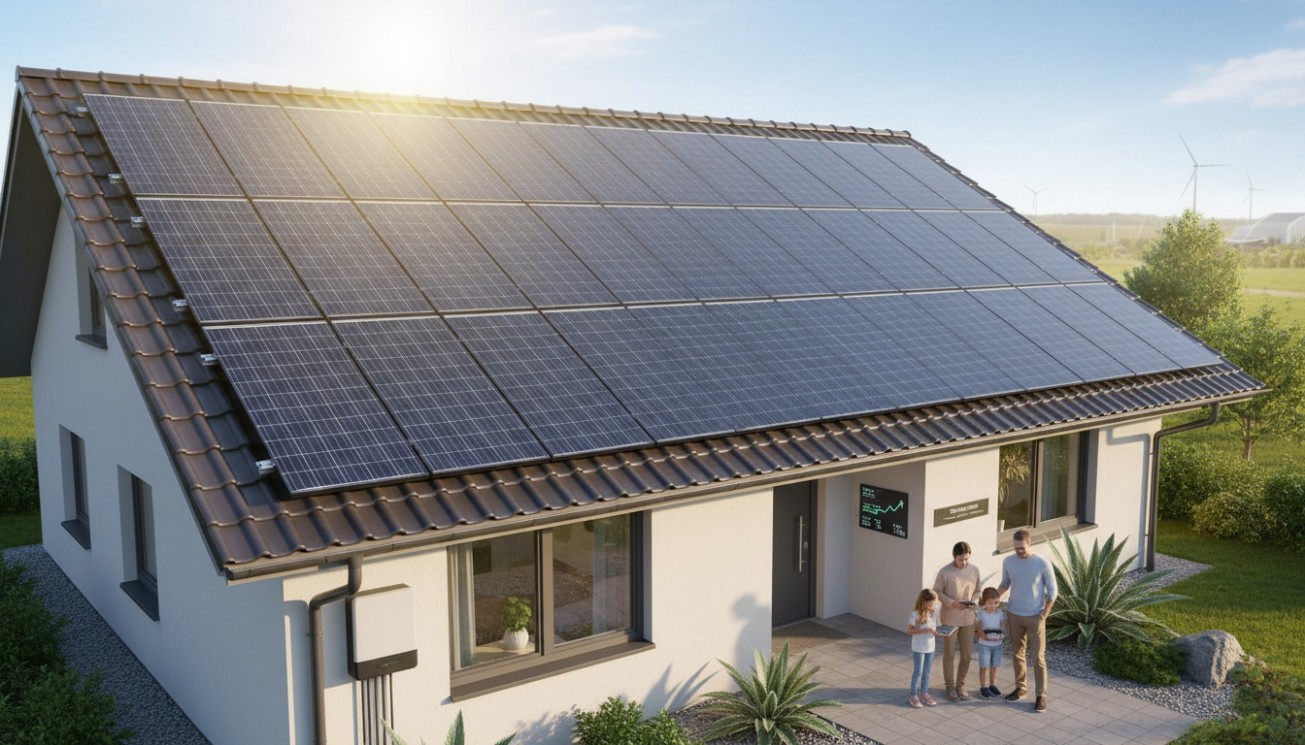
Residential PV Modules and Home Batteries: When Solar Panels Need Storage
Solar Panels Generate Energy, but Batteries Change the Time Value of Energy

A residential solar system is often introduced as a way to generate clean electricity from the roof. That explanation is correct, but it is incomplete. Residential PV modules generate electricity when sunlight is available. A household uses electricity when people live, cook, cool, heat, charge, wash, work, and relax. These two timelines do not always match.
This mismatch is the reason home battery storage has become an important part of residential solar thinking. A solar panel produces energy during the day, but many homes use a large share of electricity in the morning and evening. Without a battery, daytime solar energy must either be used immediately, exported to the grid, or wasted if export is limited. With a battery, some of that daytime energy can be stored and used later.
This does not mean every home with solar needs a battery. A house with strong daytime demand, favorable net metering, and low outage risk may get good value from solar without storage. Another house with low export value, evening peak tariffs, frequent outages, or a strong desire for energy independence may benefit from storage. The decision depends on how electricity is priced, when the home consumes energy, how much backup the homeowner wants, and how the solar system is designed.
The key point is that solar panels with battery are not simply a bigger version of a solar system. They are a different type of energy system. A solar-only system focuses mainly on generation. A solar-plus-storage system focuses on generation, storage, timing, control, and resilience. The battery does not make the modules more efficient, but it can make the electricity produced by the modules more useful.
For homeowners, this means the battery question should not be asked at the end of the project. It should be part of the original design conversation. For installers and distributors, it means residential solar storage should be explained as a system strategy rather than a simple add-on product.
The First Question Is Not “Do I Need a Battery?” but “What Problem Am I Solving?”
Many homeowners ask whether a battery is worth it. The better question is: what problem should the battery solve?
A battery can solve several different problems. It can increase solar self-consumption by storing daytime solar energy for evening use. It can provide backup power solar capability during grid outages. It can help reduce electricity purchases during expensive peak-rate hours. It can reduce dependence on low export compensation. It can prepare the home for electric vehicles, heat pumps, or future smart energy management. It can also create emotional value by giving the homeowner more control over household energy.
These problems are not the same. A battery designed mainly for self-consumption may be sized differently from a battery designed mainly for backup. A battery intended to cover short evening peak periods may not need to support the entire home overnight. A battery intended for storm resilience may need critical load planning, reserve settings, and different inverter capability. If the homeowner wants all functions at once, system cost and design complexity increase.
This is why a professional home solar battery system should begin with a clear use case. Without a use case, battery sizing becomes guesswork. Some systems become too small to satisfy the homeowner. Others become too large and expensive for the value they deliver.
Storage for Savings
When the main goal is savings, the battery should be evaluated against electricity tariffs, export credit value, peak pricing, and household load timing. The question is whether stored solar energy can replace expensive grid electricity often enough to justify the battery cost.
Storage for Backup
When the main goal is backup, the battery should be evaluated against outage frequency, critical loads, battery capacity, inverter output, reserve settings, and the homeowner’s comfort expectations. The question is not only payback. It is resilience.
Storage for Control
Some homeowners choose residential energy storage because they want more control over how solar energy is used. This may not always produce the shortest payback, but it can create lifestyle value.
Net Metering and Export Value Can Decide Battery Value

The value of storage changes dramatically depending on how exported solar electricity is treated. In markets with strong net metering, exported solar electricity may receive credit close to the retail electricity rate. In that case, the grid acts almost like a financial battery. The homeowner exports excess energy during the day and receives bill credits that can offset later usage. Under this structure, a physical battery may still be useful for backup, but it may not always be necessary for savings.
In markets where export compensation is low, the situation changes. If solar exports are credited at a partial or wholesale rate, using solar electricity directly at home becomes more valuable than exporting it. This increases the importance of solar self-consumption. A battery can store daytime solar energy and discharge it later, allowing the homeowner to use more of their own production.
This is why residential solar storage should never be evaluated without understanding local utility rules. The same battery may be financially attractive in one market and weak in another. The module, battery, and inverter may be identical, but the value of the stored energy depends on the tariff environment.
Full Retail Credit Reduces the Financial Need for Storage
If exported energy receives strong credit, the homeowner may already receive good value without a battery. Storage may still be chosen for backup or energy independence, but the savings case may be less urgent.
Low Export Credit Increases the Importance of Storage
If exported energy is credited poorly, the homeowner may lose value whenever solar production exceeds immediate demand. In this case, home battery storage can increase the useful value of the solar array.
Export Limits Create a Different Storage Logic
Some regions limit how much solar energy a home can export. When export is capped or restricted, batteries can help capture energy that might otherwise be curtailed. This makes storage part of production protection, not only bill savings.
Time-of-Use Tariffs Make Batteries More Strategic
In many markets, electricity prices vary by time of day. Under time-of-use pricing, electricity may be cheaper at night or midday and more expensive during late afternoon or evening peak periods. This changes the value of a home solar battery system.
A solar-only system produces energy during sunlight hours. If peak electricity prices happen after sunset, the solar array alone may not fully offset expensive grid power. A battery can store solar energy generated earlier and discharge during peak-rate periods. This can improve savings even if total annual solar production does not change.
However, battery strategy must be carefully designed. If the battery charges and discharges at the wrong time, it may not deliver strong savings. If the battery is too small, it may not cover peak demand. If it is too large, the extra capacity may sit unused. If the tariff structure changes, the savings model may change as well.
For this reason, solar battery sizing is not only about kilowatt-hours. It is about matching battery capacity with tariff windows, household demand, solar production, and control logic.
Peak Shaving Is Not the Same as Full Backup
A battery used for peak shaving may only need to reduce expensive grid usage during certain hours. A battery used for full-home backup may need much more capacity and power output. These two goals should not be confused.
Smart Controls Increase Storage Value
A battery becomes more useful when it can follow a clear control strategy. It should know when to charge, when to discharge, when to preserve reserve capacity, and when to support the home during grid events. This is where inverter and energy management systems become important.
Backup Power Requires More Than a Battery
Many homeowners assume that adding a battery automatically creates backup power. This is not always true. A proper backup power solar system requires the right battery, inverter, electrical configuration, transfer equipment, critical load planning, and safety isolation from the grid.
In a standard grid-tied solar system, the system usually shuts down during a grid outage for safety. This prevents electricity from being sent back into utility lines while workers may be repairing them. To keep the home powered during an outage, the system needs backup-capable architecture. This often includes a hybrid inverter system, backup gateway, protected load panel, or other approved isolation equipment.
The battery capacity also determines how long backup can last. A small battery may keep essential loads running for a short time. A larger system may support more appliances or longer outages. But even a large battery can drain quickly if it powers air conditioning, electric heating, cooking equipment, water heating, or EV charging.
This is why backup planning should start with load selection. The homeowner should decide what must stay on during an outage. Essential loads may include lights, refrigerator, internet router, medical equipment, selected outlets, garage door, and limited HVAC. Non-essential loads may be excluded to extend battery runtime.
Critical Load Planning Protects Customer Satisfaction
If a homeowner expects the entire house to run normally during an outage but the system only supports selected circuits, disappointment can follow. A professional proposal should clearly explain what the battery can and cannot power.
Solar Recharge During an Outage Depends on System Design
Some backup systems can recharge the battery from solar during an outage. Others may have limitations. The homeowner should understand whether the residential PV modules can continue charging the battery when the grid is down.
PV Module Sizing Changes When Storage Is Included

A solar-only system may be sized around annual consumption, roof capacity, export rules, or utility bill offset. A solar-plus-storage system adds another layer: how much energy is needed to charge the battery while still serving daytime loads.
If the solar array is too small, the battery may not charge fully on many days. If the solar array is too large, excess energy may still be exported or curtailed after the battery is full. The right balance depends on roof space, household consumption, battery capacity, tariff rules, and weather patterns.
This is why residential PV modules should be sized together with storage expectations. The module array is the energy source. The battery is the time-shifting device. If they are mismatched, the system may underperform financially or functionally.
A Small Battery with a Large Array
This design may work if the battery is mainly used for evening peak shaving and the utility provides decent export value. But if export value is low, the system may still send too much energy to the grid at poor rates.
A Large Battery with a Small Array
This design may not charge fully from solar, especially in winter or cloudy seasons. The battery may provide backup value but may not deliver strong solar self-consumption benefits.
Balanced Solar and Storage
A balanced system aligns daytime production, battery capacity, evening load, tariff windows, and backup requirements. This is usually more valuable than simply maximizing either panel count or battery size.
Battery Capacity and Battery Power Are Different
Homeowners often hear battery size described in kilowatt-hours, but capacity is only one part of the design. Capacity tells how much energy the battery can store. Power rating tells how much electricity the battery can deliver at one time. Both matter.
A battery with enough capacity may still be unable to run large loads if its output power is limited. A battery with strong power output may still run out quickly if capacity is small. This distinction is essential for solar battery sizing.
For example, a home may need modest backup capacity for lights, internet, and refrigeration. Another home may want to run a well pump, air conditioning, or electric cooking equipment. These loads require different power and energy planning. A system designed for one home may not fit another.
Capacity Answers “How Long?”
Battery capacity helps answer how long the home can run selected loads.
Power Answers “How Much at Once?”
Battery power rating helps answer which appliances can operate simultaneously.
Reserve Settings Affect Real Usable Capacity
Some battery systems maintain a reserve for backup. If the homeowner sets a high reserve, less battery capacity is available for daily self-consumption. This can reduce savings but increase resilience. The right setting depends on the homeowner’s priorities.
Inverter Architecture Is the Bridge Between Modules, Battery, and Home Loads
A battery cannot be discussed separately from inverter architecture. The inverter controls how solar energy, battery energy, grid energy, and home loads interact. A hybrid inverter system can often manage solar generation and battery charging within one integrated platform. Other systems may use AC-coupled batteries added to an existing solar installation.
Both approaches can work, but they have different design implications.
A DC-coupled system can be efficient for new installations where the solar array and battery are planned together. A hybrid inverter may manage PV input, battery charging, grid connection, and backup functions. This can create a clean system architecture, but compatibility must be checked carefully.
An AC-coupled system can be useful when adding storage to an existing solar system. The battery has its own inverter and connects on the AC side. This can make retrofit projects more flexible, but system efficiency, backup behavior, control logic, and equipment compatibility should be reviewed.
For installers and distributors, inverter compatibility is a major product strategy issue. A module supplier may not manufacture batteries or inverters, but module electrical characteristics should still support common residential storage architectures. Current rating, voltage range, string design, and documentation all affect how easily the system can be integrated.
Storage-Ready Does Not Mean Backup-Ready
A system may be able to add a battery but still require additional equipment for backup. This distinction should be clearly explained. Storage-ready means the system can integrate storage. Backup-ready means the system can safely power selected loads during outages.
Storage Can Improve Solar Value Without Shortening Payback
This point is important for honest communication. Home battery storage can improve the usefulness of solar energy, but it does not always shorten the simple financial payback period. In some cases, adding a battery extends payback because the battery cost is high. In other cases, it improves economics because export rates are low, peak electricity prices are high, or grid programs reward flexible storage.
The value of storage should therefore be described in multiple layers.
The first layer is financial value. This includes bill savings, peak-rate reduction, export avoidance, demand charge management, and possible program income.
The second layer is resilience value. This includes backup power during outages, protection for essential loads, and peace of mind.
The third layer is control value. This includes using more self-generated electricity, reducing dependence on utility rate changes, and preparing for future energy management.
The fourth layer is strategic value. This includes EV readiness, electrification readiness, and smart home integration.
A homeowner may choose storage for any combination of these reasons. A purely financial buyer may need a strong savings case. A resilience-focused buyer may accept longer payback because backup power is important. A technology-forward buyer may value control and future flexibility.
The Best Battery Proposal Separates the Value Layers
A professional proposal should show solar-only payback, battery-added cost, expected battery savings, backup capability, and non-financial benefits. This allows the homeowner to decide based on clear priorities.
When Residential Solar Does Not Need a Battery

A battery is not always necessary. Some homes can get strong value from solar alone.
If the home has high daytime consumption, much of the solar electricity can be used directly. If local net metering is favorable, exported energy may receive strong credit. If electricity rates are low and stable, the financial need for storage may be weaker. If outages are rare and the homeowner does not require backup, storage may not be urgent. If the budget is limited, it may be better to install a high-quality solar system first and consider storage later.
This is why solar panels with battery should not be presented as the only modern solution. Solar-only systems remain practical in many situations. The right decision depends on the home and market.
Solar-First Can Be a Good Strategy
A homeowner may install solar first and leave a pathway for future storage. This can be a good approach if battery prices, tariffs, or household needs may change. But the system should be designed with future compatibility in mind. Otherwise, adding storage later may become more expensive.
Avoid Overselling Storage
If a battery does not solve a real problem for the homeowner, it can weaken the overall project economics. Installers should avoid adding storage only to increase ticket size. Long-term trust matters more.
When Residential Solar Strongly Benefits from Storage
Storage becomes more valuable when several conditions appear together.
The first condition is low export value. If sending electricity to the grid produces weak compensation, storing energy for later use can improve value.
The second condition is time-of-use pricing. If electricity is expensive during evening peaks, stored solar can offset high-rate usage.
The third condition is outage risk. If the grid is unreliable, backup power solar can become a major reason to add storage.
The fourth condition is future electrification. If the home may add EV charging, heat pumps, or other electric loads, storage can support better energy control.
The fifth condition is export limitation. If the utility restricts solar export, batteries can capture energy that might otherwise be curtailed.
The sixth condition is homeowner preference. Some buyers value self-sufficiency and control even when financial payback is not the only driver.
Storage Is Most Valuable When It Solves Multiple Problems
A battery that only solves one minor issue may be hard to justify. A battery that improves self-consumption, reduces peak-rate exposure, provides backup, and prepares for future loads may deliver stronger overall value.
Battery Degradation and Replacement Risk Should Be Included
Just like solar modules, batteries degrade over time. Their usable capacity may decline with age, cycling, temperature, depth of discharge, and operating conditions. This affects long-term residential energy storage value.
A battery proposal should explain warranty terms, expected cycle life, usable capacity, operating temperature limits, and replacement considerations. Homeowners should understand that battery performance is not fixed forever. A system that looks attractive in year one may deliver different value in year ten.
Battery degradation also affects backup planning. A battery that can support critical loads for a certain duration when new may support less duration after years of use. This does not make storage a bad choice, but it should be included in realistic expectations.
Solar Modules and Batteries Have Different Lifecycles
PV modules often have long performance warranties. Batteries may have different warranty structures based on years, throughput, cycles, or retained capacity. The homeowner should not assume that the battery lifecycle is identical to the solar module lifecycle.
Temperature Management Matters
Batteries should be installed in locations that follow manufacturer requirements. Extreme heat or cold can affect performance, safety, and lifespan. A professional installation should consider ventilation, enclosure rating, indoor or outdoor placement, service access, and local code.
The Role of Monitoring in Solar-Plus-Storage Systems
A solar-only system benefits from monitoring, but a solar-plus-storage system needs it even more. Monitoring helps the homeowner understand solar production, battery charging, battery discharging, grid import, grid export, and household consumption.
Without monitoring, the homeowner may not know whether the battery is operating as expected. They may assume the battery is saving money when it is not cycling properly. They may believe the system is ready for outages when reserve settings are too low. They may miss performance issues caused by shading, inverter faults, communication problems, or changed household behavior.
For a home solar battery system, monitoring should be simple enough for homeowners and detailed enough for service teams. Good monitoring can improve trust and reduce support issues. It also helps installers explain system value after installation.
Data Turns Storage from a Black Box into a Managed Asset
A battery hidden in a garage or utility area may feel invisible. Monitoring makes it understandable. The homeowner can see when solar energy is stored, when it is used, and how much grid electricity is avoided.
How Installers Should Explain Solar-Plus-Storage to Homeowners

A strong installer should explain storage in plain terms without overselling. The conversation should begin with the homeowner’s goals. Does the homeowner want lower bills, backup power, more solar self-consumption, protection from tariff changes, EV readiness, or energy independence?
Next, the installer should review the home’s load profile. When does the home use energy? How much electricity is used during the evening? Which appliances are critical during an outage? Is there an EV? Is a heat pump planned? Are there large loads that the battery should not support?
Then the installer should explain system architecture. Is the system DC-coupled or AC-coupled? Is it a hybrid inverter system? Can it provide backup? Which loads will be backed up? Can solar recharge the battery during an outage? What happens when the battery is full? What happens when the grid is down?
Finally, the installer should present financial and non-financial value separately. This prevents confusion. The homeowner can see the difference between savings, backup, control, and future readiness.
Good Storage Education Reduces Complaints
Many customer complaints come from mismatched expectations. If homeowners understand what the battery can do and what it cannot do, satisfaction improves. Education is part of the system value.
How B2B Buyers Should Evaluate Residential Storage Compatibility
For distributors and module suppliers, storage compatibility is becoming part of residential PV positioning. Even if the business only sells modules, customers increasingly ask whether the modules fit battery-ready systems.
B2B buyers should evaluate whether residential PV modules are compatible with common inverter platforms in the target market. They should review voltage, current, connector standards, temperature coefficients, string design flexibility, documentation, and support materials. They should also consider whether the module size and power rating are suitable for battery-charging targets on residential roofs.
A module that produces strong output but creates inverter compatibility challenges may slow installation. A module with clear datasheets, stable supply, and predictable electrical characteristics can support better solar-plus-storage design.
Distributors should also understand local market drivers. In a market with weak net metering, modules may be sold together with residential solar storage messaging. In a market with frequent outages, backup readiness may be more important. In a market with high evening tariffs, peak-shaving value should be highlighted. In a market with strong solar export credit, storage may be positioned more as resilience than financial optimization.
A Practical Decision Framework for Solar Panels with Battery

A homeowner or installer can evaluate solar panels with battery through six questions.
First, how valuable is exported solar electricity? If export value is low, storage becomes more attractive.
Second, when does the home use electricity? If evening demand is high, storage may increase solar self-consumption.
Third, how often does the grid fail? If outages are frequent or costly, backup power solar becomes important.
Fourth, what loads need backup? Critical load planning determines battery capacity, inverter output, and electrical design.
Fifth, what future loads are expected? EV charging, heat pumps, and smart appliances can change storage value.
Sixth, what system architecture is best? A new project may support a hybrid inverter system, while an existing solar system may need AC-coupled storage.
This framework prevents the battery decision from becoming a simple yes-or-no question. Storage is not universally necessary, and it is not universally unnecessary. It is valuable when it solves the right problems.
Focused FAQ
Do residential PV modules need home battery storage?
Residential PV modules do not always need home battery storage. A battery becomes more useful when export credits are low, evening electricity prices are high, outages are common, or the homeowner wants more energy control and backup power.
What are solar panels with battery?
Solar panels with battery refers to a residential solar system where PV modules generate electricity and a battery stores excess solar energy for later use, backup power, or tariff management.
What is residential solar storage?
Residential solar storage is the use of a battery system in a home solar project to store electricity from solar panels and use it when solar production is low or grid electricity is expensive.
What is a home solar battery system?
A home solar battery system includes a battery, inverter or battery inverter, control equipment, monitoring, and electrical configuration that allows stored solar energy to serve home loads.
Why is solar self-consumption important?
Solar self-consumption is important because electricity used directly at home often has higher value than electricity exported to the grid at a lower rate. Batteries can increase self-consumption by shifting daytime solar energy to evening use.
Can solar batteries provide backup power?
Yes, but backup power solar requires more than a battery. The system must include backup-capable inverter equipment, safe grid isolation, load planning, and proper electrical configuration.
How is solar battery sizing calculated?
Solar battery sizing depends on evening load, backup load, desired runtime, solar production, tariff windows, reserve settings, and budget. It should not be based only on total annual electricity consumption.
What is a hybrid inverter system?
A hybrid inverter system can manage solar PV input, battery charging, grid connection, and home load supply within one integrated system architecture, depending on product design and local requirements.
Is residential energy storage always financially worthwhile?
Residential energy storage is not always financially worthwhile on simple payback alone. It can still provide value through backup power, self-consumption, tariff control, and future energy flexibility.
Should homeowners install solar first and add batteries later?
Some homeowners can install solar first and add storage later. However, future battery compatibility should be planned early so the system does not require expensive redesign when storage is added.
Conclusion
Residential solar is no longer only about producing electricity from the roof. It is increasingly about controlling when that electricity is used. Residential PV modules create the energy, but home battery storage can change the timing, value, and resilience of that energy.
A battery is most useful when it solves a clear problem. It can increase solar self-consumption, reduce exposure to low export credits, shift energy away from expensive peak periods, support backup power solar, and prepare the home for future electrification. But storage is not automatically required for every home. If net metering is strong, daytime load is high, outages are rare, and budget is limited, a solar-only system may still be the right first step.
The best solar-plus-storage design begins with the homeowner’s goals. Savings, backup, control, and future readiness are different goals, and they require different system decisions. Solar battery sizing, inverter architecture, critical load planning, monitoring, battery degradation, and tariff strategy all influence whether the system delivers real value.
For installers, the opportunity is to explain storage clearly and honestly. For homeowners, the challenge is to avoid treating batteries as either unnecessary luxury products or automatic must-have upgrades. For distributors and module suppliers, the industry direction is clear: residential PV products increasingly need to fit storage-ready system design, even when the module itself is only one part of the energy system.
The most professional way to think about solar panels with battery is not to ask whether storage is good or bad. The better question is whether storage improves the value of solar energy for a specific home, under a specific tariff, with specific backup needs and future energy goals. When the answer is yes, residential storage can turn a rooftop solar system into a more flexible, resilient, and intelligent home energy platform.
#ResidentialPVModules #HomeBatteryStorage #SolarPanelsWithBattery #ResidentialSolarStorage #HomeSolarBatterySystem #SolarSelfConsumption #BackupPowerSolar #SolarBatterySizing #HybridInverterSystem #ResidentialEnergyStorage