How to Compare Pressurized Solar Water Heater Quotes on Equal Terms
Compare the Hot Water Service Before Comparing the Price
A useful pressurized solar water heater quotation identifies what the buyer will receive, the conditions under which it will operate, and the work still required before it can supply hot water. Two offers with the same advertised tank volume can include different collectors, controls, protection devices, delivery arrangements, and service commitments. Ranking them by the first price on the page can therefore reward the supplier that leaves the most work outside its quotation.
Start by giving every bidder the same project brief. Then check technical suitability, reconcile the equipment and service scope, calculate the cost of completing each offer, and compare the evidence behind performance claims. Only technically acceptable proposals should enter the final commercial ranking. An inexpensive package that cannot meet the specified operating conditions is not a cheaper version of a compliant package.
This guide develops that process for importers, distributors, installers, and project purchasers. It includes a buyer input schedule, a supply responsibility matrix, an illustrative comparison of three quotations, and a purchase approval checklist. All commercial figures used below are invented teaching examples, not current market prices, supplier offers, or predicted project savings.
Write One RFQ That Every Supplier Can Answer
The most common obstacle to solar water heater quote comparison is inconsistent input. One supplier assumes a warm coastal location; another assumes winter operation inland. One includes electric backup; another expects an existing heater to remain. If the buyer requests only a tank size and a unit price, those different assumptions are likely to remain invisible until installation.
A solar water heater RFQ checklist should separate buyer requirements from supplier proposals. The buyer defines the service, site, destination, and purchasing boundary. The supplier proposes a configuration and declares its assumptions. Asking a supplier to select equipment is reasonable; allowing each supplier to invent a different demand profile prevents a meaningful comparison.
| Input | What the buyer should state | Required supplier response |
|---|---|---|
| Location and exposure | Project city, installation setting, shading information, and available site records. | Weather assumptions and any conditions requiring a site survey. |
| Hot water service | Daily volume at a defined delivery temperature, peak period, and expected seasonal variation. | Proposed storage, recovery support, and remaining information needed. |
| Incoming water | Available temperature and pressure records, water source, and water quality report if available. | Operating limits, treatment assumptions, and compatibility exceptions. |
| Building interfaces | Roof and tank locations, indicative pipe routes, available utilities, and existing heaters. | Space, structural, hydraulic, electrical, and maintenance requirements. |
| Order boundary | Quantity, destination, installation responsibility, required documents, and acceptance stages. | Included items, exclusions, delivery basis, schedule, and document list. |
| Service expectations | Required spare parts, installer support, operating records, and response arrangements. | Named support responsibilities, warranty conditions, and service pricing. |
Mark an unknown input as unknown. If incoming water pressure has not been measured, do not convert a sales assumption into a project fact. Ask each bidder to identify the measurement required, explain whether its price is provisional, and state what would trigger a revision. This makes uncertainty visible without forcing the procurement team to solve every engineering detail before approaching the market.
For a distributor buying stock rather than a defined project, create separate application profiles. A mild-climate residential package and a package intended for freezing conditions should not share one vague specification. Each stock configuration needs a declared application envelope and a list of information the installer must verify before recommending it to an end customer.
Keep all clarifications in a revision register. When the required roof frame changes, issue the same revised requirement to every bidder. Record the quotation version, currency, validity date, and assumptions together. A spreadsheet combining an old equipment price with a revised accessories list can look precise while comparing products that no supplier has actually offered.
Turn Tank Capacity into a Defined Delivery Requirement

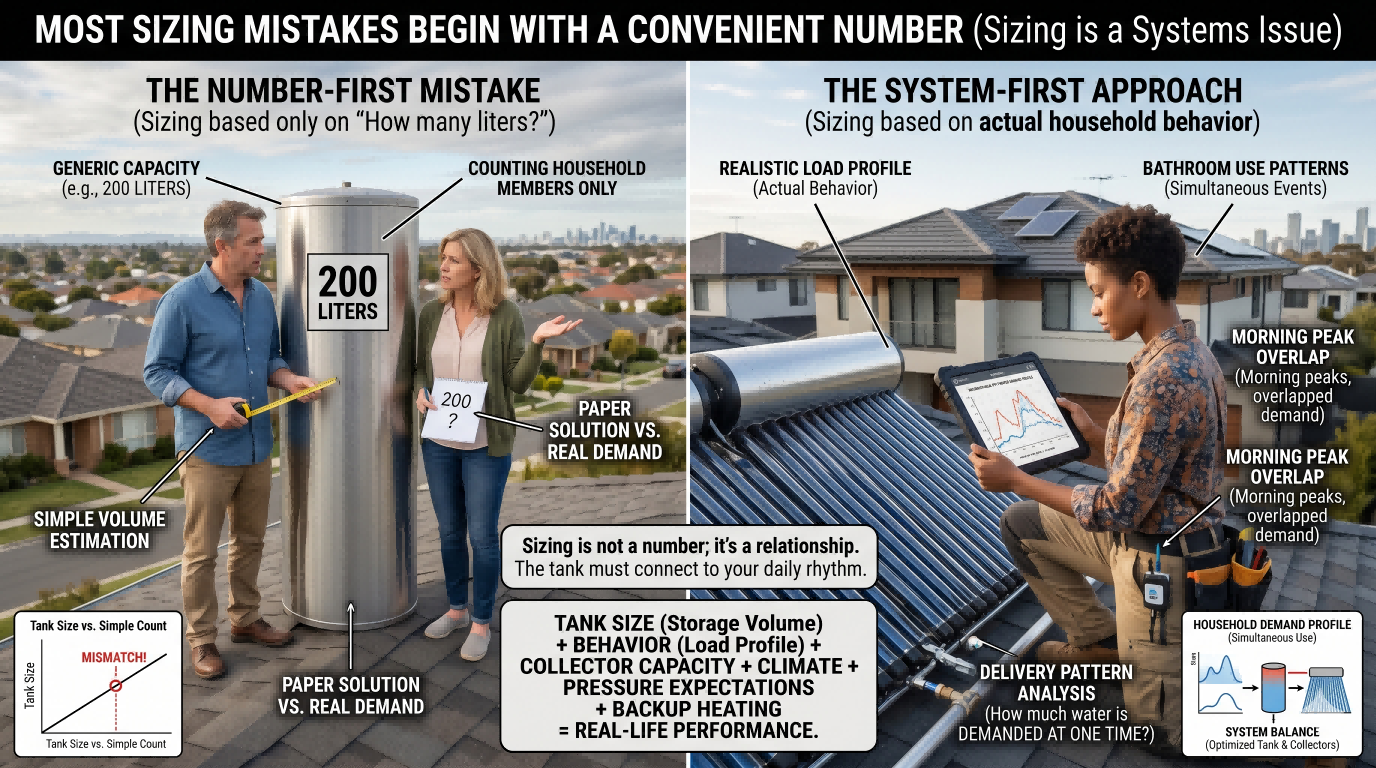
Solar water heater tank capacity describes stored volume; it does not, by itself, describe the volume delivered at a usable temperature during a peak period. Ask whether the quoted number is nominal vessel volume, usable domestic water storage, or another capacity description. Also establish whether domestic water is stored directly or heated through a coil or separate exchanger.
Gather demand information before requesting prices, including when water is used and how much demand can overlap. In a quotation exercise, these inputs should become written comparison conditions that every bidder uses when developing its proposal.
A simple energy calculation exposes inconsistent assumptions
Consider a hypothetical requirement for 600 liters of water delivered at 45°C from an incoming supply at 15°C. Using an approximate water density of one kilogram per liter and specific heat of 4.186 kilojoules per kilogram per degree Celsius, the ideal sensible heating requirement is:
Heat required = 600 × 4.186 × (45 − 15) ÷ 3,600 ≈ 20.9 kWh.
This is the heat added to that quantity of water. It excludes storage losses, distribution losses, recirculation losses, and equipment inefficiencies. It is not a collector sizing result, an annual solar yield, or a promise that a particular package will satisfy the load. It gives buyers a common starting point for examining what each supplier has assumed.
If another bidder calculates the same volume from 25°C incoming water, the corresponding ideal requirement falls to approximately 14.0 kWh. Both calculations can be arithmetically correct, yet they describe different services. The apparent performance advantage disappears when the incoming temperature is standardized.
Stored liters and mixed delivery liters need separate labels
An idealized mixing calculation provides another useful distinction. If 300 liters of stored water were uniformly at 60°C and mixed with 15°C incoming water to deliver 45°C water, the energy balance would indicate 450 liters of mixed water: 300 × (60 − 15) ÷ (45 − 15). That is a theoretical mixing result, not a product draw-off rating.
Actual delivery depends on stratification, usable storage, mixing equipment, flow, incoming water behavior, and heating during the draw. The temperatures in this example are calculation inputs, not operating instructions or a hygiene strategy. Ask suppliers for a stated draw-off method and conditions when they promise a delivery volume. Do not compare an ideal mixing calculation from one bidder with a measured result from another.
Peak service also needs a time boundary. Six hundred liters spread through a day is different from the same volume demanded during a short morning period. Require the proposed backup arrangement and recovery assumptions to be stated alongside storage. A tank that meets a daily volume description may still fail the service requirement at the critical hour.
Make the Equipment Boundary Visible
A solar water heater bill of materials should identify the offered configuration in enough detail to reconcile it with drawings, certificates, packing lists, and replacement parts. A description such as “complete system with standard accessories” leaves the buyer unable to establish what completeness means.
Separate architecture from pressure terminology. Split and integrated describe equipment arrangement; direct and indirect describe heat transfer paths; pressurized describes the relevant pressure-bearing circuit. Ask for a simple hydraulic schematic showing which fluid passes through which components. A product name alone may not identify whether the storage vessel, a domestic water coil, or both carry supply pressure.
The site's comparison of split and integrated installation layouts can help explain layout choices. The purchasing document should go further by assigning supply and installation responsibilities to every interface.
| Scope group | Details to resolve | Evidence to request |
|---|---|---|
| Collectors and mounting | Exact models, quantity, mounting components, and attachment boundary. | Model schedule, packing list, and applicable mounting drawings. |
| Storage and heat exchange | Capacity definition, connections, insulation, exchanger configuration, and access. | Tank drawing, datasheet, and material or lining description. |
| Circulation and controls | Pump equipment where applicable, sensors, controller, wiring, and configuration work. | Component references, hydraulic diagram, and control description. |
| Protection and water treatment | Specified relief, expansion, mixing, backflow, and treatment provisions as applicable. | Approved design schedule and responsibility for local compliance review. |
| Site works | Pipework, insulation, lifting, penetrations, electrical connection, and reinstatement. | Measured quantities or allowances, drawings, and exclusions. |
| Handover and service | Commissioning, training, records, initial spares, and post-delivery support. | Deliverables list, acceptance procedure, and service terms. |
Not every configuration needs every component listed in this matrix. A passive arrangement, for example, should not receive a pump allowance simply because another bid uses forced circulation. Compare the required function and engineering suitability, then reconcile the components needed to achieve it. Adding identical hardware to unlike architectures can make a comparison less accurate.
Require suppliers to price a compliant base offer before proposing alternatives. An alternative should have its own configuration reference, performance assumptions, cost effects, and installation implications. This preserves genuine engineering choice while preventing an attractive alternative price from being mistaken for compliance with the original specification.
Read Pressure and Backup Claims as Interface Requirements

Useful solar water heater specifications identify operating limits for the relevant components and circuits. A single pressure number without a label is insufficient. The buyer needs to know whether it describes a permitted operating condition, a test condition, or a protection device setting, and which component or circuit it applies to.
Pressure rating is not a pump specification and does not guarantee a flow rate at the shower or process outlet. Building supply conditions, elevation, pipe resistance, valves, and simultaneous demand affect delivery. Where pressure suitability is unresolved, request an engineering clarification rather than assigning the bid a small commercial penalty and assuming the installer will correct it.
Keep the solar collector circuit and domestic water circuit distinct in the response schedule. Their fluids, temperatures, pressures, and protection arrangements may differ. Ask the supplier to identify its supplied protection components and the project designer to confirm the full installed arrangement. No generic checklist should be used to select safety valve settings or pressure test values without the applicable design and manufacturer requirements.
Backup heating belongs in the quoted service, even when it already exists
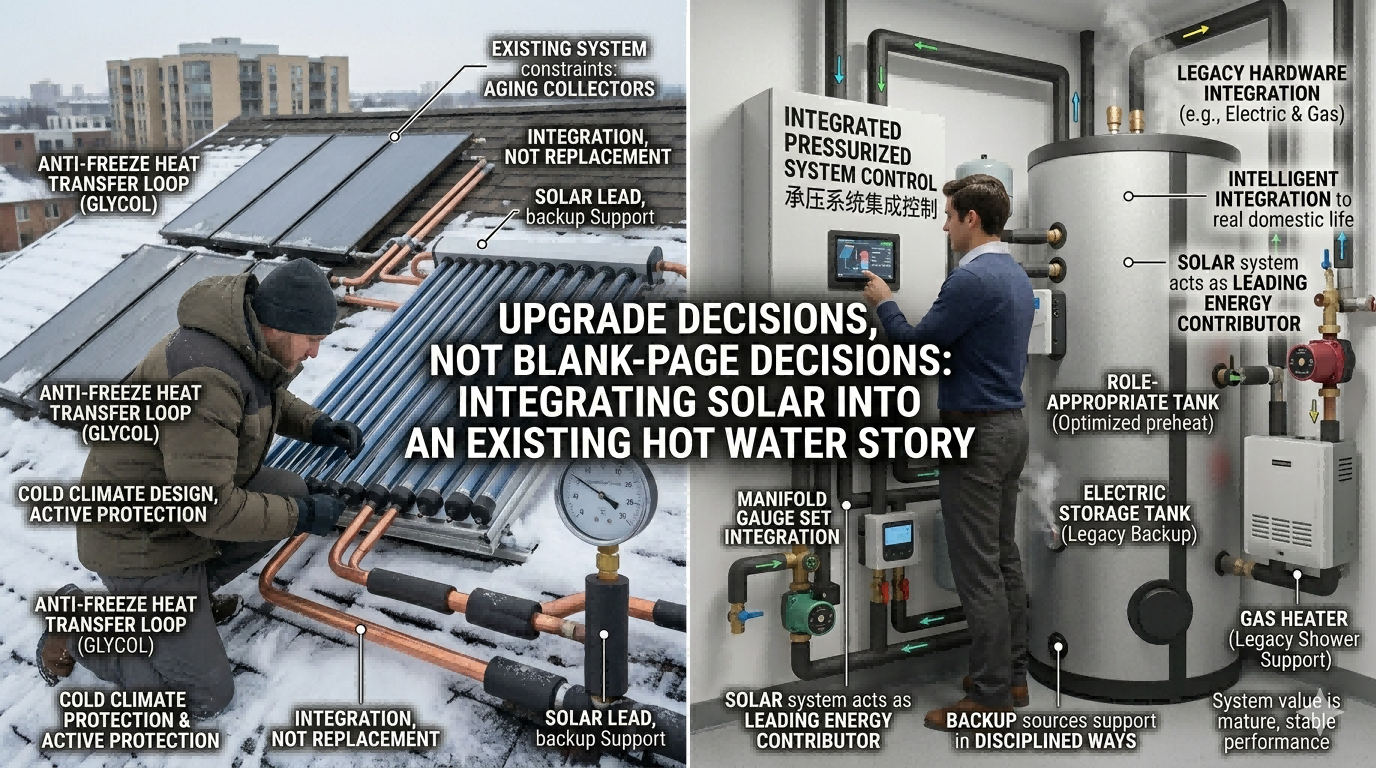
A proposal that reuses an existing heater should identify what reuse requires. This can include permitted incoming water temperature, available heating capacity, control interfaces, electrical or fuel supply, and changes to pipework. “Compatible with gas or heat pump backup” should lead to model-specific confirmation, not an assumption that every existing appliance accepts every solar preheat condition.
The existing article on solar preheat and backup heater integration provides the broader system context. For bid evaluation, request the equipment interface checks, commissioning responsibility, and cost of any modification. If these are excluded, carry them visibly into the completion budget.
Ask what the installed system is intended to do during low solar availability and during a service interruption. A hotel purchaser may require a particular level of hot water continuity, while a residential distributor may sell a package with a clearly stated backup requirement. Neither expectation should be inferred from the collector quantity or a generic claim of year-round hot water.
Check Whether the Performance Evidence Matches the Offer
Solar collector performance data is useful only when the model, area basis, and test conditions are identified. Tube count, collector dimensions, and a headline efficiency percentage are not interchangeable measures of delivered system heat. Ask bidders to provide the actual data document and identify the offered model within it.
ICC-SRCC distinguishes OG-100 collector certification from OG-300 complete-system certification. Collector ratings do not describe all the effects of storage, heat exchange, pumps, or controls on the assembled system. Treat a collector certificate as evidence for its stated scope, rather than as proof of every performance claim in the quotation. [1]
The practical purchasing question is straightforward: does the evidence refer to this configuration? Match collector models, tank references, controls, and drawings where those elements form part of the rated or certified arrangement. If a bidder changes a component, request an explanation of whether the evidence still applies. Record the answer before accepting the revised price.
Separate a test report, a current certification, and a site prediction
ICC-SRCC explains that a test report concerns the tested sample at the time of testing, while certification also evaluates products and manufacturing processes under a certification scheme. This distinction matters when the offered product has changed since a report was issued. A document headed “tested” should not automatically be described as current certification. [2]
A site prediction is another category of evidence. Ask for the weather data, load schedule, storage arrangement, pipe assumptions, and auxiliary energy treatment used in the model. A forecast can support comparison when its assumptions are disclosed. It becomes misleading when a favorable location or light demand profile is presented as a guaranteed outcome for every project.
Where suppliers use Solar Uniform Energy Factor, request the applicable rating conditions. ICC-SRCC's SUEF method uses defined assumptions and draw patterns; ENERGY STAR describes the metric as delivered system energy divided by electrical or gas input. It is a ratio under specified conditions, not an annual kilowatt-hour saving or a guaranteed return on investment. [3] [4]
These programs are examples of evidence buyers may encounter, not a universal certification checklist for every country. Establish the destination and project requirements first. Then record what each certificate proves, what it does not prove, and which offered models it covers. A document's relevance matters more than the number of logos displayed beside a price.
Rebuild Three Quotations on the Same Cost Boundary
The following example concerns three hypothetical packages for a repeatable installation program. Assume that engineering review has confirmed that all three can meet the same defined hot water service and destination requirements after the listed scope gaps are closed. The numbers illustrate the comparison method only. They do not establish an appropriate price, tank size, or configuration for any real project.
Each completion allowance has been priced and accepted for that bid. It is not a buyer's guess that an unspecified component will probably be inexpensive. Logistics and destination allowances use the same delivery endpoint, and no charge is counted twice. Recoverable taxes, financing, annual operation, and future replacement costs are excluded from this initial acquisition comparison.
| Cost item | Offer A | Offer B | Offer C |
|---|---|---|---|
| Quoted equipment package | 1,200 | 1,450 | 1,720 |
| Priced additions to meet the agreed scope | 260 | 80 | 0 |
| Allocated freight and insurance | 120 | 110 | 90 |
| Destination charges and assumed nonrecoverable import costs | 180 | 190 | 200 |
| Comparable landed subtotal | 1,760 | 1,830 | 2,010 |
| Installation and site connection | 420 | 360 | 300 |
| Separate commissioning and handover cost | 90 | 0: included above | 0: included above |
| Comparable installed acquisition total | 2,270 | 2,190 | 2,310 |
Offer A has the lowest equipment price but not the lowest installed acquisition total. Offer B is USD 80 lower per package after the scope is reconciled. Across 20 identical installations under these assumptions, that difference becomes USD 1,600. The calculation does not prove that B should win: delivery reliability, operating costs, maintainability, and contractual commitments remain to be evaluated.
Offer C is USD 120 above B on this cost boundary. The buyer can now ask a focused question: what documented benefit, if any, justifies that premium? An additional spare parts commitment, a better-supported installation process, or a relevant performance advantage can be assessed separately. A vague assertion of premium quality cannot.
Do not confuse an omission with a technical failure
Use four response statuses throughout the comparison: included, excluded but priced, awaiting clarification, and noncompliant. An omitted installation item may be resolved through a verified addition. An unsuitable pressure-bearing component may require a redesign and a new offer. These conditions should not share the same spreadsheet treatment.
Unknown costs must remain unknown until a responsible party prices them. A blank cell is not zero. If a provisional allowance is unavoidable, label it as such, identify its owner, and show a range. Do not let a low central estimate conceal the fact that one bidder has provided a firm scope while another has left major site obligations unresolved.
Use the same endpoint for landed and installed cost
Solar water heater landed cost should have a written definition in the comparison workbook. State the destination, the charges included, the currency conversion date, and the treatment of taxes. Calculate solar water heater installation cost separately so that a package delivered to a warehouse is not compared with another already connected and commissioned at the building.
ICC describes Incoterms® 2020 as rules allocating delivery-related costs, risks, and obligations between buyers and sellers. When used, identify the agreed rule, named place or port, and version. The broader equipment scope, acceptance procedure, and service commitments still need their own written treatment. [5]
For mixed shipments, explain how freight is allocated. Unit count alone may not reflect the space consumed by tanks, frames, or fragile collectors. Obtain a packing proposal and compare the same order quantity and shipment basis. A lower unit price tied to a much larger order is a different purchasing decision with different inventory and cash requirements.
Give Each Buying Team the Right Comparison Questions

A technically consistent comparison can still miss the buyer's commercial purpose. A distributor needs repeatable supply and manageable service obligations. An installer needs clear interfaces and predictable labor. A hotel owner needs reliable service through occupancy changes. Record the intended business model before assigning weights to secondary advantages.
Importers and distributors: compare the sellable package
Confirm which accessories, manuals, labels, and spares are required to make the product sellable in the destination channel. Establish whether different tank capacities share service components and whether substitutions require approval. A small purchase saving can be outweighed by a fragmented spare parts inventory, but that consequence should be estimated from the proposed range rather than assumed.
Ask how claims are handled when products are installed months after import. The warranty start event, storage conditions, traceability, and installer documentation affect what support remains available. For staged deliveries, request confirmation that later batches will match the approved configuration or arrive with an agreed change notice and supporting documents.
Installers and project contractors: compare the work remaining
Evaluate access, pipe routes, roof attachments, wiring interfaces, and commissioning tasks against actual site information. A supplier's “easy installation” claim has little budget value without a defined scope. Request the assumptions behind labor allowances and identify work that must be performed or approved by local specialists.
Design responsibility also needs a named owner. A factory may supply a standard frame while the local project team must assess the building attachment. A controller may arrive configured for a standard arrangement while the installer must verify its settings against the approved design. These interfaces should appear in the bid review, not emerge during handover.
Owners and facilities teams: compare operational consequences
Ask what happens when a pump, sensor, or backup component becomes unavailable. Establish access for replacement, the proposed temporary service arrangement, and the responsibilities for troubleshooting. For a hotel, the operational consequence may include room disruption; for staff accommodation, it may involve concentrated demand after a shift. The quotation should address the service expectation that matters to that building.
Where existing equipment will remain, record its condition and the limits of the supplier's responsibility. Reusing an aging heater can reduce initial expenditure while leaving a separate replacement risk with the owner. The comparison should show that retained risk explicitly rather than presenting reuse as a saving with no future consequence.
Read Warranty Terms Component by Component

Solar water heater warranty terms should be reviewed before shortlisting, not after the preferred supplier has been selected. A warranty duration on the front page may apply only to a collector or vessel. The pump, controller, electrical element, seals, and site labor can have different coverage.
ENERGY STAR's published solar water heater criteria illustrate this distinction by specifying different minimum periods for collectors, sealed systems, controls, and parts. Those are requirements of that certification program, not universal legal minimums or proof that a particular quotation includes all replacement expenses. [4]
- Identify the covered components and the event that starts each coverage period.
- Separate replacement parts from diagnosis, site labor, lifting, freight, and other service expenses.
- Review operating conditions, water quality limits, installation requirements, and maintenance records.
- Confirm the claim procedure, evidence required, and person responsible for communicating with the end customer.
- Ask what support remains available if a model or component is discontinued.
Consider a hypothetical controller failure. One supplier may provide a replacement unit while the distributor pays diagnosis, international shipping, and a second site visit. Another may offer local stock and remote assistance. Compare those commitments in writing. Do not assign a monetary advantage merely because a supplier says its after-sales service is better.
Fault responsibility can also cross the product-installation boundary. For example, recurring discharge needs a diagnosis rather than an automatic tank replacement claim. The site's discussion of overheating, expansion, and relief-valve discharge explains why symptoms can have different causes. The purchasing lesson is to agree who investigates, what operating records are needed, and how disputed findings are reviewed.
A service allowance should have a basis. If a buyer has reliable records from comparable installations, those records can inform a budget. Without such evidence, use clearly labeled scenarios rather than inventing a failure rate. Procurement should expose uncertain service costs, not disguise them as precise predictions.
Keep Energy Savings Separate from the Acquisition Ranking

The lowest installed acquisition cost does not necessarily produce the lowest operating cost. Equally, an impressive solar savings percentage should not overturn the price comparison until the underlying assumptions have been checked. Keep the acquisition workbook and the operating model linked, but distinct.
Specify what a quoted percentage means. It might represent a modeled share of hot water heat demand, a reduction in purchased fuel, or a reduction in a bill under a particular tariff. Ask for the calculation boundary, comparison system, weather period, load profile, and treatment of auxiliary energy. The same percentage label can conceal materially different calculations.
A thermal contribution is not automatically a financial saving
Suppose an illustrative project receives 4,500 kWh per year of useful solar heat that actually displaces output from its existing fuel heater. If the relevant marginal fuel-to-water efficiency is assumed to be 90%, the simplified avoided fuel input is 5,000 kWh. At an assumed fuel price of USD 0.12 per kWh, the gross avoided fuel cost would be USD 600.
If additional pump electricity costs USD 40 and incremental maintenance costs USD 110 per year, the illustrative annual operating benefit falls to USD 450. This simplified scenario omits other effects, including changes in standby losses, cycling, tariffs, and equipment replacement. It demonstrates why useful heat, avoided purchased energy, and net financial benefit need separate rows.
If the displaced heater were a heat pump, the avoided electricity would instead depend on its relevant operating efficiency. It would not normally equal the solar heat contribution. Compare against the actual alternative system and its expected operation. A vendor's comparison with electric resistance heating may be unsuitable for a buyer already using an efficient heat pump.
PNNL's solar water heating guidance identifies performance monitoring and measurement and verification as important to checking system production. It describes using flow and temperature information to establish delivered heat. Buyers can use that principle to ask whether a performance commitment can be measured at the proposed system boundary. [6]
Test the assumptions that can change the decision
Run at least a base case and a downside case using the same assumptions for every technically acceptable bid. Depending on the project, the useful sensitivities may include occupancy, useful solar contribution, fuel price, maintenance expenditure, and replacement timing. Show which assumptions come from project records, which come from a model, and which are provisional.
For an investment comparison, include the analysis period and discount-rate assumption, and separate recoverable taxes or incentives from underlying equipment economics. Where local incentives are relevant, verify eligibility and timing before including them. A simple payback number can be a screening measure, but it does not capture all cash timing, replacement expenditure, or service differences.
Close the Clarifications Before Approving the Order
The last quotation round should produce a revised offer that incorporates the answers, not a collection of disconnected emails. Ask each shortlisted supplier to issue one configuration schedule, one scope statement, and one commercial schedule under a clear revision reference. Attach the agreed exceptions so that purchasing, receiving, installation, and service teams work from the same record.
| Gate | Evidence needed before approval | Typical review owner |
|---|---|---|
| Technical fit | Defined service conditions, proposed configuration, operating limits, and closed technical exceptions. | Project engineer or qualified technical reviewer. |
| Comparable scope | Agreed equipment list, responsibility matrix, and priced remaining work. | Procurement with installer or contractor. |
| Evidence and documents | Applicable current certificates, model references, drawings, and promised handover files. | Quality, compliance, and engineering representatives. |
| Commercial basis | Currency, quantity, delivery basis, validity, payment schedule, and defined cost boundary. | Procurement and finance. |
| Acceptance and support | Inspection stages, commissioning records, claim process, and service responsibilities. | Project delivery and operations teams. |
Define acceptance in stages appropriate to the purchase. Shipment inspection can verify identities, quantities, condition, and specified records. Site commissioning can verify the installed arrangement and documented operation. A longer performance assessment may require suitable weather, representative demand, and agreed monitoring. These stages answer different questions and should not be collapsed into a photograph showing that the equipment arrived.
Link any negotiated payment milestones to clearly described deliverables and review periods. If a long performance period is proposed, agree how weather, demand changes, missing data, and corrective work will be treated. Procurement teams should establish these project-specific terms with the responsible technical and commercial reviewers before committing funds.
The final decision record should explain why the selected offer meets the defined service and why its total evaluated cost and commitments are acceptable. That record becomes a practical reference if a later change, missing component, or service dispute occurs. It also makes the next purchasing cycle easier because the team can compare outcomes with its original assumptions.
Focused FAQ
What should a pressurized solar water heater quotation include?
It should identify the offered configuration, tank capacity definition, collector models, relevant pressure and temperature limits, controls, backup arrangement, included accessories, exclusions, delivery basis, and warranty conditions. It should also state the assumptions behind any performance claim and list the drawings, records, and support delivered with the order.
Can two systems with the same tank capacity be compared directly?
Not from capacity alone. Their usable storage, heat exchange arrangement, collector output, backup recovery, and installation scope may differ. Compare the hot water service at the same incoming temperature, delivery temperature, demand schedule, and site conditions before comparing price.
Is price per liter a useful buying metric?
It can describe price within a tightly defined product family, but it is weak as a primary system selection metric. It does not reveal delivered heat, installation work, operating limits, or service obligations. Use it only after the relevant configuration and supply boundary are aligned.
Does a collector certificate certify the complete water heater?
Not necessarily. The scope of the certificate determines what it covers. In the ICC-SRCC example, OG-100 covers collectors and OG-300 covers complete systems. Match the quoted product and configuration to the actual certificate instead of relying on a logo or an unsupported claim of system certification.
How should missing items be treated in a quote comparison?
Mark them as excluded, awaiting clarification, or noncompliant as appropriate. Add a completion cost only when the required item and its price are established. Keep provisional allowances visible, and do not turn an unresolved engineering issue into an assumed low-cost accessory.
What separates landed cost from installed acquisition cost?
Landed cost uses a defined delivery endpoint and agreed treatment of transport, import charges, and taxes. Installed acquisition cost adds the site work, connection, commissioning, and handover needed to reach the specified service boundary. Both definitions should be written into the comparison so that included costs are not counted twice.
Should the supplier promising the highest solar savings win?
Only a comparable, supported claim should influence the ranking. Check the load, climate, baseline heater, auxiliary consumption, tariff, and calculation method. A higher percentage under more favorable assumptions may deliver less value at the actual project than a lower but better-supported estimate.
What is the most useful document to request before purchase approval?
Request a consolidated final offer containing the configuration schedule, scope and responsibility matrix, technical exceptions, commercial terms, and acceptance requirements. Supporting evidence should be referenced by model and revision. This gives each delivery team a common record of what was actually agreed.
Technical References
The sources below support the stated distinctions between ratings, certification, trade responsibilities, and measured heat. The RFQ structure, comparison tables, and hypothetical calculations in this article are editorial tools, not requirements quoted from these organizations. Source pages were checked on September 29, 2026.
- ICC-SRCC: Scope of OG-100 and OG-300 certification.
- ICC-SRCC: Testing and certification.
- ICC-SRCC: Solar Uniform Energy Factor methodology.
- ENERGY STAR: Water heater product criteria and metric definitions.
- International Chamber of Commerce: Incoterms 2020.
- Pacific Northwest National Laboratory: Solar water heating operations and performance monitoring.