How to Design a Reliable Pressurized Solar Water Heater System: Collector Angle, Pipework, Tank Sizing, and Pump Logic
Most Solar Hot Water Problems Are Not Product Problems. They Are Design Problems.
In the market, many system discussions begin at the wrong end. People compare collectors, tank materials, pressure ratings, or product appearance, then assume the quality of the final result will follow automatically from the quality of those individual parts. That assumption is one of the biggest reasons projects disappoint. A pressurized solar water heater does not become reliable simply because the collector is more expensive or the storage tank looks more substantial. Reliability is created much earlier, in the design logic that connects every part of the system into one coordinated whole.
This is why solar water heater system design matters more than product hype. A system can be assembled from good components and still behave poorly if its hydraulic path is careless, its storage volume is mismatched, its collector field is over- or under-ambitious, or its controls do not reflect the way the building actually uses hot water. By contrast, a system made from comparatively ordinary components can perform remarkably well if the design respects the building, the climate, the demand profile, and the operating discipline of the owner.
That distinction is especially important in a pressurized solar hot water system because pressure-rated domestic hot water installations are usually chosen for buildings with higher functional expectations. These projects are not simply trying to heat water. They are trying to deliver stable, comfortable, modern hot water performance that can fit into real daily life. Once those expectations exist, system design becomes more demanding. The collector must not only collect. The tank must not only store. The pipework must not only connect. Each element has to contribute to a broader goal: a reliable solar water heating system that behaves well in real operating conditions.
A surprising number of failures that users interpret as “bad products” are really failures of system thought. The hot water is not consistent enough. The roof gets too hot in summer. The upper-floor shower feels weaker than expected. The pump runs too often. Heat is lost between collector and tank. The system is oversized for daytime occupancy but undersized for morning peak use. None of these problems can be solved by discussing product quality alone. They must be solved by understanding how the system should have been designed from the start.
That is why this article takes a full engineering view. Instead of asking which component is better, it asks what a correct pressurized solar water heater installation really requires: demand definition, collector angle strategy, routing discipline, storage logic, pump control, system balance, and long-term service thinking. The strongest domestic solar projects are not the ones with the loudest equipment claims. They are the ones whose design quietly prevents problems before the owner ever experiences them.
A Reliable System Begins with Demand, Not with the Roof

The first mistake many designers, installers, and buyers make is starting from the roof instead of the building’s hot water behavior. They measure available roof area, estimate how many collectors can fit, then work backward toward storage and circulation. This creates a seductive but often flawed logic: “Use as much roof as possible, then size the rest around it.” In some projects that may appear efficient, but in many residential systems it creates mismatches that later show up as overheating, underutilized collector area, poor return on system complexity, or unstable system behavior.
A better solar water heater system design begins with the load. Who is using the building? How many people? At what times? Are hot water events concentrated in the morning, spread across the day, or driven by irregular household behavior? Are there multiple bathrooms? Is hot water used only domestically, or does the system also serve utility functions such as laundry support or light commercial washdown? Does the owner expect strong comfort performance or simply reduced energy use?
These questions define the thermal mission of the system. Without them, even the most elegant collector layout is only a guess. A solar water heater for modern homes must respond not only to sun availability but to user rhythm. Modern households are often highly patterned. Morning peaks can be intense. Evening hot water events may overlap with kitchen demand. Some families use consistent routines every day, while others create fluctuating demand based on work schedules, school patterns, and weekend behavior. The correct storage and control design depends on these patterns.
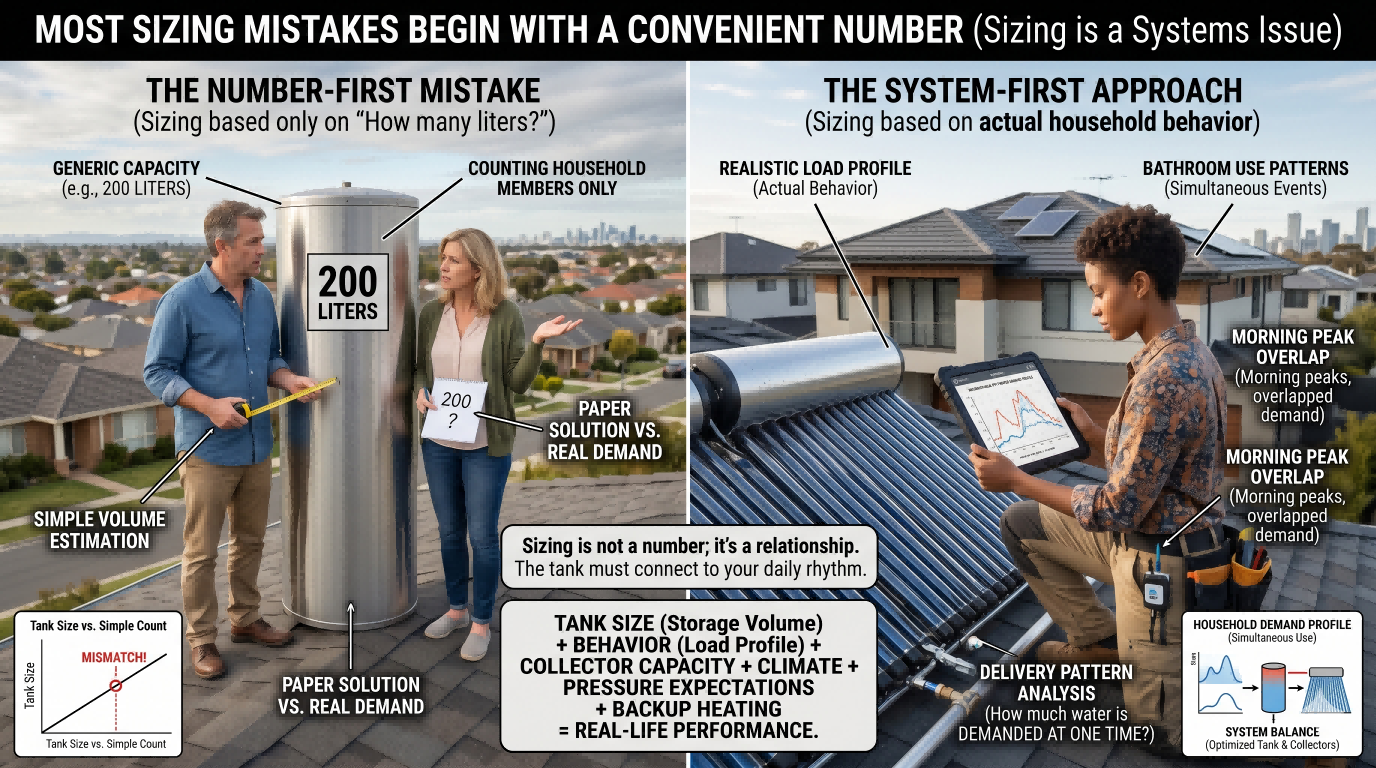
This is also where many oversizing and undersizing errors begin. If a project is defined only by “number of people” and not by actual behavior, the system may be too bluntly configured. A family of four with one bathroom and staggered schedules is not thermally equivalent to a family of four with three bathrooms and synchronized mornings. A home office couple living in the property during the day creates a different demand curve from a family whose home is empty until evening. Good design respects these differences.
A pressurized solar water heater deserves that level of design seriousness because the user expects more than symbolic solar contribution. In a pressure-rated domestic system, the owner often expects the solar installation to behave like part of the house’s permanent comfort infrastructure. That means the designer must think like a building systems planner, not just a product seller.
Collector Angle Is Not a Number. It Is a Seasonal Strategy.
Many installation conversations treat tilt as a fixed technical recommendation, something to be pulled from a general table or copied from a previous project. But the solar collector angle for water heater should never be reduced to a universal number. Tilt is a seasonal strategy. It determines how the collector field behaves across the year, how strongly the system responds in different months, and how well the thermal output aligns with the building’s actual hot water priorities.
A shallow design mindset asks: what angle gives the highest annual solar gain? A more intelligent design mindset asks: what angle gives the best operational outcome for this specific domestic hot water system? Those are not always the same question. Annual yield is useful, but domestic hot water systems do not live on annual yield alone. They live on whether the system behaves sensibly in the months when the owner most notices performance.
If a project values better winter support, the chosen solar collector angle for water heater may lean differently than if the project is primarily concerned with maximizing summer capture. If the climate has strong seasonal contrast, tilt becomes part of how the system balances winter usefulness against summer excess. If the building already has strong backup heating and values solar contribution mainly in shoulder seasons, that may shape the decision differently again.
This matters because a pressurized solar hot water system is often chosen for comfort-oriented buildings where user expectations remain high throughout the year. A family that enjoys stable pressurized hot water in winter will care far more about winter contribution than a spreadsheet that celebrates summer surplus. Good design therefore treats collector angle as part of system behavior, not as a generic solar geometry issue.
Orientation also belongs in this conversation. In an ideal world, collector placement aligns neatly with the best solar exposure. In real projects, roof shape, aesthetics, shading, setbacks, parapets, and available mounting zones all intervene. The designer has to decide whether to accept a suboptimal but workable mounting area, re-balance the field size, alter storage expectations, or refine the circulation and backup strategy to compensate. That is why collector planning belongs inside full solar water heater system design logic rather than as an isolated roofing exercise.
Pipework Is Not an Installation Detail. It Is a Performance Component.

One of the most common ways projects lose quality is through underestimating solar water heater pipework. Buyers tend to notice the collector and the tank because those are visible, while pipes are treated as connective tissue. But in a thermal system, connective tissue defines whether the organs work together or waste energy fighting one another. Pipe routing, length, diameter, insulation, elevation changes, and service accessibility all directly affect system performance.
Poor solar water heater pipework can quietly undermine otherwise strong projects. Heat collected efficiently on the roof can be partially surrendered before it reaches storage. Air traps can complicate circulation. Overly long runs can create sluggish system response. Bad insulation can turn a promising design into a system that feels underwhelming at the point of use. Pipe routing that is difficult to access can turn ordinary maintenance into a disruptive job years later.
This is why good designers think about pipework early, not after the main equipment has already been chosen. The thermal loop should be as disciplined as possible. Not necessarily the shortest conceivable loop, because real buildings impose constraints, but the cleanest and most purposeful one. Routes should be intentional. Bends, vertical transitions, concealed sections, penetrations, service points, and insulation continuity should all be part of a deliberate plan.
In a pressurized solar water heater installation, hydraulic elegance matters even more because the system is expected to behave as part of a higher-standard domestic network. If the collectors perform well but the pipe routing weakens effective heat transfer or complicates system balance, the owner does not experience a “good collector with bad pipework.” The owner simply experiences a mediocre system.
Diameter selection is another area where the market often simplifies too much. Oversized pipes are not automatically better, and undersized pipes can impose their own inefficiencies. The right choice depends on flow target, loop length, control strategy, and system scale. Pipe sizing should serve the intended circulation behavior, not guesswork. This is especially true when trying to optimize solar hot water pump logic, because pump performance and piping resistance are inseparable.
Storage Volume Is Not About Bigger Being Safer
Among all design topics, solar water heater tank sizing may be the one most vulnerable to superficial thinking. Many buyers assume a larger tank automatically creates a better system: more hot water, more buffer, more comfort, more security. Sometimes a larger tank is appropriate. Just as often, oversimplified sizing creates sluggish recovery, poor temperature behavior, unnecessary standby losses, or a collector-to-storage relationship that does not actually match the demand pattern of the home.
Good solar water heater tank sizing begins with how the building uses hot water and how the solar contribution is intended to function within the broader domestic hot water strategy. Is the system trying to cover a large share of daily load? Is it expected to preheat before a backup heater? Is it designed to serve a strong morning peak after storing energy from the previous day? Is it meant to support domestic hot water only, or also other thermal tasks? These questions change what “right size” means.
In a pressurized solar hot water system, the tank is not just a container. It is the thermal stabilizer of the entire installation. It decides how collected energy is buffered, how frequently the system cycles, how confidently the household can draw hot water across variable use periods, and how the solar fraction translates into real user experience. A tank that is too small may deliver sharp temperature swings and limit useful energy capture. A tank that is too large may behave like a slow-moving thermal mass that does not align well with the household’s actual demand and recovery expectations.
This is particularly important in solar water heater for modern homes applications, where users often expect the system to feel responsive and dependable, not simply large. A modern family does not evaluate value by liters on a product sheet. It evaluates value by whether hot water is available when needed, whether system behavior feels stable, and whether the solar contribution meaningfully reduces conventional energy use without creating management headaches.
The right tank size therefore comes from relationship, not absolute scale: relationship to collector field, relationship to daily load, relationship to seasonal behavior, relationship to backup strategy, and relationship to control logic. Once solar water heater tank sizing is understood that way, the design conversation becomes more mature and much more accurate.
Collector Field and Tank Must Be Designed as a Pair
A major mistake in weak projects is treating the collector field and storage tank as separate decisions. They are not. They are a pair. You cannot intelligently decide collector area without knowing storage strategy, and you cannot intelligently decide storage without knowing collector behavior. A reliable pressurized solar water heater comes from pairing these two elements properly so the system gains, stores, and releases heat in a balanced way.
If the collector field is too ambitious relative to storage, the system may gain heat faster than it can comfortably absorb under ordinary use. That increases the likelihood of summer stress, stagnation risk, aggressive control intervention, or owner confusion about why a “powerful” system feels difficult to manage. If the collector field is too modest relative to storage, the system may struggle to create meaningful solar contribution, especially during weaker seasons or under demanding domestic patterns.
This is why a reliable solar water heating system must be designed around energy movement, not component prestige. A large field paired with disciplined storage and control can work very well. A moderate field paired with excellent storage alignment can also work very well. What fails is not modesty or ambition in themselves. What fails is mismatch.
A useful rule in design thinking is to ask whether the storage volume and collector field create a sensible thermal personality for the building. Does the system warm and recover in a way that matches household rhythm? Does it remain manageable in strong weather? Does it have enough stored value to serve the family during actual peak periods? Does the backup system integrate smoothly? This is how professional solar water heater system design should think.
Pump Logic Is the Nervous System of the Installation
In many sales conversations, pumps are treated as accessory hardware. They are described as if their job is simply to move fluid when the sun shines. That is far too crude. In reality, solar hot water pump logic is one of the most decisive factors in whether a system behaves intelligently or clumsily. The pump does not merely circulate. It determines when collected heat is worth moving, how quickly the system responds, how efficiently energy is transferred, and how well the installation protects itself from unnecessary cycling and avoidable thermal waste.
A poorly conceived pump strategy can damage user confidence even when the collector and tank are both sound. The system may run too often for too little gain. It may delay useful transfer. It may short-cycle in marginal conditions. It may fail to coordinate well with stratification in the tank. It may react poorly to cloud transitions or partial load periods. All of these outcomes reduce the perceived intelligence of the installation.
Good solar hot water pump logic starts with control philosophy. What temperature difference should trigger circulation? How should the system behave when gain is borderline? What happens when the tank is already warm? How does the pump interact with backup heating logic? What role do sensor placement and thermal lag play? Does the control algorithm reflect the real thermal capacity of the storage tank, or is it too simplistic for the project’s needs?
These questions matter because a pressurized solar water heater is often expected to feel seamless. The owner should not have to interpret strange system behavior to appreciate the solar benefit. A good control strategy makes the system feel almost invisible: it harvests heat when that is sensible, protects the system when necessary, and avoids turning every weather fluctuation into a mechanical event.
This is also where commissioning becomes crucial. The best-designed pump logic on paper can still disappoint if sensor placement is poor, wiring is careless, or field conditions differ from assumptions. That is why pressurized solar water heater installation is never complete when the piping is tightened. The installation is only complete when the system’s control behavior has been validated against its actual thermal reality.
Sensor Placement Is a Hidden Design Decision
Many people talk about controls without talking about sensors, but that is like talking about decision-making without talking about information. In a pressurized solar hot water system, the controller only knows what the sensors tell it. If the sensors are badly placed, slow to respond, poorly attached, or thermally misleading, then even intelligent logic can produce poor outcomes.
Collector sensor location affects how early or late the system perceives useful gain. Tank sensor placement affects how the controller interprets stored energy and decides whether circulation is worthwhile. In stratified tanks, sensing strategy becomes even more important because not all tank temperatures mean the same thing. The upper portion of the tank may represent immediate domestic usefulness, while the lower portion may represent storage potential. A controller that does not “see” the right thermal reality may circulate too aggressively or too conservatively.
This is why advanced solar hot water pump logic is not only about software or controller brand. It is also about thermal truth. The system needs accurate, relevant input from the places that actually matter. Good sensor placement is part of good design, and it often distinguishes refined projects from merely assembled ones.
Pressure Side and Solar Side Must Be Balanced, Not Just Connected
A lot of design conversations keep the collector loop and the domestic delivery loop mentally separate. That is understandable from a technical diagram perspective, but in actual ownership they belong to the same experience. The solar loop may collect and transfer heat beautifully, yet the owner judges the system through domestic performance: shower comfort, response time, water stability, and confidence that the system behaves like a mature utility.
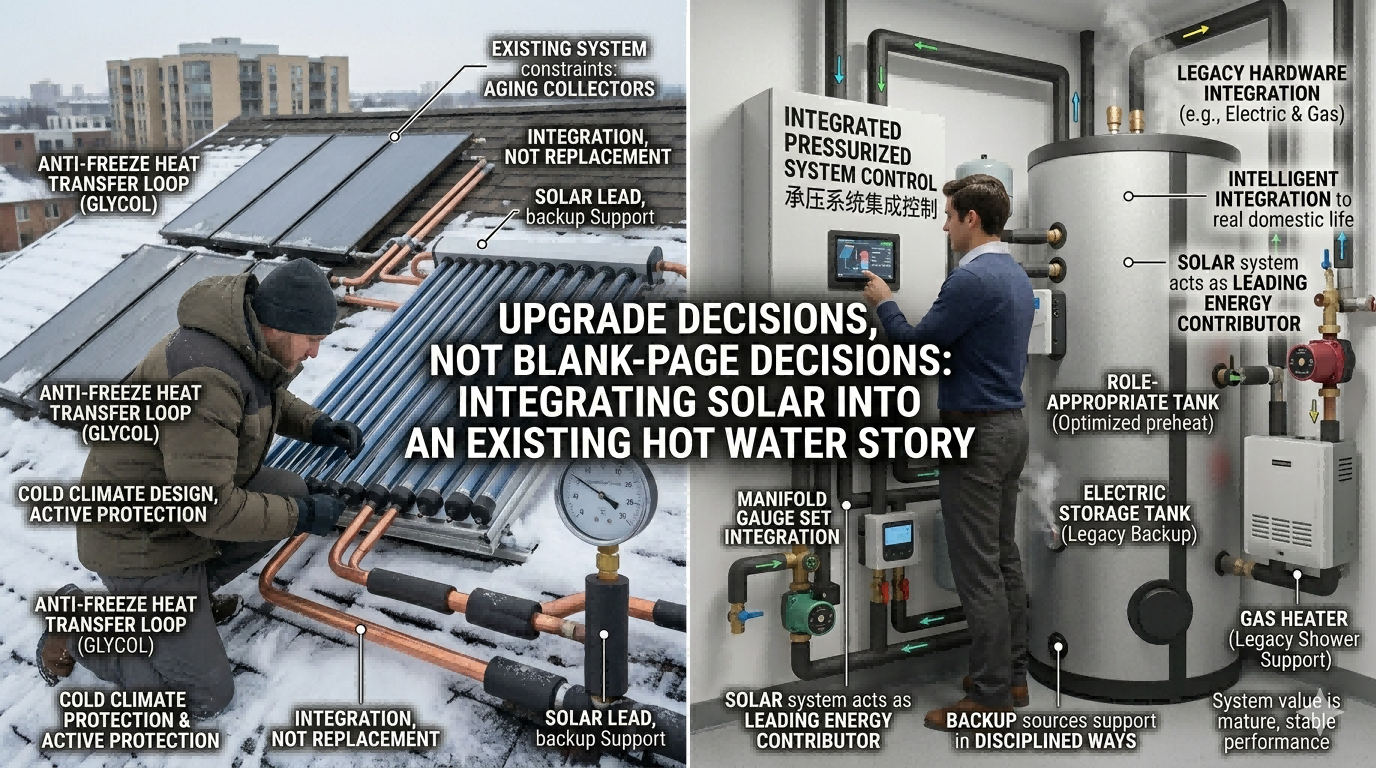
This is why a pressurized solar water heater should be designed as an integrated domestic system, not merely as a collector package attached to a water tank. The pressure-bearing side of the installation must feel harmonized with the solar side. The hydraulic path, control logic, tank behavior, and backup interaction should all support the delivery standards expected by the house.
In a solar water heater for modern homes, this integration matters immensely. Modern plumbing expectations are unforgiving. Users expect not just hot water, but smooth and predictable hot water. They expect the solar installation to work with the house, not ask the house to adapt to it. The more a system feels like an engineered whole, the more likely it is to be judged a success.
Reliability Comes from Protection Strategy as Much as from Performance Strategy
A robust solar water heater system design does not focus only on extracting heat. It also plans for the moments when the system should restrain itself, protect itself, or gracefully handle conditions that differ from ideal operation. This includes hot weather, low demand periods, sensor failure, pump interruption, scaling risk, air management, expansion behavior, and service events.
Many disappointing systems fail not because their normal-mode performance was weak, but because their abnormal-mode behavior was insufficiently considered. The system worked well when everything was ordinary, but struggled when occupancy dropped, summer temperatures rose, or one small control fault disrupted normal circulation. True reliability includes resilience.
This is another reason reliable solar water heating system design is more than product selection. Reliability emerges when performance logic and protection logic are designed together. A system that collects well but protects poorly is not truly strong. A system that is slightly less aggressive in solar gain but much more disciplined in stability can easily become the better project over ten years of ownership.
Design for Service, Not Just for Startup
Startup day is emotionally powerful. The collectors look good, the tank is in place, the controller lights up, and hot water is produced. Many projects are judged at this moment as if success has already been secured. But the real project begins after startup. Systems age. Owners change. Service technicians arrive years later without the same context the installer once had. Components may need checking, replacement, flushing, adjustment, or recalibration. A design that ignores this reality is not mature.
A good pressurized solar water heater installation is therefore one that can still be understood later. Isolation points should be sensible. Service access should be possible. Pipework should not create avoidable confusion. Control architecture should be documented and coherent. The system should support maintenance without demanding heroic effort. This is part of engineering quality, not an optional extra.
It is also a major commercial advantage. Owners trust systems they can live with. Installers build stronger reputations when their projects remain serviceable and intelligible. A reliable solar water heating system is not just a thermal success. It is a lifecycle success.
Common Design Errors That Quietly Destroy Good Projects

The market often focuses on dramatic failures, but many real-world disappointments come from quieter design errors that do not cause immediate collapse, only long-term underperformance.
Starting from maximum roof area instead of actual domestic demand
This creates systems that look ambitious but behave awkwardly.
Treating solar water heater pipework as a routing problem instead of a thermal design problem
This leads to unnecessary loss, service difficulty, and compromised system efficiency.
Choosing storage by habit rather than by solar water heater tank sizing logic
This creates tanks that are too generic for the project’s real demand profile.
Using simplistic solar hot water pump logic that ignores actual building rhythm
This creates cycling, weak harvesting, or unstable response.
Ignoring the seasonal meaning of solar collector angle for water heater decisions
This produces systems optimized for the wrong months.
Designing for installation day instead of lifecycle service reality
This undermines ownership experience over time.
These errors are common because they arise from rushing the system into existence rather than designing it as a long-term building asset. The cure is not more expensive products. The cure is better design discipline.
A Better Design Process Works from Function to Form
The most successful projects usually follow a more disciplined sequence:
First, define domestic hot water behavior.
Second, define solar contribution goals.
Third, determine storage strategy.
Fourth, pair collector field and storage.
Fifth, refine solar collector angle for water heater according to climate and seasonal priority.
Sixth, plan solar water heater pipework as part of performance design.
Seventh, create control philosophy and solar hot water pump logic.
Eighth, validate service access and protection behavior.
Ninth, commission the system based on how it actually behaves, not how it was assumed to behave.
This sequence is powerful because it starts with function and only then moves toward form. It resists the market’s temptation to choose the visible product first and solve the rest later. That is exactly what serious solar water heater system design should do.
The Best System Often Feels Unremarkable to the Owner
There is a paradox in domestic energy systems: the better the design, the less drama the owner experiences. The owner does not wake up excited about pump differential settings or pipe insulation thickness. The owner simply expects hot water to be there, to feel stable, and to reduce conventional energy use without creating confusion. In that sense, the best pressurized solar water heater often feels unremarkable in daily life. It does its job so smoothly that the owner rarely thinks about it.
That quiet success is the result of engineering discipline. It comes from correct solar water heater tank sizing, balanced collector planning, intelligent solar hot water pump logic, disciplined solar water heater pipework, and a seasonal strategy built into the solar collector angle for water heater. It comes from designing the installation as a domestic system, not just as a solar product.
This is why a solar water heater for modern homes should be sold and designed at a higher level than generic sustainability equipment. Modern homes do not merely want visible technology. They want mature technology. Mature technology is technology that behaves appropriately, predictably, and gracefully.
Final Thought
A pressurized solar water heater becomes reliable long before the first liter of hot water is used. It becomes reliable when the system is designed with discipline: when demand is defined before the roof is filled, when solar collector angle for water heater is treated as a seasonal strategy, when solar water heater pipework is engineered as a performance path, when solar water heater tank sizing reflects real domestic behavior, and when solar hot water pump logic is built to harvest heat intelligently rather than mechanically.
That is the real standard behind a reliable solar water heating system. It is not the result of one premium component or one impressive specification. It is the result of correct relationships among all parts of the installation. The collector must match the tank. The tank must match the load. The controls must match the thermal reality. The installation must match the building. The service logic must match the lifetime of the project.
When those relationships are respected, a pressurized solar hot water system stops feeling like a collection of equipment and starts behaving like a true building system. That is the goal of serious solar water heater system design—not just to make hot water, but to make dependable, comfortable, long-term domestic performance feel natural.
#PressurizedSolarHotWaterSystem
#SolarWaterHeaterSystemDesign
#SolarWaterHeaterPipework
#SolarWaterHeaterTankSizing
#SolarHotWaterPumpLogic
#SolarCollectorAngleForWaterHeater
#PressurizedSolarWaterHeaterInstallation
#SolarWaterHeaterForModernHomes
#ReliableSolarWaterHeatingSystem
#SolarThermalEngineering
#DomesticHotWater
#RenewableEnergy
#HotWaterSystemDesign