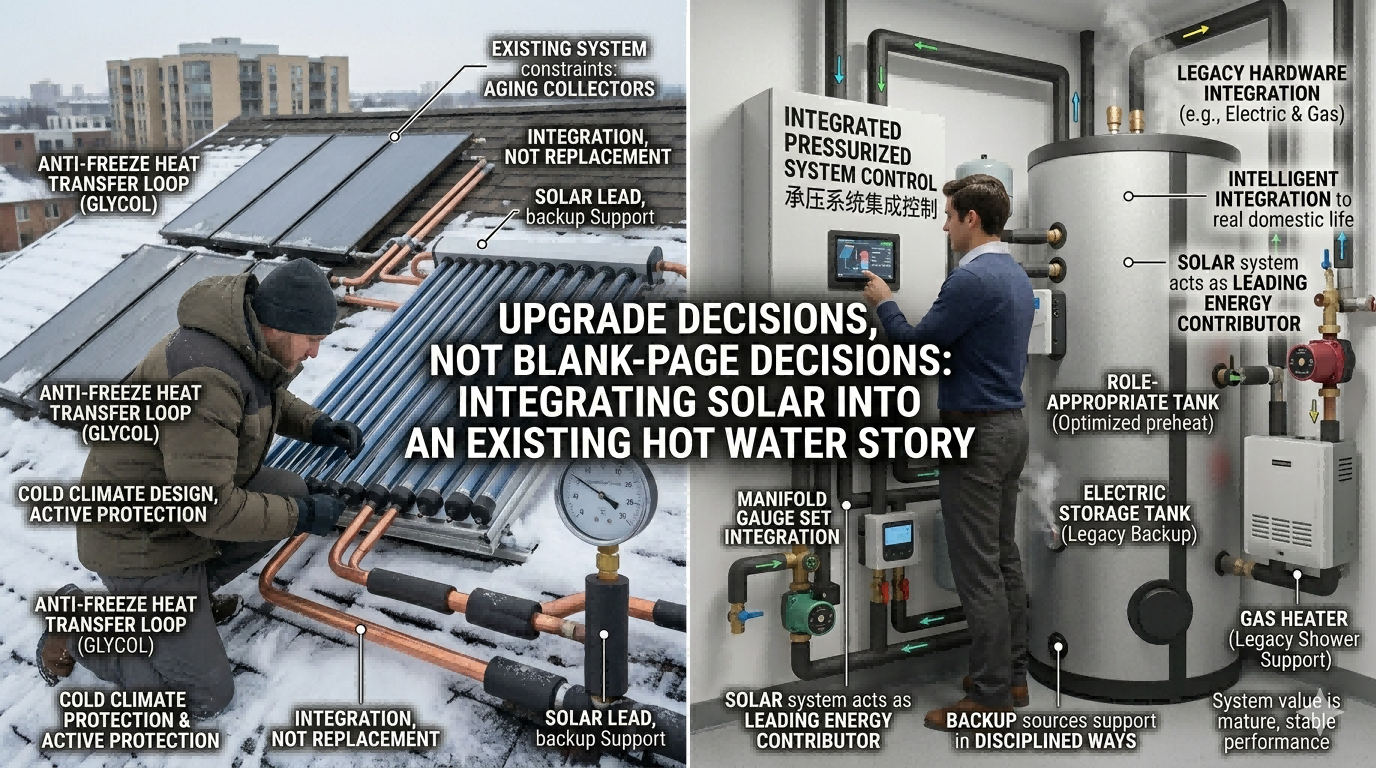
Why Pressurized Solar Water Heaters Overheat, Leak, or Trigger Pressure Relief Valves—and How to Prevent It
A Pressurized Solar Water Heater Rarely “Fails for No Reason”
When a homeowner sees hot water dripping from a discharge pipe, moisture appearing around fittings, or steam-like heat building around the system in summer, the first reaction is usually emotional. Something must be broken. The collector must be too powerful. The tank must be defective. The installer must have used poor components. These reactions are understandable, but in many cases they are not accurate. A pressurized solar water heater usually does not fail randomly. It sends signals first. The problem is that many people misunderstand those signals.
A system that overheats, leaks, or repeatedly opens a relief valve is often not experiencing a single isolated fault. It is revealing an imbalance. In a pressurized solar hot water system, temperature, pressure, circulation, storage, and control logic are tightly connected. When one part of that chain is poorly matched, the resulting symptom can appear somewhere else entirely. The leak may not begin where the real problem starts. The discharge pipe may be doing exactly what it was designed to do. The overheating event may not mean the collector is “too strong,” but rather that the system has nowhere sensible to put the heat it collected.
This is why professional solar water heater troubleshooting begins with system logic rather than with panic. A technician or informed buyer should ask: what is this symptom trying to tell us about energy movement, pressure behavior, and protective control? Is the system collecting too much for its storage and demand profile? Is circulation delayed or interrupted? Is thermal expansion being managed properly? Is the pressure relief valve responding to a real overpressure event, or is it masking a deeper design mismatch?
These questions matter because a reliable pressurized solar water heater is not simply one that heats water efficiently. It is one that remains stable under ordinary use, strong sun, variable demand, and seasonal change. Stability is the real mark of maturity in solar hot water engineering. A system that produces hot water but becomes difficult in summer, noisy under peak temperature, or suspiciously wet around its relief discharge is not yet fully engineered from the user’s point of view.
The good news is that most recurring solar water heater pressure problems are understandable. They are not mystical. They come from a finite set of causes: excess heat without enough absorption, restricted or mistimed circulation, inadequate expansion space, undersized or poorly placed safety devices, pipework that traps heat or air in unhelpful ways, storage that does not match demand, and control strategies that react too late or too simply. Once these causes are understood, prevention becomes much more practical.
This article therefore takes a different approach from generic product promotion. It does not try to convince the reader that every issue is rare or insignificant. Instead, it treats overheating, leakage, and relief-valve discharge as diagnostic clues. In other words, the system is not merely misbehaving. It is communicating. The job of the designer, installer, distributor, or owner is to understand what it is saying before a small issue becomes a reputation problem or a long-term reliability problem.
The Three Symptoms People Notice First—and Often Misread
In the field, most owners do not begin with thermal theory. They begin with what they can see, hear, or feel. Three symptoms tend to trigger concern faster than anything else in a high pressure solar water heater safety discussion:
- the system gets “too hot” or seems unstable in strong sun
- water appears where it should not, leading to concern about solar water heater leaking
- a discharge line drips or relieves water, causing alarm around the pressure relief valve solar water heater assembly
These symptoms are real, but they are often misread because users assume symptom equals root cause. It rarely does.
Overheating is usually interpreted as collector excess
When people talk about solar water heater overheating, they often imagine a collector that is overly aggressive or unsuitable for the climate. That can be part of the story, but overheating is more often a system balance issue than a collector identity issue. Heat becomes a problem when the system cannot absorb, move, store, or dissipate it properly. A collector alone does not create failure. A poorly managed energy path creates failure.
Leaking is often interpreted as material failure
Visible moisture or dripping fittings quickly make owners think the tank or piping has failed. Sometimes that is true. But solar water heater leaking can also be secondary. Repeated heat stress, expansion pressure, overtemperature events, valve discharge, or cycling at the wrong pressure can all create the conditions that make leaks appear. In many cases the leak location is only the weakest point, not the original cause.
Relief valve discharge is usually interpreted as a faulty valve
This is one of the most common misunderstandings in the entire category. When a pressure relief valve solar water heater line discharges, many people assume the valve itself is bad. Sometimes the valve does fail or foul over time, but very often it is doing its protective job correctly. The more useful question is not “Why is this valve defective?” but “Why is the system repeatedly reaching a condition that requires the valve to respond?”
That shift in mindset is critical. A strong pressurized solar water heater strategy is not built on hiding these symptoms. It is built on understanding them.
Overheating Is a Storage-and-Absorption Problem Before It Becomes a Temperature Problem
The phrase solar water heater overheating sounds like a temperature issue, but in engineering terms it is better understood as an absorption problem. The system is collecting energy faster than it can productively use or safely store it. Once viewed this way, overheating becomes much easier to diagnose.
A solar thermal system is constantly answering one question: where should the heat go now? If the house is drawing hot water, some of the answer is immediate use. If the storage tank is cool enough, some of the answer is storage. If the circulation strategy is functioning correctly, some of the answer is controlled transfer. But if storage is already hot, demand is low, the pump is off or mistimed, or the control logic is too crude to manage strong solar input, then the system has no elegant destination for incoming heat. That is when temperature rises from useful to stressful.
This matters particularly in a pressurized solar hot water system, because pressurized domestic systems are often installed in buildings that expect stable year-round comfort. That means the system may be relatively ambitious in collector area or performance expectation. If the household is away during the day, if summer demand is lower than anticipated, or if the tank is sized according to generic habit rather than actual use, the system can become thermally “full” long before the day’s solar gain is over.
A common mistake in design is assuming that strong collector performance is always desirable. In reality, strong collection must be matched by adequate storage, sensible demand timing, and intelligent control. Otherwise the system becomes like a business that keeps taking deliveries after the warehouse is full. The problem is not that deliveries arrive. The problem is that there is nowhere orderly to put them.
This is why a reliable pressurized solar water heater is usually calmer in summer, not merely more productive. Calmness is an engineering achievement. It means the system has been sized and controlled with seasonal surplus in mind.
Signs that overheating is really a balance issue
If the system behaves well in moderate weather but becomes troublesome only during strong sunny periods, this strongly suggests a system-balance problem. If the tank is already hot by midday and relief events occur later in the afternoon, that is not random. If no one is using hot water while the collectors remain fully exposed, the thermal load path is clearly incomplete. If the collector array is large relative to the building’s actual hot water draw, overheating is even more likely to be a design outcome rather than a surprise defect.
Why summer reveals hidden weakness
Winter can hide poor design because the environment naturally absorbs some mistakes. Lower ambient conditions reduce solar intensity, household demand may be stronger, and the system has more room to move heat into useful storage. Summer is less forgiving. The sun is stronger, the tank heats earlier, demand may be lower, and the margin for control error becomes smaller. That is why many owners first notice solar water heater pressure problems during hot seasons.
Leakage Is Often the End of the Story, Not the Beginning
Few symptoms damage owner confidence faster than visible water. Once someone sees damp insulation, staining around fittings, or dripping beneath the tank or relief line, the immediate conclusion is solar water heater leaking. The phrase sounds simple, but the underlying causes vary widely. In many cases, leakage is not the original problem. It is the final visible expression of a system that has been stressed elsewhere.
In a pressurized solar water heater, leakage can emerge from repeated thermal expansion, cycling pressure, gasket fatigue, joint stress, valve discharge pathways, material aging, or poor support of pipe runs that expand and contract with temperature swings. These conditions do not always appear dramatically on the first day. They accumulate. A fitting that seems acceptable during commissioning may become vulnerable after months of repeated expansion stress if the system frequently reaches aggressive temperature conditions.
This is why professionals should avoid treating every leak as a purely local repair issue. Tightening one fitting may stop one drip, but it does not answer why that point became the failure point. Was the system repeatedly overheating? Was the expansion vessel undersized or incorrectly charged? Was the pipe route allowing too much thermal movement without compensation? Was a relief line intermittently discharging and being mistaken for a leak? Was the tank experiencing higher-than-intended stress because the control strategy allowed it to sit too long at elevated temperature?
A mature solar water heater troubleshooting process asks these questions before declaring victory. Otherwise, the project becomes a cycle of symptom repair rather than system correction.
Not all “leaks” are true leaks
An important nuance in solar water heater leaking discussions is that not all visible water indicates the same type of failure. Relief discharge can be mistaken for leakage. Condensation can be misread in some climates or installation zones. Minor seepage around safety components after temperature events may indicate overpressure conditions more than bad assembly. That is why diagnosis should include timing. When does the water appear? During hottest hours? After pump cycles? After long sunny periods with low use? Timing often reveals more than the wet spot itself.
Why weak points fail first
In any stressed system, the weakest point announces the problem first. That does not make it the original cause. In a pressurized solar hot water system, the weakest point might be a valve seat, a threaded joint, a poorly supported section of pipe, or a fitting exposed to repeated heat expansion. Repairing that point is necessary, but diagnosing only that point is insufficient.
A Pressure Relief Valve Is a Messenger, Not the Villain

If there is one component that homeowners misunderstand most, it is the relief valve. The phrase pressure relief valve solar water heater often shows up in customer complaints because discharge looks alarming. Water coming from a safety device feels like failure, and many people assume the valve is defective simply because it opened.
In reality, the relief valve is often the system’s last honest component. It is telling you the installation reached a condition it was designed to protect against. In other words, the valve is not the main story. It is the messenger.
A relief valve opens for a reason: excessive pressure, excessive temperature, or both, depending on system design and device type. In a pressurized solar water heater, those conditions usually arise from one of several broader causes:
- the water expanded as temperature rose, but the system lacked adequate expansion accommodation
- the tank reached a temperature range that drove pressure upward during low-demand conditions
- circulation failed or lagged, allowing collector-side heat to intensify system stress
- the relief valve was correctly sized, but the rest of the protective strategy was incomplete
- the expansion vessel existed but was mischarged, waterlogged, or not properly matched to the system
This is why repeated discharge should never be normalized. A single occasional protective event may occur under unusual conditions. Repeated events mean the system’s routine behavior is pushing regularly into its protective boundaries. That is not the valve’s fault. It is a design or operating issue.
Why owners should not “silence the symptom”
One of the worst responses to repeated discharge is trying to suppress the messenger without curing the cause. Replacing a functioning valve with a harder-opening one, capping relief flow incorrectly, or treating discharge as an annoyance rather than a warning can create a false sense of stability. In serious cases, that is exactly how manageable thermal stress becomes a safety problem. A responsible high pressure solar water heater safety approach respects the protective chain rather than trying to hide it.
Relief valve discharge is often linked to expansion, not only to collector heat
This distinction is important. People commonly assume the collector is to blame whenever a relief valve opens. But many relief events in a pressurized solar hot water system occur because hot water expands in a closed volume with insufficient cushioning. The system may be functioning exactly as a pressurized system normally would—until thermal expansion has nowhere acceptable to go. That brings us directly to one of the most overlooked components in the whole category.
Expansion Space Decides Whether Heat Stays Manageable or Turns into Pressure Trouble
A closed, pressurized thermal system changes character when water is heated. It expands. This is basic physics, but in practical system design it becomes one of the most decisive issues in preventing solar water heater pressure problems. A solar hot water expansion tank is not a peripheral accessory. It is one of the components that determines whether temperature rise remains manageable or becomes a pressure event.
In a pressurized solar water heater, expansion management is especially important because the system operates within a sealed, pressurized domestic environment rather than a gravity-fed open condition. When the tank heats, pressure rises unless there is somewhere for that expansion energy to be buffered. If the expansion vessel is absent, undersized, mislocated, poorly charged, or degraded over time, the relief valve ends up handling conditions that should have been smoothed out much earlier.
This is one reason many projects appear fine at startup and become troublesome later. The system may have been marginally acceptable when new, then become less forgiving as real seasonal conditions, user patterns, and component aging exposed the weakness. A solar hot water expansion tank that is improperly matched to actual system volume or actual temperature behavior may quietly allow repeated pressure swings that the owner only notices once discharge becomes obvious.
Expansion control is part of reliability, not just compliance
Some installers or buyers think of expansion tanks mainly as code or specification items. That mindset misses their real value. In a reliable pressurized solar water heater, the expansion function helps prevent stress cycling, nuisance discharge, and avoidable wear on system joints and valves. It reduces drama. And in thermal engineering, reducing drama is a serious achievement.
Symptoms of poor expansion management
Frequent relief discharge during hot periods, pressure gauge instability, leak emergence after sunny days, and repeated complaints that “the system seems fine until it gets really hot” often point toward inadequate expansion strategy. Not always, but often enough that no competent diagnosis should ignore it.
Circulation Problems Turn Normal Solar Gain into Abnormal System Stress
Even a well-sized system can become unstable if heat is not moved when it should be moved. That is why circulation belongs at the center of serious solar water heater troubleshooting. Heat collection is only valuable when the system can transfer it productively. If the pump fails, starts too late, stops too early, loses prime, misreads sensor conditions, or moves heat inefficiently due to pipe or control issues, then thermal energy starts accumulating in the wrong place at the wrong time.
A pressurized solar water heater with weak circulation behavior may still appear functional in mild conditions. The owner gets hot water, the display works, and the system seems active. But under strong solar input, the weakness becomes more obvious. Collector temperatures rise faster than expected. The tank does not seem to absorb heat as efficiently as the weather would suggest. Pressure events become more likely. Relief discharge may appear. Eventually, users interpret the symptoms as overheating or leakage, when the deeper issue is poor heat transfer discipline.
This is why pump logic, sensor accuracy, pipe layout, air management, and commissioning quality are all part of the same conversation. In a pressurized solar hot water system, circulation is the bridge between solar opportunity and domestic stability. If the bridge is weak, the rest of the system becomes vulnerable.
Intermittent circulation faults are especially deceptive
A permanently failed pump is easier to identify than a pump that only underperforms in certain conditions. Intermittent faults—air in the loop, inconsistent sensor reading, control thresholds set too bluntly, or circulation that behaves poorly at marginal differentials—can be much harder to diagnose. Yet these are exactly the kinds of issues that create “mystery” solar water heater overheating complaints.
Storage Strategy Can Prevent Problems—or Create Them
Many owners assume that once the tank reaches temperature, the system is succeeding. But a tank that becomes hot too early, too easily, or without enough relation to actual demand can create instability later in the day. In this sense, storage strategy is not just about quantity. It is about timing and operating behavior.
A pressurized solar water heater designed for strong spring and winter support may become thermally crowded in summer if the tank size, collector area, and household demand are not in balance. A building with low daytime occupancy and modest hot water use may fill its storage capacity earlier than expected. From that moment onward, the system is no longer solving the problem of domestic hot water supply. It is solving the problem of what to do with extra heat. If no good answer exists, pressure and temperature problems emerge downstream.
This is why a reliable pressurized solar water heater should be evaluated not only by how well it heats, but by how gracefully it behaves after heating. Does it remain calm once the useful load is satisfied? Or does it become a system that needs constant protective intervention?
The Best Troubleshooting Sequence Starts with Energy Flow, Not with Replacement

When owners are frustrated, there is a strong temptation to replace parts immediately. New valve. New sensor. New fitting. New pump. Sometimes replacement is necessary, but the order of diagnosis matters. Good solar water heater troubleshooting begins by tracing energy flow and pressure behavior across the system.
A useful diagnostic sequence often looks like this:
Step 1: Ask when the symptom happens
Does the issue appear only on strong sunny days? Only in summer? Only when nobody is home? Only after the tank has already heated? Timing reveals whether the issue is related to demand mismatch, expansion pressure, circulation failure, or local material weakness.
Step 2: Distinguish true leakage from relief discharge
Before diagnosing solar water heater leaking, confirm whether water is coming from a failed seal, a connection point, condensation, or a relief outlet. Misidentifying the water source can waste hours and lead to unnecessary part changes.
Step 3: Check operating temperature and pressure behavior together
Temperature without pressure data is incomplete. Pressure without timing is incomplete. In a pressurized solar hot water system, the relationship between the two is often where the answer lives.
Step 4: Evaluate expansion accommodation
Does the solar hot water expansion tank exist, function correctly, and match the actual system? Is it waterlogged, isolated, or improperly charged? This is one of the fastest ways to explain repeated relief events.
Step 5: Review circulation logic
Are the pump and controller harvesting heat when they should? Is heat being transferred effectively to storage? Are sensors telling the truth? Is pipework preventing proper movement?
Step 6: Look at design mismatch, not just component failure
Is the collector field too strong for the demand profile? Is the storage volume too generic? Is the household usage pattern too light to absorb collected summer heat? This is where “product complaint” often becomes “project design lesson.”
This structured approach is what separates professional diagnosis from guesswork.
Prevention Is More Valuable Than Heroic Repair

By the time a system is repeatedly overheating or discharging relief water, the owner is already losing confidence. Repair matters, but prevention is better. A mature industry message should therefore focus not only on how to react when a pressurized solar water heater misbehaves, but on how to prevent predictable misbehavior during design, installation, and routine maintenance.
Prevention starts with better sizing
Collector area, storage volume, and expected hot water demand must be paired realistically. Overly ambitious collection without a credible absorption path is one of the fastest routes to seasonal overheating stress.
Prevention requires real expansion strategy
A properly selected and maintained solar hot water expansion tank is not optional in serious pressurized system stability. It protects components and reduces nuisance pressure events.
Prevention depends on calm control logic
Aggressive or simplistic control can make a system look active while actually increasing instability. Intelligent circulation logic keeps temperature movement useful rather than theatrical.
Prevention includes service visibility
A reliable pressurized solar water heater is easier to keep stable when technicians can inspect pressure behavior, verify discharge, check vessel condition, and access key components without turning every visit into a major operation.
Prevention means respecting seasonal behavior
A system should not be judged only on a pleasant spring day. It should be judged by what it does in peak summer sun, low-demand periods, and real domestic variation.
What a Healthy Pressurized Solar Water Heater Looks Like
It is useful to finish not with failure, but with normalcy. What does a healthy system feel like from the user side?
A stable pressurized solar water heater delivers hot water without drama. The relief line is not repeatedly discharging. Fittings remain dry. Summer operation does not create anxiety. The system heats effectively, but not hysterically. Pressure remains controlled. Expansion is quietly absorbed. The user does not feel forced to understand thermal engineering just to trust the installation.
From the technical side, a healthy pressurized solar hot water system also has a distinct personality: balanced rather than aggressive, protected rather than brittle, predictable rather than reactive. It collects heat, moves it when appropriate, stores it sensibly, and protects itself when conditions become extreme. That is what good engineering looks like in everyday life.
Final Thought
A pressurized solar water heater that overheats, leaks, or repeatedly triggers a pressure relief valve solar water heater assembly is usually not suffering from random bad luck. It is showing the consequences of system imbalance. Solar water heater overheating often points to excess heat without enough absorption, transfer, or seasonal control. Solar water heater leaking often reflects stress that has built up over time rather than a purely local defect. Repeated relief discharge often means the system’s protective boundary is being reached too often, not that the valve itself is the true problem.
That is why serious solar water heater troubleshooting should begin with relationships: temperature to storage, heat gain to demand, circulation to control logic, pressure to expansion space, and symptom to timing. In a mature pressurized solar hot water system, stability comes from designing these relationships correctly. A proper solar hot water expansion tank, sensible collector-to-load balance, disciplined circulation, and honest seasonal design all contribute to that stability.
The ultimate goal is not just to stop one leak or replace one valve. The goal is to create a reliable pressurized solar water heater that behaves calmly under real domestic conditions. In the end, that is the clearest definition of quality in this category: not merely the ability to get hot, but the ability to stay under control.
#SolarWaterHeaterOverheating
#SolarWaterHeaterLeaking
#PressureReliefValveSolarWaterHeater
#PressurizedSolarHotWaterSystem
#SolarWaterHeaterTroubleshooting
#HighPressureSolarWaterHeaterSafety
#SolarHotWaterExpansionTank
#SolarWaterHeaterPressureProblems
#ReliablePressurizedSolarWaterHeater
#SolarThermal
#DomesticHotWater
#RenewableEnergy
#HotWaterSystemSafety