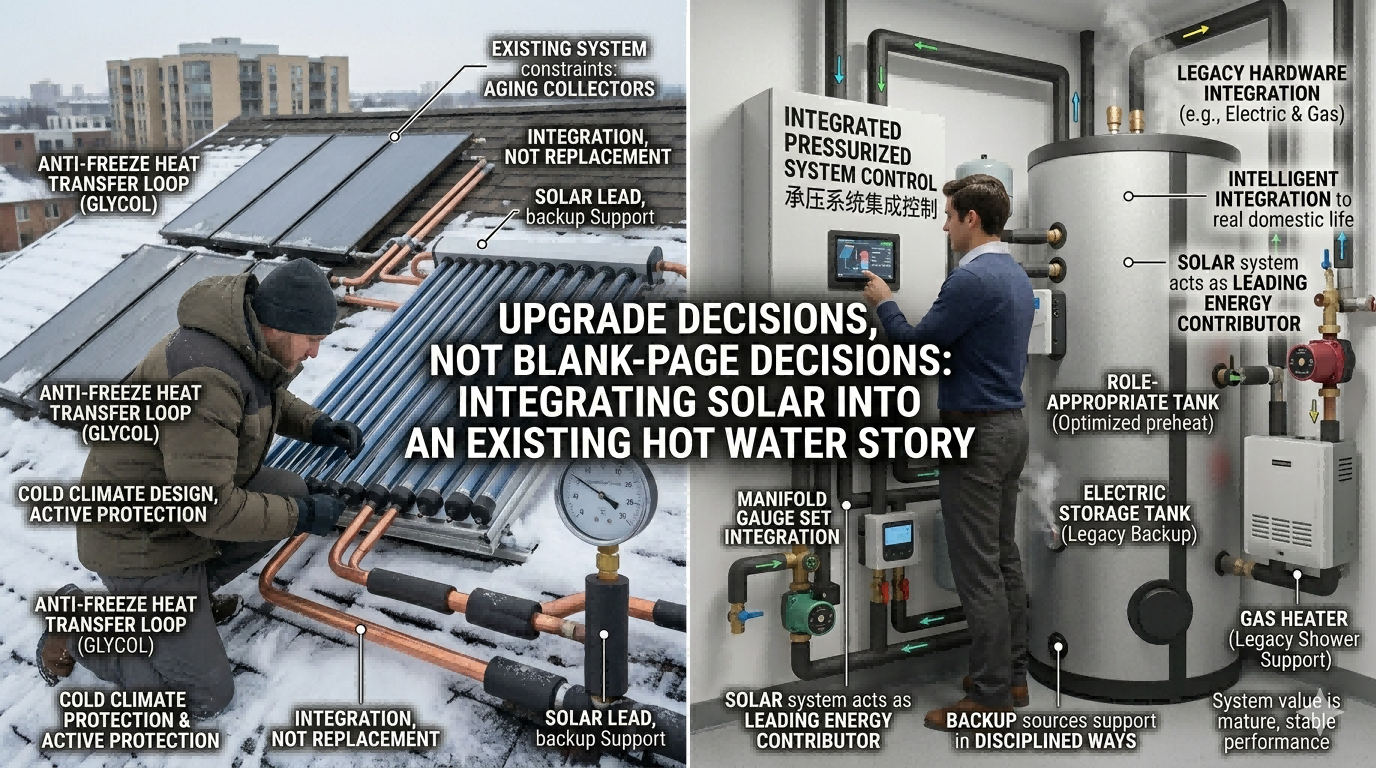
Pressurized Solar Water Heater Acceptance Evidence Buyers Need Before Sign-Off
A Warm Tap Is the Beginning of the Acceptance Discussion
A solar water heater acceptance checklist should help a buyer decide which project requirements have been demonstrated, which remain unresolved, and what responsibility can reasonably transfer to the operator. Hot water at an outlet proves something useful about service at that moment. It does not identify how much heat came from the sun, confirm every installed component, or establish that the owner has received a maintainable system.
Consider a hypothetical hotel preparing to reopen after a hot water plant upgrade. The installer presents photographs of rooftop collectors, a controller showing a warm tank, and a signed completion sheet. The existing backup heater is also operating. The facilities manager can obtain hot water, but cannot yet tell whether the solar circuit contributed, whether the controller is in its intended operating mode, or whether the delivered equipment matches the approved revision.
Three different decisions are hidden inside that apparently simple handover meeting: whether the installation is ready for the proposed use, whether the required functions have been demonstrated, and whether longer-term energy claims have been verified. Treating them as one signature creates uncertainty for both the buyer and the contractor. Separating them makes legitimate progress visible without turning an unfinished test into a completed promise.

The owner's central question: What exactly does each record allow us to conclude about this installed system, under these conditions, on this date?
This guide follows that question through a buyer's review. It complements the site's installation and commissioning procedures for split solar systems. The focus here is evidence, unresolved findings, and operational responsibility. The hotel scenario, document identifiers, decision tables, and numerical example below are original teaching examples, not reports from an actual project or prescribed acceptance forms.
Apply the review to the architecture actually purchased. A pressurized system does not necessarily have a circulation pump, a glycol loop, or remote monitoring. Mark irrelevant evidence items as not applicable with a reason. Tests involving pressure, electrical systems, protective devices, or operating limits belong to qualified personnel following the approved design, applicable requirements, and the relevant manufacturer instructions.
Read the Completion Claim Before Reading the Test Results

At the hotel meeting, the first useful action is to ask what the contractor means by complete. Equipment delivery, installation completion, permission to operate, functional verification, operator training, and a contractual performance review may occur at different times. A receipt for delivered equipment cannot answer a question about field operation. Equally, an outstanding seasonal evaluation does not automatically mean that every installation task is unfinished.
Write the requested decision at the top of the review sheet. For example: review of installed configuration and specified operating functions, with a separately scheduled performance assessment. That sentence sets the scope of the meeting. It prevents a detailed discussion about pump readings from obscuring a missing operating manual, and it prevents a commercial signature from being interpreted more broadly than the evidence permits.
The public scope of ASTM E1160-13(2021) illustrates the distinction between checking operation and measuring performance precisely. It describes on-site checks and short-term baseline information, while excluding accurate measurement of system performance or thermal efficiency. The published scope names flat-plate, concentrating-type collectors, and tank-absorber systems; applicability to other configurations must be checked. This article uses only the publicly available scope, not the purchased standard or its test procedures. [1]
For the hotel, define the service boundary explicitly. Does the agreed observation concern the solar preheat plant, the combined heating plant, or selected building outlets? Who remains responsible for retained distribution pipework? A successful observation at the plant outlet cannot silently become proof of service at every guest bathroom. Conversely, a problem in an excluded distribution branch should not be assigned to the solar supplier without investigation.
Use the approved project documents to establish those boundaries. The site's discussion of pressurized system design and control strategy provides useful background, but acceptance should refer to the actual approved drawing and revision for the site. A general article, a sales brochure, or a photograph of a similar installation is not the acceptance basis.
Turn the Handover Folder into an Evidence Register
A large folder can still leave a small number of important questions unanswered. Effective solar thermal handover documentation connects each requirement to a specific installed asset, a record, and a reviewer. The aim is not to collect the greatest number of PDFs. It is to make the reasoning behind the sign-off reproducible when a different engineer, service company, or owner reviews the project later.
Begin with a short index using identifiers that remain stable through revisions. For the hypothetical hotel, drawing AB-02 identifies the installed hydraulic arrangement, record FT-04 documents a witnessed operating sequence, and issue PL-07 records an unresolved trend-data problem. The numbering system itself has no technical significance. Its value comes from using the same references in the report, action log, and final decision.
| Decision question | Record to examine | What makes it reviewable? |
|---|---|---|
| Is this the approved equipment configuration? | Installed asset schedule and drawing AB-02. | Model and serial references, revision date, recorded substitutions, and approval status. |
| Were the relevant installation checks completed? | Contractor inspection and test records. | Identified circuit or asset, approved method, instrument details where relevant, actual result, and responsible person. |
| Did the required operating sequence occur? | Functional observation FT-04. | Starting conditions, control mode, expected response, observed response, and witness record. |
| Can the energy display support the proposed claim? | Monitoring point schedule and data export. | Measurement boundary, units, data origin, time interval, and limitations. |
| Can the facilities team take responsibility? | Training record and operating pack. | Named recipients, accessible instructions, demonstrated tasks, and escalation contacts. |
| What remains unfinished? | Issue log and decision sheet. | Defined impact, responsible party, next action, closure evidence, and review date. |
Every row needs an outcome, not just an attachment. Useful outcomes include demonstrated, not demonstrated, awaiting evidence, deferred under an agreed plan, and not applicable. Avoid an unexplained tick. A reviewer should be able to tell whether it means a document was received, its contents were checked, or a test was personally witnessed. Those are different levels of assurance.
Check whether the drawings describe the system in front of you
Review solar thermal as-built drawings against accessible equipment labels and the contractor's installation records. Look for changes that affect interpretation: a moved temperature sensor, a different heat exchanger, an added bypass, a replacement controller, or a backup connection omitted from the original schematic. The issue is whether the drawings explain the completed arrangement well enough to support operation and service.
Not every change is a defect. A documented and approved substitution may be entirely acceptable. An unrecorded substitution creates an evidence gap because the reviewer cannot determine what other documents still apply. Ask for the approval reference and the effect on the functional checks, maintenance information, and any claimed certification scope. Close the gap through a revised record instead of an informal assurance that the replacement is equivalent.
Keep a certificate separate from its supporting records
A solar thermal commissioning certificate can serve as a useful summary when the relevant project or scheme uses one. Its title alone does not establish what was tested. Check its system identifier, scope, date, signatory role, referenced reports, and listed exceptions. A one-page certificate should lead the buyer to the underlying evidence rather than replace it.
The same discipline applies to solar thermal commissioning records provided by several subcontractors. The electrical record may concern one boundary, the hydraulic record another, and the controls report a later configuration. Confirm that their asset references and revisions agree. If a controller was replaced after the original functional observation, ask which observations were repeated and which earlier results remain applicable.
For pressure-related records, identify the tested boundary: the collector circuit, a domestic water coil, a storage vessel, or particular installed pipework. A factory report about a vessel cannot document joints assembled later at the hotel. Ask for the applicable procedure reference, test conditions, instrument identification, recorded results, and the specialist's assessment. A pressure number without a circuit identity or method does not let the buyer judge whether the required check was completed. Resolve that documentary gap without substituting a generic test pressure from another product.
Witness the Question Being Answered, Not Just the Equipment Running
Well-planned solar water heater acceptance testing starts with an agreed observation and a pass criterion. The buyer should know what will be demonstrated before attending. Otherwise, a demonstration can drift toward whatever happens to work conveniently that afternoon. The contractor also benefits from clear expectations because the review does not introduce new performance requirements after the test has begun.
For each observation, record the requirement reference, the applicable system configuration, starting conditions, expected response, actual response, and evidence location. Include the test method revision and the people who performed and witnessed the work. Distinguish a measurement made during the visit from a value copied from a controller setting or a manufacturer's datasheet.
The example below shows how that information changes the decision. Its identifiers and outcomes are hypothetical. On a real project, the referenced sheets must contain the approved numerical criteria and actual readings where applicable; words such as satisfactory cannot replace those measurements.
| Requirement and criterion source | Evidence and recorded finding | Execution and review | Decision status |
|---|---|---|---|
| Installed identity against approved schedule EQ-02 and drawing AB-02. | Asset review AR-01 records matching accessible model references and an approved controller substitution. | Installer records identities; owner's representative reviews the substitution approval. | Configuration review complete within the documented inspection scope. |
| Specified outlet service under the conditions in SP-01. | Observation SV-02 records compliant readings at the agreed outlets during the defined period, with backup operating. | Commissioning specialist measures; facilities representative witnesses. | Observed service demonstrated; solar contribution remains a separate question. |
| Solar heat transfer under functional procedure FT-04. | Only tank temperature and backup status were recorded; the required heat-transfer evidence is missing. | Contractor submits additional verification for technical review. | Not demonstrated by the available record. |
| Applicable protection, domestic-water hygiene, and anti-scald verification under the project requirements. | The designated specialist's review is outstanding; record the missing approvals or observations individually. | Responsible qualified disciplines provide evidence; designated project reviewer assesses release. | Unresolved; the service observation does not replace this review. |
| Final operating mode and schedule against control revision CN-04. | Settings export CS-05 confirms the intended automatic mode after the demonstration. | Controls contractor records the final state; facilities representative checks the issued record. | Final configuration recorded; this alone does not validate every control response. |
Observation one: the required hot water service
At the hotel, a service observation might address the agreed outlet group during a defined demand period. Its scope should identify the measurement location, draw conditions, starting storage condition, and status of the backup heater. The actual temperatures, durations, and flow requirements must come from the project documents. There is no single acceptance temperature or observation duration suitable for every building.
If the selected outlets meet the agreed criterion, record that result within its stated boundary. Do not extend it to unobserved floors or an untested peak occupancy condition. If the service does not meet the criterion, preserve the observations before debating responsibility. A useful failure record identifies what was measured and under what conditions, allowing the responsible technical team to distinguish plant, control, and distribution issues.
Observation two: the solar contribution
The solar contribution needs its own evidence because backup heating can maintain service while a separate fault remains unnoticed. A rising tank temperature does not identify the heat source when several sources are active. Ask the commissioning specialist to explain how the approved method distinguishes solar heat transfer from auxiliary heating and stored energy already present at the beginning of the observation.
Where a pump is fitted, a controller command is only one part of that explanation. The relevant record should distinguish the command, the observed circulation or other approved flow evidence, and the associated temperature information. The buyer does not need to improvise a test by disconnecting sensors or disabling protection. The responsible specialist should provide a suitable method and explain the limits of its conclusions.
The existing solar and backup heater integration guide explains why these interfaces matter. At acceptance, the practical deliverable is a record of the installed sequence and the conditions observed. A statement that the appliances are compatible is less informative than evidence showing how the actual combination responded.
Observation three: the state in which the system is left
A functional demonstration may temporarily use a service mode or a revised schedule. The review should identify those temporary changes and require confirmation of the final intended configuration. A successful response obtained through manual intervention does not, by itself, show that the same response will occur under normal control. Preserve the relevant final settings record alongside the test result.
Include the building controls interface where it is within scope. A local display and a facilities dashboard may use different labels or units. Ask for an observation showing that the point displayed to the operator represents the intended physical measurement. A screenshot is much more useful when its point name can be traced to a sensor location on the drawing and to a timestamp in the recorded data.
Challenge the Number on the Screen Before Using It as Evidence
Solar thermal performance monitoring becomes useful when the owner can explain where each number comes from. A display marked kWh may report an estimate, a meter total, or a calculation based on several inputs. Those approaches can serve different purposes. The acceptance review should establish which approach is installed and whether it is suitable for the particular claim being evaluated.
RESOL's DeltaSol CS Plus manual provides a concrete product example: its heat quantity function can estimate heat using an entered fixed flow-rate value, or use the supported flow sensor, with the required temperature and heat-transfer-fluid inputs. Therefore, the same type of energy display can have different evidential meaning depending on configuration. This is a model-specific example; the buyer should check the manual and settings for the controller actually supplied. [2]
Separate three heat boundaries
Heat collected in the solar circuit, heat transferred into storage, and heat delivered toward the building are different accounting locations. Pipework losses, storage changes, auxiliary heating, and the selected observation interval can affect the relationship between them. A useful monitoring schedule names the location of each measurement and the components included between the measurement points.
The System Advisor Model solar water heating documentation illustrates why this distinction matters by reporting separate quantities for useful heat supplied to the tank, heat delivered at the solar storage tank outlet, tank losses, auxiliary heating, and pumping. Those are simulation outputs within that model's assumptions, not interchangeable labels for field measurements. The procurement lesson is to name the quantity being accepted before comparing it with a prediction. [3]
For a closed collector loop, also identify the heat transfer fluid and the basis used by the measuring system. Treat an undocumented fluid setting as a review question rather than assuming it is correct because the displayed total increases. The owner needs a record of the configured basis and the responsible specialist's verification, not a generic calculation pasted from a different project.
To assess the measurement itself, request instrument identities, suitable measurement ranges, and the applicable calibration or verification records. Confirm the flow and temperature measurement locations and whether the readings represent the same time interval. Ask the responsible specialist whether measurement uncertainty is small enough to support the agreed decision, especially when a result lies close to a contractual limit. Extra decimal places on a display are not evidence of greater accuracy. A result that cannot reliably distinguish compliance from noncompliance needs a better-supported assessment, not more confident wording.
A small example of a large interpretation error
Suppose the hotel's hypothetical heat counter reads 1,240.6 kWh at the beginning of an observation and 1,259.0 kWh at the end. The counter increased by 18.4 kWh. If the configured measurement boundary is heat transferred from the solar loop into storage, and the counter and inputs are valid, that difference describes the recorded heat crossing that boundary during that interval.
It does not automatically mean 18.4 kWh reached the guest outlets, 18.4 kWh of electricity was avoided, or the hotel saved a particular amount of money. Those claims require additional boundaries and a suitable comparison. Nor can the interval total be multiplied by an arbitrary number of sunny days to establish annual savings. The calculation is simple; the meaning of the result depends on the evidence around it.
PNNL's solar water heating guidance links heat delivery assessment to flow, fluid heat capacity, and temperature change, and discusses the use of monitoring or estimation for measurement and verification. That supports a direct buyer question: which inputs are measured, which are assumed, and how is the result recorded? An estimated quantity can be useful when its method and limitations are visible. [4]
Check the data trail, not only the dashboard
Ask the supplier to export a short sample during the handover review. Check whether the file includes timestamps, units, point names, and the relevant operating states. Confirm the timezone and whether the displayed value is cumulative or an interval total. Identify how resets, missing readings, and changes of device appear. These details determine whether a later analyst can reproduce an interpretation.
For example, a daily report assembled from two different timezones can associate morning demand with the wrong solar period. A counter reset can look like negative production if the export does not flag it. A missing afternoon cannot fairly be treated as a measured zero or silently filled with a favorable estimate. Record the agreed data treatment and preserve the original file alongside any corrected analysis.
Choose the level of monitoring to match the decision. A small package sold without a measured savings guarantee does not automatically need the same instrument set as a project with a contractual energy commitment. However, a demanding performance claim cannot be supported merely by lowering the evidence requirement after installation. Resolve that mismatch explicitly with the parties responsible for the agreed scope.
Decide Whether a Finding Blocks Sign-Off, Needs Correction, or Requires Later Evidence
The most consequential part of the review is often the treatment of unresolved findings. A cosmetic label issue, an unavailable data export, an unexplained discharge event, and an unobserved seasonal operating condition should not receive the same response. Describe each issue by its consequence for the decision rather than by how easy it is to fix or how close the project is to its planned opening date.
The following categories are an editorial review tool. They do not create a contractual right to accept, withhold payment, or operate equipment. The authorized project representatives must apply the actual agreement and relevant technical requirements. In particular, a conditional status is not a substitute for resolving a safety concern or obtaining a required approval.
| Finding | Evidence problem | Appropriate review path |
|---|---|---|
| Unresolved protective-device concern or required approval missing. | The proposed release cannot be justified. | Do not sign off the affected requirement; obtain qualified resolution and the required verification. |
| Specified operating response failed. | The required function has not been demonstrated. | Assign correction and repeat the relevant observation against the approved criterion. |
| Results refer to an earlier configuration. | The report may not represent the installed system. | Identify affected evidence, update the configuration record, and determine necessary repeat checks. |
| Operating evidence is satisfactory, but a noncritical document correction remains. | The file is incomplete in a defined respect. | Consider a recorded exception only if permitted, with an owner, deadline, and closure requirement. |
| Agreed seasonal conditions have not occurred. | The planned observation cannot yet be completed. | Record a specific deferred verification plan; do not mark the unobserved result as passed. |
At the hypothetical hotel, the team separates its findings by their consequences. A controller channel has an unclear label, a recurring discharge event remains unexplained, and the agreed winter review cannot occur during the present season. Renaming the channel may be straightforward, but it still requires confirmation that the displayed point is correct. The discharge concern needs technical resolution. The winter review needs an agreed future observation, not a fabricated result.
Where symptoms require investigation, the site's guide to overheating, leakage, and relief-valve discharge provides background. The acceptance file should preserve the actual symptom, operating conditions, investigation, correction, and repeat verification. A later photograph of a dry floor does not explain why the discharge occurred or establish that its cause has been addressed.
Write a closure requirement that someone can verify
“Supplier to resolve” is too weak for a useful issue log. A stronger entry identifies the affected requirement, the responsible company and person, the agreed corrective deliverable, the review date, and who may close the issue. If the correction changes a component or a control sequence, identify which drawing, manual section, or test record also needs revision.
Distinguish the person completing the work from the person accepting the evidence. This need not introduce an elaborate approval hierarchy. On a small project, the buyer's designated representative may perform the document review. On a larger hotel or campus project, a commissioning specialist may recommend closure while the owner's authorized representative records the commercial decision.
Example wording for a deferred item
Record DV-03: The specified seasonal operating observation has not been completed because the agreed conditions were unavailable. The contractor will submit the named trend data and test report when those conditions are met, within the scheduling arrangements agreed by the parties. The owner will appoint the reviewer. This record confirms the deferral and does not record a passing performance result.
Complete that example with actual conditions, dates, criteria, and responsibilities before use. Keep payment milestones, warranty start events, and any retained obligations explicit in the governing project documents. They may be related to acceptance, but they should not be inferred from an engineer's attendance sheet or from the label on a folder.
Separate the Operating Baseline from the Savings Baseline

Solar thermal performance verification becomes confused when the word baseline describes two different things. An operating baseline records how the accepted installation behaved under documented conditions. It can help a service team recognize later changes. A savings baseline describes the relevant energy use without the solar contribution, with the assumptions or adjustments needed for comparison. One cannot simply stand in for the other.
The hotel's accepted starting record might include its installed configuration, control revision, data point definitions, initial meter totals, and observed operating conditions. That record helps answer a future question such as whether the same pump command now produces a different response. It does not, by itself, establish what the hotel's energy bill would have been without the project.
When a savings commitment exists, keep its measurement and verification plan identifiable. State the energy boundary, comparison method, treatment of auxiliary consumption, relevant load or occupancy information, and handling of missing data. A change in hotel occupancy can change hot water demand; it should not automatically be credited to the collector or treated as proof of a fault.
DOE's federal ESPC implementation guidance distinguishes commissioning review from post-installation measurement and verification, and recognizes that some seasonal checks may occur later within that contracting framework. These are useful management distinctions, not universal commercial contract terms. Buyers outside that framework should define their own staged decisions and evidence obligations in the actual agreement. [5]
Schedule the later review around the question it must answer. A calendar interval alone does not guarantee representative conditions. An early operating review may reveal missing data or a persistent override, while an energy comparison may require a different observation period and more context. Explain why each review is scheduled, who collects the information, and what happens when the required conditions are unavailable.
Do not let deferred verification become an unattended reminder. Put the next review into the owner's actual work schedule, confirm that data access will remain available, and identify the contractor contact responsible for supporting it. If monitoring depends on a subscription or remote service, record its duration and the arrangements for exporting data before access changes.
Test Whether the Receiving Team Can Actually Take Over
A solar hot water system handover is incomplete if the receiving team cannot find the correct information or recognize when to call for help. The owner is taking responsibility for an operating asset, not merely acknowledging a delivery. The handover meeting should therefore include the people who will observe the system and raise service requests after the installation team leaves.
PNNL's guidance for existing-building commissioning describes handoff as equipping operations staff with usable documentation, training, and continuing operational information. Its examples include system settings, issue records, maintenance information, and field-based instruction. Although that guidance is broader than solar hot water, it supports evaluating the transfer of operating capability as a distinct deliverable. [6]
Review the supplied solar water heater operation and maintenance manual as a working document. It should identify the actual equipment and distinguish ordinary operator observations from work reserved for qualified service personnel. A collection of unrelated factory manuals may contain useful information, but someone still needs to explain how the installed combination operates and which document controls each task.
Ask a receiving team member to locate the approved operating instructions, identify the asset referenced by a displayed alarm, find the service contact, and explain how to report the event with the required information. These are simple demonstrations of usability. They can reveal a missing translation, an inaccessible file, or an asset label that does not match the maintenance system before those gaps affect a real service call.
Document the training scope and any limitations. A hotel night supervisor may need to recognize an alarm and escalate it, while a contracted technician may have authority to perform specific service tasks. Giving both people the same attendance certificate does not show that either received the instruction appropriate to their role. Record who was trained for which responsibility and how a replacement employee will obtain the material.
Connect maintenance tasks to the actual asset records. Where the installed design uses a particular heat transfer fluid, replaceable anode, or serviceable filter, make its identity and applicable manufacturer information retrievable. Avoid creating an arbitrary universal maintenance interval. The initial record should make future maintenance traceable to the equipment, site conditions, and applicable instructions.
Scale the Evidence to the Buyer's Business Model

The same core questions apply across B2B channels, but the handover boundary changes. An importer receiving packaged equipment cannot complete a site acceptance test for an unknown future building. A project contractor assembling equipment from several suppliers needs an integrated record. A hotel owner needs continuity between the accepted installation and daily facilities work. Recognizing those differences prevents impressive paperwork from answering the wrong purchasing question.
Importers and distributors: preserve configuration identity
For a distributor, the immediate acceptance file may concern shipment identity, the agreed document set, and support for downstream installation. Keep the package reference linked to its applicable manuals, approved accessory combinations, and service information. When a product revision arrives, identify which previous documents no longer apply. An installer should not have to discover the revision through an unfamiliar connection or controller screen.
Define which records the downstream installer is expected to return and what support the distributor will provide. Do not present warehouse receipt as evidence of installed performance. If registration or installation records are relevant to the supplier's warranty process, make those requirements visible before resale. This improves the quality of later claims without pretending that the distributor witnessed tests it did not attend.
EPC teams and installers: close the interfaces
For engineering, procurement, and construction teams, the main evidence gap often sits between packages. The collector supplier may verify its components, the plumbing contractor its pipework, and the controls contractor its points. Assign responsibility for demonstrating the combined sequence and for reconciling the final record. Several valid component reports do not automatically demonstrate the integrated system requirement.
Record retained equipment carefully. If an existing backup heater remains, identify what was checked under the current scope and what remains the owner's responsibility. The sign-off should not suggest that the solar contractor refurbished an excluded appliance. At the same time, an excluded appliance cannot be assumed compatible when its interface is necessary for the promised service.
Owners and portfolio managers: retain site-specific evidence
A portfolio of similar installations benefits from a shared document structure, but each site still needs its own configuration and results. Do not copy a passing temperature observation, a meter starting value, or a signatory from one building to another. Standardize the fields and review logic; preserve the evidence that makes each record true for its particular location.
Use portfolio reviews to identify recurring evidence gaps rather than to rank unlike sites by raw heat totals. Repeated missing point labels may indicate a documentation problem across the supplier's delivery process. Different heat production between two buildings may instead reflect different demand, shading, weather, or system boundaries. Treat the pattern as a prompt for a properly scoped investigation.
Finish with a Decision Record That Survives the Project Team
The final record should be short enough to read and specific enough to defend. Identify the project and installed revision, list the requirements reviewed, reference the accepted evidence, and state the outcome for each remaining exception. Name the people responsible for follow-up and the person authorized to record acceptance. Keep the detailed reports available behind that summary.
For the hypothetical hotel, the appropriate result may be that certain installation and operating requirements have been demonstrated, a technical concern remains open, and a seasonal assessment has a defined future plan. That is more useful than forcing every item into a single completed status. It explains both the progress achieved and the evidence still needed for the next decision.
Preserve the record as issued. Later corrections should create a traceable revision rather than erase the original finding. Link the accepted file to the asset register and service contacts so a future facilities manager can understand what was agreed. A strong handover gives that person a reliable starting point for operation, maintenance, and any later performance discussion.
Focused FAQ
What should a buyer verify before accepting a solar water heater project?
Verify the installed configuration, completion of applicable technical checks, demonstrated operating functions, required documents, operator readiness, and the status of unresolved findings. Tie each conclusion to a requirement and a specific record. Keep any later energy or seasonal assessment separately identified rather than marking it complete before the necessary evidence exists.
Does hot water at the outlet prove the solar system is working?
It proves service at the observed outlet under the conditions of that observation. Backup heating or previously stored energy may also be involved. Evidence of solar contribution needs an appropriate method that identifies the relevant heat path, operating conditions, and measurement boundary. A single outlet reading cannot identify all contributing heat sources.
Is a signed commissioning certificate enough for acceptance?
Its value depends on its scope and supporting evidence. Check the system identity, revision, tests referenced, signatory role, and exceptions. The certificate may summarize completed work, but the reviewer still needs access to the records that support the particular acceptance decision.
Can the owner accept a project before seasonal testing is complete?
That depends on the agreement, applicable requirements, and the nature of the outstanding work. Where a staged decision is permitted, document the uncompleted observation, its conditions, responsible parties, and review arrangements. Do not use a seasonal deferral to overlook an unresolved safety issue or falsely record a passing result.
What does the controller's kWh figure actually measure?
It depends on the controller, connected instruments, configured calculation, and measurement location. It may be an estimated heat quantity or a result based on measured inputs. Confirm the manual, settings, units, interval, and data source before describing it as delivered energy, avoided electricity, or financial savings.
How long should the initial monitoring period last?
Choose a period that can answer the agreed question and capture the necessary operating conditions. There is no single duration that validates every installation or every annual energy claim. An early review can establish data continuity and operating behavior while a separate performance assessment uses its own defined method and observation period.
Should every pressurized system have pump and glycol records?
No. Pressure terminology does not determine the entire system architecture. Request records for the circuits, equipment, fluids, and controls actually installed. Mark other items as not applicable with an explanation, and avoid applying a forced-circulation closed-loop checklist to a different arrangement without review.
How should a distributor handle acceptance before installation?
Keep shipment and configuration acceptance distinct from site acceptance. Verify the supplied package, documents, and agreed support, then define which installation records must be produced for the destination project. Warehouse receipt cannot establish field performance at a building that has not yet been identified or tested.
Technical References
The sources below support specific distinctions about operation checks, monitoring, measurement boundaries, commissioning, and handoff. The hotel scenario, example register, decision categories, and review wording are editorial tools developed for this article. They are not forms issued or endorsed by the referenced organizations. Sources checked on September 30, 2026.
- ASTM E1160-13(2021): Standard Guide for On-Site Inspection and Verification of Operation of Solar Domestic Hot Water Systems. Public scope and significance-and-use summary only; consulted for the distinction between operational checks and precise performance measurement. Applicability depends on the system and project.
- RESOL: DeltaSol CS Plus manual, document 11202673. Printed pages 62–63 describe heat quantity calculation options and input configuration; use the applicable manual for the supplied device.
- System Advisor Model Help: Solar Water Heating Results. Definitions of model outputs for heat supplied to the tank, heat delivered at the solar storage tank outlet, storage losses, auxiliary heating, and pump consumption; simulation definitions are not field acceptance results.
- Pacific Northwest National Laboratory: Solar Water Heating Systems. Performance-monitoring discussion on heat delivery, measured inputs, and estimation.
- U.S. Department of Energy: Federal ESPC Process Phase 4, Project Implementation and Construction. Federal contract context for commissioning, post-installation measurement and verification, and later seasonal checks; not a universal commercial acceptance rule.
- Pacific Northwest National Laboratory: Existing Building Commissioning Procurement. Handoff discussion supporting usable documentation, operator instruction, and continuity of operational information.