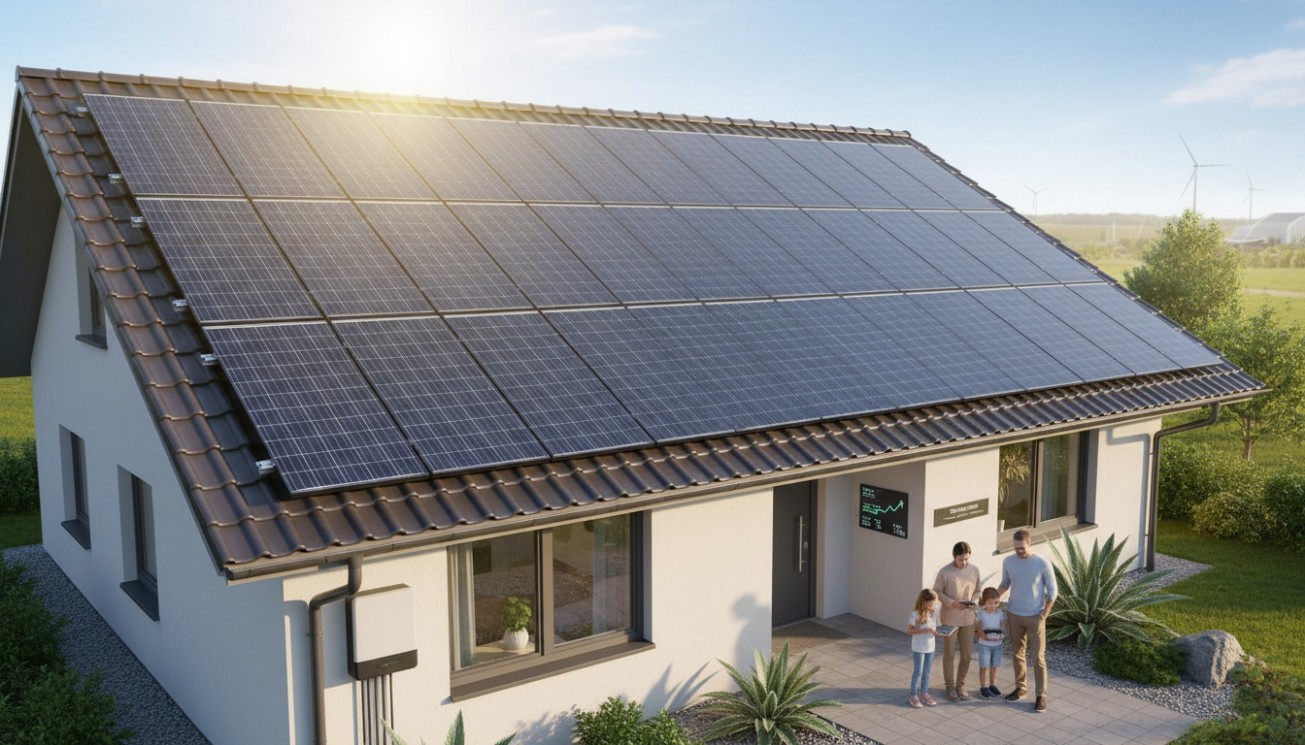
Why High-Efficiency Solar Panels Matter More for Residential Roofs
Efficiency Means Something Different on a Residential Roof
In many solar discussions, efficiency is treated as a product specification. A module with a higher efficiency percentage is seen as more advanced, while a module with a lower efficiency percentage is considered less attractive. This view is too simple for the residential rooftop market. On a home roof, efficiency is not only a laboratory number. It is a way of turning limited roof space into usable household energy.
A large commercial rooftop may have enough area to compensate for lower module efficiency. A ground-mounted project may use land, row spacing, and utility-scale design to optimize cost per watt. A residential roof is different. It is small, fixed, already occupied by vents, chimneys, skylights, ridges, dormers, access pathways, and shading risks. Once the best roof area is used, there may be no practical way to expand the system.
This is why high efficiency solar panels can matter more in residential projects than in many larger projects. The question is not simply whether the panel is technically better. The question is whether the homeowner can generate more useful electricity from the same roof. When roof space is scarce, each square meter of roof becomes valuable. Efficiency becomes a space strategy.
A homeowner may not care about the internal cell structure of the module. But the homeowner does care whether the system can cover more of the electricity bill, support a future electric vehicle, make room for a battery-ready design, or reduce the number of panels needed on a visible roof. For this reason, residential solar panel efficiency should be explained through real home outcomes, not only through datasheet values.
The real value of efficiency is not “higher is always better.” The real value is that higher efficiency gives the designer more options when the roof creates limits.
The Residential Roof Is a Scarce Energy Asset

A residential roof has two identities. It is part of the building envelope, and it is also a potential energy surface. Before solar installation, most of that roof surface does only one job: protecting the home from weather. After solar installation, the best roof areas become long-term energy-producing assets.
This creates an important shift in thinking. The question is no longer only “How much does each panel cost?” The better question is “How much energy value can this roof area produce over the life of the system?” For homeowners with limited roof space, small roof solar panels and high-efficiency designs can influence the total value of the project more than many people expect.
A roof cannot usually be expanded. A homeowner may replace an inverter, add a battery, upgrade monitoring, or change electricity behavior, but the available roof area remains fixed. If the initial system uses lower-efficiency modules and fills the strongest roof zones, upgrading later can be difficult. The homeowner may have to remove working modules or accept that the roof’s solar potential has already been locked into a lower-output design.
This is different from buying many other home products. A homeowner can replace a refrigerator, upgrade a heat pump, or add a smart thermostat later. But rooftop solar uses a limited physical surface for decades. Once that surface is occupied, the opportunity cost of the roof becomes part of the decision.
For this reason, limited roof space solar should be evaluated with a long-term mindset. If the roof is large and the homeowner only needs a modest system, a standard-efficiency module may be enough. But if the roof is small, complex, shaded in parts, or expected to support future electrification, the value of efficiency increases.
The Best Roof Zones Are More Valuable Than the Remaining Roof
Not all roof space has the same value. The best roof zones are usually clear, structurally suitable, visually acceptable, and exposed to strong sunlight. Secondary roof zones may have shade, poor orientation, awkward shape, or installation restrictions. Avoid zones may be unsafe, shaded, or too difficult to service.
High efficiency is most valuable when the prime solar zones are limited. In that situation, high efficiency PV modules allow more capacity to be installed in the best roof areas instead of pushing additional panels into weaker areas. This can improve both system performance and visual quality.
Efficiency Is Not the Same as Wattage
Many buyers confuse module efficiency with module wattage. They are related, but they are not the same thing. Wattage tells how much power a module is rated to produce under standard test conditions. Efficiency tells how effectively the module converts sunlight into electricity over a given area.
A physically large module can have high wattage even if its efficiency is not exceptional. A smaller module can have lower wattage but strong efficiency. In residential projects, this distinction matters because roofs are not unlimited. The designer needs to understand both the power rating and the physical size of the module.
For solar panel efficiency for homes, the important question is how much output can be produced from the available roof area. A homeowner comparing two modules should not only ask which panel has more watts. They should ask how much roof area each watt requires, how many modules fit cleanly on the roof, and how the layout affects total system size.
For example, a higher-wattage module may look better on paper, but if it is too large for certain roof planes, the final system may not gain as much capacity as expected. A slightly smaller but more efficient module may create a cleaner layout with better use of available space. In other cases, a larger high-power module may work perfectly on a simple roof with wide open planes. The right answer depends on the roof geometry.
This is why installers should avoid selling only by maximum module wattage. A professional explanation should connect wattage, efficiency, dimensions, layout, and actual home solar panel output. Homeowners do not buy a datasheet. They buy energy from their own roof.
High Efficiency Reduces the Cost of Roof Scarcity
The price of a solar module is only one part of the system cost. Residential projects also include design work, permitting, mounting hardware, labor, wiring, inverter equipment, monitoring, inspection, customer acquisition, installation scheduling, and after-sales service. These costs are often called soft costs or balance-of-system costs.
When a project uses high efficiency solar panels, the system may be able to generate more capacity from the same installation area. This can improve the way fixed costs are spread across the project. The mounting labor, design work, and site visit may be similar whether the system produces slightly more or slightly less power. If higher-efficiency modules increase the total system capacity without making the installation more complex, they can improve project value.
This does not mean premium modules always pay for themselves. A very expensive module may not make financial sense if the roof is large and the homeowner has modest energy needs. But in space-constrained residential projects, the cost comparison should include roof scarcity. A lower-cost module that uses more roof area may not be the better deal if it prevents the homeowner from reaching the desired system size.
Cost Per Watt Is Not Enough for Residential Decisions
Many solar buyers compare systems by cost per watt. This metric is useful, but it can be incomplete. A lower cost per watt system may still be less valuable if it cannot fit enough capacity on the roof, looks visually poor, or fails to support future household loads.
A better residential comparison should include cost per usable roof area, expected annual production, long-term degradation, system design quality, installation complexity, and homeowner goals. In other words, residential rooftop efficiency should be evaluated as a project outcome, not only as a product number.
Future Home Loads Make Efficiency More Important

Residential electricity demand is changing. Many homes are gradually adding more electric loads. Electric vehicles, heat pumps, induction cooking, electric water heating, home offices, smart appliances, pool pumps, and battery systems can all increase or shift household electricity use. A solar system designed only around today’s utility bill may become undersized later.
This is one of the strongest arguments for efficient home solar panels. If the homeowner expects future electrification, the roof may need to produce more energy than current usage suggests. A family that buys solar before purchasing an EV may later discover that the roof cannot support enough additional generation. If the strongest roof zones are already filled with lower-efficiency modules, expansion options may be limited.
High efficiency does not solve every future load problem. The system still needs proper inverter planning, electrical capacity, utility approval, and possibly battery integration. But efficiency gives the homeowner more production potential from the same surface. It creates a stronger foundation for future energy flexibility.
EV Charging Changes the Value of Roof Capacity
Electric vehicle charging can turn a modest household electricity profile into a larger energy demand. Some homeowners charge during the day, while others charge at night. If daytime charging is possible, solar energy can directly support the vehicle. If charging is mostly at night, a battery or grid strategy may be needed.
In both cases, more rooftop generation can increase flexibility. This is where high efficiency PV modules can support future planning. They may allow the roof to produce more energy without adding additional mounting area. For homeowners thinking beyond today’s bill, this can be a meaningful advantage.
Heat Pumps and Electric Heating Also Matter
As more homes move toward electric heating and cooling, seasonal electricity demand can rise. A solar system may generate strongly in sunny seasons but may not fully match winter heating demand in some climates. Even so, maximizing productive roof space can improve annual contribution and reduce reliance on grid electricity.
High efficiency should not be sold as a promise of full energy independence. It should be explained as a way to make better use of a limited home energy surface.
Efficiency Can Improve Aesthetics by Reducing Visual Compromise

Many residential buyers care about roof appearance. A system that covers too many small roof sections can look fragmented. Panels installed around vents, dormers, and odd roof edges may appear visually messy. If a homeowner wants a clean array, they may prefer fewer panels installed in the best locations.
This is another area where high efficiency solar panels can create value. If each module produces more power from the same area, the system may reach the desired capacity with a cleaner layout. In some cases, high efficiency allows the designer to avoid awkward roof zones while still meeting energy goals. The result can be a more attractive roof and a better customer experience.
Aesthetics are not superficial in residential solar. The system becomes part of the home’s appearance for many years. In neighborhoods with visible roofs, homeowner association rules, premium architecture, or strong resale concerns, appearance can influence the decision to adopt solar at all.
This is why premium solar modules often combine efficiency with visual design. All-black modules, black frames, low-contrast surfaces, and neat layouts can support homeowner acceptance. However, visual quality should not be used to hide weak technical design. The strongest residential solution combines good appearance with reliable performance, safe installation, and long-term serviceability.
Fewer Panels Can Sometimes Be Better Than More Panels
If a high-efficiency system reaches the homeowner’s energy target with fewer modules, installation may be cleaner and simpler. Fewer modules can mean fewer attachment points, fewer connectors, fewer wiring paths, and fewer visible layout interruptions. This is not always true, because system design depends on many factors, but it can be an important benefit in certain residential projects.
The key is not to promote fewer panels as a universal goal. The key is to use efficiency to create better design options.
Efficiency Helps When the Roof Has Design Constraints
Residential roofs often include constraints that reduce layout flexibility. These may include chimneys, skylights, vents, dormers, roof valleys, ridges, access paths, shade from trees, nearby buildings, roof pitch, and local code requirements. A simple roof may allow almost any module strategy. A complex roof rewards careful module choice.
For small roof solar panels and compact residential arrays, efficiency can help the designer achieve meaningful capacity without forcing panels into weak areas. If the roof has only a few strong zones, higher efficiency makes those zones work harder. If the homeowner wants to leave clear visual space around roof features, higher efficiency can help preserve design balance.
This does not mean high efficiency can overcome bad roof conditions. A heavily shaded roof still needs honest assessment. Panels placed in frequent shade may not produce enough energy to justify the installation, even if they are efficient. A roof near the end of its life may still need replacement before solar makes sense. Efficiency improves good design; it does not rescue poor design.
High Efficiency Is Most Valuable on Good but Limited Roofs
The strongest case for high-efficiency modules is a roof that has good sunlight but limited usable area. This includes small urban homes, townhouses, roofs with multiple obstacles, high-electricity-use households, and homeowners planning for future electrification. In these cases, residential solar panel efficiency can directly influence whether the project meets the energy target.
The Premium Trap: When High Efficiency Is Not Worth It
Although efficiency matters, it should not be oversold. A higher-efficiency module is not automatically the best choice for every residential project. There are many cases where a standard module can deliver excellent value.
If a home has a large, open, low-shade roof and the homeowner only needs a moderate system, a lower-cost module may reach the energy goal without using all available roof space. If the local electricity price is low, the added cost of premium modules may not produce enough financial benefit. If the system is limited by utility export rules or inverter capacity, adding more module output may not improve value. If the installer charges a high premium for equipment without improving design quality, the homeowner should be cautious.
This is why solar panel efficiency for homes should be evaluated through project conditions. Efficiency has value when it solves a real constraint. It is less valuable when there is no constraint to solve.
Premium Should Be Connected to a Clear Reason
A homeowner should ask why a premium module is being recommended. Is the roof space limited? Is the household preparing for EV charging? Is the design trying to avoid shaded zones? Is the homeowner prioritizing aesthetics? Is the module warranty stronger? Is the degradation profile better? Is the installation easier or more reliable? Is the supplier support better?
If the answer is only “because it is more efficient,” the recommendation is incomplete. High efficiency should be part of a broader value explanation.
Efficiency and Real-World Output Are Not the Same Thing
Efficiency helps determine how much power a module can produce from a given area under test conditions, but real-world output depends on many additional factors. These include sunlight availability, temperature, shading, orientation, tilt, inverter performance, wiring, soiling, degradation, monitoring, maintenance, and system availability.
This is why home solar panel output should not be predicted only from module efficiency. A high-efficiency module installed on a poorly oriented or shaded roof may underperform a standard module installed on a better roof plane. A premium product with poor installation quality may deliver disappointing results. A well-designed system with good monitoring may create better long-term value than a higher-spec system with weak service.
For homeowners, this distinction is important. Efficiency is a tool, not a guarantee. It should be combined with strong site assessment, proper electrical design, safe installation, and realistic production modeling.
For installers, this is a communication challenge. A customer may see a high-efficiency module and expect a simple performance advantage. The installer should explain how the module contributes to the overall design, while also showing how roof conditions and system architecture affect real output.
The System Determines the Value of the Module
A module does not work alone. It works with mounting, wiring, inverters, monitoring, batteries, and household loads. High efficiency increases the potential of the module surface, but the system determines how much of that potential becomes useful energy.
Degradation Changes the Long-Term Value of Efficiency
Residential solar systems are expected to operate for many years. This means buyers should consider not only initial module efficiency, but also how output may decline over time. A module that begins with strong efficiency but degrades faster may not maintain its advantage as expected. A module with stable long-term performance may deliver better lifetime energy value.
For premium solar modules, the discussion should include degradation, product warranty, performance warranty, service support, and manufacturer stability. A homeowner may not fully understand these details, but they influence the long-term economics of the system.
Degradation is especially important on space-limited roofs. If the roof cannot easily support expansion, the system’s long-term production depends heavily on the modules installed at the beginning. A roof filled with modules today may not have room for additional panels later. Lower degradation can help preserve useful output over time.
However, warranty claims and degradation numbers should be treated carefully. Buyers should understand the difference between a written warranty and practical warranty support. A strong warranty is more valuable when the supplier has clear documentation, reliable distribution, and a realistic service process.
How Installers Should Explain High Efficiency to Homeowners

A good installer should not present high-efficiency modules as a luxury upgrade without context. The explanation should begin with the homeowner’s roof and energy goals.
If the roof is small, the installer can explain that higher efficiency helps generate more energy from limited space. If the homeowner wants EV readiness, the installer can show how more rooftop capacity supports future load growth. If the roof has aesthetic constraints, the installer can explain how higher output per module may reduce the need for awkward placements. If the homeowner is comparing quotes, the installer can show how efficiency affects total system size, expected production, and roof utilization.
This approach turns residential rooftop efficiency into a practical decision. The homeowner can see why the product matters. The conversation moves away from abstract specifications and toward real household value.
A Clear Explanation Builds Trust
Residential solar buyers often receive multiple quotes. Some quotes may use lower-cost panels, while others use premium products. If the installer cannot explain the difference clearly, the homeowner may choose only by price. A strong explanation helps the homeowner understand whether the premium is justified.
The explanation should be honest. If high efficiency is not necessary for a particular roof, saying so can build credibility. Not every project needs the highest-efficiency module. But when it does matter, the reasoning should be clear.
How Distributors and B2B Buyers Should Evaluate High-Efficiency Residential Modules
For distributors, importers, and installation companies, high-efficiency residential modules should be evaluated beyond headline efficiency. The product must also fit local roof types, installation workflows, market expectations, and after-sales requirements.
A distributor should ask whether the module size is suitable for common residential roofs. Is the weight manageable for rooftop crews? Does the frame design work with common mounting systems? Are the electrical parameters compatible with popular inverters, optimizers, or microinverters in the target market? Are all-black options available for homeowners who care about appearance? Are documentation and warranty terms clear? Is packaging suitable for small-batch delivery? Does the manufacturer provide consistent supply?
This is where high efficiency PV modules become a channel strategy. A product that looks strong on paper may create installation friction if it is difficult to handle or poorly documented. A slightly less efficient product may perform better in the market if it fits local roofs, crews, and customer expectations more smoothly.
B2B buyers should also consider how the product will be positioned. Is it for premium homes, small roofs, urban projects, battery-ready homes, EV-ready households, or general residential installations? A clear market position helps avoid confusing sales messages.
A Practical Decision Framework for High-Efficiency Residential Panels

A homeowner or installer can evaluate high-efficiency modules through five practical questions.
First, is roof space limited? If the best roof zones cannot support the desired system size with standard modules, efficiency becomes more valuable.
Second, is the household’s future electricity demand expected to grow? If EV charging, heat pumps, or home batteries are likely, more rooftop generation potential may be useful.
Third, does appearance matter? If the homeowner wants a clean roof layout, high efficiency may help reduce visual compromise.
Fourth, does the premium have a clear payback or value reason? Higher efficiency should be connected to system output, roof utilization, future readiness, aesthetics, warranty, or reliability.
Fifth, is the system design strong enough to capture the module’s advantage? If shading, inverter mismatch, poor installation, or weak monitoring reduce performance, the efficiency benefit may not fully appear.
This framework avoids both extremes. It avoids treating high-efficiency modules as automatically superior, and it avoids dismissing them as unnecessary luxury products. The right answer depends on the roof, the home, and the long-term energy goal.
Focused FAQ
Why do high-efficiency solar panels matter more for residential roofs?
High efficiency solar panels matter more on residential roofs because home roof space is limited. Higher efficiency can produce more power from the same roof area, which is valuable for small roofs, future electric loads, clean layouts, and long-term energy value.
Is residential solar panel efficiency more important than panel wattage?
Both matter. Wattage shows rated power, while residential solar panel efficiency shows how much power is produced from a given area. For homes with limited roof space, efficiency can be more important than wattage alone.
Are efficient home solar panels always worth the extra cost?
Not always. Efficient home solar panels are most valuable when roof area is limited, aesthetics matter, future electricity demand is expected to grow, or the homeowner needs more output from the best roof zones. If the roof is large and energy goals are modest, a standard module may be enough.
Do small roofs need high-efficiency solar panels?
Many small roofs benefit from small roof solar panels or high-efficiency modules because there is less usable space. Higher efficiency can help reach a stronger system size without using poor roof zones.
What are high-efficiency PV modules?
High efficiency PV modules are solar panels designed to convert more sunlight into electricity per unit of area. Their value is especially important when space, layout, appearance, or future energy demand creates constraints.
What affects residential rooftop efficiency besides the module?
Residential rooftop efficiency is affected by module efficiency, roof orientation, tilt, shading, temperature, inverter design, wiring, soiling, degradation, and installation quality. A high-efficiency module still needs a good system design.
How should homeowners compare solar panel efficiency for homes?
When comparing solar panel efficiency for homes, homeowners should look at module efficiency, wattage, dimensions, number of panels that fit on the roof, expected annual output, warranty, degradation, aesthetics, and total system cost.
Does higher efficiency guarantee higher home solar panel output?
No. Home solar panel output depends on roof conditions, sunlight, shading, inverter performance, temperature, system design, and maintenance. Efficiency improves potential output per area, but the full system determines real performance.
Are premium solar modules only for luxury homes?
No. Premium solar modules can be useful for small roofs, urban homes, EV-ready households, design-sensitive roofs, and projects where long-term output matters. They should be chosen for a clear project reason, not only for status.
What is limited roof space solar planning?
Limited roof space solar planning means designing a PV system around constrained usable roof area. It focuses on using the best roof zones efficiently, avoiding weak areas, and selecting modules that maximize useful long-term output.
Conclusion
High-efficiency solar panels matter in residential projects because residential roofs are limited, personal, and long-term energy assets. A home roof cannot usually be expanded, and the best solar zones may be restricted by size, obstacles, shading, appearance, and safety requirements. In this environment, efficiency becomes more than a technical specification. It becomes a way to use scarce roof space wisely.
The strongest value of high efficiency solar panels appears when the roof is good but limited, when the homeowner expects future electric loads, when aesthetics matter, or when the project needs more output from the best roof zones. Efficiency can help improve system capacity, reduce visual compromise, support future EV or battery planning, and improve the long-term use of the available roof.
At the same time, high efficiency should not be oversold. It is not automatically the right answer for every home. Large roofs, modest energy goals, low electricity prices, weak incentives, or poor site conditions may reduce the value of a premium module. The right decision depends on the relationship between roof space, household demand, system design, product cost, and long-term expectations.
For homeowners, the best question is not simply which panel has the highest efficiency. The better question is whether higher efficiency solves a real problem on their roof. For installers, the goal is to explain efficiency through roof utilization and household energy value. For distributors and suppliers, the opportunity is to offer high-efficiency residential modules that fit real rooftops, real installation workflows, and real customer expectations.
Residential solar is moving beyond simple panel comparison. The market increasingly rewards products and suppliers that understand the whole home energy decision. In that future, efficiency will remain important, but only when it is connected to practical value: better roof use, better system design, better long-term output, and better homeowner confidence.