Flat Plate Solar Collector Preheating Guide: How Solar Thermal Works With Boilers, Heat Pumps and Commercial Hot Water Systems
Solar Preheating Is Often the Most Practical Role for Flat Plate Collectors
In many professional hot water projects, the best role for a flat plate solar collector is not to replace every heater in the building. Its most practical role is often to preheat incoming water before the final heating equipment finishes the job. This is the core logic of flat plate solar collector preheating.
For B2B buyers, this distinction is important. A solar thermal project does not need to promise 100% solar-only hot water to be valuable. In hotels, apartments, schools, factories, laundries, commercial kitchens, hospitals, sports centers, and public facilities, the hot water system usually needs reliability every day. Weather changes, seasonal demand changes, occupancy changes, and local energy prices all affect the design. In these projects, solar thermal can reduce fuel or electricity consumption while the boiler, heat pump, electric heater, or district heating system guarantees final temperature and service reliability.
This is where a solar thermal preheating system becomes commercially attractive. Instead of asking solar energy to carry the full load, the system uses solar collectors to raise the inlet water temperature. The backup system then needs less energy to reach the target supply temperature. The result can be lower operating cost, lower boiler runtime, reduced heat pump workload, and a more realistic return on investment.
This article focuses on solar thermal integration for flat plate collectors. It does not repeat basic collector structure, roof layout, freeze protection, or maintenance. Those topics can be reviewed in the related guides on flat plate solar collector quality, flat plate collector roof layout, drainback and glycol solar thermal systems, and solar thermal maintenance. This guide answers a different question: how should flat plate collectors be integrated with existing or new heating equipment so the whole system becomes more useful, reliable, and commercially sensible?
The Real Question Is Not “Can Solar Replace the Boiler?”

Many buyers ask whether solar thermal can replace a boiler, heat pump, or electric heater. In most serious commercial projects, that is not the right starting question. The better question is how much thermal load solar can remove from the final heating equipment under realistic operating conditions.
A boiler may still be required for final temperature, peak demand, cloudy weather, winter operation, hygiene rules, or backup security. A heat pump may still be required for stable water heating when sunlight is limited. An electric element may still be needed for small systems or emergency backup. Solar thermal does not need to remove these systems from the project. It can make them work less.
This is why hybrid solar water heating is often more professional than a solar-only sales promise. The solar collector field provides renewable heat when sunlight is available. The backup system protects the user experience when solar contribution is not enough. When the two systems are controlled properly, they are not competitors. They are coordinated heat sources.
Solar Preheating Reduces Temperature Lift
Every hot water system has a temperature lift. If incoming water enters the building at 15°C and the required storage or supply temperature is 60°C, the heating system must add 45°C of temperature rise. If a flat plate collector field preheats the same water to 35°C before it reaches the final heater, the backup system only needs to add 25°C.
This is the value of flat plate solar collector preheating. The collector does not need to reach final delivery temperature every day. It only needs to reduce the heating work required from the main energy system. This is especially useful in buildings with stable daily water use.
Solar Preheating Fits Real Commercial Behavior
Commercial buildings often have large water consumption but different usage patterns. Hotels may have morning and evening peaks. Schools may have shower periods after sports or dormitory schedules. Commercial kitchens may use hot water during food preparation and cleaning. Factories may need warm process water during production hours. These patterns make full solar coverage difficult, but they also create steady opportunities for preheating.
A well-planned commercial solar hot water system does not need to cover every peak by itself. It should reduce the energy required across the day while storage and backup heating protect critical usage windows.
How a Solar Thermal Preheating System Works

A solar thermal preheating system usually places the solar collector loop before the final heating equipment. Cold water or return water passes through a preheat storage tank, heat exchanger, or buffer tank heated by the flat plate collector field. From there, the preheated water moves to a boiler, heat pump, electric heater, or final storage tank.
The exact layout depends on building type, water quality, pressure requirements, local climate, energy source, and whether the project uses direct or indirect heat exchange. Buyers who need basic loop understanding can review direct vs indirect solar water heating systems before finalizing the architecture.
Simple Preheat Tank Layout
In a simple layout, solar collectors heat a dedicated preheat tank. Cold water enters this tank first. The backup heater receives warmer water from the preheat tank instead of cold water from the mains. This layout is easy to understand and works well when the building has enough space for a separate tank.
The main advantage is clarity. Solar contribution can be measured through preheat tank temperature rise. The backup heater remains responsible for final temperature. This helps avoid unrealistic performance expectations.
Buffer Tank and Heat Exchanger Layout
In larger systems, a solar thermal buffer tank may store solar heat before transferring it into the domestic hot water system. The buffer tank can be connected through an internal coil, external plate heat exchanger, or hydraulic separation arrangement. This can help manage pressure, water quality, scaling risk, and system control.
A buffer tank can also improve operation because solar heat can be stored when available and used when demand occurs. However, tank size, insulation, stratification, and sensor placement matter. A poorly designed tank can reduce useful solar contribution even when the collector field is good.
Final Heater Finishes the Temperature
The final heater should not fight the solar system. It should receive preheated water and raise it only when needed. If backup heating starts too early or heats the storage volume too aggressively, solar collectors may have no thermal room to contribute later in the day.
This is one of the most common control mistakes in hybrid solar water heating. The backup system is necessary, but it should be coordinated with solar priority.
Why Flat Plate Collectors Fit Preheating Applications

Flat plate collectors are often strong in low-to-medium temperature applications. Preheating is usually a low-to-medium temperature task. That makes the technology match logical.
A flat plate collector may not always be the highest-temperature collector choice in every climate, but for raising incoming water from cold or moderate temperature to a useful preheat range, it can be highly practical. The design is visually clean, structurally simple, and well suited to organized roof arrays.
Moderate Temperature Demand Matches Flat Plate Strength
Preheating does not always require the collector to reach final storage temperature. In many projects, raising inlet water by 10°C, 20°C, or 30°C can create meaningful energy savings. This matches the practical operating range where flat plate collectors can perform well, especially in warm, sunny, or moderate climates.
When buyers understand this, they stop asking whether flat plate is “better” or “worse” in a general sense. The more useful question is whether the collector is being assigned the right job.
Large Roof Arrays Can Be Organized Cleanly
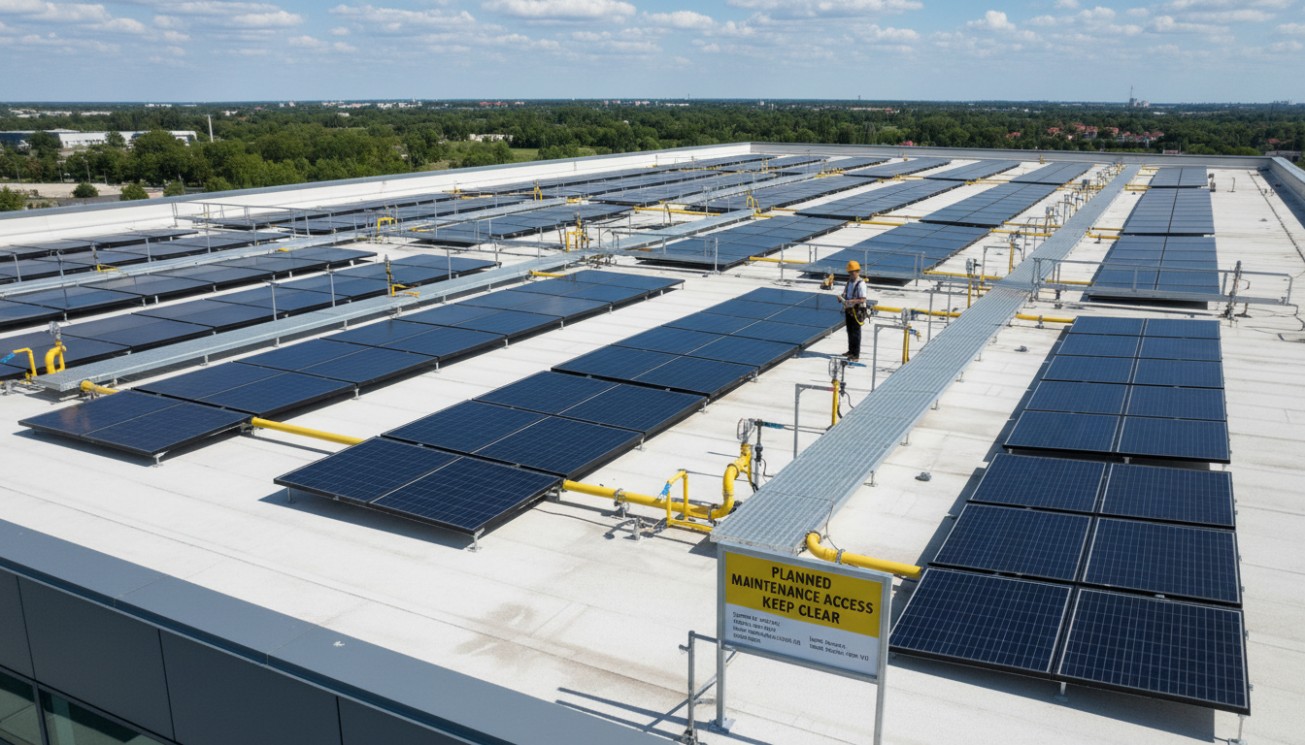
Commercial preheating projects often use multiple collectors. Flat plate collectors can form neat rows and low-profile arrays, which helps with commercial roof appearance and service access. A clean array design can also support better piping, flow balance, and maintenance planning.
For layout considerations, buyers can review the guide on flat plate collector array design. In preheating systems, roof layout and hydraulic balance directly affect useful heat delivery.
Stable Daily Heat Is More Important Than Peak Temperature Claims
Some sales discussions focus heavily on maximum temperature. For preheating, maximum temperature is not always the most important number. Daily useful heat, stable flow, low heat loss, and easy integration may matter more.
A buyer should ask how much useful thermal energy the collector field can deliver into the preheat system across normal operating days. This is more valuable than a single high-temperature claim measured under favorable conditions.
Boiler Preheating: Reducing Fuel Consumption Without Removing Reliability

Boiler preheating solar thermal is one of the most practical applications for flat plate collectors. Many buildings already use gas boilers, oil boilers, biomass boilers, electric boilers, or central heating systems to prepare domestic hot water. Solar preheating can be added before the boiler to reduce the required fuel input.
How Boiler Preheating Works
Cold water first enters the solar preheat tank or heat exchanger. The flat plate collector field raises the water temperature when sunlight is available. The boiler then receives warmer inlet water and finishes heating it to the required setpoint.
The boiler remains available during cloudy weather, peak usage, or low solar conditions. This protects service reliability. The solar field reduces the boiler’s workload rather than replacing its role completely.
Why Boiler Preheating Is Easy to Explain to Buyers
Boiler users already understand fuel cost. When solar preheating reduces the temperature lift required from the boiler, the economic logic becomes easier to explain. The buyer can think in terms of reduced boiler runtime, lower fuel use, and lower energy cost.
This makes boiler preheating solar thermal attractive for hotels, dormitories, apartments, public buildings, and factories with existing boiler rooms. It can also be suitable for retrofit projects where the building owner does not want to replace the entire mechanical system.
Control Must Prevent Boiler Short-Cycling
Solar preheating should be integrated carefully with boiler controls. If the boiler short-cycles frequently because inlet water temperature changes, efficiency and equipment life may suffer. The system should include appropriate tank volume, temperature sensors, mixing strategy, and control logic.
For large systems, mechanical designers should confirm how the solar preheat loop interacts with boiler staging, recirculation, storage, and peak demand.
Heat Pump Integration: Solar Thermal and Heat Pumps Should Not Compete

Heat pump solar hot water integration is increasingly relevant because many buildings are moving toward electrified heating. A heat pump can produce hot water efficiently, but its performance depends on temperature lift, ambient conditions, operating temperature, and system design. Solar thermal preheating can reduce some of the work the heat pump needs to do.
How Solar Helps a Heat Pump System
If solar thermal raises the preheat tank temperature, the heat pump may need less energy to reach the final hot water setpoint. In some layouts, solar thermal supplies low-temperature heat while the heat pump finishes higher-temperature heating. In other layouts, solar preheating supports the cold-water inlet to a heat pump water heater.
The goal is not to make the heat pump unnecessary. The goal is to let solar energy reduce the heat pump’s workload when sunlight is available.
Control Strategy Matters More Than Product Labels
A poorly controlled hybrid system can waste energy. For example, if the heat pump heats the tank fully before the solar collector field has a chance to operate, solar contribution will be reduced. If the solar loop heats a tank that the heat pump cannot use efficiently, the result may also be weak.
In heat pump solar hot water projects, control sequencing is critical. Sensors should be placed correctly. The system should define which heat source has priority, when backup activates, how tank stratification is protected, and how overheating is avoided.
When Heat Pump Hybrid Makes Sense
Hybrid solar and heat pump systems can make sense in buildings with high hot water demand, favorable roof area, electricity-based energy strategy, or sustainability targets. They may also fit projects where gas infrastructure is limited or where the buyer wants to reduce fossil fuel dependence.
However, the system should still be evaluated by real load, available sunlight, roof area, storage volume, electricity price, maintenance capability, and local service expertise.
Commercial Hot Water Load Profiles Decide the Design
A strong commercial solar hot water project begins with the load profile. Without understanding when and how water is used, the system may be oversized, undersized, or controlled incorrectly.
Solar hot water load profile means the pattern of demand across the day, week, season, and year. It includes average daily volume, peak hours, required temperature, inlet water temperature, occupancy changes, and process schedules.
Hotels and Guesthouses
Hotels often have strong morning and evening demand. Solar thermal collects most energy during daytime, so storage becomes critical. A preheat tank can collect solar energy during the day and reduce boiler or heat pump workload before evening peak demand.
For hotels, the goal is not to gamble on solar-only service. Guest comfort requires reliable hot water. Solar preheating can reduce energy cost while backup heating protects final delivery.
Apartments and Dormitories
Apartments and dormitories may have repeated daily demand patterns. Dormitories may have concentrated shower periods. Apartments may have morning and evening use with some daytime demand. Solar preheating can work well when storage and backup are matched to these predictable patterns.
A centralized preheat system may serve multiple users more efficiently than many small independent units, but it requires better control, circulation, balancing, and maintenance planning.
Schools, Gyms and Sports Facilities
Schools and sports facilities may have seasonal or scheduled demand. Solar preheating can be effective when usage occurs during periods of good solar availability. However, holiday periods and low-demand days should be considered to avoid overheating.
These projects should define operating calendars before sizing collector area. A system designed only for peak school activity may be oversized during long closures.
Industrial Process Water Preheating: A Different Kind of Solar Thermal Value

Industrial process water preheating is an important but often under-discussed flat plate collector application. Many industrial processes do not require very high-temperature water at the first stage. They need incoming water warmed before a boiler, heater, washer, cleaning line, dyeing process, food processing system, or other thermal equipment completes the heating.
Why Industrial Preheating Can Be Attractive
Industrial facilities often use water repeatedly and predictably. If a factory consumes warm or hot water during production hours, solar preheating may reduce energy input over a large daily volume. Even a moderate temperature increase can represent meaningful energy savings when the volume is high.
For example, raising process inlet water from 15°C to 35°C before a boiler or process heater may reduce fuel demand significantly. The final heating equipment still ensures process temperature, but it starts from a better inlet condition.
Process Stability Is More Important Than Solar Maximization
Industrial users usually care about production stability more than solar coverage. A solar thermal system should not interrupt process flow or create temperature instability. The system should be designed as a preheating layer, not as a risk to production.
This makes industrial process water preheating a good fit for conservative solar thermal design. Solar contributes where useful, while conventional equipment protects production requirements.
Water Quality and Materials Must Be Checked
Industrial water may contain minerals, chemicals, or process-related contaminants. The solar loop should usually be separated through heat exchange when water quality is uncertain. Materials, scaling risk, corrosion, and cleaning access should be reviewed before choosing the final layout.
Storage Strategy: The Buffer Tank Is Not Just a Large Container

The solar thermal buffer tank is one of the most important parts of a preheating system. It allows solar heat to be collected during sunny hours and used when demand occurs. But a buffer tank must be designed correctly.
Tank Size Must Match Useful Solar Heat
If the tank is too small, it may heat quickly and force the collector field into stagnation during sunny low-demand periods. If the tank is too large, the solar field may never raise the temperature enough to create useful preheat value. Correct tank sizing depends on collector area, load profile, climate, temperature target, and backup heating strategy.
For broader sizing logic, buyers can review split solar water heating system sizing. In a preheating project, the same principle applies: sizing begins with demand and useful heat, not with catalog model size.
Stratification Improves Usable Heat
Tank stratification means hotter water stays near the top while cooler water remains near the bottom. Good stratification can improve solar collection and hot water availability. Poor piping, excessive mixing, or wrong pump control can destroy stratification and reduce system value.
The location of inlet ports, outlet ports, sensors, and heat exchangers can affect stratification. This is why tank design should not be treated as a simple volume choice.
Insulation Protects Collected Energy
A preheat tank stores energy that the collector field has already captured. Poor tank insulation wastes that energy before it reaches the final heater. For commercial and industrial projects, tank insulation quality, pipe insulation, and mechanical room heat loss all affect real savings.
Solar Fraction: Aim for the Useful Fraction, Not the Largest Claim

In preheating systems, solar fraction should be realistic. A buyer may want the highest possible solar coverage, but chasing an excessive solar fraction can increase cost, create overheating, and reduce payback quality.
A moderate solar fraction can be more profitable than an aggressive one if it matches available roof area, daily demand, storage size, and backup integration. The best system is not the one with the biggest collector field. It is the one that delivers the most useful and reliable heat at a sensible cost.
Why 100% Solar Is Often the Wrong Target
Solar radiation changes by season and weather. Commercial demand changes by occupancy and schedule. A system sized for 100% solar coverage under weak conditions may be too large under normal or strong-sun conditions. This can create stagnation, high capital cost, and maintenance pressure.
For B2B buyers, a supplier who promises total solar coverage without analyzing the solar hot water load profile should be evaluated carefully.
Useful Solar Contribution Is the Better Metric
Useful contribution means solar heat that actually enters the water system and reduces backup energy. Collector area that produces heat when the tank is already full is not useful. Heat lost through long pipes or poor insulation is not fully useful. Heat that cannot be transferred through the heat exchanger is not useful.
A professional solar thermal preheating system should be judged by usable heat delivery, not only collector nameplate area.
Control Logic: The System Must Decide Which Heat Source Works First

Solar thermal integration depends heavily on control logic. Solar collectors, pumps, tanks, sensors, boilers, heat pumps, mixing valves, and backup heaters must work together. Without control discipline, the system can waste solar energy or reduce user comfort.
Differential Temperature Control
Solar thermal systems often use differential temperature control. The pump operates when the collector temperature is sufficiently higher than the tank or heat exchanger temperature. This prevents circulating fluid when the collector is not adding useful heat.
Sensor placement matters. A sensor in the wrong position can make the pump start too early, stop too late, or miss useful solar conditions.
Backup Heating Priority
Backup heating should protect final temperature, but it should not remove all opportunity for solar contribution. If a boiler or heat pump keeps the preheat tank too hot all day, the solar collector field may have nowhere to deliver heat.
In hybrid solar water heating, backup heating should usually focus on final delivery temperature or final storage temperature, while the solar field is allowed to preheat incoming water whenever useful.
Overheating Control
Low-demand periods can create overheating risk. Schools, hotels with seasonal occupancy, factories with weekend shutdowns, and residential villas with travel periods may all experience low demand while collectors continue receiving sunlight.
Overheating should be managed through storage sizing, control settings, heat dumping strategy when necessary, collector field sizing, and loop design. The article on solar collector overheating explains why drainback and glycol systems behave differently under stagnation conditions.
Retrofit Projects: Working With Existing Mechanical Rooms

Many boiler preheating solar thermal projects are retrofit projects. The building already has tanks, boilers, pumps, valves, distribution lines, and control habits. Solar must fit the existing system rather than assume a new-building design.
Start With the Existing System Map
Before recommending collectors, the project team should understand how the current hot water system works. Where does cold water enter? Where is storage located? How is recirculation controlled? What is the current boiler setpoint? What is the peak demand problem? Where is there space for a preheat tank or heat exchanger?
Without this map, the solar design may connect to the wrong point and fail to create expected savings.
Do Not Disturb Reliable Hot Water Delivery
Retrofit buyers are often cautious because their existing system already serves the building. Solar should be added in a way that improves efficiency without destabilizing service. Bypass valves, isolation valves, commissioning procedures, and backup operation should be planned.
Measure Before and After
Retrofit projects should define baseline energy use when possible. After solar preheating is installed, the owner can compare boiler runtime, fuel consumption, inlet water temperature, preheat tank temperature, and backup heater operation. This makes value easier to explain.
What B2B Buyers Should Ask Suppliers

Supplier evaluation for preheating systems should focus on system thinking. A supplier who only quotes collector area may not be enough for a commercial or industrial project.
Questions About Application Fit
Which applications are suitable for flat plate solar collector preheating? What water temperature range is realistic? How should the system behave during cloudy periods? What solar fraction is reasonable for this climate and load profile?
Questions About Integration
How will the solar preheat tank connect to the boiler, heat pump, or final heater? Is the design direct or indirect? What heat exchanger capacity is required? How will the controller prioritize solar energy? How will backup heating be coordinated?
Questions About Storage and Control
What solar thermal buffer tank volume is recommended? How is stratification protected? Where should sensors be installed? How does the system avoid overheating during low demand? What data can be monitored after commissioning?
Questions About Commercial Reliability
What maintenance schedule is required? What spare parts should be kept locally? How are pumps, valves, sensors, and fluid checked? How is long-term performance documented?
Common Mistakes in Flat Plate Solar Preheating Projects

Mistake 1: Selling Solar as a Complete Replacement Too Early
Solar thermal can reduce energy use, but many commercial systems still need backup heating. A more honest and practical sales message is that solar preheating reduces the workload of the boiler, heat pump, or final heater.
Mistake 2: Ignoring the Load Profile
A project cannot be designed correctly without a clear solar hot water load profile. Average daily volume, peak hours, seasonal variation, and required temperature all affect collector area, storage size, and backup capacity.
Mistake 3: Oversizing the Collector Field
More collectors do not always mean better value. Oversizing can increase cost and overheating risk. A balanced solar thermal preheating system should match useful heat demand.
Mistake 4: Letting Backup Heating Eliminate Solar Opportunity
If the boiler or heat pump heats the entire storage system too early, solar collectors may have no low-temperature water to heat. Control strategy should leave room for solar contribution.
Mistake 5: Treating the Buffer Tank as a Simple Volume
A solar thermal buffer tank must be sized, insulated, piped, and controlled correctly. Poor tank design can waste solar heat and reduce system value.
Focused FAQ
What is flat plate solar collector preheating?
Flat plate solar collector preheating means using flat plate collectors to raise the temperature of incoming water before it reaches the final heater, such as a boiler, heat pump, or electric water heater. The goal is to reduce backup energy use rather than replace the entire heating system.
Where does a solar thermal preheating system fit best?
A solar thermal preheating system fits best in buildings with stable or predictable hot water demand, such as hotels, apartments, schools, dormitories, factories, laundries, commercial kitchens, sports centers, and public facilities.
Can flat plate collectors work with boilers?
Yes. Boiler preheating solar thermal systems use solar energy to warm water before it enters the boiler. The boiler then finishes heating to the required temperature, reducing fuel consumption while maintaining reliability.
Can flat plate collectors work with heat pumps?
Yes. Heat pump solar hot water systems can use solar thermal energy as a preheating layer so the heat pump has less temperature lift to complete. Proper controls are important so the heat pump does not reduce solar opportunity.
What is a solar thermal buffer tank?
A solar thermal buffer tank stores heat collected by the solar collector field before that heat is transferred to the hot water system or final heating equipment. Its size, insulation, stratification, and sensor placement affect system performance.
Is commercial solar hot water different from residential solar hot water?
Yes. Commercial solar hot water projects usually have larger demand, stronger peak periods, more complex mechanical rooms, higher reliability expectations, and more important backup heating integration than residential systems.
What is the most important sizing factor for solar preheating?
The most important factor is the solar hot water load profile. The system should be designed around daily volume, peak demand, temperature target, usage schedule, seasonal variation, and backup heating strategy.
Can solar preheating support industrial process water?
Yes. Industrial process water preheating can reduce energy use when factories need large volumes of warm or hot water before final process heating. The solar system should be designed to support process stability, not disrupt production.
Does solar preheating need backup heating?
Most commercial and industrial systems still need backup heating. In hybrid solar water heating, solar reduces energy consumption while the backup system protects final temperature and hot water reliability.
How should B2B buyers evaluate solar thermal integration?
B2B buyers should evaluate solar thermal integration by checking the load profile, existing heater type, tank layout, heat exchanger capacity, controls, pump station design, roof space, maintenance plan, and realistic solar contribution.
Final Thought: Preheating Turns Solar Thermal Into a Practical Business Tool
Flat plate collectors become easier to justify when they are positioned correctly. In many serious projects, their strongest value is not replacing every heater. Their strongest value is reducing the energy burden on the heating system that already guarantees reliability.
A well-designed flat plate solar collector preheating system can reduce boiler fuel use, support heat pump operation, lower electric heating demand, improve commercial hot water efficiency, and provide useful renewable heat for industrial process water. It works because it respects project reality. The solar field contributes when sunlight is available. The backup system protects final temperature when sunlight is not enough.
For B2B buyers, this is a more credible message than exaggerated solar-only claims. It also creates a better engineering pathway. The project can be evaluated by load profile, collector area, storage volume, backup heating, controls, maintenance, and measurable energy reduction.
The best hybrid solar water heating projects are not built by simply adding collectors to a roof. They are built by connecting the collector field to the correct point in the hot water system, storing solar heat properly, controlling backup equipment intelligently, and measuring useful thermal contribution over time.
When flat plate collectors are used as a preheating layer, solar thermal becomes more than a product. It becomes part of a practical energy strategy for buildings and facilities that need lower operating cost without sacrificing hot water reliability.