Direct vs Indirect Split Solar Water Heating Systems: How to Choose the Right Design
Direct and Indirect Systems Are Not Just Technical Details
When buyers compare a split solar water heating system, they often focus first on collector type, tank capacity, pump station configuration, or system price. These are important factors, but one of the most critical design choices is sometimes overlooked: should the system use a direct circulation design or an indirect circulation design?
This question matters because it affects climate suitability, water quality tolerance, freeze protection, heat transfer efficiency, installation complexity, maintenance cost, and long-term reliability. A direct solar water heating system and an indirect solar water heating system may both use rooftop collectors, storage tanks, controllers, pumps, and piping, but the way they move heat is different. That difference can determine whether the system performs well for ten years or creates repeated service problems after the first winter.
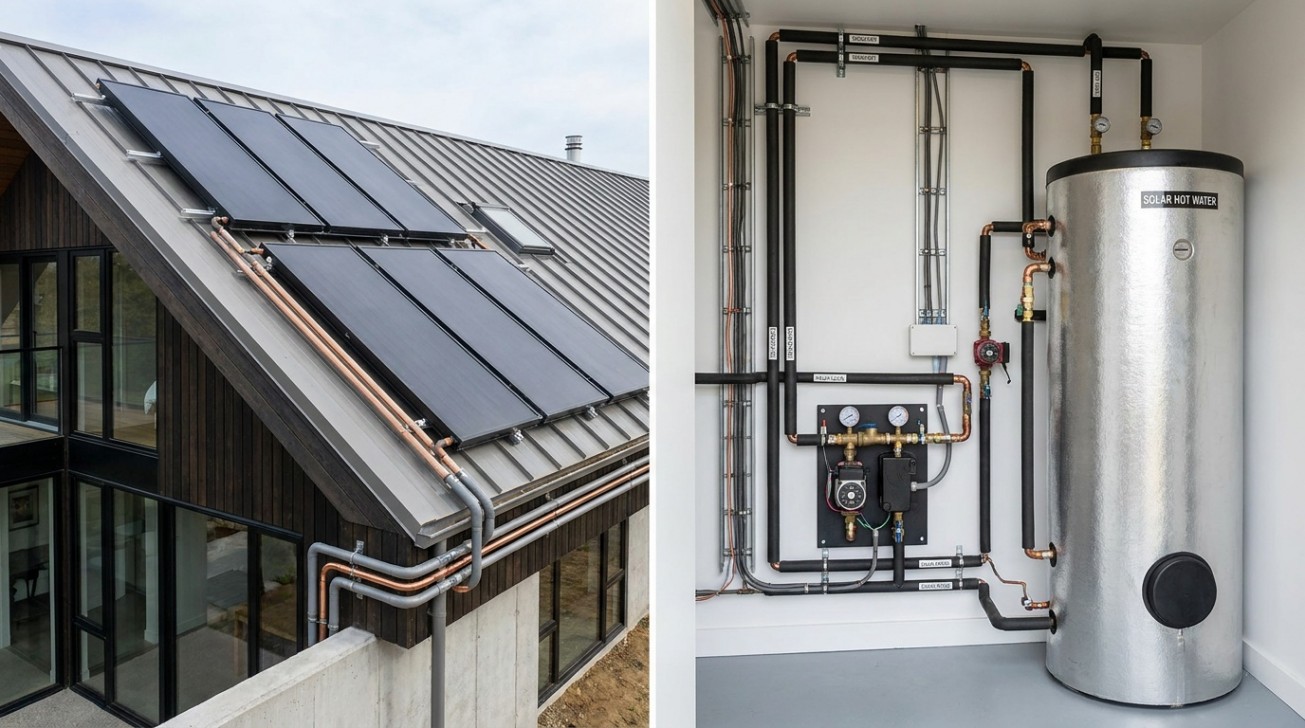
A split solar water heater separates the solar collector from the storage tank. Heat must be transferred from the collector area to the tank through a circulation loop. In a direct system, domestic water itself circulates through the collector. In an indirect system, a separate heat-transfer fluid circulates through the collector and transfers heat to domestic water through a heat exchanger.
At first glance, a direct system seems easier. Fewer components, simpler heat transfer, and lower initial cost can make it attractive. But direct systems are not suitable for every region. In climates where freezing is possible, or where water quality is hard, mineral-heavy, corrosive, or unstable, direct circulation can increase risk. An indirect solar water heating system may cost more at the beginning, but it can provide stronger protection and better adaptability in demanding environments.
This is why the direct-versus-indirect decision should not be treated as an accessory choice. It is a system design decision. A professional solar hot water system must match the climate, water source, user demand, maintenance ability, and building conditions of the project.
What a Direct Solar Water Heating System Means

A direct solar water heating system circulates domestic water directly through the solar collector. The same water that will later come out of the shower, faucet, or hot water outlet passes through the collector loop to absorb heat from the sun. After the water is heated, it returns to the storage tank or flows into the hot water system depending on the design.
In a split solar water heating system, this means the collector, pump, pipes, and tank are part of the domestic water path. When the controller detects that the collector is hot enough, the circulation pump starts. Water moves from the tank or cold supply through the collector, absorbs heat, and returns to the tank as warmer water.
The biggest advantage of a direct solar water heating system is simplicity. Since there is no separate heat-transfer fluid loop, the system can have fewer components. It may not need a dedicated antifreeze loop, internal coil, or external plate heat exchanger. This can reduce initial cost, reduce heat transfer steps, and make the system easier to understand.
Direct systems can also offer efficient heat transfer because the water being heated is directly exposed to the collector’s heat transfer channels. There is no secondary fluid and no heat exchange surface between the collector loop and domestic water. In warm climates with good water quality, this can be a practical design.
However, the same simplicity also creates limitations. Because potable water flows through the collector, the collector loop is exposed to scaling, corrosion, sediment, and freezing risk. If water freezes inside the collector or outdoor piping, it can expand and damage components. If hard water circulates through narrow collector channels, mineral deposits can reduce flow and heat transfer. If local water is aggressive, corrosion may shorten system life.
A direct solar water heating system is therefore best understood as a climate-sensitive and water-quality-sensitive solution. It can work well in the right conditions, but it should not be used blindly in every market.
What an Indirect Solar Water Heating System Means

An indirect solar water heating system uses two separated fluid circuits. The first circuit is the solar collector loop. This loop carries heat-transfer fluid through the solar collector. The second circuit is the domestic water side. The two fluids do not mix. Heat moves from the collector loop to domestic water through a heat exchanger.
In many split systems, the collector loop is a closed loop. This is why the system may also be called a closed loop solar water heater. The closed loop may contain water mixed with antifreeze fluid, commonly used in cold-climate solar thermal systems. The fluid absorbs heat in the collector, moves to the heat exchanger, releases heat to the domestic water, and returns to the collector to repeat the cycle.
The heat exchanger can be inside the storage tank as a coil or outside the tank as a plate heat exchanger. In a tank-coil design, the hot collector fluid passes through a coil inside the tank. Heat transfers through the coil wall into the stored domestic water. In an external plate design, collector fluid and domestic water pass through separate channels in a plate exchanger, allowing heat transfer without mixing the fluids.
The main advantage of an indirect solar water heating system is protection. Since domestic water does not circulate through the collector, the collector loop can be designed for outdoor thermal conditions. It can use antifreeze fluid in cold climates. It can reduce direct exposure of collector channels to hard water. It can separate potable water from the solar loop. It can also allow more controlled pressure and fluid management.
This makes the indirect design suitable for regions with freezing winters, poor water quality, hard water, variable climate, or higher service expectations. For B2B applications such as hotels, schools, dormitories, hospitals, and commercial buildings, indirect systems often provide stronger long-term reliability.
The tradeoff is complexity. An indirect solar water heating system needs a properly sized heat exchanger, expansion vessel, pump station, safety valves, filling procedure, pressure control, and fluid maintenance. The heat-transfer fluid may need periodic inspection or replacement. Installation quality matters. If the heat exchanger is undersized or the pump is not matched correctly, system performance can suffer.
The indirect design is therefore not simply “better” in all situations. It is more protective and more adaptable, but it requires better system engineering.
The Real Difference Is What Flows Through the Collector
The easiest way to understand the difference is to ask one question: what flows through the solar collector?
In a direct solar water heating system, domestic water flows through the collector. The collector is part of the water supply path. The heat path is short and simple, but the collector is exposed to the same water quality and freeze risks as the plumbing system.
In an indirect solar water heating system, heat-transfer fluid flows through the collector. Domestic water stays inside the tank or domestic water side. Heat crosses through a heat exchanger. This adds one transfer step, but it protects the collector loop and gives the designer more control over freeze protection and fluid behavior.
This difference affects everything else. It affects what happens in winter. It affects whether hard water can create scaling inside collector channels. It affects how the system is filled and serviced. It affects whether antifreeze fluid is required. It affects the role of the expansion vessel. It affects how maintenance teams inspect the system.
For a buyer, the direct-versus-indirect choice should not be made after the quotation is finished. It should be one of the first design questions. Before selecting collector size or tank volume, the supplier should understand the climate and water quality. A good supplier will not recommend the same design for a tropical villa, a Canadian hotel, a Mediterranean resort, and a high-mineral-water rural project.
A split solar water heater should be configured for the project environment. Direct and indirect designs are tools. The right tool depends on the job.
Climate Is the First Selection Factor
Climate is usually the first and most important factor when choosing between direct and indirect circulation.
A direct solar water heating system is usually more suitable for warm climates where freezing is rare or does not occur. If the collector loop never experiences freezing conditions, direct circulation can be simple and effective. This is why direct systems are often considered in tropical, subtropical, and mild coastal regions.
However, if the project is in a region with freezing temperatures, direct circulation becomes risky. Water expands when it freezes. If water freezes inside the collector, manifold, outdoor piping, valves, or fittings, it can crack components and cause leakage. Even one severe freeze event can damage the system.
An indirect solar water heating system is usually better for cold climates because the collector loop can use antifreeze fluid. This is the main reason many cold-region solar thermal systems use closed-loop indirect designs. An antifreeze solar water heater does not mean the system is maintenance-free, but it means the collector loop is designed to resist freezing conditions more safely than a direct water loop.
Climate selection is not only about the coldest day of the year. It is also about installation exposure. A roof-mounted collector is more exposed than indoor plumbing. Wind, night sky radiation, snow, and sudden temperature drops can affect outdoor loop temperature. Even if the average winter is mild, occasional freezing nights may create risk.
Buyers should therefore evaluate the real local climate, not only the general region. A city may have mild daytime temperatures but freezing nights. A mountain area may be much colder than the nearby coastal region. A system installed on an exposed roof may face stronger wind cooling than expected.
For projects in uncertain climates, the safer choice is often an indirect solar water heating system with proper solar water heater freeze protection. The higher initial cost may be justified if it prevents freeze damage and service disputes.
Water Quality Can Decide the System Type
Water quality is the second major selection factor. A direct solar water heating system exposes the collector loop to the same water that enters the building. If the water is clean, low in minerals, and not highly corrosive, direct circulation may work well. But if the water is hard, mineral-heavy, sediment-rich, acidic, or chemically aggressive, direct circulation can create long-term problems.
Hard water can cause scale buildup. When water is heated, minerals such as calcium and magnesium can precipitate and form deposits inside pipes, collector channels, fittings, and valves. In a solar collector, narrow channels may be especially vulnerable. Scale reduces heat transfer, restricts flow, increases pump load, and reduces system efficiency.
Corrosive water can attack metal components. If collector tubes, fittings, or tank parts are not compatible with local water chemistry, corrosion may cause leakage or contamination risk. Sediment can clog small passages or damage valves.
An indirect solar water heating system reduces these risks because domestic water does not circulate through the collector. The collector loop uses a controlled heat-transfer fluid. Domestic water remains on the tank side, where materials and corrosion protection can be selected more appropriately. The heat exchanger becomes the interface between the two sides.
This does not mean indirect systems ignore water quality. The domestic water side can still experience scaling in the tank or heat exchanger. But maintenance can be more manageable because the collector loop is protected from raw domestic water. In areas with very hard water, suppliers may still recommend water treatment, descaling plans, or suitable heat exchanger materials.
For B2B buyers, water quality should be checked before system selection. Many project failures happen because a product designed for one water condition is sold into another market without adaptation. A split solar water heating system should be selected not only by climate but also by water chemistry.
The Role of the Heat Exchanger in Indirect Systems
The heat exchanger is the core component that makes an indirect solar water heating system possible. It transfers heat from the collector loop to domestic water while keeping the fluids separate.
In a split system, the collector loop may carry antifreeze fluid, while the tank contains domestic water. The two fluids must not mix. The heat exchanger allows thermal energy to pass through metal walls, but the fluids remain separated. This protects potable water and allows the collector loop to use a fluid that is suitable for outdoor solar operation.
There are two common heat exchanger arrangements. The first is an internal coil inside the tank. This design is simple and common in residential or small commercial systems. The hot collector fluid flows through the coil, and the stored water around the coil absorbs heat. The second is an external plate heat exchanger, commonly used in larger systems or systems that require higher flow and easier maintenance.
Sizing is critical. If the heat exchanger is too small, the collector loop may become very hot while the tank heats slowly. This reduces efficiency and can increase overheating risk. If the heat exchanger is correctly sized, heat moves smoothly from the collector loop to the tank.
Material selection also matters. Copper, stainless steel, or other materials may be used depending on water quality, pressure, corrosion risk, and local standards. In hard water applications, plate heat exchangers may require maintenance access for cleaning. Internal coils may be less accessible, so water quality and coil design must be considered carefully.
The heat exchanger is sometimes treated as a secondary part, but in an indirect solar water heating system, it is a performance-critical component. A strong collector cannot compensate for a weak heat exchanger. A large tank cannot solve poor heat transfer. Buyers should ask suppliers for heat exchanger type, material, surface area, pressure rating, and compatibility with the collector area.
Freeze Protection: Why Indirect Systems Often Have the Advantage

Solar water heater freeze protection is one of the strongest reasons to choose an indirect system. In cold climates, water inside outdoor solar components can freeze. When it freezes, it expands and can break tubes, manifolds, valves, fittings, or pipes. This is one of the most expensive and frustrating failures in solar hot water systems.
A direct solar water heating system may use freeze protection strategies such as drainback, recirculation, or freeze valves, depending on design. However, each strategy has limitations. Recirculation uses stored heat or backup energy to prevent freezing, which can reduce efficiency. Drainback requires careful slope design and reliable drainage. Freeze valves add components and may waste water.
An indirect solar water heating system usually uses antifreeze fluid in the collector loop. This creates a more robust cold-climate solution when designed correctly. That is why the term antifreeze solar water heater is often associated with closed-loop indirect systems. The collector loop can remain filled, circulate normally, and resist freezing better than a plain water loop.
However, antifreeze systems also require maintenance. The fluid can degrade over time, especially if exposed to high temperatures. Its concentration, pH, and protection level should be checked periodically. If the fluid becomes acidic or degraded, it can reduce corrosion protection and harm components. Therefore, an antifreeze system is not maintenance-free; it is a different maintenance model.
A closed loop solar water heater also requires a correctly sized expansion vessel. As the fluid heats up, it expands. Pressure must be managed safely. Safety valves, pressure gauges, filling valves, and air removal are part of good design.
For buyers in cold regions, the question should not be “Can this solar water heater work in winter?” The better question is: what is the freeze protection method, how is it maintained, and is the whole system designed for local minimum temperatures?
Maintenance Differences Between Direct and Indirect Systems
Maintenance is different for direct and indirect systems because the risks are different.
A direct solar water heating system is simpler, but it may require more attention to water quality. If local water is hard, scaling can reduce performance over time. If sediment is present, filters or flushing may be needed. If freezing is possible, winter protection must be inspected carefully. Direct systems may be easier to understand, but failures can occur inside the collector loop if water quality or climate is unsuitable.
An indirect solar water heating system protects the collector from domestic water, but it introduces heat-transfer fluid maintenance. The collector loop pressure should be checked. Antifreeze concentration should be tested. Fluid condition should be inspected. Air should be removed from the loop. Expansion vessel pressure should be maintained. The heat exchanger should be monitored for scaling or reduced transfer performance.
The maintenance cost of an indirect system may be higher, but the system may also have better long-term protection in difficult environments. For commercial projects, this tradeoff is often acceptable because reliability is more important than minimum component count.
A solar hot water system should be evaluated by lifecycle cost, not only purchase price. Direct systems may save money upfront but may become expensive if used in the wrong climate or water condition. Indirect systems may cost more upfront but reduce risks that would otherwise cause major service problems.
For B2B buyers, maintenance capability matters. If the local installer network is not trained to service closed-loop systems, indirect designs may face support challenges. If local water quality is poor and installers understand direct systems only, training becomes important. A supplier should provide maintenance guides, fluid checking procedures, recommended service intervals, and spare parts.
Efficiency: Direct Is Simple, Indirect Is Controlled

Some buyers assume a direct solar water heating system is always more efficient because there is no heat exchanger between the collector and domestic water. In theory, direct heat transfer can reduce one layer of thermal resistance. But real efficiency depends on the complete system, not only the heat path.
A direct system can be efficient in warm climates with good water quality and short pipe runs. It has fewer heat transfer steps and may have lower initial complexity. But if scaling develops inside collector channels, efficiency can decline. If freeze protection uses recirculation, energy may be consumed to protect the system. If water quality causes flow restriction, performance drops.
An indirect solar water heating system has a heat exchanger, which creates a transfer step. If the heat exchanger is undersized, efficiency will suffer. But if it is correctly sized, the system can perform very well while also providing protection. It may maintain more stable long-term efficiency because the collector loop is protected from scaling and freezing.
This means direct systems may have an efficiency advantage under ideal conditions, while indirect systems may have a reliability advantage under difficult conditions. In real projects, long-term usable efficiency is often more important than short-term theoretical efficiency.
A professional split solar water heater supplier should not promise that one design is always more efficient. The supplier should explain the conditions. Direct circulation can be efficient in warm, clean-water applications. Indirect circulation can be more reliable in cold, hard-water, or commercial environments.
The best efficiency comes from correct system matching: collector area, tank volume, pump flow, controller settings, pipe insulation, heat exchanger sizing, and maintenance strategy. Direct versus indirect is only one part of this larger design.
Cost Comparison: Initial Cost vs Risk Cost

A direct solar water heating system usually has a lower initial cost because it needs fewer components. It may not need a separate heat-transfer fluid loop, antifreeze fluid, internal coil, external plate exchanger, or some closed-loop accessories. For warm climates and simple residential use, this lower cost can be attractive.
An indirect solar water heating system usually has a higher initial cost. It needs a heat exchanger, expansion vessel, closed-loop filling, pressure management, and sometimes antifreeze fluid. Installation may require more technical skill. Maintenance may also be more specialized.
However, cost should not be judged only by the first quotation. The wrong system can create hidden costs. Freeze damage, collector replacement, scaling, pump failure, poor heat transfer, customer complaints, and maintenance visits can all become expensive. These are risk costs.
For example, a direct system installed in a freezing climate may be cheaper at first but expensive after a freeze event. A direct system installed in a hard-water region may lose efficiency and require cleaning or part replacement. An indirect system may cost more at purchase but reduce those risks.
For B2B buyers, risk cost is especially important. A distributor may sell hundreds of systems into a market. If the system type is poorly matched, after-sales problems multiply. A hotel project may lose guest satisfaction if hot water performance becomes unstable. A public building may face higher maintenance budgets if the system requires frequent repair.
The correct cost question is not “Which system is cheaper?” The correct question is “Which system has the lowest total cost under local conditions?” In some markets, that answer is direct. In other markets, it is indirect.
Residential Applications: When Each Design Makes Sense

For residential applications, the right choice depends on region, budget, water quality, and user comfort expectations.
A direct solar water heating system can make sense for homes in warm climates where freezing is not a concern and water quality is good. It can be simple, cost-effective, and efficient. If the household has moderate hot water demand and the installer is familiar with direct systems, this design may be practical.
An indirect solar water heating system makes more sense for homes in colder climates, areas with hard water, or homes where long-term reliability is more important than minimum upfront cost. It is also suitable for modern homes that use a split solar water heater with indoor tank placement, pressurized hot water delivery, and backup heating integration.
For homeowners, the decision should not be made only by system appearance. Two split systems may look similar from the outside but work very differently inside. One may circulate potable water through the collector. Another may use a closed antifreeze loop and heat exchanger. The difference may only become obvious during winter, maintenance, or long-term use.
If the home is in a freeze-free area and budget is limited, direct circulation may be reasonable. If the home is in a climate with freezing nights, water quality concerns, or higher expectations for durability, indirect circulation is usually safer.
A residential solar hot water system should be selected for how the household actually uses hot water: morning showers, evening demand, kitchen use, backup heating needs, and seasonal variation. The circulation type should support those needs without adding unnecessary risk.
Commercial and Project Applications: Why Indirect Systems Are Often Preferred

Commercial projects usually have more demanding requirements than single homes. Hotels, apartments, dormitories, hospitals, schools, resorts, gyms, and commercial kitchens need stable hot water supply, predictable maintenance, and long service life. For these applications, an indirect solar water heating system is often preferred.
The reason is not only freeze protection. Commercial systems may have larger collector arrays, longer pipe runs, higher storage volumes, more complex controls, and higher user expectations. A closed collector loop gives engineers more control over fluid behavior, pressure management, and thermal performance. A heat exchanger allows solar energy to be integrated with centralized hot water storage, boiler preheating, or heat pump systems.
In commercial buildings, domestic water quality may vary, and scaling can become a serious issue. Separating the collector loop from domestic water can help protect expensive roof-mounted equipment. Maintenance teams can manage the solar loop separately from the domestic water side.
A closed loop solar water heater is also easier to integrate into larger mechanical systems when designed professionally. The solar loop can serve as a preheating source. The main heating system can provide final temperature control. This approach is realistic and reliable because it does not expect solar energy to cover all demand at all times.
Direct systems can still be used in commercial applications in warm climates with suitable water quality and simple system requirements. But for many B2B projects, indirect circulation provides stronger engineering flexibility and risk control.
This is why suppliers should not position indirect systems only as “cold-climate products.” They are also project-level solutions for applications where protection, control, and serviceability matter.
How to Choose Between Direct and Indirect Systems

A buyer can use a practical selection framework.
Choose a direct solar water heating system when the project is in a warm, freeze-free climate; the water quality is good; the system size is relatively simple; the buyer wants lower initial cost; the installer is experienced with direct circulation; and long-term scaling risk is low.
Choose an indirect solar water heating system when the project has freezing risk; water quality is hard or uncertain; the system is commercial or high-value residential; the buyer wants better collector loop protection; the system uses antifreeze fluid; the installation needs better integration with backup heating; or the project requires stronger control and maintenance planning.
For cold climates, prioritize solar water heater freeze protection. For hard water regions, prioritize collector loop protection and heat exchanger maintenance access. For hotels and public buildings, prioritize serviceability and system reliability. For price-sensitive residential markets, direct systems may still be competitive when environmental conditions are favorable.
The supplier should help the buyer answer several questions:
What is the minimum outdoor temperature?
Is freezing possible on the roof?
What is the water hardness?
Is the water corrosive or mineral-heavy?
What is the daily hot water demand?
Is the project residential or commercial?
Is the tank pressurized?
What type of heat exchanger is used?
What maintenance can local technicians perform?
What backup heating source will support the system?
If these questions are answered carefully, the system choice becomes much clearer.
Supplier Responsibility in System Recommendation
A professional supplier should not recommend the same split solar water heating system configuration for every market. Direct and indirect systems serve different conditions. The supplier’s responsibility is to help buyers avoid mismatch.
For export markets, this is especially important. A product that works well in Southeast Asia may not work well in Northern Europe. A system designed for soft water may not perform well in hard-water regions. A direct system that is suitable for a warm coastal market may fail in a mountain town with freezing nights.
The supplier should provide clear system diagrams, fluid loop explanations, installation requirements, maintenance guidelines, freeze protection recommendations, and water quality considerations. If the system is indirect, the supplier should explain the heat exchanger, antifreeze fluid, expansion vessel, and pressure management. If the system is direct, the supplier should explain climate limits and water quality requirements.
For B2B buyers, this kind of technical honesty is valuable. It reduces after-sales disputes and improves customer trust. Selling a lower-cost system into the wrong market may create short-term orders but long-term damage.
A strong solar hot water system is not only about product supply. It is about application fit. The difference between direct and indirect circulation is one of the clearest tests of whether a supplier understands real solar thermal design.
Focused FAQ
What is the difference between a direct and indirect split solar water heating system?
A direct solar water heating system circulates domestic water through the solar collector. An indirect solar water heating system circulates a separate heat-transfer fluid through the collector and transfers heat to domestic water through a heat exchanger.
Which system is better for cold climates?
An indirect solar water heating system is usually better for cold climates because it can use antifreeze fluid in a closed collector loop. This provides stronger solar water heater freeze protection than a basic direct water loop.
Is a direct solar water heating system more efficient?
A direct solar water heating system can be efficient in warm climates with good water quality because it has fewer heat transfer steps. However, real efficiency depends on installation quality, scaling risk, pipe insulation, pump flow, and long-term maintenance.
Why does an indirect system need a heat exchanger?
An indirect system needs a heat exchanger to transfer heat from the collector loop to domestic water while keeping the two fluids separate. This allows the collector loop to use antifreeze fluid or controlled heat-transfer fluid.
What is a closed loop solar water heater?
A closed loop solar water heater is usually an indirect system where heat-transfer fluid circulates in a sealed collector loop. The fluid collects solar heat and transfers it to domestic water through a heat exchanger.
Can direct systems be used in commercial projects?
Yes, a direct solar water heating system can be used in commercial projects if the climate is warm, water quality is good, and the system design is simple. However, many commercial projects prefer indirect systems for better protection and serviceability.
What is an antifreeze solar water heater?
An antifreeze solar water heater usually refers to an indirect solar hot water system that uses antifreeze fluid in the collector loop to reduce freeze damage risk in cold climates.
How should buyers choose between direct and indirect systems?
Buyers should evaluate climate, freezing risk, water quality, hot water demand, system size, maintenance capability, budget, and project type. A split solar water heater should be selected based on local operating conditions, not only product price.
Conclusion
The choice between a direct solar water heating system and an indirect solar water heating system is one of the most important design decisions in a split solar water heating system. Direct systems are simpler, often lower in initial cost, and suitable for warm regions with good water quality. Indirect systems are more protective, more adaptable, and often better for cold climates, hard water areas, and commercial applications.
A direct solar water heating system moves domestic water through the collector. This can be efficient and simple, but it exposes the collector loop to freezing, scaling, and water quality risks. An indirect solar water heating system uses a separate heat-transfer loop and a heat exchanger. This adds complexity but improves freeze protection, collector protection, and system flexibility.
For residential homes in warm climates, direct circulation may be practical. For villas, hotels, apartments, schools, hospitals, and commercial projects, indirect circulation often provides stronger long-term value. For cold regions, solar water heater freeze protection should be a primary design requirement. For hard water regions, collector loop separation can reduce long-term risk.
The best solar hot water system is not the one with the simplest diagram or the lowest quotation. It is the one that matches climate, water quality, building layout, hot water demand, and maintenance capability. A professional split solar water heater should be designed as a complete system, with direct or indirect circulation chosen for the real conditions of the project.
#DirectSolarWaterHeatingSystem #IndirectSolarWaterHeatingSystem #SplitSolarWaterHeatingSystem #SplitSolarWaterHeater #SolarHotWaterSystem #ActiveSolarWaterHeatingSystem #HeatExchanger #AntifreezeSolarWaterHeater #ClosedLoopSolarWaterHeater #SolarWaterHeaterFreezeProtection