Electric vs. Manual Trailer Winch: How to Choose Based on Workload, Risk, and Total Ownership Cost
When buyers compare an electric vs. manual trailer winch, they often focus on only one question: which one is easier to use? In reality, that is not the most important question.
A more professional trailer winch selection guide begins with application logic. How often will the winch be used? What type of trailer is involved? Is the operator working alone or with assistance? Is the environment dry, muddy, steep, marine, or highly repetitive? The right answer depends less on product category labels and more on workload, risk exposure, and total ownership cost over time.
For distributors, OEM buyers, and end users alike, choosing the right trailer winch means understanding not only pulling force, but also operating rhythm, power infrastructure, maintenance expectations, and recovery consistency. A low-cost solution that performs poorly under real working conditions is usually more expensive in the long run than a better-matched system.
Why “Electric vs. Manual” Is the Wrong Starting Point

Many articles compare an electric trailer winch and a manual trailer winch as if the decision were mainly about convenience versus price. That approach is too shallow for serious buyers.
The better starting point is to ask what kind of work the winch must actually do.
A manual trailer winch may be the right choice when the pull distance is short, usage frequency is low, trailer weight is manageable, and the operator values mechanical simplicity. A manual system is often easier to maintain, less dependent on vehicle electrical layout, and more forgiving in basic trailer applications.
An electric trailer winch becomes far more valuable when the operator deals with repeated loading cycles, heavier loads, steeper loading conditions, or situations where labor efficiency matters. In these cases, the benefit is not only reduced effort. It is also greater consistency, better single-operator control, and reduced fatigue during repetitive recovery or loading work.
That is why a serious manual vs. electric boat trailer winch comparison should never stop at “manual is cheaper” and “electric is easier.” The real issue is which system creates the lowest operational friction in the intended application.
Workload Frequency Is the First Real Decision Filter

The first thing buyers should evaluate is usage frequency.
If a trailer winch is used only occasionally for light-duty recovery or seasonal trailer handling, a manual trailer winch may provide enough performance without adding wiring complexity, battery load, or electrical troubleshooting. In these applications, simplicity itself is part of the value proposition.
However, when loading becomes regular, repeated, or time-sensitive, an electric trailer winch often makes more operational sense. Frequent use changes the economics of the decision. Every cycle saved reduces operator effort, speeds up trailer preparation, and improves consistency. Over weeks and months, this can outweigh the higher purchase price.
In other words, workload changes the meaning of value. A buyer who uses the system twice a year is solving a different problem from a buyer who uses it every week.
Light-Duty, Low-Frequency Use
For low-frequency use, buyers generally prioritize:
- simple structure
- lower entry cost
- easy replacement
- minimal electrical dependency
- predictable maintenance
Repetitive or Commercial Use
For higher-frequency use, buyers usually care more about:
- loading efficiency
- repeatable pulling performance
- reduced manual strain
- faster cycle time
- better control for one-person operation
This is one of the most overlooked principles in any how to choose a trailer winch discussion.
Trailer Type Changes the Entire Selection Logic

Not every trailer winch application behaves the same way. A boat trailer, a car hauler, and a utility trailer may all use a winch, but the resistance profile and operating conditions are completely different.
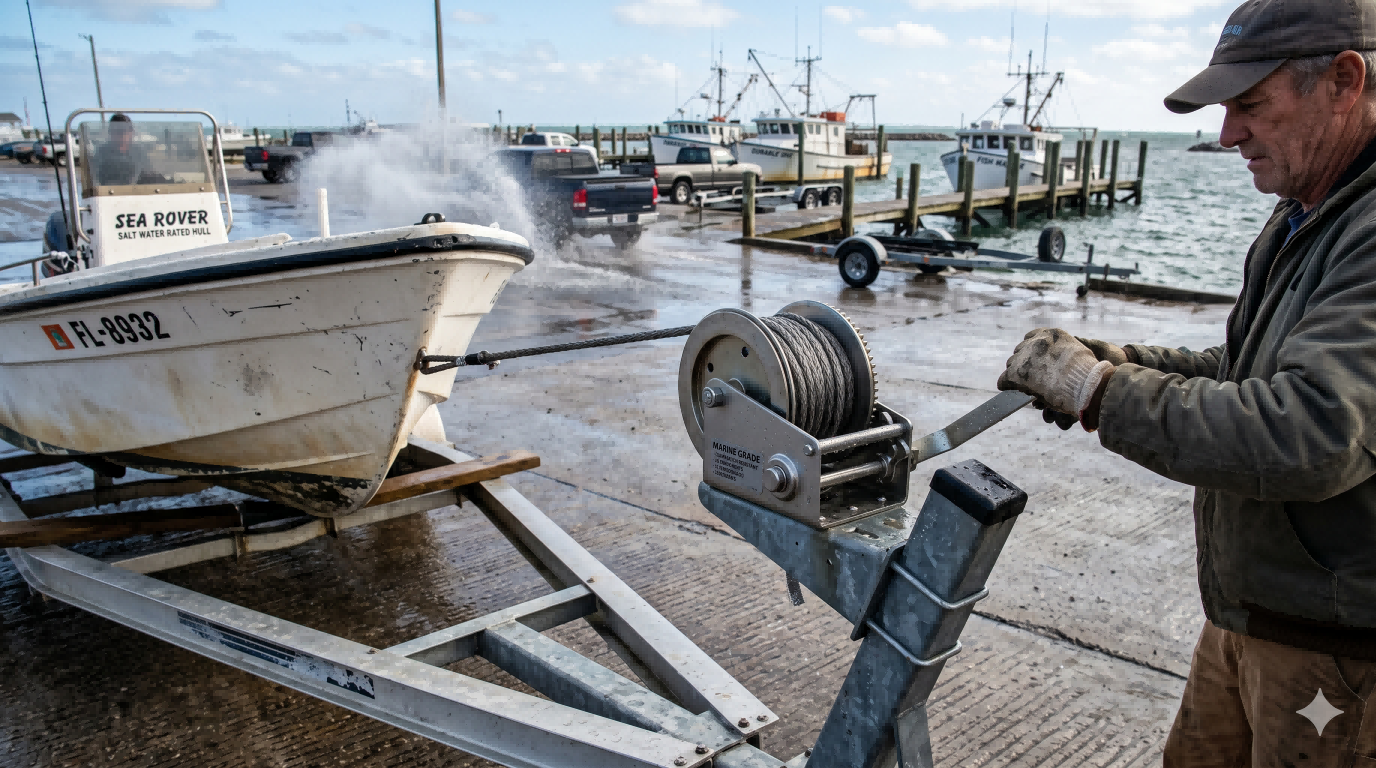
A boat trailer winch works within a marine recovery environment. Water level, hull alignment, bunk friction, ramp angle, and launch depth all affect winching behavior. A buyer may assume a stronger winch is the answer, when the real issue is trailer setup or ramp technique.
A car hauler winch faces another set of variables. Rolling resistance, tire condition, ramp angle, dead vehicle recovery, and trailer deck height all influence how much force is actually needed. In these cases, a winch is not just a convenience accessory. It is part of the loading system.
A utility trailer application may require a different balance again. Here, the decision often centers on flexibility, maintenance ease, and occasional but unpredictable pulling needs.
Because of this, the best trailer winch buying guide should never treat all trailers as one category. Buyers need to choose according to actual load behavior, not just advertised load capacity.
Manual Trailer Winch: Where It Still Makes the Most Sense

There is a common misconception that manual winches are outdated. In reality, a manual trailer winch remains a strong option in many use cases.
Its biggest strengths are mechanical simplicity, lower system dependency, easier serviceability, and lower upfront cost. It does not require a battery integration plan, heavy-gauge wiring, or remote-control management. For smaller trailers and lighter repeated loads, that simplicity can be highly efficient.
A manual system is also attractive in environments where electrical exposure, corrosion risk, or irregular usage make complex powered systems less desirable. Some buyers prefer a manual unit because it is easier to inspect, easier to understand, and easier to maintain over the long term.
Where Manual Winches Perform Well
A manual trailer winch is often a good fit for:
- small to mid-size boat trailers
- light utility trailers
- low-frequency personal use
- buyers who prioritize simplicity
- environments where electrical power is inconvenient
Where Manual Winches Become Less Ideal
Manual winches become less attractive when:
- load cycles are frequent
- the pull is long or steep
- the operator often works alone
- the load must be positioned precisely
- fatigue and time loss become real concerns
At that point, manual effort becomes an operating cost, even if it does not appear directly on the invoice.
Electric Trailer Winch: More Than Just Convenience

An electric trailer winch is often marketed as the easier option, but its real value is broader than ease of use.
A powered system helps standardize the loading process. It reduces dependence on physical strength, supports more repeatable operation, and can improve control when pulling heavy or awkward loads. In one-person workflows, it may significantly reduce the friction of daily trailer handling.
For commercial, marine, or higher-load environments, an electric trailer winch can also contribute to safer handling by reducing rushed or improvised loading behavior. The operator can focus more on alignment, positioning, and surrounding conditions rather than on pure exertion.
That said, electric systems are not automatically better. They require the right battery setup, cable routing, weather protection, and maintenance planning. If the power system is poorly designed, even a strong winch can deliver weak real-world performance.
When Electric Winches Deliver the Best Value
An electric trailer winch is especially suitable for:
- repeated weekly or daily use
- heavier boats or equipment
- car hauler and recovery-style applications
- solo operators
- buyers focused on productivity and loading consistency
Hidden Requirements Buyers Often Ignore
Before choosing an electric model, buyers should also consider:
- battery capacity
- wiring layout
- voltage drop
- circuit protection
- remote control position
- weather exposure
- long-term motor and control maintenance
This is where many buyers underestimate total system requirements.
Risk Should Be Considered as Seriously as Capacity
Capacity matters, but risk matters just as much.
When comparing a manual vs. electric boat trailer winch, most buyers look at pull rating first. A more advanced buyer also looks at risk profile. What happens when the operator is tired? What happens on a slippery ramp? What happens when alignment is poor, weather is bad, or the trailer is used by multiple people with different skill levels?
A winch that looks affordable on paper may create more risk during actual loading. A more controlled system may reduce operational variability, especially in marine or recovery applications.
This does not mean every risky application requires an electric unit. It means winch selection should include human factors, not only mechanical factors.
Questions Smart Buyers Ask
Before making a purchase, experienced buyers often ask:
- Will one person be handling the trailer alone?
- Is the loading surface steep or inconsistent?
- Does the trailer operate in saltwater or wet conditions?
- Will different operators use the same equipment?
- Is speed important, or is control more important?
- Is the current loading process physically demanding or unreliable?
These questions lead to better decisions than simply asking whether a powered winch costs more.
Total Ownership Cost Is More Important Than Purchase Price
One of the biggest mistakes in electric vs. manual trailer winch selection is to focus too much on initial purchase cost.
The real comparison should include total ownership cost:
- installation cost
- power setup cost
- maintenance frequency
- repair exposure
- downtime risk
- labor time
- operator fatigue
- usage frequency
A manual trailer winch often wins on entry price and simplicity. An electric trailer winch may win on efficiency, consistency, and reduced labor burden. The correct answer depends on whether the buyer is optimizing for short-term purchase cost or long-term operating performance.
This is why distributors and professional buyers often think differently from casual retail buyers. They are not only buying a product. They are buying a work process.
How Professional Buyers Should Make the Final Decision
For serious buyers, the final decision should be based on application fit rather than category preference.
If the load is light, the usage is occasional, the working environment is simple, and the buyer values basic reliability, a manual trailer winch may be the right answer.
If the trailer is used frequently, the operator works alone, the load is heavier, or the environment demands more consistent performance, an electric trailer winch usually offers stronger long-term value.
The most professional approach is not to ask which type is universally better. It is to ask which type is better matched to the real conditions of use.
That is the difference between buying a winch and specifying a winching system.
Final Thoughts
A high-quality trailer winch selection guide should not reduce the choice to convenience versus price. The real decision is about workload, operating environment, user safety, maintenance expectations, and ownership cost across time.
In many cases, a manual trailer winch remains the smartest solution. In others, an electric trailer winch becomes the clear operational upgrade. The right answer comes from matching the tool to the task, not from assuming one product category is always superior.
For brands, distributors, and trailer parts suppliers, this is also the right way to educate the market. Buyers do not only need product options. They need a better framework for making the choice.
When you explain how to choose a trailer winch in this way, your content stops being generic product marketing and starts becoming real industry guidance.
#Trailer Winch #Electric Trailer Winch #Manual Trailer Winch #Boat Trailer Winch #Car Hauler Winch #Utility Trailer Equipment #Trailer Parts #Winch Selection Guide #Towing Safety #Trailer Loading Solutions