Why Two-Speed Manual Trailer Winches Still Matter in a Powered World
A two-speed manual trailer winch is often misunderstood in today’s market. Many buyers see powered systems everywhere, compare products mainly by convenience, and assume that a manual winch with multiple gear ratios belongs to an earlier era. In real trailer use, that assumption is too simplistic.
A trailer winch is not chosen only by whether it is powered or non-powered. It is chosen by how it handles force, control, loading rhythm, maintenance reality, and operator behavior. That is why a serious discussion about a two-speed trailer winch should not begin with whether manual products are old-fashioned. It should begin with a more useful question: what kind of work still benefits from adjustable mechanical advantage and direct operator control?
In many applications, the answer is more important than buyers realize. A two-speed boat trailer winch can provide something that neither a basic one-speed manual unit nor an electric system always delivers in the same way: the ability to transition intelligently between faster line take-up and slower, more controlled heavy pulling without overcomplicating the system.

That is why two-speed manual systems still matter. They are not legacy products surviving by habit. When properly matched to the application, they are precise mechanical tools.
Why Two-Speed Winches Are Often Misjudged
One reason buyers overlook a two-speed manual trailer winch is that the product gets judged by category rather than by function. People hear “manual” and immediately think of lower efficiency, older technology, and more operator effort. That view misses the point.
A two-speed manual winch is not simply a slower version of an electric winch. It solves a different problem. Its value is not automation. Its value is controllable mechanical leverage.
That distinction matters because many trailer operations do not fail because the operator lacks power. They fail because the operator lacks the right combination of force and control at different moments of the pull.
The beginning of a pull often benefits from faster line recovery. The final seating of a boat or load often benefits from slower, higher-control operation. A single-speed manual system cannot adapt as gracefully between those needs. An electric system can reduce effort, but it may not always provide the same direct mechanical feel or the same low-complexity ownership logic.
This is the first key insight in how to choose a manual trailer winch: the best system is not the one with the most automation. It is the one that best fits the load transition behavior.
Speed and Torque Do Not Solve the Same Problem
The reason a two-speed winch matters is that speed and pulling force are not the same job.
A higher-speed gear ratio is useful when the line needs to be taken up quickly, the load is still relatively cooperative, or the operator wants to reduce wasted hand movement during the easier phase of loading. This makes the winch feel more efficient in normal setup and recovery.
A lower-speed gear ratio becomes valuable when the load grows more resistant, when the boat reaches the final section of the trailer, when alignment resistance increases, or when the operator needs more controlled leverage. This is where a two-speed manual trailer winch becomes much more than a convenience upgrade. It becomes a way to keep the loading process smooth and deliberate without excessive strain.
Why This Matters in Real Trailer Use
A trailer load rarely behaves the same way from start to finish. Resistance changes. Alignment changes. Friction changes. The operator may want speed at one moment and leverage at the next.
That is why a one-speed system can feel inefficient even if it is technically adequate. It may be acceptable at the beginning and frustrating near the end. Or it may feel powerful at the end but unnecessarily slow during the easy part of the pull.
A two-speed trailer winch reduces that mismatch. It allows the operator to choose the mechanical behavior that fits the stage of the job.
The Real Value of Two-Speed Design Is Transitional Control

The most overlooked benefit of a two-speed manual trailer winch is not simply that it has two gear settings. The real value is that it manages transition more intelligently.
Loading is rarely a single-condition event. A boat may come onto the trailer smoothly, then suddenly require more control near the bow stop. A piece of equipment may roll easily at first, then require more force when the approach angle changes. A utility load may be cooperative over most of the pull and then become more resistant when final positioning matters.
A two-speed system allows the operator to respond to this change without changing the winch, adding power, or overexerting in the wrong gear. That is why the product should be understood as a control tool, not only as a gearing variation.
High Speed Is About Workflow
The higher-speed mode generally supports:
- faster strap or line take-up
- reduced wasted cranking during light load phases
- smoother setup during early loading
- more efficient repetitive handling
Low Speed Is About Mechanical Advantage
The lower-speed mode generally supports:
- heavier final pull
- better control under resistance
- reduced operator strain at high load moments
- more deliberate load seating
This combination is exactly why two-speed winch benefits are often underestimated by buyers who focus only on whether a system is powered.
A Two-Speed Manual Winch Is Especially Valuable in Marine Trailer Applications
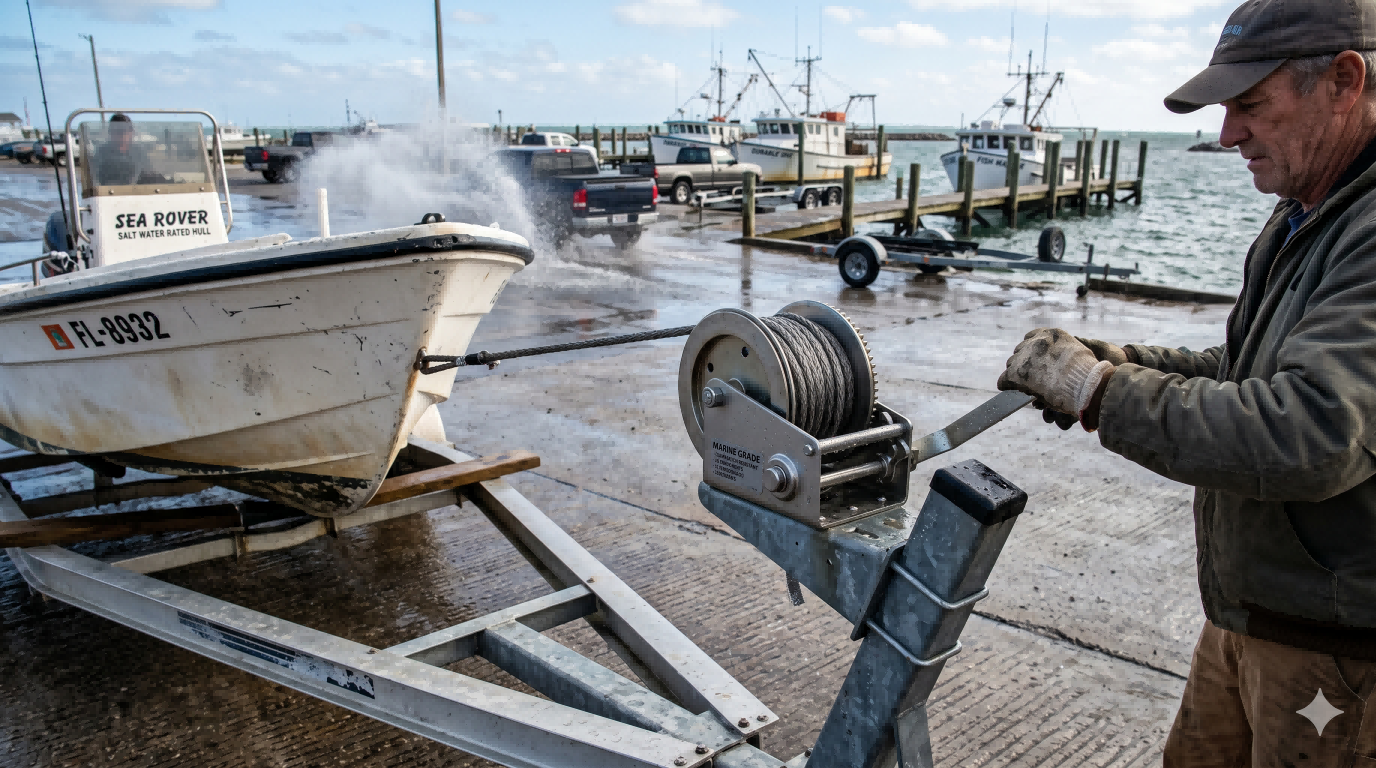
A two-speed boat trailer winch makes particular sense in marine environments because boat loading is often variable, guided, and highly sensitive to final positioning.
Boat retrieval is not just about getting the hull moving. It is about controlling how the boat aligns, how it centers, and how it seats at the front of the trailer. In many cases, the hardest part is not the first pull. It is the last controlled pull.
At that stage, the operator may need extra leverage without losing feel. A two-speed manual winch helps by allowing a faster approach during easier retrieval phases and then a more powerful, slower gear when final tension and positioning matter more.
This is especially useful on trailers where the boat behaves predictably most of the time, but still requires added leverage near the end of retrieval.
Why Marine Buyers Still Choose Two-Speed Manual Systems
A two-speed boat trailer winch remains attractive when buyers value:
- controlled final boat seating
- better leverage near the bow stop
- simple ownership without electrical dependency
- easy serviceability
- dependable operation at ramps without power-system concerns
For many marine users, that balance of control and simplicity is more valuable than a purely convenience-driven powered upgrade.
Not Every Manual Winch Needs to Be Electric to Be Modern

One of the biggest market misunderstandings is that “modern” automatically means powered. That is not always true.
In trailer equipment, modernity should not be defined by how much electricity is involved. It should be defined by how well the system fits the application. A manual trailer winch can still be the more modern choice when it solves the job with less system complexity, lower maintenance exposure, and better operator understanding.
A two-speed model takes that logic one step further. It modernizes manual performance by improving adaptability rather than by turning the product into a powered subsystem.
That matters for buyers who want higher control and better ergonomics, but do not want battery planning, cable routing, connector maintenance, or remote control dependency.
This is why a good manual trailer winch vs electric discussion should not assume that electric always equals progress. In many use cases, progress means choosing the simplest system that still manages the load correctly.
Where a Two-Speed Manual Trailer Winch Makes the Most Sense
A two-speed manual trailer winch is especially strong when the buyer needs variable pulling behavior without taking on the complexity of a powered setup.
Best-Fit Scenarios
A two-speed system is often a smart fit for:
- boat trailers with guided but sometimes resistant final loading
- operators who value mechanical control
- users who load regularly but not at commercial fleet frequency
- trailers where electrical power is inconvenient or unnecessary
- owners who prefer easy service and lower system dependency
Why Buyers Like It
These buyers are often looking for:
- faster light-load retrieval
- heavier controlled final pull
- reduced hand strain compared with one-speed manual units
- less electrical maintenance than a powered system
- a more confidence-inspiring loading rhythm
This is where the two-speed manual trailer winch stands out. It gives the operator options without forcing the trailer into a full electrical architecture.
Where One-Speed Manual Winches Still Work — and Where They Fall Short
A one-speed manual trailer winch is not automatically the wrong choice. In simpler applications, it can still be efficient and economical.
For lighter trailers, shorter pulls, and lower-resistance systems, a one-speed unit may be entirely adequate. Some buyers do not need more complexity, and a straightforward manual solution can work well.
However, the limitation appears when the application demands different behaviors during different parts of the pull. A one-speed system forces compromise. The operator must either accept slower overall operation or accept heavier cranking when the load becomes more difficult.
That is where the trailer winch gear ratio question becomes important. If the buyer expects the pull to change in character during loading, a two-speed design often creates a noticeably better ownership experience.
Two-Speed Manual vs. Electric Is a Control Question, Not Just an Effort Question
When buyers compare a manual trailer winch vs electric system, they often focus on effort reduction first. That is understandable, but it is not the whole story.
Electric systems reduce physical work. That is their major advantage. But they also introduce batteries, wiring, connectors, environmental protection needs, and a different form of maintenance discipline. They change the system architecture.
A two-speed manual trailer winch does not remove effort in the same way. Instead, it redistributes effort more intelligently. It gives the operator a better mechanical choice for the current stage of the pull.
That means the comparison is not only about exertion. It is about what kind of control the application really requires and what kind of system ownership the buyer wants.
When Two-Speed Manual Wins
A two-speed manual system often wins when the buyer values:
- mechanical simplicity
- low system dependency
- better force control than one-speed manual designs
- reliable use in remote or wet environments
- easier field service
When Electric Wins
An electric system often wins when the buyer values:
- repeated loading frequency
- one-person workflow efficiency
- reduced physical strain
- faster higher-volume operation
- consistent powered pulling across routine cycles
A serious trailer winch selection process should compare those ownership models honestly rather than assuming one is universally superior.
Mechanical Feel Still Matters More Than Some Buyers Admit
One reason experienced operators continue to value a two-speed trailer winch is mechanical feel.
That phrase may sound subjective, but it has practical meaning. Mechanical feel helps the operator sense increasing resistance, alignment changes, load response, and final seating tension. In some trailer operations, this feedback is extremely useful. It helps the user avoid over-rushed loading and maintain a more controlled rhythm.
A powered system can be efficient, but it may distance the operator from the physical feedback of the load. A one-speed manual unit preserves feel but may force awkward effort at the wrong time. A two-speed manual design often sits in a productive middle ground. It preserves feedback while improving adaptability.
That is why experienced trailer users often judge a winch by how it behaves in the hand, not only by what the specification sheet says.
Maintenance Simplicity Is Part of the Product Value
Another reason two-speed manual winch benefits remain relevant is maintenance simplicity.
A manual system generally avoids the full electrical concerns of a powered installation. There is no battery readiness problem, no remote control troubleshooting, no cable routing design, and no connector corrosion diagnosis. For many buyers, especially those using trailers seasonally or in environments where long-term simplicity matters, this is a real advantage.
A two-speed manual unit adds functionality without pushing the trailer into a completely different maintenance category. That is why it can occupy an attractive middle position: more capable than a basic one-speed manual winch, but still simpler than a powered system.
Why This Matters for Ownership
Buyers who think long term often care about:
- how easy the winch is to inspect
- how easy it is to explain to new users
- how little supporting infrastructure it needs
- how predictable it remains after storage
- how quickly it can return to service
This makes a two-speed manual trailer winch especially appealing for owners who value dependable readiness over full automation.
Boat Trailers, Utility Trailers, and Mixed-Use Applications All Read This Differently
Although the two-speed concept is often associated most strongly with marine trailers, it also matters in broader trailer use.
Boat Trailers
In marine applications, the two-speed advantage is often about controlled final positioning and better leverage during the last stage of retrieval.
Utility Trailers
In utility use, the value may come from mixed loading behavior. The load may not be especially heavy all the time, but resistance can vary enough that one fixed gear ratio becomes annoying or inefficient.
Mixed-Use Owners
For mixed-use trailer owners, a two-speed trailer winch offers flexibility. They may not need a powered system, but they do need more adaptability than a basic manual unit provides.
This is why the two-speed design should not be reduced to a niche marine feature. It is a broader answer to variable pulling conditions.
The Best Buyers Choose by Loading Behavior, Not by Product Trend
The smartest trailer winch selection decisions usually come from buyers who understand loading behavior rather than product fashion.
A buyer who asks, “Is this product manual or electric?” is still at the surface level.
A buyer who asks these questions is thinking at a higher level:
- Does the load behavior change during the pull?
- Do I need faster take-up and stronger final leverage in the same job?
- Do I value direct control more than powered convenience?
- Do I want increased capability without electrical complexity?
- Will the trailer benefit from better mechanical adaptability over time?
These are the questions that reveal when a two-speed manual trailer winch is the right answer.
How Professional Buyers Should Make the Final Decision
A useful how to choose a manual trailer winch process should not begin with price alone. It should begin with application logic.
Define the Pull Rhythm
Understand whether the job involves mostly uniform resistance or whether the load changes character during retrieval.
Evaluate Operator Priorities
Decide whether the operator needs more speed, more leverage, more mechanical feel, or lower system complexity.
Compare Ownership Models
Review whether the application is better served by one-speed manual simplicity, two-speed manual adaptability, or electric efficiency.
Match the Winch to the Real Work
Choose the system that delivers the best long-term control, not just the most attractive first impression.
This is the difference between choosing a catalog item and specifying a functional trailer subsystem.
Final Thoughts
A two-speed manual trailer winch still matters because many trailer applications do not simply need power. They need adaptable mechanical control.
That is especially true when the load changes behavior during the pull, when final positioning matters, when maintenance simplicity is valuable, and when the owner wants more than a basic manual system without taking on the complexity of a powered one.
A two-speed boat trailer winch is not outdated. It is often the most intelligent answer for guided loading where speed and leverage are both necessary at different moments. More broadly, a two-speed trailer winch remains relevant because it respects how trailer loads actually behave in the field.
The best equipment decisions are not made by asking which product category feels newer. They are made by asking which system gives the operator the right control, at the right moment, with the right ownership model.
That is why two-speed manual winches still deserve a place in a powered world.
#Two-Speed Trailer Winch #Manual Trailer Winch #Boat Trailer Winch #Trailer Winch Selection #Trailer Loading Control #Marine Trailer Equipment #Utility Trailer Winch #Towing Safety #Trailer Parts #Winch Gear Ratio