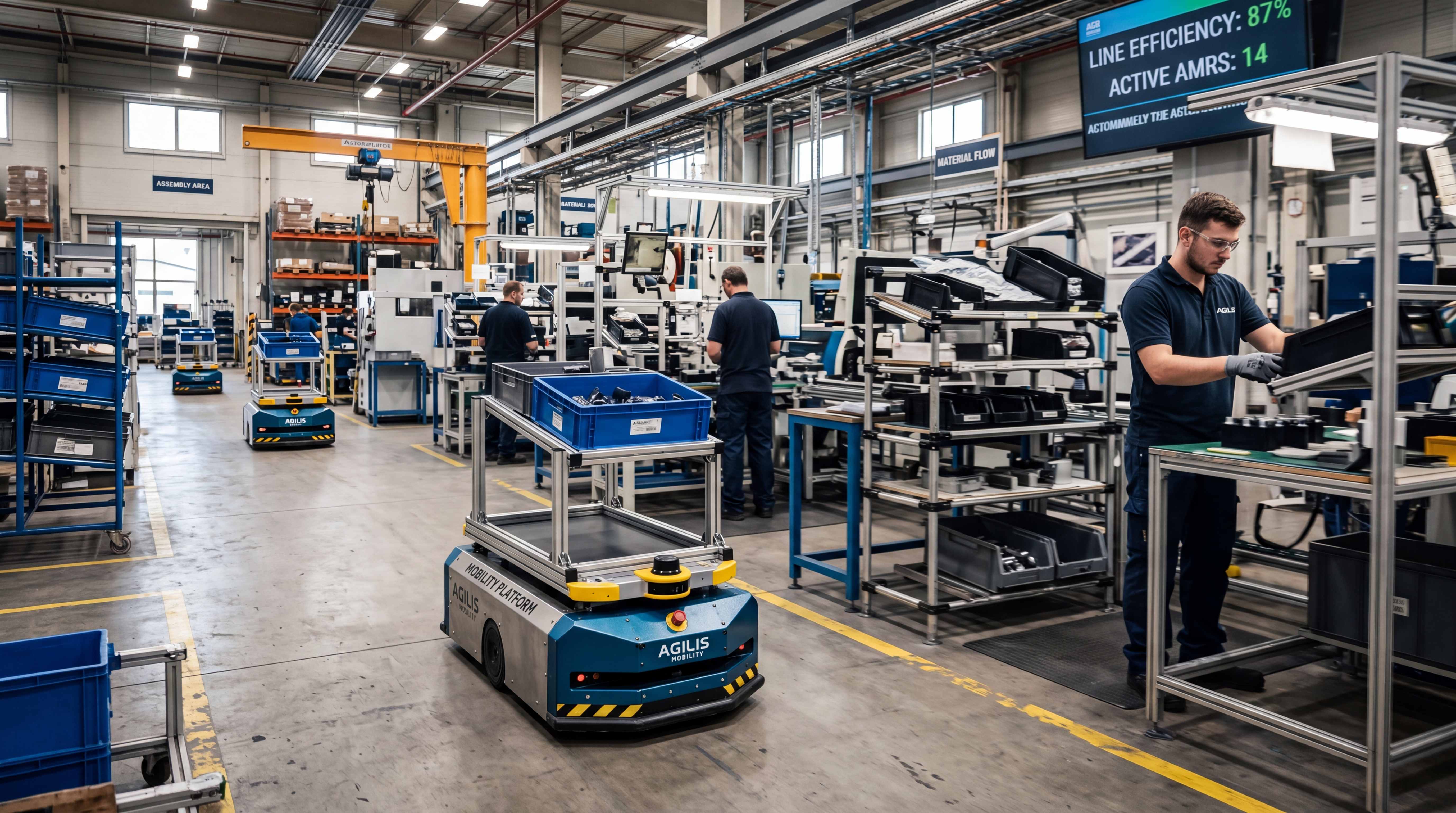
An AMR/AGV Mobile Base Is Not the Final Product: Real Value Begins When It Becomes a Complete Working Unit
The Chassis Is Rarely the Product the Customer Actually Wants
When buyers begin evaluating a mobile robotics project, they often start by looking at the base itself.
They compare payload, dimensions, navigation method, turning radius, safety sensors, speed, battery runtime, and floor clearance. These are all legitimate factors. A weak base creates obvious limits. A badly chosen vehicle can distort the entire project. But even after all of those variables are considered, one critical truth still remains:
The customer usually does not want a chassis.
The customer wants a job completed.
This is where a great deal of confusion enters the market for an AMR mobile base or AGV mobile base. The industry often presents the base as if it were the finished answer. It is shown as the center of the solution. It is described by performance specifications. It is compared by model family. It is sold through technical features. Yet in real operations, the base is rarely the final economic unit of value.
A buyer does not wake up wanting “a platform that can move at 1.5 meters per second.”
A buyer wants machine tending without unnecessary labor walking.
A buyer wants line feeding without cart congestion.
A buyer wants pallet movement without forklift dependency in a certain zone.
A buyer wants parts replenishment that arrives on time and docks reliably.
A buyer wants internal transfer that can scale without constant redesign.
In other words, the desired output is not movement alone. The desired output is a reliable working function.
That function only appears when the mobile robot platform becomes more than a moving base. It must become a complete working unit—one in which the base, the top module, the transfer logic, the robot docking system, the interface tolerances, and the task rules all support the same operational goal.
This is the point where many product discussions become too narrow. They stay at the level of the vehicle when the real business value is created at the level of system architecture. The base may be essential, but it is only the foundation. A foundation is not the finished building.
A serious buyer therefore needs to ask a different question.
Not: “Which industrial mobile base should we buy?”
But: “What kind of working unit do we need this base to become?”
Once that question moves to the center, the entire logic of evaluation changes. The base is no longer judged only by how well it moves. It is judged by how effectively it can host, support, stabilize, align, and repeat the work that happens above it and around it. At that moment, the conversation becomes much more commercially honest.
Because in real factory intralogistics, value does not come from mobility alone. Value comes from useful mobility, structured mobility, repeatable mobility, and most importantly, integrated mobility.
That is where the base stops being a component and starts becoming a solution.
Why Movement Alone Is a Weak Definition of Value
There is a simple reason so many mobile robot projects appear promising early and become disappointing later: movement by itself is easy to overestimate.
A robot moving through a plant looks productive. It looks advanced. It signals automation visibly. But visible motion is not the same as useful throughput. A vehicle can travel elegantly and still fail to create much value if the work it performs before and after movement remains weakly defined.
A base that drives from one zone to another without a stable transfer method may only relocate uncertainty.
A base that reaches the station but requires human correction every time has not fully automated the task.
A base that carries the payload but cannot align with the next process reliably creates an expensive manual boundary.
A base that can host different modules in theory but requires major redesign for each use case is not yet delivering true flexibility.
This is why movement is only the outer shell of the value proposition.
The real value in material handling automation comes from how movement is connected to task execution. A mobile base becomes economically relevant when it is embedded in a working logic that reduces labor, shortens non-value-added motion, improves timing reliability, lowers traffic friction, stabilizes process interfaces, or expands operational flexibility without multiplying complexity.
That outcome is never produced by the chassis alone.
It is produced by the relationship between the chassis and everything that makes the movement useful.
A Base Without Task Architecture Is Often Just a Better Cart
There is an uncomfortable but important truth in this category: some mobile robot projects never fully escape the logic of a cart.
They replace manual pushing with autonomous motion, but they do not redesign the surrounding work architecture. Pickup remains inconsistent. Drop-off remains loose. Operator dependency remains high. Exception handling is unclear. The transport event becomes automated, but the workflow remains half-manual and half-structured.
This may still create some value, but it is not the full promise of a modern autonomous mobile robot platform.
A higher-value project redesigns the task around the mobile base. It asks what module must sit on top. It asks how loads must be presented. It asks how stations must receive them. It asks whether the base should lift, tow, position, convey, rack, interface with a robot arm, or dock under a mobile structure. It asks how the transfer becomes repeatable enough that the robot is not simply moving uncertainty from one department to another.
That is the moment where the business stops buying motion and starts buying capability.
The Top Module Is Often Where the Real Application Begins

If the base is the foundation, the top module is often where the application becomes recognizable.
This is because most customers do not interact with the bare chassis logic in daily operations. They interact with the function that the chassis carries. That function may be a shelf, a roller conveyor, a pallet deck, a lifting frame, a cart hitch, a machine-tending fixture, a tow module, a bin rack, a robotic arm interface, or a customized load support structure. Whatever its form, the top module usually defines what the robot is actually doing in the eyes of the operation.
That is why top module integration deserves far more strategic attention than it often receives.
The Top Module Is Not Decoration
A common mistake in weak projects is to treat the module above the base as an accessory. It is added late, described loosely, or assumed to be a straightforward matter of mounting. In reality, the top module can reshape the technical and commercial behavior of the entire system.
It changes the center of gravity.
It changes how the load behaves under acceleration and braking.
It changes docking height and transfer alignment.
It changes structural stiffness.
It changes the repeatability requirements of the base.
It changes how operators interact with the unit.
It changes how the robot is perceived by the surrounding process.
A low-profile deck for pallet transport is a different working unit from a tall rack for parts replenishment. A conveyor top for automatic handoff is a different working unit from a tugger solution for cart trains. A lift-top module that raises a frame introduces different dynamic requirements than a machine-tending interface that must stop precisely under a robot arm.
This is why a serious AMR mobile base discussion must move quickly toward the question of module form. Without that, the project remains technically descriptive but commercially incomplete.
The Wrong Module Can Waste the Right Base
It is entirely possible to choose a strong base and still end up with a mediocre solution because the top structure was poorly conceived.
A platform may have excellent motion behavior, but if the module creates unstable loading, difficult access, awkward ergonomics, or poor interface repeatability, then the system underperforms where it matters most. The base may still be good. The working unit is not.
This is especially important in modular mobile automation, where the market often promotes flexibility by suggesting that one base can support many different applications. That statement is only meaningful if the module architecture has been designed thoughtfully enough that reconfiguration does not destroy operational clarity or create endless custom engineering.
Flexibility that exists only in marketing diagrams has little value. Flexibility that survives real workflows has a great deal of value.
A Working Unit Must Be Defined by the Task, Not by the Vehicle Category
One of the most useful shifts a buyer can make is to stop defining the project by the type of robot and start defining it by the type of working unit required.
This sounds subtle, but it transforms the decision process.
Instead of saying, “We need an AGV mobile base for this area,” a better statement might be, “We need a route-stable working unit that can carry two standardized parts racks, align to a manual unload zone, and repeat the transfer every four minutes.”
Instead of saying, “We need an AMR mobile base for this process,” a better statement might be, “We need a flexible working unit that can move variable bins between machine groups, tolerate changing pickup points, dock to a visual operator zone, and later support additional modules.”
When defined this way, the project becomes much easier to evaluate honestly.
The Task Reveals the Right Architecture
A working unit should be described through its function:
What is the transported object?
How is it loaded?
How is it unloaded?
What accuracy is needed at arrival?
What module shape best supports the load?
What height should the interface occur at?
Does the module need passive support or active motion?
Is the task repetitive, mixed, or event-driven?
Will the same base later host another module family?
Does the unit need to support human interaction, machine interaction, or both?
These questions do more to determine the correct architecture than the high-level label of AMR mobile base or AGV mobile base by itself.
Because once the working unit is clearly defined, the vehicle category becomes a means, not the end.
A Mobile Base Is Valuable When It Reduces Task Complexity
A strong working unit does not merely carry the task. It simplifies the task.
It presents the load in the right orientation.
It reduces operator reach and handling effort.
It helps the next station receive material correctly.
It minimizes ambiguity at handoff.
It reduces manual repositioning.
It aligns movement logic with process timing.
It creates a clearer physical language for the workflow.
This is why the most successful mobile automation projects often feel simple in use even if their engineering is sophisticated underneath. The complexity has been absorbed into the architecture of the working unit, which allows the operation itself to become more reliable and more intuitive.
That is a much stronger value proposition than merely offering a chassis with motion capability.
The Interface Between the Module and the Next Process Is Where the Economics Become Real

A moving unit creates most of its commercial value not while it is traveling, but at the moment it connects with the next process.
That moment may be docking to a conveyor.
It may be presenting parts to an operator.
It may be positioning a cart at a workstation.
It may be delivering a pallet to a machine load zone.
It may be placing a frame under a lift table.
It may be bringing a shelf to a picking area.
Whatever the case, that interface point determines whether the unit creates true operational leverage or just creates a new boundary that people must manage manually.
Transport Without Transfer Discipline Is Incomplete Automation

A mobile base can be excellent in motion performance and still leave most of the labor savings unrealized if the transfer moment is poorly designed.
If operators must realign the rack by hand, the module is incomplete.
If the conveyor interface depends on frequent adjustment, the docking logic is incomplete.
If the cart must be twisted into place after arrival, the working unit is incomplete.
If pallet quality variation constantly breaks repeatability, the upstream interface is incomplete.
This is why a robot docking system should not be treated as a minor technical detail. It is one of the main economic gates through which project value must pass.
The value of a mobile robot is not proven when it reaches the station.
It is proven when the station can use what it delivered without friction.
The Module and the Docking Logic Must Be Designed Together
Many weak projects separate these ideas too much. The base is selected first, the top module is discussed later, and the docking method is treated as a downstream engineering detail. This sequence often causes avoidable redesign.
In a better process, the base, the module, and the transfer logic are conceived as one working system.
If the unit must dock to a conveyor, module height and approach repeatability must be part of the same conversation.
If the unit must serve manual operators, access angles and ergonomic interaction must be considered together.
If the unit must feed a robot arm, structural stability, arrival consistency, and part presentation logic must align from the beginning.
A good mobile robot platform is therefore not just a machine with mounting points. It is a base that can become part of an integrated transfer architecture.
That is the difference between a promising prototype and a commercially strong application.
Platform Thinking Is Stronger Than Model Thinking
The market often encourages buyers to think in models.
Which model has the right payload?
Which model has the right speed?
Which model supports this navigation method?
Which model looks more advanced?
These questions are natural, but they can trap the buyer inside a supplier-centric frame rather than an application-centric frame.
Platform thinking is more powerful.
A platform is not merely a product. It is an expandable design logic. It is the combination of base capability, module compatibility, interface discipline, digital control logic, safety behavior, and workflow adaptability that allows multiple working units to be created with coherence instead of reinvention.
This is where the idea of a mobile robot platform becomes commercially meaningful.
A Platform Supports a Family of Working Units
The strongest businesses do not always want a different robotics architecture for every transport task. They often want a family resemblance across use cases.
One base family may support a shelf module for line feeding, a conveyor module for station transfer, and a tug module for cart movement. Another may support a machine-tending top on one route and a pallet support structure on another. The commercial advantage is not merely part reuse. It is operational continuity.
The maintenance logic becomes more unified.
The software environment becomes more manageable.
The user experience becomes more consistent.
The scaling path becomes more predictable.
The automation program feels like a system rather than a collection of isolated experiments.
This is the real promise of modular mobile automation when done well.
Platform Value Is Lost When Every Use Case Becomes a One-Off
Some projects claim to use a platform strategy but in practice create a new custom stack for every task. The base may be similar, but each module, interface, logic layer, and behavior rule is reinvented to such an extent that the system behaves like a series of unrelated projects.
That is not true platformization. That is repeated customization wearing a platform label.
A real platform creates enough common structure that the next working unit is easier to define, easier to validate, and easier to integrate than the previous one. It does not eliminate engineering, but it reduces the amount of rethinking required for each expansion.
This matters greatly in factory intralogistics, where the long-term value of automation is often determined less by the first successful unit than by how economically the second, third, and fourth units can be introduced.
The Best Top Module Is the One That Clarifies the Workflow
The market sometimes evaluates modules through a purely technical lens—payload support, material choice, dimensions, rigidity, or compatibility. These matter, but they are not the only criteria.
A strong top module also clarifies the workflow physically.
It makes the task legible.
An operator can see where materials belong.
A machine can receive the load in a repeatable way.
A technician can understand the arrival state immediately.
A replenishment process can stay consistent because the module encodes order into the physical presentation of material.
This is one reason shelf modules, guided rack structures, and fixed-position presentation systems can create value beyond mere transport. They reduce cognitive noise. They turn the moving unit into a structured part of the process language.
Good Modules Reduce Interpretation
In weak systems, people must interpret the arrival every time.
Where should this bin go?
Is this the right side?
Has the cart been positioned correctly?
Do we need to rotate the load?
Can the next station receive this orientation?
Should the operator unload from the near side or the far side?
Every extra interpretation point creates delay, inconsistency, or error opportunity.
A strong module reduces these questions by embodying the intended process. It does not simply carry parts. It carries instruction, structure, and timing discipline.
This is one of the least appreciated ways that a well-designed industrial mobile base can generate business value. The moving unit becomes a physical organizer of work, not just a transport tool.
Module Simplicity Can Be More Valuable Than Module Sophistication
There is also an important commercial lesson here: the best module is not always the most mechanically complex one.
A simple passive frame with excellent ergonomics and reliable repeatability may create more real productivity than an over-engineered active mechanism that introduces maintenance burden, alignment drift, or unnecessary failure points. In some cases, clever simplicity is the strongest form of sophistication.
The question is not how advanced the module looks.
The question is how effectively it makes the workflow easier to repeat.
That is a much better design standard.
The Base Must Be Evaluated for How Well It Supports the Module, Not Just the Load
A common simplification in the market is to evaluate the base only by payload rating. But once the project is viewed as a working unit, that approach becomes inadequate.
The base must support the module structurally, dynamically, and operationally.
Dynamic Support Matters More Than Static Support
A chassis may be able to carry the weight of a module and load combination, but that is only the beginning. The more meaningful question is how the system behaves while moving, stopping, cornering, and docking.
A tall presentation rack changes inertia.
A conveyor top changes height relationships.
A lifting mechanism changes dynamic load behavior.
A machine-tending frame changes positional sensitivity.
A cart tow module changes path and response logic.
The base must therefore be judged according to how well it supports the real motion behavior of the working unit, not just the bare mass on a specification sheet.
This is where a technically acceptable base can become a commercially poor choice. If it carries the load but creates unstable motion, awkward stop behavior, weak docking repeatability, or operator discomfort, then the final unit may fail to deliver the promised value.
The Base Also Determines the Upgrade Path
If the business later wants to support additional module types, the base becomes even more important. Mounting interfaces, control extensibility, IO flexibility, safety zone behavior, localization robustness, and mechanical tolerance all influence how successfully the platform can host future working units.
That is why a buyer should not ask only whether the current module can be mounted. The buyer should ask whether the base can remain useful as the architecture of the workflow grows.
A true autonomous mobile robot platform should support not just today’s module, but tomorrow’s logic.
Working Units Create Stronger ROI Narratives Than Chassis Purchases
Another major advantage of thinking in complete working units is that it creates a better business case.
A chassis is difficult to explain in economic terms by itself. It is still one step removed from the process outcome. A working unit, by contrast, can be mapped directly to labor time, process delay, station utilization, forklift reduction, walk reduction, replenishment reliability, or throughput stability.
This makes the ROI conversation much more concrete.
Operations Buy Process Outcomes, Not Mechanical Possibility
A finance or operations stakeholder usually responds better to statements like these:
This unit will present standardized parts racks to three workstations with less walking.
This unit will automate conveyor-to-line transfer without requiring manual repositioning.
This unit will replace repeated tug movement in a fixed internal route.
This unit will support late layout changes without redesigning all the transport interfaces.
This unit will reduce forklift entry into a sensitive work area.
These are business outcomes tied to recognizable working units.
By contrast, a statement such as “this base supports multiple future application possibilities” may be true, but it is a weaker economic story unless it is translated into concrete modules and real workflows.
Platform Thinking Makes Expansion Easier to Justify
Once the first working unit is successful, the platform logic becomes easier to defend internally. The business has something tangible to point to. It can say: this base-module-transfer architecture worked here; now we can adapt the same logic for a different zone with lower risk.
That is a more persuasive path than selling each new project from zero.
This is another reason why modular mobile automation becomes strategically powerful when done well. It does not only reduce engineering effort. It also reduces internal decision friction.
A Complete Working Unit Must Survive Real Operations, Not Just Technical Review
One of the hardest truths in industrial automation is that many technically elegant concepts lose strength in live use because they were optimized for engineering review rather than operational durability.
A complete working unit has to survive normal business reality.
That means operators are busy.
Traffic is imperfect.
Loads vary slightly.
Timing changes.
Temporary workarounds appear.
Layout discipline is not absolute.
Maintenance attention is limited.
Supervisors care about throughput more than conceptual purity.
If the working unit cannot remain useful under those conditions, it may still be interesting technology, but it is not yet a strong industrial solution.
The Unit Must Be Easy to Understand in the Real World
Operational durability includes usability.
Can a new operator understand what the arriving unit is for?
Can the next station accept the module state without confusion?
Can temporary issues be resolved without deep engineering support?
Can people tell whether the unit has docked correctly?
Can the workflow remain stable when staffing, volume, or priorities shift?
These are not minor concerns. They determine whether the working unit becomes part of normal operations or remains a special project requiring constant attention.
A Good Working Unit Becomes Boring in the Best Possible Way
The highest compliment for a well-designed mobile working unit is often that people stop talking about it. It becomes boring—not because it lacks value, but because it has become normal infrastructure.
It arrives where it should.
It presents what it should.
It interfaces how it should.
It leaves when it should.
It does not demand interpretation every time.
That is a sign of commercial maturity.
The mobile base disappears into the usefulness of the working unit. And that is exactly what should happen.
The Strongest Projects Move From Vehicle Selection to Application Architecture Early
There is a practical lesson running through all of this: the earlier a project moves beyond bare vehicle selection and into application architecture, the better the final result usually becomes.
Application architecture means defining the whole working unit:
the base,
the top module,
the presented load,
the arrival condition,
the docking logic,
the receiving process,
the safety interaction,
the digital task rules,
and the possible expansion path.
Once the project reaches that level, the buyer is no longer shopping for a chassis. The buyer is defining a productive capability.
That is the point where serious commercial value can be created.
Final Perspective
An AMR mobile base or AGV mobile base is essential, but it is rarely the final product the customer truly needs.
The market often begins with the chassis because it is visible, specifiable, and easy to compare. But in real factory intralogistics and material handling automation, the chassis alone is only the first layer of value. The real business outcome emerges when the base becomes part of a complete working unit shaped by top module integration, reliable interface design, disciplined transfer logic, and workflow-aware architecture.
That is when mobility stops being generic.
That is when automation stops being symbolic.
That is when the system begins to create repeatable operational leverage.
A base that only moves is not yet the full answer.
A base that hosts the right module, supports the right docking behavior, presents the right load state, and fits the right process can become a true mobile robot platform for scalable industrial use.
This is why the strongest buyers no longer ask only which base has the best specifications. They ask what kind of working unit the business actually needs, how that unit should interact with the next process, and whether the chosen architecture can grow into broader modular mobile automation rather than remaining a one-off technical success.
In the long run, this is where the most durable value is created.
Not in movement alone.
Not in platform claims alone.
Not in model comparisons alone.
But in the disciplined transformation of an industrial mobile base into a complete, usable, repeatable, economically meaningful working unit.
That is where the category becomes mature.
And that is where customers begin to feel that they are no longer buying a robot chassis at all.
They are buying capability.
#AGVMobileBase
#TopModuleIntegration
#MobileRobotPlatform
#MaterialHandlingAutomation
#FactoryIntralogistics
#RobotDockingSystem
#ModularMobileAutomation
#AutonomousMobileRobotPlatform
#IndustrialMobileBase
#SmartFactory
#IndustrialAutomation