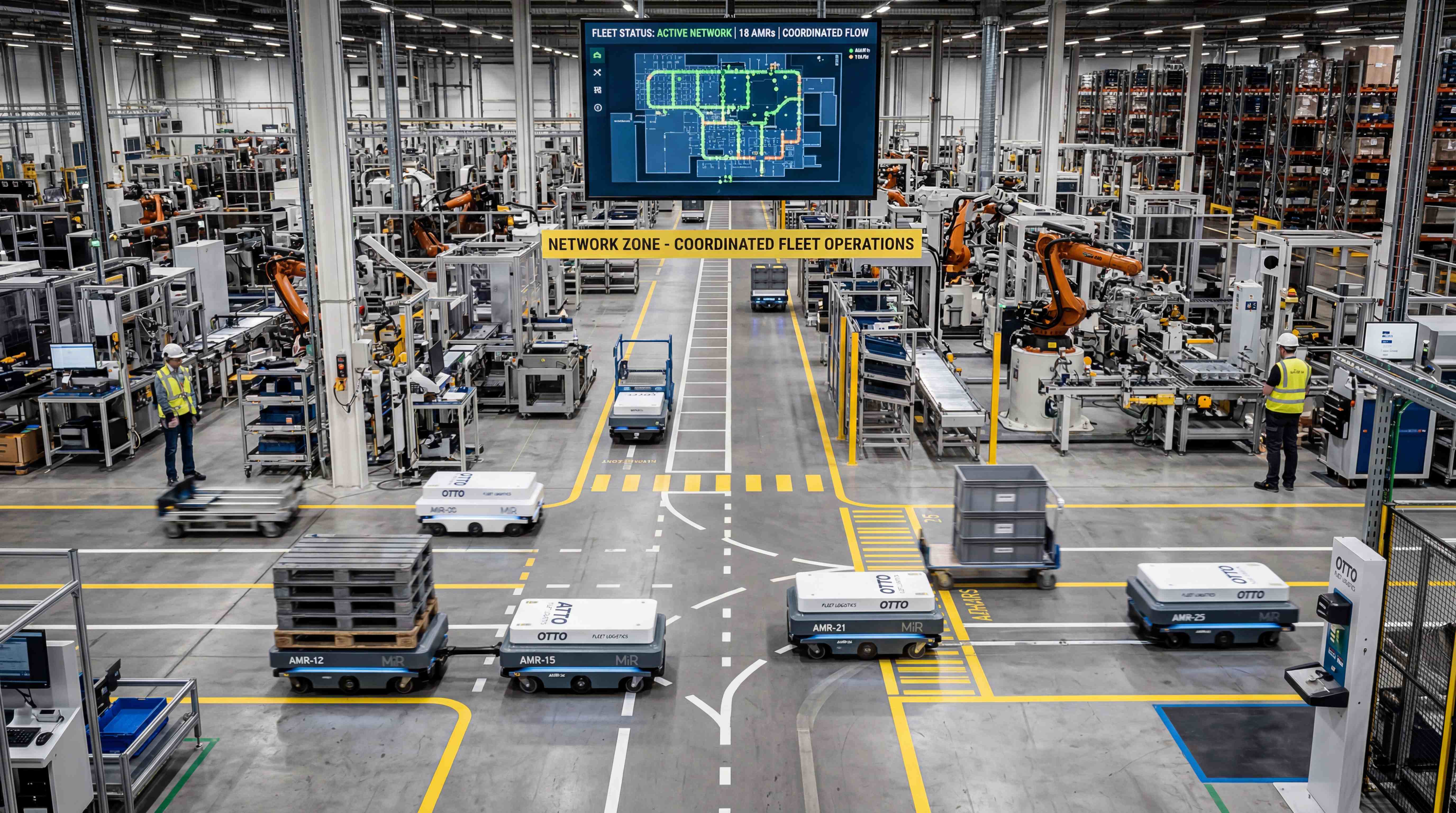
Why More Factories Are Starting Automation With a Mobile Base Platform Instead of Waiting for a Perfect Full-System Transformation
The Factory That Waits for Perfect Automation Usually Waits Too Long
There is a familiar pattern in industrial transformation.
A factory knows it needs to improve internal movement, labor efficiency, response speed, and material flow. Management sees pressure coming from multiple directions at once: product variation is rising, customer lead times are tightening, labor remains difficult to stabilize, layout changes happen more often than before, and traditional internal transport methods increasingly look expensive, inflexible, or operationally fragile. Everyone agrees that automation matters.
And then nothing major happens for a long time.
The reason is rarely a lack of interest. More often, it is the size of the imagined starting point.
The factory does not want to make a small move. It wants to make the “right” move. It begins discussing a fully integrated transformation: new cells, new conveyors, new software layers, redesigned routes, standardized stations, unified planning, perhaps even a complete future-state layout that looks clean, efficient, and highly automated. In strategy presentations, this kind of end-state is appealing. It suggests clarity. It suggests boldness. It suggests that if the business waits a little longer and plans a little harder, it can avoid fragmented upgrades and jump directly into a better future.
But real factories do not live inside presentation logic. They live inside operating pressure.
Orders still have to ship while planning is happening.
Manual transport still has to run while layouts remain under debate.
Engineering resources are limited.
Legacy processes do not disappear just because a better state has been imagined.
And the longer the business waits for the perfect all-at-once redesign, the more expensive its current movement problems become.
This is exactly why more companies are no longer starting with the dream of total transformation. Instead, they are starting with something more grounded and, in many cases, more strategically intelligent: a factory mobility platform.
That phrase matters because it changes the meaning of the first automation step. The business is no longer asking how to automate everything at once. It is asking how to introduce a reusable movement capability that can begin creating value now, support change later, and fit inside a broader automation deployment path without requiring the whole factory to become perfect first.
This is one of the biggest mindset shifts now happening in industrial automation. The starting point is moving away from “full-system redesign first” and toward mobile-first automation as a way to create operational leverage, learn from live deployment, and build a more credible long-term transformation program.
That does not mean comprehensive automation has lost value. It means the entry logic has changed.
Instead of treating automation as a final architecture that must be designed fully before the first move, more manufacturers are treating it as a staged capability program. They begin by installing mobility where mobility reduces friction fastest. They create a manufacturing mobility layer that can serve today’s workflows while gradually informing tomorrow’s structure. They use that layer to support transport, line feeding, work-in-process flow, machine service, buffer management, and other internal tasks that would otherwise remain trapped in labor-intensive routines. Over time, that first layer becomes not a temporary compromise, but the basis for a scalable internal logistics platform.
This is why the mobile base is becoming such an important strategic object. Not only because it moves, but because it allows the factory to begin changing before every other part of the factory is ready to change with it.
And for many businesses, that is the difference between transformation that is continuously delayed and transformation that actually begins.
Full-System Automation Looks Clean on Paper Because Paper Has No Legacy

One reason factories hesitate to begin with mobility is that large fixed automation still feels more “serious” in boardroom language.
Conveyors look committed.
Dedicated material routes look decisive.
Custom integrated cells look like capital investment with visible authority.
A full redesign looks strategic.
By contrast, a mobile base can be misread as provisional, incremental, or somehow less ambitious. But this is usually a misunderstanding created by looking at industrial change from the perspective of idealized design rather than operational reality.
Paper has no legacy constraints. Real factories do.
A factory may want to redesign an area completely, but the area must keep running in the meantime.
A plant may want a new material flow concept, but product mix is still changing too quickly to freeze a final layout.
A site may want to eliminate manual transport, but multiple departments are not yet ready to standardize interfaces at the same pace.
A business may want to create a future-state smart factory, but capital timing, engineering bandwidth, and ongoing production commitments make one-time transformation difficult to absorb.
This is especially true in a brownfield automation upgrade context.
Brownfield environments are not empty canvases. They are living industrial ecosystems with legacy machines, partial layouts, mixed processes, inconsistent interfaces, practical workarounds, and organizational history. Their greatest challenge is not a lack of vision. It is the difficulty of implementing new structure without breaking the working reality that still has to support the business every day.
That is why waiting for a perfect future state can become a hidden form of inaction. The project sounds bold, but the threshold for beginning remains too high. A decision that appears strategic can quietly become conservative.
Brownfield Reality Rewards Staged Capability, Not Architectural Purity
The most successful factories are often not the ones that wait until every future dependency is solved. They are the ones that know how to build capability in layers.
They start with movement where movement is the biggest friction point.
They standardize interfaces where automation can realistically connect.
They deploy transport logic in areas where the benefits are immediate but the disruption is manageable.
They use live operations to reveal where the next structure should be added.
They allow real flow data and real operator experience to shape later phases.
This is the essence of an incremental automation strategy.
It is not a smaller vision. It is a more executable vision.
A modular factory upgrade approach accepts that the factory does not need to become fully redesigned before it becomes more automated. It allows the business to improve selected logistics behaviors, reduce manual waste, and establish new movement discipline step by step. In practice, this often leads to stronger long-term systems because the transformation is informed by operational truth rather than only by early-stage planning assumptions.
Fixed Infrastructure Solves One Problem and Sometimes Creates Another
Large fixed systems can be powerful when the environment is stable enough to justify them. But in factories where layout evolution remains active, overcommitting too early can create a different kind of rigidity.
A conveyor route can optimize today’s path and constrain tomorrow’s adjustment.
A highly specific material flow design can work beautifully until product sequencing changes.
A dedicated structure can protect consistency in one zone while making cross-functional improvement harder elsewhere.
That is why more manufacturers are turning first toward flexible manufacturing transport and reconfigurable factory flow. They are not rejecting structure. They are delaying irreversible structure until the business is more certain about what should be locked in and what should remain adaptable.
A mobile base is valuable in exactly this space. It allows movement logic to become more automated without forcing the entire plant to commit physically before the learning is complete.
That is not a weak first step. In many cases, it is the most intelligent one.
The Mobile Base Has Become a Strategic Layer, Not Just a Device

If factories are increasingly starting with a factory mobility platform, it is because they are beginning to see mobility differently.
The mobile base is no longer understood merely as a transport gadget or a standalone robot unit. It is being reinterpreted as infrastructure in motion: a deployable layer of factory capability that can sit between manual labor and full fixed automation.
This matters because it changes the business case.
A device solves an isolated task.
A layer supports a family of tasks.
That is the real strategic shift.
A Manufacturing Mobility Layer Creates Reusable Value
When a business deploys a strong manufacturing mobility layer, it does not only automate one route. It creates a new way for the factory to handle internal movement.
That layer can be used to serve line feeding in one phase, then machine service in another, then work-in-process transport, then dynamic replenishment, then station-to-station transfer. Some applications may use the same mobile base family with different top modules. Some may rely on the same control environment and route governance rules even when the tasks differ. The value is not only in task completion. The value is in the establishment of repeatable movement logic that the business can expand.
This is where the concept of a scalable internal logistics platform becomes powerful.
The factory is not buying motion one route at a time. It is building a mobility architecture that can be extended as confidence, process discipline, and interface readiness grow.
Mobility Makes Change Less Expensive
One of the deepest reasons factories are starting here is economic.
In unstable or evolving environments, the cost of changing internal movement matters almost as much as the cost of movement itself. Every time a new product mix changes where parts need to go, every time a work cell shifts, every time the process requires a different interaction pattern, the business pays either through manual adaptation or through the redesign burden of whatever infrastructure it has already installed.
A mobile-first automation approach reduces the cost of those adjustments because the movement layer is inherently more reconfigurable. That does not mean it is effortless. It means the factory can modify behavior through routes, task rules, station logic, and modular attachments more easily than if every internal movement decision were embedded in fixed physical systems from the beginning.
This is the practical business value of reconfigurable factory flow. It allows the operation to learn without being punished excessively for changing.
In industries where product variation, customer mix, internal balancing, or labor structure remain fluid, that flexibility is not a luxury. It is one of the conditions for transformation to remain viable at all.
Starting With Mobility Is Often the Most Honest Way to Start With Data
Factories talk frequently about digital transformation, but many internal flow decisions are still based on limited operational visibility.
A route is believed to be stable because it has always been used.
A station is assumed to be critical because people say it is.
A certain transport pattern is treated as fixed even though nobody has measured how often it changes.
A future-state logistics map may look convincing, but it is often built on assumptions about demand timing, congestion, handoff discipline, and station readiness that have never been validated under more automated conditions.
This is another reason the automation deployment path increasingly begins with mobility.
A mobile base does not only automate transport. It also exposes the real behavior of transport.
Live Mobility Reveals the Hidden Structure of the Factory
Once movement becomes system-managed, the plant begins to learn things that manual transport previously hid.
Which routes are actually stable and which only seem stable.
Which stations create consistent demand and which produce irregular pulls.
Where congestion appears repeatedly.
Which handoff points are not standardized enough for reliable automation.
Which zones are easy to serve and which demand redesign before they can scale.
Which product families fit the new logic and which still need exceptions.
That is extremely valuable knowledge.
The business may have believed it needed a single future layout. What it may actually need is a staged sequence of layout, interface, and workflow upgrades informed by the truth of real movement data. In that sense, a factory mobility platform is not only an automation tool. It is a discovery tool.
Data From Movement Is More Actionable Than Abstract Ambition
A great many strategic mistakes happen because the business tries to design its perfect final state before it has enough structured evidence about how internal movement should actually behave.
By contrast, a modular factory upgrade path produces evidence through controlled live deployment. The factory learns where the next investment should go, which processes are ready for stronger automation, and which interfaces need more discipline before deeper integration becomes worthwhile.
This is why mobility often becomes the first serious layer of industrial digitalization. It links physical movement, task logic, route behavior, station interaction, and performance visibility in a way that purely conceptual planning cannot.
A company that starts here does not only automate earlier. It learns earlier.
And in many cases, that learning is what makes the later large investments more intelligent.
Mobility Is Easier to Justify Because It Solves Immediate Pain Without Requiring Full Agreement

Another practical reason factories begin with a mobile base is that movement pain is usually visible across departments.
Production sees missing materials or late replenishment.
Logistics sees labor inefficiency and route inconsistency.
Engineering sees the limits of current layout assumptions.
Management sees forklift dependence, non-value-added walking, and unpredictable internal flow.
Safety teams see mixed traffic pressure.
Improvement teams see that internal transport is blocking broader optimization.
In other words, mobility problems are widely understood.
That matters because cross-functional agreement is often hard to achieve in large transformation projects. Different groups want different things. Some prioritize throughput, others flexibility, others standardization, others risk reduction. A full redesign can become politically slow because too many strategic decisions need consensus at once.
A factory mobility platform often avoids part of that trap because it addresses obvious shared pain while postponing some of the more divisive structural questions.
Mobility Creates Value Before the Final Factory Philosophy Is Settled
A plant may still be debating the long-term architecture of line layout, warehouse interaction, or final automation structure. But it may already know that internal movement is too manual, too forklift-dependent, too labor-intensive, or too inconsistent.
That creates an opportunity.
The business can begin with flexible manufacturing transport and improve the logistics layer before every downstream system is fully redefined. This does not solve everything, but it creates real operational relief. It can also reduce the political temperature around transformation because it demonstrates that change does not require waiting for total alignment.
A successful early mobility program can become a credibility engine. It proves that the factory can deploy automation in a way that is useful, manageable, and scalable. Once that confidence exists, later steps become easier to justify.
Mobile-First Does Not Mean Mobility-Only
This point is important. Starting with mobility does not mean the factory intends to stop there. It means the business is choosing the layer that can unlock progress earliest, most visibly, and with the strongest balance between adaptability and value.
Over time, that movement layer may connect to fixed transfer systems, machine interfaces, digital scheduling, warehouse workflows, or broader cell redesign. The factory can still reach a highly automated state. It is simply choosing a better entrance.
That entrance matters more than many people think. The wrong entry strategy can delay transformation for years. The right one builds momentum.
A Mobile-First Strategy Works Because It Respects the Uneven Readiness of Real Factories
One of the least discussed truths in industrial transformation is that factories are rarely equally ready everywhere.
One area may have good station discipline but poor transport logic.
Another may have clear material demand but weak docking interfaces.
A third may have stable routes but highly mixed product sequencing.
A fourth may be operationally ready for automation but politically sensitive because too many teams share it.
If the business waits until every area reaches equal readiness, it often waits too long.
This is where incremental automation strategy becomes especially valuable. It allows the plant to automate according to readiness gradients rather than waiting for total system uniformity.
Uneven Readiness Is Not a Problem if the Deployment Path Is Modular
A modular factory upgrade approach does not require the whole site to become equally structured at once. It allows the factory to choose zones where mobility can create strong early value and acceptable implementation risk. Those zones become both benefit generators and learning environments.
Later, the business can standardize adjacent processes, redesign supporting interfaces, and expand the scalable internal logistics platform outward. In this way, transformation follows a logic of capability expansion rather than a logic of all-or-nothing permission.
This is one reason mobility travels so well across departments. It can serve different maturity levels without demanding identical conditions everywhere on day one.
Reconfigurable Flow Supports Improvement Culture Better Than Frozen Flow
Factories that continuously improve usually need movement systems that can tolerate the consequences of improvement.
If a line changes, internal transport must adapt.
If a buffer area shrinks, routes must change.
If one process is moved to reduce walk time, replenishment logic must follow.
If product mix shifts, delivery behavior may need to shift as well.
A highly rigid movement structure can make improvement more politically difficult because every layout change now threatens a logistics redesign. By contrast, reconfigurable factory flow allows the business to keep improving without paying such a high penalty for every adjustment.
That is why mobility often fits better inside modern manufacturing than people first assume. It is not just a transport technology. It is a support layer for organizational adaptability.
The Smartest Factories Lock In Late, Not Early
There is a persistent belief that mature strategy means deciding everything early. In reality, many strong factories have learned the opposite lesson: lock in late, but learn early.
This is exactly what a mobile-first automation path allows.
The business can begin changing internal behavior, reduce manual waste, gather operational data, and standardize what deserves to be standardized—without prematurely fixing every physical decision into place. Over time, some flows may prove stable enough to justify more dedicated structure. Others may remain better served by mobility. But the business reaches that conclusion through evidence rather than through assumption.
This is strategically powerful.
Mobility Creates Optionality Without Creating Paralysis
The fear some companies have is that flexibility will lead to indecision. But flexibility only becomes a problem when it is not guided by a real automation deployment path.
A strong mobility program does not say, “We will stay flexible forever.”
It says, “We will use mobility to identify where flexibility creates value, where structure should later be added, and where the factory is ready to formalize a longer-term architecture.”
That is a very different proposition.
It transforms optionality from hesitation into strategic sequencing.
Fixed Systems Still Matter—But at the Right Time
None of this means conveyors, dedicated transfer structures, or highly integrated fixed automation are obsolete. In the right conditions, they are extremely valuable. But their value is strongest when deployed into environments that have already proven enough stability to deserve them.
What more factories are realizing is that a factory mobility platform can help them find that point of deserved stability rather than guessing at it too early.
In that sense, mobility is not competing with full-system automation. It is often the most credible route toward it.
The Factory That Starts With Mobility Usually Builds Organizational Confidence Faster
There is also a human reason this strategy works.
Factories do not transform through technology alone. They transform through repeated proof that change can be absorbed without destabilizing the business. Every successful phase increases confidence. Every controlled success reduces resistance. Every useful deployment makes the next discussion less theoretical.
A mobile-first automation program often performs very well in this regard because the business can see and feel the improvement earlier.
The movement changes.
The burden on certain transport tasks drops.
The logistics rhythm becomes more visible.
The conversation shifts from “should we automate?” to “where do we extend this next?”
That is a major change in organizational energy.
Confidence Built Through Movement Often Spreads Into Other Domains
Once a plant sees that internal flow can be systematized without shutting down everything else, teams become more open to broader changes.
Stations become more willing to standardize interfaces.
Departments become more willing to share rules.
Management becomes more willing to support adjacent upgrades.
Improvement teams begin thinking in system layers instead of isolated fixes.
This is one of the quiet strengths of starting with a scalable internal logistics platform. It generates not just operational value, but transformation confidence.
And confidence is often the scarce resource in factories that have spent years discussing automation without moving decisively.
A Factory Mobility Platform Is Often the Most Practical First Step Toward a Smarter Factory
When people speak about the smart factory, they often imagine high-level software integration, machine communication, digital twins, adaptive scheduling, and deeply coordinated production systems. Those ambitions matter. But in many factories, none of them become truly meaningful until internal movement becomes more structured, visible, and manageable.
Why? Because movement connects everything.
Raw material movement.
WIP flow.
Tool or fixture transport.
Line feeding.
Finished goods movement.
Operator interaction.
Machine availability.
Buffer behavior.
Traffic patterns.
Exception handling.
A manufacturing mobility layer touches all of these.
That is why the mobile base is emerging as more than a logistics tool. It is becoming one of the most practical first layers of smart factory behavior because it connects physical operations with digital control, route logic, task visibility, and staged process standardization.
The smart factory rarely begins when every machine is already connected.
Often, it begins when movement stops being invisible and starts being governed.
Final Perspective
More factories are starting automation with a factory mobility platform because they no longer believe that waiting for a perfect one-time transformation is the most realistic or intelligent way to begin.
In real industrial environments—especially in brownfield automation upgrade situations—legacy constraints, uneven readiness, evolving layouts, and operational pressure make all-at-once redesign difficult to absorb. By contrast, mobile-first automation offers a way to begin building value immediately while still supporting a broader long-term automation deployment path.
This is why the mobile base has become so strategically important. It enables flexible manufacturing transport, supports reconfigurable factory flow, and helps create a manufacturing mobility layer that can grow into a scalable internal logistics platform. It allows the business to move from discussion to execution, from assumption to learning, and from fragmented manual transport toward a more structured incremental automation strategy.
In the long run, this is not a smaller ambition.
It is often the more executable ambition.
Because the factories that transform successfully are rarely the ones that design the cleanest future-state diagram and wait until every dependency is resolved. They are the ones that know how to start with a meaningful capability, expand it intelligently, and let real operations teach them where the next layer of structure should go.
That is exactly why the mobile base is becoming such a powerful starting point.
Not because it replaces every future system.
But because it makes the future system more reachable.
And for many manufacturers, that is the most important automation advantage of all.
#MobileFirstAutomation
#IncrementalAutomationStrategy
#BrownfieldAutomationUpgrade
#ReconfigurableFactoryFlow
#ScalableInternalLogisticsPlatform
#FlexibleManufacturingTransport
#ModularFactoryUpgrade
#AutomationDeploymentPath
#ManufacturingMobilityLayer
#SmartFactoryTransformation
#IndustrialAutomationStrategy