Solar Water Heater Cleaning for Limescale and Sediment
Start With the Deposit, Not the Cleaning Chemical
The useful first question in solar water heater cleaning is what needs removing and where it is located. Dust on the outside of a collector, loose material inside a tank, and a hard mineral layer on a heated surface require different decisions. A system producing less hot water does not, by itself, establish that any of those conditions is present.
For a water-in-glass, non-pressure system, the decision also depends on which parts contain household water. The cleaning method must suit the actual tank, glass tubes, seals, filling arrangement and optional electric backup. Instructions written for a tankless gas heater or a pressurized collector loop cannot simply be transferred to this configuration.
This guide helps owners describe a problem accurately and helps installers and distributors specify a service job that can be checked afterward. Its focus is the decision before cleaning: distinguishing deposits, obtaining useful water information, deciding whether treatment is justified, and agreeing what a successful repair should demonstrate. Internal cleaning and chemical treatment require the model's approved procedure and a competent service provider.
A good outcome is an identified cause, a compatible intervention and evidence that the relevant function has recovered. A photograph of dirty discharge, a bottle of descaler or a promise of restored efficiency is insufficient on its own.
Three Different Problems Can Be Called “Scale”
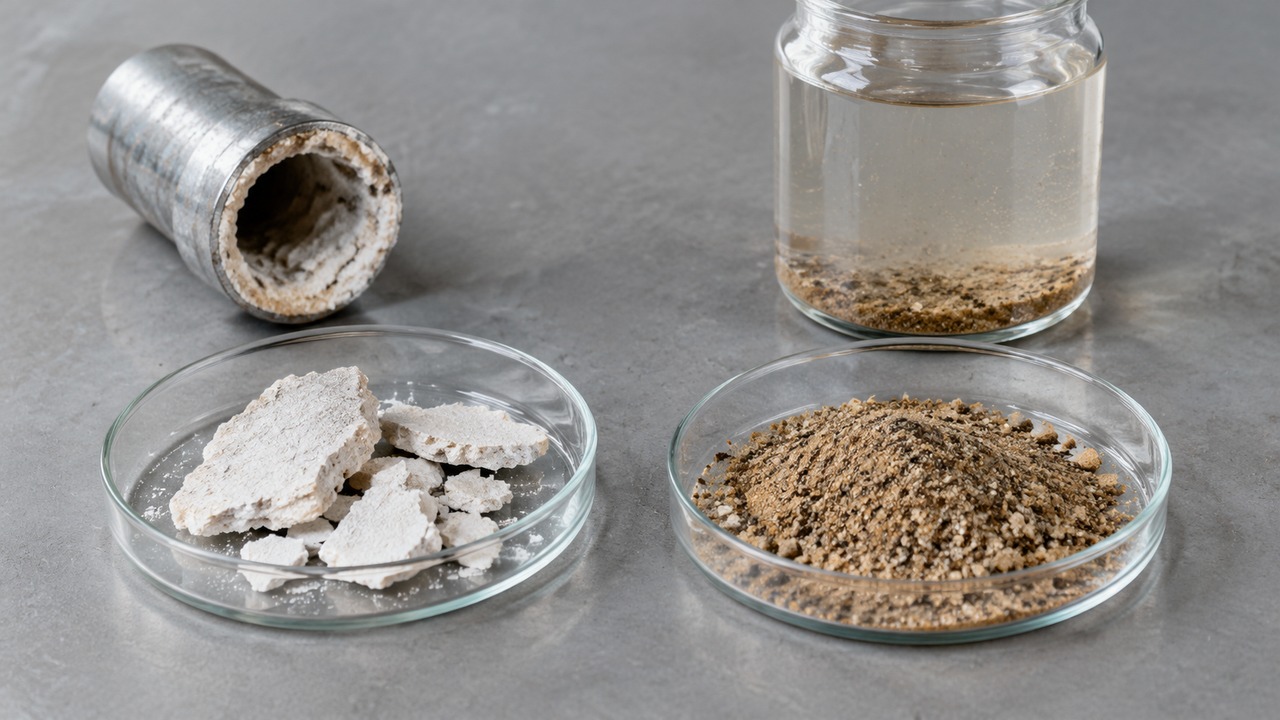
The term limescale is commonly associated with mineral deposits formed from water. The term water heater sediment describes material that has accumulated or settled, without establishing its chemistry. That material could include incoming particles, corrosion debris or fragments of previously formed deposits. Exterior dirt is a third category: it is outside the water circuit and should be assessed separately.
The USGS explanation of water hardness identifies dissolved calcium and magnesium as its principal constituents and explains that heating hard water can produce calcium-carbonate deposits. Its general classification is soft at 0–60 mg/L, moderately hard at 61–120 mg/L, hard at 121–180 mg/L, and very hard above 180 mg/L, expressed as calcium carbonate. These categories describe water; they are not a particular heater's warranty limits.
Appearance provides a starting point, not a laboratory result. A pale crust may suggest a mineral deposit, while loose grit suggests a particle problem. Neither observation identifies the complete composition or proves which component caused the complaint. Deposits can coexist with a failed filling valve, damaged seal, restricted shower fitting or deteriorated insulation.
| Observation | What it can justify | What it does not prove |
|---|---|---|
| Visible dirt on collector glass | An exterior inspection and a model-compatible cleaning assessment | That the inside of the tank requires chemical treatment |
| Particles in a sample taken during service | Recording the sample location and investigating the particle source | That dissolved hardness is excessive |
| Adherent deposits found on an accessible component | Documenting their location and asking whether analysis or approved removal is needed | That every tube has the same condition |
| Reduced flow at one shower | Comparing that outlet with other outlets before opening the solar system | That collector circulation is blocked |
| Lower delivered temperature | Reviewing weather, demand, replenishment, backup operation and delivery conditions | That descaling will restore performance |
The practical benefit of this distinction is a narrower service scope. A report can say “inspect the replenishment path after particles were found at the inlet” instead of “clean the entire heater.” That makes competing quotations easier to compare and reduces the chance that unrelated work is sold as an essential remedy.
Why the Water Path Changes the Service Decision
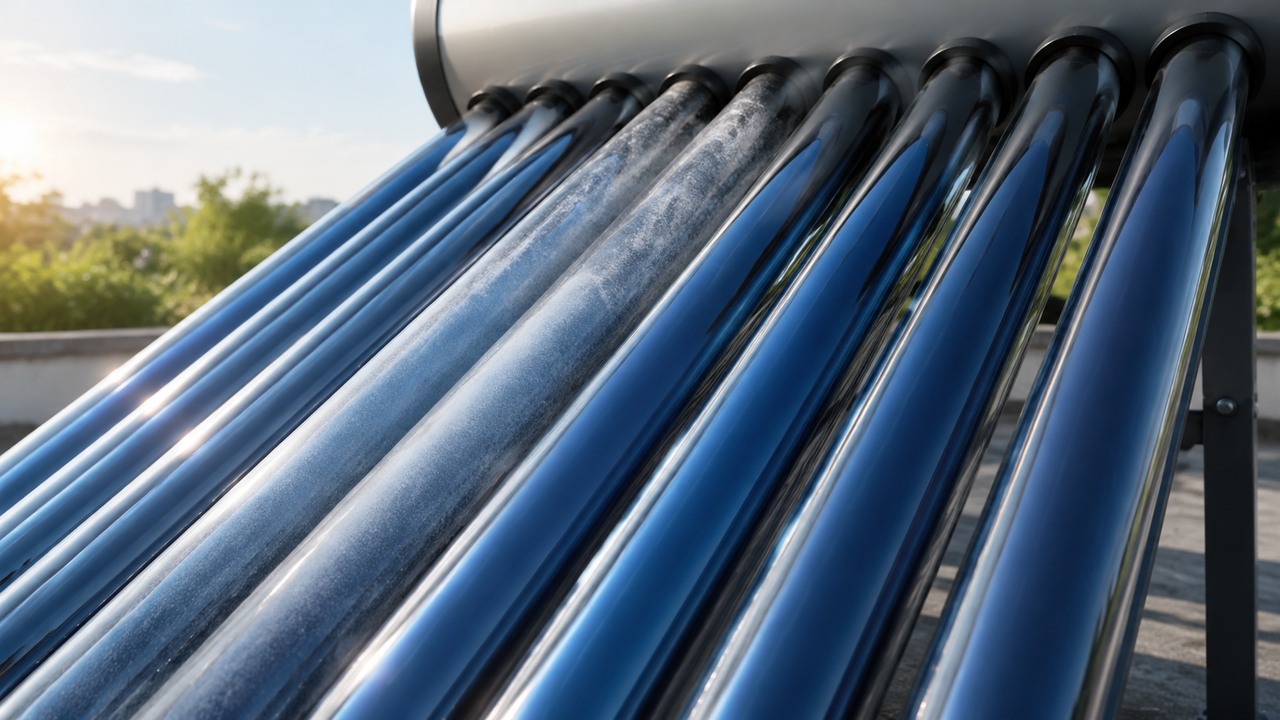
Before approving work, identify the system from its nameplate, installation record and component arrangement. The search term non pressure solar water heater covers products with different filling controls and service provisions. A familiar-looking row of evacuated tubes does not establish whether household water enters those tubes or remains separated from the solar circuit.
In Apricus's vented water-in-glass example, water is heated inside the tubes and circulates naturally to the storage tank; replenishment may be manual or use a small header tank. The same manufacturer describes a separate pressurized heat-pipe option. The distinction matters because visually similar equipment can expose different components to incoming water.
Where a heat exchanger is involved, the direct-versus-indirect water-path comparison helps clarify which circuit is being discussed. Its split-system layouts should not be assumed to describe a compact water-in-glass installation.
Ask the service provider to identify the deposit's location in relation to that water path. “Inside the heater” is too broad. Is the finding in the inlet control, storage vessel, tube opening, delivery pipe, mixing fitting or electric element area? A restricted inlet could affect replenishment; a restricted outlet could affect delivery. Neither should automatically be described as a loss of solar absorption.
Keep the system's pressure classification intact throughout the decision. An open vent is a protective part of the design, not an inconvenient opening to close during an improvised cleaning operation. Additional pumps, filters or valves need a compatibility assessment. Where the complaint is primarily weak delivery, use the separate gravity-fed hot-water flow guide to establish the hydraulic context before commissioning internal cleaning.

What the 2026 Evidence Actually Supports
A 2026 field study of water-in-glass systems in Burkina Faso is useful because it resists a simple diagnosis. The researchers surveyed 31 systems and documented service and component issues, but water-quality parameters were not measured systematically. Their limitations section says observed degradation cannot be attributed causally to particular water-quality effects. The survey was conducted in April 2024 and used a purposive and convenience sample, so its findings are not a global failure-rate benchmark.
For purchasing and after-sales work, the lesson is to record evidence that separates possible causes. A deposit and a malfunction occurring together do not establish which caused which. A field photograph can support a service record without proving the chemical explanation offered for it.
The same evidence-first approach appears in the UF/IFAS Extension water-treatment webinar recap updated October 19, 2026: identify the water problem before selecting treatment, and evaluate how the chosen equipment will be maintained. That is timely guidance for solar-heater distributors considering filtration or softening as an accessory. The accessory needs a defined job and an owner capable of maintaining it.
Build a Water Report That Answers the Service Question
Hardness and TDS answer different questions
A handheld TDS reading is not a substitute for a hardness result. The USGS discussion of groundwater chemistry describes several dissolved constituents, including sodium, calcium, magnesium, chloride, bicarbonate and sulfate. TDS represents a broader dissolved load; hardness is associated principally with calcium and magnesium. Similar TDS readings can therefore accompany different water compositions.
For a suspected deposit problem, ask for the actual hardness result, its units, sampling date and sampling point. If the manufacturer specifies additional water-quality conditions, include those parameters as well. A utility's regional report can be a useful starting point, but identify whether the building receives that water directly, blends it with well water, or stores it before it reaches the heater.
Do not turn a general hardness classification into an invented pass/fail threshold. A supplier should state the permitted water conditions for the exact model, and explain which document controls its warranty. If the only answer is “suitable for all water,” request a more useful specification before accepting an accessory recommendation or a denial of coverage.
Record changes in the water source
A building might switch from municipal supply to a borehole during shortages, or receive water through a storage tank that has its own maintenance history. Record the change and the date of the first complaint. That timeline does not prove causation, but it helps the service provider decide what to inspect and where a sample is most informative.
For a distributor handling repeated claims, a short consistent form is more valuable than a folder of unrelated photographs. Include the heater model, installation age, source water, existing treatment, recent plumbing changes, symptom location and the owner's description of when the problem occurs. Preserve the distinction between measured values, user recollections and the technician's interpretation.
Water treatment for equipment protection also needs to remain separate from drinking-water safety claims. Clear water is not proof of potable quality, and a hardness result does not establish whether microorganisms or other contaminants are present. Refer drinking-water questions to the appropriate local testing and water-supply guidance.
A number needs a location and a decision
Consider two reports for the same building: one sample was collected from the incoming supply, while the other was taken after an existing treatment unit. The values answer different questions. The first helps characterize what the treatment receives; the second helps evaluate what reaches the downstream equipment. Comparing them requires compatible tests and clear sampling conditions.
A distributor can make this practical by adding three columns to its service form: “value,” “where measured,” and “decision affected.” For example, an incoming hardness result can inform treatment selection, while a downstream result can help review treatment operation. Neither replaces inspection of a component already suspected of being restricted. If nobody can explain what decision a measurement will change, reconsider whether it belongs in the immediate investigation.

Separate Exterior Cleaning, Flushing and Descaling in the Quote
A quotation labelled “complete cleaning” can conceal very different work. Require the provider to name the component, the condition being addressed and the proposed method. That is especially important when the price includes chemical treatment without evidence of adherent deposits.
Exterior cleaning concerns the collector surface
Inspecting exterior dirt does not require assuming that the water circuit is dirty. The provider should explain how the proposed cleaning method suits the glass, coatings, surrounding materials and access conditions. Roof access and hot surfaces are service-planning issues. Owners should not be encouraged to climb onto a roof or spray cold water onto hot equipment simply because a photograph shows dust.
Flushing concerns removable material and a defined water path
Ask what flushing is expected to remove, where that material will leave the system, and how the provider will verify the result. A clear-looking discharge at the end of a job is an observation, not proof that all internal surfaces are clean or that a hidden restriction has disappeared. Equally, dirty water at the beginning does not establish that the observed particles caused the original complaint.
For a concrete model-specific example, the Ultrasun UVT manual recommends annual fresh-water cleaning of the tank and glass tubes under hard-water conditions and assigns maintenance to qualified technicians. That is guidance for the UVT configuration, not a universal chemical-descaling interval. Flushing loose material should not be represented as proof that an adherent mineral layer has been removed.
Descaling concerns an identified compatible process
Water heater descaling should be a model-specific service decision. Request written compatibility with the tank material, tube arrangement, seals, fittings and any electric element or heat exchanger exposed to the process. The quotation should identify the approved product or method, the responsible technician, the rinsing and reinstatement requirements, and the acceptance checks.
A household cleaning tip does not establish compatibility with an assembled solar heater. There is no universal acid concentration, contact time or circulation procedure that can be recommended across these systems. The correct plan must also account for isolating energy sources, safe cooling, maintaining required protection and handling the removed liquid appropriately.
PNNL's solar-water-heating maintenance guidance highlights scale inspection in direct systems using hard water and ties maintenance to equipment requirements. Its broader guidance covers several system configurations; pump or pressure-related tasks should not be copied indiscriminately into a passive, vented installation.
For the wider maintenance calendar, refer to the existing solar water heater maintenance guide. This article addresses the narrower question of whether deposits justify a particular intervention.
A Filter and a Softener Solve Different Problems
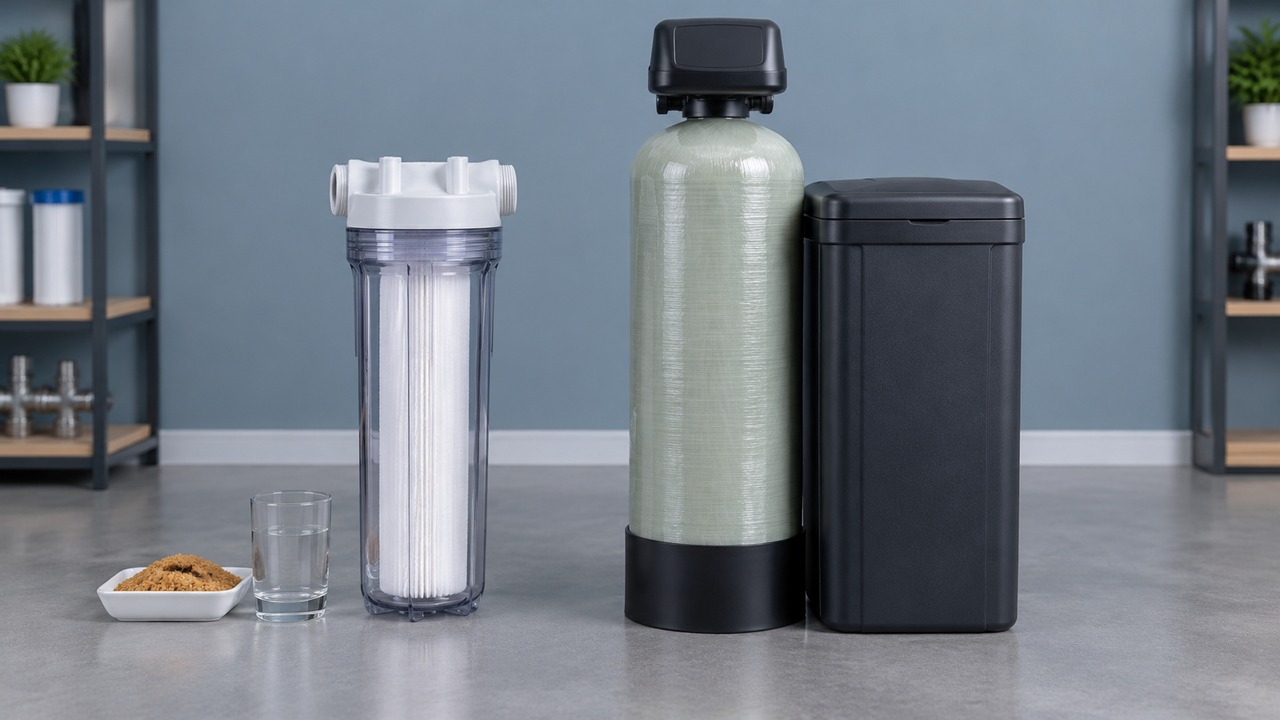
A conventional sediment filter traps particles according to its design and operating conditions. It does not become a hardness-removal device simply because its cartridge looks dirty. A softener addresses dissolved hardness minerals through a different process. Neither choice should be made from the colour of a photograph alone.
The Minnesota Department of Health's softening guidance describes ion-exchange units that remove calcium and magnesium. It also discusses maintenance and the consequences of using salt. For a solar installation, request a treatment proposal based on the measured water and the heater manufacturer's requirements, including ongoing servicing and consumables.
Installing treatment upstream is a prevention decision. It should not be sold as proof that deposits already attached to internal components have been removed. Existing water heater scale buildup needs its own condition assessment and, where warranted, a compatible service plan.
Check the hydraulic cost of an accessory
Gravity-fed delivery provides limited pressure head. Any added component must be assessed at its proposed location and operating flow, including its condition as it loads with particles. Ask for the manufacturer's pressure-loss information and the installer's explanation of its effect on filling or delivery. A filter that is acceptable upstream of a supply arrangement may be unsuitable in a different part of the hot-water path.
“Finer” does not automatically mean better for the installation. Selecting a cartridge requires a defined particle-removal objective, adequate flow capacity, appropriate temperature and pressure ratings, and a realistic replacement or cleaning schedule. The owner needs to know who will obtain replacements and how a loaded filter will be recognized.
An illustrative calculation shows why pressure-loss information matters. A water surface two metres above an outlet provides approximately 19.6 kilopascals of static pressure from elevation alone, using water density of 1,000 kilograms per cubic metre and gravitational acceleration of 9.81 metres per second squared. That is about 0.196 bar before considering flow losses.
This is a basic hydrostatic example, not a recommended installation height or a prediction of shower performance. Real delivery also depends on the pipe route, fittings, water level and operating flow. If an accessory consumes part of the available pressure during use, the installer must include it in the overall assessment. The relevant evidence is the accessory's pressure-loss curve at the intended duty, rather than its connection size alone.
For a refill line, assess whether the available supply can replenish the tank as designed. For a gravity hot-water line, assess the delivered flow and component temperature suitability. These are separate duties. Moving an accessory from one location to the other is a design change, not an automatic cure for a complaint.
Check the claim, not just the product name
If a device is advertised as an anti-scale conditioner, ask what outcome has been tested and under which water and operating conditions. Do not assume that “conditioning,” “filtration” and “softening” are interchangeable. The purchase document should state what is expected to change and how that change will be checked.
The CDC overview of home treatment systems likewise distinguishes treatment functions and recommends checking the specific removal claims. Its description of softeners notes that mineral removal does not provide removal of parasites, bacteria or viruses. Equipment-protection accessories should not be presented as complete water-safety systems.
Three Service Cases With Different Decisions
The following examples are hypothetical decision exercises, not field-test results or customer reports. They illustrate why similar complaints can require different scopes of work.
Case One: The shower weakens after a supply interruption
An owner reports weaker flow shortly after the building's water supply returns. The heater previously delivered acceptable flow, and the complaint is strongest at one shower. A quotation proposes full-system descaling because the building is in a hard-water region.
The useful first response is to establish whether other outlets are affected and to document any particles found at the affected fitting during professional inspection. The provider should review the recent supply event and the delivery path. Regional water hardness may justify investigation, but it does not locate the restriction.
If the evidence points to a local fitting, the service scope should address that finding and confirm restored flow under comparable conditions. If several outlets or the replenishment path are affected, the investigation expands accordingly. The decision to descale internal solar components remains separate and needs supporting evidence.
The lesson for the distributor is to avoid approving a broad chemical service solely from a regional label. Ask which observation would change the recommendation, and keep the quotation provisional until that observation is available.
Case Two: Deposits are found during an approved inspection
A technician inspecting a known model records an adherent deposit on a specific accessible component. The household's water report shows elevated hardness, and the supplier confirms that the current water falls outside the model's stated operating requirements.
This is a stronger basis for considering deposit removal and future water treatment. It still does not justify a generic procedure. The supplier should identify an approved method for the affected materials, explain whether worn parts require replacement, and define the checks before returning the heater to service.
The owner receives two clearly separated decisions: correcting the existing condition and reducing recurrence under the actual supply conditions. The final record identifies the cleaned or replaced parts, the post-service observations, and the maintenance responsibility for any newly installed treatment equipment.
No percentage energy saving is promised unless a suitable before-and-after measurement supports it. A cleaner component and a recovered function can be documented without inventing an annual performance improvement.
Case Three: A “scale” complaint is actually repeated overfilling
A small accommodation business sees water discharged from the rooftop system and assumes internal deposits are forcing it out. The system has an automatic filling arrangement, and staff have recently changed their operating routine.
The service provider first identifies the outlet and records when filling and discharge occur. The investigation distinguishes filling-control behaviour, actual leakage and thermal discharge. If debris is found at a control component, that finding is documented; it does not prove that all tubes require descaling.
The separate solar-water-heater overflow guide provides the relevant symptom framework. The maintenance decision then follows the confirmed fault, with any water-quality work justified separately. The protective vent remains functional throughout the approved service procedure.

Ask for an Acceptance Record, Not a “Cleaned” Stamp
Before approving solar water heater repair, agree what the provider will demonstrate at completion. The appropriate check depends on the original complaint. A flow restriction, filling fault and reduced hot-water availability should not all receive the same acceptance sentence.
A useful service record can include the following items:
- Identification: the model, relevant component and confirmed water-path configuration.
- Evidence: the symptom, inspection findings and water results that justified the work.
- Scope: parts inspected, cleaned or replaced, with the approved method identified.
- Reinstatement: checks required by the manufacturer before normal operation resumes.
- Functional result: the relevant filling, delivery or heating observation, recorded under stated conditions.
- Follow-up: remaining uncertainty, recurrence checks and responsibility for treatment maintenance.
For a flow complaint, record the outlet and comparable supply conditions. For a temperature complaint, record weather, water use and backup operation sufficiently to make the comparison meaningful. A warmer afternoon after cleaning may simply have had better sunshine or less demand. Avoid presenting such an observation as an isolated measurement of improved collector efficiency.
Photographs should identify the component and stage of work. A close-up is more useful when accompanied by location and date than when presented as a dramatic before-and-after collage with no context. Where a component has been replaced rather than cleaned, say so explicitly.
For B2B buyers, repeated service calls should feed back into the procurement specification. Ask suppliers for water-quality limits, accessible service points, approved replacement seals, spare-part availability and a clear warranty process. The existing non-pressure supplier-evaluation guide provides the broader purchasing checklist.
Compare quotations on scope before comparing totals
Two quotations can look very different because one includes inspection, replacement seals and functional checks while the other includes only labour for flushing. Ask each provider to separate diagnosis, removal work, parts, reinstatement and any proposed treatment accessory. Also establish whether further findings will require a revised quotation before additional work begins.
The cheapest total is not automatically the least expensive outcome, but a higher price is not evidence of a better diagnosis. The useful comparison is whether each proposal addresses the confirmed finding and leaves a reviewable result. An offer that promises a fixed percentage improvement without a defined measurement method should be treated as an unverified claim.
Distributors can apply the same discipline to warranty discussions. Keep the failed part, where practical and permitted, or retain identifying photographs and the service findings. Record whether the supplier attributes the failure to water quality, installation, wear or another cause, and request the evidence supporting that explanation. A consistent record is more useful than assigning all disputed failures to “bad water.”
When repairs become recurrent, compare the total practical burden: access, downtime, available expertise, parts and compatible water treatment. The repair-versus-replacement comparison can support the next decision. Replacement should solve an identified mismatch rather than merely reset the date of the next service call.

Focused FAQ
Does hard water mean my solar water heater must be descaled?
No. Hard water is relevant to deposit risk, but the service decision also needs the actual model, symptoms, inspection findings and manufacturer requirements. A hardness result alone does not reveal where deposits are present or whether they explain the complaint. It can justify further investigation and a review of treatment compatibility.
How do I know whether the problem is sediment or limescale?
Describe the material and where it was observed, then let the service provider determine what further evidence is needed. Loose particles, an adherent crust and exterior dust are different observations. Appearance alone may not identify composition. Record whether the finding came from incoming water, an outlet fitting or an internal component inspected during approved service.
Can a sediment filter prevent all solar-heater deposits?
No. Particle filtration and removal of dissolved hardness are different functions. Select equipment for the measured problem and verify its specific claims. Also check flow capacity, pressure loss and maintenance requirements at the intended location. A neglected accessory can create a new service problem even when its original selection was reasonable.
Will a water softener clean an already scaled heater?
Do not treat upstream softening as evidence that existing deposits have been removed. Evaluate the current condition separately. The treatment proposal should explain future water quality, while the repair proposal should explain what happens to affected components already inside the system. These may be related decisions, but they have different acceptance criteria.
Can I use a tankless-water-heater flushing kit?
Do not assume compatibility. A vented water-in-glass installation has a different arrangement from a tankless appliance, and added circulation equipment can introduce unsuitable conditions. The model supplier must approve the service method, connections, materials and operating limits. A kit marketed for another appliance is not an installation-specific service instruction.
How often should a non-pressure system be cleaned?
Follow the model's inspection and maintenance requirements, then use documented site experience to review them with the service provider. Water source, treatment, demand and observed condition can differ substantially between installations. A universal annual chemical-cleaning rule would ignore those differences. Exterior inspection, particle management and internal descaling also need separate schedules.
Does low temperature prove that scale is reducing heat transfer?
No. Record when the complaint occurs and compare it with weather, hot-water use, filling and backup operation. Delivery-side problems can also affect what reaches the tap. Descaling should be recommended when the evidence supports a deposit-related fault, rather than used as the default response to every temperature complaint.
What should I send a supplier before requesting a cleaning quote?
Send the model identification, installation age, water source, existing treatment, recent changes, symptom timeline and any safely obtained photographs. Include laboratory or utility water results with dates and units. Ask the supplier to distinguish confirmed findings from assumptions and to identify the approved procedure and completion checks before quoting the full job.
Sources and Evidence Notes
- USGS: water hardness — definitions and general classifications, not model-specific warranty thresholds.
- USGS: groundwater chemistry — dissolved constituents and the distinction relevant to interpreting water reports.
- Apricus: thermosiphon configurations — a manufacturer example illustrating why the water path must be identified.
- Scientific Reports, 2026: water-in-glass field survey — local evidence with sampling and water-quality limitations.
- UF/IFAS Extension, October 2026: treatment choices — matching treatment to an identified problem and maintaining the equipment.
- PNNL: solar water heating operation and maintenance — system-dependent inspection guidance.
- Davis & Shirtliff: Ultrasun UVT manual — a model-specific fresh-water cleaning example, not a universal descaling procedure.
- Minnesota Department of Health: home water softening — ion exchange and maintenance considerations.
- CDC: home water treatment systems — differences between treatment functions and removal claims.