How to Maintain a Non-Pressure Solar Water Heater and Extend Its Service Life
Maintenance Is the Difference Between Low Cost and Hidden Cost
A non pressure solar water heater is often sold as a simple and cost-effective hot water solution. Compared with pressurized or split solar water heating systems, it usually has fewer mechanical components, lower installation complexity, and easier daily operation. This is one of the reasons it remains popular in rural homes, farms, off-grid buildings, and low-pressure water supply areas.
However, simple does not mean maintenance-free.
A non-pressure system still works outdoors every day. It faces sunlight, heat, wind, rain, dust, mineral water, pipe expansion, roof vibration, and seasonal temperature changes. The evacuated tubes collect heat. The storage tank holds hot water. The support frame carries a heavy load. The seals keep water inside the tank. The pipe connections handle repeated temperature changes. The vent and overflow system protect the non-pressurized tank design. Over time, every part can be affected by use conditions.
This is why non pressure solar water heater maintenance should not be treated as an afterthought. It is part of the product’s real value. A system that is maintained properly can provide reliable hot water for many years. A system that is ignored may gradually develop weak heating, reduced flow, tube damage, tank leakage, corrosion, scale buildup, or safety risks.
For homeowners, maintenance protects daily comfort and avoids unexpected repair cost. For installers, maintenance knowledge helps diagnose problems correctly. For B2B buyers and distributors, after-sales maintenance determines whether a product line is profitable. A cheap system with frequent complaints can become more expensive than a better-quality system with proper service support.
A strong solar water heater maintenance guide should explain not only what to inspect, but why each inspection matters. Maintenance is not only cleaning. It is a way to protect heat collection, water flow, storage performance, roof safety, and customer satisfaction.
What Makes Non-Pressure Solar Water Heater Maintenance Different?
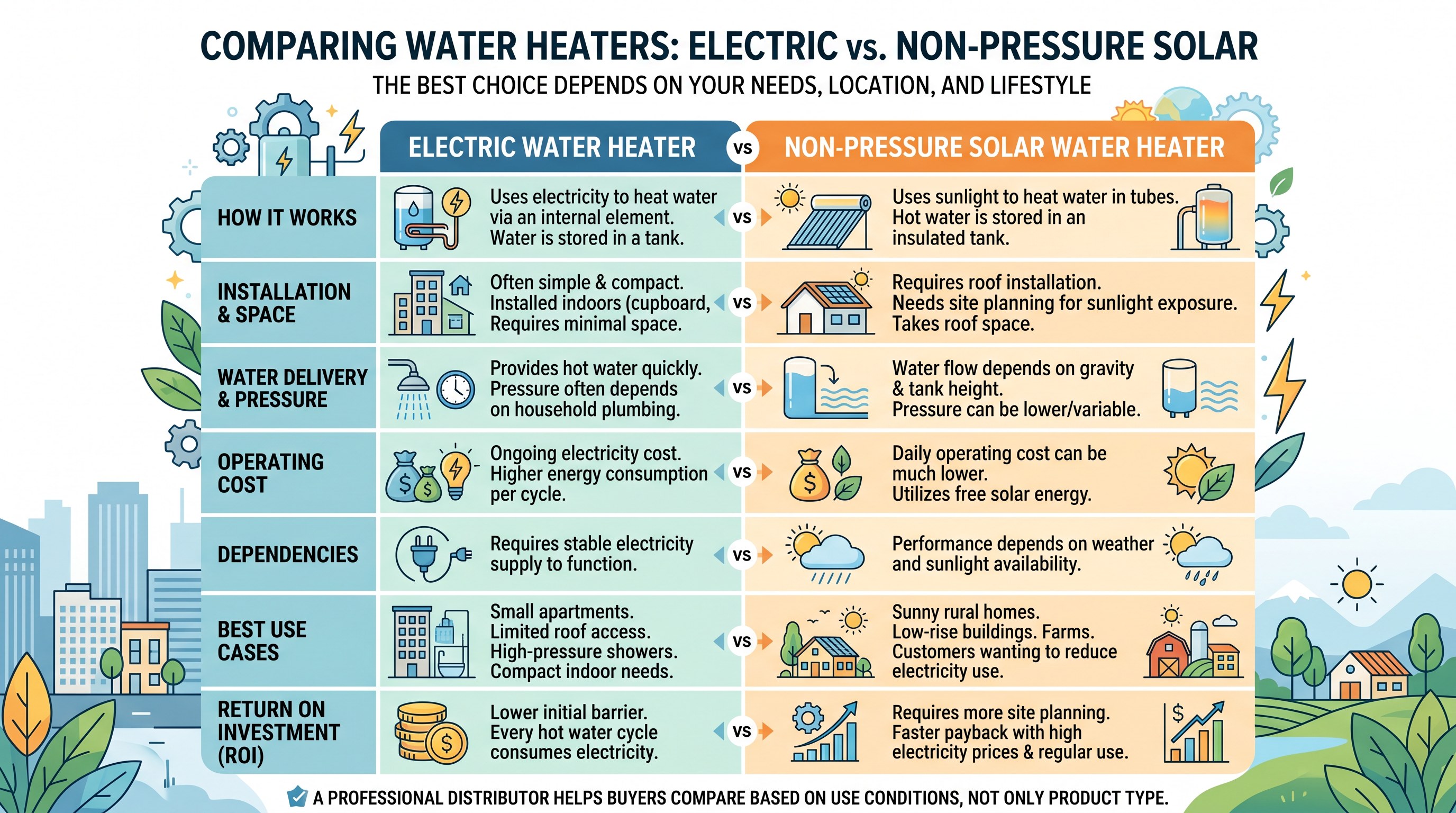
A non-pressure solar water heater has its own maintenance logic because it is usually based on open or vented low-pressure operation. It is not maintained in the same way as a fully pressurized system.
In many non-pressure designs, the storage tank is not a sealed pressure vessel. It may have a vent pipe, overflow pipe, float valve, water-level controller, and gravity-fed hot water outlet. These parts must stay clear and functional. Blocking the vent or misusing the overflow can create problems. If the tank is modified incorrectly, the system may lose its intended safety logic.
A low pressure solar water heater maintenance routine should also focus on outlet flow. Because the system depends on gravity-fed water movement, even small blockages can create noticeable weak flow. Scale, sediment, air blockage, narrow fittings, or dirty shower heads can reduce water delivery. In a pressurized system, higher pressure may hide some resistance. In a non-pressure system, resistance becomes more obvious.
Evacuated tubes also require attention. A non-pressure evacuated tube system often heats water directly or uses the tube array as the main collector. If tubes are broken, dirty, loose, or losing vacuum performance, heating efficiency can decline. Evacuated tube solar water heater maintenance is therefore one of the most visible parts of service.
Water quality is another major difference. In direct non-pressure systems, the water being heated may be the same water used by the household. If the water is hard, mineral scale can build up inside the tank and tubes. If the water is corrosive, the tank and fittings may degrade faster. If the water contains sediment, valves and outlets may clog.
In short, a non-pressure system is easier to understand, but it still needs a maintenance plan based on its real working conditions.
The First Maintenance Rule: Keep the System Filled Correctly

A non-pressure solar water heater should usually maintain a proper water level during normal operation. If the tank water level is too low, several problems can appear.
First, outlet flow may become weaker because gravity-fed pressure depends partly on water level. A lower water level means less pressure head. Users may notice weaker hot water flow even when the system is installed at a reasonable height.
Second, overheating risk may increase. If the tank or tubes are exposed to strong sunlight without enough water, parts of the system can become extremely hot. Sudden refilling with cold water may cause thermal stress. In some cases, this can contribute to evacuated tube breakage or sealing problems.
Third, water temperature may become unstable. A partially filled tank does not behave the same as a correctly filled tank. Hot and cold water layering may be disturbed, and users may get inconsistent outlet temperature.
The water filling system should be checked regularly. If the system uses a float valve, make sure it opens and closes properly. If it uses a water-level controller, check whether the sensor and controller respond correctly. If the system is manually filled, users should understand when and how to refill the tank safely.
Overflow should also be observed. Occasional overflow during filling may be normal depending on the system design, but continuous overflow may indicate a faulty float valve or incorrect water-level control. Overflow water should be discharged safely away from the roof, walls, and electrical components.
For B2B distributors, water-level education is important in rural and off-grid markets. Many user complaints begin with irregular filling, empty tanks, or misunderstanding of overflow behavior.
Managing Scale Buildup in Hard Water Areas

Solar water heater scale buildup is one of the most common long-term maintenance problems, especially in areas with hard water. Hard water contains minerals such as calcium and magnesium. When water is heated repeatedly, these minerals can form deposits inside the tank, tubes, pipes, valves, and fittings.
Scale reduces system performance in several ways. It acts as an insulating layer, making heat transfer less efficient. It narrows flow paths, increasing resistance and reducing hot water flow. It can settle at the bottom of the tank, affecting water quality and drainage. It can clog shower heads, strainers, and valves. Over time, scale can make the system heat more slowly and deliver less water.
For a non-pressure system, scale can be especially noticeable because the available water pressure is limited. A small restriction in the outlet or pipe can cause a large drop in flow. This is why weak water pressure that appears gradually over time should trigger a scale inspection.
Maintenance in hard water areas should include periodic flushing where the system design allows it. The drain or cleaning port should be used according to the supplier’s instructions. Shower heads and outlet fittings should be cleaned regularly. If the system has removable filters or strainers, they should be inspected and cleaned.
In very hard water areas, the buyer may need additional water treatment or more frequent maintenance. Suppliers should not ignore this. If the target market has known hard water conditions, the product should use suitable tank materials, accessible cleaning design, and clear maintenance guidance.
For B2B buyers, hard water is not a minor issue. A product that performs well in soft water may develop complaints in hard water markets. A serious supplier should ask about local water quality before recommending materials and models.
Inspecting Evacuated Tubes for Performance and Safety

Evacuated tubes are the heat-collecting heart of many non-pressure solar water heaters. They should be inspected visually and physically during maintenance.
The most obvious problem is a broken tube. A cracked or shattered evacuated tube should be replaced. Broken glass can be dangerous, and the system may lose heating capacity. If one tube is broken, the user may still get some hot water from the remaining tubes, but performance will be reduced.
Another issue is vacuum loss. An evacuated tube works well because the vacuum layer reduces heat loss. If the vacuum is lost, the tube may still look mostly intact, but its insulation performance declines. Some tubes show visible signs such as a changed color at the getter area or abnormal appearance. Installers should follow the manufacturer’s method for identifying failed tubes.
Dirty tubes can also reduce solar absorption. Dust, leaves, bird droppings, mineral deposits, and air pollution can block sunlight. In dusty or agricultural environments, cleaning may be needed more often. Cleaning should be done safely, using methods that do not scratch or damage the glass. Work should be performed when the tubes are not extremely hot.
Loose tubes and damaged sealing rings should also be checked. If tubes are not seated correctly in the tank or bottom holder, leakage or breakage may occur. If sealing rings become hard, cracked, or displaced, water leakage can appear near the tube ports.
Solar water heater tube replacement should be planned as part of normal after-sales service. Spare tubes should be available. Installers should know how to remove and insert tubes safely. Users should not be encouraged to handle hot or fragile tubes without proper knowledge.
For distributors, spare tube availability is a major service factor. If a customer cannot replace one broken tube locally, a small issue can become a reason to abandon the whole system.
Checking the Storage Tank for Leakage and Corrosion
The storage tank is one of the most expensive and important parts of a non-pressure solar water heater. It stores heated water, supports the tube connections, and protects heat through insulation. Solar water heater tank leakage is therefore one of the most serious maintenance issues.
Tank leakage can come from several areas. It may appear at welding seams, tube ports, inlet or outlet fittings, electric heater ports, vent connections, overflow points, or damaged tank surfaces. Sometimes users confuse normal overflow with leakage, so the first step is to identify the source accurately.
If water comes from the overflow pipe during filling, the issue may be water-level control rather than tank failure. If water drips from a fitting, the seal or connection may need tightening or replacement. If water appears from the tank body or seam, the problem may be more serious.
Corrosion is another long-term risk. The tank may be exposed to water chemistry from inside and weather conditions from outside. Coastal air, humid climates, acidic water, or poor material quality can accelerate corrosion. If the inner tank corrodes, leakage may eventually occur. If the outer shell corrodes, insulation may become exposed and heat loss may increase.
Maintenance should include visual inspection of tank ends, connection points, seams, mounting supports, and any signs of rust, swelling, staining, or dripping. If the system uses a magnesium rod or anti-corrosion component, it should be inspected and replaced according to the manufacturer’s guidance.
For B2B buyers, tank material is one of the most important purchasing factors. A low-cost tank may reduce upfront price but increase warranty claims. Inner tank quality, welding quality, insulation protection, and corrosion resistance should be evaluated carefully before bulk purchase.
Protecting Tank Insulation and Heat Retention
A solar water heater may collect heat well during the day but lose it quickly at night if insulation is poor or damaged. This is why tank insulation is part of maintenance.
The storage tank is usually insulated to keep water hot after sunset. If the outer shell is damaged, water can enter the insulation layer. Wet insulation loses performance and may accelerate corrosion. If the tank shell is dented, cracked, or poorly sealed, long-term heat retention can decline.
Users may notice this as nighttime or early morning performance loss. The water may be hot in the afternoon but only warm by evening. This problem may be blamed on tube performance, but the real issue can be heat loss from the tank or pipes.
Maintenance should include checking the outer tank shell for dents, cracks, loose end caps, damaged joints, or water entry points. Outdoor pipes should also be inspected. Uninsulated hot water pipes can lose heat before water reaches the shower or faucet. Pipe insulation should remain dry, secure, and protected from sun damage where necessary.
Good insulation is especially important in regions with cool nights, windy roofs, or large day-night temperature differences. In these areas, poor insulation can make a correctly sized system feel undersized.
For distributors, tank insulation should be part of product differentiation. A system with better insulation may cost more, but it can deliver more stable user satisfaction. In B2B sales, it is better to explain long-term performance than compete only on tank liters.
Maintaining Vent, Overflow and Drainage Paths
Because many non-pressure systems use vented tank designs, the vent and overflow paths must remain clear. They are not decorative accessories. They are part of system safety and function.
A blocked vent can interfere with normal low-pressure operation. A sealed or incorrectly modified vent may create pressure behavior the tank was not designed to handle. Users or untrained installers should not block the vent to “increase pressure.” This is a dangerous misunderstanding. A non-pressure tank should not be forced to operate like a pressure-rated tank.
The overflow pipe should also be inspected. It should direct excess water safely away from the roof structure, walls, windows, electrical wiring, and walkways. If overflow water is uncontrolled, it can cause roof stains, wall dampness, or customer confusion.
Drainage paths may become blocked by insects, leaves, dust, mineral deposits, or poor installation. During maintenance, the installer should check whether the vent is open and whether overflow water can discharge freely.
The drain or cleaning port, if provided, should also be functional. A blocked drain makes tank flushing difficult. In hard water regions, this can increase scale buildup over time.
For non pressurized solar water heater service, vent and overflow inspection should always be included because these parts are central to the non-pressure design.
Pipe, Valve and Fixture Maintenance
A non-pressure solar water heater depends heavily on low-resistance water movement. Pipes, valves, and fixtures should be maintained to protect flow.
Hot water pipes should be inspected for leaks, sagging, cracks, loose supports, insulation damage, and mineral buildup. Outdoor pipes face sunlight, temperature changes, and weather exposure. Plastic pipes may degrade if they are not suitable for high temperature or UV exposure. Metal pipes may corrode if material selection is poor or water chemistry is aggressive.
Valves should open and close smoothly. A partially blocked valve can reduce flow. A valve with a small internal passage can create unnecessary resistance. If the user complains about weak hot water flow, valves and fittings should be checked before blaming the tank or tubes.
Shower heads and taps should be cleaned regularly. Mineral deposits can clog small holes and make the flow feel weak. This is one of the easiest problems to solve, but it is often overlooked. A simple shower head cleaning can sometimes restore acceptable flow.
Mixing valves should also be checked. If cold water pressure is much higher than hot water pressure, the mixer may not work properly. Low-pressure-compatible fixtures are usually better for gravity-fed systems. If the customer has modern high-pressure bathroom fixtures, a non-pressure system may not provide the expected experience without additional design measures.
Pipe and fixture maintenance is especially important in rural homes and farms, where water quality may vary and plumbing systems may be basic.
Seasonal Maintenance: Hot Season, Rainy Season and Winter
A non-pressure solar water heater is affected by seasons. Maintenance should change with climate conditions.
In hot seasons with strong sunlight, overheating can become a concern if hot water is not used regularly. If the household leaves for a long period, the system may sit under strong sun with little water draw. Users should follow the supplier’s instructions for safe non-use. In some cases, partial covering, controlled water management, or other protective steps may be recommended.
During rainy seasons, roof drainage and pipe sealing should be checked. Heavy rain can reveal roof leaks, loose pipe supports, damaged insulation, or poor overflow routing. If the tank shell or pipe insulation allows water entry, long-term corrosion and heat loss may increase.
In dusty seasons, evacuated tubes may need cleaning. Dust and dirt reduce solar absorption. In farming areas, pollen, soil, and bird activity can make tube cleaning more important.
In cold or freezing regions, maintenance becomes more serious. A basic direct non-pressure system may not be suitable for freezing conditions unless designed with freeze protection. Water inside exposed tubes and pipes can freeze, expand, and damage components. If freezing weather is expected, users should follow the manufacturer’s winter operation or drainage instructions. If freeze risk is frequent, a different system type may be needed.
Seasonal maintenance should be adapted to the local market. A supplier selling the same model into different climates should provide different operation notes. This is part of professional solar water heater troubleshooting and service support.
Troubleshooting Common Problems

A good maintenance guide should help users and installers diagnose problems systematically.
Water Is Not Hot Enough
If the water is not hot enough, check sunlight exposure first. Shading from trees, walls, chimneys, or nearby buildings may reduce heating. Then check whether the tubes are dirty, damaged, or losing vacuum performance. Check whether the tank capacity is too large for the tube quantity. Check whether hot water is being used faster than the system can recover. Check whether tank insulation is poor or outdoor pipes are losing heat.
If the weather has been cloudy, the issue may be normal solar limitation. Backup heating may be needed.
Water Is Hot but Flow Is Weak
If the water is hot but flow is weak, check tank height, water level, pipe length, pipe diameter, valves, shower head blockage, scale buildup, and air blockage. This is often a hydraulic issue, not a heating issue.
Water Is Leaking
First identify the source. Is it normal overflow, fitting leakage, tube port leakage, tank seam leakage, or pipe leakage? Overflow may indicate filling control issues. Fitting leakage may need seal replacement. Tank seam leakage may require serious repair or replacement.
Water Temperature Drops Quickly at Night
Check tank insulation, pipe insulation, usage timing, cold water mixing, and tank capacity. If water is hot in the afternoon but cools too quickly, heat retention is the key issue.
One or More Tubes Are Broken
Stop using the damaged area safely and arrange tube replacement. Broken glass should be handled carefully. Check whether the cause is impact, hail, thermal shock, poor installation, or frame movement.
Overflow Happens Continuously
Check float valve, water-level controller, inlet pressure, and overflow pipe routing. Continuous overflow wastes water and may damage building surfaces.
A structured solar water heater troubleshooting process reduces unnecessary product replacement and helps users understand the real cause.
Building a Preventive Maintenance Schedule

Preventive maintenance is better than emergency repair. A simple schedule can keep the system working reliably.
Monthly Visual Check
Users can visually check for broken tubes, obvious leakage, abnormal overflow, loose pipes, and heavy dirt on the tubes. They do not need to climb onto dangerous roofs, but visible signs from the ground can help detect problems early.
Seasonal Check
At the start of each season, the system should be checked for pipe insulation, roof fixing, overflow discharge, tube cleanliness, and tank condition. In dusty, rainy, or windy regions, seasonal checks are especially useful.
Annual Service
An annual service by an installer can include tube inspection, tank flushing where applicable, valve inspection, seal inspection, frame fixing check, pipe support check, and user operation review. In hard water areas, scale inspection should be more frequent.
After Extreme Weather
After storms, hail, strong wind, freezing nights, or long periods of non-use, the system should be inspected. Tube breakage, frame movement, pipe loosening, and leakage may not be obvious immediately.
This schedule does not need to be complicated. The goal is to catch small problems before they become expensive repairs.
Spare Parts That Distributors Should Keep Available

For B2B distributors, spare parts planning is part of product success. A non-pressure solar water heater may be simple, but customers still need service support.
Important spare parts may include evacuated tubes, sealing rings, tube holders, float valves, water-level controllers, temperature sensors, electric backup heater elements, magnesium rods, overflow fittings, pipe connectors, valves, frame bolts, and basic installation accessories.
Spare parts should match the actual models sold. If a distributor imports several tube sizes or tank designs, spare parts must be organized clearly. A mismatch between tube length, diameter, or sealing parts can delay repairs and frustrate customers.
Spare parts packaging also matters. Evacuated tubes need protective packaging. Small seals and fittings should be labeled. Installation manuals should show part names clearly so local installers can order the correct items.
A distributor without spare parts may sell units quickly but struggle with after-sales service later. In cost-sensitive markets, customers still expect repairability. If one broken part makes the whole system unusable, brand trust declines.
For manufacturers, providing a spare parts list and recommended stock ratio can be a strong B2B advantage.
Maintenance as a B2B Differentiation Strategy
Many non-pressure solar water heaters look similar in photos: tank, tubes, frame, and fittings. Buyers may compare price aggressively because the visible product appears interchangeable. Maintenance support is one way to create differentiation.
A supplier that provides only a low price may win the first order but lose long-term trust if the distributor faces complaints. A supplier that provides installation guidance, maintenance manuals, troubleshooting charts, spare parts planning, packaging support, and training materials helps the distributor build a stronger market.
For B2B buyers, non pressurized solar water heater service should be evaluated before purchase. Ask the supplier:
Are spare tubes available?
Are sealing rings standardized?
Is there a maintenance guide?
Is there a troubleshooting chart?
Can the tank be flushed?
What is the recommended response for scale buildup?
What are the common leakage points?
How should the system be handled during long non-use?
What should installers check annually?
What packaging protects fragile components during export?
These questions reveal supplier maturity. A manufacturer that understands maintenance usually understands the real market better than one that only lists specifications.
How Maintenance Extends Solar Water Heater Service Life
Solar water heater service life depends on product quality, installation quality, water quality, climate, usage behavior, and maintenance. No single factor determines everything.
A high-quality system installed poorly may fail early. A basic system maintained well may serve reliably. A good tank exposed to corrosive water may still develop problems. Strong tubes may break if handled carelessly. Good insulation may become useless if the outer shell is damaged and water enters.
Maintenance extends service life by reducing stress on the system. Cleaning tubes improves solar collection. Flushing scale improves heat transfer and flow. Checking seals prevents leakage. Inspecting the frame protects roof safety. Maintaining overflow and vent paths preserves non-pressure operation. Replacing damaged tubes restores capacity. Educating users prevents misuse.
For end users, the benefit is lower total cost over time. For distributors, the benefit is fewer complaints and stronger repeat sales. For manufacturers, the benefit is better brand reputation in export markets.
A non-pressure solar water heater should not be marketed as “install and forget.” A better message is: simple to operate, easy to maintain, and long-lasting when properly serviced.
Focused FAQ
How often should a non-pressure solar water heater be maintained?
A basic visual check can be done monthly, while a more complete inspection is recommended seasonally or annually. In hard water, dusty, windy, or high-use environments, maintenance may need to be more frequent.
What is the most common maintenance problem?
Scale buildup is one of the most common long-term issues, especially in hard water areas. Broken tubes, leaking fittings, faulty float valves, and dirty collectors are also common problems.
How do I know if evacuated tubes need replacement?
Tubes should be replaced if they are broken, cracked, leaking, or have lost vacuum performance. Visible damage, reduced heating performance, or abnormal tube appearance can indicate a problem.
Why is my solar water heater not hot enough?
Possible causes include shading, dirty tubes, broken tubes, poor sunlight, oversized tank, insufficient tube quantity, poor insulation, heavy hot water use, or cloudy weather.
Why is the hot water flow getting weaker over time?
Gradual weak flow may be caused by scale buildup, sediment, clogged shower heads, blocked valves, air pockets, pipe restrictions, or reduced water level inside the tank.
Is overflow normal?
Some overflow may happen during filling depending on the system design. Continuous overflow may indicate a faulty float valve, incorrect water-level control, or installation problem.
Can I block the vent pipe to increase pressure?
No. The vent pipe should not be blocked unless the manufacturer specifically designs and approves such a configuration. Blocking the vent can create unsafe pressure behavior in a non-pressure tank.
How can hard water affect the system?
Hard water can create mineral scale inside the tank, tubes, fittings, pipes, and shower heads. Scale reduces heat transfer, restricts flow, and increases maintenance needs.
What spare parts should a distributor keep?
Distributors should keep evacuated tubes, sealing rings, tube holders, float valves, water-level controllers, valves, fittings, magnesium rods, electric backup parts, and common frame accessories.
How can I extend the service life of a non-pressure solar water heater?
Keep the system filled correctly, clean tubes when needed, flush scale where possible, inspect seals and fittings, protect tank insulation, maintain vent and overflow paths, check roof fixing, and replace damaged parts promptly.
Conclusion
A non-pressure solar water heater is simple, practical, and cost-effective, but it still requires proper maintenance. Long-term performance depends on water level, scale control, evacuated tube condition, tank protection, insulation quality, pipe and valve cleanliness, vent and overflow function, seasonal operation, and spare parts availability.
The most important maintenance lesson is that small problems should not be ignored. Dirty tubes reduce heating. Scale reduces flow. A faulty float valve wastes water. A damaged seal creates leakage. A cracked tube reduces collection area. Wet insulation reduces heat retention. Loose frame parts create safety risks. Each issue may start small, but over time it can reduce system performance and customer satisfaction.
For homeowners, regular inspection protects daily hot water comfort. For installers, structured troubleshooting helps identify the real cause of problems. For B2B distributors, maintenance support reduces after-sales cost and strengthens market reputation. For manufacturers, service manuals, spare parts, and training materials can become real competitive advantages.
A good non-pressure system should not only be affordable at purchase. It should be serviceable throughout its life. When maintained correctly, a low pressure solar water heater can continue to provide reliable solar hot water for rural homes, farms, off-grid buildings, and cost-sensitive markets. When maintenance is ignored, hidden costs appear through weak flow, poor heating, leakage, corrosion, and customer complaints.
The best approach is preventive: inspect regularly, clean when needed, manage scale early, protect the tank, keep spare parts available, and educate users. This turns a simple solar heater into a long-term, dependable hot water solution.
#NonPressureSolarWaterHeaterMaintenance #SolarWaterHeaterMaintenanceGuide #LowPressureSolarWaterHeaterMaintenance #EvacuatedTubeSolarWaterHeaterMaintenance #SolarWaterHeaterScaleBuildup #SolarWaterHeaterTubeReplacement #SolarWaterHeaterTankLeakage #NonPressurizedSolarWaterHeaterService #SolarWaterHeaterTroubleshooting #SolarWaterHeaterServiceLife