PET Bottle vs Glass Bottle In Soda Makers, Material Choice Is Really a Lifestyle Choice
The Bottle Is Not a Minor Accessory. It Is the User Experience in Physical Form
When people shop for a soda maker, they usually begin by looking at the machine. They compare shape, finish, price, carbonation method, and sometimes brand reputation. That is understandable, because the machine is the visual center of the category. It stands on the counter, appears in product photos, and carries most of the marketing language.
But once a soda maker enters the home, the user does not actually spend most of the time interacting with the machine itself. The user interacts with the bottle.
The bottle is what gets filled at the sink.
The bottle is what goes into the fridge.
The bottle is what gets lifted, moved, held, rinsed, dried, and carried to the table.
The bottle is what turns carbonation from a machine feature into a drinking experience.
That is why bottle material matters so much more than many buyers first assume. In practical ownership, the bottle is not a side detail. It is the product’s most human touchpoint. It is the part of the system that passes repeatedly between machine, kitchen, refrigerator, dining table, and hand. And once the product is understood that way, the debate between a PET bottle soda maker and a glass bottle carbonation system stops looking like a technical side note. It becomes central.
Consumers often ask which bottle material is better, but that question is too simple. In this category, materials are not just materials. They encode product philosophy. A plastic-based setup and a glass-based setup usually signal different assumptions about the user, the kitchen, the role of the product, and the desired experience of drinking at home. One may lean toward convenience, resilience, speed, and family practicality. The other may lean toward presentation, ritual, premium identity, and table-serving confidence. Neither is automatically superior. But they are rarely neutral.
That is why the most useful way to approach this topic is not to ask which one is objectively best in isolation. The better question is this: what kind of life is the soda maker entering, and what kind of daily behavior will the bottle need to support?
Once that question becomes the focus, bottle material becomes much easier to understand. It is no longer about surface preference. It is about whether the system’s physical form fits the way people actually live, serve, store, and repeat.
Most Consumers Think They Are Choosing a Material. In Reality, They Are Choosing a Product Identity

One reason this topic is often oversimplified is that bottle material appears to belong to the category of “specifications.” Consumers place it mentally alongside dimensions, weight, compatibility, or packaging contents. It seems like one more technical feature on a checklist.
But material choice in soda makers functions differently. It is much closer to product identity.
A bottle is not only a container for carbonated water. It is also a symbol of what kind of beverage experience the product is trying to create. In many cases, a plastic vs glass carbonator comparison is really a comparison between two different ways of imagining the product’s place in the home.
A plastic bottle system tends to communicate movement, ease, speed, and adaptability. It suggests that the machine is designed to work inside real domestic flow: fill quickly, chill easily, carry around the house, use casually, repeat often, and fit into the ordinary pace of daily family life. The bottle becomes part of household rhythm.
A glass bottle system often communicates something more composed. It suggests that the drink is not just being made, but being presented. The bottle is not merely passing through the kitchen. It is becoming part of a more complete beverage scene. It may move from carbonation to table without changing identity. In this setup, the bottle is not simply practical. It is part of a visual and tactile ritual.
This difference changes how consumers evaluate the product. With a practical bottle system, the question often becomes: is this easy to live with? With a glass-oriented system, the question often becomes: does this feel right in my kitchen and at my table? Those are very different forms of value.
That is why bottle choice for soda maker systems is best understood as a decision about product meaning. Buyers are not merely choosing between two materials with different physical properties. They are choosing between two ownership stories.
One story says the soda maker is an efficient tool for daily beverage function.
The other says the soda maker is also a design object and a serving object.
Sometimes a machine tries to bridge both worlds, but usually one logic is stronger.
For consumers, that means material choice is never as small as it looks. It shapes not only how the product performs, but how it is interpreted in the home.
In Daily Use, PET Wins Through Movement, Not Through Prestige
A PET bottle soda maker usually makes its strongest case not through luxury, but through mobility and rhythm. This is where many buyers underestimate its intelligence.
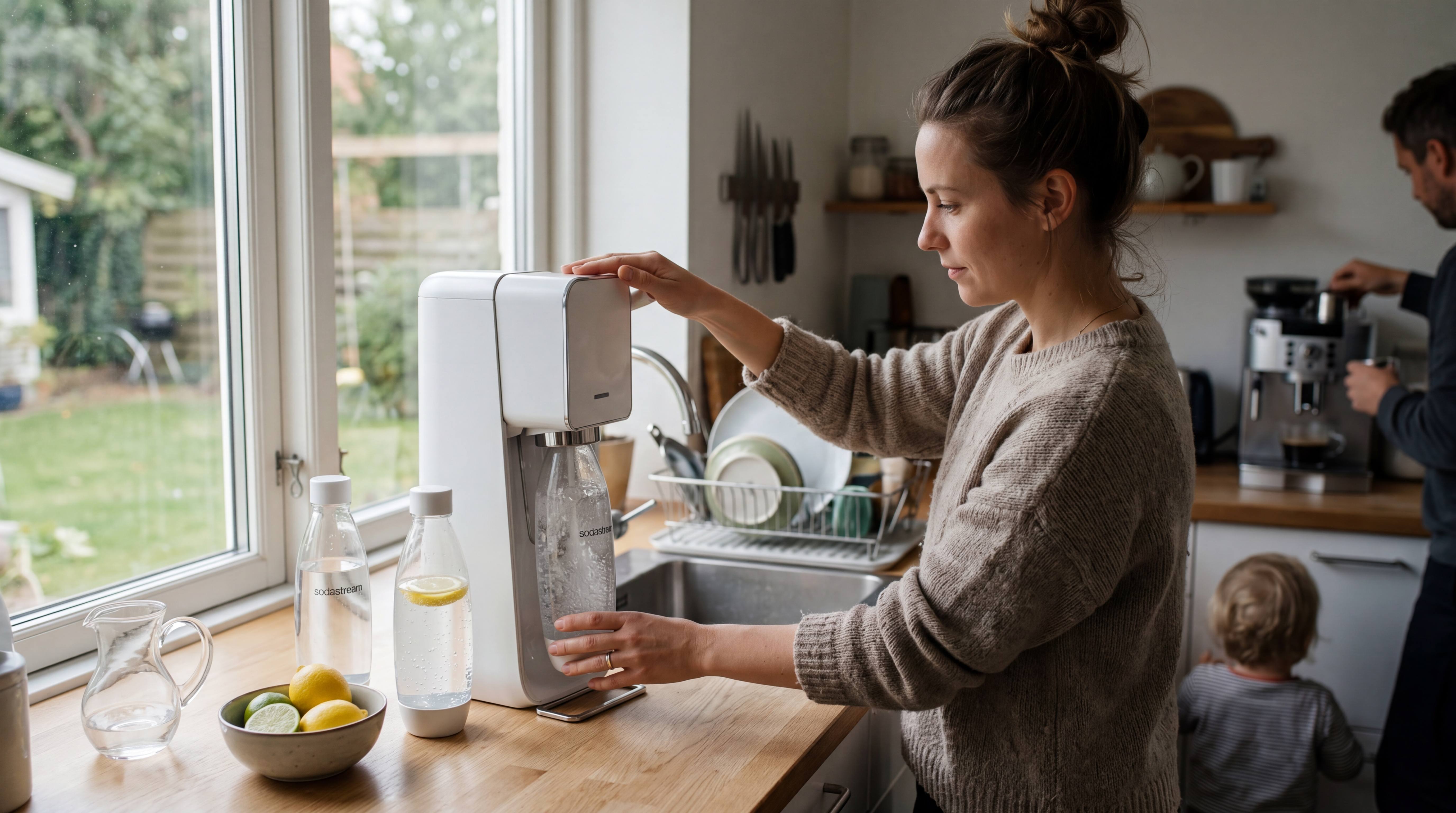
PET works well in daily-use environments because it supports a more fluid household pattern. The bottle is generally easy to handle, easy to move between sink and refrigerator, easy to carry from counter to desk or counter to dining table, and usually less emotionally stressful in active homes. It feels like a working component of an everyday system rather than a delicate object that requires special treatment.
That matters because soda makers are often sold through aspirational imagery, but they succeed through repetition. Repetition favors products that are comfortable inside ordinary life. It favors routines that feel light rather than ceremonious. PET bottles often do well here because they reduce hesitation. Users do not overthink them. They grab them, fill them, chill them, carbonate them, drink from them, and return them into rotation.
This is especially important in busy kitchens. A bottle that feels natural to move around has a better chance of becoming part of the home’s real beverage cycle. It can wait in the fridge, sit on the counter, go to the table, or travel within the house without demanding too much attention. In that sense, the value of PET is not simply that it is lightweight. Its deeper value is that it lowers the behavioral threshold for repeated use.
A good daily sparkling water bottle system depends on low-friction handling. If the household drinks sparkling water often, the bottle should not feel like a formal serving piece every time. It should feel like a working element in a reliable routine. PET supports that kind of behavior very well.
This is why many consumers who initially think they want a more premium-feeling bottle later discover that practical ownership pushes them toward something easier to live with. Prestige matters at the moment of purchase, but movement matters during months and years of use.
That does not make PET “better” in an abstract sense. It simply means PET aligns strongly with one of the most important truths in the category: the most successful soda maker systems are often the ones that fit into motion, not just into photography.
Glass Wins Where the Drink Needs to Feel Finished

If PET usually wins through movement, glass usually wins where the drink needs to feel complete.
A glass bottle carbonation system carries a different emotional and visual meaning. When glass is used well in this category, the bottle stops looking like a component and starts looking like part of the beverage itself. It feels closer to serveware than to functional equipment. This changes the way users perceive the finished drink.
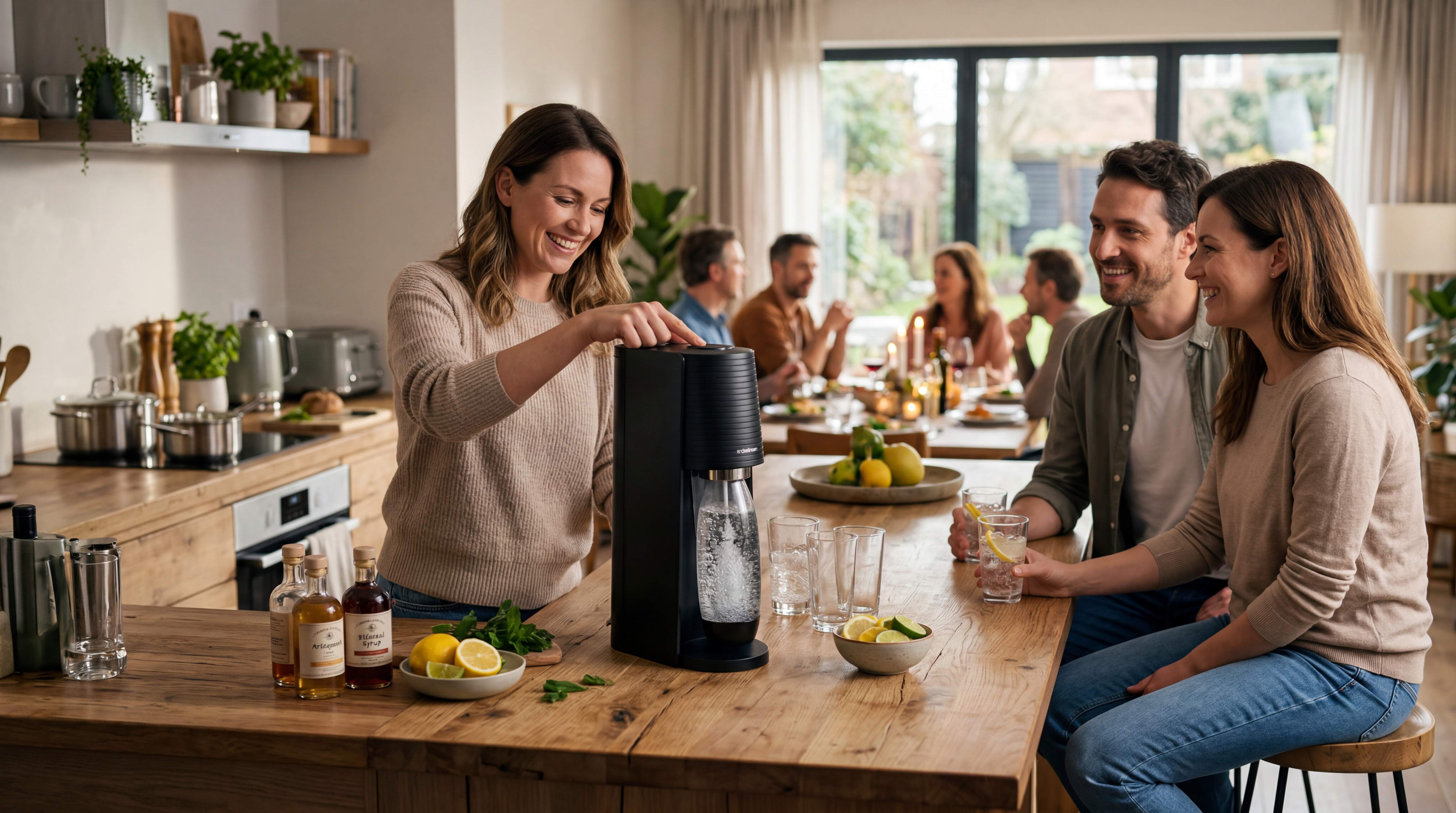
In homes where beverages are treated with more ritual, this difference matters. Sparkling water is no longer just hydration. It becomes part of meal setting, hospitality, mood, and presentation. The bottle no longer exists only to transport liquid from machine to cup. It becomes part of the table’s visual language. The drink appears more deliberate, more finished, and often more premium.
This is why many buyers who favor glass are not really buying glass as a raw material. They are buying a serving experience. They want the soda maker to contribute not only to beverage convenience, but to beverage presentation. They want the product to belong visually beside dinnerware, glassware, and other objects that shape the tone of the home. In these cases, a premium serving bottle for soda maker systems becomes part of a larger lifestyle expression.
There is also a psychological dimension here. Glass often changes how a user values the drink. The same sparkling water that feels casual in one bottle can feel elevated in another. Consumers may not always say this directly, but they respond to it. Material affects perception. Perception affects ritual. Ritual affects whether the product feels like a meaningful part of home life.
That is why glass bottles tend to perform well in kitchens where design coherence matters, where countertop objects are chosen carefully, and where the transition from preparation to serving is expected to feel seamless. In such homes, the bottle is not only part of function. It is part of identity.
A soda maker with a glass-centered setup is therefore often strongest when the buyer does not want the machine to behave like a purely utilitarian appliance. They want it to belong to a more refined home beverage culture, one in which the visual experience of the drink matters almost as much as the fizz itself.
The Real Difference Appears in the Three Most Important Moments: Filling, Storing, and Serving

One of the best ways to understand soda maker bottle material comparison is to stop thinking about the material as an abstract property and start looking at the three daily moments that define ownership: filling, storing, and serving.
These moments reveal far more than a specification list ever can.
Filling
The filling moment is the beginning of every soda maker cycle. At the sink, the bottle either feels easy and habitual or slightly more deliberate. PET often supports speed. It feels simple to lift, position, fill, and place back into routine. Users rarely treat it as a precious object. They work quickly.
Glass can feel more composed and satisfying in this moment, especially for users who enjoy tactile quality and a sense of material permanence. But that same quality can also introduce a different behavior. The user tends to become more intentional. The filling step feels less casual. For some homes, that is part of the appeal. For others, it may subtly slow the routine.
Storing
Storage is where material begins to influence system behavior. If a household keeps multiple chilled bottles in rotation, the bottle must work not only as a serving object but as a fridge object. Here PET often feels natural. It supports the logic of a reusable carbonation bottle that is constantly cycling through preparation and readiness. The household can maintain multiple bottles without feeling overly formal about them.
Glass, by contrast, may encourage more selective storage behavior. Users may keep fewer bottles in rotation, handle them more deliberately, and think more consciously about where they sit and how they fit into the refrigerator environment. Again, this is not necessarily a disadvantage. It simply points to a different mode of ownership.
Serving
Serving is where the contrast becomes most visible. PET can absolutely support service, especially in casual households, busy family meals, or everyday kitchen-to-table use. But glass often transforms service into a more finished experience. It communicates intention. It gives the drink a stronger sense of arrival.
This is why home beverage serving ritual is such an important concept in the category. The material changes not just the bottle, but the emotional endpoint of the drink.
When consumers evaluate bottle materials through these three moments, the choice becomes much clearer. They begin to see that the issue is not whether one material is stronger or more modern. The issue is whether the material fits the way the household fills, stores, and serves beverages on a repeated basis.
Material Choice Quietly Reveals the Buyer’s Relationship to the Kitchen
A very useful truth in this category is that bottle material often reveals how a buyer thinks about the kitchen itself.
Some consumers see the kitchen primarily as an operating environment. It is a place of workflow, efficiency, meal prep, cleaning, family traffic, and fast daily activity. In these homes, products are judged heavily on whether they help or interrupt movement. Here, a kitchen lifestyle soda maker tends to be evaluated in practical terms: how well it supports routine, whether it fits the counter, whether it stays easy to use, and whether its support objects—especially the bottle—behave well inside a working kitchen.
Other consumers see the kitchen not only as a work zone, but as a visual and social space. It is a place where design matters, where serving moments matter, and where appliances are part of the interior language of the home. In such kitchens, the bottle matters as an object. It is not only what holds the water. It is part of how the household presents itself, to guests and to itself.
This is why the material debate often feels more emotionally loaded than buyers expect. They may think they are deciding between practical and premium. In reality, they may be deciding between two different visions of domestic life.
Do they want the soda maker to disappear into routine?
Or do they want it to help shape the visible ritual of drinking at home?
Do they want the bottle to work like an efficient household item?
Or like an object that carries a finished beverage identity?
These questions are not superficial. They influence what kind of satisfaction the product will deliver. A buyer who wants a calm, visually coherent, elevated beverage scene may quickly feel that an ultra-practical bottle is missing something. A buyer who wants maximum flexibility and family resilience may decide that a more premium-feeling bottle adds less everyday value than expected.
That is why bottle choice for soda maker systems often becomes a proxy for something much larger than bottle preference. It becomes a way of asking what kind of kitchen life the user is trying to build.
Family Homes and Solo Homes Usually Read This Choice Very Differently
The same bottle system can feel ideal in one household and slightly mismatched in another. One major reason is household structure.
A solo user or couple living in a quieter home often has more freedom to treat the soda maker as an intentional beverage ritual. They may chill water more carefully, serve drinks more deliberately, and care more about how the bottle looks and feels during use. Their system can stay stable because fewer people are moving through it. In these homes, glass may feel more natural because the conditions support a more composed style of ownership.
Family homes often behave differently. The product must survive more motion, more hands, more schedule variation, and more mixed expectations. The bottle may move between adults and children, between meal use and casual use, between the counter and multiple rooms. In such settings, the value of a PET bottle soda maker becomes easier to understand. The system does not need to be admired every time. It needs to function again and again without creating hesitation.
This is why the material question is also a question about user distribution. A soda maker used mainly by one careful adult lives a different life than a soda maker used by a household with several drinkers. Even the same buyer may feel differently about bottle material after thinking seriously about who else will use the system.
Another important point is that families often need bottle rotation more urgently. More users mean more simultaneous demand for cold water, more washed bottles, more partially used bottles, and more speed. Practicality becomes more visible under pressure. A bottle that feels elegant in individual use may feel less strategically useful in group use if it complicates the rhythm of the household.
This is not to say that glass and family life are incompatible, or that PET belongs only to busy households. The point is that home structure changes which material values become more important. In quieter homes, refinement may rise. In more dynamic homes, adaptability often rises.
So when consumers compare a plastic vs glass carbonator, they should not ask only what they personally prefer. They should ask what kind of household energy the bottle must survive.
Sustainability Becomes Meaningful Only When the Material Works in Repeated Reality
Sustainability is often discussed too vaguely in the soda maker category. People speak as though the presence of a reusable bottle automatically settles the issue. But material sustainability is only meaningful when it survives repeated real use.
This is another reason bottle material should not be judged only by first impressions. A bottle becomes environmentally meaningful not because it looks durable or reusable on day one, but because it remains embedded in a stable habit over time. The material has to work well enough in daily life that the user keeps choosing the system instead of falling back into less intentional beverage behavior.
That is why a reusable carbonation bottle should be evaluated through realism. Will the household actually keep using it? Will it stay in rotation? Will it be cleaned and stored consistently? Will the material encourage repeated use rather than occasional admiration?
A buyer may be drawn to one material because it appears more premium, cleaner, or more permanent. Another may prefer a material that seems lighter and easier to cycle through daily behavior. From a sustainability standpoint, the more meaningful system is usually the one that stays active and believable in the home. A bottle that fits the user’s routine is more sustainable in practice than a bottle that fits only the product page narrative.
This is why repeated reality matters more than symbolic material value. The question is not which bottle looks more responsible. The question is which bottle supports a beverage habit that genuinely replaces more disposable or repetitive patterns. If the material choice helps the user keep the soda maker central to daily life, then it contributes more meaningfully to the category’s larger promise.
In other words, sustainability here is not a moral label attached to material. It is an outcome produced by material fit.
Price Alone Does Not Explain Material Choice, Because Buyers Are Paying for Different Forms of Value
Many consumers assume bottle material should map directly to cost logic: practical materials for lower budgets, premium materials for higher budgets. But in the soda maker category, value is more nuanced than that.
A buyer who chooses PET may not be choosing “cheap.” They may be choosing routine efficiency, household resilience, easier movement, faster integration, and lower handling anxiety. These are real forms of value. In fact, for heavy-use households, they may be more valuable than prestige.
A buyer who chooses glass may not be choosing “fragile luxury.” They may be choosing presentation, permanence of feeling, stronger table compatibility, and a better alignment between drink-making and drink-serving. These are also real forms of value. In design-led kitchens or lower-friction households, they may create a stronger sense of ownership satisfaction over time.
So the economics of material choice are not simply about unit price or replacement cost. They are about what kind of value the buyer wants the product to return. One material may give back speed and ease. Another may give back refinement and atmosphere. Neither of these benefits is trivial.
This is why premium serving bottle for soda maker systems attract some users even when they are not the most obviously practical route. Those buyers are not being irrational. They are simply optimizing for a broader version of product value, one that includes aesthetics, table presence, and emotional satisfaction. In the same way, buyers who choose simpler, more mobile bottle systems are not settling. They are often choosing the form of ownership that will remain most useful in real domestic life.
When the category is viewed through this lens, material choice becomes much more intelligent. It stops looking like a trade-off between good and bad, and starts looking like a decision about which benefit structure matters most.
Why the Best Bottle Is Usually the One That Matches the User’s Drinking Ritual, Not the One That Sounds Better in Theory
A major source of mismatch in this category is aspirational buying. Consumers often imagine the most idealized version of how they will use the product and then buy according to that fantasy. Later, daily life corrects them.
They imagine they will serve sparkling water in a refined, beautifully composed way every evening. They imagine guests, elegant table settings, intentional drink moments, and a more elevated routine. Or they imagine total practicality and then later wish the product felt more complete, more beautiful, or more satisfying to serve. In both cases, the issue is not poor product quality. It is inaccurate self-reading.
This is why the best soda maker bottle material comparison is never theoretical. It must be grounded in ritual.
What is the user’s real drinking ritual?
Do they mostly carbonate water for themselves and drink it casually through the day?
Do they like to place bottles directly on the table during meals?
Do they host often?
Do they want the bottle to feel invisible and efficient, or visible and finished?
Do they keep multiple bottles chilled?
Do they expect children or other family members to move through the system easily?
These questions are far more revealing than general claims about materials.
A product that matches ritual tends to remain satisfying. A product that conflicts with ritual tends to feel slightly wrong even when it is technically impressive. This is why the most experienced buyers often become less interested in abstract feature superiority and more interested in fit. Fit is what determines whether the bottle feels like part of the home or part of the sales pitch.
The strongest material choice is therefore not the one with the loudest reputation. It is the one that mirrors the consumer’s actual beverage rhythm.
Material Choice Also Shapes What Kind of Brand Story Feels Believable
Bottle material does not only matter at the consumer level. It also matters at the branding level.
In the soda maker category, brands are not just selling carbonation. They are selling a picture of home beverage life. Material helps make that picture believable. A brand that emphasizes design, premium living, table ritual, or minimalist kitchen aesthetics often benefits from a bottle system that visually supports that narrative. Likewise, a brand that speaks more strongly to daily practicality, family rhythm, convenience, and easy hydration often benefits from a system that looks comfortable inside ordinary domestic movement.
This is why material and brand language should align. A mismatch weakens trust. If a brand talks like a premium tabletop beverage company but delivers a bottle system that feels purely functional, something may feel incomplete. If a brand speaks the language of convenience and high-frequency use but chooses a bottle logic that feels too ceremonious, the product may also feel conceptually unstable.
For content creators, retailers, and manufacturers, this is a very important lesson. Material is not only part of engineering or industrial design. It is also part of category storytelling. It tells consumers what kind of relationship the product expects to have with the home.
That is why kitchen lifestyle soda maker positioning is closely tied to bottle choice. A soda maker can only credibly claim to fit a certain type of kitchen life if its material logic supports that claim in repeated use. Otherwise, the story collapses under real ownership.
Final Perspective: This Is Not Really a Material Decision. It Is a Domestic Behavior Decision
At the beginning of the buying journey, PET and glass may look like a simple material comparison. By the end of serious evaluation, it becomes clear that they are not simple at all.
They represent two different ways of bringing carbonation into the home.
Two different ways of moving beverages through the kitchen.
Two different ways of turning sparkling water into a daily routine.
Two different ways of deciding whether the bottle is mainly a utility object or a serving object.
That is why PET bottle soda maker and glass bottle carbonation system should never be compared only by asking which material sounds more premium, more modern, or more practical. The real issue is behavioral fit.
Does the user want speed, flexibility, movement, and rotation?
Or do they want finish, presentation, and a more complete serving identity?
Does the household need resilience and frequency?
Or does it value composed ritual and visual harmony more strongly?
In the end, the best bottle is not the one with the strongest marketing language. It is the one that makes the home beverage routine feel most natural, most repeatable, and most satisfying.
That is why material choice in soda makers is really a lifestyle choice.
It tells you what kind of kitchen the product belongs in.
It tells you what kind of user the product expects.
And most importantly, it tells you what kind of daily drinking life the product is trying to build.
#PETBottleSodaMaker
#GlassBottleCarbonationSystem
#SodaMakerBottleMaterialComparison
#ReusableCarbonationBottle
#PremiumServingBottleForSodaMaker
#PlasticVsGlassCarbonator
#BottleChoiceForSodaMaker
#DailySparklingWaterBottleSystem
#HomeBeverageServingRitual
#KitchenLifestyleSodaMaker
#KitchenAppliances
#HomeBeverageSystem
#SparklingWaterLifestyle
#CountertopDesign
#DrinkPresentation