
Should a Heavy-Payload AMR Weigh Pallets Onboard or at a Floor Scale
The useful result is an accepted weight record, not a number on a screen
A pallet scale can give a repeatable reading and still fail an automated warehouse process. The wrong tare may have been subtracted. A robot may still be carrying part of the pallet. The weight may belong to yesterday's job, or the receiving system may never have acknowledged it. Buyers therefore need to specify both the physical measurement and the record that authorizes the next operation.
For a heavy-payload autonomous mobile robot, the practical choice is between weighing the load at a dedicated station, weighing the complete vehicle and load on a platform, or measuring through equipment integrated into the vehicle. Each arrangement puts different objects inside the weighing boundary. That boundary determines capacity, tare, maintenance, robot availability and the evidence needed before a result can be accepted.
The short answer is to use a stationary weighing point when the process benefits from a controlled measurement location, shared inspection or an established scale installation. Consider onboard weighing when avoiding a diversion or extra transfer creates measurable operational value and the vehicle supplier can validate the complete measuring arrangement. A vehicle driving onto a platform is a third architecture with its own capacity and tare requirements; it should not be treated as equivalent to putting only a pallet on the same platform.
This guide follows one pallet from the purchase specification to an accepted warehouse record. It is written for logistics managers, automation integrators, quality teams and buyers comparing equipment quotations. Personnel weighing, vehicle axle enforcement and laboratory precision weighing are outside its scope.
Why this purchasing question deserves attention now
Recent supplier activity connects weighing more closely with automated material handling and shipment data. In its September 23, 2026 preview for the October 18–21 PACK EXPO event, Rice Lake described pairing an iDimension Flex system with a RoughDeck HP floor scale and a 680 indicator to obtain pallet dimensions and weight together. That announcement establishes the planned configuration and exhibition focus; it is not an independently observed performance trial. Rice Lake's logistics preview provides the product context.
At the mobile end, RAVAS describes weighing solutions for AGVs and AMRs that can avoid a trip to a static scale and pass weight information to business systems. Its offering includes weighing during movement, but that vendor capability must not be generalized to every robot, sensor arrangement or operating condition. RAVAS's AGV and AMR weighing information supports evaluating an integrated alternative.
The purchasing implication is that equipment location and information flow now deserve one specification. Selecting a scale first and adding the robot interface later can leave two technically functional machines with no dependable measurement process between them. The news is relevant because buyers have more integration choices; it does not prove that one architecture always produces better accuracy or lower cost.
Start with what you actually need to weigh
Draw the weighing boundary before comparing capacities
Begin with a simple list of everything whose force passes through the measuring system. It might include goods, wrapping, the pallet, a reusable cradle and a removable fixture. In a drive-on arrangement it may also include the AMR and its attached equipment. In an onboard arrangement, only the components supported above the installed weighing interface may be measured. Ask the supplier to identify this boundary on an assembly drawing.
Then define the required output. Warehouse stock control may require net goods mass, while an outbound shipment record may require the complete shipping unit. A process check may only compare the received unit with an expected range. These are different decisions, even when the same instrument generates the underlying reading. Write down which components must remain included and which may be subtracted.
For buyers asking how to weigh a pallet, this is the first step: determine the intended mass, arrange complete support through a suitable measuring system, apply the correct tare and accept the reading only under the specified conditions. Choosing a product by its nominal capacity comes after those decisions.
A worked example exposes the tare problem
Consider an illustrative installation with 800 kilograms of goods, a 28-kilogram pallet, a 20-kilogram reusable carrier and a 620-kilogram robot. These are invented planning values, not measurements from a particular product. If the whole assembly is on a platform, its gross mass is 1,468 kilograms. Subtracting only the robot leaves 848 kilograms, which still includes the pallet and carrier. Obtaining the 800-kilogram goods value requires the correct combined tare of 668 kilograms.
At a station supporting only the pallet, carrier and goods, the corresponding gross value is 848 kilograms and the required tare is 48 kilograms. An onboard module could have a different boundary again. The arithmetic is straightforward; maintaining the identity of the tare components across a changing fleet is the operational challenge.
Do not assume every apparently identical pallet has the same mass. Repairs, moisture, attachments and different carrier versions can affect the result. Decide whether the process uses a measured tare, a controlled stored value or another documented method, and quantify the consequences for the required decision. A precise display cannot correct an inappropriate subtraction.
Choose the architecture around the material flow
The following comparison separates three arrangements often mixed together in supplier discussions. It is a purchasing framework, not a universal ranking of pallet scales. Actual suitability depends on the installed system and the application evidence.
| Arrangement | What is normally measured | Operational advantage to test | Main acceptance question |
|---|---|---|---|
| Pallet-only stationary station | The load and whatever carrier rests entirely on the scale | One controlled point can serve weighing, inspection and shipment identification | Can the robot release all load support without leaving contact that changes the measurement? |
| Whole vehicle on a platform | The robot, attached equipment and carried load within the platform boundary | Potentially avoids a pallet transfer | Are total mass, wheel loading, access geometry and the correct vehicle tare all accounted for? |
| Integrated onboard weighing | The assembly supported through the specified onboard measuring interface | May remove a diversion or additional handling step | Under which stationary or moving conditions is an accepted measurement available? |
When a dedicated station makes sense
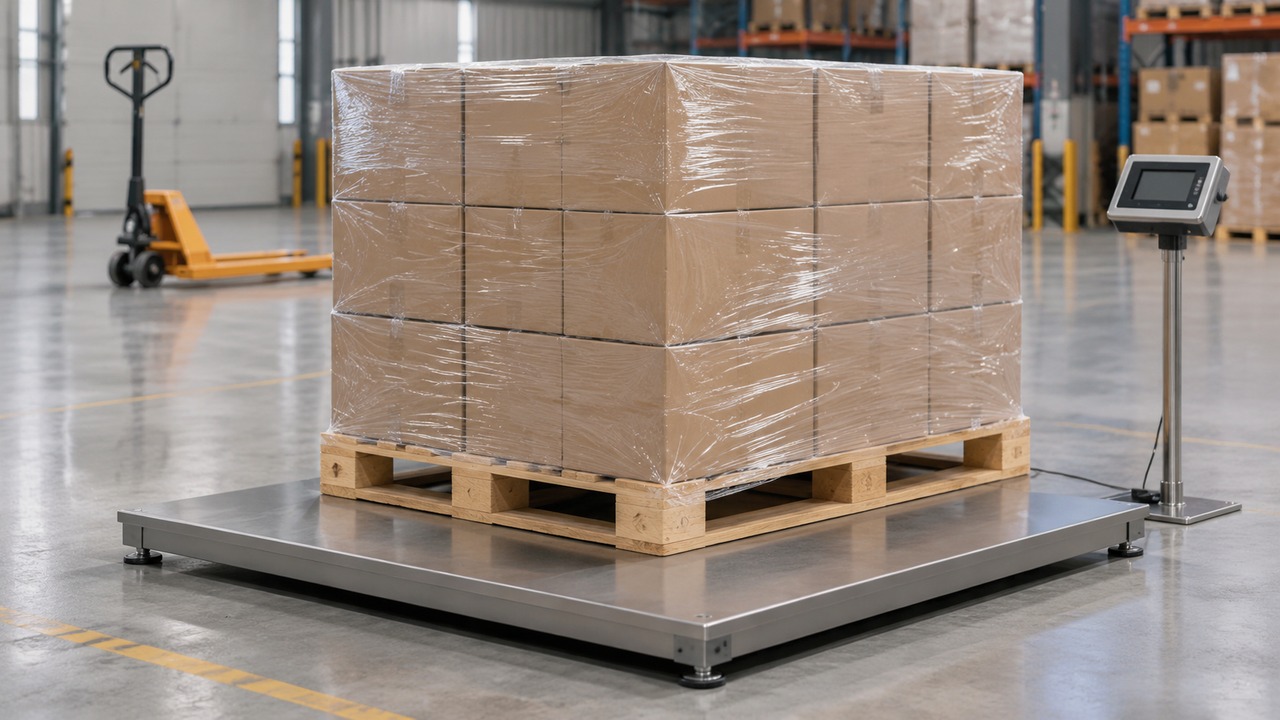
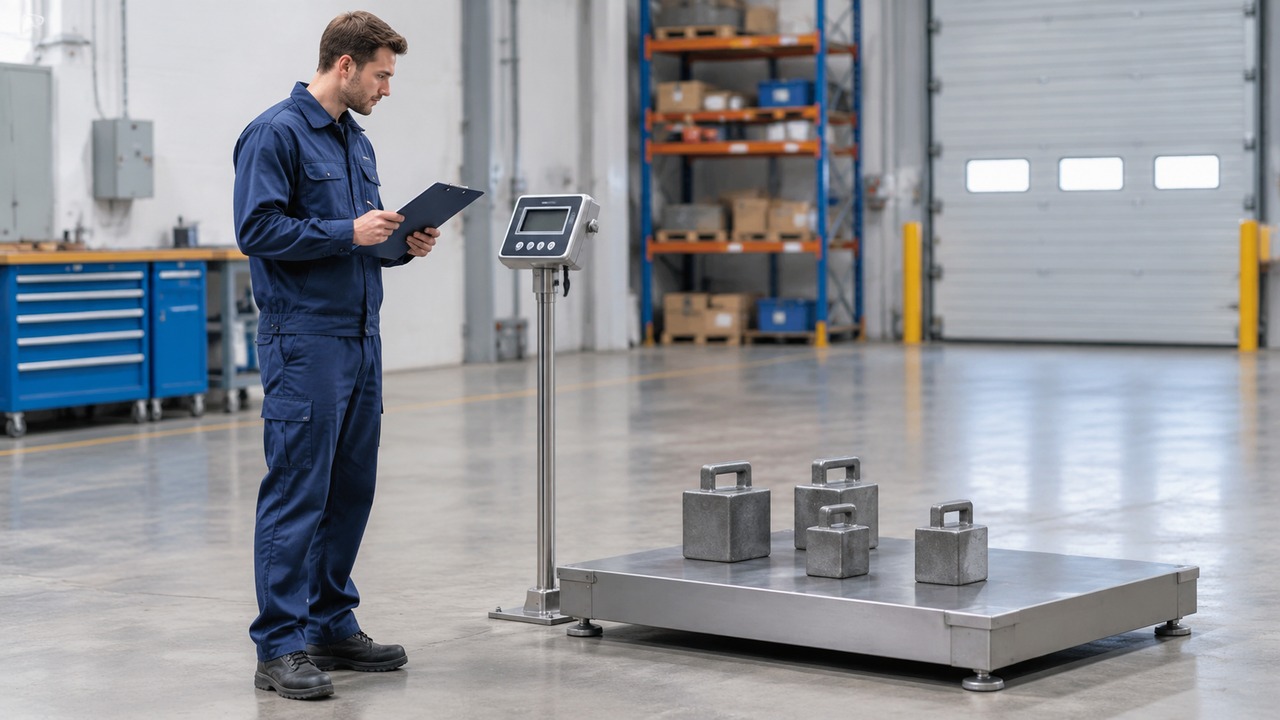
An industrial floor scale can be useful where several vehicle types deliver to one inspection or dispatch location. Maintenance and verification can be concentrated there, and a weighing task can be coordinated with labeling, shipment checks or dimension capture. The station becomes a shared resource, however, so access, waiting space and recovery routes become part of its effective capacity.
For a pallet-only station, the receiving structure must support the intended pallet geometry after the robot withdraws or lowers its lifting mechanism. A platform sold for manual loading does not automatically provide a compatible autonomous transfer interface. Confirm the support footprint, clearances, approach direction and release sequence using the actual pallet and robot configuration.
The weigh point also needs a defined empty state. Loose packaging, an abandoned fixture or a previous pallet changes what happens next. The control sequence should establish that the station is available, identify the arriving job and distinguish a new measurement from a residual display value. The site's existing AMR material-handoff validation guide explains the wider transfer-state discipline that can support this sequence.
Low entry height solves only part of the access problem
A low profile floor scale can reduce the height change at entry, but buyers still need the complete transition geometry. Ramp length, floor condition, wheel size, ground clearance and the loaded vehicle's allowable movement all matter. A nominally low deck can remain unsuitable if the robot's underside or carried equipment contacts the ramp crest.
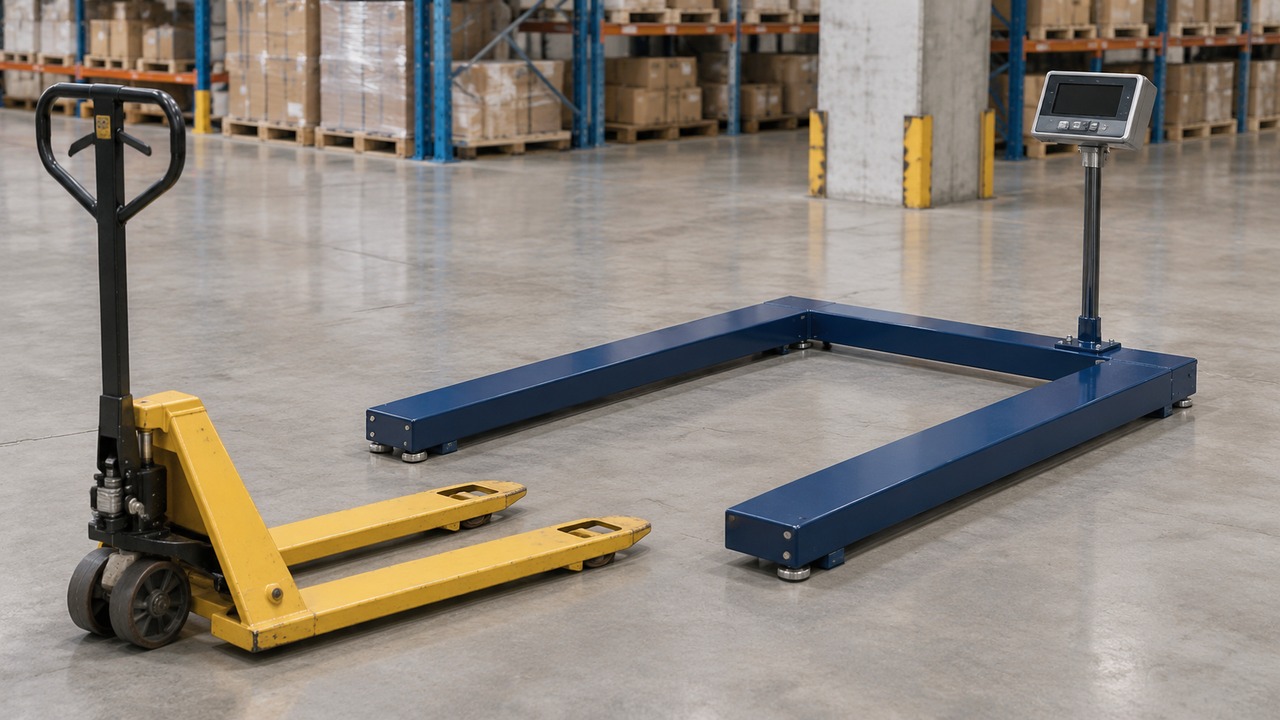
U-shaped arrangements offer another way to position certain pallets while allowing a manual handling device to enter and withdraw. Their suitability depends on pallet runners, fork approach and where the pallet finally rests. Specify these details rather than assuming the open shape guarantees compatibility with every load carrier or lifting deck.
During a transition period, a pallet jack with scale may provide a separate manual weighing route for exceptions or low-volume areas. Treat that route as a distinct process with its own device identity, tare method and operator procedure. Its existence does not prove that an AMR can use the same equipment automatically.
When the complete robot drives onto the platform
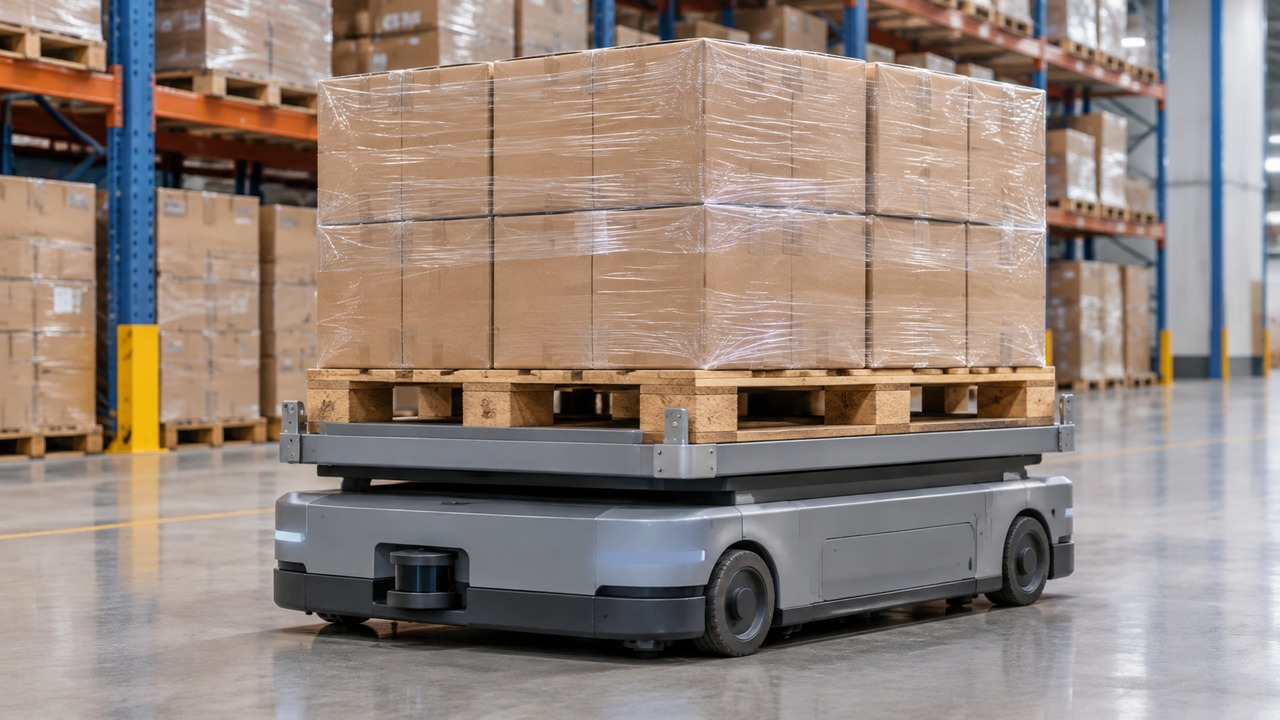
This arrangement avoids setting down the pallet, but it asks the platform to accept the entire moving assembly. Total supported mass is only one input. Wheel contact locations, concentrated loading, entry impact, platform dimensions and stopping position all need supplier review. The robot must fit fully within the approved loading arrangement, with no wheel or attachment creating an unintended support path outside it.
Vehicle tare must match the robot configuration used for that job. A replacement battery assembly, changed attachment, stored tools or a modified lifting module can invalidate a previously recorded tare. A maintenance system that tracks only the vehicle serial number may not capture those changes. Agree who releases the robot for weighing service after work that affects its mass or load path.
When the measuring equipment travels with the load
Onboard weighing can be attractive when pallets are collected from many locations and a central weigh point adds travel or congestion. It may also make the first weight available earlier in the process. The purchase should cover the complete measuring installation, not merely the availability of a load cell or an overload estimate somewhere in the robot.
Ask exactly when the system delivers a valid value: stopped on a specified surface, during a controlled lift, or while moving within documented conditions. Request evidence for the required load range, load position, vehicle state and repeatability. A published example of mobile weighing does not establish the performance of a different attachment or control configuration.
A forklift scale can be relevant when comparing weighing during existing manned handling with an autonomous installation. Its mounting, load path and intended vehicle application must still be respected. Moving an instrument concept from one vehicle type to another is an engineering integration task, not a purchasing substitution based on a similar capacity number.
Protect the physical measurement before improving the software
Keep the complete load on the intended measuring structure
The desired force must pass through the weighing system without a parallel support path. A pallet partly touching an adjacent conveyor, a fork still taking some weight or a fixture resting against a fixed structure can change the result. Contact that appears minor during a demonstration can become intermittent as pallets, floor conditions or placement vary.
Inspect the full operating envelope, including the highest and lowest permitted carrier positions. Consider cables, hoses, restraints and guards that move with the assembly. Ask the supplier how these interfaces are arranged so that ordinary movement does not introduce an uncontrolled influence. This is particularly important when a scale is installed inside a larger custom station.
Accessibility matters over the equipment's life. Rice Lake's floor-scale care guidance identifies debris-related binding and damaged connections among practical concerns. Translate that into a site-specific cleaning and inspection arrangement. Operators need access to the relevant areas without improvising around moving machinery, and maintenance must know which intervention requires a subsequent measurement check.
Separate capacity, resolution and useful accuracy
The maximum load rating answers whether a specified assembly is intended to accept a given load under its stated conditions. Display resolution describes the size of the indicated increments. Neither alone establishes the uncertainty or suitability of the measurement for your decision. A procurement table listing capacity and decimal places leaves a major gap.
For an industrial weighing scale, request performance over the load range that actually matters. A station selected for an occasional heavy load may spend most shifts weighing much lighter pallets. Define the allowable measurement error for the business decision, the method for checking it and the conditions under which that requirement must hold. Do not borrow a tolerance from an unrelated application simply because the equipment has the same nominal capacity.
Include off-center loading and repeated placement in the acceptance plan where they represent normal use. A single centered test load does not characterize all operating conditions. If the specification includes a particular test method, identify the applicable document and edition and agree who is qualified to perform the work. Instrument adjustment, calibration and verification should not be used interchangeably in the purchase record.
A weight value does not authorize a lifting or transport operation
Knowing mass is useful, but a scalar value does not fully describe load distribution, center of gravity, pallet condition or restraint. A load can be within a measured mass limit yet remain unsuitable for the vehicle's configuration or the required maneuver. The weighing function must not silently replace the manufacturer's operating limits or the system's safety assessment.
This distinction is especially important where the same warehouse uses lifting vehicles. The guide to forklift capacity at height addresses configuration-dependent handling limits. A weighing result can feed a defined decision, but it does not by itself establish that the following movement is permitted.
Make the weight belong to one pallet and one job
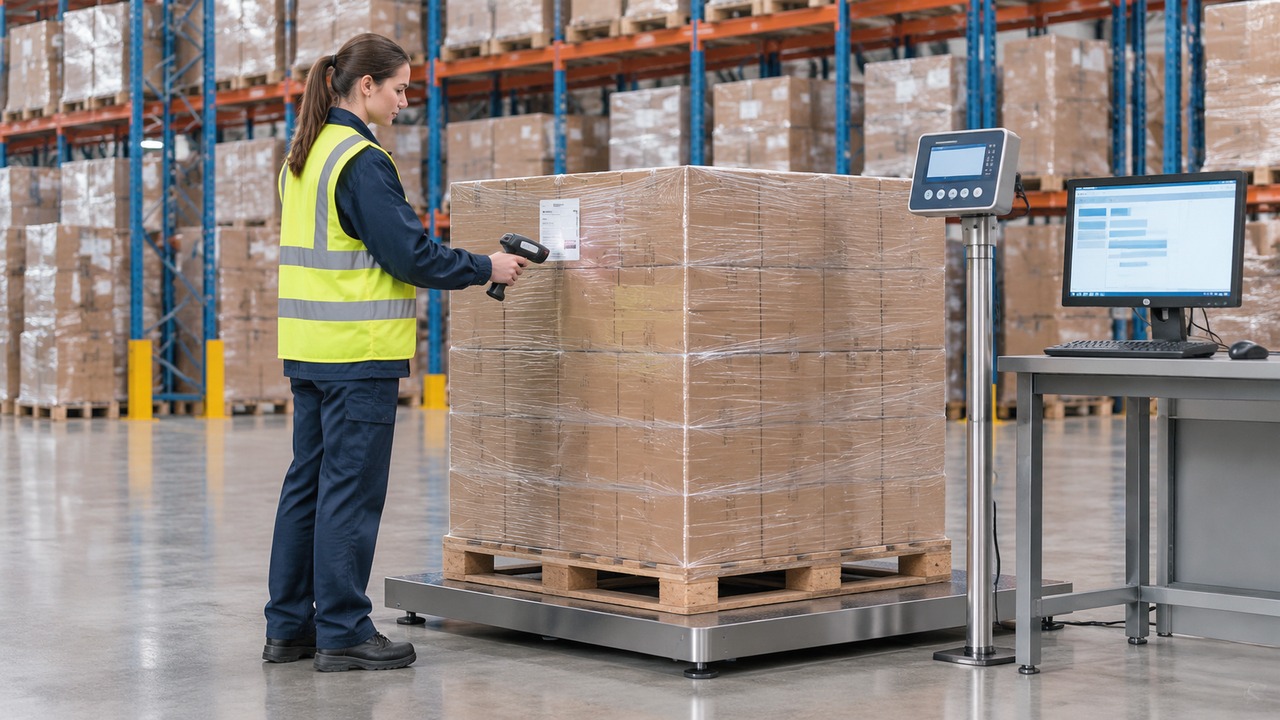
An accepted record should identify the load, the job and the measuring device, together with the measured value, unit, time and relevant status. Where gross, net and tare are used, preserve their meaning and relationship. Avoid an interface that supplies only a floating number with no indication of whether it is new, stable, valid or associated with the current load.
RAVAS's Data Collector information lists fields including gross, net, tare, product identification, time and scale identification, and describes buffering when wireless communication is unavailable. These are useful examples of available functions. Buyers still need to specify their own message ownership, acknowledgement and retry behavior across the actual systems involved.
For example, a weighing device may have completed a valid measurement while the warehouse system is temporarily unreachable. The process must distinguish “measured and awaiting acknowledgement” from “not measured.” Repeating a transmission should not create two shipment events, and a delayed message should not be assigned to the next pallet that enters the station.
Define exception handling at the same time as the successful path. Missing identification, an unknown tare, an unstable value, overload, communications loss and a duplicate transaction are different conditions. Some may allow a controlled retry; others require operator investigation or diversion. A generic error flag can force staff to guess which response is appropriate.
When a pallet dimensioner shares the station, confirm that dimensions, images and weight refer to the same physical shipping unit and process state. A dimensional record captured before a pallet is rebuilt may no longer belong with its later weight. Physical proximity between instruments does not guarantee transaction consistency.
Specify who owns the accepted result
Choose one system to establish the accepted transaction and make the other systems' roles explicit. The robot controller may identify a transport mission, the scale controller may decide whether a reading meets its measurement conditions, and the warehouse software may authorize shipment release. Those responsibilities can coexist, but their interface must prevent a transport-complete signal from being mistaken for measurement acceptance.
Units and numerical formatting also deserve an interface requirement. A value without a unit can be misinterpreted, and repeated conversions or premature rounding can change a comparison near an acceptance boundary. Keep the original measurement and its stated unit available where the process requires traceability. Define which system performs any conversion, applies the relevant business tolerance and records the final decision.
When a pallet is split, rebuilt or rewrapped, decide whether the previous result remains applicable. A record should not stay valid merely because the barcode has been reused. Define the changes that trigger another measurement and ensure that the revised result is distinguishable from the earlier one. This is a workflow-control issue as much as an instrument interface.
Compare completed work, including exceptions
Measure the cost of weighing within the whole route. A stationary option may add travel, queueing, positioning, release, settling, acknowledgement and departure time. An onboard option may avoid several of those activities but introduce its own measurement conditions, equipment cost, service work and recovery requirements. Compare equivalent accepted records, not the instruments' fastest display updates.
Consider a hypothetical operation handling 500 pallets per day. If one architecture removes 18 seconds of robot occupancy per accepted pallet, the arithmetic difference is 9,000 seconds, or 2.5 robot-hours per day. This is an illustration, not a forecast. It becomes an economic benefit only if the released capacity can be used, reduces a constrained resource or changes the fleet requirement.
Queueing can dominate the result at a shared station. Average daily volume hides bursts after production batches or before carrier collection. Assess the arrival pattern, the time occupied by other inspection tasks and the recovery time for a pallet requiring investigation. Keep a route available for exceptions so that one disputed reading does not immobilize every subsequent load.
Conversely, an onboard installation adds measuring equipment to each equipped vehicle. Ask how calibration access, damaged components, spare vehicles and software configuration are managed across the fleet. A centralized station can be a bottleneck, but duplicated equipment can increase service obligations. The cost comparison needs both effects.
Where weighing shares a conveyor interface, the site's pallet conveyor and AMR selection guide provides the broader transport comparison. For this purchase, keep the acceptance target narrower: the required number of correctly identified and accepted weight records under the expected operating pattern.
Put measurement purpose and approval boundaries in the RFQ
Internal process checking and a commercial transaction based on weight can create different requirements. Do not assume that a sensor advertised as accurate, or a component described as approved, makes the final installation acceptable for every billing use and every destination market. Identify the intended use, installation location and authority responsible for the applicable requirements.
In the United States, the NCWM NTEP FAQ explains the relationship between type evaluation and the device configuration described by a Certificate of Conformance, including the potential significance of connected equipment. Obtain the relevant certificate and confirm the configuration with the supplier and responsible authority where required. This is a purchasing check, not a declaration that a particular AMR installation is approved.
The 2026 NIST Handbook 44 Scales section also provides useful context for issues such as recorded results, load application and vehicle-related operating conditions. Its provisions should be applied only where relevant to the device and jurisdiction. Buyers should not turn a general reference into a global claim of compliance.
The RFQ below makes competing proposals easier to compare. It asks for evidence and responsibilities instead of assuming every bidder uses the same definition of an automated weighing cycle.
| RFQ item | Information supplied by the buyer | Evidence requested from the supplier |
|---|---|---|
| Measurement boundary | Goods, pallet, fixtures, vehicle configuration and required gross or net output | Annotated load path and list of measured and excluded components |
| Operating range | Typical, minimum and maximum loads; placement variation; arrival pattern | Application-specific performance and loading limits, with stated conditions |
| Valid reading conditions | Stationary or moving process, route conditions and required decision time | Definition of valid status and demonstration under the agreed operating states |
| Tare and identification | Carrier variants, job identifiers and controlled tare records | Method for selecting, updating and recording tare without assigning the wrong load |
| Data and recovery | Receiving systems, acknowledgement requirements and exception destinations | Message fields, retry behavior and recovery demonstration after interrupted communication |
| Service and intended use | Cleaning conditions, maintenance access and whether weight supports a commercial transaction | Service plan, required checks, relevant approval documents and clear responsibility boundaries |
Accept the installation with representative jobs
Agree the acceptance method before ordering. Start with the measuring equipment's required checks, then demonstrate the complete automated process using representative load carriers and operating states. Record configuration versions and test conditions so that the evidence applies to the system that will actually enter service.
Include normal variation rather than only an ideal pallet. Examine permitted load positions, different controlled tares, the expected working range and the required vehicle conditions. Confirm that deliberately invalid states are rejected appropriately. A process that always returns a plausible number may be more dangerous operationally than one that clearly reports why a value cannot yet be accepted.
Demonstrate recovery as well as measurement. Interrupt the connection to the receiving system, introduce an unknown job identifier and change a controlled tare through the authorized procedure. Observe whether the system preserves the correct record and whether the operator can understand the next action. These demonstrations should be planned safely with the supplier, without bypassing protective functions.
Finally, assign ownership after commissioning. Name the team responsible for instrument checks, mechanical access, tare control, software changes and disputed records. The best architecture is the one that can sustain the required measurement and material flow with those responsibilities in place. Buying the instrument is only one part of buying a dependable weighing process.
Also rehearse the planned fallback. If a central station is unavailable, identify the alternate instrument and the method for preserving the job association. If an equipped robot is replaced, confirm whether the spare has the required measuring configuration and current records. A fallback that depends on manually copying an unexplained number can undo the traceability built into the normal process. Include the alternate route in training and document when it may be used.
Focused FAQ
Should an AMR use an onboard scale or a stationary weigh point?
Choose around the measurement purpose and material flow. Onboard equipment may avoid a diversion or transfer, while a stationary point can consolidate weighing and other checks. Compare complete installed systems, valid measurement conditions, maintenance and accepted-record throughput before selecting either approach.
Can the robot stay on a platform while its pallet is weighed?
It can only be considered where the complete platform installation is suitable for the vehicle, load, wheel positions and operating sequence. The result includes everything inside the weighing boundary. A correct, controlled tare is needed if the required output excludes the robot and its equipment.
Does finer display resolution mean more accurate pallet weighing?
No. Smaller displayed increments do not establish the error of the installed measurement. Ask for performance over the relevant load range and operating conditions, together with an agreed verification method. Mechanical contact, incorrect tare and unsuitable operating states can undermine a finely displayed value.
Can every onboard weighing system measure while the AMR moves?
No. Some suppliers offer mobile measurement under specified conditions, while other configurations require a defined stationary or lifting state. Request evidence for the exact vehicle, measuring assembly, load positions and movement conditions. Do not infer capability from the general description “onboard weighing.”
What should happen when the warehouse system cannot receive the weight?
The agreed process should preserve the association between the measurement, load and job, distinguish pending acknowledgement from missing measurement, and avoid duplicate transactions during retries. Define whether the pallet may proceed, must wait or should enter an exception route.
Is an operational weight automatically suitable for invoicing?
No. Commercial use can require evaluation of the device, configuration and installation under applicable local rules. Confirm the intended transaction, relevant documents and required checks with the supplier and responsible authority. An internal process reading alone does not establish that status.
Professional sources and scope
This article presents original procurement analysis. Supplier pages establish available functions and product context; they do not independently validate the performance of a proposed installation. Numerical examples are explicitly illustrative.
- Rice Lake — Logistics Solutions at PACK EXPO 2026, published September 23, 2026. Exhibition preview and paired weighing/dimensioning equipment.
- RAVAS — Weighing solutions for AGV and AMR. Supplier information on integrated mobile weighing.
- Rice Lake — Tips for Floor Scale Care. Practical maintenance considerations.
- RAVAS — Data Collector. Weight records and communication functions.
- NCWM — NTEP FAQs. Type evaluation and configuration context.
- NIST — 2026 Handbook 44, Section 2.20, Scales. Technical reference subject to applicable device scope and jurisdiction.


