Automatic Coupler Latch vs Manual Latch: What Actually Improves Trailer Safety?
When buyers compare towing components, they often assume the safest product is simply the one with the most modern mechanism. That assumption sounds reasonable, especially when an automatic coupler latch is marketed as faster, smarter, and easier to use than a manual trailer latch. But real trailer safety is not created by marketing language alone. It comes from how a coupler behaves in actual hookup conditions, how consistently it reduces user error, and how well it fits the trailer’s real operating environment.
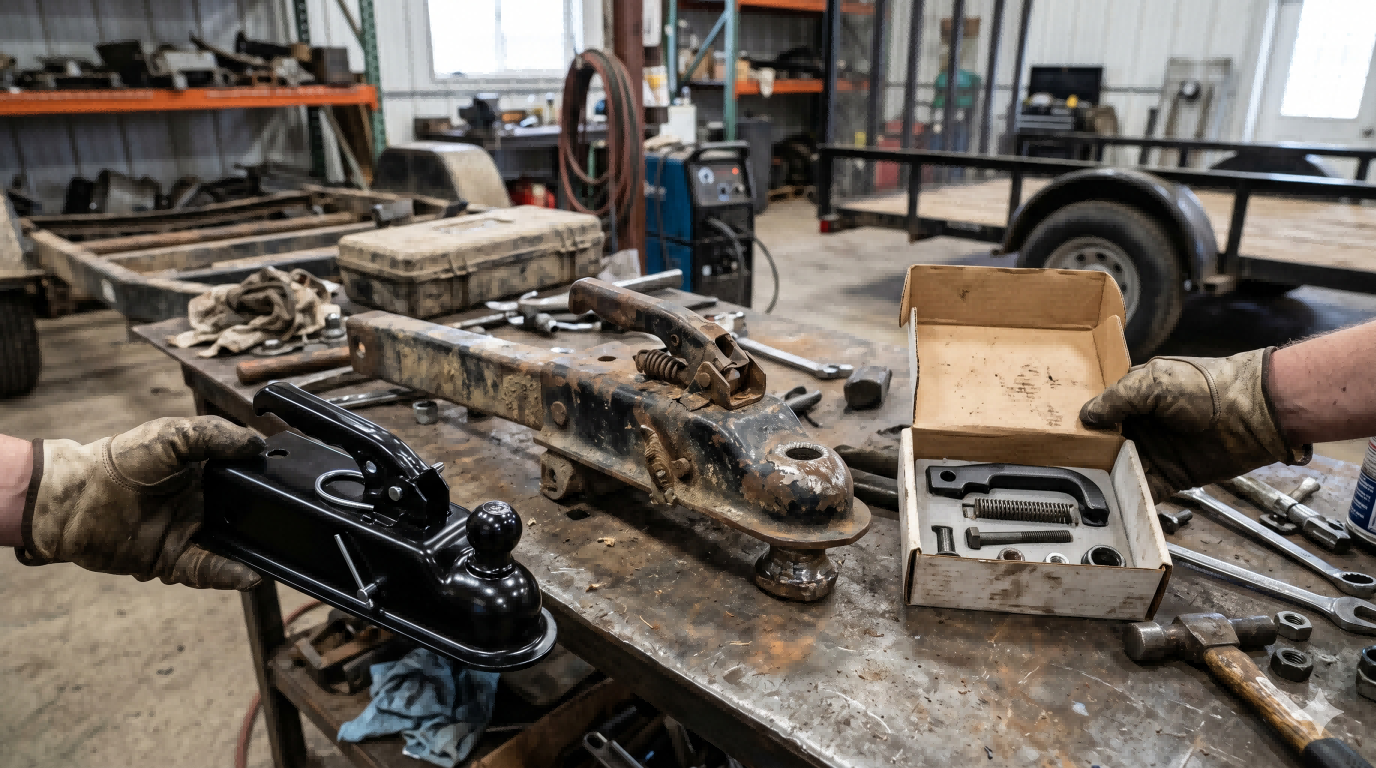
This is why the comparison between an automatic trailer coupler and a traditional manual latch matters more than it first appears. At one level, the difference seems mechanical: one system engages automatically when dropped onto the ball, while the other requires the user to close and secure the latch manually. But at a deeper level, the difference is operational. It affects hookup consistency, user behavior, inspection habits, and the margin for error in everyday towing.

The most important question is not which design sounds more advanced. The real question is what actually improves trailer hookup safety in daily use.
Why This Comparison Matters in the Real Towing Market
A trailer coupler is not just another hardware item. It is one of the most critical connection points in the entire towing system. If the coupler does not engage correctly with the hitch ball, the consequences are far more serious than ordinary noise or inconvenience. That is why buyers, dealers, and fleet users pay close attention to the coupler locking mechanism and the operational logic behind it.
Yet the market often oversimplifies the choice. Manual systems are sometimes dismissed as outdated, while automatic systems are sometimes treated as automatically safer in every situation. Neither view is complete.
The truth is that safety in coupler design comes from a combination of factors:
Hookup consistency
Does the latch system help users achieve the correct connection the same way every time?
Error reduction
Does the design reduce the chance of partial engagement, incomplete closure, or forgotten steps?
Inspection clarity
Can the operator quickly verify that the connection is correctly engaged before towing?
Long-term usability
Does the system stay practical under real weather, dirt, wear, and repeated towing cycles?
These are the questions that matter in a serious trailer coupler guide, because real safety is built through repeatable correct use, not just product claims.
What an Automatic Coupler Latch Actually Does

An automatic coupler latch is designed so that when the coupler is properly lowered onto the correct hitch ball, the latch mechanism closes and captures the ball automatically. In concept, the system is meant to reduce the number of manual actions required during hookup.
That design can offer meaningful advantages.
It simplifies the hookup sequence
Instead of requiring the operator to drop the coupler onto the ball and then manually move the latch into place, the system combines those steps. This reduces friction in the towing process.
It can reduce missed latch closure
One of the most practical safety benefits of an automatic trailer coupler is that it lowers the chance that a user forgets to close the latch after positioning the trailer on the ball.
It supports faster routine towing
For users who hitch and unhitch frequently, automatic operation can improve efficiency while also supporting more consistent behavior.
It can improve user confidence
A well-designed automatic system often feels more deliberate and more modern in use. That perceived control can improve operator confidence, especially for newer towing users.
But these advantages only matter when the operator understands what the automatic mechanism is actually doing and what it is not doing.
What a Manual Trailer Latch Actually Does

A manual trailer latch requires the user to take an explicit step to close and secure the coupler after it is positioned onto the ball. This may sound less advanced, but manual systems have strengths of their own.
The action is highly visible
With a manual latch, the operator is directly involved in the act of locking the coupler. That visible interaction can encourage better awareness of the connection state.
It can feel more mechanically straightforward
Many users trust manual systems because the mechanism is simple, familiar, and easy to understand. Simplicity often supports confidence in maintenance and inspection.
It remains widely accepted across trailer categories
A manual coupler latch is still common in utility trailers, equipment trailers, and many traditional towing applications. Its continued use is not just historical. It is also practical.
It encourages deliberate confirmation
Because the user must actively close the latch, the process can reinforce the idea that hitching is not complete until the operator has physically confirmed the connection.
This is why manual systems should not be dismissed as automatically less safe. Their safety value depends on the operator’s discipline and the system’s condition.
The Real Safety Question: Which System Reduces User Error Better?
When people ask whether an automatic coupler latch or a manual trailer latch is safer, they often expect a simple answer. But the real answer depends on how safety risk is most likely to appear in daily operation.
In practical towing, many connection failures do not happen because the coupler design is weak in theory. They happen because:
- the latch was not fully engaged
- the wrong ball size was used
- the operator assumed the connection was correct without checking
- the coupler was worn or poorly maintained
- the trailer was not fully seated before towing
This means the better system is often the one that most effectively reduces common user mistakes.
Automatic systems reduce one type of error very well
They are especially strong at reducing the risk that a user forgets to perform the latch-closing step after lowering onto the ball.
Manual systems can reduce a different type of error
Because they require direct user action, they may encourage closer attention from experienced operators who are used to visually and physically confirming every stage of the hookup.
Safety is not just about the mechanism
It is about the interaction between the mechanism and the user. A safer design is one that leads to more consistently correct operator behavior.
Where Automatic Coupler Latch Systems Improve Safety
A high-quality automatic coupler latch can improve towing safety in several meaningful ways when used in the right environment.
It reduces skipped steps during routine hookup
Repeated towing often creates complacency. When users hitch up frequently, they may rush. An automatic latch reduces the number of required steps and therefore lowers the chance of one being missed.
It helps newer users feel less overwhelmed
Newer trailer owners often struggle with sequence and confidence. A system that closes automatically can make the hookup process feel easier and more repeatable.
It supports fleet or multi-operator use
In commercial or shared-equipment environments, consistency matters. An automatic system can help standardize the connection process across operators with different experience levels.
It can improve operational speed without sacrificing discipline
In theory, faster and safer do not always go together. But when an automatic latch is well-designed, it can improve efficiency while still supporting correct engagement behavior.
This is one reason the automatic trailer coupler category continues to gain attention in the market. It aligns with the broader industry trend toward error-resistant hardware.
Where Manual Latch Systems Still Make Strong Sense
Manual systems remain relevant because safety is not only about automation. It is also about predictability, maintainability, and user awareness.
Experienced users often value direct control
Many seasoned towing users trust a manual trailer latch because it makes the locking action explicit. They know exactly when the latch was moved, when it was pinned, and when the connection was confirmed.
Simpler systems can be easier to inspect
A more straightforward mechanism often feels easier to diagnose, clean, and maintain over time.
Manual systems remain practical in harsh environments
Mud, dust, repeated outdoor exposure, and work-trailer conditions can challenge any moving mechanism. Some users prefer manual simplicity in these contexts.
Not every towing routine needs automation
If the operator is careful, experienced, and already follows a disciplined hookup process, a manual system may continue to perform very well.
This is why the best trailer coupler latch is not always the most automated one. It is the one that best supports correct behavior and dependable long-term use.
What Automatic Latch Does Not Eliminate
This is where many product comparisons go wrong. Buyers hear “automatic” and assume the system has eliminated most of the hookup risk. That is not true.
An automatic coupler latch can reduce certain user errors, but it does not eliminate the need for:
Correct ball size selection
A latch system cannot make a mismatched ball safe. Proper sizing remains fundamental.
Visual and physical confirmation
Even if the coupler closes automatically, the operator should still verify correct seating and secure engagement.
Pinning or securing the mechanism as designed
If the system is built to use a safety pin or retention method, that step still matters.
Safety chain connection
No coupler design replaces the need for properly connected safety chains.
Jack, wiring, and breakaway checks
True trailer hookup safety is a system process. The coupler is critical, but it is not the whole process.
This is one of the biggest industry lessons in the category: automation may reduce one failure path, but it does not replace towing discipline.
What Manual Latch Does Not Guarantee
A manual system also has limits, and those limits should be stated honestly.
A manual coupler latch does not guarantee safety simply because it requires user involvement. In fact, manual systems can fail in real use if the operator:
- forgets to close the latch fully
- assumes the ball seated correctly without checking
- skips the secondary retention step
- works too quickly under routine conditions
- neglects wear or damage in the latch area
In other words, manual systems are only as safe as the habits that support them. Direct control is valuable, but only when it is paired with consistent attention.
The Operational Difference Between “Safer Design” and “Safer Outcome”
This distinction is extremely important. A design may be safer in theory because it reduces a known error path. But a safer outcome only happens if the full operating process improves.
An automatic coupler latch may be a safer design in situations where missed manual closure is a common problem. But if the operator becomes overconfident and stops checking the connection properly, the safety advantage can be reduced.
A manual trailer latch may appear less advanced, yet in the hands of a disciplined operator it can still deliver a very safe outcome.
This is why serious towing evaluation must separate:
Design safety potential
What failure path is the mechanism designed to reduce?
Real-use safety outcome
How do real users behave when using it?
The gap between those two ideas explains why product selection should never rely on labels alone.
Which One Makes More Sense for Different Users?
The better choice often depends on the user profile and towing pattern.
For newer trailer owners
An automatic coupler latch often makes strong sense because it reduces setup complexity and lowers the risk of skipped manual latch closure.
For frequent recreational towing
If the trailer is used often and convenience matters, automatic systems may improve both speed and consistency.
For fleet or shared-use applications
Consistency across multiple operators often favors designs that reduce process variation. In these cases, automation can have real safety value.
For experienced operators who prioritize direct control
A manual trailer latch may still be preferred when the user values visible mechanical simplicity and a deliberate routine.
For demanding work environments
The better answer depends on the exact environment, the maintenance culture, and how the hardware is actually treated in service.
Maintenance and Wear Matter More Than Buyers Think
Latch type alone does not determine long-term towing safety. Wear, contamination, lubrication condition, and inspection discipline matter just as much.
Automatic systems need clean, reliable movement
If the mechanism is obstructed by dirt, corrosion, or neglected service, the benefit of automatic engagement may be reduced.
Manual systems need consistent locking behavior
If the handle, latch, or closing components show wear, users may think the connection is secure when it is not as positive as expected.
Both systems depend on inspection
No latch design should be treated as maintenance-free. A coupler is a working mechanism, not a decorative part.
This matters because many safety failures are not caused by the original design choice. They are caused by neglect after purchase.
What Actually Improves Trailer Safety Most
So what actually improves trailer safety more: automatic latch or manual latch?
The most honest answer is this:
A better latch design helps.
But a better hookup process helps even more.
In real towing, safety improves the most when these factors work together:
Correct coupler-to-ball fit
The coupler must match the ball size and application correctly.
A latch design that reduces likely user error
Automatic systems often help here, especially for frequent or less experienced users.
Clear confirmation before towing
Whether the latch is automatic or manual, the operator must still verify correct engagement.
Good maintenance habits
Wear, dirt, rust, and neglected inspection reduce safety in any latch system.
A disciplined full hookup routine
Chains, wiring, jack clearance, breakaway, and final walk-around checks all remain essential.
This is the real industry answer. Buyers should not treat latch selection as the entire safety strategy. It is one important layer inside a larger system.
A Better Buying Mindset
The wrong question is:
“Which one is always safer?”
The better question is:
“Which latch system is more likely to produce correct, repeatable hookup behavior in my actual towing routine?”
That question leads to much better decisions.
It helps buyers choose based on:
- operator experience
- towing frequency
- need for consistency
- inspection habits
- service environment
- maintenance discipline
That is the difference between casual product shopping and serious towing judgment.
Final Thoughts
The debate between automatic coupler latch and manual trailer latch is not really about old versus new. It is about what creates the most reliable trailer hookup safety in real use.
An automatic system can absolutely improve safety when it reduces skipped steps, supports consistency, and makes correct engagement easier to achieve. A manual system can still be highly effective when it is used by an attentive operator who values direct confirmation and keeps the hardware in proper condition.
So what actually improves towing safety?
Not automation by itself.
Not manual control by itself.
What improves safety is the combination of correct latch design, correct application, correct maintenance, and correct operator behavior.
That is the standard serious buyers should use when evaluating any trailer coupler latch system.
#AutomaticCouplerLatch #ManualTrailerLatch #TrailerCoupler #TrailerSafety #TowingSafety #TrailerHookup #CouplerLatch #TrailerParts #TrailerTowing #TrailerEquipment