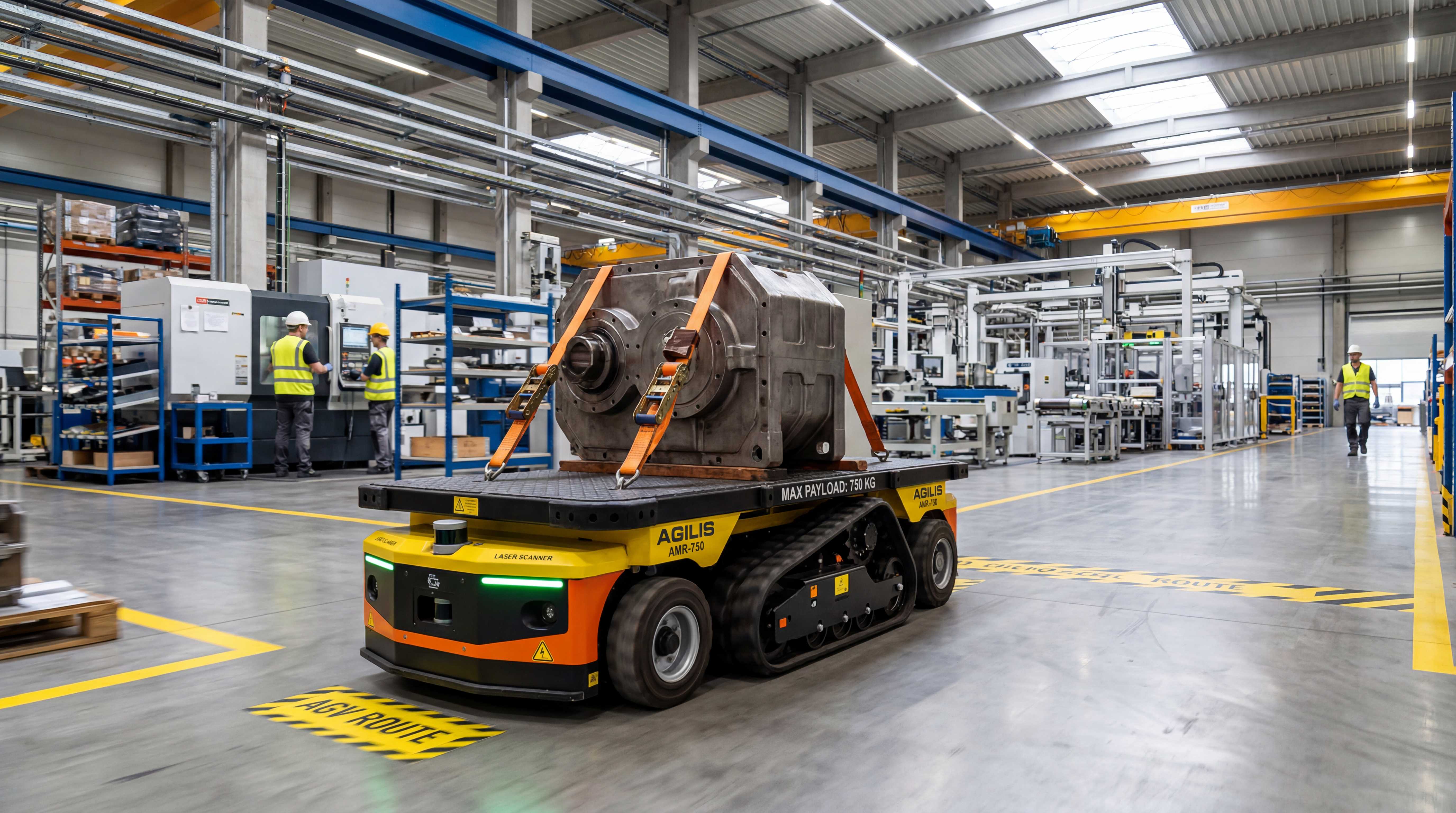
SLAM, QR Code or Hybrid Navigation How Heavy-Payload Chassis Should Navigate in Real Factories
Navigation Is Not Just Route Finding for Heavy-Payload AMRs
When people talk about AMR navigation, they often focus on one simple question: how does the robot find its way? This question is important, but it is not enough for heavy-payload chassis applications. A small AMR carrying cartons or totes may only need to move from one point to another with reasonable flexibility. A heavy-payload AMR carrying pallets, racks, engines, battery trays, molds or large work-in-process materials must do much more. It must move safely, precisely and predictably while managing the physical risk of a heavy load.
This is why heavy-payload AMR navigation should be evaluated differently from light-duty robot navigation. The issue is not only whether the robot can build a map, recognize a QR code, follow a path or avoid an obstacle. The real issue is whether the navigation system can support stable movement under load, reliable mobile robot localization, accurate docking, safe braking, repeatable transfer and smooth integration with the factory process.
A heavy-payload chassis has higher inertia. It needs more distance to stop. It may carry a load that extends beyond the robot body. It may need to align with conveyors, racks, machines, pallet stands, elevators or production cells. It may operate around workers, forklifts, manual carts and other robots. In these conditions, navigation is not a convenience feature. It becomes part of the safety architecture and productivity model.
Industrial buyers often compare SLAM navigation AMR systems, QR code navigation AGV systems and hybrid navigation robot solutions. Each method has strengths. SLAM can offer flexibility in changing environments. QR code navigation can support repeatability and controlled routes. Hybrid navigation can combine flexible movement with precise docking. However, none of these methods is automatically best for every heavy-load application.
The right question is not “Which navigation technology is more advanced?” The better question is “Which navigation method fits the real facility, load, route, docking point and safety requirement?” This article explains how to evaluate AMR navigation for heavy-payload chassis in real factories and warehouses.
Why Heavy Loads Change the Navigation Requirement

A heavy-payload AMR does not behave like a light robot. Even if the navigation software is similar, the movement consequences are different. A robot carrying a light bin can slow, stop or reroute with relatively low risk. A heavy load transport platform must consider load stability, braking distance, turning forces and the safety space around the vehicle.
The first difference is inertia. When the payload increases, the robot cannot change speed as freely. If the navigation system plans a route with frequent sharp turns, sudden stops or narrow interactions, the robot may need to move slowly to remain safe. This affects throughput. A navigation system that looks flexible on a map may not be efficient if the heavy-payload AMR must slow down constantly in real operation.
The second difference is load footprint. The robot body may be compact, but the load may be wider, longer or taller than the chassis. A pallet may overhang. A rack may extend beyond the sensor field. A fixture may create blind spots. The AGV navigation system must consider the actual moving envelope, not only the vehicle dimensions. A safe route for an empty robot may not be safe for the same robot carrying a large load.
The third difference is docking accuracy. Heavy-payload robots often interact with fixed stations. They may need to dock under a rack, align with a conveyor, position a pallet at a transfer point or stop near a production machine. A small positioning error can cause failed pickup, poor transfer, manual correction or product damage. AMR docking accuracy becomes a core performance factor, not a minor feature.
The fourth difference is human trust. Workers are more cautious around large moving loads. If the robot hesitates, changes path unexpectedly or stops too late, people may lose confidence in the system. Smooth and predictable warehouse robot navigation helps workers understand robot behavior and reduces unnecessary disruption.
SLAM Navigation AMR: Flexible Movement in Dynamic Facilities

SLAM stands for simultaneous localization and mapping. In simple terms, a SLAM navigation AMR can build or use a map of the environment while estimating its own position within that map. It often uses laser scanners, cameras or other sensors to recognize natural features such as walls, columns, racks, equipment and structural objects.
The main advantage of SLAM navigation is flexibility. The robot does not always need fixed physical markers on the floor. This can be valuable in factories and warehouses where layouts change, workstations are adjusted, storage areas are modified or routes need to be updated. For heavy-payload AMR navigation, this flexibility can help companies deploy robots without rebuilding the facility around a fixed path.
SLAM can be especially useful for point-to-point transport. A robot may receive a task, plan a route through the mapped environment and adjust movement around obstacles. This makes SLAM attractive for material flow where pickup and delivery locations are not limited to one fixed loop. It can support warehouse replenishment, production supply, pallet movement, rack transport and flexible line-side delivery.
However, SLAM is not magic. It needs a suitable environment. If the facility has too many changing objects, highly reflective surfaces, narrow corridors, glass walls, dust, poor lighting or many temporary obstacles, localization quality may be affected. A heavy-payload AMR cannot rely on uncertain localization when it is carrying a valuable or unstable load. Buyers should evaluate how stable the environment features are and whether the robot can localize reliably across shifts.
SLAM also needs careful traffic design. Flexible navigation does not mean the robot should move everywhere freely. In heavy-load applications, routes, speed zones, pedestrian crossings and docking points should still be planned. A SLAM navigation AMR can be flexible within defined rules, but the facility should not treat flexibility as a replacement for operational discipline.
Where SLAM Works Best for Heavy-Payload Chassis

SLAM navigation works best when the facility needs route flexibility but still has enough environmental structure for reliable localization. Warehouses with stable racks, factories with fixed columns, production areas with clear walls and facilities with controlled traffic zones can be suitable. The robot can recognize the environment and navigate without requiring dense floor markers.
For heavy-payload chassis, SLAM is useful when the same robot must serve multiple pickup and delivery points. For example, a warehouse AMR may transport pallets from receiving to several staging areas. A factory AMR may deliver heavy materials to different production cells depending on the production schedule. A work-in-process transport robot may move between machining, inspection, assembly and testing zones. These applications benefit from adaptable routing.
SLAM is also useful when the facility wants phased deployment. A company may start with one route, then add more points later. If the navigation system supports map updates and route changes, the automation project can grow gradually. This is often important for companies that do not want to redesign the whole factory in the first phase.
However, SLAM should be tested under real load conditions. A robot may localize well when empty, but the load can change sensor visibility or movement behavior. If the load blocks sensors, extends beyond the robot body or changes the center of gravity, the final configuration must be tested. Buyers should evaluate the complete robot with the actual load interface, not only the base platform.
QR Code Navigation AGV: Repeatable Paths and Controlled Positioning

QR code navigation AGV systems use visual codes placed on the floor or at specific locations to help the robot confirm position and follow a defined route. The robot reads the codes and uses them as location references. This method can provide strong repeatability in structured environments where routes and stations are stable.
The main advantage of QR code navigation is control. The facility can define where the robot should travel and where it should confirm position. For heavy-payload applications, this can be useful because predictable routes and repeatable positioning reduce uncertainty. If the robot always follows a controlled path between fixed points, route planning and safety management can become easier.
QR code navigation can be especially useful near docking stations. A heavy-payload AMR may use codes to confirm that it has reached the correct pickup or drop-off point. This can improve AMR docking accuracy for pallet stands, conveyors, racks, elevators or production stations. When the task requires repeatable positioning more than route flexibility, QR codes can provide practical value.
However, QR code navigation also has limitations. The floor codes must be installed, protected and maintained. If codes are damaged, covered by dust, blocked by pallets or worn by traffic, navigation may be affected. In facilities with frequent layout changes, changing routes may require moving or adding codes. This can increase maintenance work compared with marker-free navigation.
QR code navigation AGV systems are often best for structured material flow. If the robot moves along fixed routes between stable stations, the benefits of repeatability can outweigh the loss of flexibility. But if the facility changes frequently or needs dynamic rerouting, QR code navigation alone may be too rigid.
Where QR Code Navigation Works Best for Heavy Loads

QR code navigation works best when the facility has stable routes, controlled floors and repeatable transfer points. Production plants with fixed loops, assembly lines, conveyor transfer routes and defined warehouse lanes can be good candidates. The more stable the process, the more valuable QR code repeatability becomes.
For heavy-payload chassis, QR code navigation is especially useful when docking matters more than open route flexibility. A robot carrying a heavy pallet may need to stop in exactly the right position for a lift module. A conveyor AMR may need to align with a fixed conveyor. A platform AGV may need to place a load at a production station. In these cases, repeatable local positioning can reduce failed transfers.
QR code navigation can also be useful in areas where the environment lacks enough stable natural features for SLAM. A large open warehouse, a repetitive rack area or a space with few unique features may create localization challenges. Floor codes can provide clear position references. However, the facility must be willing to maintain those codes as part of the system.
Buyers should ask practical questions. Will the codes remain visible? Will forklifts, pallet trucks or cleaning machines damage them? Will the route change often? Can workers avoid covering codes with pallets? Who is responsible for inspection and replacement? QR code navigation is reliable only when the physical references remain reliable.
Hybrid Navigation Robot Systems: Combining Flexibility and Precision

Many heavy-payload applications do not fit neatly into one navigation method. A facility may need flexible movement through open areas but precise positioning at docking points. A robot may use SLAM for general travel and QR codes for final alignment. It may use natural feature navigation for route movement and visual markers, reflectors or local sensors at transfer stations. This is where hybrid navigation robot systems become valuable.
Hybrid navigation is not a single technology. It is an architecture that combines multiple localization references according to the task. The robot may rely on SLAM in wide areas, switch to QR code correction near stations, use reflectors in difficult zones, or use local sensors for final docking. The goal is to use the right navigation reference at the right stage of movement.
For heavy-payload AMR navigation, hybrid systems can be very practical. Heavy loads need both flexibility and certainty. A robot may need to reroute around temporary obstacles in the warehouse, but when it reaches a conveyor, it must stop accurately. It may travel dynamically through a production area, but when it docks under a rack, the tolerance may be small. Hybrid navigation can support this balance.
The challenge is system complexity. More navigation methods mean more configuration, testing and maintenance. The robot must know when to use each reference and how to handle conflicts. If SLAM says one thing and a marker says another, the system must resolve the difference safely. Integrators must design transition zones carefully.
A hybrid navigation robot system is often the best choice when the facility includes both dynamic travel areas and high-precision docking areas. It may cost more to design, but it can reduce operational risk if the application truly requires both flexibility and repeatability.
Mobile Robot Localization: The Foundation of Safe Heavy-Load Movement
Mobile robot localization means the robot understands where it is. For light robots, small localization errors may be tolerable in some tasks. For heavy-payload chassis, localization errors can create larger problems. If the robot is not exactly where it thinks it is, route clearance, docking accuracy and safety margins may all be affected.
Localization quality depends on sensors, maps, markers, algorithms and the environment. A SLAM navigation AMR depends on recognizable features and stable mapping. A QR code navigation AGV depends on readable physical codes. A hybrid navigation robot depends on multiple references working together. In all cases, localization must be reliable enough for the task.
For heavy loads, localization should be evaluated at several levels. The first level is general route localization. Can the robot travel from zone to zone without losing position? The second level is local approach. Can it approach the correct station from the correct direction? The third level is docking. Can it stop within the required tolerance for pickup or transfer? The fourth level is recovery. If localization confidence decreases, can the robot stop safely and request help?
Buyers should ask how the robot reports localization confidence. Does the system detect when the map no longer matches the environment? Does it slow down in uncertain areas? Can it recover after being moved manually? Can it handle blocked routes? Can it maintain localization when carrying different top modules or loads? These questions are important because localization errors in heavy-payload applications can affect safety and uptime.
AMR Docking Accuracy: Where Navigation Meets the Real Process

AMR docking accuracy is one of the most important performance indicators for heavy-payload applications. A robot may navigate well through the facility, but if it cannot dock correctly, the application may fail. Docking is where autonomous movement meets the physical process.
Different applications require different docking accuracy. A robot delivering a pallet to a staging zone may need moderate accuracy. A robot transferring goods to a conveyor may need closer alignment. A robot lifting a rack from underneath may need accurate entry. A robot placing a heavy fixture near a machine may need even tighter positioning. The navigation system must match the required tolerance.
Docking accuracy depends on more than navigation. It also depends on drive type, station design, load interface, floor condition, sensor feedback and control logic. For example, an omnidirectional robot may make fine lateral corrections more easily than a steering-based vehicle. A station with mechanical guides may reduce the required navigation precision. A QR code or visual marker near the station may help the robot correct its final position.
Heavy loads make docking more important because failed docking can be costly. A misaligned pallet lift may damage a carrier. A conveyor misalignment may create a jam. A poorly positioned fixture may require manual correction. Repeated small errors can reduce confidence in the system. For this reason, docking should be tested as part of the full duty cycle, not only as a single demonstration.
Buyers should define docking requirements clearly. What tolerance is needed? How often must the robot dock per shift? What happens if docking fails? Can the robot retry? Can the system detect misalignment? Is manual recovery simple? These questions help determine whether SLAM, QR code, hybrid navigation or additional local positioning is required.
Obstacle Avoidance Is Not the Same as Safety
Many AMR navigation systems include obstacle detection and avoidance. This is important, but industrial buyers should not confuse obstacle avoidance with complete autonomous mobile robot safety. For heavy-payload chassis, safety must include route design, speed control, braking distance, load stability, protective fields, human behavior and emergency procedures.
A heavy-payload AMR may detect a person or object in its path, but detection is only the beginning. The robot must decide whether to slow, stop, wait or reroute. Because the load is heavy, the robot needs enough distance to stop safely. If the load overhangs the chassis, the safety field must include the full swept area. If the robot moves near forklifts or manual carts, traffic rules must be defined.
Obstacle avoidance can also affect productivity. If the robot reroutes too often, it may create delays. If it stops too frequently in crowded areas, workers may see it as a bottleneck. If it moves too aggressively, workers may feel unsafe. The navigation system must balance safety and throughput through well-designed speed zones, routes and interaction rules.
For heavy-payload AMR navigation, the safest system is usually not the one that simply reacts to obstacles. It is the one that avoids unnecessary conflict through good route planning. Pedestrian crossings, forklift zones, staging areas and robot lanes should be designed before deployment. Navigation software should support the operational rules of the facility, not replace them.
Warehouse Robot Navigation Must Fit the Facility, Not the Demo Room
Warehouse robot navigation often looks clean in demonstrations. The floor is open, the route is clear, lighting is stable and obstacles are controlled. Real warehouses are more complicated. Pallets may be placed temporarily in aisles. Workers may cross routes. Forklifts may enter shared zones. Racks may look repetitive. Dust, stretch wrap, reflective surfaces and lighting changes may affect sensors.
This is why buyers should test navigation in the real facility. A navigation method that works in a showroom may need adjustment in a busy warehouse. SLAM may need stable reference features. QR codes must remain visible. Hybrid navigation requires transition points. Safety fields must match actual traffic. The robot should be tested with real loads, real routes and real operating behavior.
The facility should also be prepared for navigation success. This may include route cleaning, floor repair, traffic separation, better staging discipline, marker maintenance, station design and worker training. Many navigation problems are not purely technical. They are process and environment problems. A good robot cannot compensate for a completely uncontrolled facility.
Warehouse robot navigation should therefore be treated as a joint design between the robot supplier, integrator and facility team. The robot provides the navigation capability. The facility provides the operating conditions. Both must work together for heavy-payload automation to succeed.
How to Choose Between SLAM, QR Code and Hybrid Navigation
Choose SLAM When Route Flexibility Is Important
A SLAM navigation AMR is a strong choice when the facility needs flexible point-to-point movement, changing routes or phased deployment. It is suitable when the environment has stable natural features and the robot does not need to rely on dense floor markers. Buyers should test localization reliability under real load, real traffic and real environmental conditions.
Choose QR Code Navigation When Repeatability Is More Important Than Flexibility
A QR code navigation AGV is a strong choice when routes are stable, stations are fixed and repeatable positioning matters. It can support controlled heavy-load movement and precise local references. Buyers should confirm that floor codes can be protected, cleaned and maintained.
Choose Hybrid Navigation When Travel Flexibility and Docking Accuracy Are Both Required
A hybrid navigation robot is often the best option when the robot must move flexibly through the facility but dock precisely at transfer points. It can use SLAM for general movement and QR codes, reflectors or local sensors for final positioning. Buyers should evaluate the complexity, maintenance and transition logic of the hybrid system.
Choose Additional Local Positioning When the Load Transfer Is Critical
Some heavy-payload applications require local positioning beyond the main navigation method. Conveyor transfer, rack pickup, machine loading and custom fixture docking may need extra sensors, mechanical guides, visual markers or final correction logic. In these cases, the navigation system should be designed around the transfer requirement.
Questions Buyers Should Ask Before Selecting a Navigation System
Before choosing an AGV navigation system, buyers should begin with the facility. Are routes fixed or changing? Are aisles wide enough? Are there stable walls, columns, racks or landmarks for SLAM? Are floor markings easy to maintain? Are there reflective surfaces, dust, wet areas, repetitive racks or changing layouts? These conditions affect navigation reliability.
The next question is about the load. Does the load block sensors? Does it overhang the robot body? Is it tall, unstable or sensitive? Does the robot need slower turns or wider safety fields when loaded? Heavy-payload AMR navigation should be evaluated with the actual load, not only the empty chassis.
Buyers should also define docking needs. How accurate must the robot be at each station? Does it dock with a conveyor, rack, pallet stand, elevator, machine or custom fixture? Can the station guide the robot mechanically? Is there a need for final positioning markers? What happens if docking fails?
Safety questions are equally important. Where do workers walk? Where do forklifts move? How does the robot handle blocked routes? Does the system slow down in shared zones? Can it stop safely under full load? Are protective fields adjusted for load size and direction of travel?
Finally, buyers should ask about maintenance. Who updates the map? Who maintains QR codes? Who verifies sensor cleanliness? How often should routes be reviewed? Can the system recover if localization fails? Navigation is not a one-time setup. It is part of long-term operation.
Focused FAQ
Which navigation method is best for heavy-payload AMRs?
There is no single best method for every heavy-payload AMR. SLAM navigation is useful for flexible routes, QR code navigation is useful for repeatable structured paths, and hybrid navigation is useful when both flexible travel and accurate docking are required. The best choice depends on facility layout, load type, docking tolerance and safety requirements.
Is SLAM navigation reliable enough for heavy loads?
SLAM navigation can be reliable for heavy loads when the environment has stable features and the robot is properly configured. Buyers should test SLAM navigation AMR performance with the actual load, top module and route conditions. If docking accuracy is critical, SLAM may be combined with local markers or sensors.
Why use QR code navigation for AGVs?
QR code navigation AGV systems can provide repeatable positioning and controlled paths. They are useful in structured routes, production lines and docking areas where stable references are valuable. The main requirement is that floor codes must be visible, protected and maintained.
What is hybrid navigation for mobile robots?
Hybrid navigation combines multiple localization methods. A robot may use SLAM for general travel and QR codes, reflectors, visual markers or local sensors for final docking. This approach is useful when a heavy-payload robot needs both route flexibility and high docking accuracy.
Why is AMR docking accuracy important?
AMR docking accuracy is important because heavy-payload robots often need to interact with fixed stations, conveyors, racks or load carriers. Poor docking can cause failed pickup, transfer jams, product damage or manual correction. Docking accuracy should be defined according to the real load interface and process requirement.
Does obstacle avoidance make a heavy-payload AMR safe?
Obstacle avoidance is only one part of autonomous mobile robot safety. Heavy-payload AMRs also need proper route design, braking distance, speed zones, protective fields, load stability, worker training and traffic rules. Safety must be designed around the full robot-load-facility system.
Conclusion: Navigation Must Serve the Load, the Route and the Process
Heavy-payload AMR navigation is not only about helping the robot find a path. It is about helping the robot move heavy materials safely, accurately and predictably through real industrial environments. The navigation system must support mobile robot localization, route planning, docking accuracy, obstacle response, speed control and process integration.
SLAM navigation can provide flexibility when routes change and natural features are available. QR code navigation can provide repeatability when routes and stations are stable. Hybrid navigation can combine flexible travel with precise docking. Each method has value, but each must be evaluated in the context of load size, center of gravity, facility layout, floor condition, worker traffic and transfer requirements.
For industrial buyers, the best navigation choice is not the most fashionable technology. It is the navigation architecture that supports the real material flow. A heavy-payload chassis must not only know where to go. It must know how to get there safely, how to arrive accurately, how to interact with the load interface and how to keep the factory running with confidence.
#SLAMNavigationAMR
#QRCodeNavigationAGV
#HybridNavigationRobot
#HeavyPayloadAMRNavigation
#MobileRobotLocalization
#AMRDockingAccuracy
#WarehouseRobotNavigation
#AGVNavigationSystem
#AutonomousMobileRobotSafety