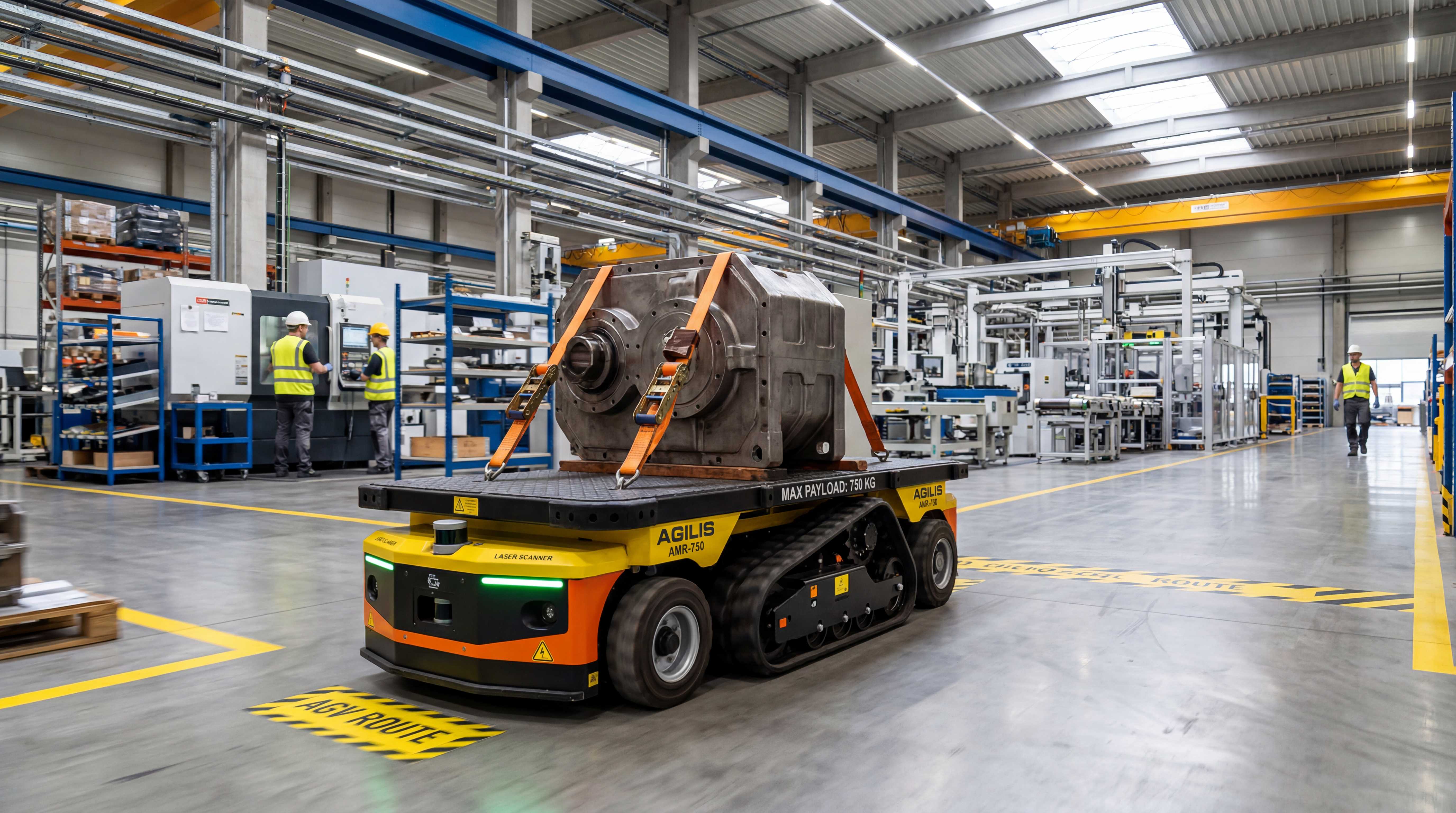
Payload Capacity Is Only the Beginning How to Evaluate a Heavy-Payload Mobile Robot Chassis
Payload Capacity Is Only the Beginning
When industrial buyers compare heavy-payload mobile robots, the first number they usually look at is payload capacity. A product may be described as a 500 kg AMR, 1000 kg AMR, 1500 kg AMR or even a heavier mobile robot platform. This number is useful because it quickly tells buyers the approximate load range of the robot. However, payload capacity alone does not determine whether a heavy-duty robot chassis will succeed in a real factory or warehouse.
A heavy-payload mobile robot does not operate in a laboratory specification sheet. It operates on real floors, through real aisles, around real workers, with real loads that may be uneven, unstable, oversized, sensitive or difficult to position. A heavy load does not only add weight. It changes braking distance, turning behavior, battery consumption, safety field design, docking accuracy, tire wear, structural stress and maintenance requirements. That is why a serious heavy-payload AMR selection process must go far beyond one maximum payload value.
In many projects, two robots with the same rated payload can perform very differently. One heavy load mobile robot base may be suitable for compact pallet transport in a wide warehouse aisle. Another may be better for line-side delivery in a production plant. A third may be designed for low-speed movement of custom fixtures with sensitive parts. The payload number may be similar, but the engineering logic behind each application is different.
This guide explains how industrial buyers, automation managers, warehouse operators and system integrators should evaluate a heavy-duty robot chassis. Instead of asking only whether the robot can carry the load, buyers should ask whether it can carry the load safely, repeatedly and efficiently under real operating conditions. The goal is not to select the biggest robot. The goal is to select the right industrial robot chassis for the real material flow.
Why the Maximum Payload Number Can Be Misleading
Maximum payload capacity is usually measured under defined conditions. These conditions may assume a stable load, proper load placement, a suitable floor, controlled speed, acceptable center of gravity and a specific top module configuration. In real operations, those assumptions may not always exist. This is why buyers should treat the payload number as a starting point rather than a final decision.
For example, a heavy-payload mobile robot rated for 1000 kg may carry a compact steel block safely. But the same robot may not be suitable for a tall rack with the same weight if the center of gravity is high. A 1200 kg load on a stable fixture may be easier to move than an 800 kg load that extends beyond the robot body. A pallet with evenly distributed goods may be safer than a partially loaded pallet with weight concentrated on one side.
This is the first lesson in heavy-payload AMR selection: the load rating tells you how much weight the chassis can support, but it does not fully describe load behavior. A real load has shape, height, width, contact points, center of gravity, packaging quality, surface condition and movement risk. These factors decide whether the robot can accelerate, turn, stop and dock safely.
Another problem is that maximum payload does not tell buyers anything about throughput. A robot may carry a heavy load, but it may need to move slowly when fully loaded. It may require long stopping distance, large turning space or frequent charging. If the robot cannot complete enough tasks per shift, the rated payload will not create business value. In a real facility, productivity depends on the complete duty cycle, not only the maximum load.
Buyers should also consider safety margin. A robot rated exactly at the required payload may not be the best choice if loads vary or if future applications may become heavier. At the same time, oversizing the robot can also create problems. A larger chassis may cost more, require wider aisles, consume more energy and reduce layout flexibility. The best selection is usually based on the right payload range with enough safety margin, not the highest number available.
Start with a Complete Load Profile

The most important step in evaluating a heavy-payload mobile robot is to define the load profile. A load profile is a complete description of what the robot must move. It includes weight, size, shape, center of gravity, stability, contact surface, container type, pallet type, rack structure, fixture design, handling frequency and product sensitivity.
Weight should be defined as a range, not only a single number. Many facilities move different products on the same route. One pallet may weigh 600 kg, another may weigh 900 kg, and a future product may reach 1100 kg. If the selected heavy-duty robot chassis cannot handle the full range, the system may become limited as production changes.
Load dimensions are equally important. A wide load may require wider aisles and larger safety fields. A long load may affect turning radius. A tall load may create tipping risk. An overhanging load may extend beyond the robot’s sensor coverage or protective field design. In heavy-payload AMR selection, the effective footprint is not only the robot body. It is the robot plus the load plus the required safety space.
Center of gravity should be reviewed carefully. A low center of gravity improves stability. A high or offset center of gravity increases risk during acceleration, braking and turning. If the load is not centered on the chassis, the robot may experience uneven wheel loading, reduced traction or increased mechanical stress. For heavy industrial robot chassis applications, center of gravity is not a small detail. It is a key safety and performance factor.
Buyers should also define how the load is supported. Is it on a pallet? A rack? A cart? A custom fixture? A metal frame? A container? Does the robot lift it from below, carry it on top, tow it, receive it from a conveyor or dock under it? The load interface determines whether the chassis needs a lift module, fork module, roller conveyor, turntable, towing hook or custom mechanical structure.
A complete load profile helps buyers avoid vague requirements such as “we need a 1000 kg AMR.” A better requirement would be: “We need a heavy load mobile robot base that can move 700 to 950 kg palletized components, with a maximum footprint of 1200 mm by 1000 mm, a low but slightly offset center of gravity, ten movements per hour, across a 90-meter route, with two docking points and mixed pedestrian traffic.” This level of detail makes the selection process much more reliable.
Evaluate Load Stability During Motion

AMR load stability is one of the most important topics in heavy-payload applications. A load may appear stable when the robot is stationary, but motion changes everything. Acceleration, braking, turning, floor vibration and emergency stops can all affect the relationship between the load and the chassis.
Acceleration creates force on the load. If the load is not secured, it may shift. If the load is tall, acceleration may create a tipping moment. If the load is fragile, sudden motion may damage the product. For this reason, a heavy-payload mobile robot should not be evaluated only by whether it can start moving. It should be evaluated by how smoothly it accelerates under load.
Braking is even more critical. A loaded robot has more inertia than an empty robot. If the robot must stop quickly because a person or obstacle appears, the braking behavior must be predictable. The chassis, wheels, control system and safety logic must work together. The load must remain stable during normal stops and controlled emergency stops. Buyers should ask how braking distance changes under different load conditions and speeds.
Turning also affects stability. A heavy load creates lateral forces when the robot turns. A compact and low load may tolerate sharper turns. A tall rack, high pallet or uneven fixture may require slower turning speed. The AMR turning radius and turning method must be matched with the load profile. A robot that can rotate in place when empty may still need speed limits when loaded.
Floor vibration should not be ignored. Expansion joints, small bumps, slopes and uneven surfaces may cause vibration. For some materials, vibration is only a comfort issue. For precision parts, batteries, electronics, glass, molds or high-value components, vibration can become a quality issue. A heavy-duty robot chassis should be selected with the sensitivity of the load in mind.
Load stability is not only a mechanical problem. It is also a process problem. Operators must place loads correctly. Pallets and racks must be in good condition. Fixtures must be inspected. Maximum load height and overhang should be defined. If the process allows unstable loading, even the best robot cannot fully eliminate risk.
Match Speed, Acceleration and Braking to Real Throughput
Speed is often misunderstood in heavy-payload AMR selection. Many buyers look for the highest maximum speed because they assume faster robots create higher productivity. In reality, maximum speed is only one part of throughput. A heavy-payload robot may spend much of its operating time accelerating, slowing down, waiting at intersections, docking, transferring loads and charging. The average cycle time matters more than the top speed.
Loaded speed should be evaluated separately from unloaded speed. Some robots move much faster when empty than when loaded. This may be acceptable if the robot often returns empty and the route is open. But if most trips are loaded, the loaded speed becomes the real performance number. Buyers should ask how speed changes at different payload levels.
Acceleration and deceleration curves also matter. Smooth acceleration protects the load and improves worker confidence. Controlled deceleration reduces the risk of load shift. In facilities with many people or intersections, the robot may need to slow down frequently. If deceleration is too conservative, throughput may suffer. If it is too aggressive, load stability and safety may suffer. The correct setting depends on payload, route and safety requirements.
Braking distance must be considered with safety zones. A heavy-duty robot chassis cannot stop instantly. The safety scanner or obstacle detection system must provide enough distance for the robot to slow or stop before reaching a person, vehicle or object. This is why protective field size and speed control are connected. The faster the robot moves under load, the more carefully the safety field must be designed.
Throughput should be calculated by cycle time. A complete cycle may include task assignment, travel to pickup point, docking, loading, travel to destination, docking again, unloading, confirmation and return. If the robot must wait for a conveyor, elevator, door or operator, that waiting time must be included. A realistic throughput model helps buyers understand how many robots are needed and whether the selected platform can support the required production rhythm.
Review Turning Radius and Aisle Behavior

AMR turning radius is a practical selection factor that can quickly determine whether a robot fits a facility. Heavy-payload chassis platforms often have larger bodies, larger wheels, stronger structures and wider safety fields. When a large load is added, the required operating space may become much larger than expected.
A robot’s technical turning radius may not be enough for real planning. Buyers should consider the turning radius of the robot body, the load footprint, the load overhang and the protective safety field. In a narrow aisle, the robot may physically fit but need to move very slowly. If it stops frequently to allow people or forklifts to pass, the material flow may become inefficient.
Different drive types behave differently. A differential drive AMR may rotate in place or turn with a compact radius, but tire wear and floor stress should be considered under heavy loads. A steering-based chassis may move smoothly along longer routes but require more space for turning. An omnidirectional chassis may align more easily in tight spaces, but it may have different floor and maintenance requirements. The best drive architecture depends on aisle width, load type and route pattern.
Buyers should test or simulate key turning points before selection. These include aisle intersections, docking areas, staging zones, elevator entrances, doorways, production cell entrances and charging locations. A heavy-payload mobile robot often fails not on the straight route but at the turning and docking points where space is limited.
Aisle behavior should also include human interaction. If workers walk near the route, the safety field may extend into pedestrian areas. If forklifts share the aisle, traffic rules must be defined. If pallets or carts are often left near the route, the robot may stop frequently. Turning radius is not only a geometry question. It is a material flow and traffic management question.
Check Battery Runtime Under Real Working Conditions
AMR battery runtime is another specification that should be evaluated carefully. A battery runtime number may be measured under standard conditions, but real heavy-payload operations can be more demanding. Moving heavy loads requires more energy, especially when the route includes frequent stops, acceleration, turning, slopes, long distances or active top modules.
The first question is duty cycle. How many hours per shift must the robot operate? How many loaded trips are required? How long is each route? How much time is spent waiting, docking or transferring loads? Does the robot work one shift, two shifts or continuously? The battery strategy should match the operation, not only the catalog specification.
Opportunity charging can be valuable in some heavy-payload AMR systems. Instead of stopping for a long charging period, the robot may charge during natural breaks, waiting periods or shift changes. However, opportunity charging requires good task scheduling and suitable charging station placement. If charging stations are placed poorly, robots may waste time traveling to charge.
Charging time should be evaluated together with runtime. A robot with long runtime but slow charging may not support continuous operations. A robot with shorter runtime but fast opportunity charging may work well if the workflow allows frequent charging windows. Buyers should calculate total availability, not only battery size.
Top modules also affect power consumption. Lift modules, conveyor modules, sensors, lights, controllers and communication systems all consume energy. A heavy-payload mobile robot carrying loads on a flat platform may have a different energy profile from a robot that repeatedly lifts pallets or powers a conveyor. High payload AMR specifications should therefore be reviewed in the context of the complete robot configuration.
Battery maintenance and lifecycle cost should also be considered. Batteries degrade over time. Charging behavior, temperature, operating intensity and maintenance practices affect battery life. A professional heavy-payload AMR selection should include not only runtime but also battery replacement planning, charging safety and long-term operating cost.
Assess Floor Conditions Before Choosing the Chassis
Floor condition is a basic but often underestimated factor in heavy-payload mobile robot projects. A heavy-duty robot chassis transfers significant force to the floor through its wheels. Poor floor conditions can affect traction, navigation, vibration, wheel wear, load stability and safety performance.
A smooth and level floor is ideal, but many real facilities have expansion joints, cracks, slopes, repaired areas, dust, oil, water, metal debris or uneven transitions between zones. A forklift may pass through these areas because a human driver can adjust behavior manually. An autonomous robot depends on sensors, control algorithms, traction and planned routes. Therefore, the floor must be assessed from the robot’s perspective.
Slope is especially important. Even a small ramp can affect energy consumption and braking distance under heavy load. If the robot moves up or down a slope while carrying a high or offset load, stability must be reviewed carefully. Buyers should ask whether the robot is rated for the actual slope under the required payload, not only whether it can climb a slope when empty.
Wheel type and floor contact should also be reviewed. Different wheel materials behave differently on concrete, coated floors, dusty surfaces or wet areas. Heavy loads can accelerate wheel wear. If the robot turns frequently in place, the floor and tires may experience additional stress. Maintenance planning should include wheel inspection and replacement intervals.
Floor markings, QR codes, reflectors and other navigation aids may also require maintenance. If the facility uses QR code navigation or floor markers, they must remain visible and undamaged. If the robot uses SLAM navigation, the environment should provide stable features. Floor condition and navigation reliability are connected more closely than many buyers realize.
Understand the Relationship Between Chassis Size and Payload Efficiency
A larger heavy-payload chassis may appear more capable, but size creates trade-offs. Chassis size affects aisle fit, turning radius, docking space, storage area, charging station layout and route flexibility. Buyers should evaluate payload efficiency, not only payload capacity. Payload efficiency means how much useful load the robot can carry relative to its footprint, cost and operating impact.
If the chassis is too small for the load, stability and safety may become problems. If the chassis is too large for the application, it may reduce facility flexibility. A large robot may block aisles, require wider turns, move more slowly in shared spaces or need more expensive route modifications. In some cases, two smaller robots may provide better flow than one oversized robot. In other cases, one larger platform may be more efficient because it reduces trip count.
Buyers should consider how the robot will interact with existing infrastructure. Can it pass through doors? Can it enter elevators? Can it dock at existing conveyors? Can it fit near workstations? Can it park or charge without blocking traffic? Can the facility support its turning and safety envelope? These questions connect chassis size to real usability.
The relationship between chassis size and load size should also be reviewed. If the load is much larger than the robot body, overhang may become a safety issue. If the robot body is much larger than the load, the system may waste space and capital. A well-selected industrial robot chassis should provide enough stability and safety margin without creating unnecessary layout burden.
Evaluate Docking Accuracy and Transfer Requirements
A heavy-payload mobile robot does not create value by moving alone. It creates value when it can pick up, deliver, transfer or position the load correctly. That is why docking accuracy and transfer requirements are essential selection criteria.
Docking may be simple or complex depending on the application. A robot that carries a pallet to a staging area may need only moderate positioning accuracy. A robot that transfers a load to a conveyor may require precise alignment. A robot that enters a production cell, docks under a rack or positions a fixture near a machine may need much higher repeatability. The required docking accuracy should be defined before selecting the robot.
Transfer method also matters. If the robot uses a roller conveyor, the fixed conveyor and mobile conveyor must align in height, direction and timing. If the robot uses a lift module, the pickup and drop-off structure must match lifting height and contact points. If the robot uses a fork module, pallet entry and placement accuracy become critical. If the robot carries a custom fixture, mechanical guides or locating pins may be required.
Navigation method can be linked to docking needs. SLAM may provide flexibility for general movement, while QR codes, reflectors, visual markers or local positioning sensors may improve precision near docking stations. A hybrid navigation approach can be useful when a heavy-payload AMR must move flexibly through the facility but dock accurately at fixed transfer points.
Buyers should not assume that a robot with good navigation automatically has good transfer performance. Transfer performance is created by the combination of navigation, mechanical design, sensor feedback, control logic, station design and load interface. The docking point is often where the whole system proves whether it is truly ready for production.
Consider Safety Margin as an Engineering Requirement
Safety margin is not only a conservative habit. It is an engineering requirement in heavy-payload AMR selection. A robot should not operate continuously at the edge of its capability. Real operations include variation. Loads may be slightly heavier than expected. Pallets may be uneven. Floors may be imperfect. Workers may enter the route. Production demand may increase. The selected platform should handle normal variation without becoming unstable or unreliable.
Safety margin should be applied to payload, braking distance, battery capacity, docking tolerance, route width and structural design. For payload, the robot should have enough capacity for the heaviest expected load plus realistic variation. For braking, the protective field should provide enough distance under loaded conditions. For battery, the system should have enough reserve to handle delays, route changes or increased task volume.
However, safety margin does not mean buying the largest available platform. Overdesign can create cost and layout problems. The goal is balanced margin. Buyers should work with vendors or integrators to define realistic operating limits and understand how the robot behaves near those limits.
Safety margin also includes process control. If the facility allows loads to be placed incorrectly, if pallets are damaged, if routes are blocked frequently or if operators override rules, the technical margin may not be enough. Safe operation requires both equipment capability and disciplined operating procedures.
Look Beyond Purchase Price to Total Cost of Ownership
Heavy-payload AMR selection should include total cost of ownership, not only purchase price. The initial cost of the robot is only one part of the investment. Buyers should also consider installation, site preparation, top modules, fixtures, docking stations, software integration, safety validation, training, maintenance, spare parts, battery replacement and future expansion.
A low-cost heavy-duty robot chassis may become expensive if it requires frequent maintenance, has limited integration capability, consumes batteries quickly or cannot scale to future routes. A more expensive platform may deliver better value if it reduces downtime, supports modular expansion, provides stronger safety functions and integrates more easily with factory systems.
Maintenance cost should be evaluated based on real operating intensity. Wheels, batteries, sensors, lift mechanisms, conveyors, brakes and safety devices all require inspection. Heavy loads accelerate wear. Facilities with dust, debris, uneven floors or long operating hours may need more frequent maintenance. Buyers should ask for maintenance intervals and spare parts availability before selecting a robot.
Software and integration costs should also be included. If the robot needs to connect with WMS, MES, PLCs, conveyors, elevators or doors, the project may require engineering support. Fleet management software, API development, traffic rules and data reporting can become important parts of the investment. These costs are not problems if they create long-term value, but they should be visible from the beginning.
The right financial question is not “Which robot is cheapest?” The right question is “Which heavy-payload mobile robot provides the best operational value across its lifecycle?” This includes productivity, uptime, safety, maintainability, flexibility and scalability.
A Practical Selection Checklist for Industrial Buyers
A structured checklist can help buyers compare high payload AMR specifications more professionally. The first section should define the load. What is the minimum, typical and maximum weight? What are the length, width and height? Where is the center of gravity? Is the load stable, fragile, oversized or overhanging? Is it carried on a pallet, rack, cart, fixture or directly on the robot?
The second section should define the route. How far does the robot travel? How many trips are needed per hour or per shift? Are routes fixed or changing? Are there intersections, doors, elevators, ramps, narrow aisles or shared traffic areas? What is the required AMR turning radius at key points? Where will the robot wait, charge and recover from blocked routes?
The third section should define performance. What loaded speed is required? What cycle time is acceptable? What docking accuracy is needed? How long must the robot operate between charges? What is the expected AMR battery runtime under real load? Does the robot need opportunity charging or continuous shift operation?
The fourth section should define safety. What people and vehicles share the route? What are the required speed zones? How large are the protective fields? What happens in emergency stops? Is the load secured? Are there blind corners, pedestrian crossings or forklift intersections? Who is responsible for training, inspection and route changes?
The fifth section should define integration. Does the robot receive tasks manually or from software? Does it need to connect with WMS, MES, ERP, PLCs, conveyors, doors or elevators? Will it operate alone or as part of a fleet? What data should be reported? How will the system scale in the future?
When buyers answer these questions, the selection process becomes much clearer. The best heavy-payload AMR selection is based on a complete operating picture, not a single payload number.
Common Mistakes When Reading High Payload AMR Specifications
The first common mistake is comparing payload capacity without comparing load conditions. A 1500 kg rating may not mean the same thing across different platforms if the load height, center of gravity, floor condition and speed assumptions are different. Buyers should ask under what conditions the payload rating applies.
The second mistake is ignoring the difference between platform capability and configured system capability. A base chassis may support a certain payload, but adding a lift module, conveyor, fixture or battery configuration may change performance. The final robot configuration should be evaluated, not only the base chassis.
The third mistake is focusing on maximum speed instead of cycle time. A robot that moves fast in open areas may still be slow in real operation if it stops at intersections, docks slowly, waits for equipment or charges frequently. The useful performance number is the completed task rate.
The fourth mistake is forgetting the environment. Floors, aisles, lighting, dust, traffic and docking areas can all affect performance. A heavy-payload mobile robot should be selected for the actual site, not an ideal demonstration area.
The fifth mistake is ignoring future growth. A platform may solve the first route but fail when the company adds more robots, heavier loads or new workflows. Industrial buyers should select a heavy-duty robot chassis that supports future automation plans whenever possible.
Focused FAQ
Is payload capacity the most important factor in heavy-payload AMR selection?
Payload capacity is important, but it is not enough. Buyers should also evaluate load size, center of gravity, load stability, turning radius, braking distance, battery runtime, floor condition, docking accuracy, safety margin and system integration. A robot with the right payload but poor fit for the site may not perform well in real operation.
How much safety margin should a heavy-duty robot chassis have?
The safety margin depends on load variation, route conditions, floor quality, speed, center of gravity and future application needs. The robot should not operate constantly at its maximum limit. However, oversizing can also create cost and space problems. The best margin is balanced according to real operating conditions.
Why does center of gravity matter for heavy-payload mobile robots?
Center of gravity affects load stability during acceleration, braking and turning. A low and centered load is usually easier to move safely. A high, offset or overhanging load may require slower speed, wider turns, better fixtures and stronger safety controls. Center of gravity should always be part of the load profile.
How should buyers evaluate AMR battery runtime?
Buyers should evaluate AMR battery runtime under real working conditions, including loaded travel, route distance, starts and stops, slopes, docking time, top module power consumption and shift schedule. Charging time, opportunity charging and charging station placement should also be included in the analysis.
Why is AMR turning radius important for heavy-load transport?
AMR turning radius affects whether the robot can move through aisles, intersections, docking areas and production zones. For heavy-payload applications, the load footprint and safety field must be considered together with the robot body. A robot may technically fit but still operate inefficiently if the space is too tight.
What is the best way to compare high payload AMR specifications?
The best way is to compare specifications in the context of the real application. Buyers should define the load profile, route, duty cycle, facility conditions, safety requirements, docking needs and integration level. Specifications become useful only when they are matched with the actual material flow.
Conclusion: Select for the Real Operation, Not the Biggest Number
Payload capacity is an important starting point in heavy-payload AMR selection, but it should never be the only decision factor. A heavy-payload mobile robot must carry real loads through real facilities under real operating constraints. Weight alone cannot explain load stability, route fit, turning behavior, braking distance, battery runtime, floor condition, docking accuracy or system integration.
Industrial buyers should build their selection process around a complete understanding of the material flow. They should define the load profile, evaluate AMR load stability, review chassis size and turning radius, calculate duty cycle, assess AMR battery runtime, check floor conditions, design safety margins and confirm integration requirements. This approach turns product comparison into engineering decision-making.
The best heavy-duty robot chassis is not always the one with the highest rated payload. It is the one that can move the required load safely, repeatedly and efficiently in the actual facility. When buyers think beyond payload capacity, they are more likely to select a heavy load mobile robot base that supports productivity, safety and long-term automation growth.
#AMRPayloadCapacity
#HeavyDutyRobotChassis
#IndustrialRobotChassis
#AMRLoadStability
#HighPayloadAMRSpecifications
#HeavyLoadMobileRobotBase
#AMRTurningRadius
#AMRBatteryRuntime
#HeavyPayloadAMRSelection