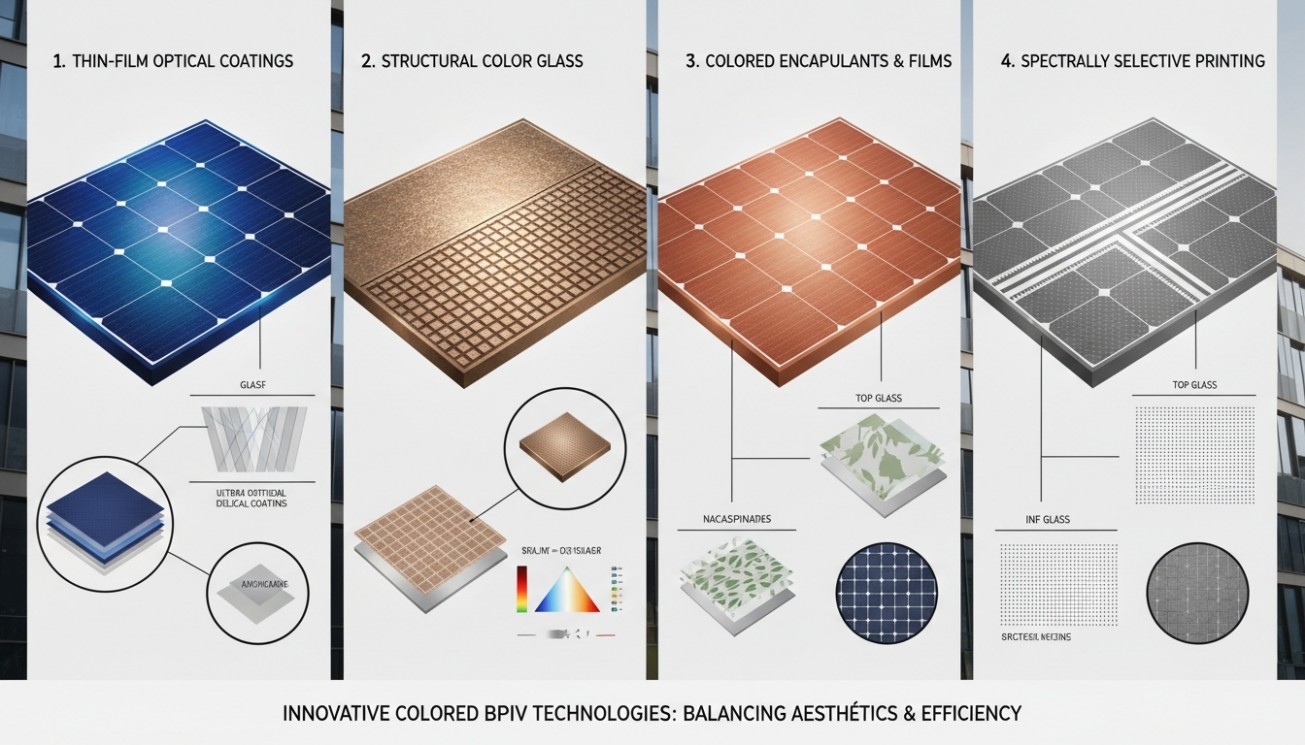
Colored Photovoltaic Glass: How Solar Facades Become Building Materials
Colored Photovoltaic Glass Changes the Question From “Where Can We Put Panels?” to “Which Building Surfaces Can Generate Power?”
Most solar conversations begin with available roof area. A project team measures the roof, checks shading, evaluates structural capacity, calculates module quantity, and then estimates expected yield. This approach works well for many conventional rooftop PV projects. But it also creates a narrow view of what solar energy can be inside architecture.
Buildings have far more than roofs. They have facades, curtain walls, skylights, atriums, canopies, balcony rails, shading structures, entrance roofs, winter gardens, noise barriers, and exterior cladding zones. Many of these surfaces are already built from glass, metal, ceramic, stone, or composite materials. If some of those passive surfaces can become energy-generating surfaces, solar power no longer needs to be treated only as equipment added after construction.
This is where colored photovoltaic glass becomes important.
Unlike standard framed solar modules, colored photovoltaic glass can be designed as part of the building envelope. It may appear as a facade panel, a curtain wall unit, a skylight, a canopy, a railing element, or a decorative glass surface. It can contribute to the building’s appearance while generating electricity. In this sense, it belongs to both the solar industry and the construction materials industry.
The shift is significant. Conventional PV asks, “Where can we install solar panels?” Architectural solar glass asks, “Which parts of the building can become active materials?” That difference changes the role of architects, facade consultants, developers, EPC contractors, and suppliers. It also changes how the product should be evaluated.
A normal solar panel is usually judged by power, efficiency, price, warranty, degradation, and installation cost. Colored photovoltaic glass must be judged by those factors plus visual appearance, glass structure, safety behavior, facade compatibility, transparency, color stability, module size, cable routing, building code requirements, and long-term replacement logic. It is not simply a module with better appearance. It is a building material with photovoltaic function.
Why Glass Is the Natural Bridge Between Architecture and Solar Energy

Glass has always played a special role in architecture. It brings daylight into buildings, shapes facades, reflects the surrounding city, expresses modernity, and creates visual connection between interior and exterior space. In commercial architecture, glass is often associated with transparency, openness, technology, and premium building identity.
Solar cells, however, have traditionally been seen as technical components. They are dark, repeated, grid-like, and usually designed for maximum energy conversion rather than architectural expression. When solar cells are placed behind or inside glass, a new design opportunity appears: the surface can remain architectural while becoming functional.
This is why BIPV glass is one of the most important forms of building-integrated photovoltaics. It can combine photovoltaic cells, glass layers, interlayers, colors, patterns, transparency, and safety structures into a product that behaves more like a construction component than an add-on module.
A PV glass facade can be opaque, semi-transparent, patterned, colored, or visually coordinated with passive glass panels. It may be used in areas where full transparency is not required, such as spandrel zones, parapets, side walls, facade cladding fields, stairwells, elevator cores, atrium roofs, or sunshades. In these areas, the building already needs material coverage. If the material can generate electricity, the facade becomes more productive.
This does not mean every glass surface should be photovoltaic. Some areas need clear views, high daylight transmission, strict thermal control, or specific fire and safety performance. But it does mean that project teams should stop treating glass as only transparent enclosure. In many building zones, solar facade glass can provide a more active role.
Colored Solar Glass Is Not Just Transparent Glass With Cells Inside
A common misunderstanding is that colored solar glass is simply transparent glass with solar cells hidden inside. In reality, the category is much more diverse.
Some products are built as opaque or nearly opaque photovoltaic glass panels for facades. Others are semi-transparent, allowing daylight through spaces between cells or through specialized module structures. Some use visible cells as part of the design language. Others use color layers, patterns, frits, coatings, or optical treatments to reduce the visual dominance of the cells. Some are designed for roof glazing or skylights. Others are designed for curtain wall spandrel areas, rainscreen cladding, railings, or shading elements.
The “colored” part also varies. It may involve terracotta tones for brick-like buildings, blue-green tones for glass-heavy architecture, bronze tones for commercial curtain walls, grey tones for stone or aluminum facades, or custom visual effects for public projects. The goal is not always to hide the photovoltaic function. Sometimes the goal is to make the solar layer appear intentional, coordinated, and architecturally acceptable.
This makes colored photovoltaic glass different from ordinary decorative glass. Decorative glass only needs to satisfy visual and construction requirements. Photovoltaic glass must also generate electricity, manage electrical connections, tolerate environmental exposure, and maintain performance over time. At the same time, it must look good at building scale, not just as a small sample.
A sample panel on a desk may look attractive. A facade with hundreds or thousands of square meters of panels may reveal color variation, cell visibility, reflection differences, edge details, and installation inconsistencies. For this reason, architectural solar glass should always be evaluated through mockups, facade drawings, real lighting conditions, and system-level coordination.
From Passive Facade Material to Active Building Skin
Traditional facade materials are usually passive. Aluminum panels, ceramic panels, stone cladding, composite boards, standard glass, and decorative louvers all serve building functions, but they do not generate energy. They protect, insulate, shade, decorate, or define the building’s exterior identity.
Photovoltaic building materials change that logic. A facade panel can still protect and define the building, but it can also produce electricity. A canopy can still shelter an entrance, but it can also contribute to renewable energy generation. A skylight can still provide daylight, but it can also become part of the energy system. A balcony railing can still provide safety, but it can also use its exposed surface to generate power.
This idea is especially powerful in cities. Urban buildings often have limited roof space compared with their electricity demand. High-rise buildings, dense commercial blocks, mixed-use developments, hotels, hospitals, schools, and public facilities may not have enough roof area for a large conventional PV system. Facades and glazing areas, however, can be substantial.
A PV glass facade does not always produce the same yield per square meter as an optimally tilted rooftop system. Vertical orientation, shading, reflections, and urban context all affect output. But the value comes from activating surfaces that would otherwise be passive. Even moderate electricity generation can become meaningful if it is integrated into a large envelope area and combined with facade material value.
This is why buyers should avoid judging colored photovoltaic glass only by the logic of standard solar panels. The correct comparison is often not between PV glass and rooftop modules. The better comparison is between PV glass and conventional facade glass or cladding that produces no electricity. If the building already requires a premium facade material, energy-generating glass can create additional value over the life of the building.
Solar Curtain Wall Applications Need Early Design Coordination
A solar curtain wall is one of the most visible and technically demanding applications for BIPV glass. Curtain walls are not simple exterior decorations. They are engineered facade systems that must handle wind load, water tightness, air infiltration, thermal movement, structural support, fire safety, installation sequence, maintenance access, and long-term durability.
When photovoltaic glass enters a curtain wall system, electrical design must be coordinated with facade design. The project team must consider where cables exit, how junction boxes are hidden or accessed, how panels connect to strings or optimizers, where inverters are located, how shading affects electrical grouping, and how maintenance teams will service components without damaging the facade.
This is why a solar curtain wall should be planned early. If BIPV is added after the curtain wall grid is already fixed, the design may face awkward module dimensions, visible cable routes, inefficient active areas, or difficult access points. Early coordination allows the architect, facade consultant, electrical engineer, and BIPV supplier to align the facade rhythm with photovoltaic logic.
The key design decisions include active versus passive panel zones, module size limits, glass thickness, cell layout, color matching, panel replacement method, drainage, ventilation, structural fixing, and fire compartmentation. These decisions cannot be solved by a PV datasheet alone. They require system thinking.
For developers, this means colored photovoltaic glass should not be treated as a late sustainability feature. It should be part of the facade concept from the beginning. The earlier it enters the design process, the more likely it is to look intentional and perform reliably.
Skylights, Canopies, and Atriums Are High-Value Areas for Colored PV Glass
Facades receive most of the attention, but colored solar glass can also be valuable in horizontal and sloped architectural elements. Skylights, atriums, canopies, walkway covers, entrance roofs, and transit shelters are natural candidates because they already use glass and are exposed to sunlight.
In a skylight or atrium roof, photovoltaic glass can provide shade while producing electricity. The spacing of solar cells or the degree of transparency can be adjusted depending on the desired daylight level. A fully transparent roof may create glare and overheating. A photovoltaic glass roof can filter sunlight, reduce solar gain, create visual texture, and generate power at the same time.
Canopies are another strong application. A building entrance, parking area, outdoor walkway, school courtyard, public station, or commercial plaza often needs shelter. If that shelter is made with laminated solar glass, it can provide weather protection and renewable energy in the same structure. In these cases, the solar product is not competing with a rooftop module. It is replacing or upgrading a glass canopy material.
For atriums and public spaces, the visual quality of architectural solar glass is especially important. People may see the glass from below, from the side, or from upper floors. The cell pattern, color, transparency, and light quality all influence user experience. A poorly designed photovoltaic roof can feel heavy or dark. A well-designed one can create a distinctive architectural atmosphere.
This is why transparency should not be treated as a simple percentage. The right level of transparency depends on the space below. A shopping mall, school atrium, office lobby, greenhouse-like public space, or transit concourse may each require a different balance between daylight, shading, energy generation, and visual comfort.
Laminated Solar Glass Brings Safety and Building Logic Into PV Design
The phrase laminated solar glass is important because many architectural glass applications require more than electricity generation. They require safety behavior. Laminated glass usually includes interlayers that help hold glass fragments together if breakage occurs. In building applications such as overhead glazing, railings, facades, canopies, and curtain walls, this can be essential.
When photovoltaic elements are integrated into laminated structures, the product must be designed around both electrical and safety requirements. Glass thickness, interlayer type, cell encapsulation, edge sealing, mechanical strength, impact behavior, and thermal stress all matter. A product that works as a solar module may not automatically be suitable as building glass.
This distinction is critical for buyers. A standard PV panel and laminated solar glass may both contain solar cells, but their application responsibilities are different. A framed module on a rooftop mainly needs to generate power and withstand outdoor conditions. A glass element used above people, on a facade, or as a railing must also satisfy construction safety expectations.
For this reason, project teams should ask what role the glass will play. Is it overhead? Is it part of the building envelope? Is it accessible to people? Does it need to resist impact? Does it need to support wind load? Does it require fire performance documentation? Does it need to coordinate with a certified facade system? These questions help determine whether the selected product is appropriate.
In high-quality BIPV projects, solar performance and building safety are not separate topics. They must be engineered together.
Color, Transparency, and Cell Visibility Shape Architectural Acceptance

The success of colored photovoltaic glass depends heavily on visual acceptance. A product may be technically strong, but if it looks wrong on the building, it may be rejected by architects, developers, planners, or end users.
Three visual factors are especially important: color, transparency, and cell visibility.
Color determines how the glass relates to the building’s material palette. A grey PV glass facade may blend with aluminum and stone. A bronze facade may support a premium commercial identity. A terracotta surface may relate to brick, clay tile, or historic surroundings. A blue-green glass surface may fit modern curtain wall architecture.
Transparency determines how the product affects daylight and interior experience. In some areas, opacity is acceptable because the panel covers spandrel zones or solid walls. In other areas, partial transparency may be required to preserve daylight. The more transparent the product is, the more design flexibility it may provide, but energy generation and cell coverage must be evaluated carefully.
Cell visibility determines whether the product reads as technical, decorative, or integrated. Some projects celebrate the photovoltaic pattern as part of the design. Others want the cells to be less visible. Neither approach is automatically better. The right choice depends on the architectural concept.
This is why architectural solar glass should be selected through design intent, not only through product availability. The question is not “Can this glass generate power?” The question is “Can this glass generate power while supporting the building’s identity?”
Active and Passive Panels Must Be Designed Together
A real facade rarely consists only of active photovoltaic panels. It usually includes windows, opaque panels, vents, doors, corners, spandrels, fire breaks, service zones, shading elements, and non-generating materials. If the active photovoltaic glass looks too different from the passive facade materials, the building may appear fragmented.
This is why active and passive panel coordination is one of the most important details in PV glass facade design. Some projects use active BIPV panels in sun-exposed zones and visually matching passive panels in shaded or non-electrical zones. This allows the facade to maintain a consistent appearance while placing photovoltaic function where it makes sense.
Passive matching is not only visual. It also affects procurement and maintenance. If a building uses both active and passive panels, the project team must understand which panels generate electricity, which are decorative, how they are labeled, how they are replaced, and how future maintenance teams can identify them. Poor documentation can create confusion later.
For solar curtain wall projects, this coordination is even more important because curtain wall systems rely on regular grids and visual continuity. A few poorly integrated active panels can make the facade look like an afterthought. A carefully coordinated active-passive system can make the photovoltaic function almost invisible or elegantly expressed.
This is one of the reasons colored photovoltaic glass is often a project-specific solution rather than a simple catalog item. The supplier may need to provide both active and passive glass options, color samples, drawings, and coordination support.
Electrical Details Decide Whether the Building Looks Clean
Many people focus on the visible glass surface, but the hidden electrical details often determine whether the final building looks professional. Solar glass must connect to an electrical system. That means cables, junction boxes, connectors, inverters, optimizers, monitoring equipment, grounding, and maintenance access.
In conventional rooftop PV, these components can often be hidden behind modules or routed across the roof with relatively limited visual impact. In architectural solar glass, the facade or canopy may be visible from many angles. Exposed cable routes, poorly placed junction boxes, inconsistent connector locations, or awkward service access can damage the architectural quality.
A well-designed PV glass facade should plan electrical components together with facade detailing. Cable paths should be integrated into mullions, cavities, service zones, or hidden channels when possible. Junction boxes should be located in accessible but visually controlled areas. String design should consider facade zones, shading patterns, and maintenance logic.
This is also where supplier experience matters. A supplier that understands only module manufacturing may not anticipate facade installation challenges. A supplier experienced with photovoltaic building materials can communicate with architects and facade contractors about cable exits, panel orientation, active area placement, and replacement strategy.
The best projects make the electrical system feel invisible to the public but accessible to maintenance teams. That balance is difficult, but it is essential.
Colored Photovoltaic Glass Must Be Evaluated at Building Scale
One of the biggest mistakes in BIPV selection is judging a product from a small sample alone. Samples are necessary, but they are not enough. A small piece of colored solar glass may look beautiful in a meeting room. On a full building facade, the same color may appear darker, lighter, more reflective, more patterned, or more inconsistent than expected.
Building scale changes everything. Viewing distance changes perception. Sun angle changes color. Neighboring buildings create reflections. Adjacent materials affect contrast. Large repeated grids can make subtle differences more obvious. A color that looks elegant on a single panel may become visually overwhelming across a large facade.
This is why mockups are essential for serious architectural solar glass projects. A mockup should be reviewed outdoors, under different lighting conditions, and ideally with adjacent materials. The review should include architects, owners, facade consultants, and BIPV suppliers. If possible, electrical output and thermal behavior should also be considered.
For colored products, batch consistency should be discussed early. The project team should understand how color variation is controlled, how replacement panels will be matched, and whether passive panels can match active ones. Without this planning, a future panel replacement may create a visible patch on the facade.
For colored photovoltaic glass, visual durability is part of product durability. If the glass still generates power but no longer matches the building after years of exposure, the architectural value is weakened.
How Colored PV Glass Fits Different Building Types
Different building types use BIPV glass for different reasons. Understanding these use cases helps buyers and content readers move beyond generic product descriptions.
Commercial Office Buildings
Office buildings often use large facade areas, curtain walls, atriums, and entrance canopies. Colored photovoltaic glass can support a corporate sustainability message while becoming part of the building identity. In premium office projects, the facade is a branding surface as much as a protective envelope. A well-integrated PV glass facade can make renewable energy visible without making the building look like an engineering experiment.
Hotels and Hospitality Projects
Hotels care about guest experience, image, and visual comfort. Standard solar panels may not be acceptable on prominent facades or entrance areas. Colored solar glass can support energy generation while preserving a refined exterior. Canopies, atriums, skylights, and decorative facade zones are especially relevant.
Public Buildings and Schools
Public buildings often need visible sustainability. Schools, libraries, universities, museums, and government buildings can use architectural solar glass as an educational feature. The building can demonstrate renewable energy in a way that is visible and understandable to the public.
Transport Hubs and Urban Infrastructure
Stations, airports, bus shelters, walkways, and noise barriers often have large glass or canopy surfaces. Laminated solar glass can provide shelter and electricity together. These projects may also benefit from modular design and repeated panel systems.
Residential Towers
High-rise residential buildings may have limited roof area but extensive facade and balcony surfaces. Solar glass can be used in balcony rails, spandrels, shading panels, or facade cladding. The challenge is balancing cost, safety, appearance, and maintenance access.
Renovation Projects
Existing buildings may need facade upgrades for appearance, energy performance, or compliance. Photovoltaic building materials can turn renovation spending into an opportunity for renewable generation. In renovation, color matching becomes especially important because the new material must relate to the old building context.
The Procurement Logic Is Closer to Facade Engineering Than Module Trading

Buying colored photovoltaic glass is very different from buying standard modules from a price list. The buyer must think like a construction project team.
Important questions include:
What building surface will the glass replace or cover?
Is the application vertical, sloped, overhead, or accessible?
Does the glass need to be transparent, semi-transparent, or opaque?
What color and finish are required?
Will active and passive panels need to match?
What module sizes fit the facade grid?
Where will cables and junction boxes go?
What safety standards apply to this application?
How will panels be replaced in the future?
What documentation is required by the architect, facade consultant, EPC, and local authority?
These questions show why photovoltaic building materials cannot be selected only by wattage and price. The product must fit a building system. If the supplier cannot support drawings, samples, color confirmation, glass structure details, installation coordination, and electrical integration, the project may face risk.
For this reason, the best suppliers of architectural solar glass are not only manufacturers. They are project partners. They understand that solar glass must pass through design review, facade engineering, procurement approval, site installation, commissioning, and long-term maintenance.
What Developers Should Measure Beyond Power Output

Power output matters, but it is not the only value of BIPV glass. Developers should evaluate a broader value structure.
First, there is energy value. The glass produces electricity that can reduce building energy demand, support self-consumption, or contribute to sustainability targets.
Second, there is material substitution value. If the solar glass replaces a conventional facade or canopy material, part of the cost should be viewed as building envelope cost, not only PV cost.
Third, there is branding and asset value. A visible solar facade can strengthen the building’s sustainability identity, support leasing narratives, and differentiate the property.
Fourth, there is regulatory and certification value. Depending on the project, BIPV may support green building certification, carbon reduction goals, or local renewable energy requirements.
Fifth, there is urban value. A good PV glass facade can show that renewable energy can be integrated into dense cities without damaging architectural quality.
This broader value model does not mean every project will justify the cost. Some will not. But it prevents a common mistake: treating architectural solar glass as overpriced conventional PV. It is not conventional PV. It is a hybrid material that belongs to both facade budgets and energy budgets.
Common Mistakes in Colored Photovoltaic Glass Projects

Several mistakes appear repeatedly in early BIPV planning.
The first mistake is adding BIPV too late. If the facade grid, glass type, electrical room, cable paths, and design concept are already fixed, integration becomes difficult.
The second mistake is focusing only on color renderings. Renderings can be useful, but they cannot replace real samples, outdoor mockups, and technical data.
The third mistake is ignoring passive panel matching. A facade may need both active and passive panels. If they do not match, the building can look inconsistent.
The fourth mistake is using rooftop PV logic for facade products. A solar curtain wall is not just a vertical solar array. It is part of the building envelope.
The fifth mistake is underestimating maintenance. A facade panel may be harder to access than a rooftop module. Replacement planning should be included from the start.
The sixth mistake is separating architecture and electrical design. In colored photovoltaic glass, the visible surface and hidden wiring are part of the same system.
The seventh mistake is assuming all glass-based PV is suitable for building use. The project must confirm safety, glass structure, certifications, and application compatibility.
Avoiding these mistakes can make the difference between a symbolic green feature and a successful long-term building system.
Focused FAQ
What is colored photovoltaic glass?
Colored photovoltaic glass is glass-based solar material designed to generate electricity while serving as part of a building surface. It can be used in facades, curtain walls, skylights, canopies, railings, shading elements, and other architectural applications.
How is colored photovoltaic glass different from standard solar panels?
Standard solar panels are usually mounted onto a roof or support structure. BIPV glass is designed to become part of the building envelope. It must satisfy both photovoltaic requirements and construction material requirements.
Where can colored solar glass be used?
Colored solar glass can be used in a PV glass facade, solar curtain wall, skylight, atrium roof, canopy, balcony railing, sunshade, entrance roof, or decorative facade zone. The correct application depends on structure, safety, transparency, color, and electrical design.
Is PV glass facade suitable for commercial buildings?
Yes. A PV glass facade is especially relevant for commercial buildings with visible exterior surfaces, curtain walls, atriums, or premium facade requirements. It can support renewable energy generation while contributing to architectural identity.
What is laminated solar glass?
Laminated solar glass is photovoltaic glass designed with laminated glass structures and solar cells or photovoltaic layers. It may provide safety behavior required for architectural applications such as overhead glazing, facades, canopies, or railings.
Does colored solar glass replace normal facade materials?
In many projects, yes. Photovoltaic building materials can replace passive cladding, glass, or shading elements while adding electricity generation. The value should be evaluated as both a facade material and an energy system.
What should buyers check before choosing architectural solar glass?
Buyers should check color, transparency, output per square meter, glass structure, safety documentation, module size limits, cable routing, active-passive panel matching, facade compatibility, warranty, and supplier project support.
Is solar curtain wall difficult to design?
A solar curtain wall requires careful coordination because it combines facade engineering and photovoltaic system design. It should be planned early with architects, facade consultants, electrical engineers, and BIPV suppliers.
Conclusion
Colored photovoltaic glass represents one of the most important shifts in building-integrated solar design. It moves solar energy away from the idea of external equipment and toward the idea of active building materials. When properly designed, glass surfaces can do more than admit light, define facades, or protect interiors. They can generate electricity, support sustainability goals, and become part of a building’s long-term value.
The real importance of architectural solar glass is not that it makes solar look more attractive. Its deeper value is that it allows solar power to enter parts of architecture where standard modules often do not fit. Facades, curtain walls, skylights, canopies, railings, and cladding systems can become energy-generating surfaces when photovoltaic function is integrated with building logic.
However, this category requires professional evaluation. Colored solar glass must be assessed through color, transparency, safety, electrical design, facade compatibility, maintenance, and real project conditions. It cannot be purchased like a standard commodity module. It must be specified like a building material and engineered like an energy system.
For architects, BIPV glass offers new design freedom. For developers, it offers visible sustainability and material substitution value. For facade contractors, it creates a new layer of technical coordination. For cities, it opens the possibility of renewable energy becoming part of everyday architecture.
The future of solar buildings will not depend only on covering roofs with panels. It will also depend on turning the building envelope itself into an intelligent energy surface. Colored photovoltaic glass, PV glass facade systems, solar curtain wall solutions, and other photovoltaic building materials are central to that future because they help solar power become part of the building, not something added after the building is complete.